Introduction
Sleep disturbances are associated with an impoverishment of the quality of life of patients in their final stage of life (Berger et al., Reference Berger, Parker and Young-McCaughan2005; Fiorentino and Ancoli-Israel, Reference Fiorentino and Ancoli-Israel2006; Kvale and Shuster, Reference Kvale and Shuster2006; Mystakidou et al., Reference Mystakidou, Parpa and Tsilika2007; Warth et al., Reference Warth, Kessler and Bardenheue2017). However, information on sleep disturbances in this population is scarce (Mercadante et al., Reference Mercadante, Aielli and Adile2015).
The prevalence of insomnia in people with advanced cancer admitted to palliative care units (PCUs) ranges from 12% to 96%, being higher in the case of women and elderly persons (Berger et al., Reference Berger, Parker and Young-McCaughan2005; Akechi et al., Reference Akechi, Okuyama and Akizuki2007; Mystakidou et al., Reference Mystakidou, Parpa and Tsilika2009; Bernatchez et al., Reference Bernatchez, Savard and Savard2017).
Sleep deficits in palliative patients have been associated with pain, depression, anxiety, and discomfort (Delgado-Guay et al., Reference Delgado-Guay, Yennurajalingam and Parsons2011; Yennurajalingam et al., Reference Yennurajalingam, Balachandran and Pedraza Cardozo2017). This variability of associated symptoms and the high prevalence of sleep disturbances indicate a need for screening that allows early detection (Bernatchez et al., Reference Bernatchez, Savard and Savard2017). A fundamental evaluation tool in palliative care is the Edmonton Symptom Assessment Scale (ESAS) (Bruera et al., Reference Bruera, Kuehn and Miller1991), which has a subscale for the measurement of sleep disturbances (ESAS-Sleep). This subscale has been shown to be a good screening instrument, taking as criteria the overall score of the Pittsburgh Sleep Quality Index (PSQI) with a cut-off point of 3 for patients with advanced cancer — sensibility (SE): 0.74 and specificity (SP): 0.73 (Delgado-Guay et al., Reference Delgado-Guay, Yennurajalingam and Parsons2011). Renom-Guiteras et al. (Reference Renom-Guiteras, Planas and Farriols2014) proposed asking the patients directly about sleep disturbances as a screening test, although they indicated the need for larger sample sizes in order to confirm its usefulness.
The clinicians’ perception about the importance and severity of this problem suggests the convenience of short, simple, and easy to apply procedures for the screening of sleep disturbances in the context of palliative care (Montgomery and Dennis, Reference Montgomery and Dennis2002; Delgado-Guay et al., Reference Delgado-Guay, Yennurajalingam and Parsons2011; Yennurajalingam et al., Reference Yennurajalingam, Chisholm and Palla2015).
The objectives of the present study are as follows:
1. To evaluate sleep disturbances in patients during their admission to a PCU.
2. To verify the diagnostic accuracy of three screening procedures, using the overall score of the PSQI as the criterion variable (Buysse et al., Reference Buysse, Reynolds and Monk1989):
a. Sleep subscale of the Edmonton Symptom Assessment Scale (ESAS-Sleep) (Bruera et al., Reference Bruera, Kuehn and Miller1991; Centeno et al., Reference Centeno, Noguera and López2004).
b. The single question “How much do you worry about your sleep problems?” (Sleep-Worry-Q), which is answered on a categorical scale of 0 (no worry) to 10 (maximum concern).
c. The single question “Do you think you have sleep problems?” (Sleep-Problem-Q), which is answered Yes/No.
Methods
It was an observational study in which sleep disturbances were evaluated and the accuracy of three different screening tests in detecting sleep disturbances in patients at the end-of-life in a PCU was compared.
Sample
The sample consisted of 150 patients at the end-of-life admitted to the PCU of the Virgen de la Poveda Hospital. The inclusion criteria were having a chronic disease condition (oncological/non-oncological) in an advanced stage, not susceptible to active treatment, with a life prognosis that is limited in time, and with a need for symptomatic control in a hospital setting. The exclusion criteria were the presence of delirium; cognitive impairment prior to admission; diagnosis of previous psychiatric pathologies, and pathologies associated with sleep (e.g., obstructive sleep apnea).
Variables and instruments
Data related to socio-demographic variables, clinical diagnosis, psychiatric illnesses, and hypnotic treatment received were collected from the patients’ medical history.
Functional capacity was assessed using the Palliative Performance Scale (PPS) (Anderson et al., Reference Anderson, Downing and Hill1996), which has adequate validity and reliability (Morita et al., Reference Morita, Tsunoda and Inoue1999; Virik and Glare, Reference Virik and Glare2002). Morita et al.'s (Reference Morita, Tsunoda and Inoue1999) study showed a high correlation of the PPS with the Karnofsky Index: 0.94.
Sleep quality was assessed using the PSQI, in its Spanish version (Buysse et al., Reference Buysse, Reynolds and Monk1989; Royuela and Macías, Reference Royuela and Macías1997). This test has been used to quantitatively assess the quality of sleep in a wide variety of clinical populations, including cancer patients (Beck et al., Reference Beck, Schwartz and Towsle2004; Delgado-Guay et al., Reference Delgado-Guay, Yennurajalingam and Parsons2011). According to Buysse et al. (Reference Buysse, Reynolds and Monk1989), a total score of 5 would be the cut-off point that would separate individuals that have a good quality of sleep from those who do not. Carpenter and Andrykowski (Reference Carpenter and Andrykowski1998), with an oncologic population, established the cut-off point at 8 to differentiate the insomnia individuals from the good sleepers. This criterion was also used in the present study.
The following were used as screening tests for sleep disturbances:
− The ESAS is a specific test for patients in their end-of-life stage (Bruera et al., Reference Bruera, Kuehn and Miller1991; Centeno et al., Reference Centeno, Noguera and López2004; Carvajal et al., Reference Carvajal, Centeno and Watson2011). It evaluates, in scales ranging from 0 to 10 points, the severity of 10 of the main symptoms in these patients. It consists of 10 subscales: pain, tiredness, nausea, depression, anxiety, drowsiness, appetite, well-being, and sleep. The average time in which this test can be completed is 5.5 min (Carvajal et al., Reference Carvajal, Centeno and Watson2011). This scale has been validated and adapted to the Spanish population with good psychometric results; it presents an internal consistency with a Cronbach's alpha of 0.75 95%CI (0.70–0.81) and a test–retest reliability (4–6 h) of 0.65 (Spearman's rho) (Carvajal et al., Reference Carvajal, Centeno and Watson2011). In the present study, the ESAS-Sleep subscale has been used as a screening test, given the good results obtained in previous investigations (Delgado-Guay et al., Reference Delgado-Guay, Yennurajalingam and Parsons2011; Yennurajalingam et al., Reference Yennurajalingam, Balachandran and Pedraza Cardozo2017).
− The question “How much do you worry about your sleep problems?” (Sleep-Worry-Q) is asked during the first assessment interview of the patient. The participants were asked to respond according to a numerical scale of 0–10 points since it is the numerical interval with which these patients are more familiar. To avoid terminological difficulties, the word insomnia was not used in the question but “sleep problems,” an expression that is easier to understand.
− The direct question to the patient about whether or not he/she has difficulties in their night's rest: “Do you think you have sleep problems?” (Sleep-Problem-Q). It is a closed question, with two response options: Yes/No. The expression “sleep problems” was chosen to facilitate the understanding of the question, as in Sleep-Worry-Q. It is a closed question, whose response options are two: Yes/No, the choice of this screening test responds to the fundamental criteria of evaluation in patients at the end-of-life, i.e., simplicity, brevity, and less intrusiveness.
A statistical analysis was carried out with the descriptive statistics of centralization and dispersion of the socio-demographic variables and the scores of the tests performed.
The usual indexes SE, SP, positive predictive value (PPV), negative predictive value (NPV), and the indexes recommended by Mitchell: The clinical positive utility index (CUI), the test for case-finding (confirmation) (CUI+) = SE × PPV; the clinical negative utility index (CUI−), which shows the usefulness of the test for screening (ruling out): CUI− = SP × NPV; and the overall value of CUI+ and CUI− were considered in order to determine the validity of each screening test to detect sleep disorder (Mitchell, Reference Mitchell2011). The qualitative assessment of these scores were as follows: excellent: ≥0.81; good: 0.64–0.80; fair: 0.49–0.63; poor: 0.37–0.48; and very poor: <0.37 (see http://www.psycho-oncology.info/cui.html). All of these indexes were calculated for all cut-off points, and the points that obtained a larger overall value were chosen. In addition, the diagnostic accuracy of each test was assessed using the receiver operating curve (ROC). The area under the ROC curve (AUC) indicated overall performance, with a greater AUC reflecting better performance (excellent: 1–0.90; good: 0.80–0.89; fair: 0.70–0.79; poor: <0.70).
The odds ratio (OR) was calculated for each of the best cut-off points of each screening tests.
The data analysis was carried out with the help of the statistical package IBM SPSS 22.0 for Windows.
Results
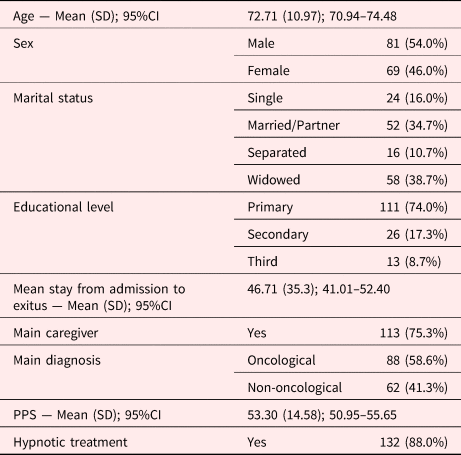
The socio-demographic variables can be seen in Table 1.
Sample characteristics (N = 150)

SD: standard deviation; CI: confidence interval; PPS: Palliative Performance Scale.
As fundamental characteristics of the sample of selected patients, it can be highlighted that the majority were men with primary education who were admitted to the PCU for more than a month before they died. They had a primary caregiver, and more than half had a cancer diagnosis. The PPS indicated that many of these patients remained seated or bedridden, incapacitated for any type of work, and needed considerable help in the performance of self-care routines. In addition, these patients’ oral intake was already reduced, and their level of consciousness had begun to fluctuate between normality and confusion. Another relevant characteristic is that there was a great use of hypnotic medication. Therefore, it was a sample of fragile patients with a high level of deterioration.
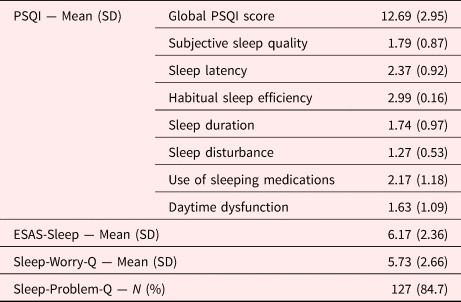
The results obtained from the PSQI scale, as well as in the three screening tests performed ESAS-Sleep, Sleep-Worry-Q, and Sleep-Problem-Q, can be seen in Table 2.
Results of sleep assessments (N = 150)

PSQI: Pittsburgh Sleep Quality Index; ESAS-Sleep: Edmonton Symptom Assessment System; SD: standard deviation.
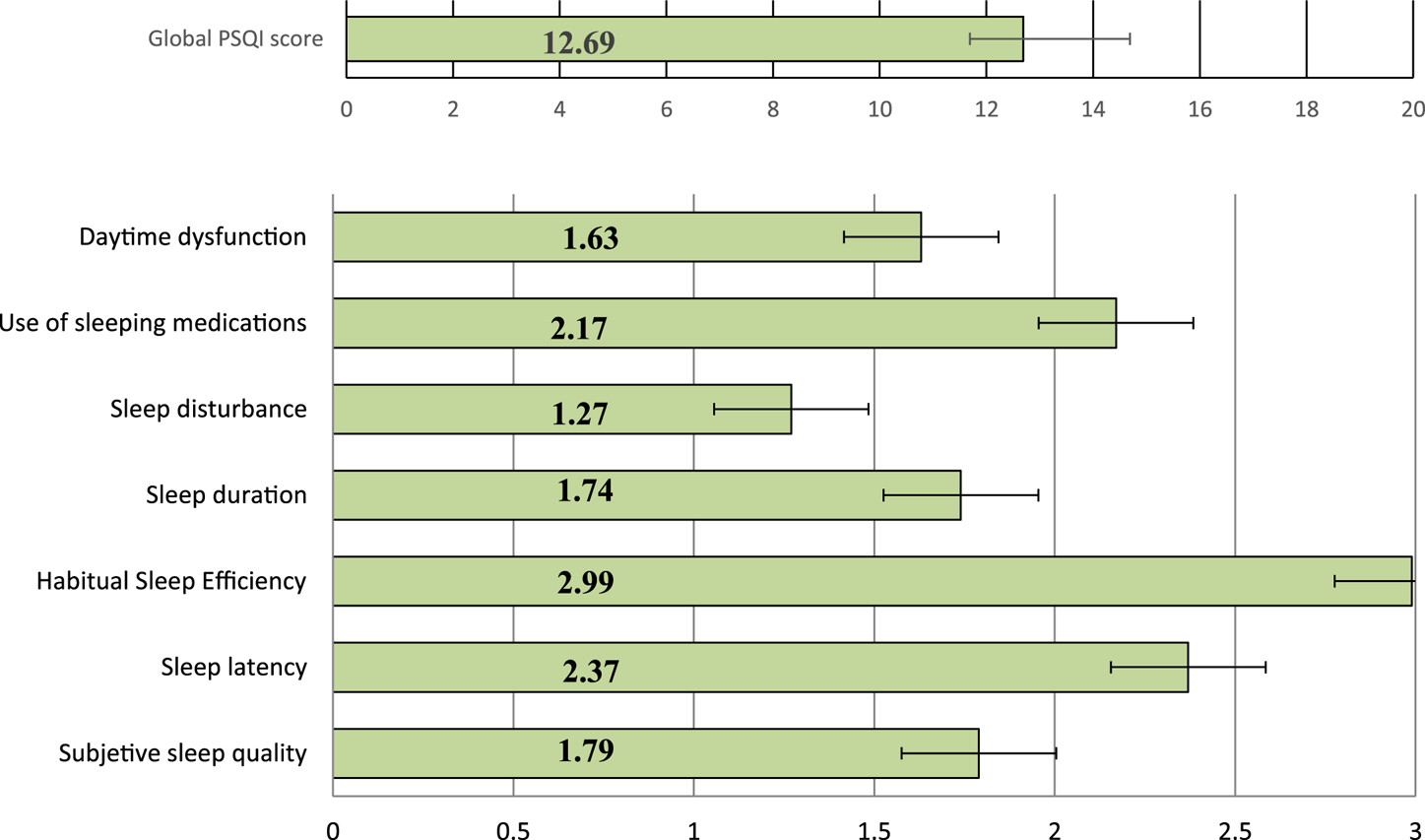
The data collected with the PSQI showed a general deficit in the quality of sleep, as the total mean score exceeded the established cut-off point. With the cut-off point of 8, the frequency of sleep disturbance cases reached 87%. It is noteworthy that, on a scale of four points (0–3), all components exceeded 1 on average. In the 75th percentile, all the values of the subcomponents exceeded 2. The components that appeared most damaged were sleep latency, use of sleeping medications, and specifically habitual sleep efficiency. The least damaged components were sleep disturbance and daytime dysfunction. Almost 100% of the patients had very bad habitual sleep efficiency. Figure 1 shows the PSQI score (Mean, SD).
Pittsburgh Sleep Quality Index (PSQI) scores (Mean, SD).

Patients with a lower functional capacity presented greater sleep disturbances, as the PPS correlated significantly with the Global PSQI score (r = −0.275, p = 0.001).
The results obtained in the ESAS subscales were ESAS-Anxiety = 6.43; ESAS-Tiredness = 6.30; ESAS-Sleep = 6.17; ESAS-Depression = 5.53; ESAS-Well-being = 5.17; ESAS-Appetite = 4.72; ESAS-Pain = 3.84; ESAS-Drowsiness = 3.51; ESAS-Dyspnea = 1.75; and ESAS-Nausea = 0.97. The data obtained showed that sleep disturbances were a very prevalent symptom for the sample of patients analyzed, even more prevalent than pain.
The Sleep-Worry-Q presented a result somewhat above the mean of the scale with which its results are measured.
The data obtained with the Sleep-Problem-Q are very relevant, in which 84.7% of the patients in the present sample claimed to have sleep problems.
Table 3 shows the results of the diagnostic accuracy of screening tests for sleep disturbances.
Diagnostic accuracy of the screening tests

SE: sensibility; SP: specificity, PPV: positive predictive value; NPV: negative predictive value; CUI+: clinical positive utility index; CUI−: clinical negative utility index; O. value: overall value.
The three screening tests analyzed were proven to be valid tools as screening for sleep disturbances among the present study's population. All of them exceed the 0.81 points in the overall value, which is excellent. The SEs are greater than 0.85. The SE achieved by a test as simple as the Sleep-Problem-Q is especially relevant. It should be emphasized that the Sleep-Worry-Q obtained the best results of the tested screening instruments.
The results found for the ORs were as follows: Sleep-Worry-Q (cut-off point = 4) OR = 14.08 (95%IC: 4.32–45.84); ESAS-Sleep (cut-off point = 3) OR = 7.938 (95%IC: 2.186–28.821); and Sleep-Problem-Q OR = 9.864 (95%IC: 3.009–32.328). All the ORs show the strength of the three screening tests in the study. It should be highlighted that the data indicated that the Sleep-Worry-Q showed the most satisfactory results.
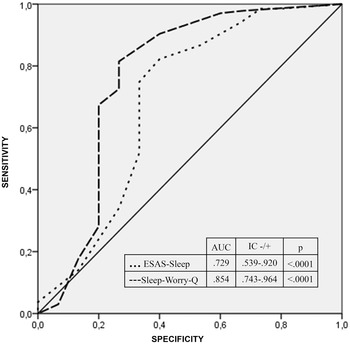
Figure 2 shows the ROC curve data for the ESAS-Sleep, Sleep-Worry-Q, and their respective AUC.
Receiver operating characteristics (ROC) curve and AUC for ESAS-Sleep and Sleep-Worry-Q.

The data found showed that the Sleep-Worry-Q was the screening method that obtained the best results. This scale reaches an AUC of 0.854, which corresponds to a good rating.
Discussion
Sleep disturbances were present in 87% of the sample. These data are greater than those found in other studies, in which the sample was composed of less advanced palliative patients, such as Mercadante et al. (Reference Mercadante, Aielli and Adile2015), with a 60%; Yennurajalingam et al. (Reference Yennurajalingam, Chisholm and Palla2015), with a 62%; or Delgado-Guay et al. (Reference Delgado-Guay, Yennurajalingam and Parsons2011) study, in which the data show up to an 85%. Sleep disturbances are a difficult symptom to control in palliative patients.
The large sleep deficit found in the present study points toward not only a poor sleep efficiency but also deterioration in latency, diurnal dysfunction, subjective quality of sleep perceived by the patient and duration of sleep cycles (means greater than 2 over a maximum of 3 points). Compared with the results of Delgado-Guay et al. (Reference Delgado-Guay, Yennurajalingam and Parsons2011), higher mean scores in both the total PSQI score (9.56 vs. 12.69 in this sample) and in the Use Sleep Medication subscale (1.18 vs. 2.17 in this sample) have been observed. On the other hand, a lower daytime dysfunction (2.2 vs. 1.63 in this sample) has also been observed.
The higher levels in the frequency of sleep disturbances reported in this study compared with other studies is mainly explained by the greater functional deficit of the present sample and especially by the proximity of these patients to exitus (Delgado-Guay et al., Reference Delgado-Guay, Yennurajalingam and Parsons2011; Renom-Guiteras et al., Reference Renom-Guiteras, Planas and Farriols2014; Mercadante et al., Reference Mercadante, Aielli and Adile2015; Bernatchez et al., Reference Bernatchez, Savard and Savard2017).
A lower functional capacity is associated with greater sleep disturbances, confirming similar data from Mercadante et al. (Reference Mercadante, Aielli and Adile2015), although the percentage of variance explained of the overall PSQI score by the PPS is only 7.6%.
The three screening procedures analyzed are valid for detecting sleep problems, taking as a reference the PSQI in patients in their end-of-life stage. The results found with the ESAS-Sleep scale are similar to those found by Delgado-Guay et al. (Reference Delgado-Guay, Yennurajalingam and Parsons2011), who with a cut-off point of 2 reported an SE = 0.86 and an SP = 0.53, and with a cut-off point of 3, reported an SE = 0.74 and an SP = 0.73. In this study, the cut-off point of 3 was chosen for the ESAS-Sleep scale with an SE of 0.87 and an SP of 0.58.
However, the Sleep-Worry-Q scale has shown the best accuracy as a screening instrument. Even a single question, such as the Sleep-Problem-Q, has proved to be valid and better than the ESAS-Sleep. This method is the simplest, shortest, least intrusive, and easiest to answer and can be included as part of an interview. This type of evaluation has already been proposed by Renom-Guiteras et al. (Reference Renom-Guiteras, Planas and Farriols2014), who found that 62.3% said “Yes,” a figure much lower than in the present study, where 84.7% said they had sleep problems. The differences may be due to the fact that in the Renom-Guiteras et al.'s sample, 39.3% of the participants were being treated at home, and the mortality within the PCU was only 45.9%, compared to 100% of deaths registered in the present investigation.
The sample consisted of patients with great functional impairment, who were very close to death, had been admitted to a PCU, and thus, presented multiple multifactorial and changing symptoms. The frequency of patients without sleep problems was scarce in the present sample. Therefore, the cut-off point used was 8, which is less usual than the most frequently used cut-off point of 5. And this is also the reason why the three screening tests showed an SP with only an acceptable level, while the SEs were very high.
It would be necessary to replicate the present study in palliative patients with a higher life expectancy and with greater functional ability to check the accuracy of the two instruments presented: the Sleep-Worry-Q and the Sleep-Problem-Q. In addition, the use of a diagnostic interview, sleep diaries or polysomnography could offer a better assessment of sleep than the PSQI and should be considered for future studies.
However, the present study is the first to review the diagnostic accuracy of sleep screening in patients so close to death. The data found have clinical relevance among this population, as a better control of this symptom is fundamental. The first step is early detection, which, in turn, will initiate the necessary interdisciplinary treatments.
Patients in their end-of-life stage, who are close to exitus, have high levels of sleep disturbances that can be detected early in the most efficient way and with better diagnostic accuracy with the Sleep-Worry-Q. Although from a clinical point of view, the application of Sleep-Problem-Q can be advantageous, as it presents a good diagnostic accuracy, less intrusion, greater simplicity, and brevity, taking into account that the three sleep disturbances.