Despite advances in diagnosis and treatment over the last few decades, mortality and morbidity remain high in patients with infective endocarditis.Reference Sadiq, Nazir and Sheikh 1 In addition to medical treatment of patients with infective endocarditis, surgical intervention may be indicated when persistent sepsis, heart failure, recurrent embolism, or vegetations >10 mm in size are present.Reference Akinosoglou, Apostolakis, Koutsogiannis, Leivaditis and Gogos 2 , Reference Prendergast and Tornos 3 In patients with isolated large vegetations, percutaneous vegetectomy using a snare may be a reasonable option to open-heart surgery. We describe a patient with operated tetralogy of Fallot who underwent successful vegetectomy of right-sided endocarditis via a percutaneous approach.
Case report
A 9-year-old girl with high fever and dyspnoea was referred to our hospital. She had been diagnosed with tetralogy of Fallot and infective endocarditis at the local university hospital 2 months earlier. Antifungal and antibiotic therapy were administered, corrective surgery was carried out, and persistent vegetations were removed at that time. The patient was then referred to our institution with continuing dyspnoea and a vegetation in the right atrium.
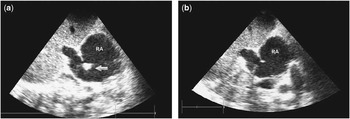
At the time of her referral, she had fever, tachycardia, tachypnoea, a third-degree systolic ejection murmur at the left sternal border, rales in both lungs, hepatomegaly, with her liver measuring 5 cm below the right costal margin, and right hemiplegia. Laboratory evaluation revealed elevated acute-phase reactants, and her chest radiography showed cardiomegaly and pulmonary congestion. Transthoracic echocardiography revealed a hypermobile vegetation attached to the right atrium, measuring 21×11 mm (Fig 1a, video 1). Brain MRI identified multiple areas of white-matter abnormality, suggestive of periventricular embolism.
Echocardiography. ( a ) Two-dimensional subcostal view before vegetectomy demonstrating a vegetation in the right atrium (RA) (arrow) (video 1). ( b ) Two-dimensional subcostal view demonstrating no residual mass after vegetectomy (video 2).

Blood cultures were obtained for microbiological investigation, and vancomycin, meropenem, and fluconazole were administered for 6 weeks. During this time, her heart failure resolved and her acute-phase reactants normalised, but the size of the vegetation did not diminish. After a detailed discussion with the family, we obtained informed consent to remove the vegetation using a percutaneous approach.
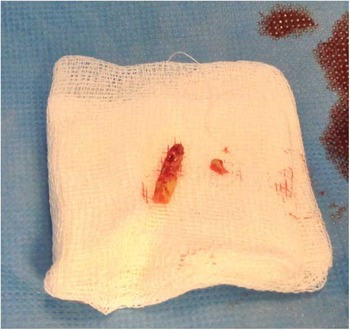
The procedure was performed in the cardiac catheterisation laboratory under echocardiographic and fluoroscopic guidance. Transoesophageal echocardiography was performed at the onset of the procedure, but the location of the vegetation precluded proper imaging. The procedure was continued under transthoracic echocardiography guidance. Vascular access was obtained via the right femoral vein, and a 10-French FuStarTM Steerable Introducer (Lifetech Scientific, Shenzhen, China) was advanced into the right atrium. The tip of the sheath was angled towards the vegetation. A 12×20-mm triple-loop wire vascular snare (Atrieve Vascular SnareTM; Angiotech, Seattle, WA, United States of America) was passed into the sheath. Under fluoroscopic and transthoracic echocardiography guidance, the wire loops were engaged around the vegetation, the snare was tightened, and the vegetation was carefully removed through the sheath on the first attempt; there were no complications. Follow-up echocardiographic assessment demonstrated no residual mass (Fig 1b, video 2). The procedure lasted 15 minutes. Pathological assessment of the vegetation supported the diagnosis of active infective endocarditis (Fig 2).
Removed tissue after snare vegetectomy.

Discussion
Infective endocarditis is a complication of congenital structural heart disease that can lead to high morbidity and mortality. Although the prognosis for right-sided endocarditis is more favourable than left-sided endocarditis, 5–16% of these patients will eventually require surgical intervention.Reference Musci, Siniawski and Pasic 4 The indications for surgical intervention include the presence of large (>10 mm) vegetations, unresolving sepsis, recurrent embolism, and heart failure.Reference Akinosoglou, Apostolakis, Koutsogiannis, Leivaditis and Gogos 2 , Reference Prendergast and Tornos 3
Despite appropriate antibiotic and antifungal treatment, our patient experienced a persistent, hypermobile, large vegetation that posed a risk for pulmonary embolisation. This represented an absolute indication for surgical excision; however, the patient had recently undergone open-heart surgery, and both her family and the surgeons were reluctant to authorise a second major surgery. We therefore decided to attempt removal of the vegetation via a percutaneous approach, hoping to avoid the morbidity and risks associated with open-heart surgery. A flexible sheath was used to provide proper access and angulation as well as easy handling of the vegetation, minimising the risk of embolism. The selection of a larger sheath than the patient’s body size allowed easy removal of the large vegetation on the first attempt. The use of a large sheath and proper snare selection permitted complete removal of the vegetation without any complications.
There are some reports in the current literature on removal of vegetations by the percutaneous approach. Most of these describe transvenous lead removal in patients with pacemaker-lead endocarditis.Reference Seow, Lin and Wong 5 , Reference Ruttmann, Hangler and Kilo 6 There are also reports of percutaneous extraction of right-sided vegetations using aspiration systems.Reference Divekar, Scholz and Fernandez 7 , Reference Smith, Wolff and Kohmoto 8 All of these, except one case very recently reported by Khan and Momenah,Reference Khan and Momenah 9 are reports of adults who had intracardiac devices such as leads or prosthetic valves. The present report describes snare vegetectomy in a 9-year-old girl without any prosthetic material; to the best of our knowledge, this is the first paediatric case of percutaneous vegetation removal.
Despite the successful outcome in our patient, we recognise that there are several limitations to this approach. Use of the percutaneous technique should probably be limited to the right heart, given the risks of systemic embolism with left-sided lesions. This approach may not be suitable for patients with sessile, rather than pedunculated, vegetations. For safety reasons, vegetations should not involve intracardiac structures such as the valves, papillary muscles, and chordae.
The primary objective of this case presentation is to describe a novel method of percutaneous catheter removal of an infected heart-chamber vegetation. We suggest that vegetectomy, using a wire snare, may be a viable option in carefully selected patients with endocarditis. The technique dramatically reduces the cost, complications, and hospitalisation period. This study encourages and opens the way for catheter intervention in children with infective endocarditis.
Conclusion
Transcatheter removal of a vegetation using a wire snare may be an alternative to open-heart surgery in selected patients with infective endocarditis.
Acknowledgements
None.
Financial Support
The clinicians received no grants from any funding agency and no support from any commercial or not-for-profit sector.
Conflicts of Interest
None.
Ethical Standards
The authors assert that this study complies with the ethical standards of the relevant national guidelines on human experimentation and with the Helsinki Declaration of 1975, as revised in 2008. This study was approved by the institutional committee of Cerrahpasa Medical School.