Introduction
The co-infection of a host snail with miracidia of two digeneans often causes the death of one parasite. However, in several cases, the development or the death of the first djgenean after its penetration into the snail facilitates the growth of the second parasite and leads to complete larval development of the first species, the second or both (Lie et al., Reference Lie, Heyneman and Richards1977a, b; Lie & Heyneman, Reference Lie and Heyneman1982; Southgate et al., Reference Southgate, Brown, Warlow, Knowles and Jones1989). The presence of natural co-infections with two digeneans has already been observed in several snail–parasite models. In the lymnaeid Galba truncatula, several co-infections with Calicophoron microbothrium and Fasciola hepatica have been reported by Samnaliev et al. (Reference Samnaliev, Kanev and Vassilev1978). In the same way, Manga-Gonzalez et al. (Reference Manga-Gonzalez, Gonzalez-Lanza and Kanev1994) have noted the presence of four co-infected G. truncatula, i.e. three with F. hepatica and Plagiorchis elegans and the other with Opisthoglyphe ranae and Notocotylus reynai, among the 6291 snails they collected from Spain. Natural co-infections of G. truncatula with Calicophoron daubneyi and F. hepatica were also found in central France: 111 snails out of 24,764 collected between 1995 and 2002 (Rondelaud et al., Reference Rondelaud, Vignoles and Dreyfuss2004) and six snails out of 11,025 collected between 2012 and 2014 (Rondelaud et al., Reference Rondelaud, Vignoles and Dreyfuss2015). In the laboratory, the use of two digeneans at miracidial exposure allowed successful co-infections to be obtained with lymnaeid species which were age-resistant to infection with either parasite. The snail Lymnaea glabra, for example, is known to be susceptible to F. hepatica in its first days of life only, i.e. < 2 mm in shell height (Boray, Reference Boray1978), whereas it is completely resistant to C. daubneyi infection, whatever snail age (Abrous, Reference Abrous1999). The co-infection of pre-adult L. glabra, i.e. 3–6 mm at miracidial exposure, with these digeneans was successful and resulted in complete larval development of F. hepatica, C. daubneyi or both (Abrous et al., Reference Abrous, Rondelaud and Dreyfuss1996, Reference Abrous, Rondelaud, Dreyfuss and Cabaret1998, Reference Abrous, Rondelaud, Dreyfuss and Cabaret1999). Similar findings were also found with Lymnaea fuscus and L. palustris when pre-adults were subjected to co-infections with these two parasites (Dreyfuss et al., Reference Dreyfuss, Vignoles and Rondelaud2015).
In view of the above data, one may wonder if lymnaeids susceptible to F. hepatica and resistant to C. daubneyi can ensure larval development of either digenean when they are co-infected with both parasites at the pre-adult stage, i.e. 3–6 mm. To verify this possibility, experimental infections were carried out using Pseudosuccinea columella. This lymnaeid was age-resistant to C. daubneyi infection and only young snails, measuring 1 or 2 mm at miracidial exposure, could ensure larval development of the parasite up to cercarial shedding (Dar et al., Reference Dar, Rondelaud, Vignoles and Dreyfuss2015b). In contrast, it is already known to be a natural snail host of F. hepatica (Cruz-Reyes & Malek, Reference Cruz-Reyes and Malek1987; Gutiérrez et al., Reference Gutiérrez, Yong, Perera, Sánchez and Théron2002; Vázquez et al., Reference Vázquez, Sánchez, Pointier, Théron and Hurtrez-Boussès2014; Dar et al., Reference Dar, Vignoles, Rondelaud and Dreyfuss2015a). Experimental infections of snails measuring 1–6 mm in shell height were carried out with a first exposure to C. daubenyi and a second to F. hepatica, according to the protocol used by Abrous et al. (Reference Abrous, Rondelaud, Dreyfuss and Cabaret1998) for L. glabra.
Materials and methods
Snail collection
The population of P. columella originated from the Lot River near Castelmoron, department of Lot, south-western France. A total of 50 adult snails, measuring 10–15 mm in shell height, were collected in September–October 2013 from two sites (44°23′27.31″N, 0°32′2.43″E and 44°23′31.18″N, 0°29′59.30″E). In the laboratory, the snails were placed in a 10-litre covered aquarium with five snails per litre of permanently oxygenated spring water. These aquaria were subjected to constant conditions: temperature, 23 ± 1°C; light/dark period, 12 h/12 h. The dissolved calcium concentration in spring water was 35 mg/l. Snails were fed on pesticide-free fresh lettuce leaves ad libitum and the spring water in aquaria was changed weekly. Egg masses laid by these adult snails were collected and placed into small rearing aquaria. Newly hatched snails fed on finely powdered lettuce and those that attained 1 mm (24 h of life), 2 ± 0.1 mm (5 days of life), 3 ± 0.1 mm, 4 ± 0.1 mm, 5 ± 0.1 mm or 6 ± 0.1 mm in shell height, were used. A total of 1200 snails were subjected to experimental infections.
Parasite egg collection
Eggs of F. hepatica were collected from the gall bladders of naturally infected cattle at the slaughterhouse of Limoges, department of Haute Vienne, central France. To obtain C. daubneyi eggs, adult worms were collected from the rumen of infected cattle at the same slaughterhouse and dipped in a physiological saline solution (0.9% NaCl, 0.45% glucose) before being placed at 37°C for 3 h. Both F. hepatica and C. daubneyi eggs were washed several times with spring water and immediately incubated in the dark at 20°C for 20 days (Ollerenshaw, Reference Ollerenshaw1971).
Experimental protocol
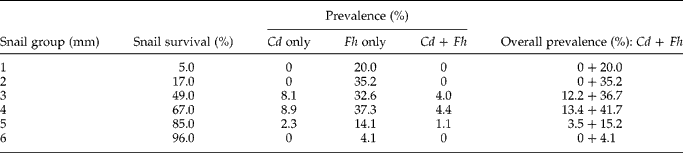
The aim of the first experiment was to determine the aptitude of juvenile and pre-adult P. columella to ensure larval development of C. daubneyi and/or F. hepatica when they were co-infected. Six groups of 100 snails each were used in February 2014 (table 1). Each snail was first subjected to five miracidia of C. daubneyi for 4 h at 23°C in 3.5 ml spring water and secondly to five miracidia of F. hepatica for another 4 h. The choice of ten miracidia for this snail co-infection (five miracidia of each digenean) was based on the results of a preliminary experiment performed by Dar et al. Reference Dar, Vignoles, Rondelaud and Dreyfuss(2015a) on P. columella. According to these authors, the redial and cercarial production of F. hepatica was greater when five miracidia were used to infect each snail. Snails were then raised for 42 days in individual 50-mm Petri dishes with 10 ml spring water per recipient. A piece of pesticide-free fresh lettuce leaf was placed in each dish. Petri dishes were then placed in the same air-conditioned room at 23 ± 1°C as the parent snails and were examined daily, so that spring water and food could be changed if necessary. On day 42 post-exposure (pe), surviving snails were dissected under a stereomicroscope to detect the presence of larval forms of C. daubneyi, F. hepatica or both within their bodies. The rediae of F. hepatica possessed well-developed pharynges, collar rings and pairs of appendages in the third posterior part of their bodies (Thomas, Reference Thomas1883). In contrast, the rediae of C. daubneyi were shorter with small pharynges, and their bodies had no collar or appendages (Sey, Reference Sey1979).
Snail survival on day 30 post-exposure, prevalences of digenean infections and overall prevalence in six groups of Pseudosuccinea columella co-infected with Calicophoron daubneyi (Cd) and Fasciola hepatica (Fh). For each group, 100 snails were exposed on day 1.

The second experiment was carried out to determine the characteristics of co-infections and follow the dynamics of their cercarial shedding. As the best results were noted in the 3 and 4 mm groups (see table 1), two groups of 200 snails each were used in April 2014. Each snail was exposed to the miracidial sequence used in the first experiment. Two other groups of 100 snails each, measuring 3 and 4 mm in shell height, respectively, were exposed only to five F. hepatica miracidia per snail and served as controls. No control group was constituted with C. daubneyi because all experimental infections of 3 and 4 mm snails carried out with this digenean were negative (Dar et al., Reference Dar, Rondelaud, Vignoles and Dreyfuss2015b). Snail exposure to miracidia and maintenance were similar to those applied in the first experiment. Spring water and food were changed, if necessary, every day until snail death. When the first cercarial shedding occurred, surviving snails were subjected to a thermal shock every 3 days by placing their Petri dishes at 10–13°C for 3 h to stimulate cercarial exit (Rondelaud et al., Reference Rondelaud, Titi, Vignoles, Mekroud and Dreyfuss2013; Vignoles et al., Reference Vignoles, Titi, Rondelaud, Mekroud and Dreyfuss2014). After their emergence, cercariae were identified according to the colour of their cysts (whitish or tawny for F. hepatica and brown-blackish for C. daubneyi). They were counted and removed from Petri dishes. At the death of each infected snail, its shell was measured using callipers.
Data analysis
In the first experiment, the parameters were snail survival on day 30 pe, the frequencies of C. daubneyi, F. hepatica and both digeneans. Another parameter was the overall prevalence of C. daubneyi infection, which took into account the frequency of C. daubneyi only and that of both digeneans. The same method was used to determine the overall prevalence of F. hepatica infection. These frequencies and prevalences were calculated in relation to the number of snails surviving in each group on day 30 pe. A χ2 test was used to compare the differences between snail survival and overall prevalences.
In the second experiment, snail survival on day 30 pe, the frequencies of C. daubneyi, F. hepatica and both digeneans, the overall prevalence of each digenean infection, the shell height of infected snails at their death, the lengths of the pre-patent and patent periods, the total number of shed cercariae and the number of shedding waves for each infected snail (Rondelaud et al., Reference Rondelaud, Vignoles and Dreyfuss2009) were considered. The differences between snail survival and overall prevalences were analysed using a χ2 test. Individual values recorded for the shell heights of infected snails, the lengths of the pre-patent and patent periods, the numbers of metacercariae and of shedding waves were averaged and standard deviations were established for each snail group and each type of infection (C. daubneyi, F. hepatica or both). Normality of these values was analysed using the Shapiro–Wilk test (Shapiro & Wilk, Reference Shapiro and Wilk1965). According to results given by this test, one-way analysis of variance or the Kruskal–Wallis test were used to establish levels of significance. All the statistical analyses were performed using Statview 5.0 software (SAS Institute Inc., Cary, North Carolina, USA).
The nomenclature proposed by Correa et al. (Reference Correa, Escobar, Noya, Velásquez, González-Ramírez, Hurtrez-Boussès and Pointier2011) and that by Jones (Reference Jones, Jones, Bray and Gibson2005) were used in the present study to identify lymnaeids and paramphistome species, respectively.
Results
Aptitude of co-infected P. columella to sustain larval development of both digeneans
Table 1 gives the results of the first experiment. On day 30 pe, the survival of snails significantly increased (χ2= 268.47, P < 0.001) with increasing height of their shells at miracidial exposure. Snails harbouring larval forms of C. daubneyi were only found in the 3, 4 and 5 mm groups and their frequency was low, from 2.3 to 8.9%. In contrast, F. hepatica-infected snails were found in the six groups and the frequency peaked at 37.3% in the 4 mm group. Snails harbouring larval forms of both digeneans were only noted in the 3, 4 and 5 mm groups, with low frequencies: 1.1–4.4%. If the three types of frequency are pooled, the overall prevalence of C. daubneyi ranged from 3.5 to 13.4% and that of F. hepatica from 4.1 to 41.7%. Significant differences between the overall prevalences found in the six groups were noted for C. daubneyi (χ2= 21.98, P < 0.001) and F. hepatica (χ2= 44.64, P < 0.001).
Characteristics of co-infections in the 3 and 4 mm groups
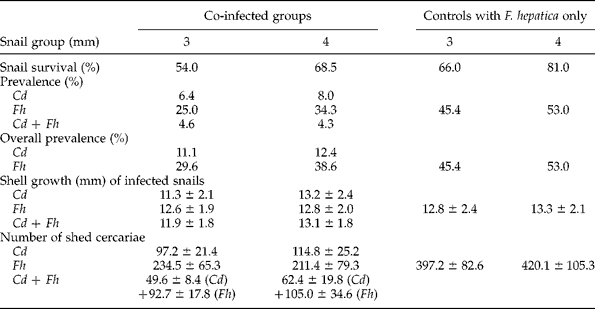
Compared to controls infected with F. hepatica only, the survival of co-infected groups on day 30 pe was significantly lower (3 mm: χ2= 3.94, P < 0.05; 4 mm: χ2= 5.24, P < 0.05) (table 2). Moreover, the survival of 4 mm snails was significantly greater than that of 3 mm groups (co-infections: χ2= 8.86, P < 0.01; controls: χ2= 5.77, P < 0.05). In both co-infected groups, snails harbouring larval forms of C. daubneyi, F. hepatica or both digeneans were found. The highest frequencies were noted for F. hepatica-infected snails: 25.0% and 35.0% in the 3 and 4 mm groups, respectively, whereas the other two categories of co-infected snails had only low values. Non-significant differences in the overall prevalences of both co-infected groups were noted for C. daubneyi and F. hepatica. The same finding was also noted for controls. In contrast, the prevalence of F. hepatica infection was significantly higher in controls than in co-infected snails (3 mm: χ2= 4.47, P < 0.05; 4 mm: χ2= 4.28, P < 0.05). The mean shell height of co-infected and control snails at their death ranged from 11.3 to 13.3 mm and no significant difference was noted, whatever the mode of comparison.
Snail survival on day 30 post-exposure, prevalence of each digenean infection, shell growth of infected snails and number of shed cercariae (mean values ± SD) in two groups of Pseudosuccinea columella co-infected with Calicophoron daubneyi (Cd) and Fasciola hepatica (Fh), and in two groups of snails infected with F. hepatica only (controls). Two hundred snails for each co-infected group and 100 snails for each control group were exposed on day 1.

In co-infected groups, quantitative variations in the mean number of metacercariae were noted according to the type of digenean infection (table 2). First, the highest numbers were noted in snails harbouring F. hepatica only, but this difference between the 3 and 4 mm groups was not significant. In each category of shell heights considered separately, the number of these larvae was significantly lower (3 mm: H= 7.85, P < 0.01; 4 mm: H= 13.00, P < 0.001) in co-infected snails with F. hepatica only than in controls. Second, C. daubneyi metacercariae in snails harbouring only this digenean were significantly less numerous (3 mm: H= 12.37, P < 0.001; 4 mm: H= 4.74, P < 0.05) than those found in co-infected individuals with F. hepatica only, and their mean numbers in the 3 and 4 mm groups were close to each other. Third, the lowest mean numbers of metacercariae in co-infected groups were noted for snails harbouring live larval forms of both digeneans. Metacercariae of F. hepatica were significantly more numerous (3 mm: H= 14.48, P < 0.001; 4 mm: H= 4.68, P < 0.05) than those of C. daubneyi and no significant difference between values recorded in both groups was noted for either parasite. Significant differences between the values found in snails with both digeneans and those recorded in individuals with larval forms of a single parasite were noted for C. daubneyi (3 mm: H= 13.78, P < 0.001; 4 mm: H= 17.34, P < 0.001) and F. hepatica (3 mm: H= 15.16, P < 0.001; 4 mm: H= 6.31, P < 0.05).
In the four groups of snails, the length of the pre-patent period ranged from 59.4 ± 4.3 days to 62.7 ± 7.4 days and no significance between these lengths was noted (data not shown). In contrast, the length of the patent period varied with the type of digenean infection. In the 3 and 4 mm snails harbouring larval forms of both parasites, the lengths were 3.1 ± 2.5 days and 4.4 ± 1.7 days, respectively. In snails harbouring C. daubneyi only, the respective values were 10.7 ± 5.9 days and 11.3 ± 4.2 days. For each category of digenean infection, no significant difference between the 3 and 4 mm groups was noted. The longest patent periods were found in co-infected snails harbouring F. hepatica only (3 mm: 20.4 ± 3.2 days; 4 mm: 18.2 ± 4.1 days) and in controls (3 mm: 34.0 ± 7.3 days; 4 mm: 37.2 ± 8.5 days). In these last snails, the patent period was significantly longer (H= 6.31, P < 0.05) in controls than in co-infected snails and did not significantly differ from each other between both groups of co-infected snails or between both control groups.
In co-infected groups, most snails harbouring C. daubneyi only or both digeneans shed their cercariae during a single wave and died after the last larva was shed. In contrast, in individuals containing larval forms of F. hepatica, several waves of cercarial shedding were noted: 1–3 waves in the 3 mm group and 1–5 in the 4 mm group. The highest number of metacercariae was noted for the second and third waves, respectively. The number of shedding waves was greater in controls: 1–7 in the 3 mm group and 1–9 in the 4 mm group (data not shown).
Discussion
Snail co-infection illustrates the parasitism of a mollusc by two digenean species or a digenean and a protostrongylid. Depending on circumstances, the penetration of both parasites can occur simultaneously. The second parasite can also enter the snail several hours or several days later. Lim & Heyneman (Reference Lim and Heyneman1972) and Combes (Reference Combes1982) have listed consequences generated by these different cases of miracidial infection in several snail–parasite models. Among the different possibilities, snails resistant to a parasite could become susceptible if they were first infected with another parasite (Lie et al., Reference Lie, Heyneman and Richards1977a, b). This interference hypothesis was verified in several snail–parasite models. Lie & Heyneman (Reference Lie and Heyneman1982) demonstrated that infection of Biomphalaria glabrata with echinostome miracidia can be advantageous for larval development of Schistosoma mansoni in snail populations naturally resistant to this latter parasite. Southgate et al. (Reference Southgate, Brown, Warlow, Knowles and Jones1989) also showed that it is possible to achieve successful infection of Bulinus tropicus with Schistosoma bovis if snails have previously been exposed to miracidia of Calicophorum microbothrium. In the present study, pre-adult P. columella, measuring 3–5 mm at exposure, were able to sustain larval development of C. daubneyi, F. hepatica or both, when they were co-exposed to both parasite species. Similar findings had already been reported for several lymnaeid species, such as G. truncatula (Augot et al., Reference Augot, Abrous, Rondelaud and Dreyfuss1996), L. glabra (Abrous et al., Reference Abrous, Rondelaud and Dreyfuss1996, Reference Abrous, Rondelaud, Dreyfuss and Cabaret1998), L. fuscus and L. palustris (Dreyfuss et al., Reference Dreyfuss, Vignoles and Rondelaud2015), when pre-adults of these species were co-infected according to the same protocol. All these results demonstrated that simultaneous penetration of both parasites in pre-adults of several lymnaeid species allowed larval development of the first parasite, the second or both. However, this ability did not seem to be general in the family Lymnaeidae because co-exposures of Radix balthica ( = R. ovata) to C. daubneyi and F. hepatica were always negative (Dreyfuss et al., Reference Dreyfuss, Vignoles and Rondelaud2015). The development of both parasite species in several co-infected snails may only be explained by the infectivity of C. daubneyi miracidia, which would have to be rather strong to withstand the immune response of the snail and continue their development within the snail body in spite of the simultaneous development of F. hepatica larval forms. It is also possible that excretory/secretory products of F. hepatica larval stages interfere with the amoebocytes of the snail, thus diminishing their killing ability and allowing the development of C. daubneyi.
Compared to controls with F. hepatica only, the overall prevalence of this parasite was significantly lower in co-infected snails harbouring the sole larval forms of this digenean: 29.6% and 38.6% compared to 45.4% and 53.0% in controls. Similar results have already been reported for pre-adults of L. glabra, L. fuscus and L. palustris when they were subjected to the same co-infections and harboured F. hepatica (Dreyfuss et al., Reference Dreyfuss, Vignoles and Rondelaud2015). In contrast, the prevalence of this digenean in pre-adult G. truncatula subjected to co-infections with C. daubneyi and F. hepatica was clearly higher: 61% for Augot et al. (Reference Augot, Abrous, Rondelaud and Dreyfuss1996) and 42.2% for Dreyfuss et al. (Reference Dreyfuss, Vignoles and Rondelaud2015). The better prevalence of F. hepatica infection reported in pre-adult P. columella (the present study) and G. truncatula (Augot et al., Reference Augot, Abrous, Rondelaud and Dreyfuss1996; Dreyfuss et al., Reference Dreyfuss, Vignoles and Rondelaud2015) might be due to the fact that these lymnaeids were natural intermediate hosts of this digenean and could be infected easily at the pre-adult stage, whereas L. glabra, L. fuscus and L. palustris were only susceptible to F. hepatica within their first days of life and were resistant at the pre-adult stage (Boray, Reference Boray1978; Dreyfuss et al., Reference Dreyfuss, Abrous and Rondelaud2000). Low values noted for the overall prevalence of C. daubneyi infection in the 3 and 4 mm groups of P. columella may also be interpreted by the same explanation, i.e. the susceptibility of juveniles and the resistance of pre-adults to this parasite (Dar et al., Reference Dar, Rondelaud, Vignoles and Dreyfuss2015b).
The patent periods noted in co-infected snails harbouring only F. hepatica were significantly shorter than those noted in controls only infected with this digenean. In the case of C. daubneyi, the patent periods noted in the present study agreed with those noted in juvenile P. columella exposed only to C. daubneyi miracidia (a mean of 8.4–10.6 days; unpublished data) but were shorter than those noted in the common snail host of this digenean, G. truncatula (a mean of 12.1–16.5 days; Abrous, Reference Abrous1999). The results noted in the present study might be explained by the degree of adaptation between the snail and its parasite. Snails which shed their cercariae during several waves and, consequently, had a long patent period, are considered to be well adapted to their parasite (Dreyfuss, Reference Dreyfuss1994). In contrast, those with short patent periods would be incompletely adapted to the digenean (Dreyfuss, Reference Dreyfuss1994). If this last assumption is valid, the adaptation between the population of P. columella used in the present study and the miracidial isolate of C. daubneyi would be incomplete at the present time.
The numbers of metacercariae noted in F. hepatica-infected controls (397.2 and 420.1 cysts per snail) were within the range of values, i.e. 243.9–472.1 cercariae shed per snail, that Dar et al. Reference Dar, Vignoles, Rondelaud and Dreyfuss(2015a) reported for three Egyptian populations of P. columella infected with sympatric isolates of miracidia. In co-infected snails harbouring F. hepatica only, the values were significantly lower: 211.4–234.5 cercariae shed per snail. This finding might be due to the miracidial dose used to infect each pre-adult, i.e. a total of ten miracidia with five for C. daubneyi and five for F. hepatica, and competition that developed between sporocysts and rediae of both parasites for sharing nutrients present in the snail body (Rondelaud et al., Reference Rondelaud, Vignoles and Dreyfuss2009). Even if several miracidia might degenerate after their penetration into the snail body, the development of the other larvae would be delayed over time because of their high number and only some of these rediae would produce cercariae, whereas the others would still be immature when the infected snail died. An element supporting this approach came from the report by Rondelaud & Barthe (Reference Rondelaud and Barthe1982) on G. truncatula. According to these authors, a delay in larval development of F. hepatica occurred when five miracidia were used to infect each snail, and this delay increased if the miracidial dose for snail exposure became higher. The above hypothesis proposed for co-infected snails with F. hepatica only can also be used to explain the results noted in individuals harbouring C. daubneyi only. Compared to values found in co-infected snails with F. hepatica, the number of C. daubneyi metacercariae was significantly lower in snails that harboured this digenean only, and this result agreed with the report by Augot et al. (Reference Augot, Abrous, Rondelaud and Dreyfuss1996) on G. truncatula co-infected with C. daubneyi and F. hepatica. This last finding can be explained by the redial burden, which was lower for C. daubneyi than for F. hepatica. According to Abrous et al. (Reference Abrous, Rondelaud and Dreyfuss1997), a total of 13–14 rediae generally developed in single-miracidium infections of G. truncatula with C. daubneyi, while a mean of 41 rediae was noted in snails infected with F. hepatica according to the same protocol (Augot et al., Reference Augot, Rondelaud, Dreyfuss, Cabaret, Bayssade-Dufour and Albaret1998). In co-infected snails harbouring live larvae of both digeneans, the low values noted for either parasite can be explained by the short length of the patent period, as snail death occurred quickly in most snails, just after the end of the first shedding wave.
In conclusion, pre-adult P. columella were capable of sustaining larval development of C. daubneyi if they were co-infected with the sequence C. daubneyi +F. hepatica. Low values noted for the prevalence of C. daubneyi infection and the number of metacercariae would be in favour of a still incomplete adaptation between the snail population used in the present study and the miracidial isolate.
Conflict of interest
None.