Introduction
In several developed countries, reports suggest that the single homeless population is ageing, and that increasing numbers of older people are seeking help because they are homeless or at risk of losing their homes.Reference Cohen1,Reference McFerran2 This paper builds on Crane and Warnes’ 2010 review of older homeless people and service responses, by examining evidence of changes in the age structure of the single homeless population and of the numbers of older people who are homeless.Reference Crane and Warnes3 It then discusses likely factors contributing to the growth of the older homeless population, the changing problems and needs of older homeless people, and how these are being addressed. It draws mainly on studies and reports from the UK, the USA, Canada, Spain, Australia and Japan, which are published in English.
There is no consensus among policy makers, service providers and researchers as to the age at which ‘older’ homelessness begins, and various ages between 45 and 65 years have been applied. In 1989, Cohen and Sokolovsky argued for a threshold of 50 years, because many people in their fifties who have been homeless for years have chronic health problems and disabilities normally associated with old age, and are unlikely to return to work.Reference Cohen and Sokolovsky4 This cut-off has been widely adopted by researchers and voluntary sector homelessness service providers but not by statutory agencies, who are often constrained by the customary age thresholds to state pensions and other entitlements.
Growth of the older homeless population
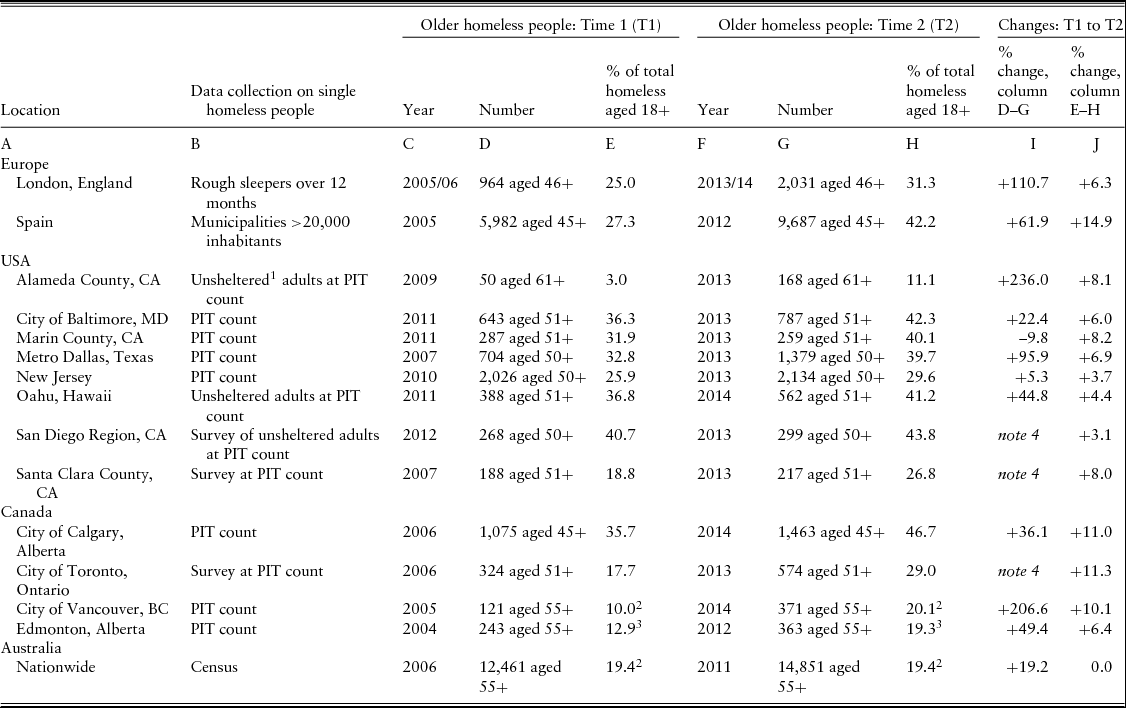
During the first half of the twentieth century, most single homeless people in England and the USA were men, and around two-thirds were over the age of 50 years. The profile of homeless people changed during the 1970s and 1980s, with more young adults and more women in this population. Since the 1990s, however, people experiencing homelessness tend to be an older and more ‘chronic’ population with more health-related problems.Reference Hahn, Kushel, Bangsberg, Riley and Moss5,Reference Israel, Toro and Ouellette6 In England, there is very little information about the number of older people who are homeless. Local authority housing departments collect data about households who apply for housing each year because they are homeless, but a much larger number of older people stay in hostels or ‘sleep rough’ on the streets and are not included in these statistics. There are little data on the numbers of ‘unofficial’ older homeless people, except in London where details are recorded of people sleeping rough and in contact with outreach teams. The number of rough sleepers of all ages in London increased by 69% between 2005/06 and 2013/14, but by 111% for those aged 46+ years.7,8 Among this older age group, 964 people slept rough at some time during 2005/06 and 2,031 during 2013/14 (Table 1).
Changes over time in the number of older homeless people and their percentage of the single adult homeless population

Sources: see references 7, 8, 10–32, 37 and 38. PIT, point in time; 1sleeping outdoors or in other places not meant for human habitation; 2aged 19+ years; 3aged 17+ years; 4change in number of older homeless people not calculated as only a proportion of homeless people were surveyed.
In the USA, the median age of single homeless adults increased from 35 years in 1990 to 50 years by 2010.9 According to surveys and enumerations conducted in 2013 in several cities and regions of the USA, 27–44% of single homeless adults are over the age of 50, and their percentage of the total homeless population has increased in recent years (Table 1).Reference Barkow10–24 A similar growth in the older homeless population is apparent in several Canadian cities (Table 1).25–Reference Sorensen31 In Vancouver, for example, the number of older homeless people (aged 55+) increased by 207% between 2005 and 2014.25,26 In Australia, around one-fifth of homeless adults were aged 55 or over in both the 2006 and 2011 national censuses, although their actual numbers rose by 19% during this period (Table 1).32
In Japan, a much higher proportion of the homeless population are older people. Nationwide the official number of rough sleepers fell sharply from 25,296 in 2003 to 9,576 by 2012, although the proportion aged 55 and above increased from 58.8 to 73.5% during this period.Reference Kasai33,Reference Okamoto34 In addition, an estimated 5,400 homeless people are ‘net café refugees’ who congregate in 24-hour internet cafés, fast-food restaurants and coffee shops, and are not included in counts.Reference Iwata35 Nearly one-quarter of these are aged in their fifties. Similarly, older people comprise very high proportions of the homeless population in Poland (50% aged 50+), Spain and Italy (42% aged 45+), and Taiwan (79% aged 41+).Reference Toro, Hobden, Durham, Oko-Riebau and Bokszczanin36–Reference Cheng and Yang40
Likely factors contributing to the growth of the older homeless population
Some older people have been homeless intermittently or continuously for years and have aged while homeless, while some experience homelessness for the first time in later life.Reference Crane41–Reference Shinn, Gottlieb, Wett, Bahl, Cohen and Ellis44 The causes of homelessness are complex, and are linked to structural, economic and policy factors such as unemployment and a shortage of affordable rented housing, combined with personal factors such as problematic behaviour and poor coping skills when faced with stresses, and inadequate welfare and support services.14,Reference Crane, Byrne and Fu42 The following sections examine demographic changes and other factors that are likely to have had an influence on the growth of the older homeless population.
Demographic changes
In many countries, the general population is ageing due to the ‘baby boom’ generation of people born between 1945 and 1964 and to increases in life expectancy. In Australia, the number of people aged 50 and over is predicted to double between 2010 and 2050, and they will increase as a proportion of the total population from 31 to 40%.Reference Petersen and Jones45 The number of people in the UK aged 65 and over increased by 1.7 million people between 1985 and 2010.46 Likewise, in the USA, the number of people aged 65 and over increased from 34.9 million in 2000 to 40.2 million in 2010, and is projected to reach 54.8 million by 2020.Reference Howden and Meyer47,Reference Vincent and Velkoff48
In England, Canada and the USA, the majority of older homeless people are in their fifties; just 5–10% of homeless adults are in their sixties or older.Reference Crane and Warnes3,14,16 In Australia, Spain and some cities of Canada and the USA, however, increasing numbers of people aged 65 and over are homeless.26,32,38 For example, 5,511 people of this age group in Australia were homeless in 2006, increasing to 6,202 in 2011.32 Predictions suggest that as the ‘baby boom’ generation ages, there will be even higher numbers of homeless people in the older age group (65+ years). In the USA, the number of homeless people aged 65 and over is predicted to rise from 44,172 in 2010 to 58,772 by 2020, and to 92,572 by 2050.Reference Sermons and Henry49 This assumes that the general population aged 65 and over will increase as predicted by the US Census Bureau, that the percentage of the older population in deep poverty will remain around 2%, as it has since 1975, and that the 2008 ratio of one sheltered elderly homeless person to every 22 elderly people in deep poverty remains constant.
Analysing data on homeless men in New York City's shelters between 1988 and 2010, and data from the last three decennial census enumerations, Culhane and colleagues concluded that the single adult homeless population is ageing regardless of the ageing of the overall USA population, and that shelter use among men was largely a cohort-related phenomenon.Reference Culhane, Metraux, Byrne, Stino and Bainbridge50 Those born between 1954 and 1967 were in the highest risk age cohort, and those with the highest relative risk for homelessness were aged 37–42 years in 2000, and 49–51 years in 2010. They associated the disproportionate housing instability and homelessness among the late baby boom cohort with several factors. The cohort came of age during the late 1970s and early 1980s when unemployment was high, wages for unskilled workers were depressed, and rental housing costs were rising. There was also a proliferation of crack cocaine usage, with risks of addiction, involvement in crime, and health and social problems. At the same time, the ‘safety net’ was stretched throughout the 1980s and 1990s as social welfare expenditures were under pressure.Reference Culhane, Metraux, Byrne, Stino and Bainbridge50
Housing and economic factors
Higher rates of homelessness have been associated with high housing prices, a lack of low-cost rented housing, and local economies that have shifted away from manufacturing and are dominated by low-paid service and unskilled jobs.Reference Burt51,Reference Elliott and Krivo52 In a Three-Nation Study of 379 older people in England, Boston (Massachusetts), and Melbourne (Australia) who had become homeless after the age of 50 years, housing, tenure and landlord problems were reported as factors leading to homelessness by 36% of participants in Australia, 22% in the USA, and 23% in England.Reference Crane, Byrne and Fu42 Most were in private rented housing at the time and had to leave their accommodation because it was sold, in need of repair or was to be converted.
The housing situation of older people in many Western cities is changing. Urban redevelopment and gentrification in inner-city areas have contributed to the demolition or conversion of low-income housing, such as rooming houses, and to spiralling rents. At the same time, a decline in the availability of public housing in some cities has led to an increase in the use of the private rented sector. In the USA, for example, there was a decrease of 6.3% in the nation's affordable, unassisted rental housing stock between 2001 and 2007, with the loss of more than 1.2 million units. At the same time, the high-rent rental housing stock increased by 94.3%.53
In England and Wales, the percentage of households in social rented housing has declined since the 1990s, and there is a growing reliance on the private rented sector.54,55 In 2011, 9.7% of households aged 50–64 years, and 6.5% aged 65 and over were renting privately.54 However, the condition of private rented housing in England is often poor; one-third of such tenures failed to meet the decent homes standard in 2012.55 They are also becoming increasingly expensive, and many older private renters are concerned about their ability to afford the rent and the lack of security of tenure.Reference Rugg and Croucher56,Reference Theseira57 Some have only assured shorthold tenancy agreements (initially for six months but can be extended if agreed by the landlord), and there has been a substantial increase over the last few years in the number of households accepted by local authorities in England as homeless due to the ending of such tenancies. This applied to 4,580 households (of all ages) in 2009 and 13,560 households in 2013.58
In Australia, the housing circumstances of older people are reported to be less stable currently, as a consequence of high and rising rents combined with low incomes and a decline in the availability of public housing.Reference Petersen and Jones45,Reference Petersen and Jones59,Reference Westmore and Mallet60 Over a 10-year period to 2006, one-quarter of people aged 55–64 years had three or more housing moves.Reference Beer and Faulkner61 There has been a sharp reduction in home ownership among those aged 45–59 years, while the number aged 55 and over renting privately increased by 42.8% between 2006 and 2011.Reference McFerran2,Reference Petersen and Jones59 According to the 2011 Australian census, 10,909 people aged 55 and over were in crowded or improvised dwellings such as caravan parks, an increase of 27% since 2001.32 A further 4,785 were in ‘boarding houses’. Many of these dwellings have minimal facilities, and are regarded as housing of last resort for individuals on the verge of becoming homeless.Reference Eastgate, Hunter and Wallace62,Reference Wensing, Wood and Holloway63 Although the community housing sector in Australia is growing, it is relatively small and unable to accommodate increasing numbers of older people.Reference Morris64
Unemployment is having an impact on older people. In the USA, the unemployment rate among older workers more than doubled during the recession to a high of 7.6% in 2010.Reference Jeszeck65 Prior to the recession, the median duration of unemployment for job seekers aged 55 and over in the USA was 10 weeks, but by 2011 this had increased to 35 weeks.Reference Jeszeck65 Some unemployed older workers have obsolete skills, are unable to compete in the job market, and experience discrimination in hiring practices.Reference Cohen1,Reference Tinsley66 During the post-war years, the low-skilled managed economically by working in the manufacturing sector, where wages could grow because of increases in productivity and the bargaining power of strongly mobilized unions. Technological advances have, however, changed the landscape of the industrial manufacturing sector and weakened the labour market position of the low-skilled. As a result, possessing low or obsolete skills now signifies a new social risk.Reference Rovny67
Unemployment among older workers threatens not only their immediate financial security, but also their ability to support themselves during retirement. In England, a third of people in 2008–2010 who stopped work between the ages of 50 and the official retirement age saw their overall household income reduce by more than one-half.68 Even if unemployed older workers obtain further employment, their earnings are often less.Reference Jeszeck65,Reference Tinsley66 In the USA, the median monthly earnings for workers aged 50–61 years, who were unemployed for at least a month during the recession but obtained further employment, declined by 23%.Reference Johnson and Butrica69 Those aged 62 and over in the USA who become unemployed can collect Social Security, but claiming before the official retirement age of 66 reduces the monthly amount they receive.Reference Johnson and Butrica69
In Japan, prolongation of the economic recession led to a surplus of construction industry workers, an increasingly competitive job market which favoured young, healthy and cheaper foreign workers, and a shift to ‘irregular’ forms of employment.Reference Okamoto34,Reference Sekine70 There was a decline in the function of the Yoseba (open-air labour markets where companies came to employ labourers for the day), where older workers tended to congregate. Among older rough sleepers in Nagoya, Japan, three-quarters cited employment factors and the disappearance of day labour jobs as reasons for leaving their home.Reference Okamoto34 At the same time, Japan has large gaps in safety-nets such as social security and public assistance to assist those who are no longer able to work.Reference Sekine70
Poverty rates among older people vary greatly between countries. Across 34 Organisation for Economic Co-operation and Development (OECD) countries, 12.8% of people aged 65 and over in 2010 were in ‘income poverty’, defined as an income below half the national median.71 Older people in Australia (35.5%) and Japan (19.4%) have exceptionally high poverty rates. In the USA, between 2007 and 2011, the median income for households headed by a person aged 55–64 years fell by 11.3%, while the poverty rate increased to 10.7% among those aged 55–59 years, and to 10.8% among those aged 60–64 years.Reference Wu72 In New York City, 53% of households headed by a person aged 60–69 years pay more than 30% of their income on rent, a level considered to be unaffordable by federal standards.Reference Liu73 Moreover, an increasing number of older people in the City are at risk of homelessness and seeking help, because they have lost their job or are among the ‘working poor’.Reference Cohen1
Problematic behaviours
Problematic behaviours linked to alcohol, drugs, gambling and criminality are contributory factors to homelessness, and a growing number of older people are experiencing such problems. In the UK, an estimated 1.4 million people aged 65 and over exceed recommended drinking limits, and those aged 46–65 years (the baby boomers) consume more alcohol than any previous generation.Reference Wadd, Lapworth, Sullivan, Forrester and Galvani74 In 2010, there were almost half a million alcohol-related hospital admissions for people aged 65 and over, and such admissions among this age group have increased by 130% since 2002.75 In the USA, the 2012 National Survey on Drug Use and Health found that 22.7% of people aged 50–54 years and 16.7% aged 55–59 years are binge drinkers, and 6.6 and 5.0%, respectively, are heavy alcohol users.76 In the Three-Nation Study (described earlier), 21% of older participants said that alcohol problems had contributed to them becoming homeless.
Drug abuse among older people is a growing public health concern. In the USA between 2002 and 2012, the rate of illicit drug use among people aged 50–54 years increased from 3.4 to 7.2%, and among those aged 55–59 from 1.9 to 6.6%.76 In England, 65,339 people aged 40 or over received treatment for drug problems in 2012/13, an increase of 102% since 2005/06.Reference Lewis and Horgan77 They comprised 34% of all drug users in treatment in 2012/13 compared with just 18% in 2005/06. The number of older people seeking treatment for drug problems has also grown in Scotland, Ireland, Spain, Denmark, Germany and Australia.78,79 Cannabis is the illicit drug most frequently used by older drug users, but for those in treatment the main problem is heroin, either alone or in combination with crack cocaine.Reference Lewis and Horgan77,78,Reference Arndt, Clayton and Schultz80
The growth in the number of older drug users partly reflects the ageing of the baby boom cohort, whose rates of illicit drug use have been higher than previous older cohorts.Reference Lofwall, Schuster and Strain81 In addition, health care for drug users has improved. There has been a significant drop in HIV/AIDS-related mortality, and people who started using drugs in the 1970s and 1980s are now being maintained through methadone and other drug treatment programmes.78
Gambling is a growth industry that generates huge profits and is increasingly facilitated by Western governments. Legalized gambling opportunities have expanded over the last 20 years in many countries, including Canada, Australia, New Zealand, the UK, Switzerland and the USA, with the introduction of casinos, electronic gaming venues, national lotteries and the internet. Older people turn to gambling for various reasons: to win money; to cope with personal problems and depression; and to socialize and relieve boredom and loneliness.Reference Ariyabuddhiphongs82–Reference Southwell, Boreham and Laffan84 Although gambling is a recreational activity for many people, a minority develop problematic or addictive behaviours. The onset of gambling in later life is more common among women, whereas older men who gamble are more likely to be lifelong gamblers.Reference Petry85,Reference Tirachaimongkol, Jackson and Tomnay86 In Australia, electronic gaming machines (EGMs) are the most significant source of problem gambling, and in Victoria older people are more likely than other age groups to use EGMs.87,88
Over the last ten years, problem gambling is reported to be growing among older people.Reference Fong89 According to studies, mainly from the USA and Canada, prevalence rates of current gambling problems among older adults range from 0.3 to 10.4%, increasing to 10–17% if ‘at risk’ gamblers are included.Reference Tse, Hong, Wang and Cunningham-Williams90–Reference Levens, Dyer, Zubritsky, Knott and Oslin92 Problem gambling can lead to financial difficulties, and the loss of employment, family and housing. Older people are particularly at risk as they are likely to be on a relatively small fixed income. In Queensland, Australia, 17% of older people who regularly played EGMs reported drawing on their savings to fund their gambling habit.Reference Southwell, Boreham and Laffan84 In the Three-Nation Study, 23% of the older Australian participants believed that gambling problems had contributed to them becoming homeless.
In many developed countries, older people are the fastest growing age group within the prison population, and their numbers have reached unprecedented levels.Reference Moll93 In England and Wales, between 1999 and 2013, the number of prisoners aged 50–59 years increased by 138% to 6,639, and the number aged 60 and over increased by 215% to 3,381.94,95 In the USA, there were 124,400 people aged 55 and over in state and federal prisons in 2010, an increase of 282% since 1995.96 Similarly, in Australia, the prison population aged 50 and over grew by 81.5% between 2000 and 2010 to 3,326 people.Reference Baidawi, Turner, Trotter, Browning, Collier, O’Connor and Sheehan97 Canada, Japan and New Zealand also report growing numbers of older prisoners.Reference Moll93,Reference Baidawi, Turner, Trotter, Browning, Collier, O’Connor and Sheehan97
Some older prisoners are repeat offenders or are serving long sentences for homicide or sex- or drug-related offences, but others have been imprisoned for the first time in later life.96,Reference Price98 Their growth in numbers has been associated not only with increased life expectancy and the demographic impact of the ‘baby boom’ generation, but also with more stringent sentencing mandates, and improvements in forensics that have led to a surge in prosecutions for historic offences.94,Reference Howse99,Reference Williams, McGuire, Lindsay, Baillargeon, Cenzer, Lee and Kushel100 Many older prisoners have chronic health problems and disabilities, are estranged from their family, and on release have no home.Reference Baidawi, Turner, Trotter, Browning, Collier, O’Connor and Sheehan97,Reference Howse99 Among 360 older prisoners in the USA, who were due to be released within 2 years, 8.4% were assessed as at risk of becoming homeless.Reference Williams, McGuire, Lindsay, Baillargeon, Cenzer, Lee and Kushel100 A 2013 UK Parliamentary Inquiry into older prisoners heard that there are great difficulties in finding accommodation for this age group, and they are more likely than younger people to be homeless when released.94
The characteristics of older homeless people
The majority (63–92%) of older homeless people are men.Reference Brown, Kimes, Guzman and Kushel101–Reference Warnes and Crane104 Many are estranged from their family or have no living relatives, and have no friends other than homeless peers. Some have been homeless for a short while, but many have long histories of homelessness. In Japan, where the majority of homeless people are over the age of 55, two-fifths have been homeless more than 5 years.Reference Kennett and Mizuuchi105 Surveys of older homeless people in Boston, Massachusetts, and Toronto, Canada, found that they had been homeless for an average of 7 years.30,Reference Brown, Kiely, Bharel and Mitchell102 In a study in England of the outcomes of resettlement for homeless people of all ages (the FOR-HOME study), 37.5% aged 50 and over (n = 56) had been homeless for more than 5 years before being rehoused.Reference Crane, Warnes and Coward106
Health and substance misuse problems
Physical health problems are common among older homeless people, and a high percentage suffer from chronic illnesses, such as arthritis, respiratory problems and hypertension.Reference Crane, Warnes, Smith, Elsinga, O’Mahony, Eng and Wachter107–Reference Van derBerk-Clark and McGuire109 Among 531 homeless adults aged 50 and over in Pittsburgh and Philadelphia, 85% reported a chronic medical condition, including 59% who described two or more conditions.Reference Garibaldi, Conde-Martel and O’Toole110 Depression and other mental health problems are also common, affecting between one-third and two-thirds of older homeless people.Reference Crane and Warnes3,Reference Crane, Warnes, Smith, Elsinga, O’Mahony, Eng and Wachter107,Reference Schinka, Schinka, Casey, Kasprow and Bossarte111 At least two-fifths of older homeless men and one-fifth of the women have alcohol problems.Reference Crane and Warnes3,Reference Van derBerk-Clark and McGuire109,Reference Schinka, Schinka, Casey, Kasprow and Bossarte111 Among older homeless people in the FOR-HOME study, during the 5 years before being resettled, 53% had suffered from mental health problems, mainly depression, and 54% from alcohol problems.Reference Crane, Warnes and Coward106
Until the mid-1990s, illegal drug use and drug problems among older homeless people were relatively uncommon, but have since become more widespread. Among older homeless people surveyed in Pittsburgh and Philadelphia, 23% reported heroin abuse or dependence, and 26% cocaine misuse.Reference Garibaldi, Conde-Martel and O’Toole110 Nearly one-quarter (23%) of older homeless veterans in Los Angeles reported drug abuse problems and 41% drug dependency problems.Reference Van derBerk-Clark and McGuire109 Among the older FOR-HOME study participants, 29% had used illegal drugs during the 5 years before being resettled.Reference Crane, Warnes and Coward106 In Spain, 27% of homeless people aged 45 and over used drugs in 2005, increasing to 38% by 2012.37,38
Many homeless people in their fifties and sixties suffer from ‘geriatric symptoms’ generally associated with very elderly people. These include functional and mobility impairment, falls, frailty, cognitive impairment and urinary incontinence. Among 250 homeless people aged 50–69 years (mean age 56) in shelters in Boston, Massachusetts, 92% suffered from at least one of these problems and 43% experienced three or more.Reference Brown, Kiely, Bharel and Mitchell102 Many (59%) had a lifetime history of traumatic brain injury, and 40% showed signs of cognitive impairment. High rates of traumatic brain injury and cognitive impairment have also been reported in other studies. In Glasgow, among 266 hostel residents whose mean age was 53 years, 78% were drinking hazardously, 82% showed signs of cognitive impairment, and an estimated 21% had alcohol-related brain damage.Reference Gilchrist and Morrison112
Mortality rates among older homeless people are high compared with the general population of the same age. Analysis of the deaths of homeless people in Boston, Massachusetts, between 2003 and 2008 found that the mortality rate for those aged 45–64 years was 4.5 times higher than among the general population, and that deaths relating to drugs, alcohol and cigarette smoking were much more common among homeless people.Reference Baggett, Hwang and O’Connell113 A second study, in Stockholm, also found increased mortality among homeless people, and that 61% of deaths were related to the use of tobacco, alcohol or drugs.Reference Beijer, Andreasson and Fugelstad114
Use of services
Some older homeless people stay in temporary accommodation such as hostels or shelters which are managed by voluntary sector and charitable organizations. Many others sleep on the streets or in secluded public places as they are reluctant to use services for homeless people, often through fear of intimidation and violence from younger users. In London, some older rough sleepers were encouraged to leave the streets when hostels were established specifically for their age group.Reference Crane and Warnes115,Reference Crane and Joly116 Those who sleep rough tend to have high levels of unmet needs. Many have serious health problems yet have had no contact with health services for years.Reference Warnes and Crane117 A study of mortality among homeless people in Boston, Massachusetts, found that 27% had had no contact with health services during the 12 months before their death, and older age was associated with less health care contact: each additional decade of age decreased the likelihood of contact by around 20%.Reference Hwang, O’Connell, Lebow, Bierer, Orav and Brennan118 Among 224 homeless people aged 50 and over on the streets and in shelters in San Francisco, 17% had not seen a health care provider during the previous 12 months.Reference Brown, Kimes, Guzman and Kushel101
Addressing the needs of older homeless people
Policy responses
In many Western countries, although national strategies have been developed to tackle homelessness and funding for service development has increased substantially, older homeless people have received less attention in public policy than other groups of homeless people. At the same time, budgets and services for ‘elderly people’ are often only available for those over the age of 65 years, and mainstream aged care services are often ill-equipped to meet the complex needs and behaviours of chronically homeless older people, particularly those with co-morbid mental health and substance misuse problems.Reference Crane and Warnes119,Reference Gonyea, Mills-Dick and Bachman120
In Australia, the Assistance with Care and Housing for the Aged programme (ACHA) supports services for older people who are homeless or insecurely housed. It is funded through the Commonwealth Department of Health and Ageing, but is a relatively small programme and its geographical coverage is patchy. There is wide criticism that the programme is grossly under-funded given the increase in homelessness and housing poverty among older people.Reference Petersen and Jones45 In 2009, homeless older Australians received recognition as a ‘special needs’ group under the Aged Care Act 1997, and operators of aged care facilities can now accept people from age 50.Reference Petersen and Jones45
In England, local authority housing departments tend only to accept homeless people as having a priority housing need because of ‘old age’ if they are ‘unintentionally homeless’ and aged 60 or over (women), or 65 and over (men). Hence people in their fifties and men in their early sixties are excluded. Similarly, many local authority adult social services departments are reluctant to assist people with alcohol and health problems who cannot live independently if they are in their fifties. In 1998 the national charity Help the Aged (now Age UK), together with Crisis and the Housing Associations Charitable Trust, formed the Older Homelessness Partnership Programme, and funded various services for older homeless people. Regrettably, most of these services ceased after 5 years when the programme's charitable funding ended. The UK Coalition on Older Homelessness was set up in 2000 to raise the profile of older homeless people and to advocate for services on their behalf. Unfortunately this was disbanded in 2010 as neither national ageing nor homelessness sector campaigning organizations were able to continue to support it.
In Japan, until the end of the 1990s, local authorities received no financial assistance from central government to construct a policy to tackle homelessness. Measures directed to help homeless people were temporary and casual.Reference Sekine70 The first homelessness law was passed in 2002, with an emphasis on supporting homeless people to find employment, training, housing and medical care. A second law was adopted in 2004, strengthening the rehabilitation and employment focus.Reference Iwata35 More recently, and due in part to the ageing of the homeless population, the emphasis is changing to include welfare and housing issues.Reference Okamoto34
Services for older homeless people
Some older people have experienced homelessness for the first time in later life, are relatively self-reliant, and can manage in affordable, independent or low-supported housing. For some in their fifties or early sixties, a return to employment may be crucial. In England, however, the government-funded Work Programme designed to help long-term unemployed people into jobs is reported to be failing to deliver the specialist help that homeless people require.121 Unemployed older people generally struggle to obtain further employment, and for those who have been homeless the difficulties are more pronounced. Among the FOR-HOME study participants who were in their fifties, just 8% were employed 6 months after being rehoused, while 68% had not looked for work. In New York City, a Senior Workforce Program has been set up by the Partnership for the Homeless to help older people at risk of homelessness develop work skills and find employment. Such schemes are, however, scarce.
For some older people, years of homelessness, heavy drinking and drug misuse have exacerbated problems such as physical and mental illnesses, frailty, and cognitive and functional impairment. They are unable to live independently and require permanent housing with high levels of support and care. Various models of supported and congregate housing have been developed in England, Australia and the USA for older people who are homeless or at risk. Some schemes have been established by homelessness sector organizations and, particularly in the USA, some by organizations that work with low-income older people.Reference Crane and Warnes3 In England, permanent supported housing for older homeless people is, however, in short supply.
It is becoming increasingly apparent that nursing home or hospice care is required by some older homeless people. They may experience barriers to accessing mainstream end-of-life care provision because of addiction problems and chaotic behaviour, and because of a lack of understanding of homelessness by health care professionals.Reference Krakowsky, Gofine, Brown, Danziger and Knowles122,Reference McNeil and Guirguis-Younger123 Yet there are very few facilities that specialize in end-of-life care for homeless people. Wintringham in Melbourne, Australia, has established a nursing home, Ron Conn, specifically for older homeless people. Care is provided to 60 residents by qualified nurses and personal care assistants. Hospices for homeless people have been set up at The Mission in Ottawa, Canada, and by the Alpha Project in San Diego, USA.
Conclusions
This review has been limited because of insufficient information in many countries and regions about the numbers and characteristics (including age) of single homeless people. Several European countries, including Germany, Austria and Greece, do not collect comprehensive national or regional data on homelessness. There is ample evidence, however, that the single homeless population in many developed countries is ageing, and that increasing numbers of older people are homeless. There is also evidence of a substantial rise in the number of older people in the general population who are involved in problematic behaviours, such as alcohol and drug misuse, that can lead to homelessness.
The increase in substance misuse among older people is a looming public health concern which has largely been ignored in policy documents in England. According to the UK Royal College of Psychiatrists, ‘the current situation in terms of a policy framework for the prevention of substance misuse by older people and the planning and provision of services for its treatment is generally characterised by a disturbing silence’.124 Given these findings, it is highly likely that the current and predicted growth in the older homeless population will be accompanied by increased morbidity, disability and frailty. This in turn has important implications for health, housing and social welfare systems.
Despite older homeless people's reluctance to use all-age homelessness services, and the inappropriateness of many aged care services, there are relatively few specialist services and programmes specifically for this group. At present, the rising numbers and changing needs of older homeless people have received little attention by policy makers and campaigning groups in countries such as England. There is a need for national and local aged care and homelessness policy and service organizations to acknowledge and respond to the growth of the older homeless population, and to the needs of older people who are homeless or at risk of homelessness.
This paper has proposed several structural and personal factors that are likely to be contributing to the growth of the older homeless population. Research is needed to examine this further and to determine the extent of the problem in various countries and the reasons for its increase. Little is known, for example, about the circumstances of older people at the time of leaving prison and whether and how this associates with later life homelessness. It has been proposed that the ageing of the single adult homeless population is largely a cohort-related phenomenon affecting the baby boom generation.Reference Culhane, Metraux, Byrne, Stino and Bainbridge50 As described earlier, however, evidence from Australia, Spain and some Canadian and USA cities also shows that increasing numbers of people aged 65 and over, who are not of the baby boom generation, are becoming homeless.
Information is needed about the relationship between policy factors, the availability and accessibility of services, and individual vulnerabilities and problems, and how these are affecting older people and possibly contributing to homelessness. For example, recent policy changes in England, such as welfare benefit changes, are adversely affecting the circumstances of some people and leading to housing instability. This has been apparent among formerly homeless people in our recently completed Rebuilding Lives Study (findings to be published in late 2014). Without a better understanding of the causes of homelessness among older people, it is extremely difficult to develop policies and services to effectively prevent and alleviate the problem.
Acknowledgements
The authors are grateful to the Elders Living at Home Program and Hearth (formerly Committee to End Elder Homelessness) in Boston, Massachusetts, and to Wintringham in Melbourne, Australia, who were partners in the Three-Nation Study. They also thank the managers and staff of Centrepoint, St Mungo's Broadway, and Thames Reach in London, Framework in Nottinghamshire, and St Anne's Community Services in South Yorkshire who were partners in the FOR-HOME study, and are collaborating in its successor, the Rebuilding Lives study. Thanks are sent to the many homeless and formerly homeless people who have participated in these studies, and to Jill Manthorpe, Director of the Social Care Workforce Research Unit, King's College London, for commenting on this paper.
Financial support
We are grateful to the UK Economic and Social Research Council for funding the English component of the Three-Nation Study and the FOR-HOME study (grants R000239675 and RES-062-23-0255). We also thank the National Institute for Health Research (NIHR) School for Social Care Research for funding the Rebuilding Lives study (grant T976/EM/KCL4). This paper has been prepared while undertaking the Rebuilding Lives study. The views expressed in this paper are those of the authors and not necessarily those of the NIHR School for Social Care Research or the Department of Health, NIHR or NHS.
Conflict of interest
Maureen Crane was a member of the former UK Coalition on Older Homelessness. The authors have no conflicts of interest.