

1. Introduction
Both autism (Abu-Akel et al., Reference Abu-Akel, Allison, Baron-Cohen and Heinke2019; Ingersoll & Wainer, Reference Ingersoll and Wainer2014) and psychosis (Kelleher & Cannon, Reference Kelleher and Cannon2011) are characterized by a continuum of phenotype. They vary from clinically relevant presentation seen in individuals with the diagnosis at the most severe end (i.e., autism spectrum disorder, ASD; and psychotic disorders), to subclinical manifestations (i.e., psychotic experiences, PEs; and autistic traits, ATs) continuously distributed within the community at the mildest end. According to the continuum model of psychosis, PEs refer to subclinical psychosis-like phenomena (such as paranoid ideation, suspiciousness, or unusual perceptual experiences) that commonly occur in general population individuals who are not diagnosed with psychotic disorders, are often transient, and are thought to reflect varying levels of liability to psychotic disorders or other psychopathology (Van Os et al., Reference Van Os, Linscott, Myin-Germeys, Delespaul and Krabbendam2009). A large amount of research now suggests that there is a symptom overlap between autism and psychosis along the continuum. The first studies on co-occurrence of autism with psychosis emerged from clinical samples, either pointing to increased prevalence rates of ATs in people diagnosed with psychotic disorders (De Crescenzo et al. Reference De Crescenzo, Postorino, Siracusano, Riccioni, Armando, Curatolo and Mazzone2019; Kincaid et al., Reference Kincaid, Doris, Shannon and Mulholland2017), or highlighting high prevalence estimates of PEs in those with ASD (Kiyono et al., Reference Kiyono, Morita, Morishima, Fujikawa, Yamasaki, Nishida and Kasai2020; Spain et al., Reference Spain, Sin and Freeman2016). Aside from these clinical studies, many other findings corroborated the coexistence of autism and psychosis in community samples, which will be the focus of the current research.
1.1. The link of ATs to PEs in community samples
Unlike the extensive amount of knowledge accumulated on the link of autism to psychosis in clinical settings, only little attention has been given to investigating this association in community settings. The Avon Longitudinal Study of Parents and Children (ALSPAC) Birth Cohort published in 2013 found that ATs and ASD observed in childhood conferred respectively a 1.15-and 2.8-fold heightened risk of developing PEs in early adolescence (Sullivan et al., Reference Sullivan, Rai, Golding, Zammit and Steer2013). Using the Adult Psychiatric Morbidity Survey (APMS 2007 and APMS 2014) and a large sample of general population adults (N = 7,500), Martinez et al. (Reference Martinez, Wickham, Rowse, Milne and Bentall2021) demonstrated that ATs were significantly correlated with an array of PEs. Also, people who exhibited greater ATs had a larger likelihood of developing a probable psychosis (odds ratio = 15.5 in 2007 and 22.5 in 2014) than those with fewer ATs (Martinez et al., Reference Martinez, Wickham, Rowse, Milne and Bentall2021). Other studies available on the topic had several methodological caveats. For instance, some studies focused on university students as target population (e.g., (Horder et al., Reference Horder, Wilson, Mendez and Murphy2014; Huang et al., Reference Huang, Zhang, Sun, Chen and Wang2021; Hurst et al., Reference Hurst, Nelson-Gray, Mitchell and Kwapil2007; Mealey et al., Reference Mealey, Abbott, Byrne and McGillivray2014; Shi et al., Reference Shi, Liu, Shi, Yan, Wang, Wang and Chan2017)), which could have affected the generalizability of results to the wider adult population (Hanel & Vione, Reference Hanel and Vione2016). Another limitation to previous studies is the use of schizotypal traits measures to investigate PEs in the general population. Schizotypal traits are conceptualized as a personality organization that indicates a putative liability to psychosis, and are different from specific positive PEs such as paranoid delusions, thought insertion, or auditory hallucinations (Fonseca Pedrero & Debbané, Reference Fonseca Pedrero and Debbané2017). Altogether, it appears still unclear how ATs relate to PEs in adult community samples. Besides, the mechanisms to account for the relationship ATs-PEs are yet poorly understood and are likely to be multifaceted and complex. Understanding pathways linking ATs to PEs, and identifying potential mediators and moderators of this association is crucial for both research and clinical purposes. When looking into potential mediators/moderators to be investigated as underlying processes of this relationship, the choice was made to prioritize distal developmental and emotional mechanisms that represent relatively stable individual differences (i.e. childhood trauma and alexithymia) over more proximal and situational influences (such as perceived stress or social support). Childhood trauma (as a historical exposure) and alexithymia (as stable personality trait) are often regarded as potential determinants that shape vulnerability to later psychological outcomes. Therefore, the present study proposes to examine the moderating effect of childhood trauma and the mediating effect of alexithymia in the pathways between ATs and PEs in a large sample of community adults.
1.2. Alexithymia as mediator
Alexithymia is a multidimensional personality construct characterized by altered emotional expression and experience. It involves difficulty in recognizing and describing emotions and feelings, difficulties in identifying own emotions and feelings to others, an external (rather than internal) thought orientation, and a lack of imagination or fantasy life (Bagby et al., Reference Bagby, Parker and Taylor2020; Sifneos, Reference Sifneos1973; Taylor et al., Reference Taylor, Bagby and Parker1991). There exists strong evidence supporting that a substantial proportion of highly autistic individuals are alexityhmic (Kinnaird et al., Reference Kinnaird, Stewart and Tchanturia2019; Vaiouli et al., Reference Vaiouli, Luminet and Panayiotou2022). Alexithymia is consistently found to be common and more represented in autism patients relative to the general population (Berthoz & Hill, Reference Berthoz and Hill2005; Fitzgerald & Bellgrove, Reference Fitzgerald and Bellgrove2006; Hill et al., Reference Hill, Berthoz and Frith2004). For example, Oakley et al., (Oakley et al., Reference Oakley, Jones, Crawley, Charman, Buitelaar, Tillmann and Loth2022) found that 29.1% of adolescent and young adult individuals with autism who were recruited across seven European study sites met criteria for significant alexithymia relative to 4.4% of controls. Another research observed that alexithymia prevalence was estimated at 55% in autistic adolescents (Milosavljevic et al., Reference Milosavljevic, Carter Leno, Simonoff, Baird, Pickles, Jones and Happé2016). A significant positive link between ATs and alexithymia was also reported in non-clinical samples from the general population (e.g., (Barros et al., Reference Barros, Figueiredo and Soares2022; Vaiouli & Panayiotou, Reference Vaiouli and Panayiotou2021)). A recent meta-analysis indicated that individuals with ASD exhibited significantly higher mean weighted prevalence rate of alexithymia compared to their neurotypical counterparts (49.93% versus 4.89%, respectively), with a risk ratio of 6.50 (Kinnaird et al., Reference Kinnaird, Stewart and Tchanturia2019). Because alexithymia is not universal across all autistic people, as not all of them have alexithymia, it has been suggested that autistic people with co-occurring alexithymia are a specific subgroup with “unique needs”, in particular concerning proneness to mental health difficulties and treatment (Kinnaird et al., Reference Kinnaird, Stewart and Tchanturia2019).
Building on previous observations that autistic individuals with high levels of alexithymia may be prone to subsequent mental health challenges and emotional processing difficulties (Livingston & Livingston, Reference Livingston and Livingston2016), our study proposes to explore how alexithymia may mediate the pathway between ATs and psychotic symptoms. This hypothesis was set up based on previous literature pointing to heightened prevalence rates of alexithymia in psychotic disorders (O’Driscoll et al., Reference O’Driscoll, Laing and Mason2014; Yi et al. Reference Yi, Huang, Jiang, Chen, Yang, Li and Wu2023), and available evidence supporting that it plays a crucial role in the vulnerability to psychosis (Feten Fekih-Romdhane et al., 2024). Indeed, alexithymia was shown to be significantly associated with psychotic symptoms in individuals diagnosed with schizophrenia (Picardi et al., Reference Picardi, Caroppo, Porcelli, Di Maria, Munittola and Martinotti2012; Van’t Wout et al., Reference Van’t Wout, Aleman, Bermond and Kahn2007). Prior research also showed that alexithymia occurs across the psychosis continuum with differing degrees of severity, with schizophrenia patients and their siblings having more pronounced alexithymia than controls, and people at ultra-high risk (UHR) for psychosis being reported to be more alexithymic than the siblings group (van der Velde et al., Reference van der Velde, Swart, van Rijn, van der Meer, Wunderink, Wiersma and Aleman2015). Van’t Wout et al., (Van’t Wout et al., Reference Van’t Wout, Aleman, Bermond and Kahn2007) demonstrated that first-degree relatives of people diagnosed with schizophrenia were at greater risk of reporting more difficulties with verbalizing emotions compared to controls. Van Rijn et al. (Reference van Rijn, Schothorst, Wout, Sprong, Ziermans, van Engeland and Swaab2011) reported that Dutch UHR adolescents with greater psychotic psychopathology showed higher alexithymia levels. More recent studies indicated that alexithymia is associated with PEs among adolescents (Pozza & Dèttore, Reference Pozza and Dèttore2017), and that it moderates the relationship between behavioral addiction and PEs in young adults (Feten Fekih-Romdhane et al., Reference Fekih-Romdhane, Ghrissi, Stambouli, Hakiri, Loch, Cheour and Hallit2024).
1.3. Childhood trauma as moderator
Based on the solid evidence that experiences of childhood trauma are highly prevalent in autism (Hartley et al., Reference Hartley, Sirois, Purrington and Rabey2023; Webb et al., Reference Webb, Lupattelli Gencarelli, Keaveney and Morris2024), psychosis (Bonoldi et al., Reference Bonoldi, Simeone, Rocchetti, Codjoe, Rossi, Gambi and Fusar-Poli2013; Pastore et al., Reference Pastore, de Girolamo, Tafuri, Tomasicchio and Margari2022), and high-alexithymia individuals (Ditzer et al., Reference Ditzer, Wong, Modi, Behnke, Gross and Talmon2023; Khan & Jaffee, Reference Khan and Jaffee2022), this study also frames and proposes to empirically verify the theoretical hypothesis that childhood trauma may moderate both the correlation between ATs and alexithymia, and the association between ATs and PEs. Childhood trauma experiences encompass an array of potentially traumatic events that occur in childhood. A meta-analysis including 40 studies found an average Odds Ratio of 2.11 of the association between a diagnosis of autism and adverse childhood experiences (Hartley et al., Reference Hartley, Sirois, Purrington and Rabey2023). Another systematic review involving four papers and 732 adults with ATs found pooled prevalence rates of sexual abuse, physical abuse, and emotional abuse of respectively 38, 39%, and 49% (Webb et al., Reference Webb, Lupattelli Gencarelli, Keaveney and Morris2024). It has been proposed that the interconnectedness between autism and childhood trauma experiences may lead to mental health conditions being found as more prevalent in people with autistic spectrum compared to community subjects (Lai et al., Reference Lai, Kassee, Besney, Bonato, Hull, Mandy and Ameis2019). At the same time, exposure to childhood trauma was shown to be significantly associated with PEs in community adults (Fekih-Romdhane et al., Reference Fekih-Romdhane, Tira and Cheour2019), and was robustly established as contributing to an increased risk of developing psychosis (Fekih-Romdhane et al., Reference Fekih-Romdhane, Hakiri and Cheour2019). According to a previous meta-analysis, the pooled prevalence rates of childhood emotional, physical, and sexual abuse in psychotic people were of 34, 39%, and 26%, respectively (Bonoldi et al., Reference Bonoldi, Simeone, Rocchetti, Codjoe, Rossi, Gambi and Fusar-Poli2013). A meta-analysis of prospective studies revealed that individuals exposed to maltreatment by an adult in childhood had a 2.20-fold higher risk for developing psychotic symptoms later in life (Pastore et al., Reference Pastore, de Girolamo, Tafuri, Tomasicchio and Margari2022). The causal link between childhood trauma and vulnerability to PEs has proven to exist beyond genetic influences (Lecei et al., Reference Lecei, Decoster, De Hert, Derom, Jacobs, Menne-Lothmann and van Winkel2019). Finally, a meta-analytic review encompassing 88 studies and 43,076 participants indicated that the experience of maltreatment as a child was significantly associated with alexithymia in adulthood (Khan & Jaffee, Reference Khan and Jaffee2022). Based on their findings, authors concluded that it is possible that alexithymia could play a certain role in psychopathology observed in childhood trauma victims and that targeting alexithymia in treatment may diminish a variety of symptoms (Khan & Jaffee, Reference Khan and Jaffee2022). In light of these observations, it appears of utmost importance to investigate the extent to which childhood trauma experiences may contribute to an explanation for the relationships between ATs, alexithymia and PEs.
1.4. Rationale of this study
This research seeks to contribute towards the growing body of literature on the relationship between ATs and PEs in a number of ways. Firstly, most of previous studies on the topic were performed in clinical populations, where findings can be affected by a large range of factors, including illness chronicity, symptom severity, and treatment and medication status. Hence the need for further examination of the relationship and possible mediators/moderators between ATs and PEs within the extended autism-and psychosis-phenotypes in the general public. Examining the expression of ATs within the community may be particularly relevant and useful in efforts to understand their contribution to the psychopathology features of the autism spectrum (Landry & Chouinard, Reference Landry and Chouinard2019), including cooccurring psychotic symptoms. In addition, because the attenuated expression of psychosis may represent early indicators of vulnerability to psychopathology, studying PEs as dimensional phenomena within the broad general population can help identify population-level risk and inform preventive interventions. Secondly, investigating alexithymia as a mediator can be a valuable contribution to the literature, as alexithymia has not been the principal focus of the majority of autism studies available, but was rather regarded as a confounding factor in various areas of investigation (Kinnaird et al., Reference Kinnaird, Stewart and Tchanturia2019). In this regard, several researchers have called for future research on the characteristics and significance of co-occurring autism and alexithymia (Cook et al., Reference Cook, Brewer, Shah and Bird2013; Kinnaird et al., Reference Kinnaird, Stewart and Tchanturia2019), and on whether autistic people who experience high alexithymia are at a heightened risk of mental health problems’ formation compared to those who are non-alexithymic (Leweke et al., Reference Leweke, Leichsenring, Kruse and Hermes2012). Thirdly, there have been few or no published articles emerging from Arab countries on autism in adults, and no previous research has specifically focused on the relationship between ATs and PEs, to the best of our knowledge. One plausible factor that could have decreased the Arab scientific community’s enthusiasm about this topic is the absence, until very recently, of psychometrically sound tools for assessing both ATs (Feten Fekih-Romdhane et al., Reference Fekih-Romdhane, Farah, Malaeb, Cheour, Obeid and Hallit2024) and PEs (Fekih-Romdhane et al., Reference Fekih-Romdhane, Farah, Malaeb, Cheour, Obeid and Hallit2024; Fekih-Romdhane et al., Reference Fekih-Romdhane, Malaeb, Obeid, Dabbous, Sakr, Hallit and Hallit2023; Fekih-Romdhane et al., Reference Fekih-Romdhane, Malaeb, Obeid, Dabbous, Sakr, Hallit and Hallit2023; Feten Fekih-Romdhane et al., Reference Fekih-Romdhane, Malaeb, Sakr, Dabbous, Obeid and Hallit2024) among Arabic-speaking adults, along with the recent interest in, and introduction of, the early intervention in psychosis paradigm in Arab settings (Fekih-Romdhane et al., Reference Fekih-Romdhane, Obeid and Hallit2023). Although autism is a universal neurodevelopmental variation, cross-cultural research showed that the expression and interpretation of self-reported ATs are largely shaped by societal values and cultural norms (Fani et al., Reference Fani, de Jonge, Janssen, Ahami and de Vries2026). The self-reporting of psychotic symptoms may also vary across cultures (Jarvis, Reference Jarvis2025). With Arab populations being largely under-represented in research in this field, our understanding of these phenomena is skewed. Therefore, it is valuable to explore how these culturally-dependent entities interact in samples from the Arab world.
The objective of our study was to test the following hypotheses in a large multi-country sample of community adults: (1) ATs will be positively related to PEs; (2) Alexithymia will serve as a mediator between ATs and PEs; (3) childhood trauma will moderate the mediation model of alexithymia between ATs and PEs. To sum up, figure 1 illustrates the moderated mediation model presented in our study.
The proposed moderated mediation model.

2. Methods
2.1. Design, sample and procedure
This study is part of a large multi-national project, i.e. The Multinational Autism Project (“MAP”) of the Arab world, aimed at providing, for the first time, an overview of the nature and correlates of the broad autism phenotype within the community in various Arab nations from an epidemiological approach. Young adults have been chosen as the target population for this study as the at-risk for psychosis population predominantly belongs to this age range (Di Luzio et al., Reference Di Luzio, Pontillo, Di Vincenzo, Bellantoni, Demaria and Vicari2022). The study took place between February and April 2024 and has a cross-sectional online design. Inclusion criteria consisted of: (1) being aged 18-35 years, (2) being of Arab origin and residing in one of the twelve Arab countries involved in this project (i.e., Tunisia, Palestine, Oman, Morocco, Lebanon, Kuwait, Kingdom of Saudi Arabia, Jordan, Iraq, Egypt, Bahrain, and Algeria), and (3) willingness and voluntary consent to participate.
A web-based self-report anonymous survey was used to gather data. The questionnaire was prepared in the Arabic language. To recruit participants, a mix of convenience and snowball sampling techniques was used. At first, participants who were accessible to the research team and met the inclusion criteria of our study were invited to participate through online platforms, social networks (Facebook, Twitter, YouTube, Instagram, WhatsApp) as well as through their own professional and personal contacts. As a second step and to increase recruitment reach, participants who took part in the study were encouraged to share the link to the survey with other potential eligible participants within their own networks.
The first page of the survey contained informed consent. The questionnaire took around 15–20 minutes to complete. It was administered to the respondents with their consent. Participation was entirely voluntary and no financial compensation was offered for taking part in the study. The study was performed according to the Strengthening the Reporting of Observational Studies in Epidemiology (STROBE) guidelines (von Elm, Reference von Elm2007). The protocol was approved by the XX and the XXX.
2.2. Minimal sample size
Based on Fritz’s formula (Fritz & Mackinnon, Reference Fritz and Mackinnon2007):
 $n={L \over f2}+k+1$
where L = 7.85 for an α error of 5% and power β = 80%, f = 0.14 for a small effect size, and k = 12 variables to be included in the model, a minimum of 413 participants was deemed necessary to have enough statistical power.
2.3. Measures
The initial part of the survey questionnaire was designed to gather sociodemographic information, including country of origin, sex, age, educational level, marital status, tobacco, cannabis and alcohol use, and household crowding index (HCI, the number of persons divided by the number of rooms in the house and used as an indicator of socioeconomic level (Melki et al., Reference Melki, Beydoun, Khogali, Tamim, Yunis and National Collaborative Perinatal Neonatal2004)). The Arabic Single-Item Financial Stress scale (SIFiS, i.e. “How stressed do you feel about your personal finances in general?” (El Zouki et al., Reference El Zouki, Chahine, Hallit, Malaeb, El Khatib, Nehme and Hallit2025)), was used to evaluate financial stress. The Autism-Spectrum Quotient-28 (AQ-28), the Prodromal Questionnaire-Brief (PQ-B), the Childhood trauma Self-Report Scale (CASRS), and the Toronto Alexithymia Scale (TAS-20) were administered to participants.
2.3.1. The autism-spectrum quotient-28 (AQ-28)
The AQ-28 is composed of 28 items divided into five factors that assess different facets of ATs: (1) Difficulties with imagination, (2) Difficulties with social skills, (3) Preference for routine, (4) Attention switching difficulties, and (5) Fascination for numbers/patterns (Hoekstra et al., Reference Hoekstra, Vinkhuyzen, Wheelwright, Bartels, Boomsma, Baron-Cohen and Van Der Sluis2011). Each item is rated on a 4-point Likert scale. “Definitely disagree”/“Slightly disagree” scores 0 and “Definitely agree”/“Slightly agree” scores 1. The total score varies between 0 and 28, with higher scores indicating greater levels of ATs. The version validated in Arabic was utilized (Feten Fekih-Romdhane et al., Reference Fekih-Romdhane, Sakr, Alhuwailah, Chaibi, Helmy, Shuwiekh and Jebreen2025), and showed a Cronbach’s α and an omega values of 0.808 [95% CI 0.802 – 0.815] in our sample.
2.3.2. The prodromal questionnaire-brief (PQ-B)
The PQ-B is a scale composed of 21 items rated as yes or no that measure the severity of attenuated psychotic symptoms (Loewy et al., Reference Loewy, Bearden, Johnson, Raine and Cannon2005; Loewy et al., Reference Loewy, Pearson, Vinogradov, Bearden and Cannon2011). In the present study, each item was coded from 0 to 5, where 0 indicated absence of the symptom and scores from 1 to 5 reflected increasing levels of distress associated with an endorsed symptom. A total PQ-B score was then computed by summing responses across all items. Consequently, the score used in the analyses reflects both the presence of psychotic-like experiences and the degree of distress associated with them, rather than symptom occurrence alone. We used the version of the PQ-B validated in Arabic (Fekih-Romdhane et al., Reference Fekih-Romdhane, Jahrami, Alhuwailah, Fawaz, Shuwiekh, Helmy and Chebly2024), which yielded a Cronbach’s α and an omega values of 0.939 [95% CI 0.937–0.941].
2.3.3. The Toronto Alexithymia Scale (TAS-20)
The TAS-20 is the most widely used measure to assess alexithymia in general, and in the autism spectrum condition in particular (Kinnaird et al., Reference Kinnaird, Stewart and Tchanturia2019). It is composed of 20 items assessing levels of alexithymia (Bagby et al., Reference Bagby, Taylor and Parker1994). Each item is scored on a 5-point Likert-type scale from 1 (strongly disagree) to 5 (strongly agree). We used the version validated in Arabic of the TAS-20 (El Frenn et al., Reference El Frenn, Akel, Hallit and Obeid2022), which yielded a Cronbach’s α and an omega values of 0.916 [95% CI 0.913–0.919] in our sample.
2.3.4. The childhood trauma self-report scale (CASRS-12)
The CASRS-12 is validated in Arabic (Fekih-Romdhane et al., Reference Fekih-Romdhane, Pandi-Perumal, Conus, Krebs, Cheour, Seeman and Jahrami2022), and consists of a shortened form of the 38-item original scale (Mohammadkhani et al., Reference Mohammadkhani, Mohammadi, Nazari, Salavati and Razzaghi2003). It contains 12 items assessing four categories of childhood trauma: sexual (3 items), physical (3 items), neglect (3 items), and psychological (3 items). Each item is scored on a 4-point scale, ranging from 0 (never) to 3 (always). Higher scores indicate greater experiences of childhood trauma. Cronbach’s α and omega values were 0.85 and 0.84 in this study.
2.4. Statistical analyses
The SPSS software version 25 was used to conduct data analysis. For the scales use, reliability was tested using McDonald’s omega and Cronbach’s α coefficients. The skewness (= 0.652) and kurtosis (= −0.040) values varied between ±1, indicating the normal distribution of the PQ-B score (Hair Jr et al., Reference Hair, Sarstedt, Ringle and Gudergan2017). The Pearson correlation was used for linear correlation between continuous variables, and the Student t-test was used to compare continuous variables between two groups. Given that participants were nested within 12 countries, an unconditional linear mixed model with random intercepts per country was conducted to estimate the intraclass correlation coefficient (ICC) for PEs.
A moderated mediation analysis was conducted using PROCESS Macro version 4.2 (Model 7) to examine whether alexithymia mediated the association between ATs and PEs and whether the indirect association was moderated by childhood trauma (Hayes, Reference Hayes2017). In this model, ATs were entered as the independent variable, PEs as the dependent variable, alexithymia as the mediator and childhood trauma as the moderator. Variables that showed a p < 0.25 in the bivariate analysis were entered as covariates (Bursac et al., Reference Bursac, Gauss, Williams and Hosmer2008). Continuous variables involved in the interaction term were mean-centered prior to analysis. Conditional indirect effects were estimated at low (−1 SD), mean and high (+1 SD) levels of childhood trauma. The significance of moderated mediation was determined using the index of moderated mediation and its 95% bootstrap confidence interval based on 5,000 bootstrap samples. An effect was considered statistically significant when the confidence interval did not include zero or when p < 0.05.
3. Results
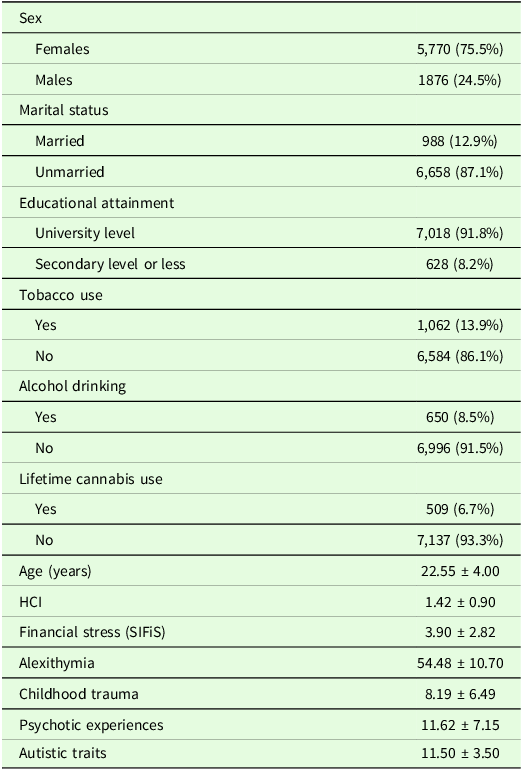
Description of the study sample can be found in Table 1. A total of 7,646 completed the survey, with a mean age of 22.55 ± 4.00 years.
Participants characteristics (n = 7,646)

Table 1. Long description
A table summarizing characteristics of 7,646 participants. The table has 11 rows and 2 columns. The columns are labeled ’Characteristic’ and ’Value’. Row 1: Sex, Females 5,770 (75.5 percent), Males 1,876 (24.5 percent). Row 2: Marital status, Married 988 (12.9 percent), Unmarried 6,658 (87.1 percent). Row 3: Educational attainment, University level 7,018 (91.8 percent), Secondary level or less 628 (8.2 percent). Row 4: Tobacco use, Yes 1,062 (13.9 percent), No 6,584 (86.1 percent). Row 5: Alcohol drinking, Yes 650 (8.5 percent), No 6,996 (91.5 percent). Row 6: Lifetime cannabis use, Yes 509 (6.7 percent), No 7,137 (93.3 percent). Row 7: Age (years), 22.55 plus or minus 4.00. Row 8: HCI, 1.42 plus or minus 0.90. Row 9: Financial stress (SIFIS), 3.90 plus or minus 2.82. Row 10: Alexithymia, 54.48 plus or minus 10.70. Row 11: Childhood trauma, 8.19 plus or minus 6.49. Row 12: Psychotic experiences, 11.62 plus or minus 7.15. Row 13: Autistic traits, 11.50 plus or minus 3.50.
Note: HCI: Household crowding index (person/room); SIFiS: The Single-Item Financial Stress scale.
3.1. Bivariate analysis
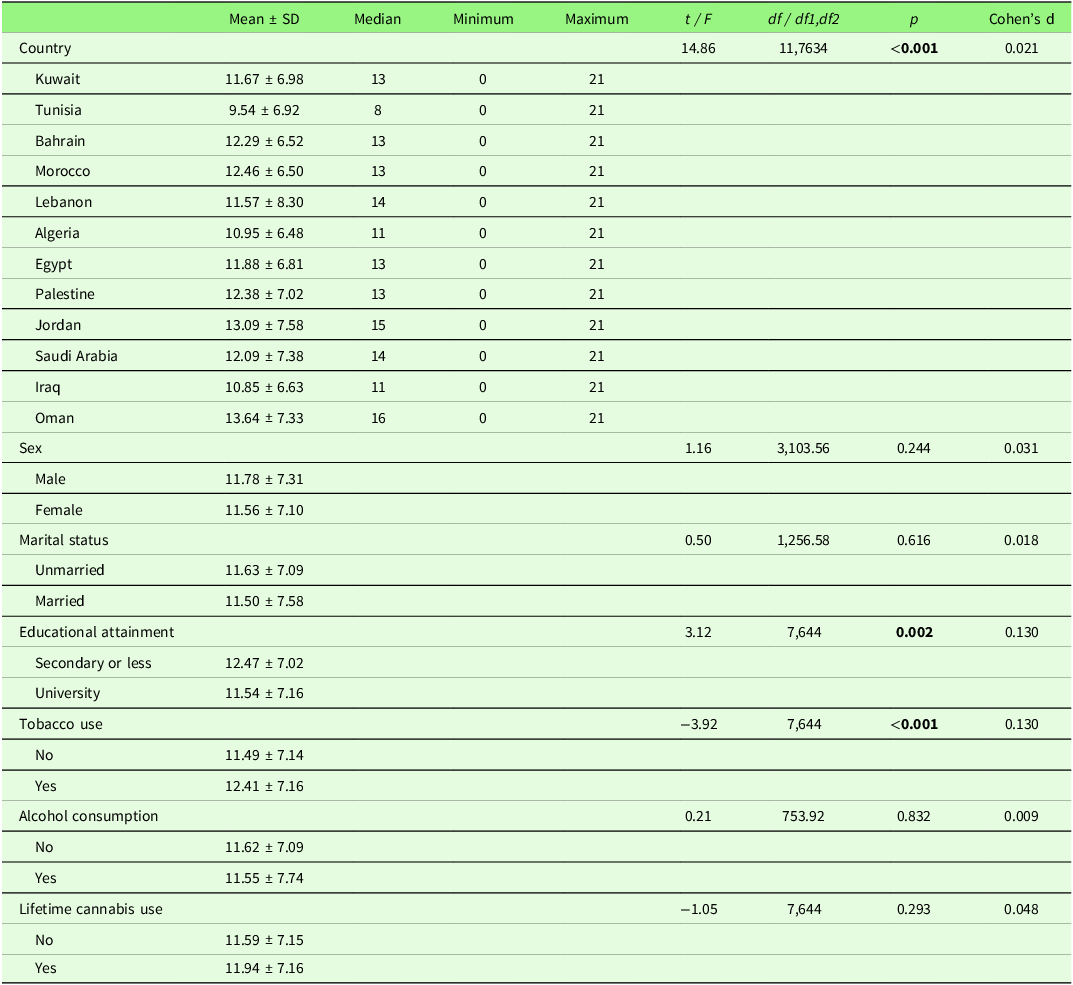
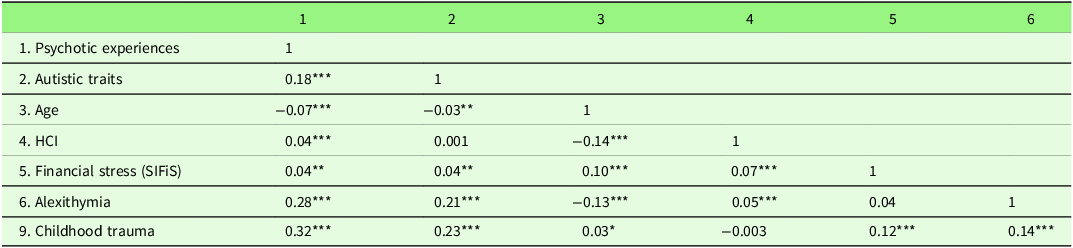
Greater PEs scores were found in participants with a secondary level of education or less compared to a university one, in those from Oman compared to those from other countries and in smokers compared to nonsmokers (Table 2). In addition, older age was significantly linked to lower PEs levels, whereas higher financial stress, HCI, ATs, alexithymia, and childhood trauma were significantly linked to more PEs (Table 3).
Factors associated with psychotic experiences

Table 2. Long description
The table presents data on factors associated with psychotic experiences, including country, sex, marital status, educational attainment, tobacco use, alcohol consumption, and lifetime cannabis use. It has 19 rows and 9 columns. The columns are labeled Mean ± SD, Median, Minimum, Maximum, t / F, df / df1, df2, p, and Cohen’s d. The rows are labeled with different categories such as Country, Sex, Marital status, Educational attainment, Tobacco use, Alcohol consumption, and Lifetime cannabis use. Each category has subcategories with corresponding values. For example, under Country, subcategories include Kuwait, Tunisia, Bahrain, Morocco, Lebanon, Algeria, Egypt, Palestine, Jordan, Saudi Arabia, Iraq, and Oman. Under Sex, subcategories include Male and Female. Under Marital status, subcategories include Unmarried and Married. Under Educational attainment, subcategories include Secondary or less and University. Under Tobacco use, subcategories include No and Yes. Under Alcohol consumption, subcategories include No and Yes. Under Lifetime cannabis use, subcategories include No and Yes. The table provides mean, median, minimum, maximum, t / F values, degrees of freedom, p-values, and Cohen’s d for each subcategory.
Note: Numbers in bold indicate significant p values.
Pearson correlation matrix

Table 3. Long description
A table with 6 rows and 6 columns showing Pearson correlation matrix. The rows and columns are labeled with different factors: Psychotic experiences, Autistic traits, Age, HCI, Financial stress (SIFIS), Alexithymia, and Childhood trauma. Each cell contains a correlation value indicating the relationship between the factors. Row 1: Psychotic experiences, value 1. Row 2: Autistic traits, value 0.18***. Row 3: Age, values -0.07***, -0.03**, and 1. Row 4: HCI, values 0.04***, 0.001, -0.14***, and 1. Row 5: Financial stress (SIFIS), values 0.04**, 0.04**, 0.10***, 0.07***, and 1. Row 6: Alexithymia, values 0.28***, 0.21***, -0.13***, 0.05***, 0.04, and 1. Row 7: Childhood trauma, values 0.32***, 0.23***, 0.03*, -0.003, 0.12***, and 0.14***.
Note: HCI: Household crowding index (person/room); SIFiS: The Single-Item Financial Stress scale.
* p < .05; **p < .01; ***p < .001.
3.2. Moderated mediation analysis
The ICC value was 0.013, indicating that only 1.3% of the variance was attributable to between-country differences. The low ICC suggested negligible clustering effects; therefore, subsequent analyses were conducted without multilevel correction.
All assumptions of homoscedasticity and normality were visually verified via the scatterplot, normal P-P plot and histogram. In addition, no evidence of multicollinearity was found as verified by variance inflation factor (VIF) values < 5. The moderated mediation analysis was adjusted over age, sex, education level, HCI, financial burden, tobacco use and country. Childhood abuse significantly moderated the association between ATs and alexithymia (interaction term: Beta = −0.02; SE = 0.01; p < 0.001; 95% CI [−0.03; −0.01]). Higher ATs were significantly associated with higher alexithymia scores, and this association was stronger at lower levels of childhood abuse (Beta = 0.70, SE = 0.05; p < 0.001; 95% CI [0.61, 0.79]) than at higher levels of childhood abuse (Beta = 0.39, SE = 0.05; p < 0.001; 95% CI [0.29, 0.50]). In turn, higher alexithymia was significantly associated with higher PEs (Beta = 0.17; SE = 0.01; p < 0.001; 95% [CI 0.15, 0.18]). The direct association between ATs and PEs remained significant (Beta = 0.24; SE = 0.02; p < 0.001; 95% [CI 0.19, 0.28]) (Table 4).
Moderated mediation of the association between autistic traits and psychotic experiences through alexithymia according to childhood abuse

Table 4. Long description
The table presents the results of a moderated mediation analysis examining the association between autistic traits and psychotic experiences through alexithymia, moderated by childhood abuse. It has five rows and five columns. The columns are labeled Effect, Path, Beta, SE, 95% CI, and p. The rows detail the direct effect, moderation effect, and mediator paths. Row 1: Direct effect, Autistic traits ➔ Psychotic experiences, Beta 0.24, SE 0.02, 95% CI 0.19; 0.28, p <0.001. Row 2: Moderation effect, Autistic traits x Childhood abuse ➔ Alexithymia, Beta -0.02, SE 0.01, 95% CI -0.03; -0.01, p <0.001. Row 3: Mediator path (a), Autistic traits ➔ Alexithymia, Beta 0.55, SE 0.04, 95% CI 0.48; 0.61, p <0.001. Row 4: Mediator path (b), Alexithymia ➔ Psychotic experiences, Beta 0.17, SE 0.01, 95% CI 0.15; 0.18, p <0.001.
Numbers in bold reflect significant p values.
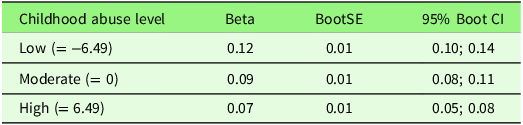
The conditional indirect effect of ATs on PEs through alexithymia was significant at low (Beta = 0.12; BootSE = 0.01; 95% bootstrap CI [0.10, 0.14]), moderate (Beta = 0.09; BootSE = 0.01; 95% boostrap CI [0.08, 0.11]), and high (Beta = 0.07; BootSE = 0.01; 95% bootstrap CI [0.05, 0.08]) levels of childhood abuse (Table 5). Furthermore, the index of moderated mediation was significant (index = −0.004; BootSE = 0.001; 95% bootstrap CI [−0.006, −0.002]), indicating that childhood abuse significantly moderated the indirect association between ATs and PEs through alexithymia.
Conditional indirect effects

Table 5. Long description
A table with three rows and three columns comparing the effects of different levels of childhood abuse on beta values and confidence intervals. The columns are labeled Childhood abuse level, Beta, BootSE, and 95% Boot CI. The rows are labeled Low, Moderate, and High. Row 1: Childhood abuse level, Low (= -6.49); Beta, 0.12; BootSE, 0.01; 95% Boot CI, 0.10; 0.14. Row 2: Childhood abuse level, Moderate (= 0); Beta, 0.09; BootSE, 0.01; 95% Boot CI, 0.08; 0.11. Row 3: Childhood abuse level, High (= 6.49); Beta, 0.07; BootSE, 0.01; 95% Boot CI, 0.05; 0.08.
Note: Numbers in bold reflect significant p values.
4. Discussion
This research is envisioned to shed light on potential mediators and moderators explaining the positive link between ATs and PEs in a wide multinational sample of community adults. Specifically, the aim of this study was to determine whether alexithymia has a mediating effect on the relationship between ATs and PEs, and whether childhood trauma has any moderating effect in this mediation model. The results indicated that ATs were positively correlated with PEs, and this relationship was partially mediated by alexithymia. The mediating effect of alexithymia was distinguished as being affected by different levels of childhood trauma.
The evaluation of PEs in our sample yielded a score of 11.62 ± 7.15. Previous studies found varying yet lower scores (e.g., 4.8 ± 3.8 in 243 college students from Italy (Preti et al., Reference Preti, Raballo, Kotzalidis, Scanu, Muratore, Gabbrielli and Carta2018), 4.6 ± 4.2 in 1,103 students and community members from the general population of Colorado, United states (Lång et al., Reference Lång, Mittal, Schiffman and Therman2021), 7.9 ± 5.1 in 1,461 help-seekers aged 15–45 years from Shanghai, China (Xu et al., Reference Xu, Zhang, Zheng, Li, Tang, Luo and Wang2016)). Although comparison of our PQ-B score with that of previous studies is difficult because of important methodological differences, an increased prevalence of PEs has generally been found in Arabs compared to non-Arabs (Fekih-Romdhane et al., Reference Fekih-Romdhane, Sassi, Ennaifer, Tira and Cheour2020). This aligns with previous observations that the endorsement of PEs varies across countries and cultural contexts (Fekih-Romdhane et al., Reference Fekih-Romdhane, Azzi, Harb, Obeid and Hallit2026; Fekih-Romdhane et al., Reference Fekih-Romdhane, Pandi-Perumal, Conus, Krebs, Cheour, Seeman and Jahrami2022; McGrath et al., Reference McGrath, Saha, Al-Hamzawi, Alonso, Bromet, Bruffaerts and Kessler2015). Consistent with our results, a previous multinational study conducted in six Arab countries found a PQ-B score of 10.05 ± 7.56 among 3,247 young adults from the general population (varying from 8.89 in Morocco to 11.11 in Egypt and Lebanon) (Feten Fekih-Romdhane et al., Reference Fekih-Romdhane, Jahrami, Alhuwailah, Fawaz, Shuwiekh, Helmy and Chebly2024).
4.1. The association between ATs and PEs in young non-clinical adults
In mediation analysis, the direct effect between ATs and PEs was significant. These results support our hypothesis and the large previous evidence mostly obtained from Western contexts on the close connection and overlap between autistic and psychotic manifestations, in both non-clinical (Horder et al., Reference Horder, Wilson, Mendez and Murphy2014; Huang et al., Reference Huang, Zhang, Sun, Chen and Wang2021; Hurst et al., Reference Hurst, Nelson-Gray, Mitchell and Kwapil2007; Mealey et al., Reference Mealey, Abbott, Byrne and McGillivray2014; Shi et al., Reference Shi, Liu, Shi, Yan, Wang, Wang and Chan2017) and clinical (De Crescenzo et al., Reference De Crescenzo, Postorino, Siracusano, Riccioni, Armando, Curatolo and Mazzone2019; Kincaid et al., Reference Kincaid, Doris, Shannon and Mulholland2017; Kiyono et al., Reference Kiyono, Morita, Morishima, Fujikawa, Yamasaki, Nishida and Kasai2020; Spain et al., Reference Spain, Sin and Freeman2016; Vaquerizo-Serrano et al., Reference Vaquerizo-Serrano, Salazar de Pablo, Singh and Santosh2022) samples. In the same vein, ATs have been suggested as a precursor to the onset of psychosis, based on findings of birth cohort studies demonstrating a causal link between childhood ATs and subsequent emergence of PEs in early adolescence (Bevan Jones et al., Reference Bevan Jones, Thapar, Lewis and Zammit2012; Esterberg et al., Reference Esterberg, Trotman, Brasfield, Compton and Walker2008; Sullivan et al., Reference Sullivan, Rai, Golding, Zammit and Steer2013). Our findings are also consistent with earlier prospective epidemiological studies in which ATs were reported as strong predictors of later development of PEs (Cederlöf et al., Reference Cederlöf, Pettersson, Sariaslan, Larsson, Östberg, Kelleher and Lichtenstein2016; Hennig et al., Reference Hennig, Jaya, Koglin and Lincoln2017; Jones et al., Reference Jones, Thapar, Lewis and Zammit2012). As the mediation model was controlled for covariates, including country of origin, the co-occurrence of ATs and PEs is likely independent of culture. Although the positive relationship between ATs and PEs has received support from a growing body of empirical research, there remains a lack of knowledge to date regarding the moderated mediation mechanisms underlying this relationship. To fill this gap and comprehend how these phenomena are related, our study proposed to test the mediating effect of alexithymia on the relationship between ATs and PEs, and the moderating effect of childhood trauma in Arab young adults.
4.2. The mediating role of alexithymia
Our results indicated that alexithymia may partially mediate the association between ATs and PEs. In other words, it can be suggested that those who experience alexithymia on the autism spectrum appear to have a heightened vulnerability to PEs. These results follow the theoretical basis which states that alexithymia commonly co-occur in highly-autistic individuals (Kinnaird et al., Reference Kinnaird, Stewart and Tchanturia2019), and that it can contribute to the development of psychosis (Feten Fekih-Romdhane et al., Reference Fekih-Romdhane, Ghrissi, Stambouli, Hakiri, Loch, Cheour and Hallit2024; O’Driscoll et al., Reference O’Driscoll, Laing and Mason2014; Van’t Wout et al., Reference Van’t Wout, Aleman, Bermond and Kahn2007; van der Velde et al., Reference van der Velde, Swart, van Rijn, van der Meer, Wunderink, Wiersma and Aleman2015; van Rijn et al., Reference van Rijn, Schothorst, Wout, Sprong, Ziermans, van Engeland and Swaab2011; Yi et al., Reference Yi, Huang, Jiang, Chen, Yang, Li and Wu2023). The mediation results suggest that alexithymia may partially explain how ATs translate into higher vulnerability to PEs in healthy individuals from the general population. Individuals higher in ATs have an increased tendency toward impaired ability to identify, understand, and describe their own emotions. These difficulties in emotional awareness and expression compound the poor emotion regulation strategies already experienced by highly autistic individuals in the general population (Dell’Osso et al., Reference Dell’Osso, Massoni, Battaglini, De Felice, Nardi, Amatori and Carpita2023), which may alter – in turn – the interpretation of internal states and external (interpersonal) experiences (Wittkamp et al., Reference Wittkamp, Krkovic and Lincoln2021). These processes may subsequently increase psychosis-proneness. This is in coherence with the theoretical model of psychosis by Garety et al. (Reference Garety, Kuipers, Fowler, Freeman and Bebbington2001) positing that negative emotions have a key influence on how external and internal experiences are interpreted, thereby leading to paranoid ideation. Overall, these results suggest that the mediating effect of alexithymia should be considered when developing prevention and intervention strategies targeting PEs reductions in high-autistic individuals.
4.3. The moderating role of childhood trauma
Personal history of childhood trauma at any level moderated the indirect path from ATs to alexithymia. This concurs with the well-established literature recognizing the elevated prevalence rates of childhood trauma in populations with ATs compared to their neurotypical counterparts (Hartley et al., Reference Hartley, Sirois, Purrington and Rabey2023; Webb et al., Reference Webb, Lupattelli Gencarelli, Keaveney and Morris2024). The findings are also in line with the extensive evidence available on the overrepresentation of childhood trauma among high-alexithymia people (Ditzer et al., Reference Ditzer, Wong, Modi, Behnke, Gross and Talmon2023; Khan & Jaffee, Reference Khan and Jaffee2022). Indeed, there is strong evidence from a large meta-analysis that exposure to traumatic events and experiences in childhood is associated with increased risk to be alexithymic as an adult (Khan & Jaffee, Reference Khan and Jaffee2022). Alexithymia was assumed to be used by those who experience childhood trauma as a way to defend themselves psychologically and relieve distress, by preventing access to internal feelings (Fang et al., Reference Fang, Chung and Wang2020). The moderation result suggest that childhood trauma experienced by individuals higher in ATs may amplify their pre-existing struggle with emotional processing difficulties (Dell’Osso et al., Reference Dell’Osso, Massoni, Battaglini, De Felice, Nardi, Amatori and Carpita2023). In other words, ATs already increase the likelihood of emotional dysregulation; and childhood trauma exposure could further undermine emotional development (Fan & Kang, Reference Fan and Kang2025), making emotional difficulties even more prominent. This moderation effect can be understood through the diathesis-stress model (Zuckerman, Reference Zuckerman1999) according to which it can be speculated that with a higher degree of ATs, a person could develop alexithymia more easily when having a history of childhood trauma. Until future prospective studies can draw valid causal inferences, it can be suggested that increasing levels of childhood trauma experiences may act as an environmental stressor that interact with the individual’s neurodevelopmental profile to enhance vulnerability to alexithymia in a dose-dependent manner. Exposure to even low levels of childhood trauma appear to increase vulnerability to alexithymic difficulties in those with elevated ATs.
4.4. Study limitations
There are some limitations that need to be recognized. First, because of the cross-sectional design, directionality of the link between ATs, alexithymia and PEs and accurate mediation/moderation estimates cannot be determined. Second, the target population consisted of young adults, limiting the generalizability of findings to other age groups. Therefore, findings should be replicated in children and adolescents’ samples, so that the pathways between ATs and PEs could be better understood in individuals early on in their lives. Third, self-report measures adopted in this study can be prone to bias. Clinical interviews are recommended in future studies for more accurate assessment of ATs and PEs. Fourth, participants were recruited through a non-probability sampling strategy combining convenience and snowball sampling. Although this approach allowed to further expand recruitment and facilitate access to diverse members of the target population, it may also have introduced selection bias and could limit the representativeness of our results to the broader population, particularly to males, married individuals and those with lower levels of education. To ensure a more balanced sample and enhance the generalizability of the findings, future studies using probability-based sampling methods are warranted. Fifth, although the AQ is one of the most commonly used screening measures, its items are predominantly male-centric and have been criticized for insufficiently capturing the autism phenotype in females (Cook et al., Reference Cook, Hull and Mandy2024; Dolfi & Tudose, Reference Dolfi and Tudose2025; Napolitano et al., Reference Napolitano, Schiavi, La Rosa, Rossi-Espagnet, Petrillo, Bottino and Casula2022). For instance, females often resort to compensatory strategies in social and interaction situations (such as sustaining eye contact or mimicking others), which can overrate their performance in items covering social confidence and friendliness (Groen et al., Reference Groen, Ebert, Dittner, Stapert, Henning, Greaves-Lord and Allison2023). Of note, the AQ-28 is to our knowledge the unique scale available for use in the Arabic language. Future studies should consider using measures that improve detection accuracy of female-typical presentations of ATs, such as the Camouflaging Autistic Traits Questionnaire (Dolfi & Tudose, Reference Dolfi and Tudose2025). Sixth, the TAS-20 has been used in our study to assess alexithymia, which, although validated in Arabic, has shown critical limitations in terms of reliability and validity and has been recommended for use in combination with other alexithymia measures (Kooiman et al., Reference Kooiman, Spinhoven and Trijsburg2002). Future research should address this limitation. Lastly, as per the objectives of the study, only the effects of alexithymia and childhood trauma were investigated. The associations observed may be influenced by other factors, such as broad psychological distress (Fekih-Romdhane et al. Reference Fekih-Romdhane, Jahrami, Alhuwailah, Fawaz, Shuwiekh, Helmy and Chebly2024). Future research should verify whether other factors might be involved in the proposed moderated-mediation model.
4.5. Implications and future research directions
According to our knowledge, this study is the first to support that alexithymia serves as a mediator in the positive association between ATs and PEs, and that childhood trauma has a moderating role in the indirect mediation pathway between ATs and alexithymia. These findings may offer new opportunities for intervention and prevention in both the autism and psychosis fields. Pending confirmation in future longitudinal and intervention studies, it can be suggested that clinicians in mental health treatment settings might consider screening highly autistic people, especially those with a personal history of childhood adversities, for alexithymia to detect those at risk of developing psychotic symptoms. Highly autistic individuals who score high in alexithymia may exhibit more PEs, and represent, therefore, a distinct subgroup who can benefit from interventions aimed at preventing or reducing these co-occurring psychotic symptoms, such as mindfulness exercises or training in identifying and communicating feelings (Baer et al., Reference Baer, Smith, Hopkins, Krietemeyer and Toney2006; Beresnevaite, Reference Beresnevaite2000). Moreover, moderation results suggest that interventions targeting childhood trauma could benefit young adults with elevated ATs by alleviating the level of alexithymia. Some points of relevance for future research can also be identified. Future studies are warranted to replicate our findings using a longitudinal design, provide evidence for causality, advance theoretical insight into the mechanisms underlying interactions between ATs and PEs, and strengthen practical implications. Studies on the topic from underexplored populations of different (non-Western) cultural backgrounds should be encouraged.
5. Conclusion
Based on theoretical considerations, the current results provide an empirical framework for improving our understanding of how ATs are linked to PEs among community young adults, by testing the mediating role of alexithymia and the moderating role of childhood trauma. In sum, the present results suggest that alexithymia and childhood trauma seem to be key factors that should be considered together as specific targets for treatment to improve the severity of psychotic symptoms and even possibly prevent psychosis in highly-autistic young adults. However, these results and suggested implications are only preliminary indications that need to be confirmed reliably in further longitudinal research.
Data availability statement
Because of ethical committee constraints, none of the data collected or analyzed during this study are publicly available. However, the corresponding author (SH) may make the data available upon reasonable request.
Supplementary material
The supplementary material for this article can be found at https://doi.org/10.1017/pen.2026.10009
Acknowledgments
The authors would like to thank all participants.
Author contributions
Feten Fekih-Romdhane: Conceptualization-Lead, Investigation-Equal, Methodology-Equal, Supervision-Lead, Validation-Equal, Visualization-Equal, Writing - original draft-Lead, Writing - review & editing-Equal; Amthal Alhuwailah: Data curation-Equal, Writing - review & editing-Equal; Fouad Sakr: Data curation-Equal, Writing - review & editing-Equal; Leila Sarra Chaibi: Data curation-Equal, Writing - review & editing-Equal; Mai Helmy: Data curation-Equal, Writing - review & editing-Equal; Hanaa Ahmed Mohamed Shuwiekh: Data curation-Equal, Writing - review & editing-Equal; Nedjem Eddine Boudouda: Data curation-Equal, Writing - review & editing-Equal; Btissame Zarrouq: Data curation-Equal, Writing - review & editing-Equal; Abdallah Y Naser: Data curation-Equal, Writing - review & editing-Equal; Esra’ O. Taybeh: Data curation-Equal, Writing - review & editing-Equal; Kamel Jebreen: Data curation-Equal, Writing - review & editing-Equal; Mohammed Lakhdar Roubi: Data curation-Equal, Writing - review & editing-Equal; Bassam Abdul Rasool Hassan: Data curation-Equal, Writing - review & editing-Equal; Nisma Merdad: Data curation-Equal, Writing - review & editing-Equal; Rizwana Amin: Data curation-Equal, Writing - review & editing-Equal; Inad Nawajah: Data curation-Equal, Writing - review & editing-Equal; Ali Haider Mohammed: Validation-Equal, Visualization-Equal, Writing - review & editing-Equal; Sinan Subhi Farhan: Data curation-Equal, Writing - review & editing-Equal; Omar Abdulwahid AlAni: Data curation-Equal, Writing - review & editing-Equal; Mariam Dabbous: Data curation-Equal, Writing - review & editing-Equal; Diana Malaeb: Validation-Equal, Visualization-Equal, Writing - review & editing-Equal; Sahar Obeid: Validation-Equal, Visualization-Equal, Writing - review & editing-Equal; Majda Cheour: Validation-Equal, Visualization-Equal, Writing - review & editing-Equal; Alexandre Andrade Loch: Validation-Equal, Visualization-Equal, Writing - review & editing-Equal; Souheil Hallit: Conceptualization-Equal, Formal analysis-Lead, Investigation-Equal, Methodology-Equal, Software-Equal, Writing - original draft-Equal, Writing - review & editing-Equal
FFR and SH designed the study; FFR drafted the manuscript; SH carried out the analysis and interpreted the results; FS, AA, LSC, MH, HAMS, NEB, BZ, AYN, EOT, KJ, MLR, NM, RA, BARH, AHM, SSF, OAA, and MD collected the data; MC, DM, AAL, and SO reviewed the paper for intellectual content; all authors reviewed the final manuscript and gave their consent.
Financial support
None.
Competing interests
The authors have nothing to disclose.
Ethical standards
The protocol was approved by the home institutions of the study’s principal investigators (FFR and SH), namely the ethics committee of Razi Psychiatric Hospital, Manouba, Tunisia (ECRPH-2024-032) and the Lebanese International University’s School of Pharmacy ethics committee (2024ERC-025-LIUSOP). When filling out the online form, each participant provided written informed consent. All methods were performed in accordance with the relevant guidelines and regulations (in accordance with the Declaration of Helsinki).
Consent for publication
Not applicable.
Code availability
Not applicable.




 Open access

