




No CrossRef data available.
Competition Between Unequals: The Role of Mainstream Party Strategy in Niche Party Success
Published online by Cambridge University Press: 02 September 2005
Abstract
What accounts for variation in the electoral success of niche parties? Although institutional and sociological explanations of single-issue party strength have been dominant, they tend to remove parties from the analysis. In this article, I argue that the behavior of mainstream parties influences the electoral fortunes of the new, niche party actors. In contrast to standard spatial theories, my theory recognizes that party tactics work by altering the salience and ownership of issues for political competition, not just party issue positions. It follows that niche party support can be shaped by both proximal and non-proximal competitors. Analysis of green and radical right party vote in 17 Western European countries from 1970 to 2000 confirms that mainstream party strategies matter; the modified spatial theory accounts for the failure and success of niche parties across countries and over time better than institutional, sociological, and even standard spatial explanations.
Information
- Type
- ARTICLES
- Information
- Copyright
- © 2005 by the American Political Science Association
Since the 1960s, political systems around the world have undergone a revolution. From Western Europe and North America to Australasia and Latin America, new political parties have emerged and gained popularity on the basis of previously overlooked issues such as the environment, immigration, and regional autonomy. In addition to challenging the economic focus of the political debate, these niche parties have threatened the electoral and governmental dominance of mainstream political parties. For example, since 1960, over 54% of green, radical right and ethnoterritorial parties in Western Europe have held a seat in a national legislature.1
Author's calculations from Woldendorp, Keman, and Budge 1998.
This question has typically been answered with institutional or sociological explanations. According to the first set of theories, electoral rules, governmental types, and the structure of the state, among other institutions, constrain or facilitate a new party's electoral advancement (e.g., Duverger 1963; Harmel and Robertson 1985; Müller-Rommel 1996). For proponents of sociological approaches, new party support varies by the socioeconomic conditions and value orientation of a society (Golder 2003; Inglehart 1998). Although popular, these explanations are insufficient. Static institutions cannot account for variation in a party's vote share over time. And, as shown in cross-national analyses of new party vote (Swank and Betz 1995, 1996, 2003), both sociological and institutional approaches stumble in the face of the numerous green and radical right parties that attract little support under propitious circumstances and significant support under inauspicious ones.
In emphasizing the context in which party competition takes place, the existing literature has curiously ignored the behavior of the competitors. This article brings parties back into party analysis. I demonstrate the critical role that the most powerful set of party actors—mainstream parties of the center-left and center-right—plays in shaping the success of niche parties.
THE NEW COMPETITORS: THE NICHE PARTY PHENOMENON
The electoral arenas of developed and developing democracies have been flooded with new political parties over the past 40 years. Although many of these new political organizations are variants of the existing socialist, liberal, and conservative parties, there is a group of parties that stands out. These actors, which I call niche parties, differ from their fellow neophytes and the mainstream parties in three significant ways.2
Following the tradition of identifying parties by their substantive positions, scholars have typically treated green and radical right parties as distinct party families (see Kitschelt 1994, 1995; O'Neill 1997). When we focus on the function of these new parties within the party system, however, their similarities outweigh their differences.
Second, the issues raised by the niche parties are not only novel, but they often do not coincide with existing lines of political division. Niche parties appeal to groups of voters that may cross-cut traditional partisan alignments. As a result, cases of voter defection between “unlikely” party pairs have occurred. The defection of former British Conservative voters to the Green Party in 1989 and former French Communist party voters to the radical right Front National in 1986 are typical examples.
Third, niche parties further differentiate themselves by limiting their issue appeals. They eschew the comprehensive policy platforms common to their mainstream party peers, instead adopting positions only on a restricted set of issues. Even as the number of issues covered in their manifestos has increased over the parties' lifetimes, they have still been perceived as single-issue parties by the voters. Unable to benefit from pre-existing partisan allegiances or the broad allure of comprehensive ideological positions, niche parties rely on the salience and attractiveness of their one policy stance for voter support.
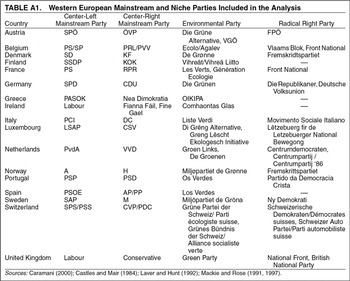
The niche party phenomenon has most strongly affected the political arenas of Western Europe. Over the past 30 years, approximately 110 niche parties have contested elections in 18 countries.3
These countries are Austria, Belgium, Denmark, Finland, France, Germany, Greece, Iceland, Ireland, Italy, Luxembourg, the Netherlands, Norway, Portugal, Spain, Sweden, Switzerland, and the United Kingdom.
The five countries lacking a niche party with a peak national vote greater than 5% are Greece, Ireland, the Netherlands, Portugal, and the United Kingdom.
A STRATEGIC EXPLANATION OF NICHE PARTY VOTE
Recognition of these differences in niche party formation and success prompts an obvious question: why did some of these new parties gain more electoral support than others? Moreover, what determined the timing of the peaks and troughs in the electoral trajectories of these parties? In recent years, the standard answers to any question of new political party success have been institutional and sociological (e.g., Golder 2003; Inglehart 1998). As noted in the introduction, however, the utility of structural explanations is limited. Not only do these theories fail to account for the electoral performance of several key cases, but they also downplay the role of political actors. When modeling the behavior of voters and its impact on party electoral prospects, the existing literature disregards the fact that parties have tools that allow them to adapt to the institutional and sociological environment in which they participate. In this article, I advance a theory of niche party success that focuses on the role of mainstream party strategies in determining the competitiveness of new political dimensions and that of the niche parties competing on them.5
Mainstream parties are defined as the electorally dominant actors in the center-left, center, and center-right blocs on the Left-Right political spectrum. In this classification, the center-left parties explicitly exclude left-libertarian parties, whereas the center-right categorization excludes right-authoritarian, or right-wing, populist parties. The criteria generally yield three mainstream parties per country, one in each category. For more on coding, see the independent variables section.
Largely ignored by the literature on new party success,6
strategic models of party competition are hardly new. Made famous by Downs (1957), the spatial theory of party and voter behavior—whereby rational parties choose policy positions to minimize the distance between themselves and the voters—lies at the heart of significant theoretical work on the entrance, interaction, and success of (mainstream) parties (e.g., Enelow and Hinich 1984; Kitschelt 1994; Shepsle 1991). According to this framework, parties competing for votes are faced with two possible strategies: movement toward (policy convergence) or movement away from (policy divergence) a specific competitor in a given policy space. Policy convergence, or what I call an accommodative strategy, is typically employed by parties hoping to draw voters away from a threatening competitor. On the other hand, by increasing the policy distance between parties, policy divergence, or what I term an adversarial strategy, encourages voter flight to the competing party.This programmatic conception of party behavior has become the dominant lens through which to understand political competition and party strategies. However, it is not without limitations. Whether spatial theorists view the policy arena as having equally or unequally weighted dimensions, they explicitly assume that the salience of those issue axes remains fixed during party interaction. But just as exogenous factors like economic crises or natural disasters can alter the importance of an issue dimension, studies have shown that parties also can manipulate the perceived salience of issues within the political arena (Budge, Robertson, and Hearl 1987; Rabinowitz and Macdonald 1989). Budge, Robertson, and Hearl (39) observe that “(p)arties compete by accentuating issues on which they have an undoubted advantage, rather than by putting forward contrasting policies on the same issues.” In other words, parties do not compete on all issues in the political space in every election.7
For competition between unequals, this means that mainstream parties compete with the niche party using strategies restricted to the new issue dimension. This constraint allows us to avoid the problems of modeling competition between multiple players in multiple dimensions (Enelow and Hinich 1984).
In addition, existing strategic models have generally disregarded issue ownership. According to standard spatial theories, where voter decisions depend solely on ideological proximity, voters facing equally distant parties are indifferent between their political options. But voter choice is not necessarily (or typically) dictated by the flip of a coin. Just as partisan identification has been shown to influence voter decision-making in highly aligned political environments, a party's issue credibility, or ownership, plays a key role in issue-based voting (Budge and Farlie 1983); voters accord their support to the most credible proponent of an issue. Although much has been made of the stickiness of issue ownership (Petrocik 1996), more recent observations confirm that policy reputations are not static (Bélanger 2003). Through their campaign efforts, parties have reinforced or undermined linkages between political actors—themselves and others—and specific issue dimensions (Budge, Robertson, and Hearl 1987; Meguid 2002). Issue ownership, therefore, is subject to party manipulation.
I argue that a new conception of party strategies is needed, one that recognizes that parties compete by altering policy positions and the salience and ownership of issue dimensions. In the next section, I spell out the implications of this new conception of strategies for a theory of party competition between unequals.
THE MODIFIED SPATIAL THEORY
An Expanded Toolkit
In moving from a definition of strategies as purely programmatic tools to one with salience, ownership, and programmatic dimensions, our understanding of the range and effectiveness of party tactics increases. In contrast to spatial theories that emphasize party movement on a given issue dimension, this new theory suggests strategic behavior toward a niche party starts one step earlier—with the decision regarding mainstream party entry. Established parties must decide whether to recognize and respond to the issue introduced by the niche party. Party presence on a specific policy dimension, like the environment or immigration, is not a given.8
The work on party realignment does recognize that political actors might not take positions on all issue dimensions. However, even this body of research (e.g., Rohrschneider 1993) has not included the decision to ignore new issue dimensions in its repertoires of party strategy.
Parties finding an issue unimportant or too difficult to address can decide to ignore it. Rather than indicating a party's failure to react, this previously ignored “non-action” is a deliberate tactic that I call a dismissive strategy. By not taking a position on the niche party's issue, the mainstream party signals to voters that the issue lacks merit. If voters are persuaded that the niche party's issue dimension is insignificant, they will not vote for it. Thus, even though a dismissive strategy does not challenge the distinctiveness or ownership of the niche party's issue position, its salience-reducing effect will lead to niche party vote loss.
Conversely, parties can compete with the new party by adopting a position on its issue dimension. The salience of that issue increases as the mainstream party acknowledges the legitimacy of the issue and signals its prioritization of that policy dimension for electoral competition. Depending on the position that the mainstream party adopts upon entering the new issue space, this response is one of the already familiar accommodative (convergence) and adversarial (divergence) strategies.
Although both boost issue salience, the similarities between accommodative and adversarial tactics end there. An accommodative tactic undermines the distinctiveness of the new party's issue position, providing like-minded voters with a choice between parties. Consistent with standard spatial models, those voters closer to the accommodating mainstream party on the new issue will desert the niche party. But, according to my theory, even those voters who are (programmatically) indifferent between the two parties may be persuaded to leave the new party. By challenging the exclusivity of the niche party's policy stance, the accommodative mainstream party is trying to undermine the new party's issue ownership and become the rightful owner of that issue. The mainstream party is aided in this process by its greater legislative experience and governmental effectiveness. In addition, mainstream parties generally have more access to the voters than niche parties, allowing them to publicize their issue positions and establish name-brand recognition.9
That exposure occurs through the media and the mainstream party's activists. The latter are typically more numerous and better integrated into society than those of the niche party.
In addition to strengthening the already powerful tool of convergence, the salience and ownership dimensions also empower the commonly ignored spatial strategy of policy divergence. When a party adopts an adversarial strategy, it declares its opposition to the niche party's policy stance. This strategic behavior calls attention to that challenger and its issue dimension, leaving voters primed to cast their ballots on the basis of this new issue. The adversarial strategy also reinforces the niche party's issue ownership by defining the mainstream party's issue position in juxtaposition to that of the new party. It strengthens the link in the public's mind between that issue stance and the niche party as its primary proponent. As a result, the adversarial strategy encourages niche party electoral support.
The predicted effects of this expanded set of party strategies on issue salience, ownership, and party programmatic position and, in turn, niche party vote are summarized in Table 1. Given that a niche party's support depends on a single issue, any tactic that undermines the perceived relevance of that issue, or the distinctiveness or credibility of the niche party's position on that dimension will result in vote loss. Assuming that voters find the niche party's policy stance attractive, mainstream parties can undermine niche party vote with dismissive or accommodative tactics and boost it with adversarial strategies.

Changing the Nature of Party Competition: The Critical Role of Non-Proximal Parties
The expanded conception of strategies alters our understanding of the range and effectiveness of political tactics. But the implications of this revision extend far beyond the size of the party's toolkit. They call into question the very rules of party interaction propounded by spatial models. Recall that in the standard spatial conception of strategy, parties can only affect the electoral support of neighboring parties; in a unidimensional space, this means that movement by a center-left party away from a center-right party cannot impact the electoral support of a right flank party. If instead strategies can also alter issue salience and ownership, then parties can target opponents anywhere on that dimension. Ideological proximity is no longer a requirement.
Consider the effects and utility of the adversarial strategy. Given that political opponents are generally viewed as threats, it might seem counterintuitive to suggest, as I did, that a party would seek to heighten the visibility and electoral strength of a competitor. Indeed, in a two-party system where politics is a zero-sum game, political parties are unlikely to employ adversarial tactics. When competition occurs between three or more players on a single dimension, however, such a vote-boosting strategy might be used against a competitor on the opposite flank of the political spectrum. The salience- and ownership-altering aspects of adversarial tactics allow mainstream parties who are not directly threatened by the niche party to use it as a weapon against their mainstream party opponents. This is the political embodiment of the adage “the enemy of my enemy is my friend”; the mainstream party helps the niche party—the enemy of its enemy in this case—gain votes from the other mainstream party. As this discussion intimates, failure to consider the tactics of the nonproximal party could lead to faulty predictions about niche party support.
Hypotheses of the Modified Spatial Theory
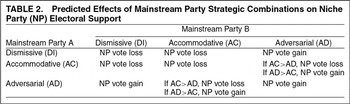
Table 2 contains the predictions of my modified spatial theory of party competition for niche party success. These hypotheses are based on the behavior of multiple mainstream parties on one dimension—the niche party's new issue dimension. For ease of presentation, I assume that there are only three parties in the political system—mainstream party A, mainstream party B, and the niche party.10
This restriction does not represent an intrinsic limitation of the model.

The reconceptualization of party strategies has a profound impact on the expected outcomes of party competition. Not only does each party have multiple means of undermining and bolstering a niche party's vote, but also the electoral fortune of that niche party is shaped by the behavior of multiple mainstream parties. The predictions in Table 2 suggest that one party's behavior alone is rarely determinative of niche party support; mainstream parties can use tactics to thwart the strategic efforts of their mainstream competitor. For example, I posit that mainstream party B's adversarial (AD) strategy will decrease the effectiveness of mainstream party A's vote-reducing dismissive (DI) and accommodative (AC) tactics. In the case of a DIAD combination, the salience, ownership, and programmatic effects of the adversarial strategy are expected to overpower the simple salience-reducing impact of the dismissive strategy. The result will be a more popular niche party with strengthened issue ownership.
The expected outcome of the ACAD strategy is less straightforward. Although the adversarial behavior of mainstream party B prevents its mainstream opponent from easily coopting the niche party's issue ownership and issue voters, B's ability to bolster the neophyte's vote depends on the relative intensity of the two strategies, where intensity is a function of the prioritization, frequency, and duration of party tactics. In this situation, best described as a battle of opposing forces, the mainstream party employing the greater number of tactics consistently for the longer period of time will prevail. If the accommodative strategy is more intense than the adversarial one, I expect that the niche party will lose issue ownership and issue-based voters to the accommodating party. If the adversarial tactic is stronger and more consistently employed, then the issue ownership of the niche party will be strengthened, and its electoral support will increase.
The effectiveness of these strategic combinations is not without constraints, however. Mainstream party tactics must be accompanied by changes in voters' perceptions of party positions, issue salience, and issue ownership. As in all theories of strategic interaction, policy inconsistency limits the success of a party's strategy; the promotion of contradictory policy stances either simultaneously or over time raises doubts among the voters about the credibility of the strategizing actor. My reconception of strategies as issue-ownership-altering devices also means that the utility of these tactics depends on their implementation shortly after the emergence of the niche party on the electoral scene. Once the voters identify the niche party as the sole proponent of the issue, the costs involved in undermining that perceived ownership render its likelihood slim. Hesitation, therefore, undermines the potency of these reconceptualized strategies.
DATA
Dependent Variable
To test the hypotheses of my modified spatial theory, I look at the electoral trajectories of niche parties that emerged and contested national-level legislative elections in Western Europe from 1970 to 2000. The dependent variable is operationalized as the percentage of votes received by a given niche party in a national legislative election.11
With the data organized as niche party panels, the separate inclusion of multiple green or multiple radical right parties from the same country would violate the assumed independence of the observations; it would introduce the possibility that the electoral failure of a green party simply reflects the success of a different green party in that country. Thus, for those countries in which two or more green parties contest a given election, the value of the dependent variable for that country-party-election observation is the sum of those parties' votes. The same adjustment is made for countries with multiple radical right parties.
In order to best examine the success of these parties across the entire set of Western European countries, my analysis focuses on the most common set of niche parties: the environmental and radical right parties. Following from my original description of niche parties, I categorize individual parties on the basis of their primary issue positions. Those single-issue actors prioritizing the environment are labeled green parties, and those emphasizing issues of law and order and immigration are deemed radical right parties. The resulting categorization is largely consistent with the classifications made by other party researchers (e.g., Golder 2003; Kitschelt 1994).
Given that mainstream party strategies are implemented only after new party challengers have developed, the cases in this analysis are limited to those instances of green and radical right party emergence.12
This is different from sociological models in which observed rates of unemployment can be used to impute latent green or radical right party support in the absence of party formation (Golder 2003; Jackman and Volpert 1996; Swank and Betz 2003). This article, therefore, assesses the impact of the explanatory variables on niche party vote conditional upon niche party entry.
This requirement led to the elimination of the eighteenth country—Iceland—from the analysis. The Icelandic green party, Vinstrihreyfingin—grænt frambodh, only contested one national-level election during the time period under examination.
Independent Variables
Mainstream Party Strategies
I argue that the competitiveness of niche parties is directly shaped by the behavior of their fellow political contestants. Although the political arena may contain up to 50 party competitors in any one national legislative election, this analysis focuses on the tactics of a subset of political actors: the mainstream parties of the center-left and center-right.14
In results not presented here, I find that the addition to the model of variables capturing the strategic behavior of a third set of mainstream parties—the centrist parties—does not change the results. When the strategic responses of center-left and center-right mainstream parties are controlled for, centrist party tactics generally prove insignificant.
Mainstream parties from the 17 countries were initially chosen according to their position on the Left-Right axis. Drawing on the party classification structure proposed by Castles and Mair (1984, 83), mainstream parties of the center-left, or “Moderate Left,” were defined as those parties with scores of 1.25 to 3.75 on a scale of 0 to 10. Mainstream parties of the center-right, Castles and Mair's “Moderate Right” parties, were those parties with positions of 6.25 to 8.75.15
With an average score of 5.4, Italy's commonly recognized center-right party, Democrazia Cristiana, was the exception. See Castles and Mair 1984, 80.
The dominance of a noneconomic dimension in Irish politics means that Fianna Fáil and Fine Gael are largely indistinguishable on the Left-Right spectrum.
I drew on data from the Comparative Manifesto Project (CMP) to determine mainstream parties' responses to the niche parties. This dataset records a party's support for and prioritization of a set of issue positions.17
Though there is disagreement in the literature as to whether precise spatial positions can be derived from CMP data, it is not necessary to join that debate here; information about the precise spatial position of a mainstream party on a particular issue is not necessary for my coding of party behavior.
These measures of strategy capture the policy behavior of parties, not the effects of those tactics on voter perceptions of the salience and ownership of the niche party's issue. Because the predictions of the standard and modified spatial theories are not observationally equivalent, conclusions about the relative explanatory power of these strategic theories can be drawn without looking at the micro-level mechanism. In case studies of mainstream party-niche party interaction conducted elsewhere (Meguid 2002), I find direct evidence supporting my hypotheses about the issue salience- and ownership-altering mechanisms of strategies.
For a strategy to be coded accommodative, a party's pronounced support of a neophyte's issue position could be accompanied by few references in opposition to that policy stance. A similar confirmatory procedure was employed when coding the adversarial tactics.
The Comparative Manifesto Project does not include a negative corollary to Variable 605 measuring support for law and order. As noted by Laver and Garry (2000, 621), not all issues coded in the dataset are presented as positional issues—topics with positive and negative stances to them.
Manifestos for a particular national-level election reflect the strategies adopted by mainstream parties sometime after the previous election but before the one being contested.
The following resources were examined: British Labour and Conservative Party Archives; French Socialist Party Archives; Hainsworth 2000; Keesing's Worldwide 1999; Kitschelt 1994, 1995; O'Neill 1997; and Taggart 1996.
From the classification of individual mainstream party tactics, I find occurrences of each of the six possible strategic combinations in the data. I model DIDI, DIAC, DIAD, ACAC, and ADAD as simple dummy variables. The effect of the sixth strategic combination, ACAD, depends on the relative intensity of the constituent strategies, with intensity measured by the percentage of each party's manifesto devoted to its issue position. I code the ACAD variable −1 when the intensity of the AC strategy is greater and +1 when the intensity of AD is greater.
As currently operationalized, the strategic variables capture mainstream party behavior toward niche parties independent of the tactics the mainstream parties employed in previous electoral periods. However, my modified spatial model posits that policy inconsistency and delay can undermine strategic effectiveness. A review of mainstream party strategies in my dataset reveals that policy hesitation, more than policy inconsistency, occurs during mainstream party–niche party interaction in Western Europe. Of the 114 observations, there are 18 cases of mainstream parties employing accommodative tactics (ACAC or DIAC) following two or more periods of dismissive strategies. Because there are only two instances of a mainstream party switching between AC and AD tactics in successive electoral periods in my data, I model only policy delay. I create time-sensitive dummy variables for DIAC and ACAC strategies, where the variables are coded 1 when the strategy was implemented after two or more periods of joint dismissive tactics. Because a mainstream party's ability to acquire issue ownership—the key mechanism behind accommodative tactics—is limited once voters deem the niche party the sole issue owner, hesitation is expected to counteract the vote-reducing power of these strategies.
Institutional and Sociological Variables
In addition to these strategic variables, I include those institutional and sociological factors identified by previous research as relevant to new party success. The permissiveness of the electoral and political environment is captured by two variables, a measure of district magnitude and a dummy variable indicating a centralized (as opposed to a federal) state structure.23
Following the practices of Amorim Neto and Cox (1997) and Golder (2003), the first variable is operationalized as the logged magnitude of the median legislator's district.24Data from Golder 2003.
The logic of their claim is as follows: a decentralized system increases the number of representative positions and, thus, the likelihood that a new party will attain office. New parties who can draw on local-level governmental experience and grassroot support will gain higher vote shares when seeking national office.
To assess the significance of the sociological climate for niche party support, I use two measures of economic health: the current level of GDP per capita and the current rate of unemployment.26
GDP per capita, reported at current prices and current purchasing power parity (PPP) in thousands of U.S. dollars, and unemployment, measured as a percentage of the total labor force, were taken from the OECD Statistical Compendium CD-ROM 2000.
Measures of postmaterialism and immigrant concentration—additional sociological measures of green (Inglehart 1998) and radical right party support (Golder 2003; Swank and Betz 2003)—were excluded from the model because of severe data restrictions and the lack of suitable proxies;27
The demographic variables typically associated with postmaterialist values—age and education—are not appropriate substitutes for the value orientation variable. Although age is negatively correlated with postmaterialism and green party support, it is also negatively correlated with materialist values and radical right support (Taggart 1996). Education has been found to have no relationship with green party vote when other factors are taken into account (Bürklin 1984).
The Eurobarometer surveys only provide time-series data on postmaterialism for 11 of the 17 countries (European Communities Studies, 1970–1992), whereas the three waves of the World Values Survey only provide one observation per country per decade for a limited number of these countries. Similarly, data on the percentage of immigrants in a country are unavailable for nine elections across five countries in my dataset (Golder 2003).
MODEL AND ANALYSIS
To estimate the effect of these institutional, sociological, and strategic factors on niche party electoral support, I employ pooled cross-sectional time-series analysis. Specifically, I ran an ordinary least-squares (OLS) regression with a lagged dependent variable, panel-corrected standard errors (Beck and Katz 1995, 1996), and country-fixed effects. The result of a joint F-test supports the inclusion of country dummy variables. Not only do these variables help to minimize country-level heteroskedasticity, which is not addressed by the niche party panel-level standard error correction of the model, but also they reflect country differences unaccounted for by the independent variables. These differences include, most importantly, variation in the distribution of voters' positions in the policy space—a variable for which no cross-country measure exists, yet which is critical to the predicted effect of mainstream party strategies on niche party support. As recommended by Beck and Katz (1995, 1996), the lagged dependent variable was added to eliminate autocorrelation in the underlying data.
Findings
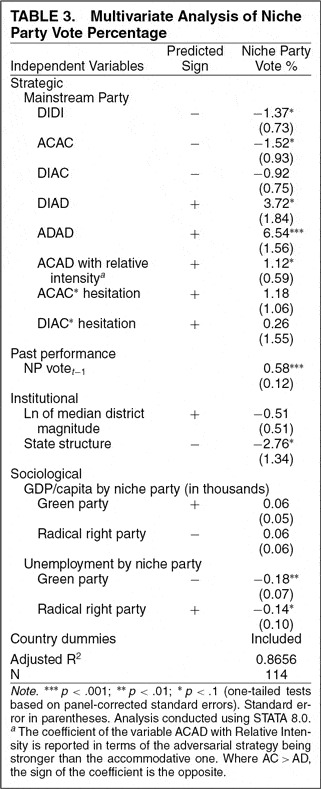
The regressions results are reported in Table 3, with the predicted signs of the independent variables listed in column 2. The statistical significance of the coefficients is measured with one-tailed t-tests due to the directional nature of the institutional, sociological, and strategic hypotheses. For ease of presentation, the estimates of the 17 country dummies are not shown.29
In all but one case—Spain—the coefficients of the country dummy variables were statistically significant at p<0.1 in a two-tailed test. Although these variables were included to account for unmeasurable country-level characteristics, the sign and magnitude of the specific country coefficients are not, in and of themselves, of interest here.

The regression results confirm that the electoral trajectories of niche parties are not solely determined by—or, in some cases, even critically influenced by—institutional and sociological factors. Rather, mainstream party tactics exert statistically and substantively significant effects on niche party vote across elections. Of the factors used to test the competing institutional and sociological hypotheses, only the measures of state structure and unemployment in green party cases are significant and correctly signed predictors of niche party vote. Although insignificant findings could be encouraged by the lagged dependent variable model, which measures short-term determinants of niche party support levels, the statistical significance of the other institutional and sociological factors does not increase when the lagged dependent variable is dropped. The results are also robust to alternate specifications of the institutional and sociological variables.30
Replacement of the logged median district magnitude variable with alternate specifications—including the logged average district magnitude and a dummy variable capturing the plurality-proportional representation dichotomy—did not alter the results. Similarly, use of lagged economic variables did not change the significance of the sociological variables or any of the other variables in the model.
Beyond supporting the significance of strategic behavior, the analysis confirms that mainstream parties can use strategies either to weaken or to strengthen niche party electoral support. Consistent with the predictions of my modified strategic model, joint dismissive (DIDI) and joint accommodative (ACAC) tactics decrease, and dismissive–adversarial (DIAD) and joint adversarial (ADAD) tactical combinations increase, niche party support. The effect of dismissive–accommodative (DIAC) tactics, on the other hand, proves statistically insignificant. As expected, the impact of accommodative–adversarial (ACAD) tactics depends on the relative intensity of the constituent strategies. When adversarial tactics are dominant (ACAD =+1), this strategic combination leads to an increase in niche party vote. When accommodative actions are stronger (ACAD =−1), niche party support declines.
Although the effects of these strategies largely match the predictions of my modified spatial model, the regression results offer surprisingly little support for the claim that hesitation mitigates the vote-reducing power of accommodative tactics. A visual inspection of the data confirms that niche party support changes by a larger positive amount following the use of “delayed”—as opposed to timely—joint accommodative (ACAC) and dismissive–accommodative (DIAC) strategies, yet these vote-boosting effects do not appear to be significant when other factors are accounted for.31
Without controlling for other factors, the mean change in niche party vote following the timely implementation of ACAC is 0.61. It increases to 0.97 following the use of a “delayed” ACAC tactic. Similarly, mean change in niche party vote following the timely implementation of DIAC is 0.59. When the strategy is implemented after a delay, the mean change increases to 1.31.
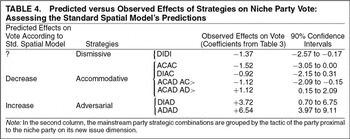
On the whole, then, the regression results provide support for my strategic model of niche party success. Do they, however, contradict the claims of the traditional spatial theories of party interaction? Can we conclude that strategies follow a micro-level mechanism whereby tactics alter issue salience and ownership, not just party programmatic position? To help answer these questions, I have summarized in Table 4 the expected impact of each strategy in a unidimensional space according to the standard spatial model along with the strategy's observed effect from the regression. Recall that the actions of a non-proximal party are considered irrelevant by the standard spatial theory. Thus, if we focus only on the behavior of the mainstream party closest to the niche party on this new issue, we can reduce our set of six different strategic combinations to three: those where there are no proximal parties (DIDI), those where the proximal party is accommodative (ACAC, DIAC, ACAD where AC>AD, and ACAD where AD>AC) and those where the proximal party is adversarial (DIAD and ADAD).32
Proximity to the niche party in this unidimensional space is determined by the position adopted by a mainstream party upon entering the new issue dimension. A party acting accommodatively is proximal to the niche party on the new issue. The adversarial party is considered to be non-proximal unless no other mainstream party is accommodative; in that case, the adversarial party is considered proximal. Where both parties refuse to take a position on the new issue dimension (i.e., both act dismissively), there is no proximal party.

A comparison of the predicted and observed effects of these strategies offers some support for the standard spatial model. As anticipated by that theory in unidimensional competition, adversarial tactics employed by the proximal party—represented by DIAD and ADAD in our set of mainstream party responses—lead to neophyte vote gain. Accommodative strategies, in general, also have the expected effect—niche party vote loss. The standard spatial theory offers no clear predictions about the impact of dismissive tactics, or not taking a position along the new policy dimension, on target party vote levels.
But the shortcomings of the standard spatial model begin to surface when we compare the effects of strategies within each of these three categories. No two of the combinations containing accommodative strategies have regression coefficients of the same magnitude. Greater inconsistencies emerge when we compare the coefficients of the strategic combinations in which the proximal party is adversarial. Consideration of the confidence intervals around these point estimates reduces the perceived differences between the strategies within each of the three categories, but several discrepancies remain. When accommodative tactics are paired (i.e., ACAC strategy), they reduce niche party support by 1.5 percentage points. Yet, when accommodation is joined with a more intense adversarial tactic (ACAD where AD>AC), niche party vote increases by 1.1 percentage points.33
The two-tailed 90% confidence intervals of these two strategic combinations do not overlap.
FROM ONE ELECTION TO MANY: EXPLAINING A NICHE PARTY'S ELECTORAL TRAJECTORY
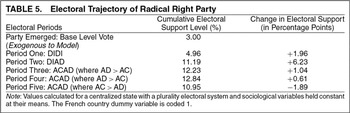
The regression parameter estimates confirm the central claim of my strategic model: mainstream party strategies affect the electoral strength of niche parties in a given election. But what can this model tell us about the shape of a niche party's electoral trajectory when mainstream parties employ different strategies over time? In Table 5, I present a typical set of mainstream party responses to a radical right party and its estimated effect on that niche party's vote over several elections. In this example, the electoral support levels are evaluated under plurality-based electoral rules in a centralized state with all economic variables held constant at their means. A vote of 3% was chosen to represent the niche party's opening electoral performance.

Although a mainstream party's initial strategy is contingent on a neophyte's degree of electoral threat, a survey of the data shows that most implement a cautious, low-cost dismissive tactic in the first electoral period.34
For a discussion of the factors affecting mainstream party strategic choice, see Meguid 2002.
Far from being a mere hypothetical, this scenario resembles the set of strategies pursued by the French mainstream Socialist (PS) and Gaullist (RPR) parties against the radical right Front National (FN) from 1978 to 1997. The Socialist party adopted an early, adversarial stance against the niche party. The internally divided Gaullist Party, on the other hand, was slow to respond actively to the threatening anti-immigrant party; the RPR pursued a cooptative strategy only as of 1986, after the electoral and reputational entrenchment of the FN. In contrast to the hypothetical presented above, the RPR's accommodative strategy remained weaker than the PS's adversarial tactics throughout this time period.
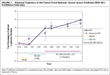
A comparison of the predicted effects of these mainstream party strategies with the niche party's actual electoral trajectory demonstrates the explanatory power of my model. In Figure 1, I plot these trajectories, with the model's predictions of FN support from 1981 to 1997 based on the set of mainstream party strategies, institutional and sociological conditions, and lagged FN vote observed in France. As the Figure reveals, in four of the five predicted elections, the 95% confidence intervals around each point estimate encompass the actual FN vote share. Although we cannot fully ignore how GDP per capita and unemployment rates varied during this time period, the significant electoral gains made by the FN cannot be attributed to these sociological variables; in each of these elections, the joint effect of the sociological variables was to depress—not to boost—the vote share of the niche party. Thus, it was the strategic maneuvering of the French Socialists and Gaullists that served as the workhorse of the FN's electoral success.

Electoral Trajectory of the French Front National: Actual versus Predicted (With 95% Confidence Intervals)
In addition to confirming the power of mainstream party strategies, this comparison also calls attention to the role played by each established party in altering niche party success. In my model, increases in niche party support came largely at the hands of a traditionally ignored, non-proximal party. This prediction is consistent with the facts in the French case: it is readily accepted by French scholars and journalists that the FN's high vote percentages were the direct result of the PS's adversarial behavior (Faux, Legrand, and Perez 1994).35
The Socialist Party also engaged in institutional forms of adversarial strategy towards the FN. To boost the niche party's support to the detriment of the RPR, the PS changed the electoral rules from a two-ballot plurality formula to PR in 1986. The RPR reinstated the plurality formula in 1988. These changes to the electoral system are reflected in the predicted values in Figure 1.
CONCLUSION
By focusing on electoral rules, state structure, and the economic health and value orientation of a society, theories of new party electoral strength have prioritized the structure of the competitive arena over the behavior of the actors within it. The evidence presented here suggests that party strategies should not be overlooked. Across Western Europe, the strategies of the electorally and governmentally dominant parties shape the electoral fortunes of niche parties. Moreover, when the actions of the mainstream parties on the niche party's new issue dimension are taken into account, the standard institutional and sociological factors fail to exhibit a consistently significant effect on green and radical right party vote levels.
The findings also challenge the sufficiency of the standard spatial conception of party strategy. Additional data on voter perceptions of the salience and ownership of the niche parties' issues are needed to examine explicitly the micro-level mechanism behind party tactics, but the regression results reveal that mainstream parties competing with niche actors are not merely altering their positions along established policy dimensions with fixed salience. Rather, the results are consistent with a modified spatial logic, whereby mainstream parties also manipulate the salience and ownership of the new party's issue. It follows that competition is not restricted to interaction between ideological neighbors, as the standard spatial theory claims; non-proximal parties play a critical role in the success and failure of Western Europe's niche parties.
In affirming the general hypotheses of my spatial theory, this analysis implies that mainstream party strategies influence more than just niche party vote. Indeed, competition between party unequals has ramifications for the long-run competition between mainstream party equals. First, mainstream party responses to the new parties change the effective dimensions of political competition. By adopting either an accommodative or an adversarial strategy, the mainstream party is prioritizing the niche party's issue dimension and including it within the mainstream political debate. Thus, not only is the shape of the policy space endogenous to party competition, but also the “success” of the niche party's issue is distinct from niche party electoral success. Immigration and the environment have become mainstream campaign topics in most Western European countries, even though many of the niche parties that introduced them have disappeared. Strategies directed against short-term threats, therefore, may have a lasting impact on the content of the political debate.
Second, in an even more direct manner, these strategies affect the very survival of the mainstream parties. When adversarial strategies are employed against a non-proximal niche party, they turn it into a weapon against an established party opponent. Even though mainstream party electoral success typically depends on the party's attractiveness on multiple policy dimensions, such single-issue adversarial tactics have been responsible for the loss of mainstream party legislative seats and even governmental turnover. Examples are not restricted to Western Europe, as demonstrated by the role of the Republicans' adversarial tactics toward Green Party candidate Ralph Nader in the defeat of Democrat Al Gore in the 2000 U.S. presidential election. At the extreme, adversarial strategies could result in party system realignment through the elimination of the mainstream party opponent and its replacement with the niche party. With consequences for both the number of parties and the issues dominating political debate, mainstream party tactics against niche parties are not just means to counteract a set of single-issue political actors; these everyday strategies have effectively become tools in the larger political processes of party system change.
APPENDIX

Previous versions of this paper were presented at the 2002 Annual Meeting of the Midwest Political Science Association and the 2001 Annual Meeting of the American Political Science Association. I thank conference panelists, Jim Adams, Kevin Clarke, Michael Delgado, Jorge Dominguez, Matt Golder, Peter Hall, Torben Iversen, Ken Kollman, and the Editor and reviewers of the APSR for their helpful comments and suggestions.
References
Amorim Neto Octavio, and
Gary Cox.
1997.
“Electoral Institutions, Cleavage Structures and the Number of Parties.”
American Journal of Political Science
41
(January):
149–
74.Google Scholar
Beck Nathaniel, and
Jonathan N. Katz.
1995.
“What to Do (And Not to Do) with Time-Series-Cross-Section Data.”
American Political Science Review
89
(September):
634–
47.Google Scholar
Beck Nathaniel, and
Jonathan N. Katz.
1996.
“Nuisance vs. Substance: Specifying and Estimating Time-Series-Cross-Section Models.”
Political Analysis
6:
1–
36.Google Scholar
Bélanger Eric.
2003.
“Issue Ownership by Canadian Political Parties since 1953.”
Canadian Journal of Political Science
36
(July/August):
539–
58.Google Scholar
Budge Ian, and
Denis Farlie.
1983.
“Party Competition—Selective Emphasis or Direct Confrontation?”
In Western European Party Systems: Continuity and Change,
ed. Hans Daalder and
Peter Mair.
London:
Sage,
267–
306.
Budge Ian,
Hans-Dieter Klingemann,
Andrea Volkens,
Judith Bara,
Eric Tannenbaum, et al.
2001.
Mapping Policy Preferences: Estimates for Parties, Electors, and Governments 1945–1998.
Oxford:
Oxford University Press.
Budge Ian,
David Robertson, and
Derek Hearl.
1987.
Ideology, Strategy and Party Change: Spatial Analyses of Post-War Election Programmes in 19 Democracies.
Cambridge:
Cambridge University Press.
Bürklin Wilhelm.
1987.
“Governing Left Parties Frustrating the Radical Non-established Left: The Rise and Inevitable Decline of the Greens.”
European Sociological Review
3
(September):
109–
26.Google Scholar
Caramani Daniele.
2000.
Elections in Western Europe Since 1815.
New York:
Macmillan.
Castles Francis G., and
Peter Mair.
1984.
“Left-Right Political Scales: Some “Expert” Judgments.”
European Journal of Political Research
12
(March):
73–
88.Google Scholar
Downs Anthony.
1957.
An Economic Theory of Democracy.
New York:
Harper Collins.
Duverger Maurice.
1963.
Political Parties: Their Organization and Activity in the Modern State.
London:
Metheun.
Elazar Daniel.
1994.
Federal Systems of the World.
Vol. 2.
Harlow, UK:
Longman Current Affairs.
Enelow James M., and
Melvin J. Hinich.
1984.
The Spatial Theory of Voting: An Introduction.
Cambridge:
Cambridge University Press.
Faux Emmanuel,
Thomas Legrand, and
Gilles Perez.
1994.
La Main Droite de Dieu.
Paris:
Editions du Seuil.
Golder Matt.
2003.
“Explaining Variation in the Success of Extreme Right Parties in Western Europe.”
Comparative Political Studies
36
(May):
432–
66.Google Scholar
Hainsworth Paul, ed.
2000.
The Politics of the Extreme Right.
New York:
Pinter.
Harmel Robert, and
Kenneth Janda.
1982.
Parties and Their Environments.
New York:
Longman.
Harmel Robert, and
John Robertson.
1985.
“Formation and Success of New Parties: A Cross-National Analysis.”
International Political Science Review
6
(October):
501–
23.Google Scholar
Harmel Robert, and
Lars Svasand.
1997.
“The Influences of New Parties on Old Parties' Platforms.”
Party Politics
3
(3):
315–
40.Google Scholar
Inglehart Ronald.
1998.
Modernization and Postmodernization.
Princeton:
Princeton University Press.
Jackman Robert W., and
Karin Volpert.
1996.
“Conditions Favouring Parties of the Extreme Right in Western Europe.”
British Journal of Political Science
26
(October):
501–
21.Google Scholar
Keesing's Worldwide.
1999.
Keesing's Record of World Events CD-ROM.
Bethesda, MD:
Keesing's Worldwide.
Kitschelt Herbert.
1994.
The Transformation of European Social Democracy.
Cambridge:
Cambridge University Press.
Kitschelt Herbert.
1995.
The Radical Right in Western Europe.
Ann Arbor:
University of Michigan Press.
Laver Michael, and
John Garry.
2000.
“Estimating Policy Positions from Political Texts.”
American Journal of Political Science
44
(July):
619–
34.Google Scholar
Laver Michael, and
W. Ben Hunt.
1992.
Policy and Party Competition.
New York:
Routledge.
Mackie Thomas, and
Richard Rose. 1991,
1997.
The International Almanac of Electoral History.
London:
Macmillan.
Mair Peter.
1999.
“New Political Parties in Established Party Systems: How Successful Are They?”
In Elites, Parties and Democracy,
eds. E. Beukel,
K. Klausen, and
P. Mouritzen.
Odense:
Odense University Press,
207–
24.
Meguid Bonnie M.
2002.
“Competition Between Unequals: The Role of Mainstream Party Strategy in Rising Party Success in Western Europe.”
Ph.D. diss.
Harvard University.
Müller-Rommel Ferdinand.
1996.
“The New Challengers: Explaining the Electoral Success of Green and Right-Wing Populist Parties in Western Europe.”
In Les Petits Partis,
eds. Annie Laurent and
Bruno Villalba.
Paris:
L'Harmattan,
119–
41.
Organization of Economic Cooperation and Development.
2000.
OECD Statistical Compendium CD-ROM.
Paris:
OECD Electronic Editions.
O'Neill Michael.
1997.
Green Parties and Political Change in Contemporary Europe.
Brookfield, VT:
Ashgate.
Petrocik John.
1996.
“Issue Ownership in Presidential Elections, with a 1980 Case Study.”
American Journal of Political Science
40
(August):
825–
50.Google Scholar
Rabinowitz George, and
Stuart Elaine Macdonald.
1989.
“A Directional Theory of Issue Voting.”
American Political Science Review
83
(March):
93–
121.Google Scholar
Rohrschneider Robert.
1993.
“New Party Versus Old Left Realignments: Environmental Attitudes, Party Politics and Partisan Affiliations in Four Western European Countries.”
Journal of Politics
55
(August):
682–
701.Google Scholar
Shepsle Kenneth A.
1991.
Models of Multiparty Electoral Competition.
New York:
Harwood Academic Publishing.
Swank Duane, and
Hans-Georg Betz.
1995.
“Right-Wing Populism in Western Europe.”
Paper presented at the annual meeting of the American Political Science Association,
Chicago.
Swank Duane, and
Hans-Georg Betz.
1996.
“Internationalization and Right-Wing Populism in Western Europe.”
Paper presented at the Conference on Globalization and Labor Markets,
University of California,
Los Angeles.
Swank Duane, and
Hans-Georg Betz.
2003.
“Globalization, the Welfare State and Right-Wing Populism in Western Europe.”
Socio-Economic Review
1
(May):
215–
45.Google Scholar
Taggart Paul.
1996.
The New Populism and the New Politics.
New York:
St Martin's Press.
Willey Joseph.
1998.
“Institutional Arrangements and the Success of New Parties in Old Democracies.”
Political Studies
46
(3):
651–
68.Google Scholar
Woldendorp Jaap,
Hans Keman, and
Ian Budge.
1998.
“Party Government in 20 Democracies: An Update (1990–1995).”
European Journal of Political Research
33
(1):
125–
64.Google Scholar

Predicted Effects of Mainstream Party Strategies (in Isolation)
Predicted Effects of Mainstream Party Strategic Combinations on Niche Party (NP) Electoral Support
Multivariate Analysis of Niche Party Vote Percentage
Predicted versus Observed Effects of Strategies on Niche Party Vote: Assessing the Standard Spatial Model's Predictions
Electoral Trajectory of Radical Right Party
Electoral Trajectory of the French Front National: Actual versus Predicted (With 95% Confidence Intervals)
Western European Mainstream and Niche Parties Included in the Analysis
 You have
Access
- 955
- Cited by
Comments
No Comments have been published for this article.