Introduction
Cognitive impairment represents a prominent feature of several psychiatric illnesses, including schizophrenia (SZ), major depressive disorder (MDD) and bipolar disorder (Reference Heinrichs and Zakzanis1–Reference Goldberg and Chengappa3). Deficits in long-term memory, working verbal memory, executive functioning and vigilance have been consistently associated with poor functional outcome in persons with SZ (Reference Green4–Reference Bourgeois, Swendsen and Young8). As pharmacological treatment is not routinely efficacious (Reference Rund and Borg9), there is ongoing interest in adjunctive non-pharmacological interventions for ameliorating cognitive deficits (Reference Wykes, Reeder and Landau10–Reference McGurk, Twamley, Sitzer, McHugo and Mueser12).
In comparison with conventional therapies, yoga represents a different approach. It is a set of mental and physical practices that have been evolving in India for several millennia. Yoga is viewed by many practitioners as a systematic process designed to purify the body and the mind from toxins accumulated due to improper lifestyle choices and negative thinking patterns. Yoga includes components centred on meditation, breathing and activity or postures designed to balance the body's ‘energy centres' (13). Intensive yoga exercises may improve the cognitive function among psychiatrically ill and healthy adults (Reference Raju, Prasad, Venkata, Murthy and Reddy14–Reference Subramanya and Telles20). There are several mechanisms by which the practice of yoga may improve the cognitive function. Yoga emphasises body awareness and involves focusing one's attention on breathing or specific muscles or parts of body, so yoga may improve more general as well as focused attention. Yoga practice also influences perception by increasing perceptual sensitivity, by selectively ‘shutting out' undesirable stimuli and by changing distorted perception. Practising yoga improved auditory and visual perception, by increasing sensitivity to various characteristics of the stimuli (e.g. intensity and frequency) (Reference Brown, Forte and Dysart21). A recent study (Reference Subramanya and Telles20) observed that memory functions of male volunteers improved after yoga. In an open trial of yoga (n = 21) versus physical therapy (n = 20) among patients with SZ in India, greater improvement in psychopathology BP1 was reported with yoga therapy (YT) compared with physical therapy. Improvement in clinical severity was noted following 3 weeks of YT, but cognitive function was not evaluated (Reference Duraiswamy, Thirthalli, Nagendra and Gangadhar22). In another study (Reference Behere, Arasappa and Jagannathan23), yoga was found to improve facial emotion recognition deficits. The precise physiological basis for the beneficial effects of yoga is unknown and continues to be investigated. Selvamurthy et al. (Reference Selvamurthy, Nayar and Joseph24) have found that yoga helps achieve a stable autonomic balance. Others have reported that the practice of yoga reduces autonomic arousal (Reference Wallace, Benson and Wilson25,Reference Joseph, Sridharan and Patil26). Because increased physical activity reduces autonomic reactivity to mental stressors (Reference Steptoe, Kearsley and Walters27), it is possible that some of the beneficial effects of yoga are related to stabilisation/normalisation of autonomic function.
The studies reviewed above were conducted by highly trained therapists or clinicians in structured academic centres. Their utility in routine clinical practice is uncertain. Moreover, YT has typically not been used as a cognitive remediation strategy for individuals with impaired cognition. In the present pilot study, we evaluated the impact of YT among individuals with severe psychiatric illnesses. Cognitive domains known to be impaired in these disorders were assessed.
Methods
Design
We conducted an open, non-randomised pilot study of adjunctive YT in comparison with treatment as usual (TAU) among patients with SZ. Cognitive function was evaluated using an automated computerised battery that evaluates cognitive variables known to be impaired in SZ. Group-wise comparisons were conducted between the YT and the TAU SZ groups using non-parametric tests. YT was also administered to individuals with other disorders including stable cardiac disease (CAD), to evaluate whether the changes among SZ patients were also observed in non-SZ groups. A pair-wise design was also used to evaluate temporal changes in each participant. As we are not aware of publications regarding YT and diverse neurocognitive functions in SZ patients, the potential effect size and hence the required sample size could not be estimated. We therefore based our target sample size on the prior yoga study of SZ in India that reported improvement in facial emotional recognition deficits (Reference Behere, Arasappa and Jagannathan23).
Eligibility criteria
The participants were outpatients at Dr Ram Manohar Lohia Hospital (RMLH), Delhi, a publicly funded general hospital. All participants were older than 18 years and resided in Delhi. Persons dependent on alcohol/illicit substances or individuals with neurological disorders that interfered with diagnosis or cognitive evaluations were excluded. At the psychiatric outpatient clinics of RMLH, all patients clinically diagnosed with psychoses who fulfilled these criteria were invited to participate in the study over a period of 3 years, during which treatment was provided (February 2006 to August 2009). Consenting individuals who were willing and able to come to RMLH to participate in the structured YT programme were included in the YT groups. Individuals with SZ who could not participate in YT for logistical reasons but consented to the research project participated as the TAU group. Patients in the other diagnostic categories were included if they fulfilled diagnostic criteria and could participate in YT. There were several reasons for non-participation, including cumbersome commutes, difficulty in travelling alone/lack of companion for travel, inability to get time off from work and availability of preferred neighbourhood yoga centres.
Ethical approval for the study was obtained from Ethics Committee at Dr Ram Manohar Lohia Hospital (Delhi), India and the Institutional Review Board, University of Pittsburgh, Pittsburgh, PA, USA.
Flow of potential participants in the study
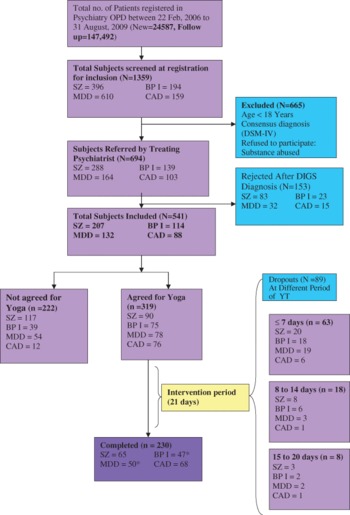
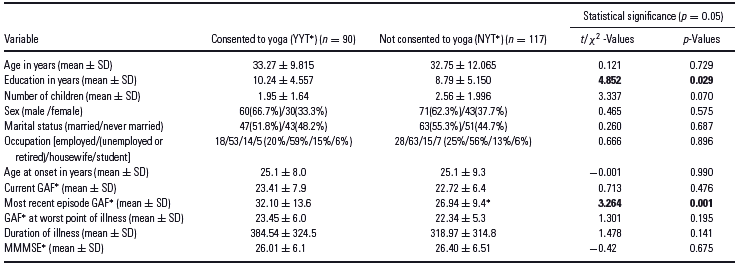
The detailed recruitment is illustrated in the flow chart (Fig. 1). Briefly, a total of 24 587 new and 147 492 repeat outpatients visited the RML outpatient clinics during the recruitment period. Of these, 1359 subjects had suitable clinical diagnoses assigned by their physicians on the basis of unstructured interviews. Following structured diagnostic interviews, a total of 541 participants were recruited to the study. Of these, 319 individuals agreed to participate in YT, of whom 230 completed the entire regimen [SZ = 65; bipolar I disorder (BPI) = 47; MDD = 50; CAD = 68]. There were no significant differences with regard to age, sex, marital status and occupation between SZ patients who participated in yoga (YYT) and those who refused yoga (NYT), but the former had significantly longer periods of education (Table 1). The YYT/SZ group did not differ with regard to age at onset, duration of illness or scores on the modified mini-mental state examination, but had significantly poorer global assessment of functioning (GAF) scores at the worst point during a recent episode (t = 3.264, p = 0.001; Table 1). The distribution of patients in the other diagnostic groups who consented to YT or declined was not significantly different; there were also no significant differences between the patients who consented to YT or declined YT with regard to diagnostic or available key clinical variables in these groups (data not shown).
Sample recruitment flow chart. *We have pre- to post-CNB data for SZ = 65, BPI = 40 and MDD = 37.

Demographic and clinical characteristics of patients who consented or did not consent to yoga therapy
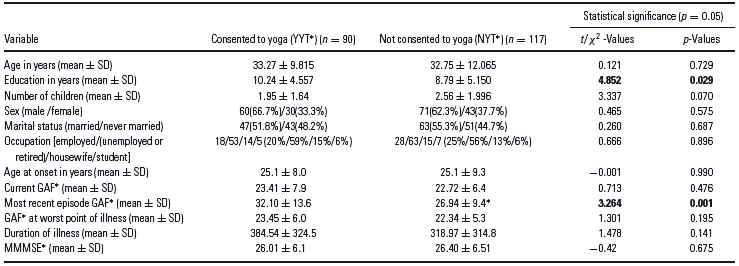
* MMMSE, Modified Mini-Mental State examination; NYT, declined yoga; YYT, agreed to yoga.
* Lower GAF scores reflected more severe illness. Significant values are in bold.
Participants evaluated for the study
A total of 65 outpatients with SZ completed YT. There were 117 patients who were assessed at baseline but did not participate in yoga. Of these, a subgroup were re-evaluated after 2 months (TAU group, N = 23). The demographic and cognitive variables of this subgroup were compared with individuals who were not re-evaluated after 2 months; there was no significant difference between these groups on age, gender, education and cognitive variable (data not shown).
Patients with BPI (n = 40) and MDD (n = 37) also participated in the study and received YT. A group of outpatients at the RMLH cardiology clinic were also recruited to receive adjunctive YT (n = 68). All participants provided written, informed consent.
Diagnostic evaluations
Participants were evaluated using the Hindi version of the diagnostic interview for genetic studies (DIGS) (Reference Nurnberger, Blehar and Kaufmann28,Reference Deshpande, Mathur, Das, Bhatia, Sharma and Nimgaonkar29). The DIGS is a comprehensive interview schedule, which acquires extensive clinical as well as demographic information. Information from the DIGS was integrated with the available information from medical records and family interviews conducted using the family interview for genetic studies (FIGS) (Reference Maxwell30). This information was discussed with board certified psychiatrists and psychologists who established consensus diagnoses.
Adjunctive treatment
Yoga. Participants completed a prescribed YT protocol daily for approximately 1 h for 21 consecutive days, excluding Sundays. The YT protocol was designed for the study in consultation with the Central Council of Research and Naturopathy (AYUSH), Ministry of Health and Family Welfare, Government of India. YT protocol was uniform for all participants and is uploaded on website http://www.indouspgp.info/publications/400. YT was conducted by a qualified yoga instructor who was trained to provide the customised YT, under the supervision of an accredited physician. A Professor of yogic studies affiliated with AYUSH also supervised the yoga instructor and observed the YT sessions periodically. The YT comprised combinations of ‘asanas' (postures or exercises) and ‘pranayam' (breathing protocols). Each session commenced with ‘Om' chanting (deep breathing with prayer), followed by warm-up exercises and breathing exercises. The pranayama was designed to correct movements and synchronise movement with breathing. The asanas comprised different postures, including standing (Kati chakrasan, Tadasan, Trikonasan); supine lying postures (Savasana, Uttanpadasan, Naukasan, Pawanmuktasan – Ardha and poorna); prone position postures (Makarasan, Bhujangasan, Shalabhasan, Dhanurasan); sitting postures (Pashimottanasan, Ushtrasan, Gomukhasan, Ardha Matsyendrasan, Vajrasana). On Saturdays, patients exercised a simple practice known as Kriya or Jalneti (a cleansing practice of the sinus passages with warm saline water, thought to provide physical and psychological benefits).
Medication management. All participants received conventional pharmacological and non-pharmacological treatment from their psychiatrists and therapists throughout the study. No changes in medications were required as a part of YT. The therapists were not told whether patients were in the YT or TAU groups.
Neurocognitive assessment
Cognitive functions were assessed with a Hindi version of the Penn Computerised Neuropsychological Battery (CNB) (Reference Gur, Ragland and Moberg31). The CNB includes neurocognitive domains known to be impaired among individuals with SZ (Reference Sachs, Steger-Wuchse, Kryspin-Exner, Gur and Katschnig32). Data are acquired in an automated fashion, reducing observer bias. It is also possible to measure both accuracy and response times. The construct validity of the Penn CNB has been established and it has been used extensively (Reference Gur, Ragland and Moberg31,Reference Gur, Nimgaonkar and Almasy33). The battery assesses the following neurocognitive domains: abstraction and mental flexibility (ABF), attention (ATT), working memory (WM), verbal memory (VMEM), face memory (FMEM), spatial memory (SMEM), spatial processing (SPA), language (LAN), sensorimotor dexterity (SM), emotion processing (EMO). The verbal domains are available only in English. As many Indian participants did not speak English, the verbal domains were excluded. For each domain, three summary functions are calculated: (a) accuracy, which reflects the number of correct responses; (b) speed, which reflects the median reaction time for correct responses and (c) efficiency, which reflects both accuracy and speed (accuracy/log of speed). Participants can be differentially sensitive to these indices. The battery was administered in a fixed order using a web browser interface. The CNB was administered twice to all participants (before and after completion of YT). Accuracy estimates for sensorimotor accuracy were not analysed in this sample, as the majority of patients obtained perfect scores at baseline. Participants need not be computer literate to complete the Penn CNB, as the evaluations are straight forward. In addition, each participant is required to complete a practice session designed for familiarisation with the computer mouse and the video monitor. All CNBs were administered under the supervision of research staff.
Timeline for cognitive assessments
The YT group was assessed at baseline, 21 days after YT and 2 months following completion of YT. The TAU group was assessed at baseline and after 2 months.
Statistical analysis
The demographic, clinical and cognitive variables of the yoga and TAU groups were compared at baseline using Mann-Whitney U-test. CNB scores were normalised using data obtained from Indian control individuals (Reference Gur, Nimgaonkar and Almasy33). The Kruskal-Wallis test was used to evaluate the difference between SZ/YT and SZ/TAU groups with regard to changes in the cognitive domains. Separately, pair-wise comparisons between baseline and post-treatment values for CNB domains were compared in each diagnostic group, using the Wilcoxon's signed rank test (two-tailed). Effect sizes (ES) were calculated by dividing the differences between baseline and post-assessment means with the standard deviation of baseline separately for each index of all domains (Cohen's d) (Reference Avila, Bottino, Carvalho, Santos, Seral and Miotto34,Reference Cohen35). Corrections for multiple comparisons were applied as recommended by Hochberg (Reference Hochberg36).
Results
Comparisons at baseline
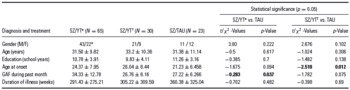
The demographic and clinical details of the SZ/YT and SZ/TAU groups are shown in Table 2. The SZ/YT group included individuals who were evaluated on completion of YT (3 weeks post-baseline) and those who were also evaluated 2 months post-treatment. There were no significant differences between the SZ/YT (either group) versus the SZ/TAU group with regard to age, education or duration of illness. There were proportionately more men in the SZ/YT groups compared with the SZ/TAU. Although the age at onset of illness (a proxy for illness severity) was similar in the entire SZ/YT group compared with the TAU group, the GAF scores during the past month were significantly higher in the TAU group, suggesting more severe impairment in the TAU participants at baseline. The smaller SZ/YT group (2 month evaluation post-baseline) had mean GAF scores similar to the TAU group, though the former had later mean ages at onset. Using the Mann-Whitney U-test, there were no significant differences with regard to cognitive domains between the SZ/YT and the SZ/TAU groups, apart from working memory (speed) domain, which was significantly better in the YT group (p = 0.033, uncorrected).
Demographic and clinical characteristics of the SZ YT and TAU samples

* F, female; M, male; TAU, treatment as usual, including routine pharmacotherapy; YT, yoga therapy as an adjunct to pharmacotherapy.
Variables are listed as mean ± SD. All p-values are uncorrected for multiple comparisons.
* Individuals who were evaluated on completion of YT (3 weeks post-baseline). Significant values are in bold.
† Individuals who were evaluated 2-months post-treatment.
The demographic features of the other diagnostic groups are as follows: BPI (mean age 36.43 ± 15.34 years, mean education 10.77 ± 3.39 years, 27 men); MDD (mean age 41.05 ± 10.68 years, mean education 10.77 ± 4.60 years, 19 men); cardiac outpatients (mean age 66 ± 9.84 years, mean education 13.00 ± 3.63 years, 54 men). There was a relative excess of men in these diagnostic groups. The cardiology outpatient group was significantly older (cardiac vs. SZ: Z = 8.85, p < 0.001; cardiac vs. BPI: Z = 6.23, p < 0.001; cardiac vs. MDD: Z = 5.42, p < 0.001) and more educated than the other diagnostic groups (cardiac vs. SZ: Z = 3.03, p = 0.002; cardiac vs. BPI: Z = 6.23, p = 0.004; cardiac vs. MDD: Z = 2.21, p = 0.027).
Changes in cognitive domains following treatment in the SZ/YT group compared with the SZ/TAU groups
The Kruskal-Wallis test was used. As efficiency is derived from the accuracy and speed estimates, the efficiency estimates were not compared to limit the number of comparisons. At the 3-week assessment point, greater improvement was present in the SZ/YT group on speed indices for abstraction (X 2 = 4.228, p = 0.040) and attention (X 2 = 4.913, p = 0.027). After Hochberg correction, attention (speed) remained significant (p = 0.025). As significantly more men were present in the SZ/YT group, differences in cognitive changes were also analysed separately by gender. Among men, the accuracy for emotional processing (X 2 = 5.076, p = 0.024) and speed for attention (X 2 = 4.269, p = 0.039) and sensorimotor (X 2 = 3.903, p = 0.048) improved to a greater extent in the SZ/YT group compared with that in the SZ/TAU group. Following Hochberg correction, only the emotion variable remained significant (p = 0.05). Among the women, only sensorimotor (speed measure) was nominally better in the SZ/YT group (X 2 = 3.84, p = 0.05); it remained the same following Hochberg correction.
The preceding analyses compared the SZ/YT group at 3 weeks post-treatment with the TAU group, which was assessed 2 months after the baseline assessment. Assessments at 2 month post-treatment in the SZ/YT group (n = 30) were also compared with the SZ/TAU group (n = 23). There was significantly greater improvement in the SZ/YT sample compared with the SZ/TAU group with regard to attention (accuracy) (X 2 = 4.603, p = 0.032); abstraction (speed) (X 2 = 4.971, p = 0.026) and attention (speed) (X 2 = 6.001, p = 0.014). After Hochberg correction, attention (speed, p = 0.025) remained significant. Separate comparisons between men and women were also conducted. Among the men, there was significant improvement in attention accuracy (X 2 = 4.63, p = 0.031), face memory accuracy (X 2 = 6.14, p = 0.013), emotion accuracy (X 2 = 4.885, p = 0.027), attention speed (X 2 = 4.594, p = 0.032) and sensorimotor speed (X 2 = 6.216, p = 0.013). After Hochberg correction, face memory accuracy (p = 0.025) and sensorimotor speed (p = 0.05) were significant. There was no significant difference between the female SZ/YT and SZ/TAU groups.
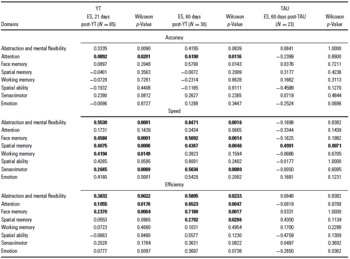
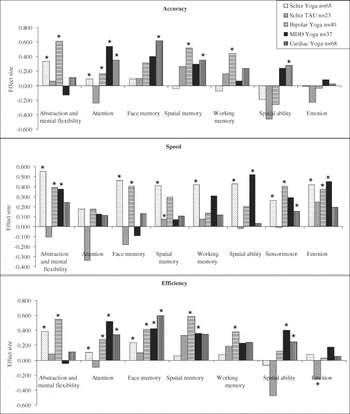
We also estimated ES (Cohen's d) in the SZ/YT and SZ/TAU groups using pair-wise pre- and post-treatment comparisons (Table 3 and Tables S1–S5). Comparisons of pre- and post-treatment values for cognitive domains by diagnostic group are illustrated in Fig. 2. Pre- and post-treatment means, standard deviations, Cohen's d and Wilcoxon Z with p-values for all cognitive domains of all groups (YT: SZ, BPI, MDD, cardiac controls, SZ/TAU) are enumerated in Tables S1–S5. The SZ/YT values for pre- and post-21 days yoga and also after 2 months follow-up are also included in this table.
Comparison of CNB domain effect sizes and Wilcoxon Z scores among persons with schizophrenia following YT or TAU

ES, effect size (Cohen's d).
p-Values computed with the Wilcoxon's sum of ranks test. Significant values are in bold.
Cognitive evaluations.

In the SZ/YT group, there was significant improvement on speed indices for all the domains, except attention and spatial ability. The speed ES ranged from 0.26 (sensorimotor) to 0.55 (abstraction and mental flexibility). Two domains also showed improvement in accuracy (abstraction and mental flexibility) and attention. Significant beneficial effects in the efficiency scores were noted for abstraction and mental flexibility as well as face memory (Cohen's d = 0.24). In the SZ/TAU group, there was significant decline in emotion processing (efficiency). On the other hand, there was significant improvement in spatial memory (speed). Other domains did not show statistically significant changes in the SZ/YT or the TAU groups.
YT in other diagnostic groups
The ES for the changes in CNB scores among the other diagnostic groups are shown in Fig. 2 and in the Tables S1–S5 (p-values uncorrected for multiple comparisons). In the BPI group, speed, accuracy and efficiency improved for abstraction and mental flexibility and face memory. Accuracy and efficiency improved in the attention, working memory and spatial memory domains. Speed but not accuracy or efficiency improved significantly in the emotion processing test. There were significant improvements in the MDD group with regard to accuracy indices for attention, face memory and spatial memory. There was also significant improvement in speed indices for the abstraction and mental flexibility, spatial ability and emotion domains. Unlike the SZ group, where the improvements were most marked with regard to speed, the cardiac outpatient group showed improvement in accuracy for the following domains: attention (ES = 0.35), face memory (0.615), spatial memory (0.35) and spatial ability (0.28). There was no significant change with regard to abstraction and mental flexibility and emotion domains. Efficiency also improved in the attention (0.34) and face memory (0.595) domains.
Discussion
Improvement occurred in certain cognitive domains following relatively brief YT. Significant improvement was noted in indices of speed as well as accuracy for these domains, with attendant improvement in efficiency. The changes varied across diagnostic groups and provide grounds for therapeutic optimism. The magnitude of the changes also varied across domains, suggesting some specificity for the adjunctive treatment. For example, indices of speed were more likely to improve than accuracy with YT in the SZ group. In the YT groups, significant differences were observed in relation to attention immediately after completion of the yoga regimen as well as at the 2-month point. The improvement was more prominent among the men than the women. There was also variation in the degree of improvement across diagnostic groups. The BPI, MDD and cardiac groups improved predominantly with regard to accuracy following YT, though improvements in speed were also noted for some indices. Overall, the number of domains that improved significantly with YT is higher than would be expected by chance alone. In contrast, only three variables improved in the SZ/TAU group, with significant deterioration in another variable. The cognitive domains that were evaluated are rooted in complex neural pathways and are correlated. YT also includes several components and is inherently difficult to evaluate through therapeutic trials. Additionally, the relatively small sample and the non-randomised design make it premature to speculate on the primary effects of YT. For the same reasons, it is not possible to identify the specific components of the adjunctive treatment that were beneficial. For example, the benefit may have accrued from a placebo effect, due to physical exercise or through interactions with meditations.
Yoga includes a set of spiritual and physical practices that have been evolving over several millennia. It may be viewed as a mind-body approach that has components which centres on meditation, breathing and activity or postures. While the precise components of YT that contribute to cognitive improvement cannot be identified at present, repeated contact with empathic therapists over a 3-week period must be considered as a contributory factor. Further research is required to clarify whether the temporal changes can be attributed to YT acting in isolation or in conjunction with medications. Practice effects may also have played a role, as some beneficial effects were observed even in the TAU groups. However, significant improvement was more often observed in the YT groups than in the TAU groups.
The sample comprised outpatients at a publicly funded facility. A wide spectrum of individuals was thus represented. Our YT participants comprised cooperative urban dwellers who were likely more educated than individuals who reside in rural regions of India. Therefore, our results may not be generalisable to Indian persons who live in rural areas or less educated individuals. We have also highlighted clinical differences between the SZ/YT and the SZ/TAU groups that may impact the different patterns of improvement noted in these groups (Table 2). As a result of the non-randomised design, there may be other unidentified confounding variables that may also explain these patterns. The results may also not be generalisable at present, because the YT protocol required adherence to a strict attendance routine that necessarily led to ascertainment bias for the YT group. We made within-group (over time) comparisons for each participant, as well as between-group (SZ/YT vs. TAU) comparisons for the YT and TAU SZ groups. Both sets of comparisons show significant improvement in the YT group for specific cognitive domains. While care was taken to ensure that YT was provided in a uniform manner, it was adjunctive in nature. Pharmacotherapy or other forms of therapy administered concurrently to the patients were not regulated; neither did the treating clinicians specifically inquire about yoga participation. In addition, we did not assess changes in clinical status, such as symptom scores. Therefore, it is uncertain whether the cognitive variables improved in tandem with symptom scores or were independent. The study design did not include placebo groups. Indeed, it would be difficult to design suitable comparable ‘placebo' groups for YT. Although double-blind evaluations would be difficult for studies on YT, the automated nature of the CNB itself reduces observer bias. The duration between the initial and the follow-up cognitive assessments differed in the YT/SZ and the TAU/SZ groups. However, comparison of these groups at identical time points continued to indicate significantly greater improvement in the YT group. Finally, the non-random assignation of YT in the SZ group introduces bias that may influence the results. Additional, randomised studies are needed.
In conclusion, our pilot study suggests that cognitive impairment in psychotic disorders may improve with adjunctive treatment. Adjunctive YT improves performance in different domains of cognitive function across psychiatric disorders. The physiological basis for the observed changes is unknown. It may be related to correction of autonomic dysfunction reported among patients with SZ (Reference Nielsen, Mehlsen and Behnke37). Mentally ill persons could benefit from simple economical yoga exercises if these are incorporated in their treatment regimens. This cognitive improvement may help them in their rehabilitation and adjustment in society.
Supporting Information
The following Supporting information is available for this article:
Table S1. Effect sizes of changes in pre- and post-therapy values for cognitive domains in the schizophrenia yoga therapy (21 days) and treatment as usual groups (2 months)
Table S2. Effect sizes of changes in pre- and post-therapy values for cognitive domains in the bipolar disorder yoga therapy
Table S3. Effect sizes of changes in pre- and post-therapy values for cognitive domains in the major depressive disorder yoga therapy
Table S4. Effect sizes of changes in pre- and post-therapy values for cognitive domains in the cardiac controls yoga therapy
Table S5. Effect sizes of changes in pre- and post-therapy values for cognitive domains in the schizophrenia yoga therapy (2 months) and treatment as usual groups (2 months)
Additional Supporting information may be found in the online version of this article.
Please note: Wiley-Blackwell Publishing is not responsible for the content or functionality of any supplementary materials supplied by the authors. Any queries (other than missing material) should be directed to the corresponding author for the article.
Acknowledgements
We thank our study participants, clinical recruiters and data specialists of our research groups. Constructive comments from two peer reviewers are acknowledged with gratitude. We thank Ms Sue Clifton for editorial advice and Mr Pramod Thomas for statistical inputs. This work was supported in part by grants from the Central Council for Research in Yoga and Naturopathy, AYUSH, MoHFW, India (12-1/CCRYN/2005-2006/Res.P-III) and NIH (MH56242, MH66263, MH 63480 and Indo-US Project Agreement # N-443-645). The authors do not declare any conflict of interest relevant to this manuscript.