The Great East Japan Earthquake (magnitude 9.0) and the subsequent tsunami on March 11, 2011, caused tremendous damage to the coastal areas of northeast Japan. The death toll was estimated to be 20 900 by December 2012. 1 , 2 Among the prefectures directly hit by the tsunami, Miyagi, the closest to the epicenter, suffered the severest damage. 3
In Ishinomaki, which is the second largest city in Miyagi and is located on the coast, 4 the tsunami damaged the homes and property of more than 53 000 people. According to data from the Miyagi prefectural government, this population represented more than one third of the city’s residents. 5 The survivors initially were evacuated to shelters. By the time all of the shelters were closed in September 2011 (6 months after the disaster), approximately 30 000 people had been relocated to temporary/rental housing. 6 It was presumed that the people who were not housed in these accommodations returned to live in their damaged houses.
Unlike those who moved to temporary housing and who were supported by the local government, it was difficult to determine where and how the people who returned home were living. Their houses were located sporadically, and many were geographically isolated among the wreckage of the uninhabited houses devastated by the tsunami. Therefore, because the disaster disrupted the neighborhood structure and the community information networks, these survivors were considered at risk of social isolation, which could affect their physical and psychological health.Reference House 7 , Reference Coyle and Dugan 8 In addition, the proportion of the elderly population was very high in these localities—about 1 in 3 people were older than age 65 years—and the death toll was significantly higher among elderly people compared with younger generations. 9 Thus, it was urgent to assess the health and social conditions of survivors in these areas.
The survivors of natural disasters are known to experience a broad range of consequences including psychological problems,Reference Bland, O'Leary, Farinaro, Jossa and Trevisan 10 , Reference Phifer and Norris 11 such as depression, anxiety, and posttraumatic stress disorder, and physical health problems, such as insomnia and impaired immune function.Reference Norris, Friedman, Watson, Byrne, Diaz and Kaniasty 12 The elderly are considered particularly vulnerable after a disaster because of physical or socioeconomic limitations.Reference Banks 13 - Reference Sakauye, Streim and Kennedy 16
Having social support is known to protect people from post-disaster psychological distressReference Betancourt and Khan 17 , Reference Lowe, Chan and Rhodes 18 and alleviate the conditions related to traumatic loss due to disasters.Reference Lee and Youm 19 - Reference Walsh 21 However, research also indicates that perceived social support, and the quantity and quality of interpersonal relationships, may decrease after disasters.Reference Norris, Friedman, Watson, Byrne, Diaz and Kaniasty 12 , Reference Norris 22 The decline in perceived social support could partly explain physical and mental health problems among the survivors.Reference Norris and Kaniasty 23 Building and rebuilding interpersonal relationships at the time of catastrophic events may not be easy, especially when survivors have lost their significant supporters through death. These situations could lead to the reduction and sometimes lack of relationships with family, friends, or neighbors, and they could cause social isolation.
Therefore, it was valuable to investigate the risk of social isolation in this population to provide appropriate support in terms of health and social perspective for those who returned home after the disaster, as these individuals could be geographically and socially isolated. In this study, we focused on the risk of social isolation of survivors living at home and whether they had friends to talk with, close neighbors, or social/family interactions. We hypothesized that elderly people and those living alone may be at high risk of social isolation. In collaboration with the Health and Life Revival Council in Ishinomaki District (RCI), and using the survey data collected by its surveyors, we assessed these and associated socioeconomic factors among the survivors living in tsunami-damaged areas in Ishinomaki.
METHODS
Procedures and Participants
Between October 2011 and March 2012 (6-12 months after the disaster), the RCI conducted a door-to-door survey in the areas where houses were damaged by the tsunami. The RCI, which is an association composed of a number of private entities, including a clinic and private nonprofit organizations, aimed to provide rapid and appropriate support in response to the needs of the victims of the disaster. The primary objective of the survey was to evaluate the living conditions of the tsunami survivors at home and coordinate necessary support for those who have particular needs, such as medical care, long-term care for the elderly, financial support, housing repair, and psychological care.
Candidates for survey participation were persons living in the tsunami-affected areas in Ishinomaki, in spite of serious damage to their houses. The RCI survey organizers determined the areas to be surveyed using a map showing the range of the tsunami’s damage. Areas that had severe damage but were re-inhabited were chosen as the survey zone, because survivors in these areas were considered to have received less support from governmental agencies, which focused on supporting people in temporary shelters. A part of Onagawa, a small town adjacent to Ishinomaki, was also included in the survey because of its close proximity and the severe damage it sustained from the tsunami.
The surveyors visited each of the houses in the selected survey areas. If it was inhabited, they requested an interview with 1 person from each household, who was either the head of the family or someone available during the surveyor’s visit. The surveyors, who conducted a semistructured interview using a questionnaire, were volunteers with various backgrounds—nurses, care workers, college students in nursing/social work, and other local people who wished to help. Before beginning the interviews, the surveyors were trained using a video and a handbook that showed how the interview should be conducted. Surveyors also practiced interviewing 1 or 2 people under the supervision of trained surveyors. All surveyors completed at least a half-day of training before visiting the disaster victims by themselves.
The surveyors collectively visited a total of 8700 households in the survey zone, and 4176 households (48.0%) agreed to participate in the study. The surveyors explained the purpose of the survey to the participants, who then gave written consent to participate. Personal information such as name and address of the participant was omitted before the researchers analyzed the data. Ethics approval for this study was granted by the Institutional Review Board of Teikyo University (No.12-079).
Measurements: Outcome Variables
The participants’ risk of isolation was assessed using the following 3 questions: (1) “Do you have friends to talk with about your problems?” (2) “Do you have close neighbors?” and (3) “Do you have any interactions with your family, relatives, friends, home helpers, or anyone else, such as a volunteer worker? If so, who do you have contact with?” The first question evaluated whether participants can receive help when in need, thus representing social support. The second question assessed whether they have close neighbors, which would reflect a sense of belonging to a community. The third question determined whether the participants have any social/family interactions.
Among these 3 items, the first 2 variables assessed whether the participants have specific social interactions (ie, friends or neighbors), whereas the third variable determined whether they have any kind of interaction. Compared with those who lack interactions with either friends, neighbors, or both, we considered participants who reported a lack of social/family interaction to be most at risk for social isolation because they could contact no family member or caregiver.
Measurements: Explanatory Variables
For basic characteristics, we asked the age and gender of all household members, sources of income (pension and salary, pension only, salary only, social welfare, or unemployment insurance/other sources), and whether participants had changes in family structure or employment because of the disaster (any/none). The respondents were categorized into 2 cohorts by age (≥65 years/ <65 years). If the households consisted of only elderly persons (≥65 years), they were labeled elderly households. We categorized the number of residents in the household into 3 (1, 2, or 3 or more) to look at the risk of social isolation for those who lived alone. The surveyed area was divided into coastal plain and ria coast areas, because they differed in geographical characteristics.
We also assessed the level of damage to the house in each household, using previously determined local government criteria divided into 5 groups: completely destroyed, largely destroyed, half destroyed, partially destroyed, or not destroyed. According to the criteria, if the water reached the entire first floor of a house, it was completely destroyed; if the water was about 1 m high in a house, it was largely destroyed; if the water was above the floor level, it was half destroyed; and if the water had not reached the floor, it was partially destroyed. To clarify the differences of house damage for statistical analysis, we later divided the levels into completely/largely destroyed and not destroyed or partially/half destroyed.
Statistical Analyses
We used χ2 tests to analyze the differences in the proportions of the outcome variables by the demographics of respondents. “Having no social/family interactions” was the outcome variable for the primary analyses because it assessed the greatest risk of social isolation, as compared with the other 2 outcome variables, as described. To determine the risk of social isolation in 1-person and elderly households, we calculated the proportion of the respondents reported with no social/family interactions, stratifying them by the number of persons in the household, gender, and whether the household was elderly. Also examined was the effect of interaction of gender and elderly households.
Logistic regression analyses were used to estimate the crude odds ratio (model 1), age-gender adjusted odds ratio (model 2), and multivariate-adjusted odds ratio (model 3) with 95% confidence intervals (95% CI). We excluded missing data from analyses in models 1 through 3. Finally, supplementary analyses were conducted on the other 2 outcome variables, using stratified analyses and logistic regression analyses, as described, to determine which factors were related to each. All statistical analyses were performed using SPSS statistics version 21.0 (IBM Corp). All tests were 2 sided, and statistical significance was set at P<.05.
RESULTS
Demographics of the Participants
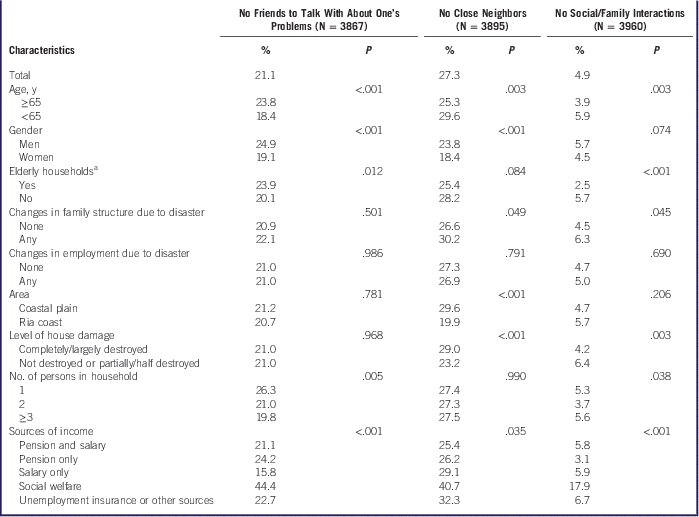
We used the data of the 4176 people who agreed to participate in the survey as representatives of each household. The characteristics of the participants are shown in Table 1. Women made up two thirds of the participants. Approximately 1 in 4 households comprised individuals aged 65 years or older. Respondents of more than half of the surveyed households were living in houses that had been completely or largely damaged by the tsunami. The proportion of those living on social welfare (0.7%) was lower than the average of Miyagi Prefecture as a whole, which was 1.1% before the disaster.
Characteristics of the Study Participants (N=4176)

a Households only with individuals aged 65 years or older.
Risk of Isolation and Participants’ Demographics
Table 2 shows the relationship between participants’ characteristics and risk of isolation. Among the participants, 21.1% stated that they have no friends with whom to talk about their problems, and 27.3% responded that they have no close neighbors. In addition, 4.9% reported having no social/family interactions. Elderly people were more likely to state that they had no friends to talk with about their problems, as compared with those younger than 65 years old. However, the elderly were more likely than members of the younger generations to have close neighbors and social/family interactions.
Characteristics and Risk of Social Isolation of Participants

a Households only with individuals aged 65 years or older. Missing data are excluded. P values were determined using the χ2 test.
Households with only elderly inhabitants were similar, in that elderly persons may hesitate to talk about their problems and ask for help from people close to them, as compared with households that included younger generations. Men were more likely than women to report having no friends to talk with about their problems or close neighbors. Persons living alone also were less likely to have close friends to talk with about their problems.
High levels of damage to the respondents’ house were related to having no close neighbors but to having social/family interactions. Sources of income were factors related to each of the items concerning risk of social isolation. Persons receiving social welfare were more likely to report that they had no friends to talk with about their problems, close neighbors, or social/family interactions.
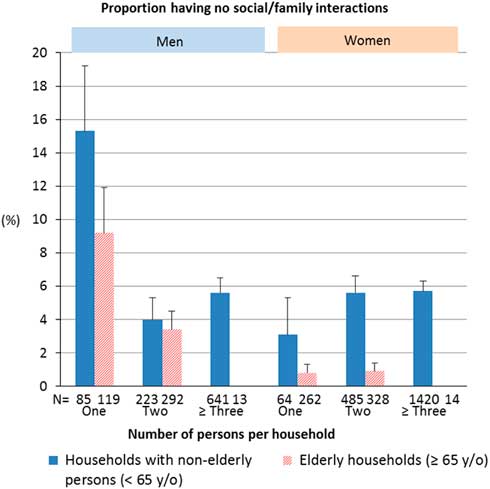
Participants who completely lacked interaction with families, friends, neighbors, or anyone else were considered at particularly high risk of social isolation and classified as “having no social/family interactions” in the primary analyses. When stratified by gender and the number of the persons in the household, men living alone made up the highest proportion of those who had no social/family interactions (Figure). Considering whether they resided in elderly households or not (ie, aged ≥65 years old in the case of 1-person households), as many as 1 in 7 men younger than age 65 years who were living alone reported having no social/family interactions. The findings showed that gender, whether the household was composed of elderly people, and the interaction effects between them were statistically significant (P<.001, P<.001, P=.001, respectively).
Number and Proportion of Persons per Household Having no Social/Family Interactions by Gender. The highest proportion of people without social/family interactions were men living alone. Error bars indicate standard error.

Factors Related to Having no Social/Family Interactions
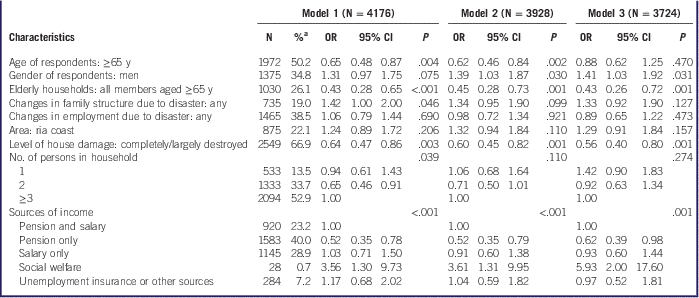
According to the results of the bivariate analyses (model 1) shown in Table 3, the factors related to having no social/family interactions were being elderly (at least 65 years old), whether the household comprised only elderly people, severe house damage, number of persons in the household, and sources of income. When adjusted for gender and age (model 2), the number of persons in the household did not remain significant. In the final model (model 3), factors that were significantly associated with having no social/family interactions were gender, whether the household comprised only elderly people or not, severe house damage, and sources of income.
Odds Ratio of Having no Social/Family Interactions by Household CharacteristicsFootnote a

a N, number of persons described by each variable; OR, 95%CI; and P values were calculated by logistic regression analyses. Missing data were excluded. Model 1, crude OR; model 2, adjusted for gender (men/women) and age group (≥65 y/ <65 y); and model 3, adjusted for gender (men/women), age group (≥65 y/<65 y), elderly households or not, changes in family structure (any/none), changes in employment (any/none), and area (ria coast/coastal plain).
Throughout all 3 models, being on social welfare was significantly associated with having no social/family interactions. Being male was the only factor that was consistently associated with the other 2 outcome variables (ie, having no friends to talk with about one’s problem and having no close neighbors) in the supplementary analyses (data not shown).
DISCUSSION
Our study investigated the risk of social isolation among the survivors in Ishinomaki who returned to their damaged houses at an early stage after the 2011 Great East Japan Earthquake and tsunami by visiting each household in the area devastated by the disaster. Because social isolation has been reported to affect physical and psychological health,Reference House 7 , Reference Coyle and Dugan 8 we assessed risk in terms of having friends to talk with about problems, having close neighbors, and having social/family interactions.
Social Isolation
Contrary to our hypothesis that the elderly in particular could be at greatest risk of isolation, we found that elderly people were more likely than those younger than age 65 years to have close neighbors and social/family interactions. Moreover, as many as 1 in 7 men younger than age 65 years and living alone had no social/family interactions. This finding illustrated the high risk of social isolation among middle-aged men living alone.
The post-disaster changes in family and work status may have affected their risk of social isolation. Among the middle-aged men living alone, 44.8% experienced changes in employment due to the disaster, and 24.7% experienced changes in family structure. These proportions were slightly, but not significantly, higher than those of other participants (38.7% and 18.9%, respectively). However, considering the short time that elapsed between the disaster and our survey, many of the survivors may have been in the early stage of grief over these losses and may have isolated themselves from others. Receiving social welfare was also significantly related to having no social/family interactions, although the proportion of those receiving social welfare was relatively low.
The characteristics of our study participants were important in interpreting our findings. The participants in our study returned to their homes in spite of serious damage to their houses caused by the tsunami. They may have done so for unknown reasons (eg, the sense of belonging to the community), which may have influenced the results. Moreover, the participants included persons who were at home when a surveyor visited during the daytime, and their responses were used to represent those of the household.
For example, if middle-aged men participated, they may have been at home during the day for some reason such as being unemployed, which may have been associated with social isolation. Among the participants, 28.3% of the middle-aged men living alone were receiving unemployment insurance, and 3.3 % were receiving social welfare, both of which were significantly higher than those of other participants (7.0% and 0.6%, respectively). Moreover, among unemployed middle-aged men living alone, 24.1% had no social/family interaction, raising the proportion from 1 in 7 to 1 in 4. Although, our participants may not have fully represented stay-at-home survivors, our findings still indicated that unemployment and post-disaster income instability may have been associated with the risk of social isolation, especially in middle-aged men.
Psychological Stress
To interpret our findings, it was helpful to review previous research to gain insight into the resilience of the elderly to psychological distress after disasters.Reference Seplaki, Goldman, Weinstein and Lin 24 Although the elderly are more likely to have higher mortality and physical distress, as compared with younger generations,Reference Lin, Huang, Huang, Hwang, Tsai and Chiu 25 , Reference Osaki and Minowa 26 they reportedly experience less psychological impact.Reference Seplaki, Goldman, Weinstein and Lin 24 This tendency has been called the maturation hypothesis, inoculation hypothesis, and burden perspective.Reference Seplaki, Goldman, Weinstein and Lin 24 , Reference Knight, Gatz, Heller and Bengtson 27
The maturation hypothesis suggests that psychological maturity and higher improved coping styles could lead to lower levels of emotional reactivity in elderly people to stressful events.27 The inoculation hypothesis proposes that past experiences of traumatic events could function protectively for the elderly.24,27 Last, the burden perspective surmises that middle-aged people have more social and familial responsibilities, and these burdens render them more psychologically vulnerable in the aftermath of a disaster.Reference Seplaki, Goldman, Weinstein and Lin 24 , Reference Cherry, Brown and Marks 28 As our findings demonstrated, the high risk of social isolation among men younger than age 65 who are living alone discloses a vulnerability among middle-aged persons that should be of concern for support organizations.
In general, middle-aged employed men spend most of their time in workplace settings, work life tends to be central to their interests, and their social relationships are largely related to their workplaces. As a result, interactions with family, friends, or neighbors may not be a priority before a disaster. Once their life is altered by a disaster, for example by losing a job or family members, they may not have other resources, such as neighbors, to turn to. In fact, slightly higher suicidal rates have been observed in middle-aged men and elderly women after disasters.Reference Krug, Kresnow and Peddicord 29
Although women reportedly have higher post-disaster psychiatric morbidity than men,Reference Yang, Yeh and Chen 30 particularly in the elderly,Reference Suzuki, Tsutsumi, Fukasawa, Honma, Someya and Kim 31 it appears that middle-aged men also should be considered at high risk of social isolation and be provided with psychological and social support. Considering the process of disaster recovery, it may be beneficial for middle-aged men to act as key community leaders and members.Reference Nakagawa and Shaw 32 Empowering them in the role of community members could be helpful to rebuild destructed communities, and prevent further isolation and related health problems.
Damage to Residences
Our findings also showed that people whose houses were more severely damaged were less isolated than those whose houses were less severely damaged. It may be that if residents were living in houses that were largely or completely destroyed, they needed more help from local community support, home builders, and neighbors. This reliance on others may have led to increased communication with local people.
A previous study showed that people whose residences completely collapsed in the Chi-Chi earthquake in Taiwan reported a higher quality of life in social relationships, as compared to those with lesser house damage.Reference Lin, Huang, Huang, Hwang, Tsai and Chiu 25 Another report from China indicated that those who received less post-disaster help reported poorer quality of life and psychological well-being.Reference Wang, Gao, Zhang, Zhao, Shen and Shinfuku 33 We believed that people with severe damage to their homes needed more help and maintained interpersonal relationships, and those whose houses had less damage received less help, which led to social isolation. Moreover, disaster survivors who received social welfare may be particularly at risk of isolation. Consequently, the support of social organizations would be important to care for the financial needs of survivors in disasters.
Limitations
Our study had several limitations. First, it is a cross-sectional study, and cause and effect relationships could not be inferred from our results. Second, although our samples were large enough for statistical analyses, they were not selected randomly, and the survey did not include all persons living in the areas affected by the tsunami. In addition, only 1 person was selected from each household, which may have produced sampling bias, resulting in a higher rate of social isolation in 1-person households. Third, the participants of our study had re-inhabited their tsunami-damaged houses for unknown reasons, and were at home during the daytime.
Moreover, about half of the households visited by surveyors did not participate in our study. The reasons for non-participation were either that no one was at home at the time of the visit or that someone was at home but did not want to respond to the survey, even though the surveyors offered to coordinate support the survivors may have needed. Therefore, we could not estimate the risk of social isolation for the nonparticipating households.
Also, we excluded missing data from our analyses. Those who did not answer all the questions necessary for the analyses may have had a higher risk of social isolation and different demographics from those of the respondents. However, the proportion of missing data for the items of social isolation was about 5%. When we imputed missing variables with the opposite data for men and women (ie, men having social/family interaction and women not having it), the results had no substantial effect on our findings.
In spite of these limitations, we believe that our study is important because it describes a large-scale survey on the risk of social isolation among those living in the tsunami-affected houses soon after the disaster. The findings demonstrating the risk of social isolation among middle-aged men are significant for support activities targeted at tsunami survivors and for redeveloping destructed communities. Although our survey has targeted people who returned to their homes after the disaster, it also would be worthwhile to evaluate the risk of social isolation among those who were relocated to temporary housing. Assessing the impact of relocation on social relationships and the risk of social isolation could provide additional information to prevent and detect in early stages subsequent health problems among survivors.
CONCLUSIONS
The findings of our study have implications for the support of survivors who return to their own homes after disasters. Elderly people were more likely to have close neighbors and social/family interactions than those who were younger than age 65 years. Men, particularly those younger than age 65 years and living alone, were at high risk of social isolation and may need increased attention for maintaining good physical and psychological health. Involving this at-risk population in redevelopment activities in local communities and empowering them as community members might be important for disaster recovery, as well as for enhancing their health and well-being.
Funding and Support
This work was financially supported by the Japanese Society of Public Health (special grant for the public health project for the Great East Japan Earthquake).
Acknowledgments
Ai Sonoda, BBA, and Miyuki Osaka, LLB, provided data management; members of the Health and Life Revival Council in Ishinomaki District (RCI) participated in data collection; and volunteer interviewers conducted the survey for this study. Members of the Teikyo–Ishinomaki Research Group not listed as authors are Eiji Yano, MD, MPH, DMSc; Hideki Yamamoto, MD, MPH, PhD; Kunio Hara, PhD; Kazuo Inoue, MD, PhD; Mariko Inoue, PhD; Hirokazu Furukawa, PhD; Takeaki Takeuchi, MD, MPH, PhD; Tadashi Haraguchi, MD, MPH, PhD; Aya Ishiguro, MD; and Yuriko Togita, MPH.