INTRODUCTION
Recent taxonomic revision within the Mobulidae (devilrays) has divided the previously monotypic genus Manta into two species (Marshall et al., Reference Marshall, Compagno and Bennett2009), the reef manta ray Manta alfredi (Krefft, 1868) and the giant manta ray M. birostris (Walbaum, 1792). The distribution of the species is circumglobal for M. birostris and semi-circumglobal (absent in the East Pacific and West Atlantic Oceans) for M. alfredi, which suggests large-scale macrosympatry (i.e. overlapping geographical ranges, defined by Smith (Reference Smith1965)). The two species are distinguishable by external coloration on their dorsal and ventral body surfaces (Marshall et al., Reference Marshall, Compagno and Bennett2009). Relatively rare melanistic (black) and leucistic (white) colour morphs exist in both species, with the distinguishing coloration pattern still often visible. The pattern of coloration in M. birostris is fairly constant worldwide but that of M. alfredi varies considerably. Manta alfredi is a more tropical, coastal, residential, smaller (maximum disc width, W D, of about 5 m) and schooling species compared to M. birostris, and is found around coral and rocky reefs, tropical island groups and atolls. Manta birostris is a more cold-water tolerant, pelagic, migratory, larger (maximum W D of about 7 m) and solitary species, which is commonly sighted at offshore pinnacles, seamounts and oceanic islands (Marshall et al., Reference Marshall, Compagno and Bennett2009).
While the scientific literature on manta ray biology and life history is relatively sparse, several points on inter-specific similarities can be made. Individuals of both species demonstrate a sophisticated ability to sample and choose habitat. For example, both species demonstrate habitat fidelity and seasonal aggregation behaviours (Dewar et al., Reference Dewar, Mous, Domeier, Muljadi, Pet and Whitty2008; Luiz et al., Reference Luiz, Balboni, Kodja, Andrade and Marum2009; Marshall, Reference Marshall2009). They both visit specific sites, such as ‘cleaning stations’: patches of reef where various ‘cleaner’ fish species remove parasites from their body, and ‘feeding areas’: locations where dense plankton blooms commonly occur (Homma et al., Reference Homma, Maruyama, Itoh, Ishihara and Uchida1999; Marshall, Reference Marshall2009; Anderson et al., Reference Anderson, Adam and Goes2011a, Reference Anderson, Adam, Kitchen-Wheeler and Stevensb). Both species travel at least meso-scale distances, with movements between locations up to ~500 km apart recorded for M. alfredi in Japanese and Australian waters (Kashiwagi et al., Reference Kashiwagi, Ito and Sato2010; Couturier et al., in press) and over 1000 km for M. birostris (Marshall et al., Reference Marshall, Holmerg, Brunnschweiler and Pierce2010). The two species show similar courtship and mating behaviours (Yano et al., Reference Yano, Sato and Takahashi1999; Marshall & Bennett, Reference Marshall and Bennett2010). Both species are slow to mature (~10 years for females) and have low fecundity (with mostly a single offspring every 2 to 3 years or possibly longer cycles on average), based on decades-long observation of a population of M. alfredi in Japan since the mid-1970s (Ito, Reference Ito1987, Reference Ito2000) and similar reports by other authors (Homma et al., Reference Homma, Maruyama, Itoh, Ishihara and Uchida1999; White et al., Reference White, Giles, Dharmadi and Potter2006; Marshall, Reference Marshall2009; Marshall & Bennett, Reference Marshall and Bennett2010).
The considerable similarities in the biology of the two species and their macrosympatric distribution raise the question of whether habitat use is segregated between M. alfredi and M. birostris. It is important to study microgeographic relationships in their ranges to understand differences in habitat preferences and habits that could have been important in their evolutionary history (Mayr, Reference Mayr1942, Reference Mayr1947, Reference Mayr1963; Rivas, Reference Rivas1964; Smith, Reference Smith1965). While a map depicting worldwide, macrosympatric distribution of the two species has been presented previously (Marshall et al., Reference Marshall, Compagno and Bennett2009), the purpose of the current paper is to elucidate habitat segregation at a microgeographic scale at various localities by increased effort in collecting and analysing photographic records. Photo-identification of individual manta rays emerged in the 1970s (Ito, Reference Ito1987) and is now employed successfully in many locations around the globe (Ishihara & Homma, Reference Ishihara and Homma1995; Clark, Reference Clark2002; Marshall, Reference Marshall2009; Deakos, Reference Deakos2010; Kitchen-Wheeler, Reference Kitchen-Wheeler2010; Couturier et al., in press; Marshall et al., in press). Manta rays are major photographic subjects for SCUBA divers and it is common for images of manta rays to be uploaded in the internet environment as newsworthy material that can be found by keyword searches. These ‘manta ray occurrence data’ with supporting photographic images and location information have become highly accessible due to recent expansion in digital communication (e.g. web page of dive operations, blogs, YouTube http://www.youtube.com/ and Facebook http://www.facebook.com/), even from places where occurrences are rare. With a reasonable search effort, these data can provide a robust record of the occurrence of manta ray at specific sites, together with an indication of the frequency of site visitation (Kashiwagi et al., Reference Kashiwagi, Ito and Sato2010). This unique situation makes the current study feasible. This paper utilizes photographic records from multiple sources to establish baseline distributional data on a global geographical scale. These data will assist future monitoring and assessment of responses of these two species to possible changes in the marine environment (Soberon & Peterson, Reference Soberon and Peterson2009; Boakes et al., Reference Boakes, McGowan, Fuller, Chang-qing, Clark, O'Connor and Mace2010) as well as considering evolutionary hypotheses.
MATERIALS AND METHODS
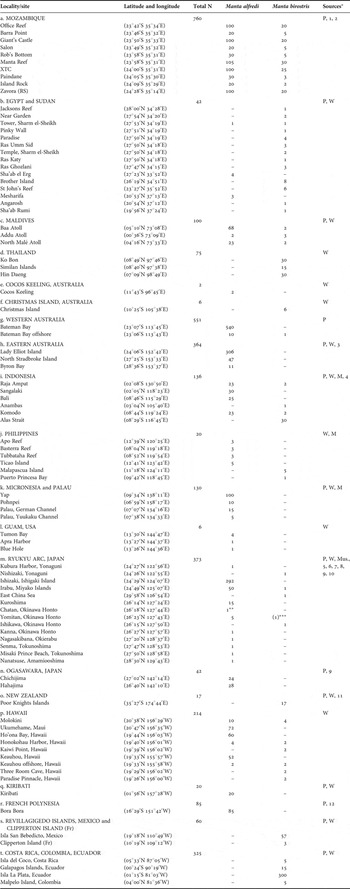
The geographical relationships of populations of the two species at 20 localities in the Indo-Pacific Ocean, using a total of 3328 photographic records, was assessed. The characterization of the geographical relationships of two or more species in a unit area is dependent on scales, that is, the resolution at which patterns are observed. Although numerous terms and concepts for characterizations and demarcations exist (e.g. reviewed by Mayr (Reference Mayr1942) and Rivas (Reference Rivas1964)), we used the ones proposed by Smith (Reference Smith1965) here. Under macrosympatry, Smith (Reference Smith1965) proposed ‘microsympatry’, ‘microallopatry’ and ‘microparapatry’. For the purpose of this paper, we scored the geographical relationships exhibited at a locality by the two species as either ‘microallopatry’ (record of co-occurrence at distances less than 100 km apart was not observed), ‘microparapatry’ (record of co-occurrence within 2 – 100 km was observed, but no record of co-occurrence at the same dive site, typically defined by a 100 m radius, was observed) or ‘microsympatry’ (record of co-occurrence at the same dive site was observed). We used these terms on the basis of occurrence records only and did not consider other ecological phenomena that could be associated with these terms (e.g. physical or reproductive contact). Reflecting the above resolution, we collated our data with detailed site information within localities where the two species occurred. There were up to 15 sites per locality. For localities where only one species occurred, the site information was represented with a few main sites (up to 4 sites per locality). Names of the 20 localities, 91 sites, their latitude and longitude and a total number of individuals per locality identified in this study are listed in the Appendix.
More than 80% of those observed records were from long-term photo-identification projects conducted by the authors and our field collaborators that utilize spot patterns on the ventral surface for individual identification purposes. To be consistent with a given total number of individuals per locality, individuals photographed at multiple sites were counted as one record at one representative site only. Other sources of records included private collections, museum records, magazine articles and web-based information (e.g. web-based manta ray identification databases, catalogued stock photograph entries, tour reports and other web pages). Examples of web-based manta ray identification databases include: Manta Pacific Research Foundation (http://www.mantapacific.org/mantapacific/) and Manta Conservation Thailand – Identification Group in Facebook (http://www.facebook.com/). For web-based searches, we spent at least six hours of targeted keyword searches for each locality, which found many records from localities where sighting records were abundant and a small number of records from localities where sighting records were relatively scarce. Authenticity of the record was checked by contacting the photographer for confirmation where needed (e.g. rare occurrence of the species at the location). Further we interviewed people with local knowledge to seek clarification about whether any apparent scarcity of web-based records was a realistic representation of the sighting frequency of manta rays at those locations. These people were able to provide additional information about the frequency of occurrence and habitat utilization of two species at the locality.
Species identification was based on the differences in coloration patterns described in character keys of Marshall et al. (Reference Marshall, Compagno and Bennett2009). We also recognized keys provided in Sato et al. (Reference Sato, Uchida, Nishida, Toda, Obata, Matsumoto, Kitadani and Miura2010), however, we found that their keys, which were constructed based on very small sample sizes, were not useful for identification due to the inaccurate and insufficient descriptions of coloration patterns for the two species.
RESULTS AND DISCUSSION
Microsympatry and microparapatry
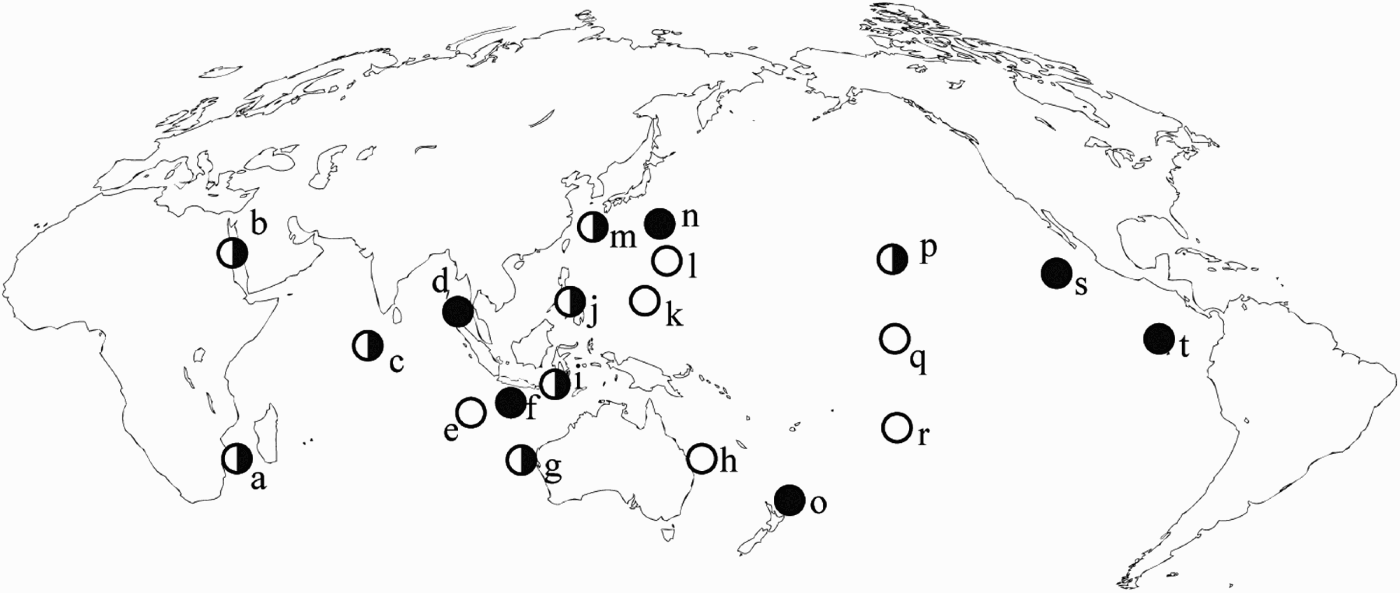
Across the examined twenty localities in the Indian and Pacific Oceans (Figure 1 & Appendix), we found occurrences of both species at eight localities. In general, sites (within localities) of occurrences appeared to be segregated between the two species. However, most localities included a few to several sites where the two species occurred in microsympatry.
Habitat use by Manta alfredi and M. birostris. ○ & •, indicate ‘microallopatry’ (see main text for definition) by M. alfredi and M. birostris, respectively. A half and half black and white circle indicates the occurrence of both species either in ‘microparapatry’ or ‘microsympatry’. See main text for details. Locality codes (a – t) correspond to those in the Appendix: a, Mozambique; b, Egypt and Sudan; c, Maldives; d, Thailand; e, Cocos Keeling, Australia; f, Christmas Island, Australia; g, Western Australia; h, eastern Australia; i, Indonesia; j, Philippines; k, Micronesia and Palau; l, Guam, USA; m, Ryukyu Arc, Japan; n, Ogasawara, Japan; o, New Zealand; p, Hawaii; q, Kiribati; r, French Polynesia; s, Revillagigedo Islands, Mexico and Clipperton Island (Fr); t, Costa Rica, Colombia and Ecuador.
Mozambique was the only locality where both species occurred in microsympatry along a wide range of coastline. At this locality, several microsympatric sites were identified where both species occurred regularly and were recorded in large numbers. The two species occurred in microsympatry at over 15 feeding sites and cleaning sites from Office Reef (23°42′S 35°34′E) in the north off Inhambane to Zavora (24°28′S 35°14′E) in the south. While the two species sometimes can be seen in a single dive, the two species do not interact with each other. For example, the two species feeding in a group or females being chased by allo-specific males, was not observed. There were a large number of records in this locality (N = 760). The majority of the records were for Manta alfredi (~85%).
The northern Red Sea was previously known as a habitat of M. birostris from records around Sharm el Sheikh, Egypt (28°0′N 34°28′E–27°47′N 34°15′E), Brother Islands (26°19′N 34°51′E) and St John's Reef (23°27′N 35°52′E) (Marshall et al., 2009). Our study found occurrence records of M. alfredi in shallow habitat west of the Sinai Peninsula around Sha'ab el Erg (27°23′N 33°52′E) as well as from a site in Sharm el Sheikh (27°53′N 34°19′E). We did not find M. birostris around Sha'ab el Erg, and records of M. alfredi around Sharm el Sheikh were very rare. There were no indications of regular co-occurrence of the two species around Sharm el Sheikh (Helen Chambers, Catherine Bates and Tina Gauer, personal communications). Both species occurred in Sudanese waters with records of M. alfredi at Mesharifa (20°53′N 37°13′E) and records of M. birostris at Sha'ab Rumi (19°56′N 37°24′E) and Angarosh (20°54′N 37°12′E).
In the Maldives, both species occurred around the atoll of Addu (0°36′S 73°9′E), North Malé (4°16′N 73°33′E) and Baa (5°10′N 73°8′E). However, the vast majority of the photographic records were for M. alfredi (~95%). There were no indications of regular co-occurrence of the two species at the same sites. Our interview with a local observer (Guy Stevens, personal communication) noted that M. birostris tended to occur along outer atoll edges where the reef drops off steeply into extremely deep water, but he reported that sightings were certainly not consistent in most locations and could also occur randomly inside the atolls. The overall rareness of M. birostris was also reported in Kitchen-Wheeler (Reference Kitchen-Wheeler2010), which identified over 1000 individuals.
In Western Australia, both species occurred around Bateman Bay. There was a large number of records of M. alfredi (N = 540) at inner reef sites (23°7′S 113°45′E), but no observation of M. birostris. Both species occurred at sites in the outer reef zone (23°6′S 113°43′E), that were infrequently visited by divers. Our interview with a local observer (Frazer McGregor, personal communication) noted that this zone was utilized by M. alfredi as a pathway to inner reef sites as well as feeding and cleaning year-around. He reported that sightings of M. birostris were rare and that there were no known cleaning stations for this species.
In Indonesia, Raja Ampat (2°8′S 130°50′E) was known to be a habitat of M. alfredi (Marshall et al., Reference Marshall, Compagno and Bennett2009) but this study found that M. birostris appeared from time to time from (Shawn Henrichs, personal communication). Similarly, both species occurred around Komodo (8°44′S 119°24′E). Images from around Bali (8°46′S 115°29′E) and Sangalaki (2°5′N 118°23′E) indicated the presence of M. alfredi, while M. birostris occurred in the Alas Strait (8°29′S 116°45′E) and at Anambas (3°4′N 105°40′E).
In the Philippines, M. alfredi was found in the reefs of Apo (12°39′N 120°25′E), Basterra (8°4′N 119°18′E), Tubbataha (8°52′N 119°54′E) and around Ticao Island (12°41′N 123°42′E), while M. birostris was found around Puerto Princesa Bay (9°42′N 118°45′E) and around Malapascua Island (11°18′N 124°11′E). We could find only a relatively small number of photographic records from this locality (N = 20) despite a presumed abundance of SCUBA diving activities and abundance of manta rays reported in the past (Alava et al., Reference Alava, Dolumbalo, Yaptinchay, Trono, Fowler, Reed and Dipper2002).
The Ryukyu Arc region in Japan was previously known as a habitat of Manta alfredi based on records of this species from the year-round aggregation site around Ishigaki Island (24°29′N 124°7′E) and seasonal occurrence around Miyako Islands (24°49′N 125°7′E) (Marshall et al., 2009). The occurrence of both species around Yonaguni Island (24°26′N 122°55′E) and around Okinawa Honto (26°18′N 127°44′E) was reported recently (Kashiwagi et al., Reference Kashiwagi, Ito and Sato2010). This study discovered the occurrence of M. birostris at Miyako Islands (24°49′N 125°7′E) and an offshore site in the East China Sea (29°58′N 126°54′E, National Museum of Nature and Science, Tokyo: NSMT-P 63289). The record of the offshore site was from a trawl survey by the fisheries agency and this record highlights the possibility that the surveys outside the area of normal SCUBA diving activities might reveal unrecorded occurrences of M. birostris in various localities. The records of the occurrence around Okierabu (27°50′N 128°37′E), Tokunoshima (27°47′N 128°53′E, 27°50′N 128°58′E) and Amamiooshima (28°30′N 129°43′E) were rare (Kiyohisa Kawamoto, Shoji Ito and Masahiro Yoshikawa, personal communication) and records were of M. alfredi only. There was a reasonable amount of SCUBA diving activity around these three islands and we would have expected to find more records if manta rays are abundant. Overall, the majority of the records in the Ryukyu Arc were M. alfredi (~99%).
In Hawaii, records from around Ukumehame, Maui (20°47′N 156°35′W), Ho'ona Bay, Hawaii (19°44′N 156°3′W), and Keauhou, Hawaii (19°33′N 155°57′W) were of M. alfredi. Two offshore sites, Three Room Cave, Hawaii (19°29′N 156°2′W) and Paradise Pinnacle, Hawaii (19°26′N 156°0′W) and a nearshore site Kaiwi Point (19°39′N 156°2′W) had records of M. birostris only. Both species occurred in microsympatry at Molokini, Maui (20°38′N 156°29′W), Honokohau Harbor, Hawaii (19°40′N 156°1′W) and Keauhau offshore (19°33′N 155°58′W). Some local divers have been calling M. birostris ‘pelagic manta’ which tended to occur at offshore dive sites and they have long recognized the differences between it and M. alfredi, which occurs at popular near-shore night diving sites (Manta Pacific Research Foundation http://www.mantapacific.org/mantapacific/). Overall, the majority of records from Hawaii were for M. alfredi (~95% in Maui and ~80% in Hawaii).
Microallopatry
In Cocos Keeling, Australia, only M. alfredi was found (N = 2). Compared with other localities in this study, the amount of SCUBA diving activities in this locality is relatively low. Thus, more information is necessary.
In eastern Australia, only M. alfredi was found in large numbers (N = 364) from three sites, Lady Elliot Island (24°6′S 152°42′E), North Stradbroke Island (27°25′S 153°33′E) and Byron Bay (28°36′S 153°37′E). There have been no confirmed photographic records of M. birostris from this locality, despite considerable amount of effort in gathering records (Couturier et al., in press). This indicated that M. birostris is at least not abundant where SCUBA diving activities were taking place.
Similarly, only M. alfredi was found in other localities, Micronesia and Palau (9°34′N 138°11′E, 6°59′N 158°17′E, 7°7′N 134°16′E and 7°38′ 134°33′E), Guam, USA (13°30′N 144°47′E, 13°27′N 144°37′E and 13°26′N 144°36′E), Kiribati (1°56′N 157°28′W) and Bora Bora, French Polynesia (16°29′S 151°42′W), where the amount of SCUBA diving activities were relatively high. There have been no confirmed photographic records of M. birostris from French Polynesia, despite considerable effort in gathering records (Moeava de Rosemont, personal communication).
Only M. birostris was found around Thailand (8°49′N 97°46′E, 8°40′N 97°38′E and 7°9′N 98°49′E), Christmas Island, Australia (10°25′S 105°38′E), Ogasawara Islands, Japan (27°2′N 142°14′E and 26°40′N 142°10′E), and New Zealand (35°27′S 174°44′E).
Only M. birostris was found among a large number of records collected from Revillagigedo Islands, Mexico and Clipperton Island (Fr) (19°18′N 110°49′W and 10°19′N 109°12′W), and Costa Rica, Colombia and Ecuador (5°33′N 87°5′W, 4°0′N 81°36′W, 0°24′S 90°19′W and 1°15′S 81°3′W). The absence of M. alfredi in the East Pacific Ocean was previously reported (Marshall et al., Reference Marshall, Compagno and Bennett2009) and this study supported this with a larger number of observations.
Habitat segregation and mosaic sympatry
Our study revealed mosaic habitat occupancy between the closely-related species Manta alfredi and M. birostris in the majority of their distributional range. At twelve localities, they were microallopatric, while at eight localities they were microparapatric interspersed with mostly only a few microsympatric sites. Given the known mobility of both species, this pattern suggests that two species have distinct habitat use and habitat preference. Physical and biotic factors influencing habitat selection is an important but relatively neglected area of research in biology of sharks and rays until recently (Simpfendorfer & Heupel, Reference Simpfendorfer, Heupel, Carrier, Musick and Heithaus2004). In addition, patchy, interdigitated distribution of the two forms in sympatry is sometimes termed as ‘mosaic sympatry’ (Mallet, Reference Mallet2008; Mallet et al., Reference Mallet, Meyer, Nosil and Feder2009) and distinguished from a more universally mixed pattern, ‘pure sympatry’. This has important implications in considering how ecological adaptation might have played a role in the evolution of the two species.
Habitat segregation between M. alfredi and M. birostris has been suggested between near-shore and offshore environments, respectively (Marshall et al., Reference Marshall, Compagno and Bennett2009). Our study supported this generally, finding that M. alfredi commonly uses shallow near-shore environments while M. birostris commonly occurs on offshore reefs, islands or locations that are in close proximity to deep water, such as the edge of the continental shelf. For example, in localities where the two species are known to co-occur, M. birostris is often reported from offshore reefs (e.g. St John's Reef in the Red Sea; offshore dive sites in Hawaii Island and Western Australia), offshore islands (e.g. the Brother Islands in the Red Sea), the extremities of island groups (e.g. Addu Atoll in the Maldives) or outer atoll edges near drop-offs (e.g. Addu, North Malé, and Baa Atolls in the Maldives). Microallopatry of M. alfredi was recorded from shallow reef environments in Yap, Pohnpei, Palau, eastern Australia and French Polynesia, while microallopatry of M. birostris (e.g. Ogasawara, Japan; New Zealand; Thailand and all East Pacific localities in this study) was recorded from habitats characterized by a more oceanic environment.
The relationship between occurrence of each species and physical variables such as distance from land or proximity to the deep water is likely to be complex. Microgeographic relationships between the two species are likely to be further complicated by more precise habitat choice and the migratory behaviour of both species, causing labile boundaries. Examples of distributions that are beyond the simple explanation of near-shore or offshore partitioning include the intermingled habitat occupancy observed in some localities (e.g. Indonesia and Philippines). Seasonal shifts in Manta spp. distributions or seasonal change in visitation patterns (Duffy & Abbot, Reference Duffy and Abbot2003; Dewar et al., Reference Dewar, Mous, Domeier, Muljadi, Pet and Whitty2008; Anderson et al., Reference Anderson, Adam and Goes2011a, Reference Anderson, Adam, Kitchen-Wheeler and Stevensb; Couturier et al., in press) may accompany changes in microgeographic relationships between the two species in locations where both species occur.
The precise nature of physical and biotic factors that characterize the observed habitat segregation between the two Manta spp. is still uncertain and deserves further focused research. This will enhance understanding of the ecological requirement of the two species and contribute to a better management of their populations. We hypothesize possible niche divergence in physical dimensions such as water temperature, depth, light regime and spatial and temporal characteristics of upwelling events. Biotic dimensions might include primary production, availability of suitable food (zooplankton), contrasting parasite communities, contrasting cleaner fish communities and risk of predation by sharks. These are in line with several mechanisms suggested by Bull (Reference Bull1991) in the studies of the ecology of parapatric distribution, which includes: (1) ecotonal change; (2) interspecific competition preventing species from invading each other's habitat; (3) differences in susceptibility to predation; (4) contrasting interaction with parasites and disease; and (5) reproductive interference.
The evolutionary origin of the two species is also of interest. Preliminary studies suggested that the genetic distance between the two species is not so large and speciation might be recent (Kashiwagi, unpublished data). Consideration of how the observed pattern of mosaic sympatry arose along with speciation scenarios is a subject of our ongoing study.
ACKNOWLEDGEMENTS
We thank the people listed in the Appendix footnotes and Dr Gento Shinohara (National Museum of Nature and Science, Tokyo) for providing photographic records. We appreciate the support provided by Sea World Research & Rescue Foundation, Australian Biological Resource Study, the Save Our Seas Foundation, the Queensland Government and the University of Queensland. We wish to thank Gimme Walter, James Hereward, Andrew Ridley, Jason Callander, Michelle Rafter, Iman Lissone and two anonymous referees for their helpful comments and suggestions.
Details of photographic records of Manta alfredi and M. birostris. Names of localites, sites, latitude and longtitude and the number of observed individuals (N) are listed. Sources are indicated as private collections (P); web-based information (W); magazine articles (M); museum records (Mus.); and published references (numbers). See footnotes for more information.

*, Private collections were provided by: Andrea Marshall (a, b, c, i, k, s, t); Simon Pierce (a); Helen Chambers (b); Robert Fabbri (b); Tina Gauer (b); Rudolf Svensen (b); Guy Stevens (c); Ken Hoppen (f); Frazer McGregor (g); Christine Dudgeon (h); Mark Atkinson (h); Kathy Townsend (h); Lydie Couturier (h); Tom Kashiwagi (i); William White (i); Jenny Giles (i); Shawn Heinrichs (i); Edi Frommenwiler (i); Tim Rock (a, k); Bill Acker (k); Mark Thorpe (k); Tova Harel-Bornovski (k); Takashi Ito (k, m); Shoji Ito (m), Masahiro Yoshikawa (m), Yuki Toyozato (m), Kazunari Yano (m) Kiyohisa Kawamoto (m), Yoshihisa Hagiwara (m); Fumihiko Sato (n); Clinton Duffy (o); Tim Dykman (q); Moeava de Rosemont (r); Tom Campbell (a, s, t); Terry Mass (s); and Mark Harding (t). Published references are: 1, Marshall (Reference Marshall2009); 2, Marshall et al. (in press); 3, Couturier et al. (in press); 4, White et al. (Reference White, Giles, Dharmadi and Potter2006); 5, Ito (Reference Ito1987); 6, Ito (Reference Ito2000); 7, Uchida (Reference Uchida1994); 8, Masuda et al. (Reference Masuda, Amaoka, Araga, Uyeno and Yoshino1984); 9, Kashiwagi et al. (Reference Kashiwagi, Ito and Sato2010); 10, Sato et al. (Reference Sato, Uchida, Nishida, Toda, Obata, Matsumoto, Kitadani and Miura2010); 11, Duffy & Abbot (Reference Duffy and Abbot2003); and 12, de Rosemont (Reference de Rosemont2010). A list of URLs for web-based information, magazine titles, issue numbers, page numbers and photograph credits is available from the corresponding author. **, site and identification based on the account of Uchida (Reference Uchida1994) and the photograph in Masuda et al. (Reference Masuda, Amaoka, Araga, Uyeno and Yoshino1984); ***, identification according to Sato et al. (Reference Sato, Uchida, Nishida, Toda, Obata, Matsumoto, Kitadani and Miura2010). No photograph of this individual in the cited paper.