

Introduction
The inclusion of organic acids in broiler diets has been demonstrated to inhibit growth of pathogenic bacteria in the gut (Corduk et al., Reference Corduk, Ceylan, Dede and Tel2008) and enhance FCR (Hassan et al., Reference Hassan, Mohamed, Youssef and Hassan2010). Acidification reduces pathogen colonisation of the gastrointestinal tract and thus inhibits damage to the epithelial cell (Langhout, Reference Langhout2000). Organic acids have been demonstrated to improve the digestibility of protein and amino acids (Afsharmanesh and Pourreza, Reference Afsharmanesh and Pourreza2005), and minerals such as calcium, phosphorus, magnesium and zinc in broiler chickens (Garcia et al., Reference Garcia, Catalá-Gregori, Hernandez, Megias and Madrid2007). It has been reported that supplementation with butyric acid and its sodium salt had a positive effect on intestinal integrity and growth performance of broiler chickens (Hu and Guo, Reference Hu and Guo2007; Smulikowska et al., Reference Smulikowska, Czerwiński, Mieczkowska and Jankowiak2009). In addition, butyrate acid may be used as a source of energy for intestinal epithelium and stimulate intestinal epithelial growth (Mroz et al., Reference Mroz, Koopmans, Bannink, Partanen, Krasucki, Øverland, Radcliffee, Mosenthin, Zentek and Żebrowska2006).
Fermentation of carbohydrates such as dietary fibre and undigested starch in the distal part of the gut are accompanied by the production of short chain fatty acids (SCFA) such as propionate, acetate and butyrate (Hu and Guo, Reference Hu and Guo2007). In broilers, the amount of SCFA produced by fermentation in the gut is relatively low in first days of life (van der Wielen et al., Reference van der Wielen, Biesterveld, Notermans, Hofstra, Urlings and van Knapen2000). Non-protected organic acids are readily absorbed in the upper part of digestive tract (Molatová et al., Reference Molatová, Skřivanová, Baré, Houf, Bruggeman and Marounek2011), therefore, supplementation with microencapsulated organic acids into poultry diets may be useful because this allows the active agent to reach the lower digestive tract and modulate mucosal morphology, intestinal microflora and improve protein digestibility. The objective of this study was to investigate the effect of encapsulated sodium butyrate (SB) on broiler performance and gut health.
Materials and Methods
Animal husbandry
Both experiments were approved by the Animal Ethics Committee of the University of New England (Approval No: AEC11/064 and AEC13-039). In experiment 1, 408 d-old male Ross 308 birds obtained from the Baiada hatchery (Tamworth, NSW, Australia) were placed in 24 floor pens randomly assigned to four treatments with six replicates. All the birds were vaccinated against Marek's disease and infectious bronchitis. Each pen had 17 chicks from day 0, and two were culled at day 10. The pens consisted of wire mesh partitions with dimensions of 120 cm long and 75 cm wide. Temperature and lighting were adjusted according to the husbandry guidelines for the Ross 308 strain (Aviagen, 2012). Each pen was equipped with a tube feeder and two water cup drinkers. Water and feed were provided ad libitum. Mortality was recorded daily while cumulative pen weight and feed intake were recorded on days 10, 24 and 35. The birds were fed starter diets from day 0 to day 10, grower diets from day 10 to day 24, and finisher diet from day 24 to day 35. On day 10 and 24, three birds and two birds, respectively from each pen were randomly selected, weighed and killed by cervical dislocation. The content of ileum and caeca were collected and stored in 50 ml plastic containers. Around 1 g of ileal and caecal contents was used to measure the pH and the rest frozen directly at −20 °C for SCFA analysis.
In experiment 2, 2160 day-old male Cobb 500 birds obtained from the Baiada hatchery (Tamworth, NSW, Australia) were placed in 54 floor pens and randomly assigned to nine treatments with six replicates each upon arrival at the Kirby Research Station of the University of New England, Armidale, Australia. Birds were vaccinated against Marek's disease and infectious bronchitis on hatching. Each pen contained 40 chicks from day 0, with the two weakest chicks culled at day 10. The pens consisted of wire mesh partitions with dimensions of 150 cm long and 150 cm wide. The shed temperature was set at 33–34 °C initially and gradually decreased by 3 °C per week until 22–24 °C was reached by the third week. Chicks were subjected to artificial fluorescent illumination for 23 h between days 0–7, and 18 h from days 8 to 24. Each pen was equipped with a separate feeding trough and eight nipple drinkers. Water and feed were provided ad libitum. The birds were fed starter diets from days 0–10 and grower diets from days 10–24. Mortality was recorded daily while body weight and feed intake (FI) were recorded on days 10 and 24 for the calculation of weight gain (WG) and FCR which was corrected for mortality. On days 8 and 22, three birds from each pen were randomly selected, weighed and killed by cervical dislocation. The abdominal cavity was opened and the content of ileum and caeca were sampled to measure SCFA and pH.
Diets
Experiment 1
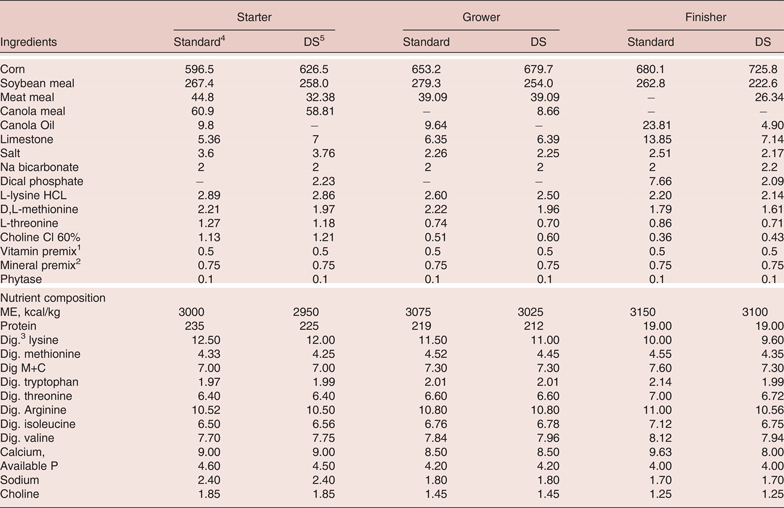
Four diets were formulated with corn, soybean meal, solvent extracted canola meal and meat meal as the main ingredients (Table 1) according to the Aviagen Guideline for Ross 308 birds. The dietary treatments were as follows: 1) standard basal diet (ND); 2) standard basal diet + 1 g/kg SB (NDSB); 3) down specification diet (minus 50 kcal/kg relative to standard diet) (DS); 4) down specification diet (minus 50 kcal/kg relative to standard diet) + 1 g/kg SB (DSSB). All raw materials were subjected to proximate and amino acids analysis prior to formulation. Feeds were changed from starter to grower on day 10 and growers to finisher on day 24. Residual feed was weighed on the d of feed changes and at the end of the trial.
Composition and nutrient content of diets (g/kg) (experiment 1)

1Vitamin concentrate supplied per kilogram of diet: retinol, 12000 IU; cholecalciferol, 5000 IU; tocopheryl acetate, 75 mg, menadione, 3 mg; thiamine, 3 mg; riboflavin, 8 mg; niacin, 55 mg; pantothenate, 13 mg; pyridoxine, 5 mg; folate, 2 mg; cyanocobalamin, 16 µg; biotin, 200 µg; cereal-based carrier, 149 mg; mineral oil, 2.5 mg.
2Trace mineral premix supplied per kilogram of diet: Cu (sulphate), 16 mg; Fe (sulphate), 40 mg; I (iodide), 1.25 mg; Se (selenate), 0.3 mg; Mn (sulphate and oxide), 120 mg; Zn (sulphate and oxide), 100 mg; cereal-based carrier, 128 mg; mineral oil, 3.75 mg.
3Dig. = digestible
4 Standard = starter 3000 kcal/kg, grower 3075 kcal/kg and finisher 3150 kcal/kg
5DS = minus 50 kcal/kg relative to standard
Experiment 2
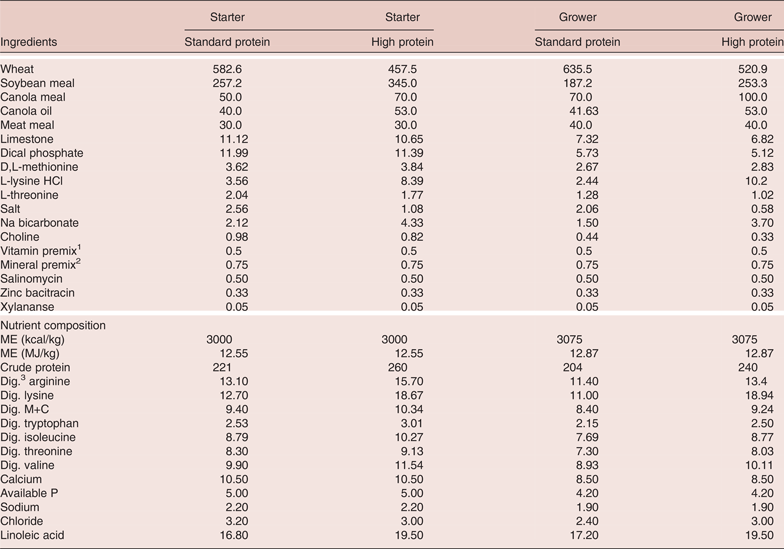
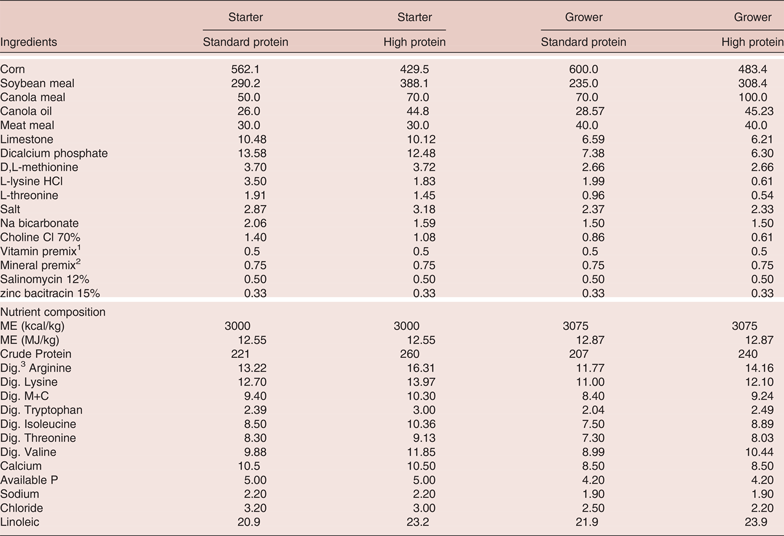
Nine diets were formulated with either wheat or corn, soybean meal, canola oil, solvent extracted canola meal and meat meal as the main ingredients (Tables 2 and 3) according to the guideline for Cobb 500 birds. The diets were assigned as: 1) corn-based diet (C); 2) corn-based diet + 1 g/kg SB in starter and 0.5 g/kg in grower (CSB); 3) corn-based diet, high protein (CHP); 4) corn-based diet, high protein + 1 g/kg SB in starter and 0.5 g/kg in grower (CHPSB); 5) wheat-based diet (W); 6) wheat-based + 1 g/kg SB in starter and 0.5 g/kg in grower (WSB); 7) wheat-based diet, high protein (WHP); 8) wheat-based diet, high protein + 1 g/kg SB in starter and 0.5 g/kg in grower (WHPSB); 9) wheat-based diet, high protein + 2 g/kg SB in starter and 1 g/kg in grower (WHP2 × SB). The diets were pelleted at 60°C for approximately 1 min following hammer milling of the grains at the screen size of 5 mm.
Composition and nutrient content of wheat base diets (g/kg) (experiment 2)

1Vitamin concentrate supplied per kilogram of diet: retinol, 12000 IU; cholecalciferol, 5000 IU; tocopheryl acetate, 75 mg, menadione, 3 mg; thiamine, 3 mg; riboflavin, 8 mg; niacin, 55 mg; pantothenate, 13 mg; pyridoxine, 5 mg; folate, 2 mg; cyanocobalamin, 16 µg; biotin, 200 µg; cereal-based carrier, 149 mg; mineral oil, 2.5 mg.
2Trace mineral premix supplied per kilogram of diet: Cu (sulphate), 16 mg; Fe (sulphate), 40 mg; I (iodide), 1.25 mg; Se (selenate), 0.3 mg; Mn (sulphate and oxide), 120 mg; Zn (sulphate and oxide), 100 mg; cereal-based carrier, 128 mg; mineral oil, 3.75 mg.
3Dig. = digestible
Composition and nutrient content of corn base diets (g/kg) (experiment 2)

1Vitamin concentrate supplied per kilogram of diet: retinol, 12000 IU; cholecalciferol, 5000 IU; tocopheryl acetate, 75 mg, menadione, 3 mg; thiamine, 3 mg; riboflavin, 8 mg; niacin, 55 mg; pantothenate, 13 mg; pyridoxine, 5 mg; folate, 2 mg; cyanocobalamin, 16 µg; biotin, 200 µg; cereal-based carrier, 149 mg; mineral oil, 2.5 mg.
2Trace mineral premix supplied per kilogram of diet: Cu (sulphate), 16 mg; Fe (sulphate), 40 mg; I (iodide), 1.25 mg; Se (selenate), 0.3 mg; Mn (sulphate and oxide), 120 mg; Zn (sulphate and oxide), 100 mg; cereal-based carrier, 128 mg; mineral oil, 3.75 mg.
3Dig. = digestible
Measurements and analyses
Approximately 1 g of content was diluted in 9 ml of distilled water to measure pH. The suspension was homogenised with a stirrer and the pH was determined using EcoScan 5/6 pH meter (Eutech Instrument Pte Ltd., Singapore) on the day of sampling.
Excreta moisture was measured from three birds from each pen in experiment 1. The birds were transferred to the AME cages at day 21 and 35 to measure the moisture of manure. Ten fresh droppings were collected from each cage and dried for 24 h at 105 °C. The moisture was calculated using the formula (wet weight – dry mater)/wet weight, and expressed as % wet weight. SCFA were analysed as described by Jensen et al. (Reference Jensen, Cox and Jensen1995).
Statistical analysis
The SAS statistical package (PROC GLM) was used to determine significance and interactions of main effects (SAS, 2013). When interactions were observed (P < 0.05), Duncan's multiple range test was used to detect the differences between individual treatment means.
Results
Experiment 1
Growth performance
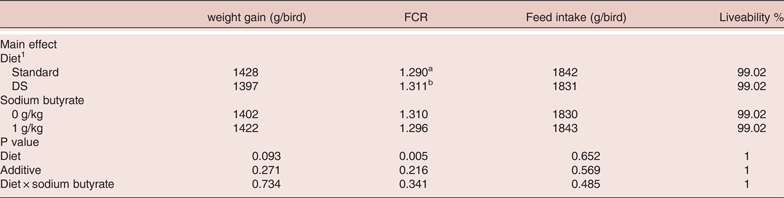
During days 0–10 and 0–35, no significant differences in WG, FI, LV or FCR were observed between birds fed different experimental diets. However, between day 0 and 24, the FCR of birds fed standard diet was improved compared to those fed the DS diet as expected (P < 0.01) (Table 4).
Performance of birds fed coated sodium butyrate and different ME from d 0–24 (experiment 1)

ab Means sharing the same superscripts are not significantly different from each other at P < 0.05.
1Standard = starter 3000 kcal/kg, grower 3075 kcal/kg and finisher 3150 kcal/kg, DS = minus 50 kcal/kg relative to standard
Ileal and caecal pH and excreta moisture
Ileal and caecal digesta pH data showed no significant differences in birds fed different diets between days 10 and 24 (P > 0.05). Similarly, the excreta moisture levels did not differ on days 21 and 35 (P > 0.05).
Short chain fatty acids
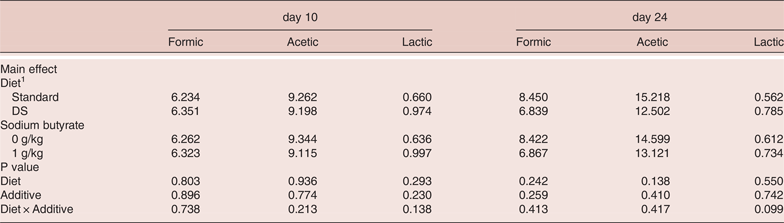
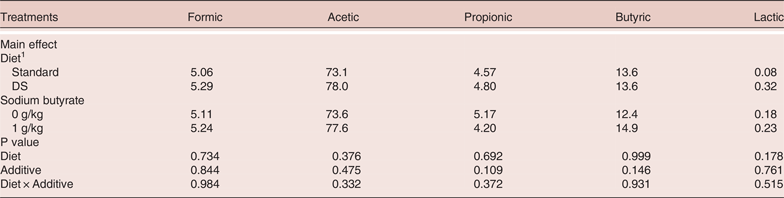
The effects of SB on ileal and caecal SCFA contents are presented in Tables 5 and 6. No differences of ileal and caecal SCFAs were detected among the birds under different treatments (P > 0.05).
Concentration of various short chain fatty acids (μmol/g) in ileal contents (experiment 1)

1Standard = starter 3000 kcal/kg, grower 3075 kcal/kg and finisher 3150 kcal/kg, DS = minus 50 kcal/kg relative to standard
Concentration of various short chain fatty acids (μmol/g) in caecal contents at day 24 (experiment2)

1Standard = starter 3000 kcal/kg, grower 3075 kcal/kg and finisher 3150 kcal/kg, DS = minus 50 kcal/kg relative to standard
Experiment 2
Growth performance
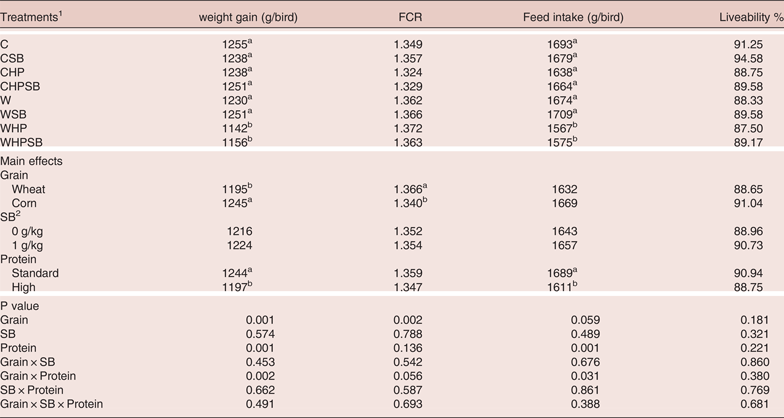
From days 0–10, no significant differences were observed in WG, FI, LV and FCR between birds fed different experimental diets (P > 0.05). From days 0–24, birds receiving the wheat based diet had poorer FCR (P < 0.01) and lower body WG (P < 0.01) compared with those fed corn diet (Table 7). No impact on performance was detected in birds supplemented with 1 g/kg SB (P > 0.05). Grain × protein interaction was detected for WG (P < 0.01) and FI (P < 0.05). Birds fed high protein diets had decreased WG and FI (P < 0.05) for the wheat based diets but not in corn based diets.
Performance of birds fed different diets from d 0–24 (experiment 2)

ab Means sharing the same superscripts are not significantly different from each other at P < 0.05.
1C = Corn based diet, CSB = Corn based diet + 1 g/kg Sodium butyrate in starter and 0.5 g/kg in grower, CHP = Corn based diet, high protein, CHPSB = Corn based diet, high protein + 1 g/kg Sodium butyrate in starter and 0.5 g/kg in grower, W = Wheat based diet, WSB = Wheat based diet + 1 g/kg Sodium butyrate in starter and 0.5 g/kg in grower, WHP = Wheat based diet, high protein, WHPSB = Wheat based diet, high protein + 1 g/kg Sodium butyrate in starter and 0.5 g/kg in grower
2SB = sodium butyrate
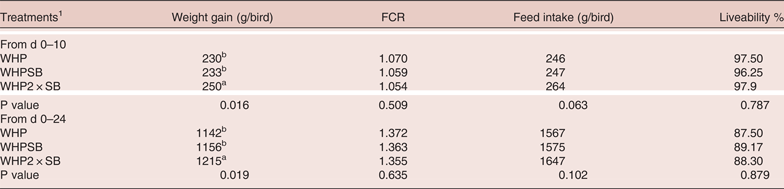
In the starter and grower phases, birds fed the WHP2 × SB diet were heavier compared with those fed WHPSB or WHP diets (Table 8). However, WHP2 × SB did not improve FI, FCR or LV of the birds (P > 0.05), although there was a tendency (P = 0.063) that WHP2 × SB fed birds consumed more feed than birds in other groups during days 0–10 of age.
Effect of sodium butyrate level in high protein wheat based diets (experiment 2)

ab Means sharing the same superscripts are not significantly different from each other at P < 0.05.
1WHP = wheat-based diet, high protein, WHPSB = wheat-based diet, high protein + 1 g/kg SB in starter and 0.5 g/kg in grower, WHP2 × SB = wheat-based diet, high protein +2 g/kg SB in starter and 1 g/kg in grower
Ileal and caecal pH
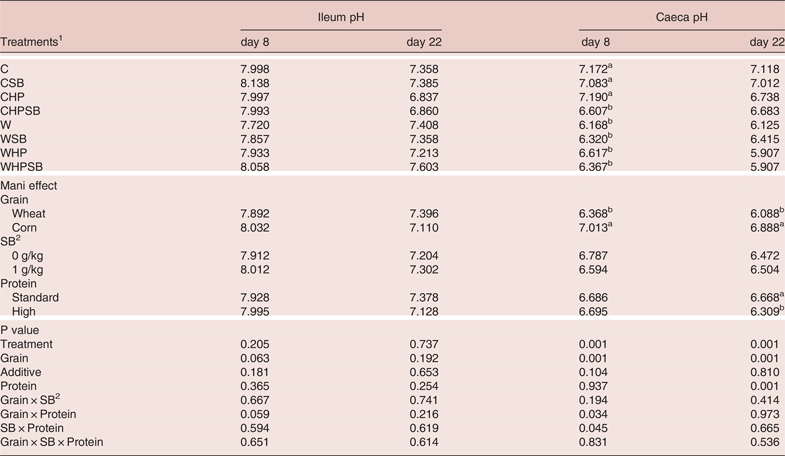
The pH of caecal digesta was lower in birds fed wheat based diets than those fed corn based diets at both days 8 and 22 (P < 0.01) (Table 9). The birds fed high dietary protein had decreased caecal digesta pH at day 22 compared to those fed standard protein diets (P < 0.001). Grain × protein (P < 0.05) and SB × protein interactions (P < 0.05) were detected for caecal pH at day 8. No difference of caecal pH was observed by alteration of protein level in corn-based diets but lower caecal pH was present in the high protein wheat-based diets while SB was supplemented. The birds fed the high protein diet supplemented with 1 kg SB had lower caecal pH (P < 0.01) in the corn-based diet but not in wheat based diet at day 8.
Ileal and caecal pH (experiment 1)

abc Means sharing the same superscripts are not significantly different from each other at P < 0.05.
1C = Corn based diet, CSB = Corn based diet + 1 g/kg Sodium butyrate in starter and 0.5 g/kg in grower, CHP = Corn based diet, high protein, CHPSB = Corn based diet, high protein + 1 g/kg Sodium butyrate in starter and 0.5 g/kg in grower, W = Wheat based diet, WSB = Wheat based diet + 1 g/kg Sodium butyrate in starter and 0.5 g/kg in grower, WHP = Wheat based diet, high protein, WHPSB = Wheat based diet, high protein + 1 g/kg Sodium butyrate in starter and 0.5 g/kg in grower
2SB = sodium butyrate
Discussion
The objective of the study was to determine the effect of coated SB supplementation on the growth performance and intestinal SCFA of broiler chickens, as varying responses have been reported regarding the usefulness of SB. Several studies have suggested that dietary SB or its salts had a positive effect on bird performance (Antongiovanni et al., Reference Antongiovanni, Buccioni, Petacchi, Leeson, Minieri, Martini and Cecchi2007; Taherpour et al., Reference Taherpour, Moravej, Shivazad, Adibmoradi and Yakhchali2009). However, other studies showed no such beneficial effects (Smulikowska et al., Reference Smulikowska, Czerwiński, Mieczkowska and Jankowiak2009; Zhang et al., Reference Zhang, Jiang, Zhu, Gao, Dai, Chen and Zhou2011; Czerwiński et al., Reference Czerwiński, Højberg, Smulikowska, Engberg and Mieczkowska2012).
In the present study, growth performance and intestinal SCFA of birds were not affected by dietary SB supplementation when it was included at 1 g/kg in the diets. These results are in agreement with Smulikowska et al. (Reference Smulikowska, Czerwiński, Mieczkowska and Jankowiak2009), Zhang et al. (Reference Zhang, Jiang, Zhu, Gao, Dai, Chen and Zhou2011) and Czerwiński et al. (Reference Czerwiński, Højberg, Smulikowska, Engberg and Mieczkowska2012). Collectively, these studies suggested that the dietary addition of SB did not have significant effects on WG, FI and FCR of birds grown in hygienic conditions and with high health status (Smulikowska et al., Reference Smulikowska, Czerwiński, Mieczkowska and Jankowiak2009). Furthermore, in the current study, SB did not affect ileal and caecal pH values and SCFA contents. Similar findings were reported in literature (Mahdavi and Torki, Reference Mahdavi and Torki2009; Smulikowska et al., Reference Smulikowska, Czerwiński, Mieczkowska and Jankowiak2009; Czerwiński et al., Reference Czerwiński, Højberg, Smulikowska, Engberg and Mieczkowska2012). However, the current study showed that SB at a higher dose (2 g/kg) significantly increased growth rate for the birds fed wheat-based diets.
The data showed that grain type had a significant effect on bird performance. The WG and FCR of birds fed corn-based diets were significantly better compared to those fed wheat-based diets. The poorer performance of birds fed wheat-based diets has been documented elsewhere. For instance, Abdollahi et al. (Reference Abdollahi, Ravindran and Svihus2013) showed that the digestibility of starch, nitrogen, fat, Ca and P, as well as apparent metabolisable energy values of wheat-based diets were lower than corn-based diets. In addition, wheat is known to contain a considerable amount of non-starch polysaccharides (NSP) which are anti-nutritive in poultry diets as they impede the digestion and absorption of nutrients (Choct et al., Reference Choct, Hughes and Bedford1999). In the present work, wheat-based diets decreased caecal pH suggesting more SCFAs had been produced. This is not surprising as the NSP move down the digestive tract undigested, and more substrates become available in the lower part of the gut where the microorganisms start to ferment them to produce metabolites (Mirzaie et al., Reference Mirzaie, Zaghari, Aminzadeh and Shivazad2012). A lower energy content coupled with a higher NSP level would make wheat an inferior cereal for broiler diets compared with corn.
High dietary protein levels negatively affected bird performance in the birds fed wheat-based diets. High protein diets significantly decreased body weight and FI of birds. However, such an effect was not observed in corn-based diets. Abdollahi et al. (Reference Abdollahi, Ravindran and Svihus2013) reported that wheat base diets had lower nitrogen digestibility when compared to corn. Thus, it can be speculated that the N excretion in wheat base diet was higher. Ritz et al. (Reference Ritz, Fairchild and Lacy2004) reported that N is excreted as uric acid and as undigested protein in faecal waste. Roughly 50% of the N content of freshly excreted poultry manure is in the form of uric acid. N in uric acid can rapidly convert to ammonia (NH3) by mineralisation, hydrolysis, and volatilisation (Oenema et al., Reference Oenema, Bannink, Sommer, Van Groenigen, Velthof, Hatfield and Follett2008). This may have negative effects on bird's appetite and hence affect weight gain. The current results showed that high dietary protein decreased caecal pH over the effects observed in similar diets with standard level of protein. This may indicate that the NSP in wheat exacerbated the amount of excess protein which escaped digestion and entered the hindgut where it was fermented, resulting in a caecal pH decrease. Nordgaard et al. (Reference Nordgaard, Mortensen and Langkilde1995) reported that protein which had avoided digestion and absorption in the small intestine, produced SCFAs and branched chain fatty acids. Protein fermentation can lead to unfavourable outcomes through the production of toxic substances, such as phenols, thiols, amines, ammonia and indoles, which may have negative effects on broiler performance.
Conclusions
The results of this study indicated that the inclusion of encapsulated SB at 1 g/kg did not substantially improve growth performance and change, ileal and caecal pH and SCFAs, but increasing inclusion rate to 2 g/kg improved bird weight gain. When trialling the efficacy of SB in poultry diets, the conditions under which the animals are maintained should be taken into account, as this appears to have an impact on responses.