INTRODUCTION
Rice is the main staple food for a large proportion of the world's population and is produced in at least 95 countries (Maclean et al. Reference Maclean, Dawe, Hardy and Patel2002; Zhang Reference Zhang2007). Rapid population growth and economic development pose growing pressures for increased food production. Demand for rice will grow to an estimated 2000 million tonnes by 2030 (FAO 2002). However, rice production is facing challenges from global warming, water shortages and other factors that limit the capacity of farmers to grow the crop (Ge et al. Reference Ge, Jin, Shi and Gao2002; Peng et al. Reference Peng, Huang, Sheehy, Laza, Visperas, Zhong, Centeno, Khush and Cassman2004; Krishnan & Surya Rao Reference Krishnan and Surya Rao2005; Bouman et al. Reference Bouman, Feng, Tuong, Lu, Wang and Feng2007; Krishnan et al. Reference Krishnan, Swain, Chandra Bhaskar, Nayak and Dash2007; Ainsworth Reference Ainsworth2008). Global average surface air temperature has increased significantly by 0·05–0·15°C per decade in the 20th century (Houghton et al. Reference Houghton, Ding, Griggs, Noguer, van der Linden, Dai, Maskell and Johnson2001). Enhanced greenhouse effects of greenhouse gases are predicted to cause an average global warming of 1·1–6·4°C by 2100 (Solomon et al. Reference Solomon, Qin, Manning, Chen, Marquis, Averyt, Tignor and Miller2007).
China is the leading rice-producing country, accounting for 0·32 of global production from only 0·20 of the world's rice-growing area (Childs Reference Childs and Champagne2004). Rice is very sensitive to excessive heat or cold, which has detrimental effects on grain yield. Global warming due to high levels of CO2 is a major concern for future crop production (Shimono et al. Reference Shimono, Okada, Yamakawa, Nakamura, Kobayashi and Hasegawa2008). In China, increasing temperatures have shortened the growing season in some locations, leading to decreased yields (Erda et al. Reference Erda, Wei, Hui, Yinglong, Yue, Liping and Liyong2005). High temperatures during the grain filling stage have been found to be one of the major factors affecting rice yield and grain quality. Many studies have suggested that spikelet fertility would be significantly reduced if air temperature exceeded 35°C at heading and flowering stages (He et al. Reference He, Bai and Tan1998; Wang Reference Wang2005; Lou et al. Reference Lou, Zhang, Sun, Zhan, Yu and Wu2006). Previous experiments in controlled-environment chambers revealed that temperatures above 34°C (Satake & Yoshida Reference Satake and Yoshida1978) or 35°C (Matsui et al. Reference Matsui, Omasa and Horie2001) at the time of anthesis induce floret sterility. Temperatures above 36°C at flowering, along with factors including higher air humidity and wind velocity, induce spikelet sterility of japonica rice, mainly through disturbances to pollination, while lower relative humidity (RH) reduces organ temperatures and spikelet sterility (Matsui et al. Reference Matsui, Omasa and Horie1997; Weerakoon et al. Reference Weerakoon, Maruyama and Ohba2008). High temperatures at the time of anthesis impede the swelling of pollen grains in the locules (Matsui et al. Reference Matsui, Omasa and Horie2000) which are the driving force for anther dehiscence. This can result in indehiscence of the anther and defective pollen release (Matsui et al. Reference Matsui, Omasa and Horie2000). The resulting poor pollination is the main cause of the floret sterility observed at those temperatures (Satake & Yoshida Reference Satake and Yoshida1978).
Canopy temperatures under varying sets of environmental conditions reflect the complex interactions between the energy absorption and dissipation mechanisms acting within the canopy (Ferguson et al. Reference Ferguson, Eslick and Aase1973). Canopy temperature and canopy temperature depression have been recognized as indicators of overall plant water status (Ehrler Reference Ehrler1973; Jackson et al. Reference Jackson, Idso, Reginato and Pinter1981; Blum et al. Reference Blum, Mayer and Gozlan1982; Choudhury Reference Choudhury1985) and have been used in such practical applications as evaluations of plant response to environmental stress (Jackson et al. Reference Jackson, Idso, Reginato and Pinter1981; Howell et al. Reference Howell, Musick and Tolk1986), irrigation scheduling (Hatfield Reference Hatfield1982; Wanjura et al. Reference Wanjura, Upchurch and Mahan1995), cultivar comparisons of water use (Hatfield et al. Reference Hatfield, Quinsenberry and Dilbeck1987), tolerance to heat (Reynolds et al. Reference Reynolds, Balota, Delgado, Amani and Fischer1994; Amani et al. Reference Amani, Fischer and Reynolds1996), drought (Blum et al. Reference Blum, Shpiler, Golan and Mayer1989; Royo et al. Reference Royo, Villegas, Garcia Del Moral, Elhani, Aparicio, Rharrabti and Araus2002; Fukuoka et al. Reference Fukuoka, Tani, Iwama, Hasegawa and Jitsuyama2003) and for assessments of grain yield (Ajayi & Olufayo Reference Ajayi and Olufayo2004). Genotypic differentiation temperature and its relationship to RH and dew formation are important aspects of the temperature complex. The value of leaf temperature minus air temperature has been used to predict the degree of water deficit in cotton (Baker et al. Reference Baker, Gitz, Payton, Wanjura and Upchurch2007). Rice genotypes have been screened for tolerance to high temperatures during flowering (Stake & Yoshida Reference Satake and Yoshida1978; Matsui et al. Reference Matsui, Omasa and Horie2001). These studies identified a few heat-tolerant genotypes capable of setting seed at high temperatures in both indica and japonica rice. Estimating the influences of environmental temperature on rice can be achieved by adjusting the temperature of the rice organ. Previous studies have paid more attention to the relationship of environmental temperature, such as air temperature and room temperature, on the spikelet fertility of rice.
The basis of the general relationship between organ temperatures and microclimate is understood and panicle-air temperature differences (TDs) have already been reported in relation to the pollination stability (Matsui et al. Reference Matsui, Omasa and Horie1997; Matsui et al. Reference Matsui, Kobayasi, Yoshimoto and Hasegawa2007; Weerakoon et al. Reference Weerakoon, Maruyama and Ohba2008). However, only a few studies have so far been conducted that report the effects of genotype, age of organs and agronomic practices on TDs and canopy temperature. The objectives of the present study were (1) to understand the effect of temperature and RH on panicle and leaf temperature; (2) to study the difference of panicle and leaf temperature in cultivars with different panicle characteristics; (3) to investigate the relationship between TD and spikelet fertility and (4) to investigate the effects of panicle fertilizer application rate on plant organ and canopy temperatures of rice, in order to assess the role of agronomic practices in enhancing the resistance of rice to heat injury.
MATERIALS AND METHODS
Field experiments
Experiment 1: Effect of air temperature on TDs between the air and the plant organs
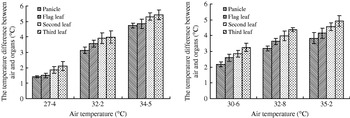
Weather data were collected for 10 days after heading of rice cultivars Kyou 818 in 2006 and Shanyou 63 in 2007 (primary cultivars in China at the time). The temperature and RH were measured at 13.00–14.00 h in both years. Data were collected for organ temperature and TDs and calculated for similar RH and contrasting temperatures (30·6, 32·8 and 35·2°C, respectively, for 2006; 27·4, 32·8 and 34·5°C, respectively in 2007). Other environmental factors were also measured at this time (solar radiation, 1011–1022 and 930–955 μmol/m2/s in 2006 and 2007, respectively; wind speed, 1·5–1·7 and 2·8–3·4 m/s in 2006 and 2007, respectively). In order to convert μmol/m2/s into W/m2 (J/m2/s), multiply by 0·342. Results are shown in Fig. 1.
TDs of panicle and leaf under environment of different air temperatures, but similar RHs. Cultivars, Shanyou 63 (indica; left) and Kyou 818 (japonica; right); environmental factors for Shanyou 63: solar radiation, 930–955 μmol/m2/s; wind speed, 2·8–3·4 m/s; RH 69–71%; environmental factors for Kyou 818: solar radiation, 1011–1022 μmol/m2/s; wind speed, 1·5–1·7 m/s; RH 61·6, 58·3 and 57·5%. Data are presented as means±s.e.d. of three replicates.

Effect of air RH on TD between the air and plant organs
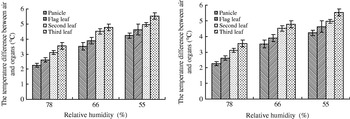
In 2006, the site microclimate was measured on 3 clear days, when solar radiation was 977–993 μmol/m2/s and wind speed 2·9–3·6 m/s. Cultivar Shanyou 63 was used and the measurements were conducted at the same time as the above study. Data for similar temperature (32·4–33·2°C) and contrasting humidity (49–84%) were also collected and calculated. In 2007, cvar Ningjing 1 was used and data for similar temperature (33·7, 33·2 and 34·1°C) and contrasting humidity (55, 66 and 78%) were collected and calculated on 3 clear days (solar radiation, 989–1002 μmol/m2/s; wind speed, 1·9–2·3 m/s). Results are shown in Fig. 2.
TDs of panicle and leaf under different RHs, but similar air temperatures. Cultivars, Shanyou 63 (indica; left) and Ningjing 1 (japonica; right); environmental factors for Shanyou 63, solar radiation, 977–993 μmol/m2/s; wind speed, 2·9–3·6 m/s; air temperature, 32·4–33·2°C; environmental factors for Ningjing 1, solar radiation, 989–1002 μmol/m2/s; wind speed, 1·9–2·3 m/s; air temperature, 33·2–34·1°C. Data are presented as means±s.e.d. of three replicates.

Effect of genotype on TD between air and plant organs
A field experiment was conducted between April and October in 2006 and 2007 at the Jiangning Experimental Station (118°30′E, 31°50′N. 8·9 m asl), of Nanjing Agricultural University, Nanjing, Jiangsu Province, China. Twenty-one indica and 29 japonica rice cultivars were included in the study. The seeding dates of varieties having different times to maturity were staggered in order to synchronize flowering among varieties. For indica cultivars, seeds were sown on 5, 10, 15 and 20 May and heading and flowering dates were 21–25 August. For japonica cultivars, seeding dates were 30 April, 5, 10, 15 and 20 May, and heading and flowering dates were 7–11 September.
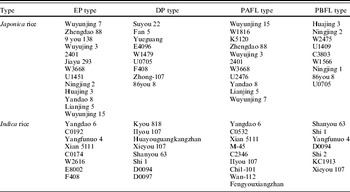
Cultivars were divided into two groups depending upon curvature of the panicle (panicle angle, i.e. the angle between stem and the extension line of the auricles and the top of panicle): (i) erect panicle cultivars (EP, panicle angle <40°) and (ii) droopy panicle cultivars (DP, panicle angle >50°). The EP group included 13 japonica cultivars and eight indica cultivars. The DP group included nine japonica cultivars and 8 indica cultivars (Table 1).
Cultivars used in the effect of genotype on panicle and leaf temperature in 2006 and 2007

EP=Erect panicle type: panicle angle <40°; DP=Droopy panicle type: panicle angle >50°; PAFL=panicle above flag leaf; PBF=panicle below the flag leaf.
Cultivars were also classified on the basis of the position of the panicle relative to the flag leaf (Table 1), i.e. either above it (50 mm between the top of the panicle, not including awns, and the top of the flag leaf 2 weeks after heading, PAFL) or below it (top of the panicle, not including the awns, PBFL). Each cultivar was grown in randomly arranged plots 4·0 m long×3·0 m wide, replicated three times. Plant spacing was 300 mm between rows and 133 mm between plants. The soil was sandy clay loam containing 0·9 g/kg total nitrogen, 126·5 mg/kg available nitrogen, 34 mg/kg available phosphorus and 114 mg/kg total potassium content. The total amount of nitrogen fertilizer (225 kg N/ha) was applied as carbamide to the soil at transplanting (108 kg N/ha), tillering (27 kg N/ha) and the initial stage of rachis differentiation (90 kg N/ha), respectively. The basal fertilizer application rates for phosphorous and potassium were 115 kg P2O5/ha and 180 kg K2O/ha. Phosphorous and potassium fertilizers were applied all at once before transplanting.
Experiment 2: Effect of nitrogen application rate on canopy temperature
A field experiment was performed in 2007 to evaluate the effect of panicle fertilizer application rates on canopy temperatures for cvar 2401 (japonica rice) and cvar IIyou 107 (indica rice). The basal fertilizer application rates for phosphorous and potassium were 115 kg P2O5/ha and 180 kg K2O/ha. The basal nitrogen fertilizer (67·5 kg N/ha) was applied at tillering as urea to the soil for japonica rice and at the initial stage of rachis differentiation (termed herein as panicle-spikelet fertilizer) at one of four levels: 0 kg N/ha (N0), 67·5 kg N/ha (N1), 135·0 kg N/ha (N2) or 202·5 kg N/ha (N3). For indica rice, the basal nitrogen fertilizer applied at tillering was 56·25 kg N/ha and the four treatments applied at the initial stage of rachis differentiation were 0 kg N/ha (N0), 56·25 kg N/ha (N1), 112·5 kg N/ha (N2) and 168·75 kg N/ha (N3). The experimental design was a split-plot technique where fertilizer applications were the subplots. The experiment was replicated three times with a total plot area of 50 m2.
Plant growth chamber experiments
Effect of temperature and RH on TD and spikelet fertility
Plant growth conditions and plant growth chambers
In order to avoid environmental errors, controlled environments (growth chambers) were used to study the influence of humidity and temperature on the panicle temperature and fertility of rice.
In 2007, two indica hybrid cultivars of rice, Shanyou63 and IIyouhang1, were grown in growth chambers. A combination of two levels of RH and two levels of air temperature were imposed. Rice plants of each cultivar were grown in 40 pots with four plants per pot (300×300 mm). Basal fertilizers were applied at the following rates: 225 kg N/ha, 115 kg P2O5/ha, and 180 kg K2O/ha. Water was applied every day to maintain consistent level of soil moisture among the treatments, because the soil water content significantly influenced the canopy temperature of rice (Zhang et al. Reference Zhang, Han, Du, Huang and Chen2007b).
Plant growth chambers (overhead light artificial climate chamber, QS-AGC-3, Zeda Instruments, China) were used, each chamber measuring 5 m×3 m×2 m with a light source (Philip's plant growth light) to maintain a photosynthetic photon flux density (PPFD) of 800 μmol/m2/s. Temperature controls were maintained by air-conditioning (CJX1-9, PEOPLE GROUP, China) and the chambers were maintained at 390 μmol/mol CO2 of air. Air temperature and RH were monitored and controlled with TC2 controllers (Environmental Growth Chambers, Inc., Chagrin Falls, OH).
Heat stress treatment
Plants were sown in pots and maintained outside during the vegetative growth period. After transfer to plant growth chambers at heading, different temperature and RH treatments were applied during pollination. Ten pots (40 plants) of each cultivar were transferred to plant growth chambers for each treatment at the heading stage. The four treatment conditions were: (1) ambient temperature at 28°C and low RH at 50% (28/50); (2) ambient temperature at 28°C and elevated RH at 80% (28/80); (3) high temperature at 35°C and low RH at 50% (35/50); (4) high temperature at 35°C and elevated RH at 80% (35/80). Treatments were applied for 5 days, 480 μmol/m2/s photosynthetic photon flux, with a 14 h day length beginning at 07·00 h. The heating began at 09·00 h and ended at 15·00 h; after 5 days at these temperatures and RH levels, plants were transferred back to field conditions.
Data collection
Air temperature, RH and organ temperature measurements
After the heading stage, 10 random samples per plot were taken, between 13.00 and 13.30 h, with three replications, using the hand-held infrared thermometer (Foodpro, Raytek, USA), to calculate the mean surface temperature of organ in each plot. Air temperature and RH measurements were taken at 200 mm above the canopy and were measured continuously with solid-state sensors (ZDR-20, Zeda, China and Model DHM-2, Aspiration Psychrometer, China); values were recorded at 10 min intervals. In addition, solar radiation and wind speed were also recorded at 10 min intervals by a data logger (Delta-T Devices, UK).
Thermal image acquisition
Thermal images of the canopies of two cultivars were obtained for panicle fertilizer treatments under cloudless weather conditions, using a ThermaCAM camera (model P25, FLIR systems, USA). Thermal images were taken from 12.00 to 13.00 h, the view of angle was 45° off the horizontal at a distance of 1 m from the lens to the upper leaves, and ambient conditions were 29°C and 50% RH.
Spikelet fertility, seed setting rate and 1000 grain weight determination
At maturity, the spikelet fertility of 30 panicles per treatment, chosen at random, was measured. These panicles were harvested at physiological maturity and data on the numbers of filled and unfilled grains per panicle were collected. The proportion of filled grain was estimated as the ratio of number of filled grains to total number of reproductive florets (expressed as a proportion). ‘Seed setting’ was estimated as the ratio of the number of completely filled grains to the total number of reproductive florets (expressed as a proportion). Each floret was pressed between the forefinger and thumb and the starch observed to determine whether the grain was filled or not. The number of filled grains included both completely and partially filled grains. A 1000-grain random bulk sample was used to determine 1000 kernel weight. The sample was oven dried at 105°C for 72 h to determine weight and adjusted to fresh weight by adding 135 or 145% g moisture/kg seed for indica and japonica rice, respectively. Five replicates for each treatment were used.
Data analysis
The experiment was arranged in a randomized block design with three replications. Standard errors and significant differences between samples were determined using the SPSS 11·5 statistical software.
RESULTS
Effect of air temperature and RH on TD of panicle and leaf
As shown in Fig. 1, for a similar RH, panicle and leaf temperatures of rice at a lower air temperature were significantly lower than those at a higher air temperature. TD between air temperature and organ temperatures increased as the air temperature increased. Organ temperatures were significantly different between different organs of the rice plant, with a decreasing order of flag leaf>second leaf>third leaf. Panicle temperature was generally higher than leaf temperature for the same air temperature and so the panicle TD was less than the leaf TD. This suggests that air temperature could have a greater impact on the upper organs such as the panicle than on lower organs such as the third leaf.
Under similar air temperatures, there was a significant difference in panicle and leaf temperature between different RHs (Fig. 2). Panicle and leaf TDs at higher air humidity were significantly lower than those at lower air humidity, i.e. the higher the air humidity, the higher the organ temperature for the same air temperature. TDs at the lower humidity were larger than those at the higher humidity.
Effect of genotype on panicle and leaf temperature
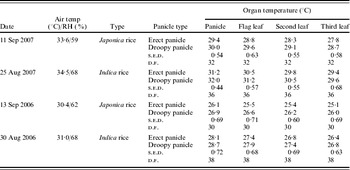
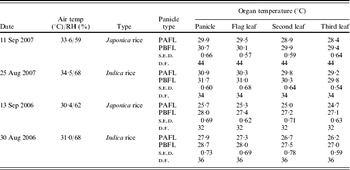
As shown in Table 2, panicle and leaf temperature of cultivars with erect panicles were significantly lower than those with droopy panicles for both japonica and indica rice cultivars. This showed that the TDs of EP were higher than those of DP. The measurements were the same for both panicle and leaves. Similarly, panicle and leaf temperature of the PAFL-type cultivars were lower than those of the PBFL-type cultivars (Table 3), indicating that the TDs of PAFL-type cultivars were higher than those PBFL-type cultivars. Generally, the panicle and leaf temperature of japonica rice were lower than those of indica rice, i.e. the TDs of japonica rice were higher than those of indica rice.
Effect of rice panicle type on panicle and leaf temperature

Air temp: air temperature; RH: relative humidity. Erect panicle type: panicle angle <40°; Droopy panicle type: panicle angle >50°. Daily maximum and minimum temperature: 35·6 and 27·2°C (11 Sep 2007, japonica rice), 36·5 and 27·9°C (25 Aug 2007, indica rice), 32·4 and 23·1°C (13 Sep 2006, japonica rice), 33·3 and 25·2°C (30 Aug 2006, indica rice), respectively.
Effect of rice panicle position on panicle and leaf temperature

PAFL type, cultivars with panicle above flag leaf; PBFL type, cultivars with panicle below the flag leaf. Daily maximum and minimum temperature: 35·6 and 27·2°C (11 Sep 2007, japonica rice), 36·5 and 27·9°C (25 Aug 2007, indica rice), 32·4 and 23·1°C (13 Sep 2006, japonica rice), 33·3 and 25·2°C (30 Aug 2006, indica rice), respectively.
Effect of temperature and RH on TDs, spikelet fertility and seed setting
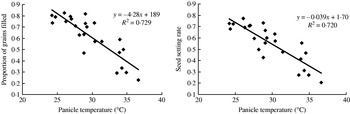
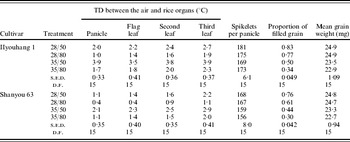
Under controlled atmospheric conditions, the effect of ambient temperatures and different levels of RH on organ temperatures and spikelet fertility were studied in a number of rice cultivars. There was a significant relationship of organ temperatures with air temperature and RH (Table 4). TDs for treatment 35/50 were significantly higher (P⩽0·05) than for treatment 35/80, whereas TD for treatments 28/50 and 28/80 were generally smaller. The TD difference of cvar Shanyou 63 in treatments 28/50 and 28/80 were greater than for cvar IIyouhang 1. The proportion of filled grain was higher in lower RH environments (e.g. 35/50) than for the same variety grown at a higher RH (e.g. 35/80; Fig. 3 and Table 4). Panicle temperature was negatively correlated with the proportions of seed set and grains filled under ambient temperatures of 28–35°C. The performances of the two cultivars were the same.
Relationship between panicle temperature and proportion of grains filled (left), proportion of seeds set (right). Panicle temperature was measured on the second day after air temperature and RH treatment (in plant growth chambers). At maturity, filled grain rate and seed setting rate were measured.

Effect of ambient temperature and RH on TD and spikelet fertility of two indica cultivars of rice

The four air temperature and RH treatment were in plant growth chambers.
Effect of panicle fertilizer application rate on canopy temperature
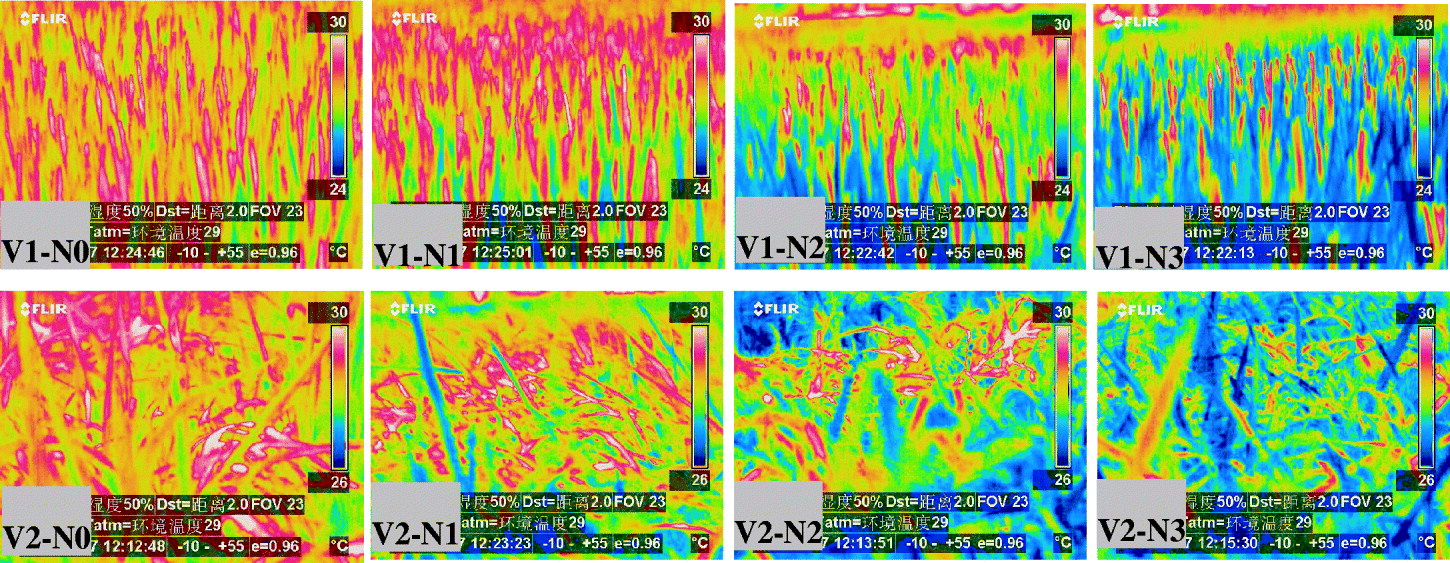
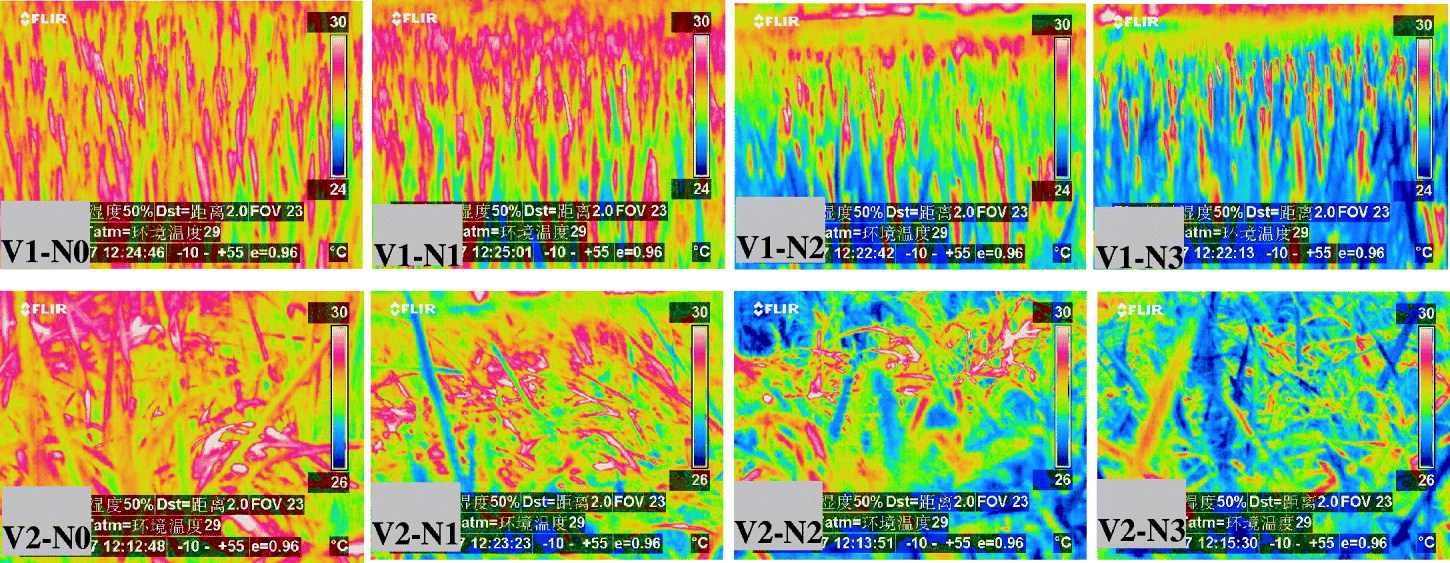
The different colours in the infrared image represent different canopy temperatures, blue and red indicating lower and higher temperatures, respectively. The temperature ranges were 24–30°C (2401) and 26–30°C (IIyou 107), respectively.
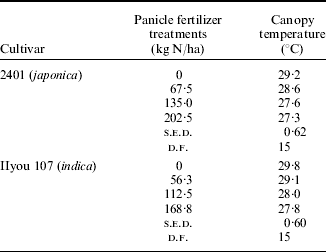
Canopy temperature was significantly affected by different panicle fertilizer treatments (Fig. 4 and Table 5). The canopy temperatures of plots treated with higher panicle fertilizer application rates were lower, with the order of decreasing temperatures being N0>N1>N2>N3.
Infrared image of rice canopy for different panicle fertilizer treatments at heading stage. V1: 2401 (japonica rice); panicle fertilizer application rate treatments (kg N/ha) were: N0=0 (control treatment), N1=67·5, N2=135·0 and N3=202·5. V2: IIyou 107 (indica rice); panicle fertilizer application rate treatments (kg N/ha) were: N0=0 (control treatment), N1=56·25, N2=112·50 and N3=168·75.
Effects of different panicle fertilizer treatments on canopy temperature of two cultivars of rice at the heading stage
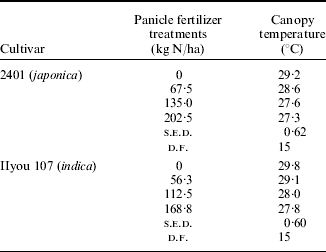
N0, N1, N2 and N3 were panicle fertilizer application rate treatment (N0, control treatment; the order of panicle fertilizer application rate was N0<N1<N2<N3); Environmental factors: solar radiation 1008·8 μmol/m2/s; Wind speed 2·2 m/s; RH 51%; Air temperature 30·5°C.
DISCUSSION
The ecological mechanisms of crop responses to heat have been investigated through studies of canopy characteristics and the relationships with canopy temperatures. Mackill & Coffman (Reference Mackill and Coffman1983) observed, under identical air temperatures, that lower temperatures of the panicle indicated slight heat injury. Xu et al. (Reference Xu, Chen, Zhang and Yang1990) noted that lower canopy temperatures enhanced resistance to heat injuries. Prasad et al. (Reference Prasad, Boote, Allen, Sheehy and Thomas2006) recorded that different rice populations had different canopy temperatures. Due to different panicle fertilizer treatments, Zhang et al. (Reference Zhang, Zheng, Yang, Tian, Peng, Li, Bian and Zhang2007a) found that TD was positively correlated with leaf area index, biomass and the absolute number of tillers, but there was a significant negative correlation between TD and canopy light intensity. In wheat at high temperatures, high depression of canopy temperature (CTD), resulting in relatively lower canopy temperatures, was associated with higher photosynthetic rates. Thus, it was suggested that CTD may offer a potential methodology for screening physiologically superior lines in wheat breeding programmes (Ayeneh et al. Reference Ayeneh, van Ginkel, Reynolds and Ammar2002). Based on the present field experiment and plant growth chamber experiments, the results show that panicle temperature is generally higher than leaf temperature, but lower than the above-canopy air temperature. This is in agreement with Yoshimoto et al. (Reference Yoshimoto, Oue, Takahashi and Kobayashi2005), who measured panicle temperature in Wuxi, Jiangsu, China and showed that the panicle temperature was similar to or slightly lower than air temperature inside the canopy (at the panicle height) but 0·4–1·5°C lower than the above-canopy air temperature. They developed a simple heat-budget model to calculate panicle temperature in the rice canopy. In the present work, parameters were measured at 13.00–14.00 h in both field plots and plant growth chambers, under similar climatic conditions (solar radiation, wind speed, canopy conductance and atmospheric CO2 concentration), with only air temperature and RH varying. The results showed that the TDs of rice organs during the heading stage were positively correlated with spikelet fertility. These results are in accordance with previous findings (Weerakoon et al. Reference Weerakoon, Maruyama and Ohba2008) and suggest that employing CTD for crop improvement has considerable potential.
The infrared images of different populations directly reflect the relationship between canopy temperature and agronomic practices, such as panicle fertilizer application rates. Based on the present field experiments, different populations were constructed through panicle fertilizer treatments and it was found that increasing panicle fertilizer application rates resulted in reduced canopy and organ temperatures, the difference between them being up to 2°C. Similar work on wheat (Fischer et al. Reference Fischer, Rees, Sayre, Lu and Condon1998) also showed that different genotypes, as well as different fertilizer rates applied to the same genotype, had different community structures and panicle temperatures. Seligman et al. (Reference Seligman, Loomis, Burke and Abshahi1983) proposed that the canopy of spring wheat grown with an ample supply of nitrogen was generally cooler than the canopy of a nitrogen-deficient crop. A possible ecological mechanism is that higher panicle fertilizer application rates result in a larger population, as well as increases in total leaf area index, the number of productive tillers and absolute plant height. Therefore, it decreases canopy light intensity and resulting energy. On the other hand, total transpiration increases along with plant metabolism and an increase in radiation could result in lower temperatures for the organ and canopy. Medium panicle fertilizer application rates treatment had stronger leaf photosynthesis capability and intense transpiration rates. This may reduce the temperatures of the panicles, leaves and canopy, and improve resistance to heat injury.
High temperatures reduce spikelet fertility and grain yield of rice (Zheng et al. Reference Zheng, Zhang and Chen2005). Furthermore, spikelet fertility is directly influenced by air temperatures greater than 35°C at the heading and flowering stages (He et al. Reference He, Bai and Tan1998; Wang Reference Wang2005; Lou et al. Reference Lou, Zhang, Sun, Zhan, Yu and Wu2006). This may be associated with increased temperatures of the rice organs (Prasad et al. Reference Prasad, Boote, Allen, Sheehy and Thomas2006). In contrast, Zheng (Reference Zheng2003) found no significant correlations among light intensity, air temperature and spikelet fertility. However, the above studies mainly focused on the effect of air temperature on spikelet fertility, with little emphasis on the effect of rice organ temperatures, RH or plant type of cultivars. The present results show that panicle and leaf temperature under lower RH conditions are lower than those for higher RH. This might be attributed to the higher vapour pressure at high RH, which depresses transpiration and thus increases the temperature. Besides, based on the experiments in the field, it was found that TDs of cultivars with erect panicles were higher than those with droopy panicles. These results are in agreement with the finding of Xu et al. (Reference Xu, Chen, Zhang and Yang1990), who reported that the micro-meteorological conditions of EP were superior for photosynthesis than that of cultivars with droopy panicles. Generally, the organ temperatures of japonica rice were lower than those of indica under similar climatic conditions. This might be due to the fact that the leaves of japonica rice are often erect and narrow, and the stoma are abundant, so these plants have higher metabolic activity and transpiration rates, which leads to increases in released energy. Therefore, cultivars exhibit difference in organ temperatures, physiological traits and yield; this is similar to the findings of Vargas et al. (Reference Vargas, Crossa, Reynolds, Dhungana and Eskridge2007). The panicle temperature was generally higher than leaf temperature but lower than air temperature, indicating that air temperature could have a greater impact on the upper organs (panicle) than the lower organs (the third leaf). This probably reflects the greater receipt of solar radiation by upper organs compared to lower (shaded) ones.
The effect of air temperature and RH on organ temperatures and spikelet fertility was also studied in plant growth chambers, which showed significant difference among organ temperatures at same air temperature with different RH levels. This is partly attributed to the higher vapour pressure under high RH conditions, which decreases transpiration and thus ultimately increases the temperature. It is obvious from these results that the RH influences spikelet fertility differently than air temperature. Matsui et al. (Reference Matsui, Omasa and Horie1997) found that the fertility of spikelets flowering at 37·5°C was highest with 45% RH, followed by that at 60% RH, and lowest at 80% RH. Weerakoon et al. (Reference Weerakoon, Maruyama and Ohba2008) showed that the lower RH reduced organ temperatures and spikelet sterility. The present results are in agreement with these observations. The higher temperature and RH environment cause organ temperatures to increase, reducing spikelet fertility. Although the air temperature was high during the grain filling stage at Taoyuan (China), the present research also reported higher spikelet fertility. This is partly attributed to the lower RH, which resulted in increased transpiration and decreased the rice organ temperatures. But under higher RH conditions in Nanjing (China), plant organ temperatures are higher, which affects physiological processes and causes lower spikelet fertility. In addition, it was also observed that organ and canopy temperatures were significantly affected by panicle fertilizer application rates; therefore, regulating cultivation practices (fertilizer application, etc.) may be useful for establishing which populations have reasonable canopies and resist heat stress damage, which ultimately could favour higher and more stable rice production.
In the present study, differences in rice organ temperatures were associated with panicle type and position, nitrogen application rate at panicle stage, RH and air temperature. The main conclusions are: (1) organ temperatures and spikelet fertility varied with air temperature, RH and rice genotypes at heading stage. It was found that increasing RH at constant air temperature or increasing air temperature at constant RH significantly increased the panicle and leaf temperature. A higher RH at flowering under high temperature had a negative effect on fertility. (2) Cultivars with erect panicles showed lower organ temperatures than did cultivars with droopy panicles under similar climatic conditions. Cultivars of PAFL-type had lower organ temperatures than those of the PBFL-type. Genotypic panicle characteristics may indicate responses to the cultivar to high temperature. (3) Agronomic practices, such as panicle fertilizer application rates, had a significant effect on the temperatures measured at both organ and canopy, and also enhanced the resistance of rice to heat stress.
This research was supported by the National Natural Science Foundation of China (NSFC30471016) and National Ample Commissariat Program of Technology (2006BAD02A03).