IntroductionFootnote *
The study of kinship and kinship ideology has long been one of the main topics of anthropological research, and among scholars of Indian society it has figured at the heart of many village ethnographies, though often secondary to the overwhelming preoccupation with caste and religion (see Lambert Reference Lambert and Carsten2000: 73–74). Unfortunately, however, this concern with kinship relationships has only rarely been extended to studies of work and industry on the sub-continent. While class formations, migration, work regimes, labour recruitment, structures of hierarchy and gender are only some of the topics elaborately analysed in recent anthropological and historical publications, kinship seems to have disappeared from the scene altogether (Breman Reference Breman1994; Reference Breman1996; Chandavarkar Reference Chandavarkar1994; Fernandes Reference Fernandes1997; Nair Reference Nair1998; Sen Reference Sen1999; van der Loop Reference Van Der Loop1996). In his introduction to the edited volume The Worlds of Indian Industrial Labour (1999), Parry recognised that
The problem with much of the sociology of India has been its rather one-sided preoccupation with representations and values, and with caste, kinship and ritual, the problem with the study of labour has been an almost equally one-sided preoccupation with interests, with instrumental or ‘practical’ reason, its want of ‘thick description’ and its ‘black-box’ treatment of culture (1999: xii).
While the papers in the volume undoubtedly provide a good deal of ‘thick description’ and open up the worlds of work and industry, an ethnography and analysis of kinship relations, discourses and representations remain largely absent. One exception, however, is the contribution of Douglas Haynes. In his discussion of labour relations in the textile industries of Surat and Bhiwandi, Haynes focuses on the ‘discourses’ of workers and owners about their past relations in the industry (1999: 142). Various sets of actors deploy the ghar (family or home) as a metaphor for worker-employer relations before 1960. While the portrayal of past relations ‘as having been like a family’ takes a central place in how the past is recalled, each group of actors do have sharply different views of whether work relations were once family-like. Haynes paper is appealing for at least two reasons. First, he focuses on the role of kin relations in the industry (many workers were related to their employers as real kin), and even more so on how a particular idiom of kinship is constructed and deployed by different actors (workers, employers and union activists) for various reasons. He shifts the focus from a narrow preoccupation with structural kin links to the varied ways in which kinship and its discourses are constructed, deployed or denied within a context of work. Kinship, it transpires, is highly malleable and negotiable, and can be strategically widened or limited according to need. Second, he relates the actors’ ideas and representations to their material conditions and interests. The workers’ views of past labour relations differed significantly from those of their employers, largely because of their different conditions within the industry. The workers’ nostalgic attitudes and more critical recollections were shaped by a present characterised by serious strains between capital and labour and by real fears of losing work (ibid.: 157–162). In short, Haynes goes some way to answer Béteille's call of more than thirty years ago to complement the ‘sociology of ideas’ with a ‘sociology of interests’ (Béteille Reference Béteille1969).
In this paper I will similarly be concerned with the place of kinship within the context of work and co-operation, and in particular with the issue of the morality of kinship and the nature of that morality in contexts that stretch beyond the household and the family. What kinship terms/discourses are used to invoke relatedness on the shop floor? What sort of fictive kinship is created between employers and workers? And, how is the morality of kinship invoked inside the factory and with what effects? It will be suggested that while factory owners make constant attempts to use kin morality strategically on the shop floor to instil commitment and discipline in the labour force, these attempts repeatedly fail in an unstable labour market where workers continually shift between factories. Those proclaimed to be ‘kin’ by the employer frequently let down their patron, opting for those employers who can provide regular work and income. The argument put forward in what follows points to the limits of morality and questions its effectiveness in the context of labour recruitment and deployment. I will reconsider the plausibility of the claim made by Bloch that ‘the crucial effect of morality is long term reciprocity and that the long term effect is achieved because it is not reciprocity which is the motive but morality’ (1973: 76).
In two seminal papers on the issue, Bloch introduced two conceptual distinctions, which are worth recalling here. First, in an article on the economic significance of the morality of kinship, he distinguishes between the short term and the long term (1973: 75–77). Kinship relates to the long term, that is, it tolerates imbalances in the reciprocal aspects of the relationship. In other words, kin are not only expected to help each other out, but they are also expected to tolerate delays in return or remuneration. There is reciprocity involved in the relationship, but, Bloch argues, ‘it is a special kind of reciprocity whose characteristics derive from the categorical moral nature of the dogma’ (ibid.: 81). It is the moral character of kinship that forces the actor to accept imbalances in the short term. Relationships between friends or neighbours, on the other hand, operate in the shorter term, as the willingness to accept imbalances is lower and the relationship thus less moral. Bloch illustrates his point with examples from the Merina in Madagascar whose agricultural working groups always consist of more artificial kinsmen than real kinsmen. The reason for this is plain. Reciprocal arrangements are set up between people who need each other's labour in the short run, while real kin can always be relied on anyway, even if their labour can only be reciprocated with delay. Less moral relationships (such as artificial or distant kin, neighbours or friends) are useful in the short term as they are cheaper to maintain and can more easily be discarded (ibid.: 84). To cover labour needs in the long term, however, one has to rely on closer kin as their reliability over time stems from the morality of their relationship (ibid.: 79). I will return to this distinction below, and question this last assumption: that kinship entails by definition a morality that turns kin into reliable and trustworthy co-operators.
The second distinction introduced by Bloch is that between the moral and tactical meanings of kinship terms (1971). Kinship terms have both a moral meaning and a tactical or strategic use. Rather than to try to record each and every person who can be called by a particular kin the term, Bloch recommends us to define the term as a moral concept first—that is to unravel what values and expectations it implies—and then to observe the tactical uses to which it is put and which may have little to do with kinship in the strict sense of the word (1971: 84). The Merina kin term havana for example, can be translated as ‘kinsmen’, but it can also be used for anybody with whom one is claiming a relationship, even for people with whom one does not have a genealogical or affinal link (ibid.: 81–82). We therefore have to unravel its moral meaning first and then see how it is tactically used in specific contexts. I will draw on this distinction below and explore how certain kin terms are used on the shop floor to create ties of kinship and to transport their moral content from the home to the factory.
In what follows, I will first describe the dyeing industry, the community of Vanniyars involved, the neighbourhood in which they live, and the highly irregular and unpredictable employment conditions that shape their work pattern. I shall then investigate how employers’ malleable constructions of ‘kinship’ and ‘relatedness’ on the shop floor aim at securing a stable labour force, disciplining workers and generating loyalty among labourers in a highly fluctuating market. These discourses of kin-cum-labour relations will then be contrasted with workers’ responses and with the harsh reality of a high labour turnover and constantly collapsing relations of trust. While the morality of kin loyalty and caste unity, invoked by the employers in their attempts to secure a reliable labour force and to prevent class opposition, do succeed in silencing the workers on the shop floor, the latter are certainly not prevented from leaving labour conditions they do not like or representations they do not share. It is only by distinguishing between discourses of kinship on the one hand, and the actual deployment of kin on the shop floor on the other hand, that we can begin to see how representations of kin and caste unity promoted by the employers intend to generate workers’ co-operation, but fail in the light of the volatility of labour within the industry.
The dyeing industry of the small town Bhavani (Erode District) in Tamilnadu, sets the scene and the owners of small workshops, their managers, maistries and workers are the actors. Fieldwork in the dyeing factories was conducted between August 1995 and January 1997, and in more detail from October 1999 till September 2000. The data presented result from a survey conducted in about 25 dyeing units, from in-depth interviews with owners and workers, and from extensive observation and participation on the shop floor. Whereas Haynes, referred to above, emphasises that his informants were ‘recalling’ past labour relations ‘in response to specific stimuli rather than retrieving some kind of readymade memories intact’ (1999: 144). The comments he heard were ‘hardly a pure form of workers’ ‘discourse’. They were responses to specific questions posed by an American scholar’ (ibid.: 143). In other words, they were removed—both through time and place—from the actual labour relations on which they reflect. My data were gathered in a radically different manner. I recorded the use of kin terms on the shop floor itself where they are crucial for the ongoing formation of labour relations within the factory and the neighbourhood. While these discourses and representations have been affected due to the presence of the anthropologist in the workplace, the point is that they were never primarily directed towards me, but usually towards the others in the workplace. They were seldom comments in response to direct questions, although I obviously picked up on the discourses and asked the informants to elaborate on them, probably more than they would normally do.
The dyeing industry, the neighbourhood and the Vanniyars
Dyeing in and around Bhavani developed as an ancillary industry to the handloom and power-loom industry in the area. The first factories were initially situated in Kumarapalayam and run by the owners of the power-loom factories, who were manufacturing lungis, towels and handkerchiefs for the Indian market. The power-loom owners, mainly belonging to the traditional weaving castes of Mudaliyar and Devangar Chettiyar, used to have their own dyeing units, for which labour was provided by the low caste Vanniyar and SC communities, such as Paraiyar and Chekkliyar. The Vanniyars, locally called Padaiyatchi and traditionally known as agricultural labourers and small cultivators, are today mainly employed as textile workers, especially as dyers; they currently constitute about 75% of the labour force in the dyeing industry. Work in a yarn dyeing unit is particularly polluting, dirty and exhausting, and this is recognised by the higher caste employers as the reason for the presence of Vanniyars in the industry. ‘This is very dirty work; only we Vanniyars will do it and only we are physically strong enough to work in it’ summarises how the Vanniyars themselves commonly explain their role in the industry.
But it is with some pride that they talk about their position in the local society and economy. While the above statement might seem to reflect submissive acceptance of a position shaped by preoccupations of purity and status, the Vanniyars have come up within the industry and over the last twenty odd years a number of them have moved up from worker to maistry to leaseholder, and have more recently become owners of dyeing factories. The shift to export production (marked by enhanced instability), the growing size of their industries and the increase in labour problems, turned many of the integrated factories into unmanageable units for the Mudaliyar and Devangar Chettiyar owners (see De Neve Reference De Neve1999a). From the 1980s onwards the latter began to lease out their dyeing units, usually to maistries or managers who had worked for them. In most cases these were Vanniyars. With the little money they had saved—they could usually lease the factory on favourable terms anyway—and with their practical experience, the Vanniyars were able to run the dyeing sheds without difficulty. Gradually, as they made substantial profits in the industry and benefited from further expansion during the 1980s and 1990s, many of them began to construct their own factories and continued to produce for manufacturers. However, apart from money and skill, close networks of kinship and neighbourhood played a crucial role and it is these dynamics which are explored below.
While most dyeing factories were initially located in and around the nearby town Kumarapalayam, where they mushroomed alongside the power-loom factories from the 1950s onwards, a large and increasing number of units can today be found in two main locations: Kadayampatti and Sengadu Thottam. Kadayampatti is a small village, situated one mile north-west of Bhavani, and forms one of the yelu ur (seven towns), which constitute the area in which the Yelu Ur Padaiyatchi (Vanniyars) are the dominant community. It was here that the Vanniyars started their first own factories in the early 1980s. Given that Kadayampatti is bordering the Bhavani river, water for dyeing is abundantly available and as this is one of their ‘own’ villages, Vanniyars with money had easy access to land.
Sengathu Thottam, which will be the focus of this paper, was originally a small and scarcely populated settlement situated in the open fields between Bhavani and Kadayampatti. With the expansion of the town municipality, however, it became integrated in Bhavani as a neighbourhood, which currently forms the north-western border of the town. Sengadu Thottam is almost exclusively a Vanniyar neighbourhood. Since the late 1980s, dyeing units mushroomed also here and throughout my fieldwork in 1999–2000, new units were constructed. Physically, Sengadu Thottam stretches along one long road, winding from south to north and has in many ways retained the appearance of a village. Surrounded by fields and waste land on the west and north, the neighbourhood gives a rather rural impression and its single main road was tarmaced only two years ago. Most of the houses are built from brick, have tiled roofs and consist of no more than one or two rooms. Drinking water facilities are limited to the municipality pumps along the road. Recently, however, rather impressive bungalows, made from concrete and finished with teakwood and marble floors, have sprung up amid the workers’ houses and dyeing units. Constructed by factory owners, they reflect most visibly the current upward mobility of the community as a whole. While some workers may critically comment on them, they are generally referred to as markers of the Vanniyars’ economic potential and upward social mobility, to which most community members openly aspire.
Kadayampatti and Sengadu Thottam together have about 90 factories and this number is constantly rising, even though 10 units were recently forced to close down for breaking pollution regulations. The factories in Sengadu Thottam are located along the main road, interspersed with houses and fields. Constructed of bricks and covered with sheets of corrugated iron, the factories are long, half-open buildings which contain a number of dyeing tanks (thotti) and low stone pillars used for squeezing the yarn. Attached to the main building, one often finds a small room where chemicals and yarn are stored. As most units are merely small workshops, separate offices are seldom used. The owner and manager usually work on a small desk placed somewhere in a corner of the factory. While nowadays the factory owners are obliged to build an effluent treatment tank to purify dyed water, only about 40 out of the 80 running factories have actually constructed such a system. Behind the factory, the yarn is dried in the open sun, on bamboo sticks, and some owners have erected a shed (pandal), made from wood and coconut leaves, to allow drying during the rainy season.
Work and its division on the shop floor
Since 1998, a few better-off factory owners, who run larger units, have purchased machines following a trend towards mechanised dyeing.Footnote 1 However, they are only a handful so far and most yarn dyeing in the area is an entirely manual operation. Indeed, the labour intensive nature of the industry is a key characteristic. A brief description of the tasks performed in a dyeing unit is indispensable. The workers arrive at about 9am in the morning and start filling the tanks and barrels with water. The previous evening, the yarn has been washed and is therefore ready for dyeing. At the same time, the maistry is carefully mixing the dyes and chemicals in order to obtain the required colour. He then dyes a few threads of yarn, dries them in front of a fan and compares the colour with that of the sample given by the manufacturer. In case the colours do not match, the maistry has to repeat the process and change the combination of chemicals until the right colour appears. This ‘shade matching’, as it is called, is a crucial part of the dyeing process. Once the maistry has found the correct combination of chemicals, he passes it on to the dyers who then start to dye the whole order. Either the maistry himself fills the tanks with the correct mixture of chemicals, or he instructs the dyers which chemicals to use and in what quantities. Producing exactly the colour that is required is the main task of the maistry and if he fails to get the colour right, the entire order may be rejected and payment refused.
The work then gets going and several tasks are performed simultaneously. Some of the workers do the actual dyeing work, in which they take a bundle (kattu) of yarn, soak it into a barrel or tank with dyes, turn it a few times around their lower arms and squeeze it lightly before throwing it on a pile next to them. This job is known as thotti (tank) work. From there, other workers take the bundles to the kitty. Kitty work is the term used for squeezing the yarn more thoroughly. The bundle of yarn is thrown over a horizontally fixed bar and an iron stick is then inserted into the bundle and turned around several times to squeeze the yarn. After this, the yarn might be passed on for a second round of dyeing or for soaking in oil. After a second or a third round, the dyed yarn is carried outside for drying. Apart from using cold water, some colours, such as black, can only be obtained by dyeing in boiling water. A larger tank is filled with a mixture of water and dyes, and a fire is lit underneath with wood. Once the water is boiling, two workers, standing on each side of the tank, hang the bundles of yarn on a stick, let them down into the tank and take them out after a few minutes of soaking. This process has to be repeated several times until the yarn is fully dyed, and it is not surprising that the heat and stench of the boiling dyes makes this a particularly arduous job. While the less experienced and younger workers are initially given the squeezing (kitty) work, every worker is familiar with all steps and the workers take the different tasks in turn. After a couple of hours of dyeing, a worker often shifts to squeezing yarn (kitty), which is usually perceived as a slightly less straining job, and then to some more thotti work or preparation of yarn for the following day. The bleaching of yarn, which is needed to obtain pure white for example, is another particularly strenuous job, as the strong smell of the bleach often makes it hard to breathe and causes serious skin irritations. No one is able to bleach yarn for a very long stretch of time, while some of the workers are physically incapable of doing this task at all, and are consequently exempted from it.
The yarn is carried away by the women workers and hung outside for drying. This usually starts in the late morning or early afternoon and, while drying, the yarn has to be turned around several times. Finally, it is removed from the sticks and tied in small bundles to be sent to the power-loom factories or handloom sheds. While employers and male workers make a clear distinction between men's work and women's work, the division of labour is not rigid at all. Drying and bundling the yarn is said to be women's work, while the actual dyeing is perceived to be what men do. Although this conceptualisation does reflect the main division of labour and simultaneously operates as a justification for wage differences (see below), it is not uncommon for women to stand in for absentee male workers and to do kitty work, or even dyeing of yarn in cold water. Bleaching, dyeing in a hot water tank and washing yarn (for which men have to enter the tank and trample on the yarn) is not done by women. On the other hand, while younger men joke about an old men bundling yarn that he is doing ‘women's work’, they themselves occasionally have to assist women with drying and bundling. However, this is more out of necessity than by choice. A lack of dyeing work, the absence of women, an urgent order or sudden rain all force men to take up what is normally seen to be women's work. A man who is caught wandering around the factory by 4pm will soon be urged by the maistry or the mudalali (owner; employer) to get the yarn in or to start bundling. Two main features of the industry shape this flexibility: the payment of fixed daily wages, to which I will return below, and the irregular employment patterns.
Fluctuations in employment and its implications
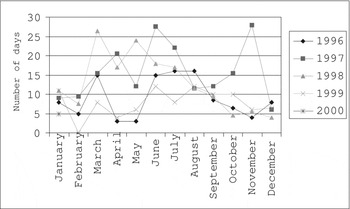
Let me turn first to the irregular pattern of employment in the dyeing industry, as this directly affects recruitment practices. When asked, workers often say that they work six days per week. However, further investigation reveals that they often get only two or three days work per week and that weeks without work at all are not uncommon. Permanent employment, as found in formal sector factories, is non-existent, and the best a worker can aspire to is to become a regular worker, that is to be regularly employed by the same factory owner whenever he has work to offer. However, even these workers are never certain of ‘regular’ work, nor of the continuation of the relationship with their employer (see also van der Loop Reference Van Der Loop1996: 276). Let me illustrate these fluctuations with data from Shivaji's factory in Sengadu Thottam. Shivaji's factory is in many ways a typical one and I will describe the work relations in this unit in more detail below. Here, I want to indicate the irregularity of employment in his factory. Based on the attendance lists of 1996–1999, I have calculated the number of full days that the factory was running per month.Footnote 2
Number of working days per month in Shivaji's factory.

The results are revealing. First, the total number of working days varies enormously from year to year. In 1997, for example, there were 189 working days, or an average of 16 days per month, while in 1999 there were only 93.5 days of work in the factory, or an average of hardly 8 days per month. Second, there are equally substantial variations in the number of working days per month within a year. In 1998, February had 7.5 working days, for example, while March had 26.5 working days. November 1997 had 28 working days, while in the following month there were only 6 days of work. Finally, within each month, the availability of work is highly irregular as well. Sometimes employment is spread fairly equally throughout the month, so that each week the workers get at least two or three days of work, while in other months ten days of non-stop work are followed by two weeks without work. Shivaji's factory is no exception and similar data for other factories inside as well as outside Sengadu Thottam would produce a similar picture.
These greatly fluctuating and highly unpredictable employment patterns in the dyeing industry are caused by a variety of reasons and for the argument of the paper it suffices to mention them briefly. The instability of demand is a major factor. Those dyeing for lungi manufacturers are affected by seasonality and tend to have a slump in demand in the months of April and May, as well as in September-November. Those working for the export market, like Shivaji, are affected by unpredictability rather than seasonality. Complaints about 1996 and 1999 being particularly bad years, when unsold stocks were piling up, are reflected in the remarkably low number of working days in these years, respectively 108 and 93.5 days, compared to the 189 days in 1997 and 156 days in 1998. As one factory owner put it: ‘we have no labour problems, only order problems; if we had regular orders, we could run our factory throughout the year.’ Employers often have to close down for days or even weeks due to a lack of orders. Related to this is the supply of yarn, which is subject to very similar irregularities. Employers get most irritated when orders have to be finished and yarn is not delivered in time. One solution would be to purchase more yarn so that work can be started any time an order arrives, but most factory owners already have major cash flow problems and are unwilling to invest their money in yarn unless they are sure about an order. It is evident, however, that order problems in turn lead to labour problems.
Two other reasons for the fluctuations are more predictable but not less disruptive. One is the rainy seasons, usually in June-July and October-November. As yarn has to dry in the open air, dyeing work comes to a sudden halt as soon as it starts raining and workers can be found in the factories and tea stalls, waiting for the skies to clear. Even if the factories have a shed to protect the yarn from rain, the dyeing work tends to be disrupted and delayed. It is not rare for an order—and payment—to be lost due to delays incurred on rainy days. Festivals are another source of work interruption. There are three main festivals during which the factories are closed for at least a week, but often for up to two or three weeks: Diwali (October-November), Pongal (mid-January) and the Selliyaandiyamman goddess festival (February-March). Here, employers and workers’ discourses differ. While the owners complain that the labourers do not turn up for work after a week's leave, the latter complain that they cannot earn a single paisa for two or three weeks as the factories are kept closed. Whatever the truth, festivals clearly disrupt production and after a break it often takes weeks before a ‘normal’ work pattern is restored.
The result is a highly variable and unpredictable employment pattern, in which the availability of work changes from week to week and even from day to day. To finish a large or urgent order, an employer has to recruit extra workers, while for a small order he might have to send half his regular workforce home. The number of workers needed in any single factory, therefore, changes from day to day and can often not be predicted until the evening before.
Labour recruitment and the use of kin terminology and morality
This raises the question as to how the employers recruit labour for their factories. I will first explore the employers’ discourses and practices and then those of the workers. The discussion will evolve around the core role played by kinship, its morality and its flexible use in the workplace.
In the dyeing factories of Sengadu Thottam, most workers and their employers belong to the same caste of Vanniyar and many of them are also related as neighbours and as kin. This is recognised by both employers and workers in the commonly used expression ‘we are all sondukarar’, a term which I prefer to translate broadly as ‘related’, as its use in the factory context is particularly flexible. In a sample of 200 workers, including maistries and managers, belonging to various dyeing units in Sengadu Thottam and outside, 143 are Vanniyar, and the majority of the others belong to the community of Nadar or Gounder. Let us take a closer look at Shivaji's factory. When the factory is running at full capacity 20 workers are employed, 4 women and 16 men, but only about 10 ‘core’ workers are employed on a regular basis. In every factory one finds a number of ‘core’ workers, usually men and women closely related to the owner, with whom the latter maintains very good relationships. In Shivaji's unit, all of these 10 workers are Vanniyars, they all live in or around Sengadu Thottam, and many of them are close kin. Shivaji's father bundles yarn, his wife dries and bundles, two of his tampi (younger brother; in this case, cousin-brother) and his mama (brother-in-law) dye yarn. One tampi's wife is also employed in the factory. In sum, 6 workers are related to Shivaji as close kin, while the 4 other workers are related as distant relatives. All are neighbours, living only a few houses away from each other.
Shivaji claims to prefer to employ caste members and especially close kin and neighbours. It is easier to call on them whenever they are needed, and they can hardly refuse to work for their annan (older brother) or mama. Whenever a few extra hands are required to finish an urgent order, Shivaji can rely on his tampis, Vijay and Sundaram, and his mama, Senthil. His father and wife are obviously always ready to help out. In case an order has to be finished the same evening, the workers will be asked to stay and work till 10–11pm and occasionally even till 1–2am. Normally, the Sunday is a day of rest, but if an order has to be finished, the workers will be asked to come in, even if they have worked for the 6 previous days. However, their willingness to work according to the requirements of the business is not self-evident, even if they are close kin. Often, the owner or his maistry have to openly invoke the morality of kinship to persuade even their ‘core’ workers to turn up for work. One Saturday evening, all workers were really tired as they had been working long days throughout the week. On gathering for their payment, the maistry asked them to come for work the next day as well. He went around the factory shouting naalaki velai (tomorrow there is work), to which the workers replied naalaki leave (tomorrow leave), and nobody seemed willing to turn up the next day. However, the maistry then came to Vijay and Sundaram and said: ‘tomorrow is a working day and you are expected to come and work for your annan’. When I asked them whether they would do so, they both told me that there was little choice, as Shivaji is indeed their annan and they feel they cannot refuse, as everyone in the family would find out about it and shout at them. A sense of duty not to let your annan or mama down lies at the heart of kin morality and it is this morality which is also extended to those who are not directly related as close kin, as the maistry that evening was also telling the other workers that their annan was expecting them to come. Even though non-kin might not be sondukarar in the sense of genealogically related, they are still called sondukarar due to the mere fact that they belong to the same caste group or neighbourhood, and that is what they are frequently reminded of by their employers. As we will see, the morality of kinship is often extended to non-kin who are turned into fictive kin, and is actively promoted by the factory owners to mobilise labour.
Indeed, kinship itself proves to be particularly flexible as is shown by the way it is used by Murugananthan in his dyeing factory in Kumarapalayam. The problem of recruitment for the dyeing units located in Kumarapalayam is particularly problematic, mainly because there are fewer Vanniyars around. Although the employers in Kumarapalayam recruit workers from various caste backgrounds, they do so out of need rather than choice, and they patently prefer workers who are related, be it through caste, neighbourhood or kinship (either real or fictive). How and whom does Murugananthan recruit, and how does he represent his relationship with the workers? Murugananthan is 31 and started to lease his factory in 1994, with the money he had saved while he was working as a labourer in a dyeing unit. The first workers in his factory, he recalls, were former co-workers and most of them were neighbours and friends from Sengadu Thottam, his native place. Although he is no longer giving baki (advance money) when recruiting new workers, he admits having given his first workers up to Rs2000–3000 in order to convince them to come to his factory.Footnote 3 But finding sufficient workers is still a problem. In November 1999, when I first began to visit him, there were about 11 labourers working in his factory, as well as a maistry and a manager. While seven out of the 13 employees were Vanniyar, he also employed three Gounders, one Dhobi and two Nadars. This composition of the workforce is rather typical in Kumarapalayam, where it is difficult to recruit only from within the Vanniyar community, let alone from among one's own circle of kin. Within earshot of his workers, Murugananthan, talks about them as follows:
All these boys are my friends. I have no friends outside the factory. They will even ask me on Sundays to go to the cinema. We are not like mudalali-tholilali (employer-worker), but like annan-tampi (elder brother-younger brother). We are all very close and I treat everyone in my factory as a friend, not as a worker. We are all sondukarar (related). All of them have been working here for at least 4 or 5 years and they are not shifting to other factories. I can always count on them. If I need them on Sundays or for over-time in the evening, they will never refuse to stay on. If they make a mistake, I shout at them, but nobody gets angry when I shout. They will adjust and continue the work. The workers see me as their annan and feel free to talk openly with me. Since I went on a pilgrimage to worship Aiyappan, they also call me sami (Lord).
The main idiom, used by Murugananthan to convey this picture of closeness and familiarity with the workers, is invariably that of kinship. ‘We are all like annan-tampi (elder brother-younger brother)’ is a concrete way in which kinship is expressed. But even more repeatedly, he stresses that ‘in this factory we are all sondam (related) or sondukarar (relatives)’, which is a term that needs further unpacking, as it is extended to about everyone in the workshop.
First of all, Murugananthan applies the term to refer to workers who are closely related to him as kin, and he always goes on to indicate how close their kin link is. For example, ‘Kumar, my manager is my own machan (wife's younger brother), and Murugan, one of the dyers, is my own tampi (younger brother; mother's sister's son).’ The same term is also used to refer to those who are related as distant kin through blood (oru irattam), or as affines through marriage. As such, he explains about Thamilselvam that ‘his sister married Perumaal, who is my mother's sister's son’ and in case he cannot recall the actual kin link, he will say something like ‘he is a relative of my mother's father's brother's son’, and so on and so forth. The same term of sondam/sondukarar is further applied to all those who belong to the same caste (jati) of Vanniyars, irrespective of whether they are related as real kin. In this respect, sondukarar covers almost the entire workshop, as in most factories the Vanniyars form the majority of the workforce. He explained to me that, as Vanniyars, they are all sondukarar because they belong to the same jati and are therefore also ‘potential relatives’. Indeed, the reasoning is often circular. Interestingly, however, the term is further extended to incorporate even those workers from other jati. When asked how Kandasamy, who is a Gounder, can be a sondukarar, Murugananthan adds the idioms of time and friendship to explain that they are ‘like relatives’: they have known each other for more than fifteen years and have worked together in another factory before.Footnote 4 ‘We are close friends and friends are even more than kin.’ Finally, the term is also used to incorporate those workers who are considered to be ‘close’ because of commonality of residence. Indeed, anyone living in Sengathu Thottam, Kadayampatti or any of the surrounding Vanniyar villages is commonly seen as sondam (here best translated as ‘one's own people’). Shared locality creates forms of relatedness which are highly valued by those involved. Helen Lambert has recently provided some excellent ethnography from north India on ways of being related other than through birth or marriage (1996; 2000). She rightly emphasises that ‘the domain of intracaste affinal and agnatic relations, which has conventionally been taken to comprise the whole domain of kinship in northern India, does not encompass all the forms of relatedness that are locally recognised and valued’ (2000: 74). Relatedness, in other words, stretches beyond the domain of kinship. Lambert looks in particular at forms of relatedness between women established on the basis of shared locality of origin (natal village), and forms of adoptive relations and fictive kinship voluntarily created between women who often even belong to different castes (1996: 102–106; 2000: 76–85). Such voluntarily created ties of relatedness provide support and affection that are locally highly desired and valued among women living away from their native kin.
This conceptualisation of kinship as a socially constructed and highly flexible domain is similarly reflected in Haynes’ findings that in Surat the phrase ‘like family relations’ was used by the employers to refer to a much wider range of persons than those who were literally kinfolk (1999: 149). Indeed, the term ghar (family or home) acquired a collective character and came to be constructed as a ‘foundational site of unity, cooperation and harmony, as a social institution embodying spiritual values and selflessness’ (ibid.: 149). It is indeed the morality of kinship, and more specifically the morality of reciprocity and equality which is called upon by the employers in their eagerness to counteract another quality of kinship, that of hierarchy.
Kinship and trust relationships
Why, then, is Murugananthan, like many other employers, so eager to turn everyone into kin, either real or fictive? The short answer is that these kin terms (annan, tampi, machan etc.) allow him to invoke kinship morality. Here I refer back to Bloch's distinction between the moral and tactical meanings of kinship terms, and his suggestion to unveil their moral meaning first (1971: 80). Here, the moral content of kinship cultivated on the shop floor is that of loyalty, reliability and above all trust, rather than that of hierarchy. This is reflected in the frequently repeated lines of praise presented by Murugananthan to me as well as to the workers themselves:
All my workers are very good, they are like gold (thangam). They work hard and I can fully trust them. I can leave the factory at any time without having to worry about what goes on inside. I do not have to fear that they will steal anything from the factory or cheat me. If I ask them to work late in the evening, they will do so. They do not fear me, rather they see me as an elder brother and listen to what I say.
The above link between kinship and relatedness, and trust is even more central to the way in which Murugananthan talks about his maistry:
Sundaram, the maistry, is like a brother (tampi) to me. I have known him for many years and he is my best friend. If I go to visit someone or to a wedding, I will always take him along. He lives in nearby Kadayampatti, which is also the native place of my parents and nearby Sengathu Thottam where I live. He is also a sondukarar of mine and we are even distant relatives. He often comes to my house, where also my parents treat him as their son. I can fully trust him in the factory and I can accomplish a lot of work through him. He is very good at his job and also likes it very much. He comes to the factory every day, even on Sundays if there is work to be completed. I can always count on him.
Sundaram merely smiles when Murugananthan presents their relationship in this manner and below I will discuss workers’ responses. While Murugananthan uses sondukarar here in the sense of ‘belonging to the same jati’, the two are definitely not related as kin. However, I would like to emphasise that trust is expressed in terms of relatedness as friends, fellow caste members, kin, and neighbours. Or, as Murugananthan's logic goes, Sundaram is a trustworthy maistry because he is a friend and sondukarar. It is in similar language that he talks about his manager with whom he is directly related as mama-machan (brothers-in-law):
I can also trust my manager, as he is my own machan (wife's brother). He will look after the orders that we get from the shops. I know that because of him we will not be cheated by the merchant-manufacturers. I will not encounter problems with the cheques or the delivery of yarn. As he is my machan I can leave him in charge of all those tasks and be sure that he will do well. He has been my manager here for the last 5 years.
Both the maistry and the manager are crucial to the work process and the business. The maistry's first task, as indicated above, is to get the colours right and to make sure that the right combination of chemicals are used. The slightest mistake can result in the rejection of an entire order. But the maistry is also involved in the supervision and co-ordination of the work process. He constantly gives instructions to the workers and tells them when to start a particular job. The maistry is the most important person among the workers and his skill and reliability are crucial to the owner. The manager is equally important, but in a different manner as he is less involved in the proceedings on the shop floor. He is responsible for getting orders, yarn and payments, and part of his time is therefore spent driving to yarn merchants, manufacturers and banks. Marketing and accounting are his main tasks, and as he is often dealing with large sums of money, it is obvious that he also needs to be trusted by the employer.
Finally, the fact that the trustworthiness and the reliability of workers are vital issues to the employer is reflected in the wider organisation of the factories and the neighbourhood itself. In Sengathu Thottam, for example, the factories are open buildings not surrounded by compound walls, fences or gates. Yarn, chemicals and tools are found all over the workplace and can be seen from the street, and even at night they are seldom locked away. It is therefore easy to steal yarn or tools, and while occasionally a few bundles of yarn disappear, the factory owners claim that their factories are safe. This is attributed by all employers to the fact that most of their workers are neighbours and kin, and can therefore be trusted not only not to cheat them but also to watch out for ‘outsiders’ roaming around the factories in the area. This trustworthiness of kin within the confines of the neighbourhood is not merely a matter of perception. The open lay-out of the Sengathu Thottam factories contrasts sharply with the high compound walls, closed gates and watchmen protecting the dyeing units in Kumarapalayam. These closed units testify to the absence of a similar sense of safety in an area marked by a mixed population that is unknown to the factory owners.
The trustworthiness of the workers, however, is even more significant in relation to the actual work, irregular employment patterns and the high quality demands. Daily reporting of the workers at the factory cannot easily be enforced, when the employer himself is unable to guarantee regular work in the first place. In this context of unpredictable work patterns, the employers are usually desperate to get ‘core’ workers whom they hope will help them out whenever hands are needed and who will not run off on the days or weeks during which no work can be offered. This reliability cannot be achieved by a mere pay rise or bonus whenever there is work, but has to be generated by other means, of which the morality of kinship, invoked for both the actual and fictive kin on the shop floor, is one strategy. Moreover, the employers have to be sure of the seriousness of the workers on the shop floor. It is the dyers’ concentration on the carefully mixing of yarn and the actual dyeing work which determines the quality of the colour achieved. Careless behaviour, such as forgetting to add oil to the dyes or not letting to soak the yarn for long enough, often leads to irreversible damage and losses for both the owner and the workers.
In short, getting labourers is one issue, but being able to keep them and to increase their commitment when one is seldom able to provide them with regular employment is another. Not everyone is prepared to work extra long days for an entire week, without being guaranteed employment the week thereafter. It is against this background that employers resort to kinship and its morality. They attempt to build up a ‘core’ group of workers whom they all turn into and address as kin (whether they are real kin or not) so that they can draw upon the morality of kinship, and in particular on the qualities of trust and reliability. The employers’ language of kinship is not merely deployed as a representation of their relationship with the workers, but also as a direct means of creating ties that invoke trust and loyalty, thereby instilling a sense of obligation and duty in the workers. By calling you tampi (younger brother), and presenting your relationship with him as such, the employer hopes that you will adhere in the workplace to the morality that this kin term embodies in the arena of domestic relationships. However, the effectiveness of kin morality on the shop floor is explored below.
Much of this rhetoric about kinship is geared towards the men on the shop floor. Older women are addressed as pati (grandmother) and other women as akka (older sister) or anni (older brother's wife), but these are respectful or affectionate terms, and used by both employer and fellow workers alike. I never heard an employer spend much time or effort on trying to emphasise the commitment or trustworthiness of a woman worker. The reasons for this gender bias are quite transparent. To begin with, women form a rather small part of the work force: about one forth of dyeing workers are women, and as described above their main task is drying and bundling yarn which involves less skill. Compared to the jobs of the dyers, and especially the maistry and manager, women's work is less skilled; they are not involved in mixing chemicals, dyeing yarn or checking colours, which are the areas where most can go wrong. For the employers this basically means that women workers need much less attention. Perhaps more importantly, employers are less preoccupied with women as the latter's labour can be replaced more easily than that of men. If a woman worker fails to turn up for work, for example, the employer's wife or mother can be called in to finish bundling a pile of yarn or, given the fairly flexible division of labour outlined above, male workers can be asked at the end of their shift to hang yarn outside or to bundle it when dry. Finally, women workers are more likely to stay with the same employer and thus to be more committed anyway. This is in part because they prefer to work for an employer close to home and so stay for longer in the same factory, and partly because women workers have little hope of better work or pay from other employers. Their work and its level of remuneration is fairly fixed throughout the industry.
Silence as consent
So much for the employers and their talk. Let me now turn to the workers and their responses to the employers’ representations and discourses of labour relations. Do they share the picture of relatedness so eagerly promoted by their employers? Or, do they have a different view of the sense of mutuality, understanding and closeness repeatedly imposed by the factory owners on the shop floor? The most striking expression of the workers in the dyeing units undoubtedly lies in their silence. While the employers fervently spell out the details of relatedness in their attempt to generate an atmosphere of commitment and loyalty, the workers merely get on with their job. They rarely respond to their employers’ discourse nor do they publicly agree or disagree with what the latter proclaim. I seldom heard a worker voluntarily engaging in an explanation about how he or she is related to the owner or about how close their relationship is. The employers’ talk is usually met with an embarrassed smile on the face of the workers, especially when the former go on and on about their friendship in my presence. This presents us with two issues: why are the employers’ representations of shop floor relationships met with silence and how are we to interpret this silence?
First of all, it is plain that, unlike their employers, the workers do not feel the same need to enter such a discourse to generate loyalty and commitment, as labour recruitment and discipline is simply not their problem. Rather, being aware of the employers’ attempts to get their labour as and when it suits the needs of the business, the workers themselves often prefer a less personalised relationship on the shop floor that does not immerse them in the morality of kin obligations and reciprocity. They are aware of the restrictive aspects of kin morality, and therefore prefer anonymous relationships with their employers, which facilitate their free mobility between factories and jobs. Indeed, it is easier for them to avoid overtime or Sunday work when the employer is not their uncle or presented as such. Their silence, in this respect, is undeniably strategic.
Secondly, their silence also reflects the very fact that many of them are indeed related to their employer as kin, fellow caste members or neighbours, which limits the extent to which they can deny or criticise these relationships in front of their employer-kinsman. Silence, therefore, is often the only public response they can afford and which does not commit them to sharing the same values as their employers. In private and to the inquiring anthropologist, many workers admit that they find it harder to refuse to turn up for work when their brother or uncle is calling them, and they clearly feel trapped by the demands of kin relationships, be they real or fictive, on the shop floor. After an exhausting week of long days, Sundaram and Vijay were not at all eager to turn up for work on Sunday, but although they complained about it, they had no choice. I doubt they would have worked for Shivaji if he was not their cousin-brother.
However, not everything is negative about being employed by a kinsman, and most workers themselves feel rather ambivalent about these kin-cum-labour relations. It is in many ways their own indecisiveness about how to respond which produces silence. Sundaram, for example, recognises that hanging on to a close and cordial relationship with the employer also has its advantages. Indeed, the morality of kinship also applies to the employer-patron who in turn has obligations towards those whom he recognises as kin. The most tangible reward is that of being offered work whenever it is available, which is crucial to the workers given the irregularities and unpredictability of the job market. Loyal and committed workers, who are also kin and neighbours, are indeed the first ones to be given work when an order comes in and the last to be sent back home when fewer hands are needed. Thus, playing along with the employers’ discourse, or at least not openly resisting it, is usually a safe bet.
But there is more to it. Both Sundaram and Vijay, who are cousin-brothers of Shivaji, received money from the latter at various occasions when they were in financial need. Sundaram obtained a loan of Rs15,000 to pay for the wedding of his sister, while Vijay got Rs6,000 at the time of his own wedding and more money after the birth of his first son. Sundaram admits that Shivaji is always willing to help them out financially and that he is a real patron for everyone who is in need in Sengathu Thottam, and not only for those who work in his factory. It should be noted that everyone living in Sengathu Thottam is a potential worker for Shivaji, and the latter is well-versed in the politics of goodwill. While the money obviously has to be repaid, there is usually no strict timeframe imposed, nor are Sundaram or Vijay expected to pay interest. In its ideal form, kin morality dictates that one cannot refuse to work for an uncle, but also that an uncle cannot avoid assisting those whom he recognises as his nephews. Many of the employers act as local ‘big men’ and patrons, a model shaped after the role of mama or maternal uncle, who cares for his kin. Employers try hard to present themselves not as heartless money makers, but as ‘benevolent patriarchs’ who care for their kin and try hard to provide them with regular employment.Footnote 5 These are the perks attached to a close and committed relationship with the employer, and few workers dare to forego them by raising a critical voice in the factory. Keeping a low profile in front of the employer, thus, seems to be the most beneficial strategy to them. These workers’ perceptions correspond with the ambiguity in the workers’ representations of past labour relations in Surat and Bhiwandi, as described by Haynes. While some workers had critical recollections of the past, others did present a rather ‘nostalgic picture that is captured in personal terms, as family-like or at least affectionate’ (1999: 155).
Finally, the workers in the dyeing units are perfectly aware of the disciplinary measures available to the employers. Apart from preferential treatment in the allocation of work referred to above, these include the politics of payment. In most factories, fixed daily wages are paid to the workers and payday is on Saturday. The level of wages vary according to experience, gender and type of work. Small boys who are newly recruited for odd jobs and some dyeing work earn Rs30 to Rs40 per day. Male workers without experience earn about Rs60 and their wages gradually increase with their skills. However, most dyers know how to do most tasks on the shop floor after two to three months of informal training and by that time their daily wage usually goes up to Rs90–Rs100. Labourers with more years of experience can earn up to maximum Rs120 per day. Women workers earn between Rs35 (when they begin) and Rs50–60 (when experienced). Maistries and managers earn a weekly salary varying between Rs750 and Rs1200, according to the tasks allocated and the size of the factory. A working day starts at about 9am and lasts till 6pm. In case overtime has to be done, the workers will be paid one and a half daily wage when they work till about 9–10pm and a double wage if they work till 1–2am.
While this system of payment might at first seem rather bureaucratic, it does give a lot of leeway to the employer to reward loyal workers and to discipline those who are less committed. Wage increases, for example, are in practice rather random and depend on how eager the employer is to hold on to a particular worker or on how much he needs their labour. Similarly, the annual bonus, while calculated according to the number of months or years of service, can also be ‘topped up’ for the most loyal workers or cut down for irregular attendance. No wonder, therefore, that both daily payments and bonuses are a recurrent cause of argument between owners and workers, and thus a major reason for the latters’ constant shifts between factories (see below). While wages are normally distributed on Saturdays, some workers are given advances during the week, and this again varies according to the extent to which the owner ‘trusts’ (nambikkai irukku) the worker. And, when an urgent order has to be finished the owners frequently postpone wage payment until Sunday evening so as to assure full attendance on Sunday. Finally, in a number of dyeing units workers are sometimes paid kattu kanukku (bundle rate), also known as contract payment. This is a method of piece-rate payment in which a group of workers, headed by an appointed ‘leader’, are given a fixed payment to dye a particular order. While this facilitates supervision for the employer, gets orders finished faster and transfers part of the risks to the workers, it also allows the latter to earn more money in a shorter period of time. However, workers often refuse to work for kattu kanukku, as they are well aware of the risks it involves in case the colours do not match or sudden rain prevents continual work. In short, these various disciplinary sanctions inherent in the levels and methods of payment and recruitment further limit the space available to the workers to challenge the owners’ representations of shop floor relationships.
Acts of avoidance
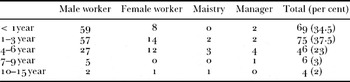
However, the silence of the workers acquires a far more controversial meaning in relation to what the workers actually do. It is in their constant shifting between various dyeing units that we find the workers’ active avoidance of the employers’ attempts to impose ‘relatedness’ and ‘closeness’, and thereby of their expectations of loyalty and commitment. In my sample of 200 dyeing workers (including maistries and managers), the vast majority of labourers had been employed in the same factory for less than three years (72 per cent), while more than one-third of the total labour force had been working for less than one year for the same owner (34.5 per cent; see Table 1).
Time of employment in the same dyeing factory (1999–2000)

Source: Survey of 200 dyeing factory workers in Bhavani and Kumarapalayam, conducted in 2000.
This high labour turnover provides an unmistakable indication of the limited extent to which the workers share their employers’ preoccupations with building close and lasting bonds within the factory. At the same time, this labour instability reflects the very cause for the employers’ anxieties about labour commitment and reliability in their factories. While some of the mobility is certainly due to the closure of particular factories or the seasonal lack of orders, many workers actively opt to shift to other dyeing units in search of a better deal. Above I described how in Shivaji's factory, Sundaram and Vijay were two of the owner's cousin-brothers and ‘core’ workers on whom he could rely. This was indeed the case, but only for a short time. Due to a lack of orders in Shivaji's factory during the months of November and December 1999, both Sundaram and Vijay shifted to other factories in January 2000, after having received their bonus at the festival of Pongal. Sundaram went to work in his mama's (uncle) factory opposite, while Vijay shifted to a small unit down the road, belonging to a fellow caste member, but not a relative. Asked whether their brother Shivaji would not mind their shifting, Sundaram exclaimed: ‘if he can't offer us regular work, how can he expect us to sit and wait in his factory?’. And, indeed, employers realise that their workers cannot be kept waiting for weeks without work, and they have no other option than to accept them leaving. As they may need them again when orders are abundant, they cannot afford to fall out with their workers. It is possible that in two or three months' time Vijay and Sundaram may again be employed in Shivaji's factory, but they might as well have moved on to another unit by then.
However, workers do not only shift when their current employer is unable to offer them regular work. Plenty of other reasons, including better pay, work conditions or prospects, make the workers opt for a more promising deal elsewhere. Often, a worker is simply not happy with the type of work or feels he does not get along with the employer or the co-workers, and decides to leave. Obviously, workers know the system and try to get the best out of it (see also Burawoy Reference Burawoy and Pahl1988). This is apparent from the massive shifts that take place after the payment of the bonus at the festival of Pongal. The annual bonus is calculated on the basis of the number of months worked in the factory. If a worker shifts to another unit just before Pongal, they lose their bonus from the previous unit and will not get anything from the new employer. But once the bonus money has been pocketed, there is nothing to stop the workers from searching for a job that may offer more attractive prospects.
In Murugananthan's factory there was fairly regular work in November and December, yet after the Pongal holidays, only four out of thirteen workers turned up again. Not only had Murugananthan been cheated by his manager Kumar, but most of his workers also let him down. His entire discourse on relatedness, trustworthiness, and commitment proved nothing more than wishful thinking. Murugananthan immediately had to look for new workers as orders were flowing in. His maistry Sundaram brought in a number of workers from Seringrayanpalayam, a Vanniyar village and Sundaram's native place just outside Bhavani. Murugananthan could not afford to be fussy and had to recruit whoever Sundaram recommended, even though he knew very little about these workers himself. Given the amount of work piling up, he even had to employ some casual workers who gather each morning on the main road of Kumarapalayam. My visit to the factory in January was revealing. When I asked Murugananthan who those new workers were, he answered without hesitating: ‘they are all sondukarar!’, and went on to explain how they were all related to each other as Vanniyars, neighbours, or friends. While none of the new recruits were close relatives, he had taken the effort of tracing the actual kin links of a few among them and explained the genealogical details to me. ‘Obviously’, he added, ‘they are all experienced and skilled workers, whom I can trust.’ His discourse started all over again, but now with an undertone of despair. Like many other employers who reopened their factories after the Pongal break, Murugananthan knew only too well that he had lost the hands he had relied on and that his renewed efforts at gaining the trust of the new recruits would at best be precarious, and at worst lead to further disappointment. He realised that kin morality has its limits, especially when invoked on the shop floor.
Limits to the morality of kinship
While trust is crucial for business, trust relations are difficult to generate and the way they are represented by employers is in many respects idealised. The employers present these relations as they would like them to be, rather than as they actually are. In particular, the link between kinship and trust is not always as straightforward as presented above; or, put differently, kin are not always or automatically the ones who are most trustworthy or those whom the employers prefer to recruit at any cost. The problematic nature of kin relations in a work context surfaces especially in relation to the crucial managerial positions in the factory. It will transpire from the following examples that employers often prefer to recruit persons who are not ‘real’ kin or caste members as maistries or managers.
In Shivaji's factory, for example, neither the maistry nor the manager are Vanniyar. Yuvaraj, the manager, is a 24 year old Nadar from a village about 10km outside Bhavani. At the age of 18 he worked as a clerk in a travel agency in Bhavani in which Shivaji was a partner. When Shivaji started his own dyeing unit, he asked Yuvaraj to become his manager, and the latter accepted as they got along well. Although Shivaji could undoubtedly have selected a manager from among his own kin members living around him, he did not do so and Yuvaraj gives us the reasons for this:
When a manager is working for a close relative, he will be more relaxed and less serious about the job. He may even cheat the employer. When the latter is shouting at him, he will simply say ‘oh, it's only mama (uncle) who is shouting’ and he will not listen to him. Also, he will not fear the sanctions in case he commits a mistake or cheats, as he knows very well that he will get the support from another uncle, brother or father. However, if I cheat this owner, I will not get any support from the community, nor will I ever be able to find work in this area or industry again. In the best case, they will simply throw me out, in the worst case, they will beat me up and get their money back.
Indeed, close kin can get away with much more than ‘those who come from outside’. Yuvaraj further explains that the employers prefer outsiders as managers and maistries because they can treat them as they want, and nobody will complain. Disciplining an outsider on the shop floor is in many ways less problematic than disciplining a relative. Indeed, when a man employs his brother's son, and the latter cheats him, the brother himself will come with a few other relatives and discuss the matter. The employer cannot merely dismiss his nephew, as the latter remains his relative and probably also lives only a few houses down the road. Or, as Shivaji, the employer, put it more concisely: ‘Even after dismissal, they still remain relatives and we still have to deal with them’. To keep them is therefore often the preferred solution, which may prevent a lot of trouble in the family. Especially the better-off owners want to avoid accusations of being proud and selfish by the poorer relatives whom they employ.
Yuvaraj is not the only ‘outsider’ in Shivaji's factory. Arjun the maistry also belongs to a different community. He is often treated in a rather harsh way by the owner, who recognises that it would be difficult to treat a relative in a similar manner. One morning, Arjun had mixed the wrong dyes and as a result a lot of yarn was dyed the wrong colour. As I arrived the owner was shouting at Arjun and accusing him of being irresponsible. Arjun kept quiet and started to re-mix the dyes so that the yarn could be dyed again. The dyers, whose work was also wasted that morning due to the maistry's mistake, were equally unhappy. Indeed, the position of a maistry, which involves considerable skill and risk, is a difficult one and he may well find himself told off by both workers and employer. As the factory owners are fully aware of the crucial, yet always potentially conflicting nature of the maistry's and manager's tasks, they often prefer to employ ‘people from outside’ for these positions, that is, people not related as close kin or as caste members.
Alternatively, employers may prefer not to employ a maistry or manager at all and take care of these crucial responsibilities themselves. This is for example the case in the factory of Madeshwaran, Shivaji's mama, where Madeshwaran himself is the maistry. As almost all owners have worked as labourers and maistries themselves, they are fully capable of doing this job as much as their time permits. Ravichandran, who started his own unit in Sengathu Thottam two years ago, says he never likes to work with a maistry or manager who is also a close relative. While he does the maistry work himself, his manager is a Nadar from a nearby village who got a degree and is knowledgeable about computers. Ravichandran does not like to employ a relative for this position because he would not be able to ‘ask anything authoritatively’. He explains: ‘if the manager was my brother's son for example, he would not listen to what I say and think: oh, it's only my cittappa (uncle) who asks something, I need not worry’. Ravichandran finds it easier to recruit a manager from outside. While kin constitute a labour force ready to be mobilised as and when needed, once employed they can easily turn into a real burden, difficult to discipline and dismiss. When crucial responsibilities and more sophisticated skills are involved, outsiders often prove to be more suitable to the needs of the business.
The cases described so far reveal some of the ambiguities inherent in the use of kin, kin terms and kinship morality for the recruitment and disciplining of labour. For particular positions, the employers clearly perceive kin relations as a disadvantage rather than an asset, and at times they explicitly prefer non-kin to those who are related in one way or the other. However, the case of Murugananthan and his manager, Kumar, reveals another side of the issue, namely the plain fact that ‘kin’ are not obviously trustworthy or reliable merely because they are sondam (related). On my first visits to his factory in November and December 1999, Murugananthan adamantly repeated that Kumar, his own machan (wife's brother), was the ideal manager, whom he could trust fully. The picture I was presented with was that of complete unity and trust between the owner, manager and workers on the shop floor. However, when I visited Murugananthan's factory after the Pongal break in January 2000, the reality looked very different and the picture of trust illusive. Kumar had been dismissed over the break and Murugananthan alleged that he had cheated him. Kumar had not searched for new orders so that the factory could not be re-opened after the break, but he told Murugananthan that there were no orders available. Murugananthan found out that Kumar had also swindled some money behind his back. As he trusted his manager blindly, he never checked the accounts and failed to follow upon what Kumar was doing. To me and the other workers around, Murugananthan emphasised repeatedly how well he had treated Kumar, how generously he had paid him, and how much he had relied on him: ‘He got a monthly salary of Rs2000 and a bonus of Rs5000, so how could he do this?’.
The owner's conclusion was straightforward, yet not unproblematic. Straightforward in that he decided never to employ a close relative like Kumar again for such a crucial position, but ambiguous in that he realised that while a relative can be dismissed (even though with a family price to pay), relationships of trust per se are still required. Kumar had to be replaced and a new relationship of trust had to be developed. However, Murugananthan was left with bitter disappointment, realising that kinship and its morality are in themselves inadequate tools to command trust and commitment. For the time being, he decided not to employ a new manager, but to allow his maistry to look after the accounts. Lacking an alternative strategy, he soon reverted to his same old discourse, telling me that Sundaram, his maistry, is hard working, reliable, trustworthy, and so on and so forth.
Conclusion: Footloose kin and related labourers
This paper has focused on the role of kinship and its morality on the shop floor of small factories in South India, where many of the workers and employers belong to the same caste of Vanniyars and are moreover related as close kin. In an industry shaped by irregular and unpredictable labour demand, and employers are forced to rely on kinship networks, and constantly draw on kinship morality to retain and discipline a ‘core’ group of reliable, committed and hard-working labourers. However, in a context where factory owners are rarely able to provide long-term employment, this is always more difficult and ambiguous than many of them initially envisage. Firstly, the availability of ‘real’ kin is limited and thus the notion of ‘relatedness’ is extended to a wider group of people who have no blood or affinal links. Workers are turned into and recognised as ‘kin’ on the basis of shared locality, caste identity or friendship. This is reflected in the flexible use of the term sondukarar on the shop floor and the ways in which kinship is extended to almost all workers in the factory. Employers are eager to represent their relationships with their employees as close and family-like, and thus to transfer the morality of domestic kin relations to the workplace. The employers’ ultimate attempt is to generate loyalty and commitment among the workers, which they so badly need for the survival of their industries.
Secondly, the ambiguities surrounding the employment of kin as workers are recognised by employers. Once kin have been recruited they often prove to be a burden rather than a blessing, and are often difficult to discipline or dismiss without upsetting family relationships, and even caste or neighbourhood links. Thirdly, the morality of kinship clearly has its limits. This is apparent from the fact that kin are not necessarily the most trustworthy workers and that the construction of kin relations on the shop floor is itself insufficient to generate the required morality. Morality does not follow naturally from kinship. Employers are let down and even cheated by kin, whether real or constructed. Trust relationships have to be constantly created and re-created and do not inherently follow from kinship, real or fictive, even if an active discourse of trust and commitment is promoted by the employers. This brings us back to Bloch's claim that ‘for long term planning, only social relationships which are reliable in the long term can be used and this reliability comes from morality’ (1973: 79). While we can usefully distinguish between the short and the long term, the data presented here suggest that reliability does not flow automatically from morality and that morality itself does not flow automatically from kinship. Or, to put it more simply, kin—whether ‘real’ or ‘constructed on the shop floor’—are not always the most reliable workers, nor can one assume that they will always be there to help out, whether in the short or the long term. I am therefore suggesting that morality is not an inherent or natural part of kinship relationships, but rather one of its possible qualities that has to be activated over and again by those involved. I refer here once more to the endless attempts of employers to show how everyone is related in the workplace and to explain what that means—or should mean—in terms of trustworthiness, commitment and reliability. None of it, however, can be taken for granted.
More helpful, is Bloch's second distinction between the moral meaning and the tactical use of kinship terms. As indicated, kin terms are constantly used by employers to address their workers and to turn biologically unrelated people into sondukarar (relatives). The moral contents of this general term, as well as of the more specific terms, such as tampi or machan, are derived from the domestic sphere and are multiple. For the employers who draw on them, these kin terms represent values of trust, co-operation and reciprocity, which they are eager to promote in highly volatile labour markets. It is therefore not difficult to see why they are tactically used in the workplace and applied to a large pool of people whose labour might be needed at various point in time. The workers, on the other hand, are equally aware of the moral content of these kin terms, but for them they carry rather different meanings. They recognise that kinship entails, on the one hand, duty and obligation and, on the other hand, support and patronage. An employer who calls you tampi (younger brother) and considers you to be a close relative of his will be more likely to expect extra commitment and hard work, but at the same time he will also be the one whom you can turn to for a loan for your sister's wedding or your child's school fees. As these kin terms and relationships entail positive as well as negative meanings for the workers, the latter retain a rather ambivalent attitude about being called a sondukarar (relative) by their employers. For them the tactical use and practical advantage of kin terms and kin relationships is far less obvious and this is most clearly reflected in their silence on the topic in the workplace. While they realise the benefits of sticking to a particular employer, they also value their liberty to move around in a labour market where work is never guaranteed by a single factory owner. Their most controversial voice is embedded in a simple, yet less overt, act: that of shifting to different factories as it suits their own and their family's needs. Indeed, all workers whether related or not remain footloose, in search of the best job available and willing to serve any suitable master temporarily.
It is the employers who desperately need their male workers’ commitment. To this end they apply various strategies of which the use of kinship and its morality is an important one. While often limited in its desired effect, the use of kin terms and the construction of kin ties nevertheless form significant ways of creating relatedness based on locality (neighbourhood), caste (Vanniyars) or friendships (work mates). These forms of relatedness, while not based on biological substance, are nevertheless actively constructed, widely recognised and often highly valued. Recent literature on kinship has begun to focus on cultures of relatedness that reach beyond the sphere of biological reproduction and affinal ties (Carsten 2000). It is increasingly recognised that kinship and alliance are inadequate concepts to capture the wide variety of bonds and connections that tie people together. While Lambert has emphasised that ‘sentiments, substance and nurturance are all constitutive of relatedness, of different degrees and types’ (2000:87), Roger Just has earlier pointed to the limits of kinship to explain social connections and relationships. Studying wine-making groups in Greece, Just observes that ‘outside the household, . . . though kinship and family could be (and were) used to explain almost every social connection, in fact they determined very little’ (1991: 115). The composition of a particular wine-making team, while incorporating kin members, could not be explained or predicted on the basis of kin relationships. Rather, what tied the wine makers together was the fact that they shared a common life-style and a common financial and cultural ascendancy (ibid.: 129). In Just's words, ‘outside the household the real bases for cooperation, loyalty, amity, and trust lay elsewhere. Kinship was their cover’ (ibid.: 115).
Indeed, kinship can never explain everything, and sometimes even seems to explain very little. The above discussion not only has implications for understanding the nature of kinship and for assumptions about kin morality, but it also allows us to shed new light on discussions of the role of caste and kinship in recruiting, retaining and disciplining labour in India's informal economy.Footnote 6 Recently, Harriss-White has argued that while much of India's economy is known as informal, unorganised, or unregulated, it does not follow that this part of the economy is therefore also ‘unstructured’ (Harriss-White Reference Harriss-White2003: 20). Harriss-White convincingly argues that while labour arrangements are less structured by the state, there is a myriad of non-class social identities and structures that regulate labour relations in the informal economy (ibid.: 21–42). These social structures include, amongst others, caste, gender, space, and family. However, those studies that have looked at the role of caste and kinship in the shaping of employer-worker relationships have often reproduced the stereotype that labour recruitment in the informal economy is largely based on caste and kinship connections: the way to find a job or to get a promotion is to contact your uncle, paternal cousin or brother-in-law who acts as a middleman or owns a factory (Breman Reference Breman1993; Reference Breman1996; Chari Reference Chari2000; Holmström Reference Holmström1976; Knorringa Reference Knorringa and Parry1999; van der Loop Reference Van Der Loop1996). Studies of the informal economy are seldom based on a critical deconstruction of how ‘kinship’, as a particular form of relatedness, plays a role in recruitment and employment. This has resulted in the reproduction of rather essentialised notions of caste and kinship as static ‘structures’ that regulate the economy and capitalist accumulation in allegedly predictable ways wherever the state has less of a direct impact (Harriss-White Reference Harriss-White2003; Chandavarkar Reference Chandavarkar1994).
In the light of such descriptions of caste and kinship, I suggest two points. Firstly, that it is not necessarily kinship that determines labour relations, but that the organisation of the production process, the division of labour on the shop floor, the required levels of skill and the volatility of market demand are themselves major factors affecting whether kin are seen as desirable factory hands and whether they are preferred to ‘outsiders’ or not. This is in line with Breman's point that in the plains of south Gujarat employers prefer to employ migrant labourers rather than local Halpatis for sugar-cane cutting (1994: 182–187). The seasonality of the industry, the harshness of labour conditions and the low wages make ‘outsiders’ the ideal workforce for this informal work, rather than locals who are seen as too close, too demanding, and too defiant. The rationale of the employers being that those who can be constructed as non-kin and unrelated can be more easily harnessed into exploitative work regimes.
Secondly, I emphasise that to refer simply to ‘kinship’ reveals very little in itself. It tells us nothing about its form, content, and value. Nor can we make a priori assumptions about how it is mobilised, for which purpose and by whom. It is crucial to distinguish, for example, how and by whom kin terminology is used, in which contexts fictive kin is created, who benefits from a rhetoric of kinship, and what forms of resistance it entails. In line with Haynes' discussion of how the metaphor of ghar (family or home) is variably deployed by different actors to recall labour relations in the textile industries of Surat and Bhiwandi (1999), I have argued that employers and workers might benefit in very different ways from the elaboration of kin relationships—real or fictive—on the shop floor. One of the crucial points is that the content of kinship itself can be elaborated to include unrelated caste members, neighbours or friends, and kinship itself can be so constructed as to incorporate even members of other castes or communities. The content and form of kinship will not only differ between contexts but is also likely to be highly flexible within any single setting. Or, as Haynes commented, ‘the concept of ghar itself proved to be a malleable one, reinterpreted in a wide variety of ways by persons in different social situations, each way with significant ramifications for their views of the past’ (ibid.: 142–3).
Furthermore, as for the value of kinship, it can not be predicted a priori whether those who employ particular kin terminology have egalitarian and reciprocal aspects of kinship in mind or more hierarchical values. Whereas the former was the case in the dyeing industry discussed here, the latter seems to be occurring among the Saurashtra Patels who dominate the diamond cutting industry of Surat. Here, owners and workers belong to the same community and many are related as kin, yet the relationship between workers and employers is explicitly unequal and hierarchical with employers frequently resorting to violence as a way of dealing with workers (Engelshoven Reference Engelshoven and Parry1999). This hierarchy is also reflected in Kapadia's discussion of the relationships between Soliya Vellalar employers and workers in the Tamilnadu gem cutting workshops. Although employers use the language of shared caste and kinship, this is by and large done to reproduce dominant and subordinate positions. But the gem cutters were well aware of this and Kapadia notes how they ‘noted the “arrogance” of the rich, who had forgotten all about caste reciprocity. Instead of treating them as kin—which is how fellow caste members should ideally be treated—they were treated as “mere servants” or as if they were “mere casual labourers”‘(1999: 335). Whereas the employers in Sengadu Thottam ultimately had the same goal of creating a suitable labour force, the language of kinship used on the shop floor was embedded in a rather different set of values that centred on reciprocity, mutual obligation and equality. Finally, the morality supposedly inherent in kinship relationships can be highly ambivalent in terms of its economic outcomes. In the dyeing industry, relying on the morality of kinship proved an extremely ambivalent and only partially profitable strategy for both employers and workers. Yet, as Engelshoven has explained for Gujarat, caste unity among the Saurashtra Patels was one of the main reasons behind the success of this community in the diamond industry and for the near total absence of resistance (1999: 371–76).
However, kinship and its morality are only one source of social connectedness that leads to joint action and co-operation. The material presented in this article testifies to the social nature and flexible construction of kinship in work contexts as well as to the malleability and limits of the morality these relationships produce, especially outside the domestic arena. The relevant question to consider, therefore, is not whether kinship or caste are important in the employment of labour, but rather what kinds of kinship and what sorts of relatedness are constructed, recognised and denied by different actors and for different purposes. Possibly even more crucial is the sort of morality that is invoked and the extent to which it leads to the desired effects of trust and commitment, and ultimately to economic success.