Early life stress (ELS) such as abuse or neglect has been associated with altered processing of emotional facial expressions (Gibb, Schofield, & Coles, Reference Gibb, Schofield and Coles2009; McCrory et al., Reference McCrory, De Brito, Kelly, Bird, Sebastian, Mechelli and Viding2013; Pollak, Messner, Kistler, & Cohn, Reference Pollak, Messner, Kistler and Cohn2009). Specifically, children who experienced ELS show hypersensitivity to the emotion of anger (Maheu et al., Reference Maheu, Dozier, Guyer, Mandell, Peloso, Poeth and Ernst2010; McCrory et al., Reference McCrory, De Brito, Sebastian, Mechelli, Bird, Kelly and Viding2011; Pollak, Reference Pollak2008). Compared with nonmaltreated children, these individuals can identify anger with fewer perceptual cues (Pollak & Sinha, Reference Pollak and Sinha2002), and misattribute the emotion of anger to neutral facial expressions (Pollak & Kistler, Reference Pollak and Kistler2002). Pollak et al. (Reference Pollak, Messner, Kistler and Cohn2009) presented children with a continuum of facial expressions which transitioned gradually from a neutral expression to a prototypical expression of anger. Children who had experienced ELS identified anger earlier in the continuum than those who had not been maltreated. These findings are supported by fMRI studies that have found heightened amygdala activation to angry facial expressions among children and adults who experienced ELS (Dannlowski et al., Reference Dannlowski, Stuhrmann, Beutelmann, Zwanzger, Lenzen, Grotegerd and Kugel2012; Di Iorio et al., Reference Di Iorio, Carey, Michalski, Corral-Frias, Conley, Hariri and Bogdan2017; Maheu et al., Reference Maheu, Dozier, Guyer, Mandell, Peloso, Poeth and Ernst2010; McCrory et al., Reference McCrory, De Brito, Sebastian, Mechelli, Bird, Kelly and Viding2011; Redlich et al., Reference Redlich, Stacey, Opel, Grotegerd, Dohm, Kugel and Dannlowski2015).
Furthermore, previous research suggests that ELS-related changes in facial emotion processing are specific to the emotion of anger; responses to happy facial expressions do not appear to be related to experiences of ELS (Gibb et al., Reference Gibb, Schofield and Coles2009; Pollak & Kistler, Reference Pollak and Kistler2002; Pollak et al., Reference Pollak, Messner, Kistler and Cohn2009; Pollak & Sinha, Reference Pollak and Sinha2002). The observation that ELS-related changes in facial emotion processing appear to be specific to anger supports the theory that these changes represent an adaptation to an abusive environment (McCrory & Viding, Reference McCrory and Viding2015; Pollak et al., Reference Pollak, Messner, Kistler and Cohn2009). In a maltreating context, the earlier a child can identify a threat (as indexed by the presence of anger), the better their chances of avoiding a harmful outcome. However, despite the intuitive value of this explanation, there has been very little investigation into whether experiences of ELS are indeed associated with atypical avoidance of threat as depicted by angry facial expressions.
In addition, the majority of behavioral research into the relationship between ELS and atypical responding to facial expressions has been carried out with children rather than with adults. One study that did focus on adults, conducted by Gibb et al. (Reference Gibb, Schofield and Coles2009), found that those who experienced high levels of ELS were better able to identify subtle expressions of anger when compared with adults who did not experience ELS. This suggests that ELS-related alterations in responsivity to facial expressions of anger are not specific to childhood; they can also be observed during adulthood (Doretto & Scivoletto, Reference Doretto and Scivoletto2018). However, it remains unclear whether these alterations in processing facial expressions extend to atypical avoidance of such expressions.
Atypical avoidance of emotional facial expressions has been found among adults with depression (Derntl et al., Reference Derntl, Seidel, Eickhoff, Kellermann, Gur, Schneider and Habel2011), a condition which is positively associated with experiences of ELS (Kessler et al., Reference Kessler, McLaughlin, Green, Gruber, Sampson, Zaslavsky and Williams2010). Seidel et al. (Reference Seidel, Habel, Finkelmeyer, Schneider, Gur and Derntl2010) found that individuals with depression were more avoidant in their responses to emotional facial expressions than healthy controls and that these effects were most pronounced among female participants. This latter finding is supported by work with healthy participants, which found that female participants showed greater levels of self-reported avoidance of emotional facial expressions than male participants (Miller, Chabriac, & Molet, Reference Miller, Chabriac and Molet2013). Given that experiences of ELS intersect with depression, anxiety, and gender (Cooke & Weathington, Reference Cooke and Weathington2014; Heim & Nemeroff, Reference Heim and Nemeroff2001), it is essential that any investigation of atypical avoidance of emotional facial expressions following ELS controls for participants’ gender and levels of depression and anxiety.
Emerging evidence suggests that the relationships between ELS and cognitive processes may present differently in adults who have gone on to develop a mental illness than in those who have remained mentally well (Suzuki, Poon, Humari, & Cleare, Reference Suzuki, Poon, Kumari and Cleare2015). For example, Saleh et al. (Reference Saleh, Potter, McQuoid, Boyd, Turner, MacFall and Taylor2017) found that, among people with depression, higher levels of ELS were associated with reduced processing speed, whereas among people without depression, higher levels of ELS were associated with increased processing speed. Their findings support the theory of stress inoculation (Meichenbaum & Cameron, Reference Meichenbaum, Cameron, Meichenbaum and Jaremko1989), which states that while chronic, uncontrollable early stress increases vulnerability to mental illness, moderate, manageable early stress may entrain resilience to future sources of stress (Southwick & Charney, Reference Southwick and Charney2012; Ashokan, Sivasubramanian, & Mitra, Reference Ashokan, Sivasubramanian and Mitra2016). In light of this, the present study included additional exploratory analyses to examine whether the interaction between ELS and the presence of mental illness was associated with adults’ approach-avoidance of emotional facial expressions.
The present study therefore examined the relationship between adults’ experiences of ELS and their approach-avoidance responses towards emotional facial expressions. Using an approach similar to that used by Seidel, Habel, Kirschner, Gur, and Derntl (Reference Seidel, Habel, Kirschner, Gur and Derntl2010), participants were required to indicate their tendency to approach or avoid images of male and female angry, happy, and neutral facial expressions. It was hypothesised that higher levels of ELS would be associated with increased avoidance responses to angry facial expressions. Furthermore, it was tentatively predicted that the relationship between ELS and approach-avoidance responses to angry facial expressions may vary according to the presence or absence of mental illness. In addition, it was hypothesised that ELS would not be associated with approach-avoidance responses to happy facial expressions.
Method
Participants
Three hundred and ninety-eight individuals took part in the study. As the study included the investigation of gender effects, two participants who described their gender as “other” were excluded. An additional participant was excluded due to incorrect completion of a questionnaire. Therefore, the final sample consisted of 395 participants (235 female) with a mean age of 23.25 years (SD = 8.92). All participants were from the United Kingdom. Ninety participants reported that they had been diagnosed with a mental illness at some time in their lives. Participants gave informed consent and were made aware that they could withdraw from the study at any time. The study was approved by the Department of Psychology Ethics Committee, University of Sheffield. Forty-eight participants (recruited via www.prolific.ac) received £2.10 for completing the study; the remainder were offered entry to a £20 prize draw.
Materials
Face stimuli
Color photographs of angry, happy, and neutral facial expressions were taken from the “FACES” database, a validated database of facial expressions (Ebner, Riediger, & Lindenberger, Reference Ebner, Riediger and Lindenberger2010). All of the color photographs depict frontal views of the head, neck, and upper shoulders of young (aged 19–31) Caucasian individuals. Pilot testing indicated that use of the full stimulus set (48 images depicting different individuals) would lead to attrition. Consequently, the full set was split into two sets of 24 images, and each participant viewed one of these sets. The stimulus sets were each comprised of 12 male faces and 12 female faces, with four faces of each gender depicting each facial expression (angry, happy, and neutral).
Questionnaires
ELS was measured with the Child Abuse and Trauma Scale (CATS; Sanders & Becker-Lausen, Reference Sanders and Becker-Lausen1995), a 38-item questionnaire concerning the respondent's home environment during their childhood and adolescence. Example items include “Were you expected to follow a strict code of behavior in your home?”; “Did your parents insult you or call you names?”; and “How often were you left at home alone as a child?” Responses to each question are measured using a 5-point Likert scale ranging from 0 (Never) to 4 (Always), resulting in possible total scores between 0 and 152. The scale showed excellent internal consistency within the current sample (n = 395, α = 0.93). Participants’ psychological wellbeing was measured using the Hospital Anxiety and Depression Scale (HADS; Zigmond & Snaith, Reference Zigmond and Snaith1983), a 14-item questionnaire that provides two scores indicating levels of anxiety and depression. Respondents indicate the extent to which they experience each symptom using a scale ranging from 0 to 3. Thus, each subscale provides a total score between 0 and 21. Within the present sample the HADS showed good internal consistency for both the anxiety subscale (n = 395, α = 0.86) and the depression subscale (n = 395, α = 0.81).
Procedure
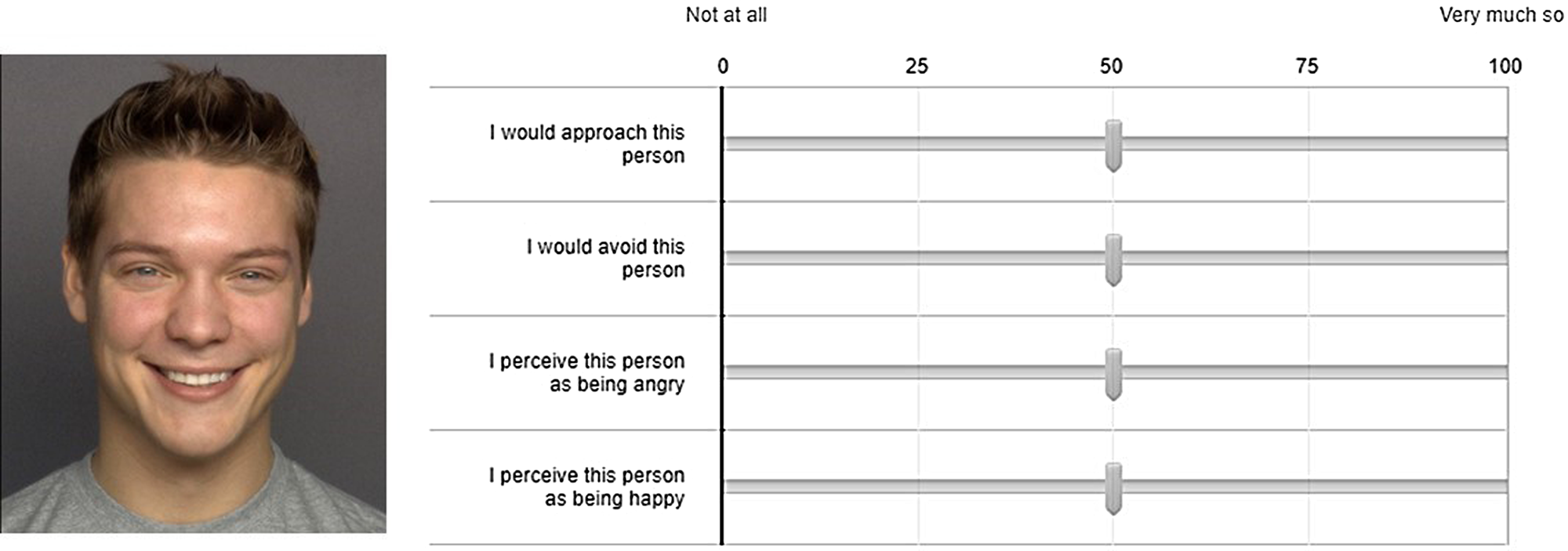
The study was carried out online via Qualtrics (www.qualtrics.com). After providing consent and demographic information, participants were shown one set of 24 images of male and female models depicting angry, happy, and neutral facial expressions. Participants used four “sliders” located below each image (Figure 1) to indicate, on a 100-point scale, the extent to which they would approach the person in the image, the extent to which they would avoid the person in the image, how angry they perceived the person to be, and how happy they perceived them to be. The order of the rating sliders was counterbalanced across participants. The task was presented across 24 web pages, with each page displaying one image positioned above the four sliders (Figure 1). The order of image presentation was randomized across participants. After completing this task, participants completed the questionnaires measuring ELS, depression, and anxiety.
Task stimuli. Example of a web page viewed by participants. Note in the actual task the image of the facial expression was positioned above the “sliders.”

Statistical Analyses
Statistical analyses were performed using IBM SPSS Statistics for Windows, Version 22.0. Several measures were non-normally distributed; thus, where appropriate, original p values are reported alongside bias-corrected and accelerated 95% bootstrap confidence intervals based on 1000 samples. Prior to analysis, a single measure of approach-avoidance responsivity was created by subtracting scores on the avoidance scale from scores on the approach scale. Scores above zero on this approach-avoidance measure indicate a tendency towards approach, while scores below zero indicate a tendency towards avoidance. Three separate measures of approach-avoidance were calculated, one for each facial expression (angry, happy, and neutral). To investigate behavioral performance in the task, the approach-avoidance scores for each of the facial expressions were entered into a repeated measures analysis of variance (ANOVA) and the mean scores for each expression were examined.
The purpose of this research was to examine the effect of ELS on approach-avoidance of emotional facial expressions. To this end, a regression model was constructed in which the control variables of participant gender, age, mental illness (as indicated by a self-reported diagnosis and/or a score above the suggested clinical cut-off of 8 or above for one or both of the HADS scales), anxiety scores (HADS-A), and depression scores (HADS-D) were entered in the first step and the variable of interest, ELS score (CATS), was entered in the second step. In light of the widely reported relationship between ELS and mental illness, an interaction term was also created by multiplying standardized CATS scores by the dichotomous mental illness variable. This interaction term was entered in the third step of the model. The regression model was used to predict each of the three outcome variables: approach-avoidance of angry facial expressions, approach-avoidance of happy expressions, and approach-avoidance of neutral expressions. After fitting the regression model, the residuals were examined and any cases with residuals >±3 standard deviations were removed (Field, Reference Field2005). The analysis was then re-run, and the results of the final analyses were reported. The number of cases removed from each analysis is detailed in the notes below the table containing the analysis. The highest number of cases removed from any individual analysis was five.
Results
Demographics
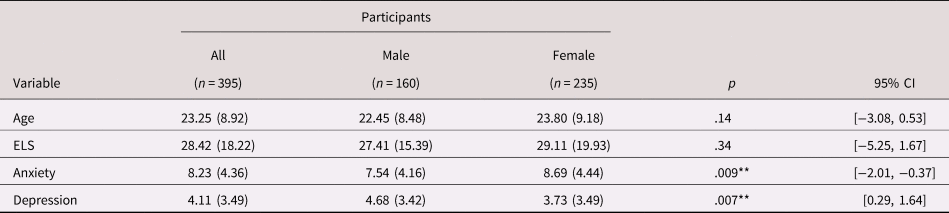
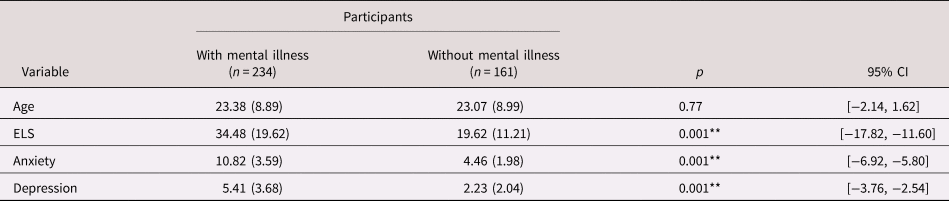
Mean scores for age, ELS (CATS), depression (HADS-D), and anxiety (HADS-A) are presented in Table 1 and Table 2. Given the widely reported relationship between ELS and depression and anxiety scores, Pearson's correlations were used to examine whether the present sample also showed this expected relationship. Due to the significant difference between male and female participants’ depression and anxiety scores (Table 1), correlations were performed separately for each gender. ELS was significantly positively associated with depression scores in both male, r (158) = .49, p < .001, BCa 95% CI [.35, .61], and female participants, r (233) = .42, p < .001, BCa 95% CI [.27, .56]. Similarly, ELS scores were significantly positively correlated with anxiety scores in both male, r (158) = .41, p < .001, BCa 95% CI [.25, .54], and female participants, r (233) = .46, p < .001, BCa 95% CI [.35, .57].
Scores on demographic variables for male and female participants

Note: Values inside the parentheses indicate the standard deviation of the mean. Independent t tests were used for comparison of means between male and female participants. ELS was measured with the Child Abuse and Trauma Scale (Sanders & Becker-Lausen, Reference Sanders and Becker-Lausen1995); anxiety and depression were measured with the Hospital Anxiety and Depression Scale (Zigmond & Snaith, Reference Zigmond and Snaith1983). **p < .01.
Scores on demographic variables for participants with and without evidence of mental illness

Note: Values inside the parentheses indicate the standard deviation of the mean. Independent t tests were used for comparison of means between participants with and without evidence of mental illness (measured as self-reported diagnosis and/or clinical score on one or both HADS subscales). ELS was measured with the Child Abuse and Trauma Scale (Sanders & Becker-Lausen, Reference Sanders and Becker-Lausen1995); anxiety and depression were measured with the Hospital Anxiety and Depression Scale (Zigmond & Snaith, Reference Zigmond and Snaith1983). **p < .01.
Task Reliability
As the present study used a new task to measure participants’ responses towards emotional facial expressions, internal consistency for each rating scale was examined using Cronbach's alpha. Cronbach's alpha was calculated for each scale in response to each facial expression (Supplementary Table 1). These alpha values were above 0.8 for all measures, indicating good reliability across the task.
Task Performance
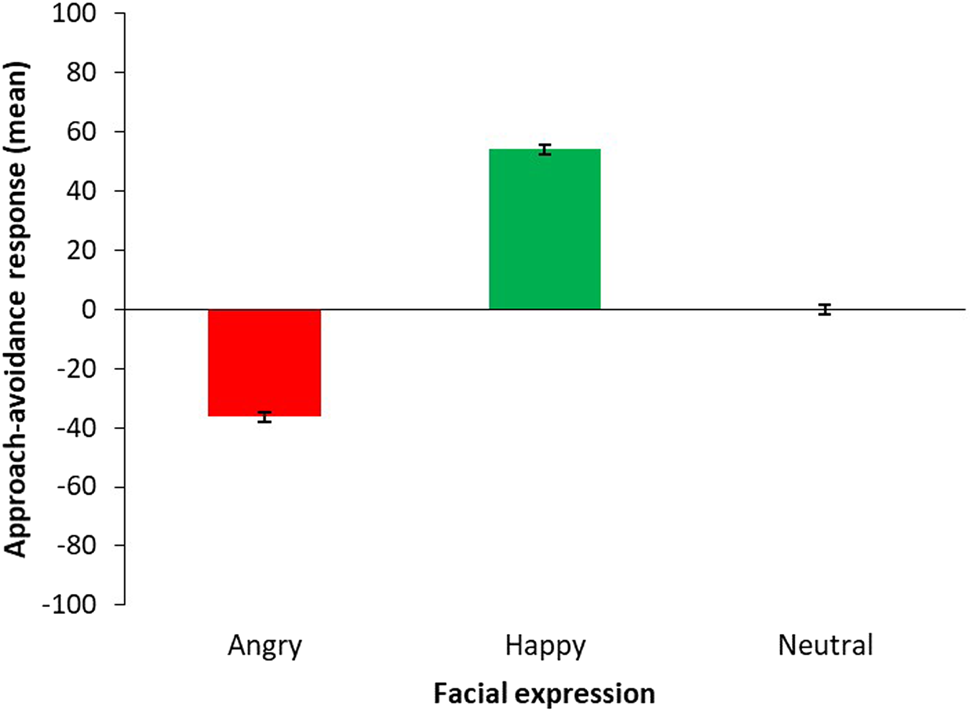
Mean approach-avoidance responses to the three facial expressions (angry, happy, and neutral) are presented in Figure 2. As the approach-avoidance score was created by subtracting the avoidance score from the approach score, values above zero indicate a tendency to approach and values below zero indicate a tendency to avoid. A repeated measures ANOVA was used to examine whether participants’ approach-avoidance responses differed between the three facial expressions. There was a significant effect of facial expression on approach-avoidance responses, F (1.70, 670.81) = 1122.05, p < .001. Examination of the mean approach-avoidance scores revealed that participants showed avoidance of angry facial expressions (M = –36.41, SD = 32.15) and approach of happy expressions (M = 54.05, SD = 31.25), while the mean approach-avoidance score for neutral expressions was close to zero (M = –0.16, SD = 31.06). As would be expected, pairwise comparisons using the Bonferroni correction demonstrated that participants were significantly more likely to avoid angry facial expressions than happy or neutral facial expressions, and significantly more likely to approach happy facial expressions than neutral expressions (all p values < .001).
Mean approach-avoidance scores across all participants (n = 395) in response to angry, happy, and neutral facial expressions. Positive scores indicate a tendency to approach while negative scores indicate a tendency to avoid. Error bars display the standard error of the mean.

Early Life Stress and Approach-Avoidance of Angry Facial Expressions
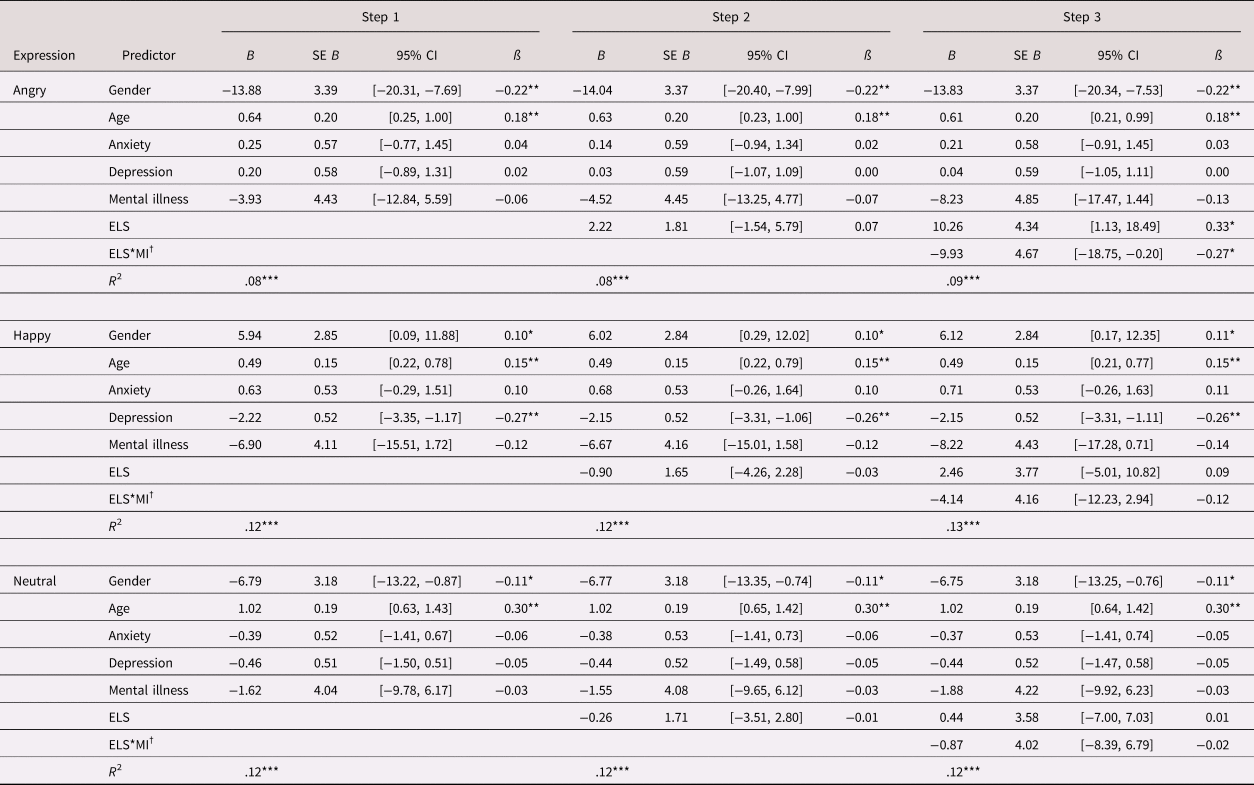
Hierarchical regression analysis was used to examine the effect of early life stress on approach-avoidance responses to angry facial expressions (Table 3). The control variables of participants' gender, age, mental illness, anxiety scores (HADS-A), and depression scores (HADS-D) were entered in the first step of the regression model, scores on the measure of ELS (CATS) were entered in the second step of the model, and the interaction term reflecting ELS multiplied by mental illness was entered in the third step.
Predictors of approach-avoidance responses to angry, happy, and neutral facial expressions

Note: Positive scores indicate increased approach, negative scores indicate increased avoidance. Each analysis had a slightly different n due to the removal of cases with residuals >±3 standard deviations. Angry: n = 393 (2 cases removed); Happy: n = 390 (5 cases removed); Neutral: n = 392 (3 cases removed). Gender refers to participant's gender and is coded as 0 = male, 1 = female. ELS = early life stress, measured using the Child Abuse and Trauma Scale (Sanders & Becker-Lausen, Reference Sanders and Becker-Lausen1995)—note that scores on this variable were standardized prior to inclusion in the model. Anxiety and depression were measured using the Hospital Anxiety and Depression Scale (HADS; Zigmond & Snaith, Reference Zigmond and Snaith1983). *p < .05 **p < .01 ***p < .001. †MI = Mental illness, measured as self-reported diagnosis and/or a score above the clinical cut-off of 8 on one or both of the HADS scales, coded as mental illness = 1, no mental illness = 0.
The final regression model predicted a significant amount of the variance in approach-avoidance responses towards angry facial expressions, R 2 = .09, F (7, 385) = 5.64, p < .001. The addition of ELS scores in the second step of the model was unable to explain a significant additional amount of variance in approach-avoidance responses towards angry facial expressions, ΔR 2 = .00, F (1, 386) = 1.58, p = .21. However, the addition of the interaction term (standardized ELS scores multiplied by mental illness) in the third step of the model was able to explain a significant amount of additional variance in approach-avoidance responses towards angry facial expressions, ΔR 2 = .01, F (1, 385) = 5.40, p = .02. Due to the observed inter-relationships between ELS, depression, and anxiety in the present sample, variance inflation factor (VIF) values were used to examine multicollinearity between the predictor variables. All predictors showed VIF values below 10, indicating that the extent of multicollinearity was acceptable (Field, Reference Field2005).
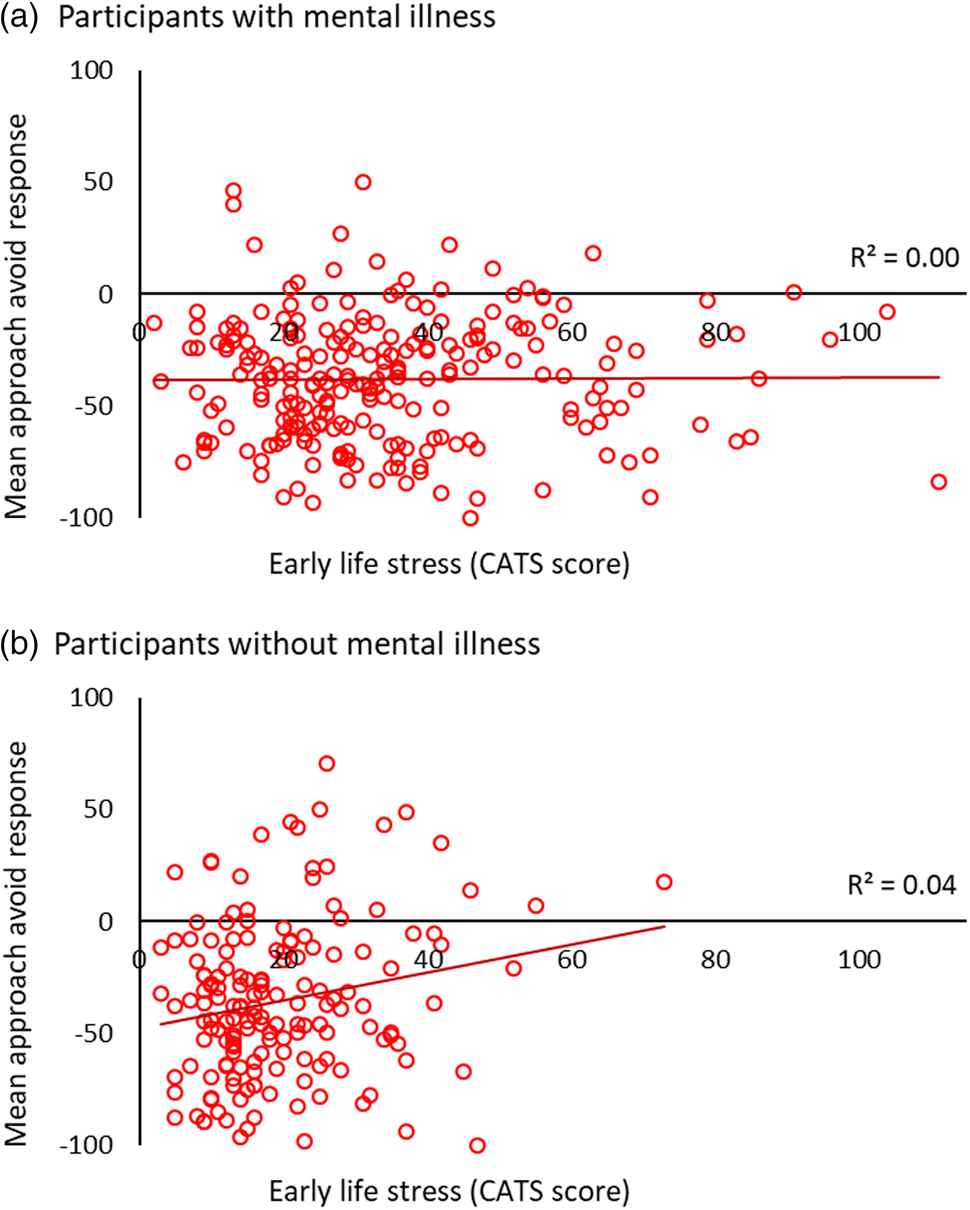
Examination of the beta weights (Table 3) revealed that the interaction between ELS and mental illness predicted a significant additional amount of the variance in approach-avoidance of angry facial expressions. To examine this interaction, the correlation between ELS and approach-avoidance of angry facial expressions was examined in participants with no evidence of mental illness and in participants with evidence of mental illness. Among participants with no evidence of mental illness, it was found that higher ELS scores were significantly associated with reduced avoidance of angry facial expressions (Figure 3), r (159) = .20, p = .01, 95% CI [0.02, 0.35]. In contrast, there was no significant relationship between ELS scores and approach-avoidance of angry facial expressions in those with evidence of mental illness, r (230) = 0.01, p = .92, 95% CI [-0.14, 0.15]. In addition, examination of the beta weights showed that female participants were significantly more avoidant than male participants in their responses to angry facial expressions, while younger participants were significantly more avoidant of these expressions than older participants. In light of the significant gender differences in depression and anxiety scores (Table 1) and the significant interaction of ELS and mental illness on approach-avoidance of angry facial expressions, an interaction term for ELS, mental illness, and participant gender was created and entered as an additional step in the regression model. There was no significant effect of this interaction term on approach-avoidance of angry facial expressions (see Supplementary Table 2).
Scatter plots depicting the correlation between early life stress and approach-avoidance responses to angry facial expressions in (a) participants with evidence of mental illness, and (b) participants without evidence of mental illness. Positive scores on the y-axis indicate greater approach, while negative scores indicate greater avoidance.

Early Life Stress and Approach-Avoidance of Happy and Neutral Facial Expressions
The hierarchical regression model was then used to examine the effect of early life stress on approach-avoidance responses to happy facial expressions and approach-avoidance responses to neutral facial expressions (Table 3). The control variables of participants’ gender, age, mental illness, anxiety scores (HADS-A), and depression scores (HADS-D) were entered in the first step of the regression model, while scores on the measure of ELS (CATS) were entered in the second step of the model, and the interaction term of ELS by mental illness was entered in the third step.
The final regression model predicted a significant amount of the variance in approach-avoidance responses towards happy facial expressions, R 2 = .13, F (7, 382) = 7.93, p < .001, and towards neutral facial expressions, R 2 = .12, F (7, 384) = 7.40, p < .001. The addition of ELS scores in the second step of the model was unable to explain a significant additional amount of variance in approach-avoidance responses towards happy, ΔR 2 = .00, F (1, 383) = 0.33, p = .57, or neutral, ΔR 2 = .00, F (1, 385) = 0.03, p = .88, facial expressions. Similarly, the addition of the interaction term (standardized ELS scores multiplied by mental illness) in the third step of the model was also unable to explain a significant amount of additional variance in approach-avoidance responses towards happy facial expressions, ΔR 2 = .00, F (1, 382) = 1.16, p = .28, or neutral facial expressions, ΔR 2 = .00, F (1, 384) = 0.04, p = .83.
Examination of the beta weights (Table 3) revealed that female participants were less avoidant of happy facial expressions and more avoidant of neutral facial expressions than male participants. Older age was associated with reduced avoidance of both happy and neutral facial expressions. In line with previous research, higher depression scores were significantly associated with increased avoidance of happy facial expressions. Neither ELS scores nor the interaction between ELS scores and mental illness were significantly related to approach-avoidance responses to happy or neutral facial expressions.
Summary of findings
Taking the analyses together, there was evidence for an effect of participant gender on responses to emotional facial expressions such that female participants were more avoidant than male participants when responding to angry and neutral facial expressions, but less avoidant when responding to happy facial expressions. In addition, older age was associated with reduced avoidance of all emotional facial expressions (angry, happy, and neutral). There was an emotion-specific effect of depression scores such that higher depression scores were associated with greater avoidance of happy facial expressions, but were not associated with avoidance responses to angry or neutral expressions. Crucially, in mentally healthy participants, higher levels of ELS predicted reduced avoidance of angry facial expressions. This relationship was not present among participants with experience of mental illness.
Discussion
This study investigated the effects of ELS on adults’ self-reported approach-avoidance tendencies towards photographs of angry, happy, and neutral facial expressions. Contrary to predictions, higher ELS scores were associated with reduced self-reported avoidance of angry facial expressions. This effect was only present among participants with no evidence of mental illness; among participants with experience of mental illness, there was no significant relationship between ELS scores and approach-avoidance of angry facial expressions. Experiences of ELS were not associated with approach-avoidance tendencies towards happy or neutral facial expressions. It was also found that participant gender and age were associated with approach-avoidance tendencies towards emotional facial expressions; female participants were more avoidant of angry and neutral facial expressions and less avoidant of happy facial expressions than male participants, while older participant age was associated with reduced avoidance of angry, happy, and neutral facial expressions. Higher depression scores on the HADS-D were associated with increased avoidance of happy facial expressions, but were unrelated to approach-avoidance responses to angry or neutral facial expressions.
In this study with adult participants, higher levels of ELS did not predict increased avoidance of angry facial expressions. This is in contrast to previous studies with children in which ELS was associated with hypersensitivity to the emotion of anger (da Silva Ferreira, Crippa, & Osorio, Reference da Silva Ferreira, Crippa and Osorio2014) as demonstrated by maltreated children's ability to detect anger with fewer perceptual and facial cues (Pollak et al., Reference Pollak, Messner, Kistler and Cohn2009; Pollak & Sinha, Reference Pollak and Sinha2002). Furthermore, the finding that higher levels of ELS were not associated with increases in self-reported avoidance appears to contradict the suggestion that ELS-related changes in responsivity to anger serve the purpose of facilitating increased avoidance of danger (McCrory & Viding, Reference McCrory and Viding2015; Pollak et al., Reference Pollak, Messner, Kistler and Cohn2009).
It is interesting to note that the present study found some evidence for the opposite pattern of responsivity; higher levels of ELS were associated with reduced self-reported avoidance of angry facial expressions among individuals with no evidence of mental illness. Given the novelty of these findings, a thorough understanding of their significance requires additional investigation. However, one highly speculative explanation for the effects is the notion that reduced avoidance in response to angry facial expressions could represent a marker of resilience or stress inoculation following manageable levels of ELS (Ashokan et al., Reference Ashokan, Sivasubramanian and Mitra2016; Ellis, Bianchi, Griskevicius, & Frankenhuis, Reference Ellis, Bianchi, Griskevicius and Frankenhuis2017). This explanation could suggest that those who had experienced moderate levels of ELS would be best equipped to deal with psychosocial challenge (such as how to respond to an angry facial expression). Unlike those with very low levels of ELS, these individuals have encountered and learned to manage stressful situations, yet they have not been exposed to the more severe levels of stress experienced by those who go on to develop mental health conditions.
Indeed, on a conceptual level, the findings align with work by Yamamoto et al. (Reference Yamamoto, Toki, Siegle, Takamura, Takaishi, Yoshimura and Yamawaki2017), who examined the effects of ELS on mentally healthy participants. They found that experience of ELS was associated with increased amygdala activation during a sad mood induction and that this increased amygdala activation was in turn associated with lower scores on a measure of depression symptomology. Yamamoto et al. (Reference Yamamoto, Toki, Siegle, Takamura, Takaishi, Yoshimura and Yamawaki2017) suggested that the ELS-related activity they observed in the amygdala represented a marker of resilience, rather than of vulnerability, to future mental illness. Similarly, the present finding of a pattern of responsivity that varies according to mental health status accords with work by Saleh et al. (Reference Saleh, Potter, McQuoid, Boyd, Turner, MacFall and Taylor2017), who found that the relationship between ELS and processing speed varied according to levels of depression symptomology.
Despite the potential value of a resilience narrative in explaining the present findings, it is acknowledged that there was no evidence of a relationship between responses to angry facial expressions and measures of depression and anxiety. This limits the proposed explanation for the results; if anxiety and depression are not in themselves associated with avoidance, it is unclear why alterations in avoidance responsivity should influence an individual's propensity for anxiety and depression. Further work should investigate this apparent discrepancy in greater detail.
It is interesting to acknowledge the patterns of emotion specificity in the present set of findings. The effects of ELS on approach-avoidance responses were specific to angry facial expressions, with no evidence for any relationships between ELS scores and responses to happy or neutral facial expressions. This specificity is broadly in accordance with previous work, which has highlighted a specific role for the emotion of anger in studies of face processing following ELS (Maheu et al., Reference Maheu, Dozier, Guyer, Mandell, Peloso, Poeth and Ernst2010; McCrory et al., Reference McCrory, De Brito, Sebastian, Mechelli, Bird, Kelly and Viding2011; Pollak, Reference Pollak2008). Similarly, the present study found that the effect of depression scores on approach-avoidance was specific to happy facial expressions (with higher depression scores associated with increased avoidance of happy expressions); depression scores were unrelated to approach-avoidance of angry or neutral facial expressions. This finding contributes to literature highlighting a bias away from happy emotional cues among people with depression (Bourke, Douglas & Porter, Reference Bourke, Douglas and Porter2010; Leppanen, Reference Leppanen2006), and extends work demonstrating that those with depression are more likely than people without depression to perceive happy expressions as neutral rather than happy (Gur et al., Reference Gur, Erwin, Gur, Zwil, Heimberg and Kraemer1992; Surguladze et al., Reference Surguladze, Young, Senior, Brebion, Travis and Phillips2004).
The present work also found significant effects of participant gender and age on approach-avoidance tendencies. Specifically, female participants were more likely to avoid angry and neutral facial expressions than male participants, an effect which was independent of levels of ELS. This is in partial accordance with Miller et al.’s (Reference Miller, Chabriac and Molet2013) finding that female participants kept a greater simulated distance between themselves and others than male participants, irrespective of the others’ emotional expressions. The present finding of a relationship between older age and reduced avoidance of emotional facial expressions was unexpected; to the authors’ knowledge, age has not previously been associated with approach-avoidance of emotional facial expressions. Further work is required in order to clarify the relationships between gender, age, and the processing of specific emotional expressions.
One of the strengths of this work is its demonstration that early experiences do not have to be extreme to have a long-lasting effect on cognitive processing. However, it is acknowledged that the relatively low levels of ELS in the present sample (M = 28.42, out of a maximum score of 152 on the CATS) do give rise to difficulties when attempting to compare the current findings with other work in the field, which has typically focused on severe ELS, such as abuse that has been documented by authorities (e.g. McCrory et al., Reference McCrory, De Brito, Sebastian, Mechelli, Bird, Kelly and Viding2011; Pollak et al., Reference Pollak, Messner, Kistler and Cohn2009). Furthermore, while steps were taken to identify those likely to be experiencing symptoms of mental illness at the time of the study, clinical interviews were not used. As such, it is possible that some of the participants identified as mentally healthy were experiencing symptoms of mental illness that were not detected by the self-report questionnaires.
The present study was limited by the use of a retrospective self-report measure of ELS and by its cross-sectional design. However, a review of the validity of adult retrospective reports by Hardt and Rutter (Reference Hardt and Rutter2004) concluded that while not all adults will disclose abuse or neglect when asked, cases where abuse or neglect are disclosed are generally reliable. Furthermore, both retrospective reports and cross-sectional designs play an important role in advancing knowledge about the pervasive long-term effects of ELS (e.g., Dannlowski et al., Reference Dannlowski, Stuhrmann, Beutelmann, Zwanzger, Lenzen, Grotegerd and Kugel2012; Du et al., Reference Du, Wang, Meng, Yong, Yang, Huang and Hu2016; Edwards, Holden, Felitti, & Anda, Reference Edwards, Holden, Felitti and Anda2003). An additional limitation of the present study concerns the task itself. The task was carried out online, and participants were given as much time as they required to respond to each facial expression. As a result, it is possible that some participants were not paying attention to the task. However, the fact that the sample as a whole performed the task as expected suggests that participants did pay attention when responding. It is also acknowledged that the task lacked ecological validity; it is not known whether participants’ approach and avoidance tendencies towards photographs reflect the responses they would make in real life situations. In hindsight, the use of separate scales for approach and avoidance was an oversight, as it reduced the ability to compare the findings as clearly with other studies that have used one scale ranging from approach to avoidance (e.g. Seidel et al., Reference Seidel, Habel, Finkelmeyer, Schneider, Gur and Derntl2010; Derntl et al., Reference Derntl, Seidel, Eickhoff, Kellermann, Gur, Schneider and Habel2011). The creation of one scale from the two scales was an attempt to remedy this, although it is recognized that this approach has not been validated by previous studies.
In spite of these limitations, this study represents, to the authors’ knowledge, the first investigation of the relationship between ELS and adults’ self-reported approach-avoidance of emotional facial expressions. In participants with no evidence of mental illness, it was found that higher ELS scores were associated with reduced avoidance of angry facial expressions. This finding represents a novel and interesting contribution to the field, demonstrating that ELS-related alterations in social cognition can be observed many years after the occurrence of ELS and that these alterations may vary according to the mental health of the individual.
Supplementary Material
The supplementary material for this article can be found at https://doi.org/10.1017/S095457941900110X.