Since 2013, the American Centers for Disease Control and Prevention (CDC) National Healthcare Safety Network (NHSN) has developed the classification of ventilator-associated events (VAEs) to replace ventilator-associated pneumonia (VAP) as a new paradigm for surveillance.Reference Magill, Klompas and Balk1,2 VAP surveillance has the shortcomings of highly subjective and nonspecific definitions.Reference Fabregas, Ewig and Torres3–Reference Tejerina, Esteban and Fernandez-Segoviano5 Since 2015, 3 tiers of VAEs events have been prevalent in intensive care units (ICUs) and may be associated with poorer outcomes: ventilator-associated conditions (VACs), infection-related ventilator-associated complications (IVACs), and possible VAP (PVAP).6–Reference Shichao, Lin and Chunhua11
However, uncertainties remain regarding the impact of VAEs. First, the impact of VAEs in different studies has not been consistent.Reference Lilly, Landry and Sood7,Reference Lewis, Li, Murphy and Klompas8 Second, the impact of VAEs in previous studies may have been overestimated. Most studies selected patients without VAEs, including patients on IMV for <4 days, as the control, whereas ≥4 days on IMV was required for determining a VAE. Third, most studies have a small number of VAE cases, which limits the number of factors that can be studied. This limitation may introduce significant selection biases. We have developed an ICU healthcare-associated infection (ICU-HAI) registry focusing specifically on the management of HAIs in the ICU setting.Reference Wen, Shichao and Qiao12 The registry includes the data from prospective VAE surveillance and may provide much-needed real-world evidence regarding VAEs. We investigated the clinical impact of and risk factors for mortality related to VAEs in ICU patients with IMV based on the ICU-HAI registry.
Methods
Study design
This cohort study was conducted based on an ICU-HAI registry, and this study was approved by the Ethics Committee of West China Hospital, Sichuan University, with a waiver of informed consent (no. WCH2018-409). Patient data were anonymized prior to analysis. All patient data were retrieved from the ICU-HAI registry.
Data source
The ICU-HAI registry was developed in the ICUs at West China Hospital Healthcare System by integrating multisource data. There are 172 beds in 6 ICUs: general ICU, surgical ICU, neurology ICU, thoracic ICU, respiratory ICU, and pediatric ICU. These ICUs have a total of ˜8,000 admissions per year in this 5,000-bed tertiary-care hospital. The ICU-HAI registry was developed based on the linkage of the database of the electronic medical record (EMR) system, the ICU system, and the ICU-HAI system in the hospital. The EMR system collected the routine electronic medical records with annual discharged patients, which exceeded 220,000 from 2016. The ICU system recorded the daily intensive care data of ICU patients, and the ICU-HAI system gathered the prospective surveillance data of HAIs in ICUs using the HAI definitions updated annually by the CDC NHSN.13 The ICU-HAI registry included >20,000 patients and 245,311,294 original records with detailed information regarding the clinical care of patients. This database has previously proven to have a high level of quality and comprehensiveness.Reference Wen, Shichao and Qiao12
Study population
All patients admitted to any of the 6 ICUs between April 1, 2015 and December 31, 2018 in the ICU-HAI registry (extended to December 31, 2018, after our previous studyReference Wen, Shichao and Qiao12) were eligible for inclusion in this study. We applied the following exclusion criteria: patients admitted to the pediatric ICU, patients aged <18 years, those without ≥4 consecutive IMV days during an ICU stay, those with a >1-year ICU stay because of medical disputes, and those not of Chinese nationality.
Exposures and confounders
The exposed group in the cohort for the outcomes contained all patients with VAEs in the ICUs, while the control group consisted of all patients receiving ≥4 consecutive IMV days but without a VAE in an ICU. A mortality risk-factor analysis was conducted in the VAE cohort. For the subgroup analysis for the outcomes of different VAE types, the cohort was limited to the patients who had a VAE only once during an ICU stay. The VAE type was the exposure for the analyses of impact of VAE type on each of the outcomes. The confounders included demographic characteristics (age and sex), illness severity (evaluated by Acute Physiology and Chronic Health Evaluation (APACHE) II scoreReference Knaus, Draper and Wagner14 during the first 24 hours on ICU admission), comorbidities on ICU admission, some treatment procedures (eg, surgical operation), and HAIs in the ICU. For the analysis of mortality risk factors, potential impact factors were explored in the confounders: demographic characteristics, illness severity, comorbidities, treatment procedures, VAE times (the number of occurrences), HAIs, and tracheotomy in the ICU. These factors were identified through literature review and by consulting ICU and HAI experts. VAEs including VAC, IVAC, and PVAP were identified using the CDC NHSN definitions.13 VAE surveillance was only conducted in ICUs. VAE date was defined as the date of the onset of worsening oxygenation according to the CDC NHSN criteria.13
Outcomes
We analyzed 8 outcomes: (1) length of stay (LOS) in an ICU, (2) LOS in the hospital, (3) hospitalization costs, (4) days on IMV in an ICU, (5) ≥9 days on IMV in an ICU, (6) failure in extubating IMV on ICU discharge, (7) death in an ICU (all-cause mortality), and (8) predicted death on ICU discharge. Predicted death on ICU discharge included death in an ICU and discharge from an ICU against medical advice because of a critical condition and the desire to pass away at home. In the subgroup analysis for the outcomes of different VAE types, we analyzed days on IMV in an ICU after the VAE date and ≥7 days on IMV in an ICU after the VAE date.
Data collection
All of the patient data including the exposures, confounders and outcomes, were retrieved from the ICU-HAI registry. Variable dictionaries were established for each of the variables. Comorbidities on ICU admission were retrieved using the International Classification of Diseases Tenth Revision (ICD-10) codes and free terms from the diagnoses on ICU admission. Data regarding treatment procedures including surgery (defined as surgeries that required general anesthesia or admission to the operating room), central-line catheter, blood transfusion, and immunosuppressive drugs used intravenously or orally (eg, dexamethasone and sirolimus) during the ICU stay were retrieved based on the medical orders. HAIs and VAEs were determined according to the ICU-HAI surveillance. The economic outcomes and mortality were obtained from the ICU-HAI registry (predicted deaths were evaluated from the discharge records of EMR), and the LOS and IMV outcomes were evaluated using time and IMV variables (eg, admission date and onset date of IMV). For the ICU-HAI registry, baseline data were collected by the infection control nurse of ICU, and VAEs were screened using the registry software. VAEs were identified by infection control practitioners.
Statistical analysis
We used STATA version 15.0 software (StataCorp, College Station, TX) to perform the statistical analyses. For the analyses of the impact of VAE on the adverse outcomes, we used propensity score matching (PSM) to ensure that the 2 groups (with or without a VAE) had similar baseline characteristics for each of the outcomes, respectively, in univariate analyses because the outcomes might have been influenced by different factors. Among 8 outcomes, days on IMV did not fit a normal distribution after any transformations and was excluded from the PSM. Variables that might affect an outcome were selected as the matching variables based on the literature and clinical expert advice. Patient matching was conducted in a 1:2 ratio using the nearest neighbor method. We calculated standardized difference (SD) to assess the balance of covariate distribution, and SD ≤ 0.1 exhibited a negligible imbalance between groups.Reference Austin15 We also used multiple linear regression models or logistic regression models to analyze the impact of VAE on outcomes after PSM. The factors that had an SD > 0.1 for a baseline covariate and were not included in the PSM were selected for the multivariate regression models. Logistic regression models were used to analyze the risk factors for mortality of VAE patients. The variables with a P value <.10 in the univariate analysis (and were considered clinically relevant according to the advice of clinical experts and previous studies) were selected for the multivariate regression models. The interaction among the factors was investigated using multicollinearity analyses. All tests were 2-sided, and P < .05 was considered statistically significant.
Subgroup analyses and sensitivity analyses
Subgroup analyses according to the VAE types were conducted to assess the impact of different types of VAE on adverse outcomes. We used logistic regression models for categorical outcomes and optimal scaling regression models for continuous numerical outcomes.
The sensitivity of the results for the impact of VAE was analyzed by propensity score weighting (PSW) and the traditional regression models, using the same adjusting factors with those after PSM. The sensitivity analysis of the mortality risk factor was conducted using predicted death on ICU discharge as the dependent variable.
Results
Baseline characteristics
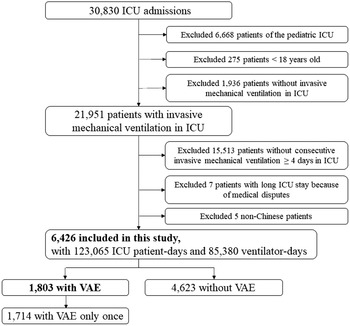
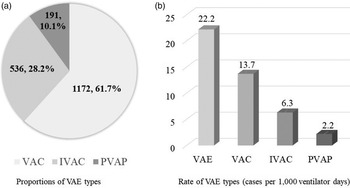
In total, 30,830 patients were admitted to the ICUs during this 4-year period, during which 21,951 adult patients received IMV. After the exclusion of noneligible patients, 6,426 patients with 123,065 ICU patient days and 85,380 IMV days were included in this study, of whom 1,803 (28.1% in patients with ≥4 IMV days) developed 1,899 VAEs (Fig. 1). The rate of VAE was 29.6% (1,899 of 6,426), with 22.2 cases per 1,000 ventilator days (1,899 of 85,380). Among those 1,899 VAEs, 1,172 were VACs (61.7%, not including IVACs or PVAP), 536 were IVACs (28.2%, not including PVAP) and 191 were PVAP (10.1%) (Fig. 2). Overall, 202 bacterial or fungal isolates were recovered from the 191 PVAP cases; among these, Acinetobacter baumannii (79 isolates, 39.1%) was the most common (Supplementary Fig. 1 online).
Inclusion and exclusion of patients in this study. Note. ICU, intensive care unit; IMV, invasive mechanical ventilation; VAE, ventilator-associated event.

Proportions and rates of different VAE types. Note. VAE, ventilator-associated event; VAC, ventilator-associated condition; IVAC, infection-related ventilator-associated complication; PVAP, possible ventilator-associated pneumonia.

Baseline clinical features and outcomes of all the 6,426 eligible patients included in this study and the patients with or without VAEs are shown in Table 1. All of the clinical outcomes were significantly different between the 2 groups (P < .001). However, we detected some differences in the baseline clinical features between the 2 groups, such as APACHE II score, chronic lower respiratory disease, and surgery.
Baseline Clinical Features and Outcomes of Patients With VAE or Without VAE

NOTE. VAE, ventilator-associated event; IQR, interquartile range; APACHE, Acute Physiology and Chronic Health Evaluation; ICU, intensive care unit; SD, standard difference; ARDS, acute respiratory distress syndrome; HAI, healthcare-associated infection; PVAP, possible ventilator-associated pneumonia; IMV, invasive mechanical ventilation; LOS, length of stay; CNY, Chinese yuan; ICU type was not included because of collinearity with the surgery and comorbidities in the multivariate analysis
a P values < .05 are shown in bold.
b Predicted deaths included deaths in an ICU and patients discharged from ICU against medical advice because of a critical condition and the desire to pass away at home.
Impacts of VAE on the outcomes
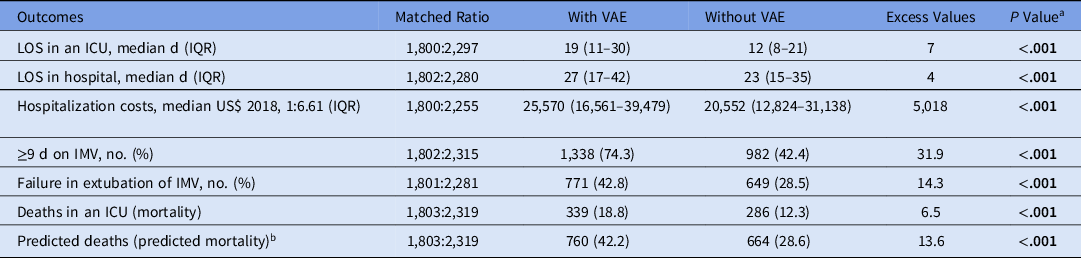
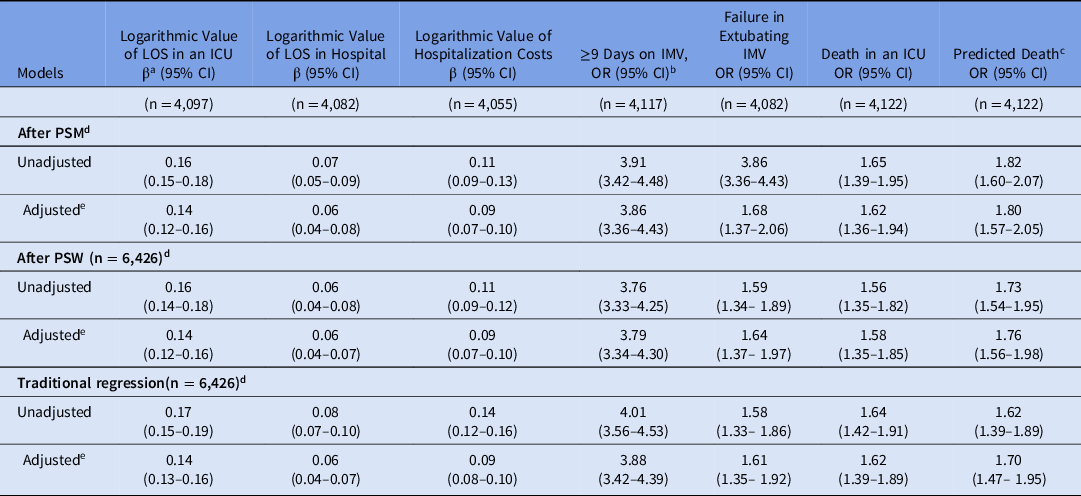
In total, 7 PSM models (matching ratio, 1:2; caliper value, 0.02) were developed to control the confounders in the cohorts for the 7 outcomes: LOS in an ICU, LOS in the hospital, hospitalization costs, etc, respectively (see Supplementary Tables 1–6 online). Compared with those without a VAE in the new cohorts, patients with VAEs did have prolonged LOS in an ICU (median, 7 days) and prolonged LOS in the hospital (median, 4 days), increased hospitalization costs (median, 33,170 Chinese yuan [CNY] or ˜US$5,018), longer days on IMV (median, 6 days), higher proportion of days on ≥9 IMV days (31.9%), higher rate of failure of extubation of IMV (14.3%), excess mortality in an ICU (6.5%), and higher predicted mortality in an ICU (13.6%) (P < .05) (Table 2). In the multivariate regression analyses (Table 3), VAE was indeed associated with poorer clinical outcomes. Supplementary Table 7 (online) list the adjusting factors for each of the outcomes in the PSM cohorts. The sensitivity analyses showed similar results, indicating the robustness of the primary results (Table 3).
Excess Outcomes of VAE After PS Matching

NOTE. VAE, ventilator-associated event; PS, propensity score; LOS, length of stay; ICU, intensive care unit; IQR, interquartile range; CNY, Chinese yuan; IMV, invasive mechanical ventilation.
a P values <.05 are shown in bold.
b Predicted deaths included deaths in an ICU and patients discharged from ICU against medical advice because of a critical condition and the desire to pass away at home.
Clinical Impacts of VAE From Multivariate Analysis in the PSM Cohorts and the Sensitivity Analysis

Note. VAE, ventilator-associated event; PSM, propensity score matching; LOS, length of stay; ICU, intensive care unit; β, unstandardized coefficients of multiple linear regression model; CI, confidence interval; IMV, invasive mechanical ventilation; OR, odds ratio; PSW, propensity score weighting.
a Continuous outcomes were analyzed using multiple linear regression models. Logarithmic transformations were conducted for the dependent variables which were not fit for a normal distribution. Days on IMV was replaced by ≥9 days on IMV because the data were not fit for a normal distribution after any transformations.
b Categorical outcomes were analyzed by logistic regression models.
c Predicted deaths included deaths in an ICU and patients discharged from ICU against medical advice because of a critical condition and the desire to pass away at home.
d All P values < .001.
e Adjusted for the same confounders for the 3 methods in each of the outcomes, respectively.
Subgroup analysis by VAE types
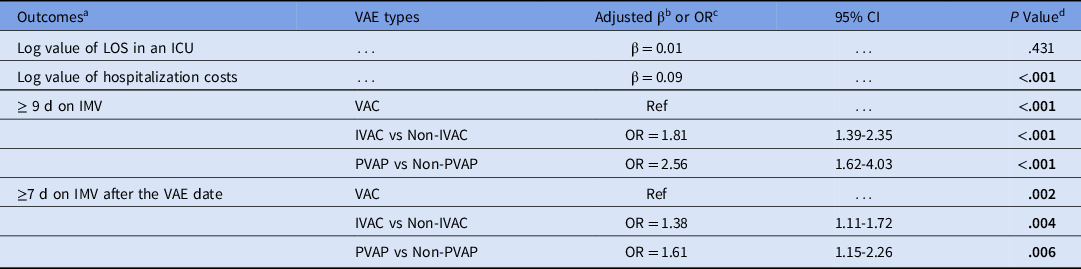
Outcomes of different VAE types in the 1,714 patients who had a VAE only once are shown in Supplementary Table 8 (online). As shown in Table 4, further multivariate analyses showed the following: (1) VAE type was not associated with different LOS in an ICU (logarithmic values; P > .05). (2) Patients with different VAEs from VACs to PVAP had increased hospitalization costs (β = 0.09 for logarithmic value). The optimal scaling regression and pairwise comparison results are shown in Supplementary Tables 9–11 (online). (3) Patients with IVAC had higher risks for ≥9 days on IMV (adjusted OR [aOR], 1.81) and higher risks for ≥7 days on IMV after the VAE date (aOR, 1.38) than those with other VAEs. (4) Patients with PVAP had higher risks for ≥9 days on IMV (aOR, 2.56) and higher risks for ≥7 days on IMV after the VAE date (aOR, 1.61) than those with other VAEs (P < .05).
Relation Between VAE Types and Outcomes From Multivariate Analyses

NOTE. VAE, ventilator-associated event; β, unstandardized coefficients of optimal scaling regression models; OR, odds ratio; CI, confidence interval; LOS, length of stay; ICU, intensive care unit; IMV, invasive mechanical ventilation; VAE, ventilator-associated event; VAC, ventilator-associated condition; IVAC, infection-related ventilator-associated complication; PVAP, possible ventilator-associated pneumonia; Ref, reference.
a Multivariate analyses were only conducted for the outcomes which had significant difference in the univariate analyses on VAE types. The adjusting factors for each of the clinical outcomes are shown in Supplementary Table 9 (online).
b Continuous outcomes were analyzed by optimal scaling regression models.
c Categorical outcomes were analyzed by logistic regression models.
d P values < .05 are shown in bold.
Risk factors for mortality in patients with VAE
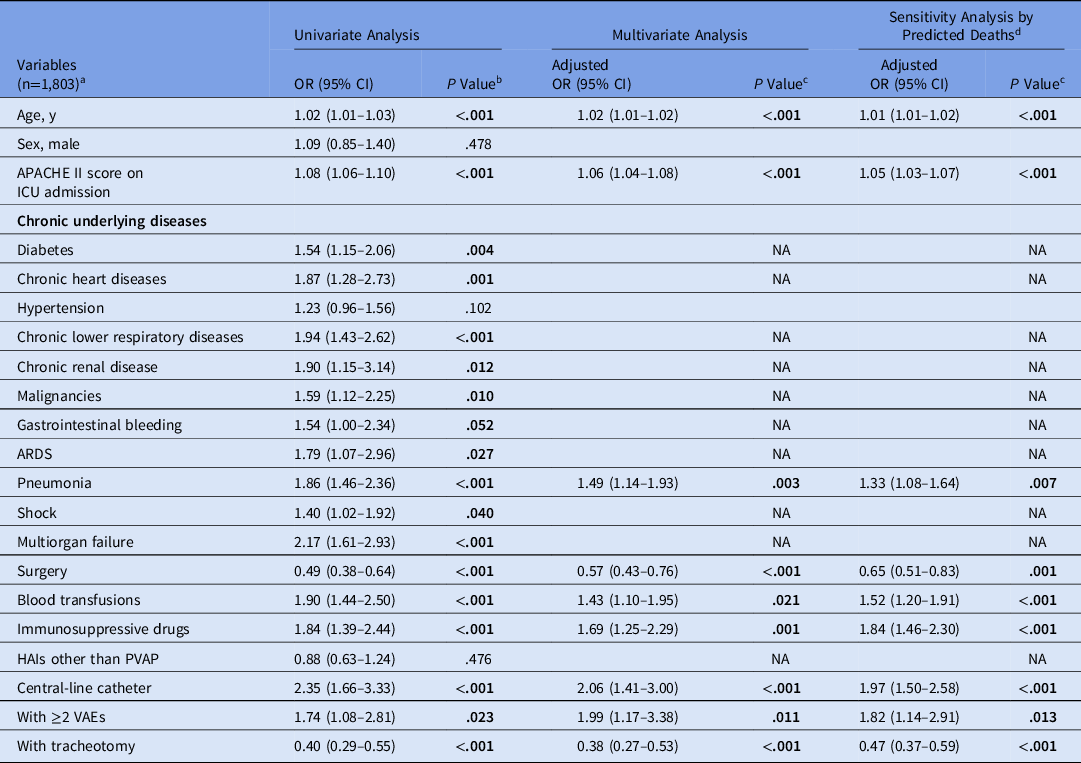
VAE patients with the following factors had a higher risk of all-cause mortality in an ICU: older age (aOR, 1.02; 95% CI, 1.01–1.02), higher APACHE II score on ICU admission (aOR, 1.06; 95% CI, 1.04–1.08), pneumonia (aOR, 1.49; 95% CI, 1.14–1.93), blood transfusion (aOR, 1.43; 95% CI, 1.10–1.95), immunosuppressive drugs (aOR, 1.69; 95% CI, 1.25–2.29), central-line catheter (aOR, 2.06; 95% CI, 1.41–3.00), and ≥2 VAEs during an ICU stay (aOR, 1.99; 95% CI, 1.17–3.38) (P < .05) (Table 5). Conversely, surgery (aOR, 0.59; 95% CI, 0.44–0.78) and tracheotomy (aOR, 0.41; 95% CI, 0.30–0.57) were associated with lower risk for all-cause mortality among patients with VAEs (P < .05). The sensitivity analyses showed similar results to the primary results using predicted all-cause mortality on ICU discharge as the dependent variable. This finding supports the robustness of the primary results (Table 5).
ICU Mortality Risk Factors for VAE Patients (Logistic Regression)

NOTE. ICU, intensive care unit; VAE, ventilator-associated event; OR, odds ratio; CI, confidence interval; APACHE, Acute Physiology and Chronic Health Evaluation; ARDS, acute respiratory distress syndrome; HAI, healthcare-associated infection; PVAP, possible ventilator-associated pneumonia.
a All variables were selected into the multivariate logistic regression model except hypertension and male sex.
b Variables were analyzed by univariate logistic regression models. Parameters with p < 0.1 are shown in bold.
c p values < 0.05 are shown in bold.
d Predicted deaths included deaths in an ICU and patients discharged from ICU against medical advice because of critical conditions and the desire to pass away at home.
Discussion
In this study, most VAE cases and the largest IMV cohort were successfully collected among studies on VAE up to now, which enabled the inclusion of many confounders to reduce the bias. We anticipate that this study based on the ICU-HAI registry could yield important evidence about VAEs in the ICU setting in China and worldwide.
The observed that the impact of VAEs on poorer outcomes in most previous studies was greater than in our study (Table 2).Reference Lilly, Landry and Sood7–Reference Shichao, Lin and Chunhua11,Reference Austin15–Reference Hayashi, Morisawa and Klompas18 Lilly et alReference Lilly, Landry and Sood7 reported that VAE patients had prolonged LOS in hospital by 10.2 days, longer days on IMV by 10 days, and excess all-cause mortality of 19.2%. Muscedere et alReference Austin15 showed that VAE patients had prolonged LOS in the ICU by 9.9 days and in the hospital by 9.9 days, longer days on IMV by 8.2 days, and excess all-cause mortality of 17.9%. Klompas et alReference Muscedere, Sinuff and Heyland16 reported that VAE patients had prolonged LOS in the ICU by 8.3 days and in the hospital by 5 days, longer days on IMV by 7 days, and excess all-cause mortality of 15%. One possible reason for this discrepancy is inconsistent inclusion criteria. Many previous studies have selected patients without VAEs, including patients with <4 IMV days as the control, while ≥4 IMV days is the premise for determining a VAE. Patients with <4 IMV days will never develop a VAE by definition, and they probably had better outcomes because of the shorter duration on IMV and lower illness severity. Therefore, the impact of VAE on patients in previous studies may have been overestimated. A study focusing on patients on ≥4 IMV days had only collected 54 VAEs (no PVAP cases) and had not conducted comparisons between VAE and non-VAE patients.Reference Klompas, Khan and Kleinman19 Our multicenter study conducted in 15 ICUs in China has shown higher values than this previous study while selecting the same control.Reference Shichao, Lin and Chunhua11 However, only univariate comparisons were conducted, and 94 VAE cases were collected in that short-term study, which may have limited the internal validity of the results. In our study, we conducted multivariate comparisons after PSM and sensitivity analyses, which showed similar results and supported the robustness of the results. Furthermore, the poorer outcomes, including increased hospitalization costs, higher risks for ≥9 days on IMV, and failure of extubation from IMV were reported for the first time. These findings provided more information on the adverse impact of VAEs.
Few previous studies have reported the differences in clinical impact among the 3 VAE types. In our previous study, we compared patients with IVACs or PVAP with those with VACs using univariate analyses only. Patients with IVACs or PVAP seemed to have longer days of IMV and LOS in an ICU than those with VACs but not longer LOS in the hospital or higher mortality. Further analyses based on univariate and multivariate models in this study identified that patients with PVAP had the highest hospitalization costs and risks for long duration on IMV in patients with VAEs. Therefore, PVAP leads to increased use of medical resources and should be given more attention among the VAE types.
Furthermore, ICU patients with the all-cause mortality risk factors investigated in this study should be more strictly monitored and protected to prevent deaths after VAEs. Age, APACHE II score, pneumonia on ICU admission, and surgery cannot be adjusted to prevent the death of a VAE patient, whereas blood transfusions, immunosuppressive drugs, central-line catheters, and VAEs in an ICU are adjustable. The application of blood transfusions and central-line catheters should be undertaken more cautiously in ICU patients with VAEs. Conservative blood-transfusion thresholds and central-line catheter indications may be helpful to prevent deaths in patients with VAEs. Avoiding a second VAE episode for a VAE patient might be an important potential measure to prevent deaths in patients with VAEs. Interestingly, VAE patients who had had surgery or tracheotomy were at lower risk for all-cause mortality in the ICU. In our ICUs, most patients with surgeries had fewer underlying diseases and had better outcomes than patients without surgeries, regardless of the presence of VAEs. Moreover, tracheotomy might be useful to improve the ventilation function and to prevent deaths in ICU patients with VAEs who had poor ventilation function.Reference Magill, Klompas and Balk1
This study has several limitations. First, all confounders were retrieved from the ICU-HAI registry, and these data depend on the quality of the registry. Any potential confounders that could not be found in the registry were not analyzed. Second, we only evaluated the medical data in a single-center design. The generalizability of our findings could be limited by the hospital type and the high prevalence of VAEs in this hospital. Third, different surgeries may have different impacts on subsequent complications and outcomes, but we did not stratify the type of surgery for this analysis. Fourth, APACHE II scores were only obtained once on ICU admission and were not reevaluated on the date of VAEs.
In conclusion, when restricting the control to patients without VAEs but with ≥4 consecutive IMV days during an ICU stay, patients with VAE still had poorer clinical outcomes. Patients with PVAP had the highest hospitalization costs and risks for long duration on IMV in those with VAEs. Older age, higher APACHE II score on ICU admission, pneumonia, blood transfusion, immunosuppressive drugs, central-line catheter, or ≥2 VAEs in an ICU were risk factors for all-cause mortality of VAE patients in an ICU, whereas surgery and tracheotomy were associated with lower risk for all-cause mortality in ICU patients with VAEs.
Acknowledgments
We thank the physicians and allied health staff of the ICU and the Department of Electronic Medical Records of West China Hospital for their cooperation and assistance in the conduct of this study.
Financial support
This study was supported by the National Natural Science Foundation of China (grant no. 71573183) and the 1.3.5 Project for Disciplines of Excellence, West China Hospital, Sichuan University (grant nos. ZYYC08003 and ZYYC08006).
Conflicts of interests
The authors declare that they have no competing interests related to this article.
Supplementary material
To view supplementary material for this article, please visit https://doi.org/10.1017/ice.2021.64