Health-related quality of life (HRQoL) is a broad concept which can be defined as a patient's general subjective perception of the effect of illness and intervention on physical, psychological and social aspects of daily life (1;2). Multidimensionality is a key characteristic of HRQoL. Physical functioning refers to mobility, self-care, usual activities, and other functional abilities. Psychological health includes elements like cognitive functioning, emotional distress and anxiety. Social health refers to the quantity and quality of social contacts and interactions (Reference Goodman3).
Objective clinical measures may correlate poorly to a patient's own feeling of wellness (Reference Goodman3;Reference Jackowski and Guyatt4). In non-fatal—but sometimes severe—diseases where an intervention does not increase survival, an improvement of HRQoL may be as important as the improvements in the efficacy endpoints (e.g., psoriasis, asthma). Therefore, taking HRQoL considerations into account in relative effectiveness assessments (REA) is important. The purpose of REA is “to inform healthcare professionals, patients and decision makers about the therapeutic added value of an intervention compared with already existing interventions” (Reference Kleijnen, Goettsch and d'Andon5). As an adequate assessment is based on data, it is important to measure HRQoL in clinical or epidemiological studies. Only this facilitates understanding patients' perspectives on the impact of a disease on HRQoL. The difficult question is, however, how to measure HRQoL.
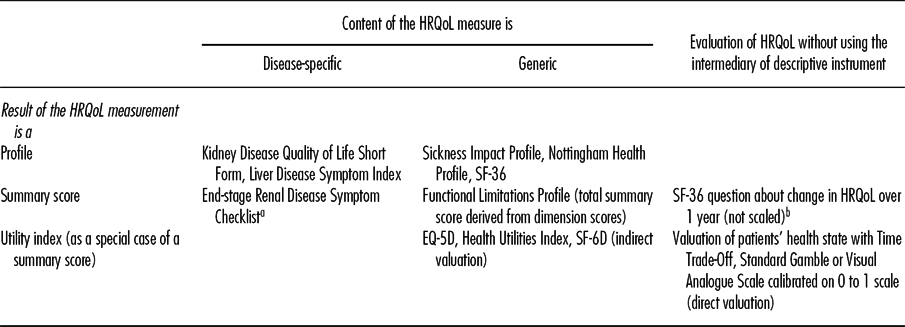
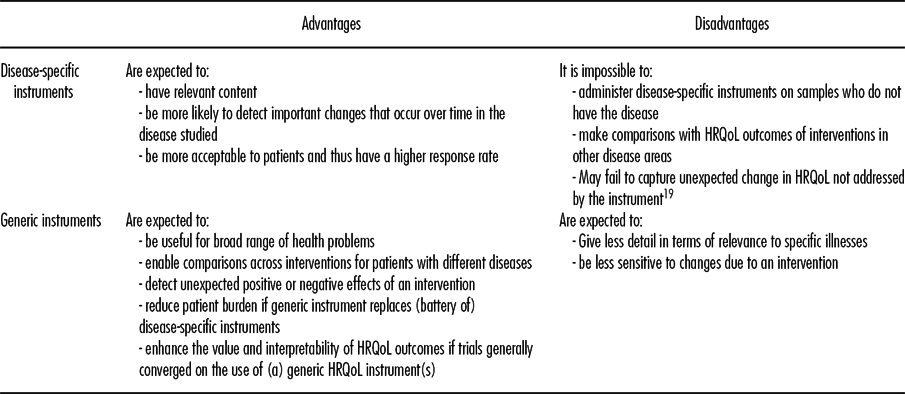
HRQoL measures can basically be categorized according to their content and their result (Table 1). In terms of content, a distinction can be made between generic and disease-specific HRQoL measures. Generic measures cover dimensions that are considered important for HRQoL in general and can be used for broad range of health problems. Disease-specific measures focus on dimensions that are specific for a disease (e.g., asthma), a site or region affected (e.g., the hip), a population (e.g., the elderly), or a function (e.g., sleep). Table 2 summarizes the advantages and disadvantages of disease-specific and generic instruments, based on a review by Fitzpatrick et al. (Reference Fitzpatrick, Davey, Buxton and Jones6).
Examples of Instruments and Outcomes of HRQoL Measures

aCombines profile measures with summary score.
bIs a single item question, answered on an ordinal scale.
Advantages and Disadvantages of Disease-Specific and Generic HRQoL Instruments

Note. Source: adapted from Fitzpatrick et al. (Reference Fitzpatrick, Davey, Buxton and Jones6)
In terms of the result of the HRQoL measurement, a distinction can be made between profile or descriptive measures on the one hand and summary score measures on the other hand. Profile measures usually consist of different items, grouped into dimensions (e.g., physical functioning, cognitive functioning, anxiety, and distress) (Reference Guyatt, Feeny and Patrick7). Each item is scored on a binary, ordinal, or continuous scale. Item scores can sometimes be combined to create a profile of dimension-specific measures or to one overall summary score (e.g., the summary score of the Functional Limitations Profile).
Utility measures are a sub-type of summary score measures. They are typically used to calculate quality-adjusted life-years (QALYs), a composite outcome measure for life years gained and HRQoL frequently used in cost-utility analyses. In contrast to other types of summary scores, utility scores are expressed on a 0 to 1 scale where 0 is the value of death and 1 the value of perfect health (negative values are possible for health states considered worse than death). The scores have interval properties, meaning that a gain in HRQoL of 0.40 is twice as good as a gain of 0.20 on a scale from 0 to 1.
The objective of this guideline is to define which type of HRQoL measure should be chosen for three possible, not mutually exclusive, purposes of HRQoL measurement: (i) assessing the relative effectiveness of a product (REA), and/or (ii) assessing the cost-utility of a product (CUA) and/or (iii) informing clinical decision making.
The guideline is meant to inform assessors of HRQoL evidence in a REA context about the type of data required to make valid assessments, as well as researchers deciding on which HRQoL measure to include in their trial about the possible future uses of the HRQoL data if a specific measure is chosen.
METHODS
A systematic literature review was performed to identify relevant exiting guidelines for HRQoL measurement for one or more purposes included in the scope of our study. Bibliographic databases (Medline, Embase, and Cochrane methodology register) as well as guidelines, reports, recommendations from regulatory (European Medicines Agency [EMA] and Food and Drug Administration [FDA]) and other agencies were searched. Guidelines and templates for reimbursement request files for pharmaceuticals were screened for specific guidance on HRQoL measures for demonstrating relative effectiveness. They were retrieved through screening of Web sites of reimbursement agencies. In addition, guidelines for health economic evaluations were screened for recommendations on HRQoL measurement. HTA agencies and research groups' Web sites were screened to identify HRQoL guidelines developed by other governmental, semi-governmental, or private organizations. Finally, handsearching was performed, based on reference lists of retained documents.
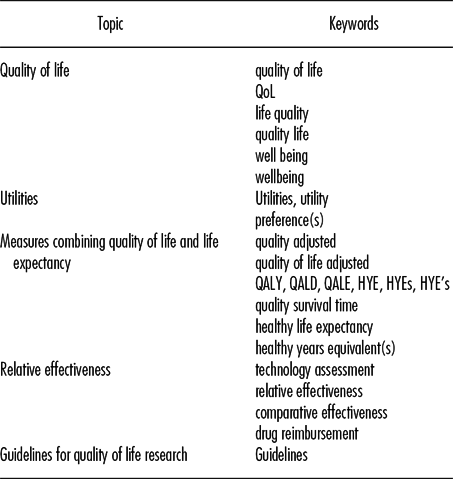
Keywords relating to HRQoL or well-being, utility, and preferences were combined with keywords relating to REA (Table 3). Medline (OVID) was searched on January 12, 2011. Embase was searched on January 19, 2011. The Cochrane Methodology register was searched using the keyword “quality of life.” Only English references published in 1995 or later were retrieved.
Topics and Keywords Used for the Search Strategy on HRQoL and Relative Effectiveness Assessment

The search of the (pharmacoeconomic) guidelines included guidelines published in English, Dutch, or French. Papers or documents were excluded for the review if they studied specific interventions, one specific HRQoL instrument or specific populations, if they were about quality of care or about the use of HRQoL measures for case-mix adjustments in financing or purposes not related to REA for the reimbursement of interventions. Letters and conference abstracts were excluded but critical analyses of HRQoL measurement, general reflections, or theoretical considerations were included.
The search in Medline, Embase, and the Cochrane Methodology Registry resulted in 3,723 references, of which 332 were selected for further consideration based on full texts. Full text selection reduced the number of relevant papers to eighty-one. In addition, twenty-four existing guidelines were included for review.
The first draft of the guideline was discussed internally with EUnetHTA partners in March 2012. In April/May 2012, a consultation with the stakeholder advisory group was performed, followed by a public consultation in June/October 2012. Twelve organizations gave detailed feedback on the draft guidelines. Appropriate action was taken or a response/reaction given to each of the 155 comments received during the consultation rounds.
RESULTS
The main finding of the literature search and analysis is that the choice of the HRQoL measure should depend on the purpose of the REA and the decision-making context. The variations in context make that consensus is often lacking on the needs regarding HRQoL evidence. However, as these needs are usually not conflicting, a set of basic requirements applicable to all contexts could be identified. Where this is not the case, possible variations are mentioned. The guideline covers twelve recommendations.
Recommendation 1: Fitness for Purpose
REA can serve different types of decision makers: patients and healthcare professionals in a clinical decision-making context or policy makers in a market authorization or coverage decision-making context. HRQoL instruments used in the context of REA should first and foremost be valid for the purpose the REA intends to serve.
For a policy-oriented REA, generic HRQoL measures should be used. The generic instrument should encompass all HRQoL dimensions on which improvement is considered meaningful from a societal point of view.
For clinicians faced with an individual patient in a clinical context, more specific information about the HRQoL dimensions affected by a disease or its intervention(s) may be needed. In those cases, the REA also benefits from including disease-specific HRQoL measures.
Recommendation 2: REA for Coverage Decisions
Guidance for HRQoL assessment in a coverage decision-making context depends on which information is used in the resource allocation decisions. There is variation across countries in how coverage decisions are made: some countries use data on cost-effectiveness in decision making, whereas others do not.
A general recommendation applicable to all REAs for coverage decisions is that both a disease- or population-specific and a generic HRQoL measure should be included for most adequately capturing the impact of a disease on daily life.
In case there is a need for the calculation of QALYs and for countries that use cost-utility data in their coverage decision making, a utility measure or generic HRQoL instrument associated with a reference set of utility values (generic utility instrument) should be used. These utility values should have been derived from the general public (indirect utility measurement) or from patients (direct utility measurement). There is no consensus across jurisdictions about the most appropriate way to measure utilities; neither about the most appropriate measurement technique, nor about whose utilities should be measured. The choice is normative, but the consistent use of one particular, easily-administered generic descriptive HRQoL instrument that is widely used is recommended for reasons of consistency and comparability (Reference Neyt8). Moreover, for consistency it is also important to use the same HRQoL measure for REA than for the cost-utility analysis. This avoids conflicting results in terms of HRQoL outcomes.
For countries that do not use cost-utility data to support a coverage decision, a disease-specific or generic HRQoL measure may suffice. However, the addition of a utility measure remains useful in this context, as it allows for the calculation of QALYs. QALYs are useful for comparing interventions affecting both mortality and morbidity.
Recommendation 3: REA for Informing Resource Allocation across Indications
Besides the use of cost-effectiveness data or not for resource allocation decision making, variation exists between countries in the extent to which they compare the value of interventions with interventions for other indications. If REA is used for deciding on how to allocate resources efficiently across the healthcare system, comparisons must be made across indications. This requires comparability of the outcome parameters used in the assessment of interventions for different indications.
Therefore, REA performed for informing resource allocation decisions across indications should primarily be based on HRQoL data obtained with a generic HRQoL instrument, encompassing all HRQoL dimensions in which improvements are considered important by the general public. Only generic instruments allow comparisons across indications and intervention types.
If no improvement on such generic HRQoL instrument is observed, the alleged benefit of an intervention is less likely to be considered meaningful from a societal point of view, given the range of existing health problems between which public resources need to be allocated. REA should consider the effect of an intervention on the HRQoL of a typical real life patient population, taking the impact of patient's co-morbidities on HRQoL into account. When also cost-effectiveness of interventions is a consideration in the decision-making process, the HRQoL measure should moreover translate into a utility measure.
Disease-specific measures are useful as complements in specific cases but cannot replace the generic HRQoL measure in the current context. Disease-specific HRQoL instruments can be considered relevant for REA in the following cases: (i) For an in-depth assessment of how life is affected when an effect is observed on a generic HRQoL instrument (Reference Fitzpatrick, Davey, Buxton and Jones6;Reference Guyatt, Feeny and Patrick7). (ii) For the assessment of the HRQoL benefits if no effect on the generic HRQoL instrument is found but a HRQoL benefit is nevertheless assumed.
Recommendation 4: REA for Informing Resource Allocation within Indications
If REA is used for deciding on how to allocate resources efficiently within an indication only, comparability of outcome parameters across indications is less important. REA performed for informing resource allocation decisions within indications can then be based on validated comprehensive disease-specific HRQoL data. If only a disease-specific measure is used, it is, therefore, important to assess whether all potentially relevant dimensions are included in the disease-specific measure used, not only the dimensions on which an improvement is expected. Unexpected side-effects should also be covered by the HRQoL outcomes. To anticipate potential discussions regarding this issue, the use of complementary generic HRQoL data is recommended. Generic HRQoL measures might capture better unexpected changes in domains of HRQoL that are not included in the disease-specific questionnaire but are nevertheless important to patients.
Recommendation 5: REA for Informing Clinical Practitioners and Patients
REA performed for the purpose of informing healthcare professionals and patients could be based on disease-specific HRQoL instruments. They can be considered as complementary to generic instruments in REA performed for policy purposes.
Recommendation 6: Repeated Measurement
HRQoL benefits of interventions should be demonstrated by means of repeated measurements in both the intervention and the control group. In REA, one is interested in the change in HRQoL due to an intervention. Repeated measurement of HRQoL should occur at least before and after intervention and at crucial events (e.g., occurrence of serious side-effects or complications). The results should provide information concerning statistical differences within groups and between groups and rates of response for the HRQoL dimensions.
Asking patients to rate changes in HRQoL compared with the past is prone to bias and should not be used to draw conclusions about the relative effectiveness of interventions. It has been shown that individuals tend to recall poorer health states than actually experienced and that the degree of improvement tends to be exaggerated, and that respondents' answers may be influenced by their current health state when asked to compare current with past health states (Reference Fitzpatrick, Davey, Buxton and Jones6;Reference Stull, Leidy, Parasuraman and Chassany9).
Recommendation 7: Single Item Scores
Single item scores for HRQoL alone are insufficient to demonstrate relative effectiveness because they are subject to bias and often too crude to detect changes in health. Single item scores are scores derived from one single question asking to value current overall health on a specific scale. Although there is evidence for validity and reproducibility of summary items, such items do not allow the identification of opposing trends in different dimensions of health (Reference Fitzpatrick, Davey, Buxton and Jones6). Especially if the response categories of simple summary items are limited to a few items, the response categories may be too crude to detect subtle but important changes in health (Reference Machin and Weeden10).
Recommendation 8: Mapping
Mapping of disease-specific or generic instruments to preference-based instruments to obtain utility values (Reference Petrillo and Cairns11) is not recommended for REA, although exceptions may apply in the short run (e.g., absence of generic HRQoL measures in older studies combined with the need to rely on these older data). Mapping introduces uncertainty about the values (Reference Chuang and Kind12).
Researchers should always include a preference-based instrument in their clinical trial protocol to avoid the need for mapping in the long run. It is better to carefully consider the purpose and future use of trial data when designing the protocol of a study than to apply mapping to resolve the issue of uncollected data.
Recommendation 9: Psychometric Properties
The validity, reliability, responsiveness, and acceptability of the HRQoL instruments used in REA should be documented (Reference Guyatt, Feeny and Patrick7), taking into account the applied mode of administration and possible cultural and/or language adaptations.
It should be noted that it is difficult to make explicit statements about the extent to which a HRQoL measure used in a particular trial satisfies these psychometric criteria, as they are not consistently defined in literature (Reference Fitzpatrick, Davey, Buxton and Jones6). Nevertheless, at least an indication for the performance of the HRQoL measure on each of these criteria should be provided. Several guidelines for assessing the psychometric properties of HRQoL instruments have been developed by international societies such as the ISOQOL (www.isoqol.org) and ISPOR (www.ispor.org). In addition, the FDA has published recommendations for assessing the psychometric properties of patient-reported outcomes (2).
Questionnaires developed and tested in a specific language cannot simply be translated and supposed to have the same psychometric properties as in the language and country of origin. Translated versions might be interpreted differently and cultural differences might adversely affect an instrument's measurement properties (Reference Guyatt, Feeny and Patrick7). For REA, it is important that the assessments of equivalence are documented when HRQoL data are derived with translated and adapted instruments (Reference Wild, Eremenco and Mear13). Several questionnaires have already been translated, adapted, and tested for cross-cultural applicability (e.g., SF-36 (Reference Ware, Keller, Gandek, Brazier and Sullivan14), EQ-5D (Reference Gao, Ng and Cheung15)).
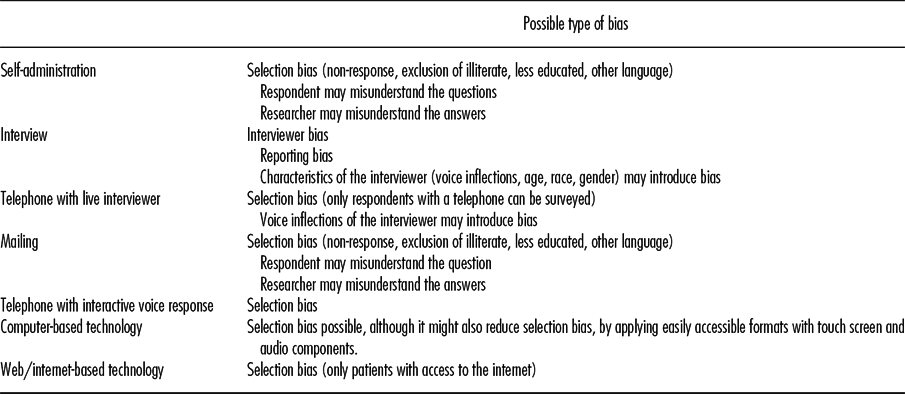
The possibility of non-response due to ill health should be considered carefully when designing a study protocol. Possible solutions to reduce this risk, for example, using alternative modes of administration, should be considered. Low literacy or visual impairment does not justify the exclusion of patients from the study or the use of proxy judges. Also in these cases, the administration mode for the HRQoL instruments could be changed to allow patients to participate in the study (e.g. interview or self-administrated multimedia survey (Reference Hahn, Bode, Du and Cella16) instead of self-completed paper survey). The advantages and disadvantages of the different modes of administration have been described by Guyatt et al. (Reference Guyatt, Feeny and Patrick7), Jackowski and Guyatt (Reference Jackowski and Guyatt4), Coons et al. (Reference Coons, Gwaltney and Hays17), and Hacker (Reference Hacker18). Possible sources of bias related to the mode of administration are listed in Table 4.
Possible Sources of Bias Related to Modes of Administration of HRQoL Instruments

Recommendation 10: Use of Proxy Judges
In principle, HRQoL should be assessed by patients. Evaluation of HRQoL by “proxy judges” should be limited to cases where the patient cannot contribute him/herself or where the use of proxies can be justified by the nature of the judgements to be made (Reference Fitzpatrick, Davey, Buxton and Jones6). The correspondence between patient and proxy response to HRQoL measures varies depending on the domain assessed and the choice of the proxy. Proxy responses on more observable domains, such as physical functioning and cognition, are generally more highly correlated with responses from patients, whereas proxies tend to overestimate patients' functional limitations as compared to the patients themselves (Reference Guyatt, Feeny and Patrick7). Medical professionals may be inclined to focus on the limitations due to a particular functional impairment, whereas patients may emphasize the possibilities still left to them (Reference Hoedemaekers and Dekkers19).
Recommendation 11: Reporting and Timing
Transparent and timely reporting of the results of all HRQoL measurements is required. If not (yet) published, the results should be made accessible to the assessors responsible for the REA to allow critical appraisal.
Specific guidelines for reporting results of HRQoL assessments in clinical trials have been published (Reference Staquet, Berzon, Osoba and Machin20;Reference Calvert and Freemantle21).
Important is that means and medians are not meaningful in the case of ordinal HRQoL scales. For ordinal or binary data, proportions of patients with a specific score should be used.
For longitudinal studies using global measures for HRQoL, individual data on each time point could be plotted. This approach may, however, not be practical for large studies (Reference Billingham, Abrams and Jones22). For groups of patients, the mean and the median of a summary measure for HRQoL can be presented or the proportion of patients with a certain level of HRQoL (in both cases with their appropriate confidence interval), depending on the properties of the scores obtained with the HRQoL instrument. The same can be done for separate domains of HRQoL, to see whether the overall pattern of response to the various dimensions differs between treatments (Reference Fayers and Machin23).
Recommendation 12: Disaggregating Aggregated Endpoints
When changes in survival and HRQoL are combined in one outcome measure such as the QALY, changes in survival and HRQoL should be reported separately. A description of the methods to combine the measurements should also be provided.
DISCUSSION
Although there is no consensus on the most appropriate instrument for each purpose, the use of a standard instrument to measure HRQoL would improve comparability and reliability of REA.
The lack of consensus was experienced at several occasions during the study process. Many of the disagreements could be brought back to differences in decision-making context, such as the wish to be able to make value comparisons across indications or not or the use or not of cost-utility data in the decision process.
The merit of this guideline is that it has been reviewed by a large group of experts from many different countries, who have been able to give feedback on how this would, or would not fit in their system. The recommendations took differences in context into account, and highlighted areas where choices are basically normative, such as whether utilities should be derived directly from patients or whether utility values derived from the general public could also be used indirectly.
The recommendations do not take a stance on normative issues, but are very explicit about the need and value of including a generic HRQoL measure in REA, although there was also discussion on this point. The inclusion of a generic instrument is particularly important for reasons of coherence in the valuation of health benefits, and in consequence, transparency of the decision-making process. Generic HRQoL measures allow comparisons across health conditions, encompass all dimensions relevant to patients, not only those dimensions on which an effect is expected and some of them allow translation into utility values which can be used for the cost-utility analyses. It has been argued before that the systematic inclusion in clinical trials of a generic utility measure associated with values from the general public, would be a big step forward (Reference Neyt8).
CONCLUSION
When preparing a HRQoL study, the selection of a HRQoL measure should take the future purposes of the study results into account. The EUnetHTA guideline for HRQoL measurement provide a basis for researchers to develop trial protocols that anticipate the requirements for quality of life data for relative effectiveness assessment in a coverage decision context.
Generic utility instruments and disease-specific HRQoL instruments are complementary and as such serve several purposes of REA, but disease-specific HRQoL data are rarely sufficient for REA. Generic measures help building up a reference framework for the societal value of HRQoL benefits, allowing to increase the consistency in the value judgement (or appraisal) process. Composite measures such as QALYs are also useful in this context if the intervention or disease affects both life expectancy and HRQoL (Reference Kristensen and Sigmund24).
CONFLICTS OF INTEREST
None of the authors declare a conflict of interest.