Critical issues in psycholinguistics include modeling the specific nature of sentence processing, also known as parsing, which is the moment-by-moment mental representation of word order and dependencies for the purpose of deciphering sentence meaning. Persistent questions include whether processing occurs in a serial (one parse at a time) or parallel (multiple parses simultaneously active) fashion, what specific strategies drive sentence processing, whether the parser (i.e., sentence processor) initially prioritizes specific types of linguistic information such as syntax or accesses all potential sources (e.g., lexicon, semantics), and how and under what circumstances the parser is motivated to abandon a parse and reanalyze a serial parse or to re-rank multiple parses constructed in parallel (see Pickering & Van Gompel, Reference Pickering, Van Gompel, Traxler and Gernsbacher2006; Vasishth & Lewis, Reference Vasishth, Lewis and Brown2006, for more in-depth discussion of these issues). Cross-linguistic variation can often provide important empirical testing ground for theoretical hypotheses, either through the study of monolingual speakers of languages other than English, or through the study of the sentencing processing behavior of bilinguals. The present study took both of these approaches, seeking first to expand the largely English-based body of knowledge on syntactic ambiguity resolution by examining such behavior among native users of Mexican Spanish. A second objective was to investigate the ambiguity resolution behavior of non-native users, in order to determine the extent to which non-native sentence processing resembles native processing with regard to the types of information available to the parser and to the nature of reanalysis/re-ranking.
The specific focus of this investigation was the effect of verb subcategorization information on the resolution and comprehension of a type of subject–object ambiguity that is known to induce garden path effects in English, as illustrated in example (1) below, taken from Frazier and Rayner (Reference Frazier and Rayner1982).Footnote 1
(1) Since Jay always jogs a mile seems like no distance to him.
The garden path effect occurs because the English reader initially tends to erroneously interpret the noun phrase (NP) a mile as the object of what appears to be in this case a transitive verb, jogs. This processing preference is accounted for in the garden path model by a principle known as late closure, by which the parser prefers to incorporate each subsequent word into the existing phrase or clause whenever possible (and not precluded by the presence of a comma), rather than to initiate a new clause (Frazier & Fodor, Reference Frazier and Fodor1978). The effects of late closure can be observed empirically when the principle conflicts with additional grammatical constraints, as is the case when the subcategorization matrix of the preposed adjunct clause verb in a sentence like When the sculptor finished the piece was three meters in height is manipulated to create When the sculptor came back the piece was three meters in height. The conflict between the initial strategy of late closure and the intransitivity of a verb like came back can cause processing difficulty, which is evident in longer reading times on an NP such as the piece when it follows an intransitive verb like came back as opposed to a transitive verb like finished. Under a modular account of this phenomenon (e.g., Van Gompel & Pickering, Reference Van Gompel and Pickering2001), the parser initially has access only to syntactic principles like late closure and therefore analyzes an NP that follows any verb as an object. Once lexical information like verb transitivity is subsequently accessed by the parser, the analysis with the piece as the object of came back becomes ungrammatical and the parser is forced into costly reanalysis, evident in longer reading times on the postverbal NP that follows an intransitive verb. Late closure is a purportedly universal strategy designed to maximize the level of structure in (i.e., connections between) the material held in working memory, thus reducing the memory load, and has served to account for other sentence processing phenomena as well (e.g., De Vincenzi & Job, Reference De Vicenzi and Job1995; Traxler, Pickering & Clifton, Reference Traxler, Pickering and Clifton1998; but see Staub, Reference Staub2007, for an alternative account). Nonetheless, Cuetos and Mitchell (Reference Cuetos and Mitchell1988) questioned whether the late closure strategy of the garden path model applies in all languages, based on their observation that Spanish tends to prefer high attachment of ambiguous relative clauses. This highlights the critical importance of complementing sentence processing research on English with similar study of other languages, particularly in testing the predictions of sentence processing theories like the garden path model, which is claimed to apply universally.
After the strategy of late closure applies to the processing of the first portion of sentences with subject–object ambiguities in English, processing of the second portion involves reanalysis, if one assumes serial processing like that proposed by the garden path model (Frazier & Fodor, Reference Frazier and Fodor1978), or re-ranking, under the assumption of parallel processing (e.g., Spivey & Tanenhaus, Reference Spivey and Tanenhaus1998; Van Gompel, Pickering & Traxler, Reference Van Gompel, Pickering and Traxler2001). In example (1), the parse in which a mile was interpreted as the direct object of jogs becomes ungrammatical upon reaching the matrix clause verb, seems, which must be preceded by an explicit subject. Under the garden path model, this conflict between the existing representation and grammar constraints forces a syntactic reanalysis or repair of the sentence, in which the NP a mile is moved from the direct object position of the adjunct clause to the subject position of the matrix clause. In previous research such reanalysis has been evident in longer reading times on the matrix clause verb (Frazier & Rayner, Reference Frazier and Rayner1982; Kennedy & Murray, Reference Kennedy and Murray1984), which are called garden path effects. Because the reading time effect occurs during reanalysis of an incorrect parse, it is greatest when the NP is grammatical as an object of the adjunct clause verb. To illustrate, the matrix clause verb can be incorporated with relative ease in When the sculptor came back the piece was. . ., but leads to processing difficulty in When the sculptor finished the piece was. . .. Thus, this garden path phenomenon that occurs on the matrix verb in the second part of the sentence also depends on the integration of lexical information regarding the argument specifications of verbs during online processing.
As already mentioned, the application of the late closure principle in Spanish remains an open question, as previous research has shown that the garden path model cannot always account for Spanish processing behavior, so subject–object ambiguity processing in Spanish may or may not exhibit the reading time effects previously observed on the first part of English sentences.Footnote 2 Supposing that the two languages do prove to be similar with regard to late closure and the Spanish processor is initially led to incorporate a postverbal NP as an object in sentences like those in (2), the second or garden path part of the sentence would then be predicted to be different in Spanish than in English, as the grammar does not necessitate a reanalysis of the initial parse.
(2)


Specifically, the Spanish parser analyzes una milla “a mile” as the object of corre “jogs”, by the principle of late closure, then reaches the matrix clause verb parece “seems”. Whereas in English the matrix clause verb's requirement of an explicit subject forces reanalysis of the existing syntactic structure to yield a parse like (2a), the availability of null subjects in Spanish allows for a parse like (2b), which is consistent with the original parse of the postverbal NP as an object. The Spanish sentence does not force reanalysis at any point. On the other hand, (2a) would also be a grammatical parse in Spanish, so the sentence is globally ambiguous in the sense that there are in theory two grammatical parses. However, a fundamental assumption common to current processing models is that once a parse is active it continues until reanalysis is absolutely necessary, so even though the Spanish parser in principle may have the option of reanalysis upon encountering the matrix clause verb, it should opt for the more economical path of least resistance, which is to move ahead with the initial parse of the postverbal NP as an object –motivated by late closure in the first part of the sentence – and assume the null subject option in (2b). Therefore, the garden path effect that occurs in English is not predicted to occur in Spanish because there is no forced reanalysis.
Non-native processing of subject–object ambiguities
The relatively new field of second language processing primarily explores to what degree non-native processing resembles native processing. Several previous studies have examined different aspects of non-native processing of subject–object ambiguities, all with English as the second language. One of the experiments reported in Juffs and Harrington (Reference Juffs and Harrington1996) looked at the processing of subject–object ambiguities by native Chinese speakers of L2 English in the United States, who were asked to read and judge the grammaticality of stimuli like (3) and (4) below.
(3) After Bill drank the water proved to be poisoned.
(4) After Sam arrived the guests began to eat and drink.
The two stimulus types varied with regard to the transitivity of the preposed adjunct clause verb. In the first part of each sentence, the native English participants appeared to have longer reading times on the ambiguous postverbal NP when it followed an intransitive verb like arrived in (4) as opposed to a transitive verb like drank in (3), as did the Chinese group. For the second part of each sentence, both participant groups appeared to engage in online reanalysis at the point of the matrix clause verb in the transitive type stimuli, at least for the stimuli that were judged correctly. A second study (Juffs, Reference Juffs1998) mostly replicated the results with L2 participants whose native languages were Chinese, Japanese, Korean, and Spanish, with one notable exception being that for the first portion of the stimuli the Spanish and native English groups did not show longer reading times on NPs that appeared after intransitive verbs, but the Chinese, Japanese, and Korean participants did. Finally, a third study (Juffs, Reference Juffs2004) included multiple groups of non-native speakers whose native languages were Chinese, Japanese, and Spanish, and found comparable results only for the second portion of the experimental sentences, the point of reanalysis.
One of the experiments reported in Frenck-Mestre and Pynte (Reference Frenck-Mestre and Pynte1997) used eye-tracking to examine the parsing behavior of very advanced EFL speakers in France. Native English and native French participants read ambiguous sentences like those in (5) below, which vary with regard to the transitivity of the preposed adjunct clause verb, and were asked to judge whether each sentence was logical or not.
- (5)
a. Every time the dog obeyed the pretty little girl showed her approval.
b. Every time the dog barked the pretty little girl showed her approval.
The study targeted the garden path effects that can occur during processing of the second part of sentences with subject–object ambiguities, but the authors also reported increased reading times on the ambiguous postverbal NP fragment the pretty when it followed an intransitive verb like barked, which suggests an attempt to apply the principle of late closure. The effect was only marginal and only evident among the native English speakers, however, which suggests either that non-native speakers may not have immediately accessed verb subcategorization information during online processing, or that they were incapable of efficient application of the principle of late closure. The latter explanation seems more likely in this case, as verb transitivity did affect non-native behavior during the reanalysis phase of the second part of the ambiguous stimuli. Specifically, both native English speakers and non-native speakers exhibited longer reading times on matrix clause verbs like showed in (5a) when they occurred in sentences with adjunct clause verbs that were transitive, suggesting that both groups engaged in online syntactic reanalysis.
More recently, Roberts and Felser (Reference Roberts and Felser2011) employed the self-paced reading method to study the non-native processing of subject–object ambiguities in English by native Greek participants in the United Kingdom. Unlike in previous investigations, the experimental manipulation involved the plausibility of the postverbal NP as a direct object of the preceding adjunct clause verb, as opposed to the transitivity of the verb itself, which is seen in the examples in (6). Furthermore, the concurrent task for the self-paced reading was meaning-based rather than metalinguistic, as illustrated by the comprehension question in (7).
- (6)
a. As the men drank the beer pleased everybody very much.
b. As the men drank the song pleased everybody very much.
(7) Did the beer/song make everybody unhappy?
Overall, in the first portion of the stimuli only the non-native speakers showed increased reading times on the postverbal NP when it was implausible as a direct object of the preceding adjunct clause verb (i.e., the song was read more slowly than the beer). This suggests that they attempted to apply the principle of late closure as well as semantic plausibility knowledge during online processing, as a conflict between the two is a likely cause of the observed increase in reading times. In addition, neither participant group demonstrated effects of plausibility in the second part of the stimuli, where reanalysis would be expected to yield a garden path effect in the condition with a plausible direct object. As this outcome was unexpected and inconsistent with most prior native language research, Roberts and Felser conducted a second set of analyses based on reading speed that provided a more detailed account of online processing behavior.
For these more detailed analyses, each participant's average reading speed across all trials was entered as a covariate into a separate analysis of variance for each participant group and two subgroups per group were formed on the basis of a median split (i.e., faster readers and slower readers), for the purpose of conducting post hoc t-tests. The reading time effect that had been observed among only the non-native speakers in the first part of the stimuli, manifest in longer reading times on postverbal NPs that were implausible as direct objects, was traced to the slower non-native speakers. The faster non-native readers, on the other hand, patterned with the native speakers in not showing any signs of an online conflict between late closure and plausibility at this point. The faster non-native readers also patterned with the native speakers for the garden path effect in the second part of the sentence; both groups showed evidence of online reanalysis in the plausible condition, but then the L2 participants as a whole had lower accuracy on the comprehension questions following stimuli in the plausible condition than in the implausible condition. Thus, the authors concluded that even those faster L2 readers who appeared to attempt reanalysis during online processing were ultimately unable to do so successfully, while the native speakers’ uniform accuracy scores across conditions for the comprehension questions indicated successful syntactic reanalysis during online processing.
Together the outcomes of these previous investigations have shown that in the first part of English sentences with subject–object ambiguities, some non-native speakers exhibit longer reading times on postverbal NPs that follow intransitive versus transitive verbs, but native speakers of certain languages like Spanish and French may not. Description of the processing of these sentences in native and non-native Spanish may help determine whether Spanish differs from English in its online application of the late closure principle and verb subcategorizations.Footnote 3 Additionally, previous research has shown that different groups of non-native readers at least attempt syntactic reanalysis while processing the second part of experimental sentences with subject–object ambiguities in a language like English, which typically evokes such garden path effects. A question that remains, however, is whether non-native speakers could remain committed to an initial parse and avoid reanalysis in a null subject language like Spanish, which presumably will not evoke English-like garden path effects. Thus, the current investigation sought answers to the following four research questions:
(i) Do native speakers of Spanish apply the principle of late closure in processing the ambiguous postverbal NP in sentences with subject–object ambiguities?
(ii) Do near-native speakers of Spanish resemble native speakers with regard to the processing of the ambiguous postverbal NP?
(iii) If late closure indeed applies in Spanish, do native speakers remain committed to the interpretation of the postverbal NP as a direct object, assuming a null subject and avoiding the garden path effect typically seen on the matrix clause verb in English?
(iv) Do near-native speakers of a null subject language like Spanish resemble native speakers with regard to the processing of the matrix clause verb?
Method
Participants
The L2 participants in this study were 23 native speakers of English (14 female, 9 male), with a mean age of 41.6 years (range 23–68). They had all acquired Spanish as adults, operationalized here as no exposure before age 12 and not reaching fluency until at least the age of 18. To establish that they were at a near-native level, these women and men were also screened for a general language proficiency score that fell within the range obtained by the L1 participants on an abbreviated version of the DELE assessment of Spanish as a foreign language (Instituto Cervantes, 2007), which is described in more detail below in the section on materials. Specifically, as the native speakers’ ranged from 40 to 50 out of 50, all of the near-native speakers scored at least 40 out of 50 on the proficiency test. Furthermore, the mean period of ongoing residency in Mexico for the near-native group was 14.1 years and the mean current linguistic exposure was 43.3% English and 54.3% Spanish, as estimated in a self-report. The majority of these participants were born in the United States, though a few were originally from Australia, Canada, or the United Kingdom. They were all professionals residing in Mexico City proper, where many worked as journalists and teachers.
The 35 native speakers of Spanish, who served as a comparison group, were recruited and tested at a large university in the Mexico City area. These 26 women and 9 men were all born and raised in Mexico City, in Mexico State, or in the immediately adjacent states and had no advanced knowledge of any foreign languages. Their mean age was 23.4 years (range 19–52) and most were enrolled as undergraduate students at the time of testing. All had graduated high school and completed some post-secondary coursework. In addition, they had not been abroad for periods of greater than two weeks, except to other Spanish-speaking countries. Thus, these participants were essentially monolingual speakers of Mexican Spanish.
Materials
All participants completed the Language Experience and Proficiency Questionnaire, which includes a range of language background questions (LEAP-Q; Marian, Blumenfeld & Kaushanskaya, Reference Marian, Blumenfeld and Kaushanskaya2007). The near-native speakers answered the questions twice, once for English and once for Spanish, while the native speakers responded to a single set of questions for Spanish. The questionnaire was presented via computer and completely in Spanish for both groups.
Following Montrul and Slabakova (Reference Montrul and Slabakova2003), the independent measure of proficiency was an abbreviated version of the superior level Diploma de Español como Lengua Extranjera, a standardized test of Spanish as a foreign language (Instituto Cervantes, 2007). There were 50 total objective items testing Spanish vocabulary and grammar. The test was piloted prior to the experiment with 12 native speakers of Mexican Spanish in order to identify and eliminate any dialect-specific items, as the exam is written and administered by speakers of Peninsular Spanish.
An offline measure of grammatical knowledge was also administered as part of the experiment. This was a timed acceptability judgment task in which participants rated the acceptability of sentences on a scale from 1 to 4 (one point per item; scores of 2 and 3 were awarded .5 points if in the right direction). Ten sentential items tested subjects’ knowledge of the lexical specifications of a random sample of the 37 different verbs that appeared in the 20 stimuli for the online measure. The acceptability judgment task was administered via computer using SuperLab such that each sentence appeared on the screen for up to 15 seconds, then the participant advanced to the probe screen and rated the sentence for correctness. In example (8) below, the sentence was rated 1 by most participants because in Spanish the verb viajar “to travel” cannot take an unmarked object. Ten critical sentential items appeared along with 50 distractors and five practice items. The entire task was administered in Spanish for all participants.
(8)

The stimuli for the experimental self-paced reading task, which are listed in the Appendix, were modeled after those previously employed in the testing of subject–object ambiguities in non-native English (Frenck-Mestre & Pynte, Reference Frenck-Mestre and Pynte1997; Juffs, Reference Juffs2004). As can be seen in (9) below, the manipulated variable was Transitivity (transitive/intransitive), which referred to the subcategorization matrix in Spanish of the preposed adjunct clause verb in each experimental sentence.
(9)

The five presentation regions for each stimulus are indicated with backslashes. According to the Spanish word frequency rankings calculated by Davies (Reference Davies2005), the transitive and intransitive verbs were similar overall with regard to frequency: t(38) = .048, p = .962. Prior investigation of such experimental sentences in English has identified two different reading time effects. The first is an increased reading time on the postverbal NP in Region 3 when it follows an intransitive versus a transitive verb, which is suggestive of a conflict between the syntactic principle of late closure and the verb's subcategorization matrix.Footnote 4 The second effect is a garden path effect in the opposite direction, with the transitive condition yielding longer reading times than the intransitive condition; this usually occurs on the matrix clause verb in Region 4. Therefore, the regions of interest for the present study were Regions 3 and 4, with 5 also analyzed as a site for potential spillover or sentence wrap-up effects.
The 20 target items, each appearing in the transitive and the intransitive conditions, were distributed across two lists in a Latin Square design. The target stimuli were combined with 120 distractors and two different pseudo-randomizations were created for each list such that no two experimental sentences appeared in succession, yielding four presentation lists total.
The comprehension questions that followed each stimulus (including all distractors) were designed to motivate the participants to focus on meaning while reading, in contrast with some earlier L2 research that had recorded reading times while participants were engaged in metalinguistic tasks such as grammaticality or acceptability judgments. Most questions required thorough processing for meaning, up to the level of inference. For instance, the stimulus given in (9) about the sculpture that was three meters high was followed by the comprehension question and binary choice options given in (10).
(10) ¿Dónde podría exponerse una escultura como esta?
a. En un estante de libros.
b. En un parque.
“Where could a sculpture like this one be exhibited?”
a. “On a bookshelf.”
b. “In a park.”
Procedure
Participants first completed the background questionnaire and the self-paced reading study, both via computer. Next was the proficiency test, which was administered in a pencil-and-paper format, and finally the acceptability judgment task. All L1 and L2 participants were paid approximately 40 U.S. dollars for a single two-hour experimental session.
For the self-paced reading activity, sentences were presented on a laptop computer using SuperLab stimulus presentation software (Cedrus Corporation, 1992). This was a self-paced, non-cumulative, phrase-by-phrase moving window procedure. Although a word-by-word presentation could perhaps have generated more detailed data, the presentation of multiple words at a time allows for more natural reading. Furthermore, no two words of potential interest were grouped together in the same presentation phrase, so a certain degree of precision was maintained. Prior to the start of each trial, a cue symbol “+” appeared at the site of the beginning of the next stimulus. The participant pressed a green key on a Cedrus RB-730 response pad to advance to the first screen of the trial. Initially, all of the words of the stimulus were masked with dashes but the spaces between words and period at the end of the sentence were visible. Each time the participant pressed the green key a few words were unmasked and the previous words were hidden again. After all the words in the sentence had been revealed, a press of the green key brought up a binary choice comprehension question that was answered using keys marked “A” and “B” on the response pad. No feedback was given for incorrect answers. Participants were explicitly instructed to read at a normal speed, as if reading a newspaper or a book, and they were told that the test targeted reading comprehension, so that they would read the sentences for meaning. Grammatical form was not mentioned prior to or during the experiment. Detailed instructions and ten practice items were presented prior to the experimental block and an optional ten-minute break was offered when the participant had read half of the 160 sentences.
Results and analyses
On the acceptability judgment task, the native speakers (M = 8.66, SD = 1.16) scored slightly higher than the near-native speakers (M = 8.52, SD = .95).Footnote 5 Mean scores were compared statistically with an independent samples t-test, which revealed that there was no significant difference between the scores for the two groups: t(56) = .486, p = .629. This indicates that the L2 participants had native-like knowledge of Spanish verb subcategorizations, at least as measured in an offline sentence acceptability test.
For the reading comprehension questions that followed each stimulus, the native speakers as a group selected the accurate response on 88.1% of trials with stimuli in the transitive condition and 94.7% of trials with stimuli in the intransitive condition; the near-native speakers had 93.0% accuracy regardless of condition. What is more, the lowest individual scores were 70% for the native speakers and 75% for the near-native speakers. Thus, both groups had high overall accuracy that suggests that they understood the task, and the near-native group scored slightly higher numerically than the native group on this measure of reading comprehension. The scores from the comprehension questions were normalized via a log transformation and submitted to a 2 × 2 (Group × Transitivity) mixed design ANOVA, with Group as a between-subjects factor and Transitivity as a within-subjects factor. This analysis revealed a significant main effect of Transitivity, F(1,54) = 4.109, p = .048 and a significant Group × Transitivity interaction F(1,54) = 4.109, p = .048. Follow-up paired samples t-tests traced the main effect to the L1 participants, who had significantly higher accuracy scores for comprehension questions that followed stimuli with intransitive verbs: t(32) = 3.323, p = .002. The L2 participants, however, had statistically similar rates of comprehension accuracy across both stimulus conditions: t(23) < .001, p > .999. Following the convention in sentence processing research, only reading time data from trials with accurate comprehension question responses was included in the analyses.
Prior to analyzing the data from the target sentences in the self-paced reading task, the reaction time data was trimmed in order to remove unusually long reading times that likely stemmed from momentary lapses in concentration or other factors unrelated to the processing effects that were the target of the present study. All reading times that were greater than two standard deviations above the mean for that group and condition were replaced with the value equal to the mean plus two standard deviations. In addition, the data from two native speakers was excluded from the reading time analyses because of unusually slow reading; data from more than 20% of each of their trials would have been trimmed. Trimming affected 6.67% of the data from the remaining 33 native speakers and 8.48% of the data from the near-native speakers. The final descriptive statistics are illustrated in Figure 1, which gives the mean reaction times for the self-paced reading stimuli as a function of participant group and stimulus type.
Mean reading times by participant group and stimulus condition.

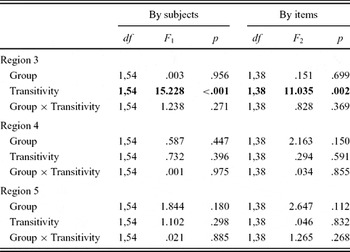
Statistical analyses were performed on the last three regions of interest: the region with the postverbal NP, the region with the main clause verb, and the sentence final region. Separate 2 × 2 (Group × Sentence Type) mixed design ANOVAs were performed on the reading time scores for each. For the analyses by subjects (F 1 and t 1), subject was a random factor, while Sentence Type (e.g., Transitive, Intransitive) was a within-subjects factor and Group (Native, Near-Native) was a between-subjects factor. The analyses by items (F 2 and t 2) also included Sentence Type as a within-items factor and Group as a between-items factor, but in this case item was the random factor. For all analyses, alpha levels of <.05 were interpreted as significant. The results of all three ANOVAs for the reading time data are given in Table 1. The third region, which contained an NP that could potentially be processed as an object of the manipulated verb, showed a significant main effect for Transitivity, but no effect for Group and no interaction between the two factors. Thus, both participant groups slowed down significantly and similarly upon encountering an NP after an intransitive verb versus after a transitive verb and both groups read the stimuli at the same overall speed. No significant effects of any kind were found in the remaining two sentence regions.
Mixed design ANOVAs for reading time data. (Effects significant at α = .05 are in boldface.)

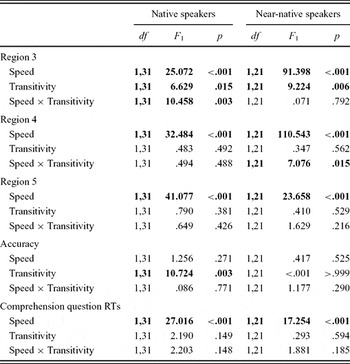
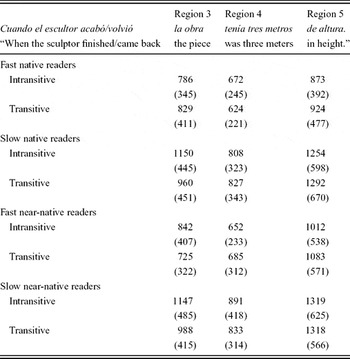
The overall similarity in reading times between the two participant groups was unexpected. Second language learners typically read significantly more slowly than native speakers when engaged in online tasks such as self-paced reading and bilinguals in general are also typically slower than monolinguals. For this reason, further analyses were conducted to determine whether individual differences in reading speed may have obscured processing trends at the group level. Following Roberts and Felser (Reference Roberts and Felser2011), a global mean reading speed was calculated for each participant on the basis of untrimmed reading times across all regions of all target items, distractors, and comprehension questions. For each of the two participant groups, these reading speed scores were first adjusted via a mean centering procedure (Delaney & Maxwell, Reference Delaney and Maxwell1981; Thomas, Annaz, Ansari, Serif, Jarrold & Karmiloff-Smith, Reference Thomas, Annaz, Ansari, Serif, Jarrold and Karmiloff-Smith2009), then entered as the covariate in an ANCOVA with Transitivity as a within-subjects factor, once for each of the three regions of interest, once for the accuracy scores for the comprehension questions, and once for the reaction times for the comprehension questions (see Table 2). In addition, a median split of the global reading speed scores for each group was performed in order to create two subgroups, the descriptive reading time statistics of which are presented in Table 3. The two native speaker subgroups had a small (4.2%) but significant difference in proficiency test scores, t(31) = 2.186, p = .036, in which the faster readers had higher scores; the two near-native speaker subgroups had similar proficiency scores, t(21) = .466, p = .646.
Repeated measures ANCOVAs for reading time and accuracy data with reading speed as a covariate. (Effects significant at α = .05 are in boldface.)

Mean RTs and SDs (in parentheses) in milliseconds for subgroups based on global reading speed median splits.

For the native speakers, there were significant main effects of Transitivity and Speed at Region 3, which contained the NP that could potentially be processed as an object of the manipulated verb. The effect of Transitivity had already been revealed by the initial ANOVA, while the effect of Speed merely confirmed a predictable link between overall reading speed and reading time scores for Region 3 of the experimental stimuli. There was also an interaction between the two factors, which was probed via paired samples t-tests on each of the native speaker subgroups. The t-tests revealed that only the slower native speakers had significantly longer reading times on the NP when it followed an intransitive verb, t 1(16) = 4.561, p < .001, while the faster native speakers did not: t 1(15) = 1.179, p = .257.Footnote 6 For the remaining two regions of interest and for the reactions times for the comprehension questions, the only significant main effects were for Speed. Finally, the log transformed accuracy scores for the comprehension questions showed the same significant main effect of Transitivity that had been detected by the initial ANOVA of the comprehension accuracy data. To summarize, there was a difference between fast and slow native readers only at Region 3, where only the slower readers took longer to read NPs that followed an intransitive verb.
Like the native speakers, the near-native speakers also showed significant main effects of Transitivity and Speed at Region 3, which contained the NP that could potentially be processed as an object of the manipulated verb. The effect of Transitivity reflected the same effect that was revealed by the initial ANOVA, while the effect of Speed again confirmed a predictable link between overall reading speed and reading time scores for Region 3 of the experimental stimuli. Unlike with the native speakers, however, there was no interaction between the two factors, so both fast and slow near-native speakers had longer reading times on the NP when it followed an intransitive verb. At Region 4, which contained the main clause verb, there was a significant Speed × Transitivity interaction, as well as the predictable main effect for Speed. Follow-up paired samples t-tests revealed that the slow near-native speakers’ longer reading times on main clause verbs in the intransitive condition were not statistically significant, t 1(11) = 1.329, p = .211, nor were the fast near-native speakers’ longer reading times on main clause verbs in the transitive condition, t 1(10) = 1.134, p = .283. For the remaining sentence final region and for the reaction times for the comprehension questions, the only significant main effect was for Speed. Finally, there were no significant effects or interactions evident with the comprehension accuracy data for this group. In sum, there was a difference between fast and slow near-native readers only at Region 4, where the slower readers showed remnants of the transitivity effect from the previous region and the faster readers exhibited a trend towards a transitivity effect in the opposite direction, with longer reading times on main clause verbs in the transitive condition.
Discussion and conclusion
The first of the four research questions guiding the present study concerned the first portion of the experimental stimuli and asked whether native speakers of Spanish would exhibit longer reading times on NPs that followed intransitive versus transitive adjunct clause verbs. Effects of this type had previously been observed among native and some non-native speakers of English, though not those whose native languages were Spanish or French. Given this prior observation that native speakers of Spanish did not exhibit such an effect during non-native processing of subject–object ambiguities in English, there was some doubt as to whether the effect would occur in native Spanish. Nevertheless, based on the results of the present study, Spanish does appear to be like English in this regard. Overall the native speakers in this experiment showed a significant reading time increase on postverbal NPs when they occurred after intransitive rather than transitive verbs, which corroborates a modular model of parsing of the type proposed by Mitchell (Reference Mitchell and Coltheart1987) and Van Gompel and Pickering (Reference Van Gompel, Pickering and Traxler2001). Specifically, it appears that the earliest stage of processing occurs on the basis of syntactic information only, so the postverbal NP is initially analyzed as an object regardless of verb transitivity, due to the principle of late closure. Subsequently, the parser accesses transitivity information in the lexicon and, in the case of a postverbal NP that follows an intransitive verb, is forced into costly reanalysis, which is evident in longer reading times relative to the stimuli condition in which the NP follows a transitive verb. More broadly speaking, the results of the current experiment also corroborate the claim that the principle of late closure is universal, purportedly because it maximizes the connections between items held in working memory in order to minimize memory load, and that it does apply to Spanish.
Once individual reading speed was entered as a covariate in a second set of analyses, the overall effect of adjunct clause verb transitivity remained significant only among the slower native readers. The faster native readers did not appear to experience the same online conflict between the syntactic principle of late closure and lexical subcategorization information. One possible explanation for this finding is to assume a modular view of sentence processing, such as the garden path model (Frazier & Fodor, Reference Frazier and Fodor1978), in which only syntax constrains the initial stage of processing and additional sources of linguistic information are then activated later on. In the case of the present study, both groups of native readers could have accessed the syntactic principle of late closure while processing the postverbal NP in question, but only the slower native readers would have dwelled long enough on the NP for verb subcategorization information from the lexicon to become active during a second phase of processing. The faster readers, on the other hand, would have engaged only the initial stages of processing the postverbal NP before quickly moving on to processing the next region. If this was the case, then the results from the present study would be consistent with those previously obtained with the eyetracking method by Van Gompel and Pickering (Reference Van Gompel and Pickering2001). In their study of native English, the first fixation durations and first pass durations for the postverbal NP showed no effect for transitivity, much like the faster native readers in the present study.Footnote 7 It was only in the regression path times that the effect of transitivity was evident in the Van Gompel and Pickering study, which was similar to the result from the slower native readers in the present study.Footnote 8 Under such an interpretation, the differences based on reading speed in the present study would reflect slower, more in-depth processing, versus faster, less complete processing.Footnote 9 Of course, a replication of the present study with the eyetracking method could provide more detailed evidence to confirm the proposed explanation.
The second of the research questions sought to compare near-native processing to native Spanish processing with regard to reading time effects on the postverbal NP. In the global analyses, both participant groups behaved similarly at this first point of interest in the stimuli. The main effect of adjunct clause verb transitivity on the postverbal NP did not interact with participant group. This outcome, which is generally consistent with similar previous research (Juffs, Reference Juffs1998; Juffs & Harrington, Reference Juffs and Harrington1996; Roberts & Felser, Reference Roberts and Felser2011; but see Frenck-Mestre & Pynte, Reference Frenck-Mestre and Pynte1997, for a different outcome), suggests that the L2 learners were able to access syntactic principles like late closure and lexical principles like verb argument specifications during online processing.
Furthermore, after the mean reading speed of individual participants was entered as a covariate into a second set of statistical tests, the near-native speakers as a whole resembled the slower native readers at this point in the stimuli. This outcome is similar to that observed in L2 English by Roberts and Felser (Reference Roberts and Felser2011) – although they manipulated semantic plausibility rather than verb transitivity – in that there were broadly parallel trends according to reading speed and nativeness. The specific manifestations of this trend differed slightly, however, as Roberts and Felser found that the fast non-native speakers in their study patterned with all of the native speakers. Both outcomes suggest a connection between variation in individual reading speed and processing patterns that vary at least locally (i.e., on a single region of interest). Thus, it can be said that in the reading time data for the present study there was an overall trend from no signs of difficulty processing NPs after intransitive verbs (faster native readers) to difficulty only on the immediate region (slower native and faster near-native readers) to difficulty that appeared to carry over into the subsequent region (slower near-native readers).
The third research question for the current investigation asked if the garden path effect, which is known to occur in English on the matrix clause verb in sentences with transitive adjunct clause verbs, also appears in a null subject language like Spanish. As was predicted herein and previously (by Juffs, Reference Juffs2004), there was no immediate or significant garden path effect on either the matrix clause verb itself or in the spillover/sentence final region, not even after individual reading speed was included as a covariate in the second set of analyses. Still, the descriptive statistics in Table 3 show a numerical trend in that direction on the sentence final region, among both the faster native readers (924 ms transitive versus 873 ms intransitive) and the slower native readers (1292 ms transitive versus 1254 ms intransitive) – and the faster near-native readers as well, as will be discussed later with the fourth research question. What is more, the accuracy data for the comprehension questions that followed the experimental stimuli were also consistent with the transitive condition sentences ultimately being more difficult to comprehend, as those scores were significantly lower than with sentences in the intransitive condition. It does therefore appear that the native speakers may have had some degree of processing difficulty when the adjunct clause verb in the first part of the stimuli was able to take the postverbal NP as a direct object.
This outcome was unexpected, as there is no point at which the transitive stimuli force a reanalysis in Spanish. Unlike in English, the initial parse in which the postverbal NP is interpreted as a direct object remains grammatical throughout the sentence, because of the availability of null subjects. It thus seems unlikely that the pattern observed here was due an attempt at reanalysis of that initial parse, as this would be an unnecessary waste of limited cognitive resources like working memory. As the difference in the reading times was not statistically significant, one possible explanation is that there is no real difference in reading times. A coincidence seems unlikely though, as the difference did reach significance in the accuracy scores for the comprehension questions. If the difference is indeed real, perhaps some other difference between the stimuli could have affected the level of processing difficulty. Looking back at just the matrix (i.e., second) clause of the stimuli, given below in (11), a notable difference is that the transitive condition had a null subject and the intransitive condition had an explicit subject.
(11)

In the case of the null subject, the antecedent was the object of the preposed adjunct clause. This is atypical for Spanish, which prefers subject antecedents for null subjects (Jegerski, VanPatten & Keating, Reference Jegerski, VanPatten and Keating2011). However, null pronouns are the only option for inanimate subjects in Spanish, which has no explicit pronoun equivalent to the English it, and all of the object antecedents in the experimental stimuli for the present study were inanimate, so the observed processing difficulty would not have been caused by infelicitous use of a null subject. The presence of a null subject pronoun versus an explicit noun subject, however, could potentially have led to increased reading times at the sentence final region if extra time was needed to assign a referent to the pronoun.
The fourth and final research question that guided the present study sought to compare the L2 participants to the native speakers with respect to processing behavior on the second portion of the stimuli, where a garden path effect typically occurs in English. In the global analyses, neither participant group had significantly longer reading times on matrix clause verbs in sentences with transitive versus intransitive adjunct clause verbs. Nevertheless, after individual reading speed was included in the second set of analyses, an interaction emerged between reading speed and the transitivity of the adjunct clause verb among the near-native speakers. Specifically, the faster near-native readers had longer reading times on matrix clause verbs in the transitive condition, which resembles an English-like garden path effect, while the slower readers had longer reading times on matrix clause verbs in the intransitive condition, which suggests a spillover of the effect from the previous region. Neither of these trends proved significant in the post hoc tests, though this may well have been because the low n sizes for each participant subgroup (11 and 12) yielded low experimental power. The faster L2 group also had a non-significant numerical trend in the same direction on the sentence final region (685 ms transitive versus 652 ms intransitive), much like both groups of native speakers. In short, the faster near-native speakers, like the native speakers, appeared to have some online difficulty on matrix clause verbs (and after) in the transitive condition.
In addition, the faster readers exhibited a pattern of processing during the second portion of the stimuli that was largely similar to that of the native speakers as a whole. Both groups showed numerically longer reading times on the sentence final region of the transitive stimuli. The near-native speakers also reacted earlier, with longer reading times immediately on the matrix clause verb in the transitive stimuli, while the native speakers were affected by the transitivity manipulation later on, in their comprehension question accuracy, where the difference reached statistical significance. It appears that both groups made use of similar types of linguistic information during online processing. Still, at first blush it would seem that the L2 participants accessed the relevant information more quickly than the L1 group and ultimately were better able to overcome the processing difficulty in comprehending the sentences. Alternatively, if the observed longer reading times on the transitive stimuli were due to those stimuli having null pronouns versus noun subjects, then perhaps the near-native speakers simply had more difficulty assigning referents to pronouns during online processing, and for that reason showed evidence of processing difficulty more immediately. As for the comprehension accuracy for the native speakers, the difference seen there could have been a similar but prolonged effect of reference assignment that occurs with Spanish in general, but it was more likely an artifact of the native speakers in the present study having relatively lower reading fluency, a point to be discussed in greater detail in the two limitations paragraphs that follow. At any rate, further research on the online processing of subject–object ambiguities in Spanish and other null subject languages is needed to strengthen these interpretations.
An important limitation to the present study has to do with the characteristics of the two participant groups that were compared: native monolingual speakers and near-native speakers of Spanish.Footnote 10 The two groups were matched for regional dialect of Spanish, as both were living in the Mexico City area and had primarily acquired that dialect of Spanish. This was not an exact match, however, as two of the L2 participants had previously studied or lived in other Spanish-speaking countries with different dialects, including Spain. Other variables that were not equal between the two groups and which could have affected the outcome of these experiments were age, level of education, and socioeconomic status. The L2 group was on average considerably older than the L1 group (41.6 versus 23.4 years), which was comprised of undergraduate students. The two participation prerequisites for long-term immersion in Spanish and adult acquisition for the near-native speaker group made it difficult to identify qualified participants that matched the undergraduate native speakers in age. With the native speaker group, on the other hand, attempts were made to recruit some older participants, but only two of these met the education requirement for having completed high school and some university-level coursework.Footnote 11 With regard to level of education, the L2 participants had completed more years of college on average because most English-speaking immigrants to Mexico City are professionals, and therefore many have graduate degrees. A comparably educated group of Mexican native speakers with no significant knowledge of other languages, on the other hand, was not identified. Graduate study is very uncommon in Mexico, and a few individuals who were initially recruited with graduate degrees were subsequently excluded from the study for having advanced knowledge of English. In the end, the requisite for monolingualism among the L1 participants took priority over an exact age and socioeconomic match to the near-native speakers. Finally, the difference in socioeconomic status was probably unavoidable in a study that sought to compare a group of Mexicans with native speakers of more developed countries like the U.S. and the U.K.
One possible consequence of the difference in level of education (perhaps compounded with socioeconomic status) between the two participant groups can be seen in the reading times throughout the experiment. Bilinguals in general are known to read more slowly than monolinguals and this would be especially true of late bilinguals, meaning those who have acquired a second language in adulthood. Older adults can also perform more slowly on some experimental tasks. The L2 participants in the present study, however, generally showed reading times that were statistically similar to those of the monolingual native speakers, despite their being bilingual and considerably older. The expected main effect for Group that is typically found in investigations of non-native processing with online measures was not observed in any sentence region. Thus, the difference in education level appears to have been associated with some degree of difference in reading skill between the two participant groups. Furthermore, this difference appears to have compensated for, and would thus be roughly equivalent to, the difference that would have otherwise been associated with unequal age and multilingual status.
In conclusion, this investigation has provided initial empirical evidence of the processing of subject–object ambiguities in a null subject language like Spanish and has contributed to the ongoing study of non-native processing. The slower native readers and the near-native readers as a whole in the present study both showed an initial reading time effect that suggests online access to the syntactic principle of late closure and to verb subcategorization information, an effect which was most prolonged among the slower near-native readers. Later on in the stimuli, Spanish appeared to differ from English, as there was no clear evidence of a garden path effect on the matrix verb. There was, however, a trend towards an effect that may have reflected the process of pronominal reference. In this regard the faster near-native readers were mostly similar to the native readers as a whole, but appeared to be more immediately sensitive to the secondary effects of the transitivity manipulation. Overall, these results suggest that differences in individual reading speed can be associated with different patterns of reading time results among both native and non-native readers and that non-native sentence processing at a near-native level of proficiency can be broadly similar to native processing.
Appendix. Self-paced reading stimuli
Condition (a) of each stimulus contains a subordinate verb that is transitive. Condition (b) of each stimulus contains a subordinate verb that is intransitive.
- 1.
a. Después de que comieron el pollo se enfrió de una vez.
b. Después de que hablaron el pollo se enfrió de una vez.
“After they ate/talked the chicken got cold right away.”
- 2.
a. Justo cuando aparcaron el carro viejo volvió a fallar.
b. Justo cuando llegaban el carro viejo volvió a fallar.
“Just as they parked/arrived the old car died again.”
- 3.
a. Antes de que cantaran esa canción no era muy conocida.
b. Antes de que festejaran esa canción no era muy conocida.
“Before they sang/celebrated that song was not very well known.”
- 4.
a. Cuando mi madre lavaba la ropa quedaba limpiecita.
b. Cuando mi madre ayudaba la ropa quedaba limpiecita.
“When my mother used to wash/help the clothes came out nice and clean.”
- 5.
a. Después de que limpiaron la casa brillaba por todos partes.
b. Después de que salieron la casa brillaba por todos partes.
“After they cleaned/left the house was shiny clean all over.”
- 6.
a. Cuando la artista pintó el cuadro cayó de la pared.
b. Cuando la artista gritó el cuadro cayó de la pared.
“When the artist painted/yelled the painting fell off the wall.”
- 7.
a. Cinco días después de que bebieron el vino se volvió vinagre.
b. Cinco días después de que celebraron el vino se volvió vinagre.
“Five days after they drank/celebrated the wine turned into vinegar.”
- 8.
a. Cuando la concursante adivinó la respuesta apareció en la pantalla.
b. Cuando la concursante se rindió la respuesta apareció en la pantalla.
“When the contestant guessed/gave up the answer appeared on the screen.”
- 9.
a. Después de que corrí el maratón no me parecía tan imposible.
b. Después de que entrené el maratón no me parecía tan imposible.
“After I ran/trained the maratón didn't seem so impossible to me.”
- 10.
a. Mientras el maestro tocaba el violín resonaba por todo el salón.
b. Mientras el maestro descansaba el violín resonaba por todo el salón.
“While the maestro played/rested the violin resonated throughout the hall.”
- 11.
a. Cuando la novia descendió la escalera le pareció muy larga.
b. Cuando la novia se acercó la escalera le pareció muy larga.
“When the bride descended/approached the stairway seemed very long to her.”
- 12.
a. Siempre que mi hermana maneja el carro suena raro.
b. Siempre que mi hermana se monta el carro suena raro.
“Whenever my sister drives/rides the car makes strange sounds.”
- 13.
a. Mientras el padre leía la biblia antigua se partió en dos.
b. Mientras el padre rezaba la biblia antigua se partió en dos.
“While the father was reading/praying the ancient bible split in two.”
- 14.
a. Mientras el novio pagaba el diamante se cayó al piso.
b. Mientras el novio llamaba el diamante se cayó al piso.
“While the groom was paying/making a call the diamond fell to the floor.”
- 15.
a. Cuando los jardineros terminaron el jardín quedó lleno de flores.
b. Cuando los jardineros se fueron el jardín quedó lleno de flores.
“When the gardeners were finished/left the garden was full of flowers.”
- 16.
a. Cuando el escultor acabó la obra tenía tres metros de altura.
b. Cuando el escultor volvió la obra tenía tres metros de altura.
“When the sculptor finished/came back the piece was three meters tall.”
- 17.
a. Después de que la arquitecta empezó los planes se volvieron más sencillos.
b. Después de que la arquitecta renunció los planes se volvieron más sencillos.
“After the architect started/quit the plans became simpler.”
- 18.
a. Este año cuando gritaron el grito sonó hasta por las montañas.
b. Este año cuando celebraron el grito sonó hasta por las montañas.
“This year when they shouted/celebrated el grito was even heard in the mountains.”
- 19.
a. Cuando Dora compró la comida se le quedó en el mercado.
b. Cuando Dora salió la comida se le quedó en el mercado.
“When Dora bought/left the food was left behind in the market.”
- 20.
a. Siempre que la niña salta la cuerda le da por la cabeza.
b. Siempre que la niña juega la cuerda le da por la cabeza.
“Whenever the girl jumps/plays the rope hits her in the head.”