INTRODUCTION
Studies of avian malaria have increased in recent years because avian malaria provides an excellent system for investigating several aspects of the parasite-host interaction: sexual selection (Hamilton and Zuk, Reference Hamilton and Zuk1982), immunocompetence (Nordling et al. Reference Nordling, Andersson, Zohari and Gustafsson1998; Tomás et al. Reference Tomás, Merino, Moreno, Morales and Martínez-de la Puente2007), costs of host reproduction (Norris et al. Reference Norris, Anwar and Read1994; Merino et al. Reference Merino, Moreno, Sanz and Arriero2000; Marzal et al. Reference Marzal, de Lope, Navarro and Møller2005), stress (Merino et al. Reference Merino, Martínez, Møller, Barbosa, de Lope and Rodríguez-Caabeiro2002; Tomás et al. Reference Tomás, Merino, Martínez, Moreno and Sanz2005), host specificity (Bensch et al. Reference Bensch, Stjerman, Hasselquist, Östman, Hansson, Westerdahl and Torres Pinheiro2000), host switching and evolutionary relationships (Ricklefs et al. Reference Ricklefs, Fallon and Bermingham2004) or latitudinal distribution of diseases (Merino et al. Reference Merino, Moreno, Vásquez, Martínez, Sánchez-Monsálvez, Estades, Ippi, Sabat, Rozzi and McGehee2008).
The use of the sensitive polymerase chain reaction (PCR) has become a routine technique for detecting these parasites (e.g., Feldman and Freed, Reference Feldman and Freed1995; Bensch et al. Reference Bensch, Stjerman, Hasselquist, Östman, Hansson, Westerdahl and Torres Pinheiro2000; Perkins and Schall, Reference Perkins and Schall2002; Ricklefs et al. Reference Ricklefs, Swanson, Fallon, Martínez-Abrain, Scheuerlein, Gray and Latta2005; Durrant et al. Reference Durrant, Beadell, Ishtiaq, Graves, Olson, Gering, Peirce, Milensky, Schmidt, Gebhard and Fleischer2006; Merino et al. Reference Merino, Moreno, Vásquez, Martínez, Sánchez-Monsálvez, Estades, Ippi, Sabat, Rozzi and McGehee2008) and several studies have been published contributing to the improvement of the method of detection (Richard et al. Reference Richard, Sehgal, Jones and Smith2002; Fallon et al. Reference Fallon, Ricklefs, Swanson and Bermingham2003; Waldenström et al. Reference Waldenström, Bensch, Hasselquist and Östman2004; Freed and Cann, Reference Freed and Cann2006). However, due to the tight phylogenetic proximity between parasites of the genera Plasmodium and Haemoproteus (7·7% average genetic divergence calculated in a variable region; Beadell and Fleischer, Reference Beadell, Gering, Austin, Dumbacher, Peirce, Pratt, Atkinson and Fleischer2005) it is very difficult to design a universal specific pair of primers to amplify only one of them and, therefore, they are frequently amplified indiscriminately (Perkins and Schall, Reference Perkins and Schall2002; Pérez-Tris et al. Reference Pérez-Tris, Hasselquist, Hellgren, Krizanauskiene, Waldenström and Bensch2005). In spite of this, several authors have developed specific primers designed for Haemoproteus or Plasmodium but they are generally useful for parasite species in a particular geographical region and not in others (Bentz et al. Reference Bentz, Rigaud, Barroca, Martin-Laurent, Bru, Moreau and Faivre2006; Merino et al. Reference Merino, Moreno, Vásquez, Martínez, Sánchez-Monsálvez, Estades, Ippi, Sabat, Rozzi and McGehee2008). Alternatively, Beadell and Fleischer (Reference Beadell and Fleischer2005) described a restriction enzyme-based assay to distinguish between avian haemosporidians. This study specifically permitted differentiation of Plasmodium from Haemoproteus in 38 lineages of both genera by using a conserved fragment of mitochondrial DNA encoding an XmnI restriction site unique to Haemoproteus. The selection of the specific restriction site in that study was based on only 5 sequences (2 Haemoproteus and 3 Plasmodium). The ability of the assay to distinguish between the two genera was then tested using samples from 33 avian host species with known infections to sum up the 38 tested samples. However, these authors did not perform an exhaustive study on the power of the assay to detect mixed infections. Of course it is very useful to have a restriction site to differentiate both parasite genera at the conserved region of the mitochondrial DNA but the lack of sequences deposited in GenBank containing this mitochondrial region prevents a firm conclusion being reached on the universality of the assay.
On the other hand, the efficacy of general primers to detect mixed infections has been recently discussed (Pérez-Tris and Bensch, Reference Pérez-Tris and Bensch2005; Valkiūnas et al. Reference Valkiūnas, Bensch, Iezhova, Krizanauskiene, Hellgren and Bolshakov2006). The main problem to detect these infections using general primers could be the different affinity shown for each lineage or the low intensity of infection by one of these parasite lineages providing low DNA concentrations and poor amplification. Although mixed infections could be important from an ecological and evolutionary perspective (Marzal et al. Reference Marzal, Bensch, Reviriego, Balbontin and de Lope2008; Merino et al. Reference Merino, Moreno, Vásquez, Martínez, Sánchez-Monsálvez, Estades, Ippi, Sabat, Rozzi and McGehee2008), no studies to date have examined the efficacy of general primers in detecting mixed infections of haemosporidian species based on samples from multiple hosts and parasite lineages (Valkiūnas et al. Reference Valkiūnas, Bensch, Iezhova, Krizanauskiene, Hellgren and Bolshakov2006).
Here, we report another restriction enzyme-based assay using a nucleotide fragment of the cytochrome B encoding an Hpy CH4III restriction site that allows differentiation of Haemoproteus from Plasmodium. In addition, we tested the efficacy of 2 sets of general primers to detect mixed infections of Plasmodium and Haemoproteus in wild birds.
MATERIALS AND METHODS
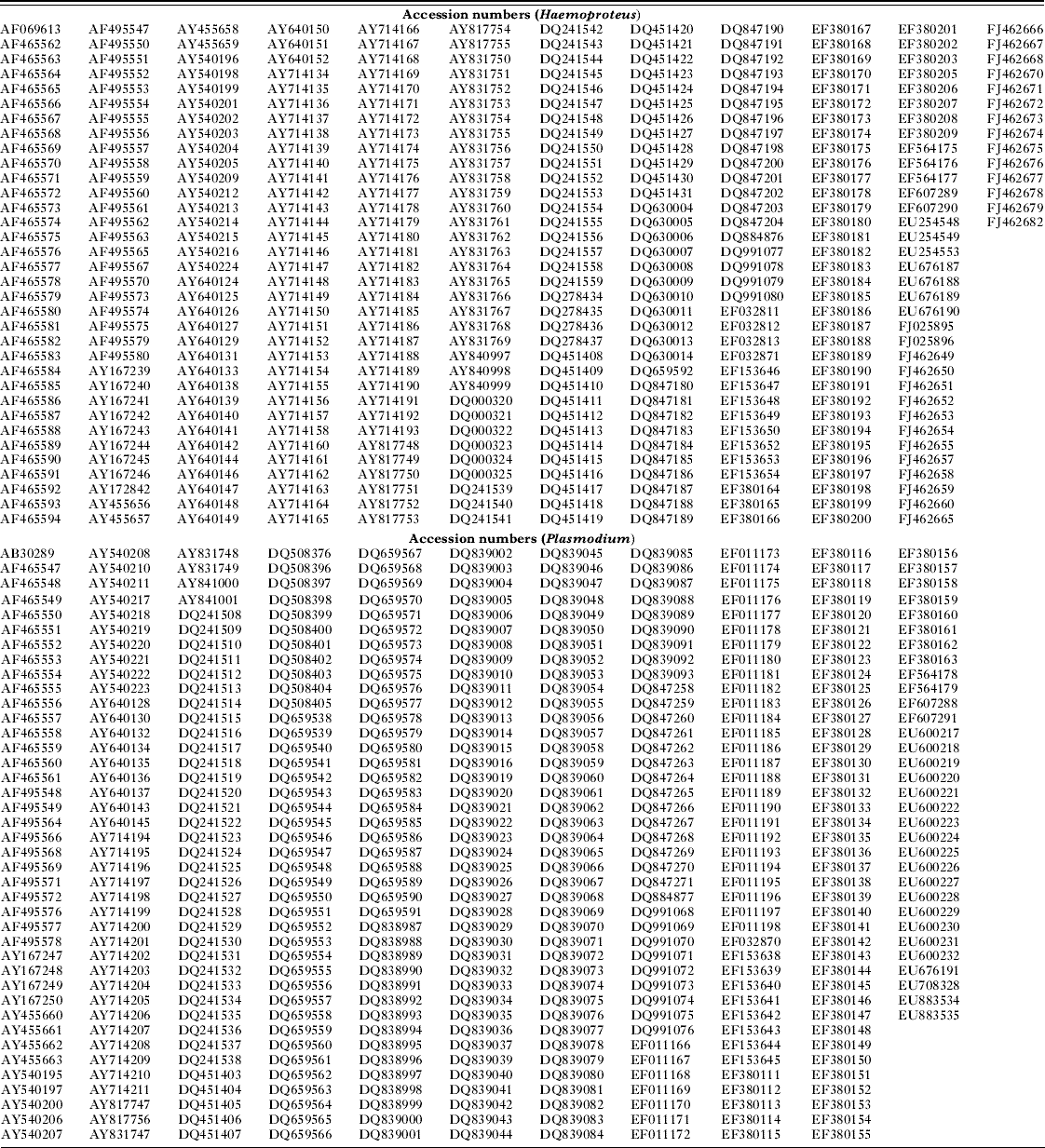
Initially, we searched all cytochrome B sequences encoding for a particular region of avian Plasmodium (432), Haemoproteus (388) and Leucocytozoon (204) currently listed in GenBank (Table 1). Recently, it has been suggested that several Haemoproteus species be transferred to the genus Parahaemoproteus (Martinsen et al. Reference Martinsen, Perkins and Schall2008). However, to date, there are no sequences assigned to this genus in GenBank. Thus, we use the nomenclature present in GenBank.
Subsequently, we achieved multiple restriction maps for groups of sequences using a tool available in http://insilico.ehu.es/restriction/main. All restriction maps were analysed in detail reporting an Hpy CH4III restriction site unique to Plasmodium with the exception of 9 non-conforming sequences. To check preliminary data obtained from restriction maps, all sequences were aligned using CulstalW program (Thompson et al. Reference Thompson, Higgins and Gibson1994), edited with the software BioEdit (Hall, Reference Hall1999).
In order to clarify the phylogenetic placement of non-conforming sequences listed in GenBank we performed a phylogenetic analysis in the following way. DNA sequences were aligned using the ClustalW program. The BioEdit program was used to edit the sequences. The MEGA4 (Tamura et al. Reference Tamura, Dudley, Nei and Kumar2007) software package was used in phylogram construction/drawing. The computer programs were set at their default parameters in all analyses. Phylogenetic analyses were carried out using the Neighbour-Joining method (Kimura substitution model). Nodal support was estimated by bootstrap analysis with 1000 replications. Phylogenetic analysis was carried out using sequences with a length of 304 bp after removing columns containing gaps or missing data. The Plasmodium lineage LIN34 was included in another tree due to the low overlap with the other non-conforming sequences, 256 bp being the length of the sequences. Several GenBank sequences from parasites recovered from birds were included in the phylogenetic trees to clarify the taxonomic position of these non-conforming sequences.
Overall 168 samples from Spanish blue-tits captured in the spring of 2007 were used (see Martínez-de la Puente et al. Reference Martínez-de la Puente, Merino, Tomás, Moreno, Morales, Lobato and García-Fraile2007 for details on areas of study and blood sampling) to select individuals infected with both parasites, Plasmodium and Haemoproteus, by using specific primers to detect each genus. In addition, we also selected 15 blood samples from Chilean birds that were previously analysed for molecular detection of parasites and showed mixed infections (see Merino et al. Reference Merino, Moreno, Vásquez, Martínez, Sánchez-Monsálvez, Estades, Ippi, Sabat, Rozzi and McGehee2008). Bird blood samples were stored in FTA classic cards (Whatman International Ltd, UK) and DNA was extracted to form a soluble solution before polymerase chain reaction (PCR) using the following protocol: cored samples were transferred to collection vials with 250 μl of SET buffer (0·15 M NaCl, 0·05 M Tris, 0·001 M EDTA, pH8) at 4°C for 6 h. Then 7 μl of 20% SDS and 50 μg proteinase K were added to the vials and incubated at 55°C overnight. After incubation, 250 μl of 4 M ammonium acetate were added to the vials at room temperature for 30 min. Subsequently, vials were centrifuged at 13 000 g for 15 min. After removing the pellet, DNA was precipitated with ethanol and re-suspended in sterile water.
We designed 2 sets of primers to specifically detect the lineages of Plasmodium or Haemoproteus present in blue-tits (Cyanistes caeruleus) from our study area in Spain (see Merino et al. Reference Merino, Moreno, Sanz and Arriero2000). In particular, primers HML (5′-GCT ACT GGT GCT ACA TTT GT-3′) and HMR (5′-CCT AAA GGA TTA GAG CTA CC-3′) were designed for Haemoproteus (367 bp; see Merino et al. Reference Merino, Moreno, Vásquez, Martínez, Sánchez-Monsálvez, Estades, Ippi, Sabat, Rozzi and McGehee2008) and Plas-F (5′-GTA ACA GCT TTT ATG GGT TAC-3′) and 4292Rw (5′-TGG AAC AAT ATG TAR AGG AGT-3′) for Plasmodium (422 bp). The primer 4292Rw was previously published (Beadell et al. Reference Beadell, Gering, Austin, Dumbacher, Peirce, Pratt, Atkinson and Fleischer2004; Durrant et al. Reference Durrant, Beadell, Ishtiaq, Graves, Olson, Gering, Peirce, Milensky, Schmidt, Gebhard and Fleischer2006). The genus specificity of the two sets of primers is due to HML and Plas-F primers for Haemoproteus and Plasmodium, respectively. The design of these primers was carried out using an alignment file with several sequences from both parasite genera. Later, the specificity of the primers was checked by performing a NCBI BLAST. The identity of the HML and Plas-F primers is not complete with any Plasmodium and Haemoproteus lineages respectively. However, the HML primer might hybridize with 2 Plasmodium sequences (DQ368386 and DQ241534) and the primer Plas-F with 7 Haemoproteus sequences (AF495574, AY714192, FJ462661, FJ462662, FJ462663, FJ462664 and FJ462657) because they have only 1–3 defective positions. Thus, the use of these primers avoids the amplification of parasites of the undesirable genus with relative confidence. PCR reactions consisted of 25 μl reaction volumes containing 20 ng template DNA, 50 mM KCl, 10 mM Tris-HCl, 1·5 MgCl2, 0·2 mM of each dNTP, 0·5 μM of each primer, and 1·25 U of AmpliTaq Gold (Applied Biosystems, Foster City, California). The reactions were cycled at the following parameters using a thermal cycler (MasterCycler Personal, Eppendorf): 94°C for 10 min (polymerase activation), 40 cycles at 95°C for 40 sec, 58°C for primers HML/HMR or 60°C for Plas-F/4292Rw for 1 min, 72°C for 1 min, and a final extension at 72°C for 10 min. The specificity of the genus-specific primers designed was tested by sequencing using an ABI 3130 (Applied Biosystems) automated sequencer. Sequences of amplicons obtained from 10 samples of Spanish blue-tits using primers HML/HMR showed only 1 lineage of Haemoproteus (corresponding to H. majoris GenBank Accession number AY099045). Likewise, the sequentiation of 5 amplicons obtained with primers Plas-F/4292Rw also revealed only 1 lineage of Plasmodium in the blue-tits (GenBank Accession number FJ494966). The parasite lineages present in the Chilean samples were previously identified (see Merino et al. Reference Merino, Moreno, Vásquez, Martínez, Sánchez-Monsálvez, Estades, Ippi, Sabat, Rozzi and McGehee2008).
GenBank Accession numbers of sequences encoding a particular cytochrome B region from avian Plasmodium and Haemoproteus currently listed

We also designed a pair of general primers Palu-F (5′-GGG TCA AAT GAG TTT CTG G-3′) and Palu-R (5′-DGG AAC AAT ATG TAR AGG AGT-3′) selecting a conserved region of the cytochrome B on the basis of the alignment file that showed the specific restriction site for Plasmodium. A total of 59 Spanish blue-tits and 15 Chilean birds with mixed infections were analysed using this pair of primers. In this case, we used the same PCR conditions described above except that the annealing temperature was 56°C. The size of the obtained amplicons was 390 bp. In order to check the effectiveness of the primers amplifying both parasites, the amplicons obtained after PCR were digested with the endonuclease Hpy CH4III (New England Biolabs, Beverly, Massachusetts). To carry out the digestion, 3 μl of PCR product was mixed with 1 μl (1 U/μl) of enzyme plus 5 μl of distilled water and 1 μl of 10× NEBuffer 4. The mix was incubated for 3 h at 37°C. The digestion products were resolved on 5% polyacrylamide gels (Miniprotean III, Bio-Rad) at 200 V for 35 min. After digestion with the endonuclease Hpy CH4III, amplicons from Plasmodium were cut into 3 fragments of 27, 36 and 327 bp and Haemoproteus in 2 fragments of 27 and 363 bp. The smaller fragments of 27 and 36 bp were indistinguishable in electrophoresis from those produced by the primers.
In order to compare the efficacy of the assay between different sets of general primers in detecting double infections, we also analysed the same 59 blue-tit samples using previously published general primers (Beadell et al. Reference Beadell, Gering, Austin, Dumbacher, Peirce, Pratt, Atkinson and Fleischer2004; Durrant et al. Reference Durrant, Beadell, Ishtiaq, Graves, Olson, Gering, Peirce, Milensky, Schmidt, Gebhard and Fleischer2006). Unfortunately, we only obtained sufficient DNA from 9 Chilean samples to conduct this second analysis. The primers were 3760F (5′-GAG TGG ATG GTG TTT TAG AT-3′) and 4292Rw (see above), amplifying a fragment of 565 bp from parasite cytochrome B. PCR reactions were conducted using the same conditions described above except that the annealing temperature was 52°C. The endonuclease Hpy CH4III cut in 2 sites on sequences from Plasmodium yielding 3 fragments of 327, 206 and 37 bp. However, it only cut at 1 site on sequences from Haemoproteus yielding 2 fragments of 206 and 363 bp. Fragments of 37 bp were indistinguishable from those produced by the primers (see Figs 1 and 2). Under-digestion of PCR products obtained by using both sets of primers was not a serious problem because in both genera there is at least 1 restriction site. Nevertheless, under-digestion was never detected using the conditions reported above.
Restriction fragments electrophoretically resolved on 5% polyacrylamide gel using primers 3760F/4292R. Two lineages of Haemoproteus from Chilean birds (H), 2 lineages of Plasmodium from Chilean birds (P) and 2 mixed infections (M) can be distinguished on the gel. Arrows show the length of fragments in base pairs. MW (molecular weight, 100 bp ladder).

Schematic representation of the cytochrome B sequence showing the Hpy CH4III restriction sites and the regions recognized by the different sets of primers used in this study (based on AF465554 sequence of Plasmodium).

RESULTS
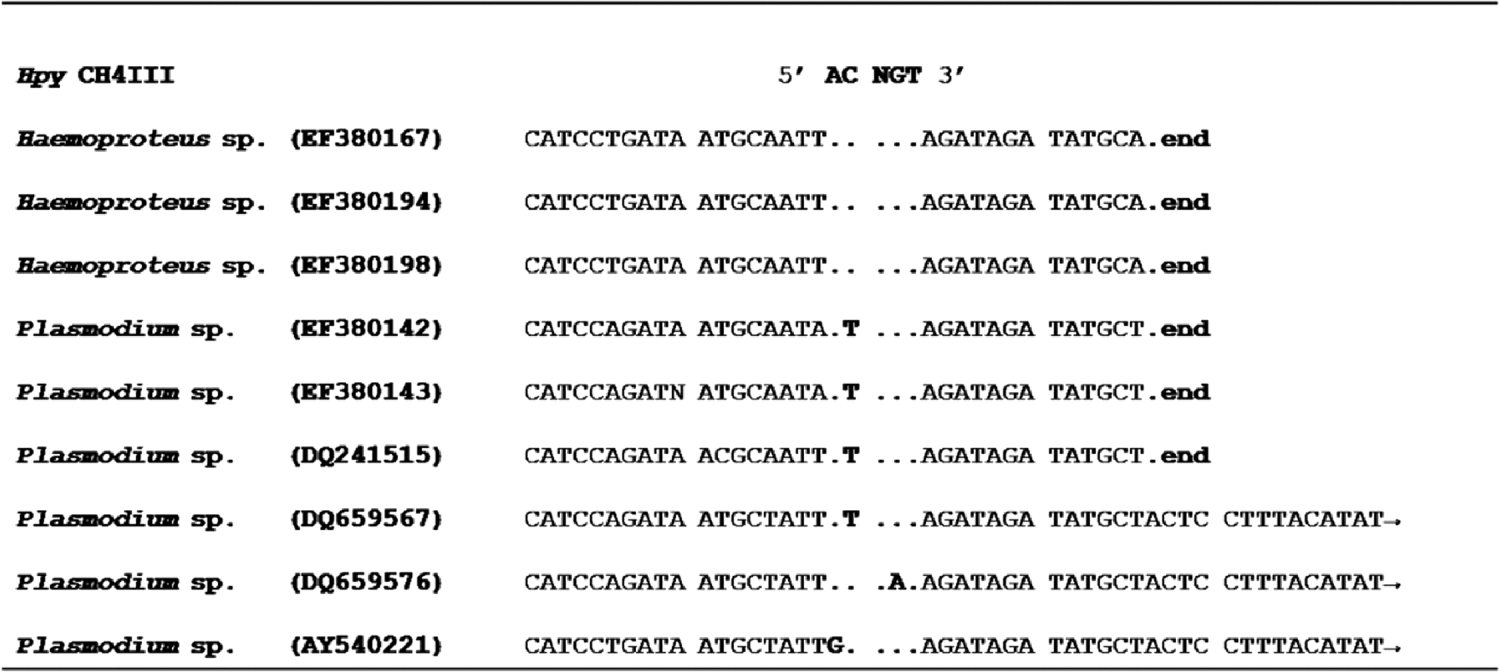
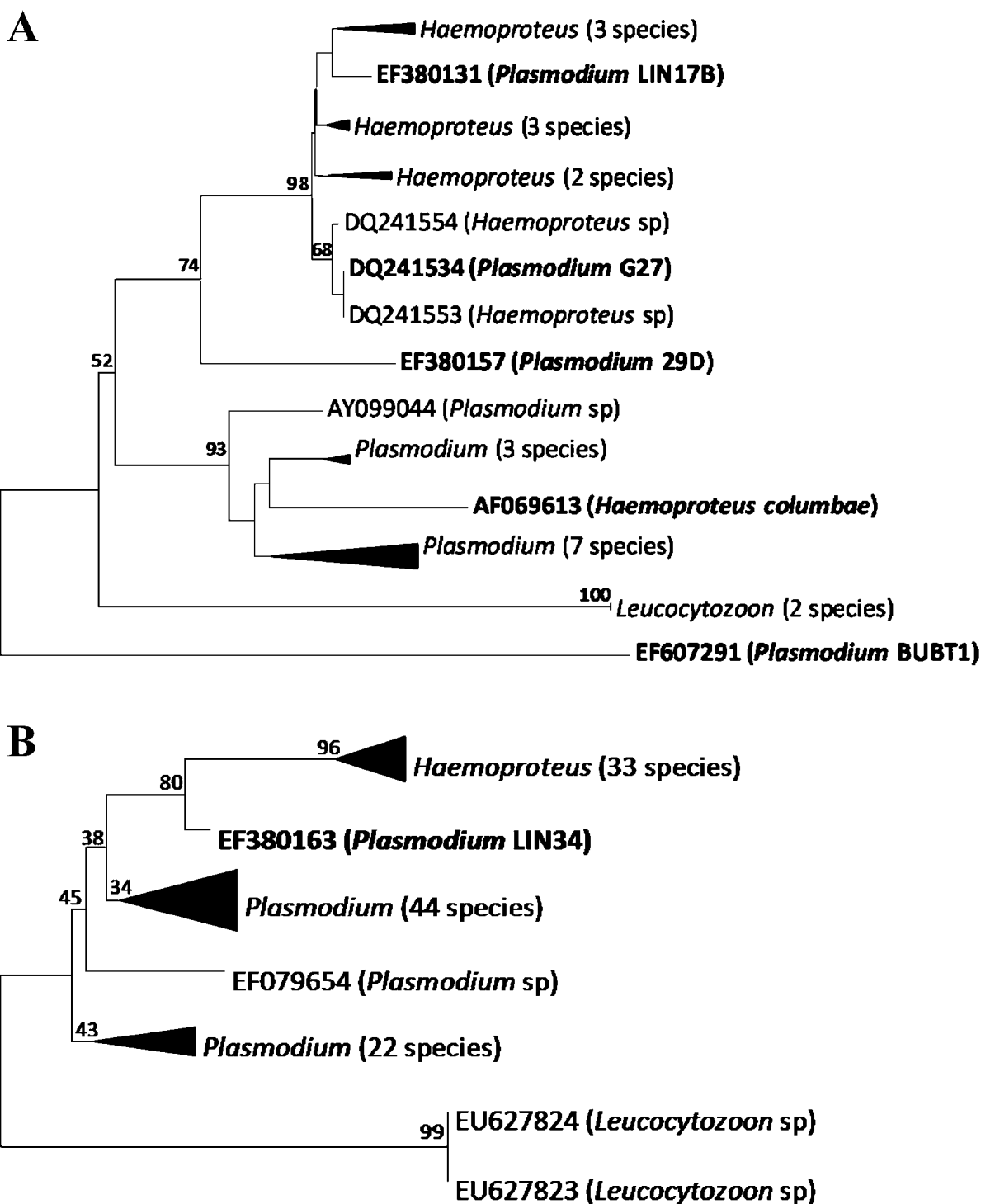
Overall 326 sequences of Plasmodium (185) and Haemoproteus (141) present enough length to include the regions where both hypothetical restriction sites are encoding. The first restriction site is present in all sequences listed on Genbank encoding for at least the portion for that particular cytochrome B region of avian Plasmodium (307 sequences) and Haemoproteus (299 sequences) except one that cannot be clearly assigned to any of that genera (see Discussion section). However, among the sequences including the fragment where the endonuclease could produce the second cut (310 Plasmodium and 230 Haemoproteus sequences), 9 sequences do not conform to the expected cutting pattern; 3 Haemoproteus sequences show the second Hpy CH4III restriction site and 6 Plasmodium sequences do not show it. The alignment of these 9 sequences showing the DNA region containing the second restriction site is presented in Fig. 3. Another 6 problematic sequences (AF069613, DQ241534, DQ241553, EF380131, EF380157 and EF380163) were incorrectly assigned at the genus level as shown by phylogenetic analysis, probably due to errors during the GenBank submission (Fig. 4).
Alignment of the Plasmodium and Haemoproteus cytochrome B sequences that cannot be differentiated using the Hpy CH4III restriction site-based assay. Only the fragment corresponding to the second restriction site is shown.

Phylogenetic tree based on a cytochrome B fragment of 304 bp (A) or 256 bp (B) using the Neighbour-Joining method (Kimura substitution model). The misidentified sequences are marked in bold.

The alignment of Leucocytozoon sequences including the fragment where the endonuclease could produce the first cut (204 sequences) showed that all of them present it. However, 50% of the 84 sequences including the fragment where Hpy CH4III nuclease could produce the second cut showed this restriction site. Accordingly, in the hypothetical case that Leucocytozoon would be amplified using the primers specifically selected for Plasmodium and Haemoproteus species, in one half of the cases the electrophoretic restriction maps would be identical to Plasmodium and in the other half to Haemoproteus.
The average genetic divergence calculated on a nucleotide fragment of 332 bp (from first to second Hpy CH4III restriction site, see Fig. 2) using Kimura-2 model in MEGA 4.0 showed a divergence within groups of 4·1%, 5·1% and 12·2% for Plasmodium (185 sequences), Haemoproteus (141 sequences) and Leucocytozoon (83 sequences), respectively. Otherwise, genetic divergence between groups was 8·3%, 15·8% and 15·5% for Plasmodium/Haemoproteus, Plasmodium/Leucocytozoon and Haemoproteus/Leucocytozoon, respectively.
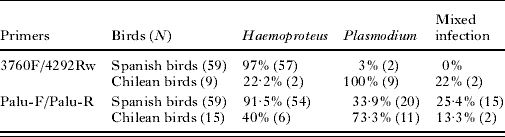
In order to test the efficacy of this assay to detect mixed infections, we first selected birds infected with both parasites from 168 blue-tit samples using the specific primers for Haemoproteus (HML/HMR) and Plasmodium (Plas-F/4292Rw). The results showed 87·5% (147) and 44% (74) of samples infected with Haemoproteus and Plasmodium, respectively. In total, 59 samples found infected by both parasite genera using specific primers were then amplified using general primers 3760F/4292Rw and Palu-F/Palu-R. The efficacy in detecting mixed infections by both pairs of primers in the two study regions was tested by one-tailed Fisher exact test comparing the expected versus observed number of mixed to single infections. The primers Palu F/R detected fewer mixed infections than expected in both Spanish and Chilean bird groups (χ12=69·57, P<0·0001 and χ12=22·18, P<0·0001, respectively). Similar results were obtained for the primers 3760F/4292Rw both, for Spanish (χ12=117, P<0·0001), and Chilean birds (χ12=10·82, P=0·001). However, the primers Palu F/R detected more mixed infections than the primers 3760F/4292Rw in the Spanish bird group (Fisher exact test, two tailed χ12=13·38, P=0·0001) although the difference was not significant for the Chilean group (Fisher exact test, two tailed χ12=0·22, P=1·00). In addition, the primers Palu F/R detected more Plasmodium infections than the primers 3760F/4292Rw in the Spanish bird group (Fisher exact test, two tailed χ12=12·53, P=0·0003) but there was no significant difference between both sets of primers detecting Plasmodium or Haemoproteus infections in the Chilean bird group (Fisher exact test, two tailed χ12=0·25, P=0·76 and χ12=0·40, P=0·68, respectively) or Haemoproteus infection in the Spanish group (Fisher exact test, two tailed χ12=0·04, P=0·90). A summary of the results is shown in the Table 2.
Efficiency of two sets of general primers amplifying Plasmodium and Haemoproteus from birds infected with both parasites and tested applying the Hpy CH4III restriction assay
(Sample size is shown in parentheses.)

DISCUSSION
This restriction enzyme-based assay is valid to discriminate between avian parasites of the genera Plasmodium and Haemoproteus in the vast majority of cases, but it has a possible error rate of about 3%. Next, we discuss the non-conforming sequences found in GenBank. (i) The sequence with Accession number AF069613 (Haemoproteus columbae from Venezuela) has the second Hpy CH4III restriction site typical of the genus Plasmodium while the sequences EF380157 (Plasmodium spp. LIN29D) and EF380163 (Plasmodium spp. LIN34) do not show this site. However, a phylogenetic analysis including these sequences confirms that they are incorrectly assigned at the genus level because (see Valkiūnas et al. Reference Valkiūnas, Atkinson, Bensch, Sehgal and Ricklefs2008 for a similar conclusion for H. columbae) those assigned to Plasmodium are in fact Haemoproteus and vice versa. This result strongly suggests that a revision of nomenclature for these three lineages is needed. (ii) The sequence EF607291 (Plasmodium spp. BUBT1) is the only parasite lineage without the first restriction site, but it is far from clear that this sequence was really a Plasmodium or even an Haemoproteus as it is not clearly grouped within these parasites (identity with other lineages only reach 85%; see also Krone et al. Reference Krone, Waldenström, Valkiūnas, Lessow, Müller, Iezhova, Fickel and Bensch2008). (iii) Sequences DQ241534 (Plasmodium sp. G27) and EF380131 (Plasmodium sp. LIN17B) are clearly errors because sequences DQ241553 (Haemoproteus sp. G46) and EF380174 (Haemoproteus sp. LIN11) respectively are completely identical. These sequences do not present the specific restriction site for Plasmodium and phylogenetic analysis grouped it within Haemoproteus. (iv) Only the sequences DQ659576 (Plasmodium sp. P35), DQ241515 (Plasmodium sp. U8), DQ659567 (Plasmodium sp. P26), EF380142 (Plasmodium sp. LIN24A), EF380143 (Plasmodium sp. LIN24B), AY540221 (Plasmodium sp. OZ42), EF380167 (Haemoproteus sp. LIN5), EF380194 (Haemoproteus sp. LIN29) and EF380198 (Haemoproteus sp. LIN33) are not correctly assigned to their genera using the assay described here because the Plasmodium sequences do have not the second restriction site for Hpy CH4III endonuclease whereas Haemoproteus sequences have it. Therefore, all sequences from both parasite genera show the first restriction site and only 9 do not follow the rule of the second restriction site. Among these 9, chromatograms for DQ659576 and DQ659567 were re-inspected and did not contain any obvious errors; in addition, unpublished sequence data appear to confirm the validity of AY540221 (J. Beadell, personal communication) Although the other 6 non-conforming sequences may also be exempt from any errors, we can venture several reasons to explain the origin of hypothetical errors. (i) The hypothetical errors could be generated during the GenBank submission process. (ii) In some sequences, the second restriction site is very close to the extreme 3′, a very sensitive zone where wrong readings are often observed. (iii) In some of them, the nucleotide change that knocks out the second restriction site consists of a thymine appearing instead of a cytosine and in another there is a guanine instead of an adenine. This points to the existence of a possible mistake in sequence readings due to the presence of a low DNA quantity of Haemoproteus in those samples because 96% and 94% of the Haemoproteus sequences present thymine and guanine in the second and the first position, respectively, within the second restriction site. This possibility cannot be ruled out due to the fact that general primers were used to amplify the parasite DNA and Haemoproteus presence may be unnoticed. In any case, we have evidence that at least 3 sequences, as mentioned above, do not contain errors and, therefore, strictly speaking the proposed test will be useful only after first surveying the lineage diversity in the host or geographical area under study.
The possibility that the general primers used in the present study could amplify Leucocytozoon species is remote, as indicated by performing a normal NCBI BLAST with the primers used in this study. The analysis BLAST showed that the primers HML, 4292Rw and Palu-R are unlikely to hybridize efficiently to the gene encoding the cytochrome B of Leucocytozoon species, whereas the other primers will do so. In addition, the high average genetic divergence between the Leucocytozoon group and Plasmodium or Haemoproteus groups (higher than 15%) also indicates that the amplification of Leucocytozoon is unlikely. Moreover, we have never amplified this parasite genus using the mentioned primers on samples with well-known Leucocytozoon infection and, to our knowledge, nobody has communicated it. Thus, we can state with relative confidence that the presence of Leucocytozoon does not affect the specificity of the test presented. Nonetheless, this should be tested using DNA from other Leucocytozoon isolates. It is also important to note that, as previously mentioned, the genera Haemoproteus and Parahaemoproteus cannot be discriminated using this assay.
The effectiveness of the assay in detecting double infections from samples of Spanish or Chilean birds was less than expected. The primer sets behaved very differently in the two groups of birds. While both primer sets detected over 90% of Haemoproteus infections in Spain, the case was just the opposite in the Chilean birds where both sets of primers detected a relatively high proportion of Plasmodium infections but failed to amplify a similar high proportion of Haemoproteus infections. In addition, primers Palu-F/Palu-R detected significantly more Plasmodium infections that primers 3760F/4292Rw in blue-tits. These facts could be due to a different affinity of the primers for the parasite lineages present in both areas or a lower intensity of Haemoproteus or Plasmodium infection in the Chilean or Spanish population, respectively. In this respect, previous data from the Spanish population of blue-tits indicated that only about 10% of samples were infected with Plasmodium using microscopy (authors' unpublished data; see also Merino et al. Reference Merino, Moreno, Sanz and Arriero2000), implying that Plasmodium DNA is probably in lower concentration as compared to Haemoproteus DNA in our blue-tit samples. In fact, detection of Plasmodium increased up to 70% by PCR using specific primers Plas-F/4292Rw (J. Martínez, unpublished data).
As mixed infections were constituted by different lineages, we can suspect that detection is completely dependent on the parasitic lineage implied and on the DNA quantity available as it was previously suggested by Beadell and Fleischer (Reference Beadell and Fleischer2005) and Pérez-Tris and Bensch (Reference Pérez-Tris and Bensch2005). These authors have tried to develop molecular methods to solve this problem but their efficiency is still very dependent on parasitic lineages and the intensity of infections. The most efficient method described to date to detect mixed infections is the highly expensive and time-consuming method of sequencing and TA cloning described by Pérez-Tris and Bensch (Reference Pérez-Tris and Bensch2005). As the assay presented here has practically 100% efficacy to differentiate both genera in samples with single infections, it can be used in combination with TA cloning to identify the parasite genus present in each clone but without sequencing, thus reducing the economic costs of detection of mixed infections by cloning. Unfortunately, the amplicons obtained with the primers used by Pérez-Tris and Bensch (Reference Pérez-Tris and Bensch2005) do not contain the specific restriction site for Plasmodium as described here, thus, another set of primers should be used before applying the assay of the Hpy CH4III restriction site.
The conclusions that we can extract from the present study are the following. (i) The general primers tested yielded a poor efficiency in detecting known mixed infections, although they were successful in detecting at least 1 of the 2 genera, thus they could be used with single-infected samples. (ii) This method may be a cost-effective way to discriminate Plasmodium and Haemoproteus infections when lineage-specific information and the exact number of mixed infections are not needed, or to reduce the costs of sequencing when using cloning to detect mixed infections. However, (iii) as the detection of mixed infections is completely dependent on the parasitic lineages and/or parasite intensity, we highly recommend the use of different pairs of general primers in the initial screening of samples, the genetic characterization of the amplicons obtained and the development of specific primers for the characterized lineages if the prevalence of each lineage is needed.
This study has been partially financed by the following projects: CGL2006-14129-C02-01/BOS from the Spanish Ministry of Education and Science, FONDECYT grant 1060186, travel grants from CSIC (grants CSIC-Univ. de Chile 2003 CL0012 and 2004 CL0033), and a BBVA Foundation grant. This study forms part of the research activities of the Biological Field Station ‘El Ventorrillo’ (Spain) and Institute of Ecology and Biodiversity (ICM-P05-002; PFB-23-CONICYT; Chile). We thank Javier Donés (Director of ‘Montes de Valsaín’) for permission to work in the study area. The Junta de Castilla y León authorized the ringing and handling of birds. J. M.-P., S. d. C. and E. L. were supported by grants from ‘El Ventorrillo’-CSIC, Comunidad de Madrid and MEC, respectively. J. R. A. is not supported by any grant.