1 Introduction
Moderators or compromisersFootnote 2 are attenuators which have ‘only a slight lowering effect’ (Quirk, Greenbaum, Leech & Svartvik Reference Quirk, Greenbaum, Leech and Svartvik1985: 597). Although moderators have not attracted as much attention as other intensifiers, they nevertheless offer excellent material for the study of grammaticalization. Their rise and development can only be understood and described if attention is given to the most important principles of evidence-based research on language, which emphasize the roles of the speaker and the addressee, pragmatic and discoursal aspects, sociolinguistics, styles and registers, subjectivity and intersubjectivity – in short, language as a means of communication. All these principles are also relevant for tracing the paths of grammaticalization, particularly in long diachrony.
The most common moderators in Present-day English are fairly, quite, pretty and rather (Paradis Reference Paradis1997: 27).Footnote 3 Their individual histories have a number of shared features. They ultimately go back to adjectives, either native, occurring from Old English (OE) on (fairly, rather, pretty) or borrowed from French into Middle English (ME) (quite). The adjectives which give rise to the moderators all have an original ‘positive’ sense – OE fæger ‘beautiful’, OE hræd ‘quick’, ‘speedy’, ‘active’, ‘eager’, ‘elated’, ME prety ‘fine’, ‘excellent’, ‘handsome’, and ME quite ‘free’, ‘safe’, ‘clear’.Footnote 4 The derivation of moderators from ‘positive’ items seems to be a phenomenon that can be seen in a number of languages;Footnote 5 cf. Spanish bastante, derived from bastar ‘to be enough, to exceed’, German ziemlich (< OHG zimilich, which glosses Latin decens, honestus, conveniens), and Swedish tämligen, derived from a verb meaning ‘to tame’.
The syntactic development of all these moderators includes not only adverbialization but also a change in function from adjunct to modifier.Footnote 6
The changes involved in the grammaticalization of rather are more radical than those of the other three moderators. The development includes the loss of the original adjective's indication of speed and movement, the development of a preferential/contrastive sense, the loss of the contrastive sense of the adverb, and the introduction of the attenuator use. Syntactic change includes the Modern English development from subjunct and conjunct to modifier use.
In this article I will trace the semantic and syntactic development of rather from Old to Present-day English. The first indications of the loss of the idea of speed or shortness of time can be traced as far back as the Old English period in the comparative expression þy/þe hraþor. In Middle English, the noncomparative form rathe loses ground and the comparative form rather becomes more common in nontemporal senses; the increasing frequency of the collocation rather (. . .) than is conspicuous.Footnote 7 In Early Modern English, the unmarked use of rather is still contrastive, but this notion gradually weakens in the course of the Late Modern English period, in conjunction with the development of the moderator sense. The modifier use with adjectives is established at roughly the same time. In Present-day English, the contrastive and moderator uses of rather exist side by side, although the contrastive use seems to be gaining ground at the expense of the moderator use.
As mentioned at the beginning of this article, the rise and development of the moderators can only be described and understood from the starting point of a communication-based variationist approach to linguistic research, which pays due attention to the roles and background of the speaker and the addressee. These aspects have been emphasized in some of the most influential recent works on grammaticalization. Traugott & Dasher (Reference Traugott and Dasher2002: 40) describe their Invited Inferencing Theory of Semantic Change (IITSC) in the following way:
although we are focusing on what is usually called ‘internal’ change, in the sense defined above as ‘natural’ and largely unconscious change, the mechanisms for change as outlined in this IITSC model of semantic change are external. This is because the mechanisms involve processes of reasoning, mental projection, association, focusing on salient issues (whether driven by social factors or SP/W's own perspective), etc., none of which are part of the language system, but rather are processes brought to bear on this system in language use.
Although the external mechanisms mentioned by Traugott & Dasher are not exactly parallel to the sociocultural, regional and genre-based external factors which form the cornerstones of variationist studies, they call attention in a useful way to the pragmatic and communicative aspects of describing and explaining change. Hopper & Traugott's summary of the pragmatic factors relevant to grammaticalization emphasizes the same aspects. According to Hopper & Traugott (Reference Hopper and Traugott2003: 98), grammaticalization can be thought of as the result of the continual negotiation of meaning engaged in by speakers and listeners. The negotiation of meaning may involve innovation, specifically pragmatic, semantic and ultimately grammatical enrichment, largely motivated by metonymic and metaphorical inferencing. The innovations may be subject to various types of reduction, typically semantic bleaching, morphological bonding and phonological attrition.
In the grammaticalization of intensifiers, subjectification and the negotiation of meaning are particularly important. Innovation and enrichment are natural results of this negotiation, as intensifiers easily lose their effect through semantic bleaching. With the moderators, and particularly with rather, the metonymic inferencing seems obvious: higher speed, the original sense of OE hraþor, means reaching the goal earlier, and this, through metonymy, invokes the sense of preference, of doing A before doing B. From the point of view of cognitive semantics, it is of interest that a similar development from temporal to ‘preferential’ sense in comparative adverbs can also be found in other languages; cf. German eher, Swedish snarare, French plutôt, Spanish antes, Finnish pikemmin. The contrastive aspect is, however, still present in these expressions. This development may have been triggered by the basic idea of something being ‘ahead of others’ or ‘more readily at hand’. Traugott & Dasher (Reference Traugott and Dasher2002: 3) call attention to this kind of regularity in semantic change, referring to conceptual structures typically associated with grammaticalization, such as spatial and temporal deixis, aspect and modality. A thorough comparative study of these expressions in various languages would be of interest.
The following discussion will take into consideration the three perspectives of grammaticalization defined by Nevalainen (Reference Nevalainen, Lindquist and Mair2004:1): lexico-grammar, corpus linguistics and sociolinguistics. The first two perspectives are at the forefront here: the first concerns the radical change of meaning from comparative temporal sense to noncontrastive moderator and the syntactic extension from adjunct to conjunct, subjunct and modifier; and the second relates to the information about the path of these developments over the course of a millennium which can be provided by a study of historical and present-day corpora. These corpora also enable us to make observations on the sociolinguistic aspects of the establishment of the moderator and modifier use: it seems we are here dealing with a change from below.
In this survey, corpus evidence is derived from The Helsinki Corpus of English Texts (HC), The Dictionary of Old English Corpus (DOEC), The Middle English Compendium (MEC), containing The Corpus of Middle English Prose and Verse (CME), The Corpus of Early English Correspondence Sampler (CEECS), The Corpus of Early English Correspondence Extension (CEECE),Footnote 8The Lampeter Corpus of Early Modern English Tracts, The Oxford Shakespeare Corpus, The Helsinki Corpus of Older Scots, A Representative Corpus of Historical English Registers (ARCHER), and the most important twentieth-century English corpora, namely, The Lancaster–Oslo/Bergen Corpus (LOB), The Brown Corpus of American English, The Freiburg LOB Corpus (FLOB) and The Freiburg Brown Corpus (Frown).Footnote 9
2 Old English beginnings
Rather goes back to the comparative form of the Old English adverb hraþe ‘quickly’, ‘immediately’, ‘at once’, ‘soon’, ‘forthwith’, ‘suddenly’, ‘readily’ (BT and BTS, s.v. hraðe). The adverb is derived from the adjective hræd ‘quick’, ‘swift’, ‘speedy’, ‘sudden’, ‘alert’, ‘rapid’, ‘prompt’, ‘active’ (BT s.v. hræd).Footnote 10 The senses given by the dictionaries of the noncomparative forms of the adjective and the adverb refer to the rapidity or immediacy of an action or movement. This is also confirmed by the c. 170 occurrences of the adverb hraþe in the Helsinki Corpus. The senses ‘alert’ and ‘active’ of the adjective are, however, worth noting.
The original temporal sense of the adverb is illustrated in (1). Note that in this example hraþe is inflected for the comparative.
(1)
Wið ðone bledendan fic, nim murran ða wyrt, . . . ðige ða on æfen, . . . & do swa nigon dagas & IX niht butan ðe raðor bot cume.
‘Against the bleeding ulcer take the herb of myrrh. . . eat it in the evening . . . and do so for nine days and nine nights except it is healed sooner.’
(Lacnunga LACN 102, HC)Footnote 11
The addition of comparativeness seems to be the trigger of the metonymic change of meaning of the adverb hraþe from temporal to preferential. The implication of preference is probably inherent in the comparative expression itself. From the cognitive point of view, the expression of temporal sequence, ‘I would first do this and then that’ or ‘I would do this more promptly than that’ includes the implication of preference – ‘I would prefer doing this to doing that’, ‘I would rather do this than that’ – particularly when subjectification is present. This development is implied in the definition of the idiom þy hraþor in Toller's Supplement: ‘(all, none) the more for this reason, on this account’ (BTS s.v. hraþe III.2).Footnote 12
There are 16 instances of the comparative form hraþor (with spelling variants) in the Old English part of the Helsinki Corpus and 80 in the Dictionary of Old English Corpus.Footnote 13 As implied by Toller's definition ‘the more’, quoted above, most of the early instances with the weakened temporal sense ‘more readily’ occur as part of the idiom þy/þe/þon hraþor, mainly in negative expressions, as in examples (2) and (3). There are ten instances of this combination in the Helsinki Corpus and no fewer than 52 in the Dictionary of Old English Corpus. In examples (2) and (3) the original temporal sense seems to be weakened and the intensifying implication is obvious:
(2)
þa þrio þincg, & þa tu þe we ær nemdon, þeah hwa wene þæt he on hiora anra hwylcum mæge habban fulla gesælða, ne bið hit no ðy hræþor swa, ðeah hi his wilnigen, buton hi þa fif ealle habben.
‘The three things, and the two that we mentioned earlier, although somebody might think that he in each of them may have complete happiness, it is none the more so, though they want this, except they have all the five.’
(Alfred's Boethius BOETHAL 77, HC)(3)
No þæt þin aldor æfre wolde
godes goldfatu in gylp beran,
ne ðy hraðor hremde, ðeah ðe here brohte
Israela gestreon in his æhte geweald,
‘Your lord never wanted to carry God's golden vessel in pride, or boast the more readily, although the army brought the treasures of Israel into his possession.’
(Daniel 753–6, DOEC)
Example (4) below is remarkable in that hraþor here occurs without the preceding demonstrative and the temporal sense is clearly weakened. This example also shows the construction hraþor (. . .) þonne ‘rather (. . .) than’, which is relevant to the development of the intensifier, as will be indicated below. The subjective attitude is obvious from the context and emphasized by the use of the verb wolde:
(4)
Wearð þa se casere for þære wogunge astyrod, wiste þæt seo dohtor, þe drihten hæfde gecoren, hraðor wolde sweltan þonne ceorlian.
‘Then the emperor was agitated by the wooing; he knew that the daughter, who had chosen Christ, would rather die than marry.’
(Ælfric, Lives, St Agnes 112, DOEC)
The following translation, which occurs in Ælfric's Grammar, is also illustrative of the emerging preferential sense:
(5)
magis swyþor: magis hoc uolo, quam illud swyðor oððe hraðor ic wylle þis, þonne ðæt.
‘magis more: magis hoc uolo, quam illud I want this more or rather than that.’
(Ælfric, Grammar 241.2, DOEC)
Notice the co-occurrence of hraðor (. . .) þonne with the verb willan even in this example.
The examples quoted above show that, although hraþor was still essentially a temporal comparative adjunct in Old English, the first traces of the development towards an intensifying subjunct are already visible.
The Old English period also witnesses the first stages in the development of another member of the paradigm of moderators, fairly, with the loss of the ‘aesthetic’ meaning and the development towards intensifier use (Nevalainen & Rissanen Reference Nevalainen and Rissanen2002). The need for new intensifying forms was obviously felt even at the earliest stages of the English language:
(6)
ic hiht on ðe hæbbe fæste, þæt þu me folc mænig fægere underþeoddest.
‘I have a firm trust in you; you subdued many nations fairly under my rule.’
(Paris Psalter 1527, DOEC)
3 Middle English development
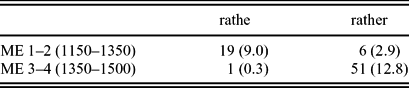
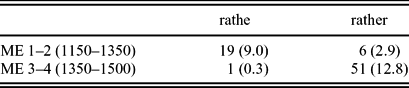
In the Middle English period, the simple temporal adverb rathe loses ground rapidly, while nontemporal intensifier uses of the comparative form rather become more common. Table 1 shows that rathe is still more frequent than rather in the first two Middle English subperiods (1150–1350) of the Helsinki Corpus, while in subperiods M3 and M4 (1350–1500) the comparative form rather is overwhelmingly more common than the declining rathe.Footnote 14 This distribution is confirmed by the Corpus of Middle English Prose and Verse, which gives fewer than two hundred instances of rathe (adjective or adverb), compared with more than a thousand occurrences of the comparative form.Footnote 15
Middle English adverbs rathe and rather in the Helsinki Corpus (figures per 100,000 words in brackets)
Given the decreasing frequency of the positive form rathe, it is no wonder that rather tends to lose its old time-related prototypical meanings ‘more rapidly’ and ‘earlier’, no longer supported by the noncomparative form. This further enhances the grammaticalization of the new contrastive intensifier senses, ‘more readily, easily or willingly’, ‘preferably’.Footnote 16 The shift of prototypical meaning also triggers the next step of the adverbialization from a manner adverb towards a subjunct (example (7) below) or a contrastive conjunct (example (8) below).Footnote 17 Subjectification certainly plays a central role in this development.
(7)
þerfor is it no synne to þe, dowtyr, for it is to þe raþar mede & meryte,
‘Therefore it is no sin to you, daughter, for it is rather a reward and merit to you.’
(c.1438, The Book of Margery Kempe KEMPE I 48, HC)(8)
Ful looth were hym to cursen for his tithes,
But rather wolde he yeven, out of doute,
Unto his povre parisshens aboute
Of his offryng and eek of his substaunce.
‘He did not wish to pronounce a curse to get his tithes, but rather he would give without hesitation to his poor parishioners out of his offerings and also out of his fixed income.’
(c.1387–95, Chaucer, Canterbury Tales CTPROL A 486–9, HC)
The phrase hraþor (. . .) þonne occurs in Old English (see examples (4) and (5) above), but is rare in comparison to the other uses of hraþe. From Middle English on, however, rather (. . .) than becomes the most common contrastive use of the intensifying rather (example (9)), as will be shown below. The phrase the rather (example (10) below), from OE þy hraþor (see above), is also significant.
(9)
But for to fulfille here pilgrymages more esily & more sykerly men gon first the longer weye rathere þan the nerere weye.
‘But in order to complete their pilgrimages more easily and more safely men first take the longer road rather than the shorter road.’
(c.1400, Mandeville's Travels MAND 35, HC)(10)
Therfor the Meir and Aldermen, wyllyng þat euery man þe rather shold eschewe such falsnes and disceyt in tyme comyng, haue, aftir þe fourme of þe forseyd ordenaunce, awardid þat he shal stonde here on þe pillory þis day an hour.
‘Therefore the Mayor and Aldermen, with the intention that everybody should the rather eschew such falseness and deceit in the future, have according to the form of the aforesaid ordinance decided that he shall stand here on the pillory today for an hour.’
(1419, Book of London English JUDG 101, HC)
It seems that these two constructions are of importance in the later development of the modifier and moderator uses of rather. In the former, rather can precede an adjective or adverb (as in rather slow than fast); if the comparative than phrase is dropped, as in example (11) below, the phrase can easily be reanalysed as a modifier + adjective/adverb phrase. In the latter type, rather does not normally refer to an expressed point of comparison (as in he did it the rather because . . .).
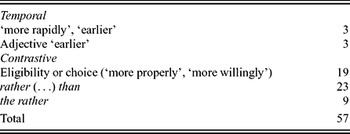
The Middle English instances of rather in the Helsinki Corpus can be grouped as in table 2. Both the very low rate of occurrence of the temporal use of rather and the high frequency of the phrase rather (. . .) than are notable.
Occurrences of rather in the Middle English part (1150–1500) of the Helsinki Corpus

The distinction between the senses ‘more properly’ and ‘more willingly’ made in the ‘eligibility or choice’ group is of interest, as it shows two possible types of subjectification. According to the OED (s.v. rather adv. III.8, 9), rather can have the sense ‘sooner’ (as a matter of fitness, expediency, etc.); ‘with more propriety or advantage’; ‘with better reason or ground; more properly or justly’; or ‘sooner’ (as a matter of individual choice); ‘more readily or willingly’; ‘with greater liking or goodwill’; ‘with or in preference’; see examples (7)–(8) above. In the former group, the subject of the clause is often inanimate (e.g. it in (7) above); in the latter, more subjective use, it is typically animate (e.g. he in example (8)). The collocation but rather occurs in 10 out of the 19 occurrences in the ‘eligibility or choice’ group (see example (8) above). This phrase seems relevant to the development of the intensifying use as it strengthens the contrast expressed by but. Example (11), in which rather precedes an adjective, is particularly significant, as it can here more easily be interpreted as a modifier.
(11)
. . . and so as we ne deme nat that they that ben sike of hir body ben worthy to ben hated, but rather worthy of pite;
‘. . . and as we do not think that those who have a bodily sickness are worthy to be hated but rather worthy of pity;’
(c.1380, Chaucer, Boethius BOETHCH 449, HC)
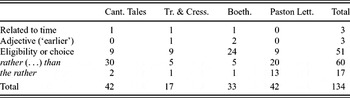
The figures derived from some of the texts of the Corpus of Middle English Prose and Verse confirm the picture given by the relatively low figures of the Helsinki Corpus. Table 3 shows the occurrences in Chaucer's Canterbury Tales and Troilus and Criseyde, in his translation of Boethius’ De Consolatione Philosophiae and in the Paston Letters.
Occurrences of rather in some Middle English texts of the Corpus of Middle English Prose and Verse

The high frequency of the construction rather (. . .) than is clear, particularly in the Canterbury Tales and the Paston Letters. The phrase the rather is infrequent in texts other than the Paston Letters. It is possible that this phrase, which may have contributed to the development of the noncontrastive use of rather as it is not followed by an expressed point of comparison, was particularly favoured in less formal genres, such as private correspondence (see section 4, below).
In the Paston Letters there are two examples in which rather is used with a comparative adjective. They are examples (12) and (13):
(12)
. . . and he bryngythe the iij horse wyth hym . . . They be delyueryd hym in as good and rather better plyght than whan I had them forthe, and nott gallyd nore hurte.
‘. . .and he brings the three horses with him . . . They should be delivered to him in as good and rather better condition than when I had them before, and not galled or hurt.’
(1474, John Paston II to Margaret Paston, Paston Letters I 476, CME)(13)
. . . whan so euer I come to Caleys I shall fynde all thyng there as I woll have it, and rather better than it was heere-tofor.
‘. . .whenever I come to Calais, I shall find everything there as I wish to have it, and rather better than it was before’.
(1474, John Paston II to John Paston III, Paston Letters I 480, CME)
There is one more instance of rather better in the Helsinki Corpus material.
(14)
Also all such fyne Silver as shall be parted and fyned as is aforeseid, that it be made so fyne that yt may bere xij peny Weght of alay in a pownd Weght, and yet be as goode as Sterlyng and rather better then werse:
‘Also all such fine silver as shall be separated and purified as aforesaid, so that it be made so pure that it may carry twelve pennyweight of alloy in a pound-weight, and yet be as good as Sterling and rather better than worse.’
(1488–91, Statutes of the Realm LAW II 527, HC)
This combination of two adjectives may be another sign of an early weakening of the contrastive sense of rather, although the implication ‘better rather than worse’ may be either implicitly (examples (12) and (13)) or explicitly (example (14)) traceable in the context.
The loss of the adverb rathe ‘speedily’, ‘rapidly’ and the reanalysis in Middle English of the form rather as an independent contrastive adverb, rather than the comparative form of the old adverb, is graphically illustrated by the emergence of the form ratherest in Late Middle English, as in examples (15) and (16):
(15)
þe grete caiseres & þe kyngis . . . Turne to him [Antichrist] shul raþerest [Vsp: titest; Frf: be-fore] And siþen oþere.
‘The great emperors and kings . . . will turn to him [Antichrist] soonest and then others.’
(a.1400, Cursor Trin-C R.3.8 22129, MEC)(16)
For y nyl not deme nomon here. /Bot þe best we shulle ratherest byleue to, /For goddus mercy passeth alle þe gode werkus þat he dude wyrche.
‘I will not condemn anybody here. But we should most particularly believe that the best will happen, for God's mercy surpasses all the good works he did.’
(a.1450, St. Editha Fst B.3 4055, CME)
To summarize, the Middle English development, as evidenced by the Helsinki Corpus and the Middle English Compendium, shows the loss of the noncomparative adverb rathe, as well as the waning of the temporal senses ‘more rapidly’, ‘more speedily’, ‘at an earlier time’, ‘first’, and the increase of the varying preferential/contrastive uses of rather. The adverb is still clearly contrastive, but collocations rather (. . .) than and the rather are significantly common and may pave the way to the gradual loss of the contrastive sense and to the syntactic change from adjunct to subjunct, contrastive conjunct, and, finally, moderator/modifier in Modern English.
As for the development of the other moderators in the Middle English period, faire develops the senses ‘with moderation, moderately’, ‘fully, completely, very much’, ‘plainly, clearly’, ‘exactly, precisely, right’ in Middle English (MED s.v. faire adv. 6b, 7b, 8; see also Nevalainen & Rissanen Reference Nevalainen and Rissanen2002: 366–7). Evidence from the Helsinki Corpus and the Middle English Compendium indicates that the intensifier use of the adverb pretty appears later than that of rather or faire(ly). The adjective quite ‘excused’, ‘free’, ‘safe’, etc. (MED s.v. quite adj.) is borrowed from French into Early Middle English, and the first instances of the adverb in the maximizer use ‘completely’, ‘entirely’, etc., are recorded in fourteenth-century texts (MED s.v. quite adv.). The moderator uses develop fairly late in Modern English; the earliest instances quoted by the OED are from the eighteenth century (s.v. quite adv. II.4). There are no Middle English instances of the adverb pretty in the dictionaries or corpora, although the adjective shows a change of meaning from ‘cunning, clever’ or ‘handsome, shapely’ into ‘fair-sized, considerable, great’ in the fifteenth century (MED s.v. pratie adj. 2b).
4 Modern English establishment
In Early Modern English, in the sixteenth and seventeenth centuries, the use of rather is still essentially contrastive. The Early Modern English part of the Helsinki Corpus (1500–1710) does not give a single instance of noncontrastive rather out of a total of 154 occurrences, nor are there any instances in the Oxford Shakespeare Corpus, which contains over one million words (and 346 occurrences of rather). A survey of the Corpus of Older Scots yields the same negative result. However, the germ of the new, moderator use is already to be found in this period. The Lampeter Corpus (409 occurrences of rather) and the Corpus of Early English Correspondence Sampler (160 occurrences of rather, of which 141 occur in sixteenth- and seventeenth-century letters) give one passage each in which rather seems to be noncontrastive. Both instances come from private letters (examples (17) and (18) below). The high frequency of the expression the rather in CEECS should also be noted as a symptom of the weakening of the contrastive sense: 38 instances out of 160 contain this collocation. It seems, indeed, that the noncontrastive moderator use was a change from below, first used at less formal levels of language.
(17)
you should so far forget that Pamphlet when you wrote your Letter, as to throw it down to a Postscript, I rather wonder you should ever mind it at all, but above all I wonder, how you came to be so far forgetful of the Humour of your old Acquaintance,
(1692, Humphry Hody, Lampeter)(18)
yet I beeseech your Lapp bee pleased once more to give mee leave to bege that by my letters which I had rather a great deale doe upon my kneese, (but that I feare my sight wold bee rather a cause of adding more affliction unto you, then of reastoring my selfe to my selfe by your pardon,) which is, that your Lapp would be pleased to forgive this last act of mine,
(1631, Frederick Cornwallis 230, CEECS)
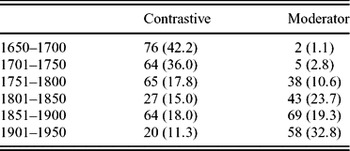
Even though these two early examples of the moderator use of rather go back to the seventeenth century, the establishment of this new use took place in later Modern English, from the eighteenth century on. This is clearly shown by the figures derived from ARCHER, which covers the period from the mid seventeenth century to the 1990s (see table 4).
Contrastive and moderator uses of rather in ARCHER

As can be seen from table 4, the moderator use becomes common in the second half of the eighteenth century, and more frequent than the contrastive one in the nineteenth. As mentioned above, the shift from a contrastive intensifier to moderator was probably due to the popularity of the phrase rather (. . .) than, and the semantic development may have been caused by the politeness factor. If something was not exactly good, a polite means of expression may have been something like ‘rather good than bad’ and, subsequently, ‘rather good’. Both the expressions in which rather is separated from than and other expressions, such as the rather, in which the point of comparison was not explicitly stated, no doubt supported the loss of the contrastive meaning.
The syntactic change from subjunct and contrastive conjunct to a modifier is a natural outcome of the semantic development outlined above: rather is reanalysed as an adverb modifying the following adjective or adverb. While the earliest eighteenth-century instances of the noncontrastive subjunctive use of rather occur mainly with verbs and nouns (cf. the seventeenth-century examples (17) and (18) above), in the second half of the eighteenth century the use with adjectives and adverbs, illustrated in example (19) below, clearly dominates: 29 instances all told, as compared with two with nouns and seven with verbs in ARCHER.
(19)
After talking with him some little time he said I might fish, but then I would not, at which he seemed rather uneasy.
(1781, James Woodforde's Diary 1759–1802, ARCHER)
The figures from CEECE, representing eighteenth-century correspondence, show an even earlier development of the use of rather in modifier position: in the letters dating from the first half of the eighteenth century, 17 out of the 19 instances of the moderator sense are used with adjectives and adverbs, as in example (20) below. This suggests, once again, that the development of the moderator/modifier use may have been a change from below.
(20)
the prospect from the Drawingroom window at which I now write, is rather picturesque, as it commands a perspective view of the left side of Brock Street,
(1799, Jane Austen to Cassandra Austen 41, CEECE)
Within the wider perspective of the development of the paradigm of attenuators, the rise and development of the moderator/modifier use of rather seems to be temporally located between similar developments of pretty and fairly. While pretty develops a modifier use as early as the late sixteenth or early seventeenth century, the modifier use of fairly is established only in the nineteenth century. Similarly, pretty can be used as a moderator from the very beginning of its modifier use, while this use of fairly develops late, probably later than its booster use.
5 Present-day English
While the data from Modern English show an increasing frequency of the moderator use (see table 4), a survey of Present-day English corpora shows that the contrastive use of rather, illustrated in example (21), is gaining ground at the expense of the moderator use exemplified in (22).
(21)
Unfortunately, this adequacy was a reminder that his problem has not been his lack of style but rather his abundance of insincerity.
(Frown B19:5)(22)
One that I shall be rather sad to see fading into the tapestry of history is the dear old CND, the Campaign for Nuclear Disarmament,
(FLOB B08:62)
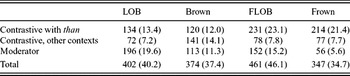
Table 5 shows the figures of four Present-day English corpora, which represent British and American English of the 1960s and 1990s.
The uses of rather in the tagged versions of the Lancaster–Oslo/Bergen Corpus (LOB) and the Brown Corpus of American English; and the Freiburg LOB (FLOB) and Freiburg Brown corpora (Frown) (figures per 100,000 words in brackets)

The contrastive uses prevail, in particular in the Brown Corpus, with 261 occurrences as compared with the 113 of the moderator use.
The figures in FLOB and Frown corpora show the same trend as their 1960s counterparts. Even in FLOB, which represents British English, the contrastive uses are clearly more frequent than the moderator use.
The most conspicuous development during one generation at the end of the twentieth century seems to be the increasing popularity of the contrastive collocation rather (. . .) than. At the same time, the moderator use seems to decrease to some extent, as shown by a comparison with the figures from ARCHER given in table 4. This phenomenon may be due to the increasing use of the other moderators in Present-day English, most notably fairly. In ARCHER texts dating from the period 1801–1900, the modifier fairly occurs only three times (0.6 occurrences per 100,000 words), while in the four late twentieth-century corpora the number of occurrences is 228 (5.7 per 100,000 words); see Nevalainen & Rissanen (Reference Nevalainen and Rissanen2002: 375, 377).Footnote 18
6 Final remarks
The history of rather shows more radical changes, both semantic and syntactic, than that of the other moderators. There is not much common ground between the temporal sense and the idea of moderating or compromising, although the metonymic development is plausible. The disappearance of the connotation of comparison and contrast in a form retaining its comparative ending is also remarkable. Syntactically, an adjunct develops into a subjunct, and finally into a modifier.
This kind of semantic and syntactic development can be explained by the very great and long-standing popularity of this moderator – most likely in spoken expression and colloquial registers. The high degree of subjectification may give us a clue as to the motivation for these changes. It seems that from the very beginning rather is characteristically used in contexts which offer a counterpoint to negative statements or attitudes. ‘It is not so bad; rather, it is good’ easily becomes ‘It is rather good’ in colloquial spoken expression, particularly when the negative idea is left unexpressed. If this line of thinking is accepted, it would also explain the loss of comparativeness and contrastiveness in a comparative form.