INTRODUCTION
The ability to predict tissue response to radiation has obvious benefits for clinical management and may lead to strategies to overcome radiation toxicity and to increase efficiency of radiotherapy. The study of various factors implicated in inflammatory cascade as well as in vascular damage could bring new insights in understanding the pathogenesis of radiation toxicity and the identification of prognostic markers for radiation effect.Reference Stone, McBride and Colema1,Reference Anscher, Chen and Rabbani2 It has been shown that the changes in plasma levels of growth factors, cytokines and soluble adhesion molecules during radiotherapy can be used to identify patients at risk for the development of radiation toxicity. For example, the changes in plasma transforming growth factor (TGF)-β1, interleukin (IL)-1α, IL-6 or intercellular cell adhesion molecule (ICAM)-1 concentrations are associated with the development of radiation pneumonitis.Reference De Jaeger, Seppenwoolde, Kampinga, Boersma, Belderbos and Lebesque3–Reference Chen, Hyrien, Williams, Okunieff, Smudzin and Rubin7 There are various other factors participating in the inflammatory cascade, and disruption of tissue integrity which might also serve as candidate markers of radiation effects; one of these is fibronectin (Fn).Reference Baluna, Eng and Thomas8–Reference Vignola, Chanez and Chiappara13 Fn is a multifunctional glycoprotein that exists in a soluble form in plasma and other body fluids and in an insoluble form in the extracellular matrix (ECM), basement membranes and connective tissue. Thus, Fn serves as a bridge between cells and ECM and influences diverse cellular processes including growth and differentiation, transformation, adhesion, migration and survival.Reference Ruoslahti14–Reference Pankov and Yamada15 In addition, plasma Fn plays a role in the maintenance of vascular integrity, reticuloendothelial system function, haemostasis and wound healing.Reference Saba and Jaffe16–Reference Romberger18 The gradient between plasma and tissue Fn can be altered in various diseases.Reference Saba and Jaffe16 Hepatocytes, endothelial cells and macrophages are major sources of plasma Fn; however, soluble Fn is found in bronchoalveolar lavage fluid, synovial fluid, cerebrospinal fluid, seminal fluid, urine, colostrum, saliva, amniotic fluid and pleural effusions. The Fn levels in plasma and other body fluids have been reported to change in various disease states, including cancer,Reference Zerlauth and Wolf19–Reference Liu, Luo, Yang and Li28 and may predict the toxic effect of therapeutic agents such as immunotoxins and IL-2.Reference Baluna, Sausville, Stone, Stetler-Stevenson, Uhr and Vitetta29 The importance of cellular Fn in radiation pneumonitis and fibrosis has been emphasised in several series.Reference Bjermer, Hallgren, Nilsson, Franzen, Sandstrom and Henriksson30–Reference Resnikoff, Brien and Vincent32 It has been shown that bronchoalveolar lavage fluid levels of Fn, TGF-β1 and IL-6 are increased in patients with radiation pneumonitis.Reference Bjermer, Hallgren, Nilsson, Franzen, Sandstrom and Henriksson30,Reference Barthelemy-Brichant, Bosquée and Cataldo31 However, it is not known whether the absolute levels or changes in levels of plasma Fn correlate with the radiotherapy outcomes in terms of normal tissue injury and tumour control. There are theoretical reasons to believe that this might be the case, owing to the role of Fn in the maintenance of tissue integrity and tumour development. The present study was carried out to evaluate the significance of plasma Fn in cancer patients undergoing radiation therapy (RT).
MATERIALS AND METHODS
Patients
In total, 14 patients with non-small cells lung cancer (NSCLC) and 12 patients with gastrointestinal (GI) cancer (3 gastric, 3 ampullary, 3 rectal and 3 anal cancer), treated with external beam RT were enrolled in this study. Radiation dose was typically given according to the standard of care for each disease site 50–70 Gy in 5–7 weeks. Plasma Fn levels were determined before and following a course of RT. The Radiation Therapy Oncology Group (RTOG) criteria were used to determine the grade of acute radiation toxicity.Reference Cox, Stetz and Pajak33 The toxicity was assessed weekly during RT. Ten patients with stage IIIB NSCLC were divided in two groups: (i) 6 patients alive during the second year after treatment with a mean follow-up of 14.5 months and (ii) 4 patients who died during the first year. All patients gave written informed consent. The institutional review board approved the protocol and consent form.
Plasma Fn level
A total of 52 samples from 26 patients were obtained before and following a course of RT. Blood samples were collected in ethylenediaminetetraacetic acid tubes, centrifuged and stored immediately at –80°C without de-freezing until testing. Plasma Fn levels were determined as previously described, using a commercial radial immunodiffusion assay (Binding Site, Birmingham, UK).Reference Baluna, Sausville, Stone, Stetler-Stevenson, Uhr and Vitetta29 All samples were tested in duplicate using the same kit. The dilution of Fn and normal donor plasma pool were used as control. Plasma Fn levels of 300 ± 50 μg/ml were considered to be normative comparator.
Statistical analysis
Statistical analysis utilised the nonparametric Mann–Whitney U-test with an α of 0.05. Fn levels and survival parameters were analysed using descriptive techniques, as well as bivariate linear regression.
RESULTS
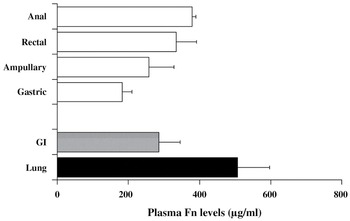
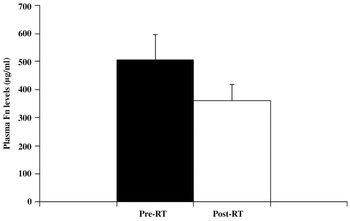
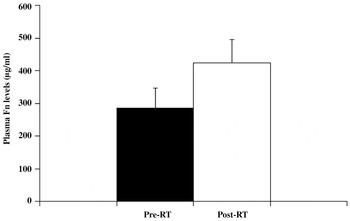
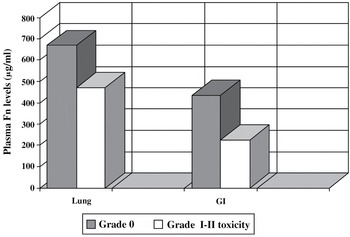
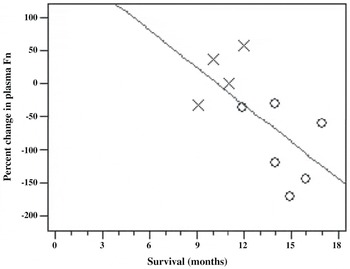
Pre-RT Fn levels were significantly higher in lung cancer patients (mean ± SE) (507.5 ± 91 μg/ml, p = 0.05) as compared with GI cancer patients (285.2 ± 62 μg/ml) (Figure 1). Interestingly, plasma Fn levels decreased in lung cancer patients at the end of RT (361.0 ± 58 μg/ml, p = 0.04) as compared with baseline levels (507.5 ± 91 μg/ml) (Figure 2), and increased in GI cancer patients at the end of RT (424.2 ± 71 μg/ml, p = 0.01) as compared with the baseline levels (285.2 ± 62 μg/ml) (Figure 3). To determine the possible predictive value of Fn for the development of radiation toxicity, the pre-RT levels of plasma Fn in patients without toxicity (median ± SE) (485.0 ± 87 μg/ml) were compared with levels of plasma Fn in patients with grade I–II RTOG acute toxicity (354.0 ± 74 μg/ml) and a significant difference was observed (p = 0.01). The pre-RT levels of plasma Fn were lower in lung cancer patients (472.0 ± 80 μg/ml, p = 0.02) and in GI cancer patients (225 ± 74 μg/ml, p = 0.03) who developed radiation toxicity as compared with patients without toxicity (669.3 ± 120 μg/ml and 436 ± 34 μg/ml, respectively; Figure 4). No significant difference in Fn levels was found in patients with grade I toxicity compared with patients with grade II toxicity. In addition, low baseline Fn levels (148 μg/ml and 299 μg/ml) were observed in two lung cancer patients who developed symptomatic pneumonitis during the first 2 months after RT. Ten patients with stage IIIB NSCLC treated with RT were followed up to 18 months. The pre-RT Fn levels were higher in the patients alive during the second year after treatment (mean ± SE) (519 ± 77 μg/ml) as compared with the patients who died in the first year after treatment (321 ± 40 μg/ml). Failure of plasma Fn levels to decrease after radiation was associated with mortality during the first year post-therapy. Of the 10 patients observed, those 3 patients not experiencing a drop in Fn were all deceased within 12 months (3/3). Of 7 patients experiencing decreased Fn, 6 were alive during the second year with a mean follow-up of 14.5 months (6/7). Additionally, a preliminary correlation was observed between the pre- and post-RT Fn ratio and survival time in months (Radj 2 = 0.35)(Figure 5).
Pre-RT plasma Fn levels are increased in lung cancer patients. The plasma Fn levels were determined in 26 patients with cancer (n = 14 lung, n = 3 gastric, n = 3 ampullary, n = 3 rectal, n = 3 anal). Data points represent the mean plasma Fn levels in each group. The difference between the Fn levels in lung and GI cancer patients is statistically significant (p = 0.05). Error bars represent standard error (SE).

Plasma Fn levels decrease in lung cancer patients undergoing RT. Plasma Fn levels were determined before and following a course of RT (n = 14). Data points represent the mean plasma Fn levels. The difference between the pre- and post-RT levels is statistically significant (p = 0.04). Error bars represent SE.

Plasma Fn levels increase in gastrointestinal cancer patients undergoing RT. Plasma Fn levels were determined before and following a course of RT (n = 12). Data points represent the mean plasma Fn levels. The difference between the pre- and post-RT levels is statistically significant (p = 0.01). Error bars represent SE.

Pre-RT plasma Fn levels are decreased in patients who developed acute radiation toxicity. Plasma Fn levels in patients without and with radiation toxicity were compared. Data points represent the median plasma Fn levels. The difference between the two groups is statistically significant in lung cancer (p = 0.02) and gastrointestinal cancer (p = 0.03).

Pre- and post-RT Fn ratio correlate with survival in lung cancer patients. Bivariate fit of survival and change in plasma Fn levels were determined in 10 patients with stage IIIB NSCLC (o = patient alive during the second year after RT; x = patient deceased in the first year after RT) (Radj 2 = 0.35).

DISCUSSION
The plasma Fn levels during RT seem likely to reflect the balance between production of Fn from activated macrophage, endothelial cells, tumour cells and other cells and the consumption of Fn in reticuloendothelial system functions and tissue repair. In addition, the gradient between plasma and tissue Fn must be considered when alterations in plasma Fn levels are analysed.Reference Resnikoff, Brien and Vincent32 Here, we showed that plasma Fn levels are increased in lung cancer patients (Figure 1). The anti-tumour response of the monocyte– macrophage system with an increase in Fn synthesis and turnover could be a viable explanation for these changes. In addition, gene expression of Fn is mediated by TGF-β1, which is known to be augmented in lung cancer patients.Reference Shanker, Olson, Bone and Sawhney34 Elevated plasma Fn levels were reported in the literature in patients with cancer.Reference Zerlauth and Wolf19–Reference Hegele, Varga, von Knobloch, Olbert, Kropf and Hofmann22 Interestingly, we found the pre-RT Fn levels were higher in the NSCLC patients alive during the second year after treatment (mean ± SE) (519 ± 77 μg/ml) as compared with the patients who died in the first year after treatment (321 ± 40 μg/ml) suggesting that Fn might stimulate the anti-tumour activities of reticuloendothelial system and protect against toxic effect of radiation which result in a better response to treatment and increased survival. These results are in concordance with the findings that in head and neck cancers, increased Fn expression appears to enhance tumour response to radiotherapy and is associated with an increase in recurrence-free survival.Reference Nishioka, Ogawa, Inomata, Maeda and Seguchi35 Thus, Fn levels might be a potential prognostic marker in lung cancer. In the present study the decrement in baseline plasma Fn level is associated with the development of radiation toxicity in lung and GI cancer patients, suggesting a protective role of plasma FN against tissue damage mediated by RT (Figure 4). The depletion of Fn has been described to be associated with severe inflammatory conditions (e.g., burns, trauma and sepsis16,23,28). The decrease in plasma Fn level in lung cancer patients during RT support the idea that Fn might be consumed in anti-tumour processes as well as in tissue injuries repair. Failure of plasma Fn levels to decrease after radiation was associated with mortality during the first year post-therapy in NSCLCA patients. However, RT in GI cancer patients resulted in significant increases in plasma Fn levels (424.2 ± 71 μg/ml, p = 0.01) compared with the baseline levels (285.2 ± 62 μg/ml) (Figure 3). These results suggest that the differential effect of RT on Fn synthesis in macrophage, endothelial cells and hepatocytes may, in part, explain differential responses in plasma Fn levels to RT to different anatomical areas.
In conclusion, these preliminary results suggest that low baseline Fn may have potential as a surrogate predictive marker for development of RT-induced toxicity, whereas high circulating baseline levels of Fn may indicate a cytoprotective propensity. Further studies are necessary to clarify the clinical significance of the changes in plasma Fn levels during RT and to elucidate the underlying mechanisms of interaction.
Acknowledgements
The funding for this study was provided by the Department of Radiation Oncology UTHSCSA.