Introduction
The study of the interaction of the rat tapeworm, Hymenolepis diminuta, with its intermediate hosts in the Tenebrionid beetle family is extensive enough to consider it a model system (Shostak, Reference Shostak2014) In this system, adult H. diminuta tapeworms reside in their rodent definitive host, primarily rats, where they produce and release proglottids, which break open in the rats' faeces to release eggs. Several species of Tenebrionid beetles are known to feed on the faeces and ingest the eggs (Sokoloff, Reference Sokoloff1972; Siles-Lucas & Hemphill, Reference Siles-Lucas and Hemphill2002). The eggs then hatch, burrow through the mid-gut and develop into the cysticercoid stage where they remain until a definitive host ingests the beetle. The many factors influencing the success from H. diminuta egg to beetle infection have been well studied and recently summarized (Shostak, Reference Shostak2014).
Sixty years of study on the infection of the intermediate host have encompassed topics from host species range through mechanisms of infection to the influence of countless variables on infection rates. However, Shostak's (Reference Shostak2014) review has identified several areas for which research is still lacking. Primarily, this review noted the difficulty of directly comparing the myriad of data generated from these studies because of the variability of the methods; therefore, not allowing for many conclusions about the integrated factors. Each previous study has concentrated on just one or a limited set of variables at one time. The logistics of comparing several variables at one time makes it difficult to complete such a comparative study.
The standard protocol for infecting beetles with H. diminuta involves several steps: starving the beetles, presenting the H. diminuta eggs gathered from the definitive host for feeding by the intermediate host, allowing time for the eggs to develop into the cysticercoid stage within the beetle and then, finally, dissection of the beetles to ascertain levels of infection. Infection is quantified first by calculating the percent of beetles that have at least one cysticercoid (prevalence) and then quantifying the mean number of cysticercoids in those beetles that have been infected (intensity).
Each stage of the infection process has numerous aspects that must be considered; both environmental and genetic. A plethora of studies have looked at many variables in this process in isolation (summarized in Shostak, Reference Shostak2014). When it comes to the condition of the Tribolium beetles as an intermediate host, it has been found that older beetles have lower infection levels (Kelly et al., Reference Kelly, O'Brien and Katz1967; Keymer, Reference Keymer1982; Shostak, Reference Shostak2008; Shostak et al., Reference Shostak, Walsh and Wong2008). However, the sex of the beetles has had contradictory results for Tribolium confusum (Mankau, Reference Mankau1971, Reference Mankau1977; Yan et al., Reference Yan, Stevens and Schall1994; Stevens et al., Reference Stevens, Guiyun and Pray1997; Shostak, Reference Shostak2012).
The initial starving step of the protocol is the most taxing on the beetles; however, removing the food source for a period of time is highly recommended for successful infection. Although starvation periods often vary amongst studies, Dunkley & Mettrick (Reference Dunkley and Mettrick1971) recommend a four-day fast for optimal infection. Although this result is taken as the current standard protocol, no study has been done since this time to compare different starvation times.
Variables during the step of the exposure of the beetles to the H. diminuta eggs has been studied much more often. Several researchers have at one time or another recommended novel treatments of the H. diminuta eggs, from separating the eggs from the faeces (Lethbridge, Reference Lethbridge1971b) to adding apple pulp (Granath, Reference Granath1980) or oatmeal (Mankau, Reference Mankau1971). However, none of these suggested treatments were directly tested for how they affected infection rates except for a study by Yan (Reference Yan1997) that suggested a higher infection level with the addition of egg yolk. Yan's suggestion may relate to the fact that the egg yolk might prevent the eggs from drying, which has been shown to be detrimental to egg viability (Keymer, Reference Keymer1982). In addition, using the eggs as soon as possible after being released from the proglottids is recommended since eggs lose viability in two weeks (Keymer & Anderson, Reference Keymer and Anderson1979; Keymer, Reference Keymer1982).
The time allowed for the beetles to feed on the eggs is also often balanced between the amount of time allowed for feeding versus increased mortality the longer that the beetles are not in their normal flour environment. Originally feeding was allowed for just a few hours for both T. confusum and Tenebrio molitor (Keymer, Reference Keymer1982; Pappas et al., Reference Pappas, Marschall, Morrison, Durka and Daniel1995). However, more recent protocols suggest one to two days for increased infection levels (Carver & Hurd, Reference Carver and Hurd1998; Shostak, Reference Shostak2014).
Another factor that plays a role is the ratio of feeding beetles to available eggs (Dunkley & Mettrick, Reference Dunkley and Mettrick1971; Keymer & Anderson, Reference Keymer and Anderson1979; Keymer, Reference Keymer1981, Reference Keymer1982; Shostak et al., Reference Shostak, Walsh and Wong2008). Not surprisingly, the more eggs available per beetle, the higher the infection rate (Keymer, Reference Keymer1982). However, if the process of presenting the eggs reduces their viability (e.g.. separation from the faeces), an increased density is not an improvement.
The final step before assaying for infection is allowing the cysticercoids to develop in the beetles by placing the beetles back in their natural flour environment for a period of time – usually two weeks based on an apparent plateau in infection levels at this point (Keymer, Reference Keymer1981). Interestingly, there have not been any other studies that significantly vary this time period. The emphasis for study at this step has been finding the appropriate incubation temperature and humidity (Turner & Voge, Reference Turner and Voge1956; Voge, Reference Voge1959b; Dunkley & Mettrick, Reference Dunkley and Mettrick1971; Soltice et al., Reference Soltice, Arai and Scheinberg1971). The optimal temperature has been determined to be between 23 and 35°C. While there is no cited optimal humidity, lower humidities have been favoured for faster and better cysticercoid development.
In this study, we used a highly inbred T. confusum strain to control for genetic effects amongst individual beetles, while altering several environmental variables including the state of the beetle host, condition of the parasite eggs and infection protocol steps. For each assay, one variable would be changed while holding all of the other variables constant. By conducting all assays simultaneously, we were able to ascertain the relative effects of each alteration of the experimental protocol on overall prevalence and intensity of the resulting infections.
Materials and methods
Source of H. diminuta eggs
Hymenolepis diminuta eggs were purchased from Carolina Biological (catalogue number 132234). Tapeworm eggs are provided as faeces collected from infected rats at their facility and shipped within one day of collection in sealed 50-ml centrifuge tubes. Upon arrival, the moist faeces was further prepared by gently mixing with 1 ml of sterile distilled water (with the exceptions as noted below). All groups of beetles were fed these eggs from the same batch of homogenized rat faeces, therefore containing approximately the same density of eggs. However, it is not known how many rats were sourced for the approximately 50 cm3 sample nor the exact density of the eggs in the overall sample.
Source of T. confusum
The strain of beetles used in this study originated from the b–+ lines created and described by Park et al. (Reference Park, Mertz and Petrusewicz1961). Since host genetics have been shown to affect infection (Yan & Norman, Reference Yan and Norman1995; Zhong et al., Reference Zhong, Pai and Yan2003), the strain was further inbred via full sibling mating for six generations to reduce genetic variability amongst the beetles. The inbred populations were then sustained in 100 g double-sifted wheat flour standardized with 5% yeast (DSS flour) with population sizes of approximately 500 beetles.
Standard infection protocol
The control group of beetles represents the standard protocol commonly used in our laboratory (See Figure 1). The standard assay contained 60 beetles divided into six groups of ten: three groups of ten males each and three groups of ten females each. Sexes were determined at the pupal stage and males and females were segregated for the entirety of the study with equal numbers in each assay. Therefore, all beetles were unmated. To control for age, one month after the beetles eclosed, the adult beetles were starved by removing them from their flour substrate and put in 75 ml glass vials in groups of ten containing only a 2 × 4 cm strip of #1 Whatman filter paper (to absorb the noxious benzoquinones secreted by the beetles) and a foam stopper. These vials were kept in an incubator at 29°C and nearly 100% humidity for one week.
Experimental protocol. The standard steps for infection of Tribolium confusum with Hymenolepis diminuta are shown in the left column. The middle column describes the alterations made to the protocol and the final column gives the name of the assay as referred to in the manuscript. In one assay – the ‘Long Starve’ – none of the beetles lived past this stage and, therefore, are not included in the final data.

After starvation, the beetles were fed H. diminuta eggs as present in rat faeces. For this step, ten beetles were placed in a 60 × 50 mm plastic Petri dish with 500 µl of the homogenized rat faeces spread on a 50 mm circle of #1 Whatman filter paper that was inverted and creased to prevent sticking to the Petri dish (in this scenario, beetles congregate on the underside of the filter paper (personal observation)) These Petri dishes were then placed in the same high-humidity incubator.
Twenty-four hours later, any live beetles were removed from the feeding dishes and placed in 10 g double-sifted flour with 5% Brewer's yeast in 75 ml glass vials. After two weeks in the flour, the beetles were removed and frozen in 1.5 ml Eppendorf tubes. Frozen beetles were subjected to dissection and the presence (prevalence) and number of cysticercoids per infected beetle (intensity) was recorded. It should be noted that beetles that did not survived the process were eliminated from the analysis, although current research has now provided a way to include these carcasses in future studies (Chin et al., Reference Chin, Luong and Shostak2017).
Experimental variations
Every experimental group followed the aforementioned protocol exactly and simultaneously, with the exception of one variable. A total of 13 variations on 11 variables were conducted, as seen in Figure 1 and described below.
Two experimental groups varied the history of the beetles before starting the protocol. The ‘Mated’ group were initially segregated by sex as previously described, but then combined in a 1:1 ratio of males to females, with 20 beetles per vial for 48 h before being segregated by sex again, by identification of the sex pit on the males, for the remainder of the experiment. The ‘Old Beetles’ group used beetles documented to be at least one year old.
The starvation step was varied in two directions. ‘Short Starve’ beetles were starved for three days and ‘Long Starve’ beetles were starved for two weeks instead of the standard of one week.
The feeding step included the alteration of eight variables. In order to study the effects of the moisture of the faeces, one group was fed faeces that had been allowed to air dry for one week on the filter paper (‘Dry Faeces’). Alternatively, one group, ‘Egg Yolk’, was given faeces augmented with 1 ml of chicken egg yolk instead of water as a suggested method to retain moisture (Yan, Reference Yan1997). Additionally, a third group was given faeces that remained in the centrifuge tube in which they were delivered at 4°C to prevent microbial growth until they were used one week later (‘Old Faeces’).
The number of beetles feeding at one time in a Petri dish was also altered from the standard ten; varying from a single beetle per dish (‘One Beetle’) to double the standard amount (‘20 Beetles’). Another group was placed in an incubator with only 30% humidity (‘Low Humid’). Once in their respective incubators, two additional groups were allowed to feed longer than the standard of 24 h: one for 72 h (‘Mid Feed’) and one for a full week (‘Long Feed’).
Finally, one group was given four weeks after being returned to their flour environment rather than the standard of two weeks (‘Long Dev’) in order to determine if a longer time from the end of the feeding step increased the prevalence and number of visible cysticercoids.
Measurements and statistics
All analyses were conducted using the JMP 8 Statistical Software package (Sall et al., Reference Sall, Creighton and Lehman2006). Assays were first compared for survivorship of the beetles until the end of the experiment via a Chi-Square test. Experimental assays were subsequently compared with post hoc Bonferroni testing. All comparisons for survivorship deemed to be statistically different by these methods resulted in P-values less than 0.0001.
Two variables were calculated pertaining to infection in each beetle group: percent of beetles infected (prevalence), and average number of cysticercoids per infected beetle (intensity). Therefore, the intensity means did not include the zero values for uninfected beetles.
Since survivorship varied amongst assays, sample sizes were not equal. Therefore, comparisons of mean percent prevalence in the assays were compared using non-parametric methods. When a Wilcoxon Rank Sums test demonstrated a difference amongst assays for prevalence (df = 12 and P = 0.0038), further testing using the Steel method to compare with the control was employed.
The distribution of the parasite load data (mean = 1.625 parasites per beetle) was extremely leptokurtic (7.9) and skewed (2.77) and could not be transformed adequately. These values are typical for parasite load data (Shostak, Reference Shostak2014). Supporting this observation, the Levene's Test indicated unequal variances (F = 5.23, df = 10, P < 0.0001), similar to what has been previously noted (Shostak, Reference Shostak2014). Therefore, parasite loads were compared via non-parametric methods using a Welch's Test. The Steel method was subsequently used to compare the control to each assay as well as to compare the highest intensity group, the old beetles, to the other assays.
Results
Survivorship
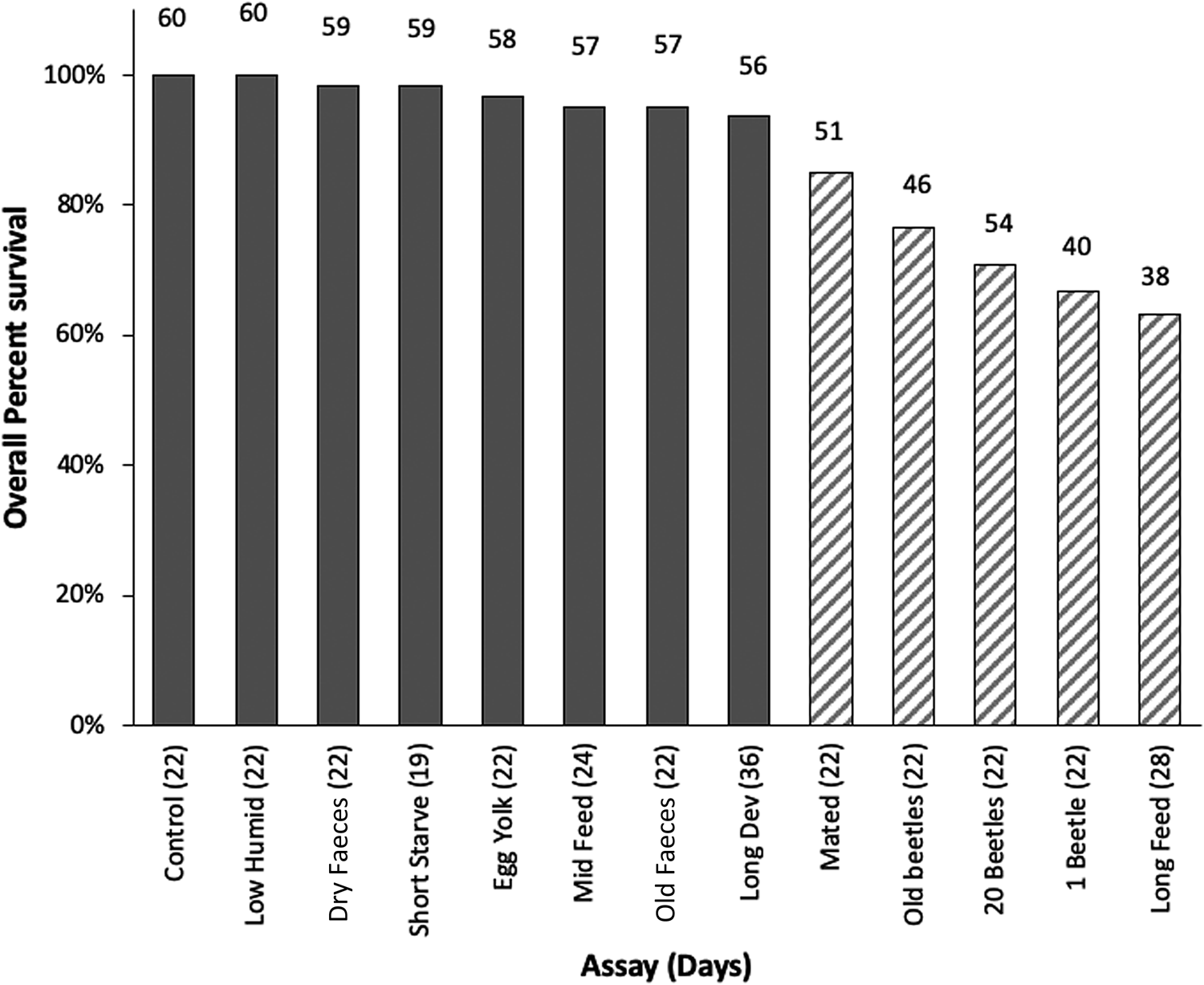
The infection protocol can be taxing on the beetles and some do not survive the process. However, not all experimental groups survived equally. Two assays – the control and the low-humidity feeding – had no deaths amongst the 60 beetles. On the contrary, the two-week starving period was too long for the beetles and none survived. Therefore, this assay was not included in the statistical analysis for this or any other comparisons. While there was no significant difference between sexes in survivorship (χ2 = 0.498, df = 1, P = 0.4802), there was a highly significant difference amongst treatments (χ2 = 126.088, df = 12, P < 0.0001; fig. 2). This fact also contributed to the unequal variances seen in the load data since only surviving beetles contribute to that data. As noted in fig. 2, the total length of the assay did not seem to affect the survivorship.
Survivorship. The relative percent survival over the course of the experiment in each of the assays with the exclusion of the beetles starved for two weeks (with 0% survival). The number of days for each assay are given in parentheses after the assay name. Assays with solid bars did not differ significantly from the control. Those with striped bars were shown to differ from the control by post-hoc testing. The number of surviving beetles is given above each bar.

Several conditions led to significant reductions in survival when compared to the controls: older beetles, feeding time of one week and having a different beetle density. These aforementioned variables that did affect survivorship dealt with the state of the beetles or extensions to the infection protocol. None of the variables related to H. diminuta egg state (dry faeces, old faeces or egg-yolk-enhanced eggs) altered mortality. Additionally, shortening the starving period, a three-day feeding time or increasing the post-infection development time (when the beetles were returned to the flour) had no effect on survivorship.
Prevalence
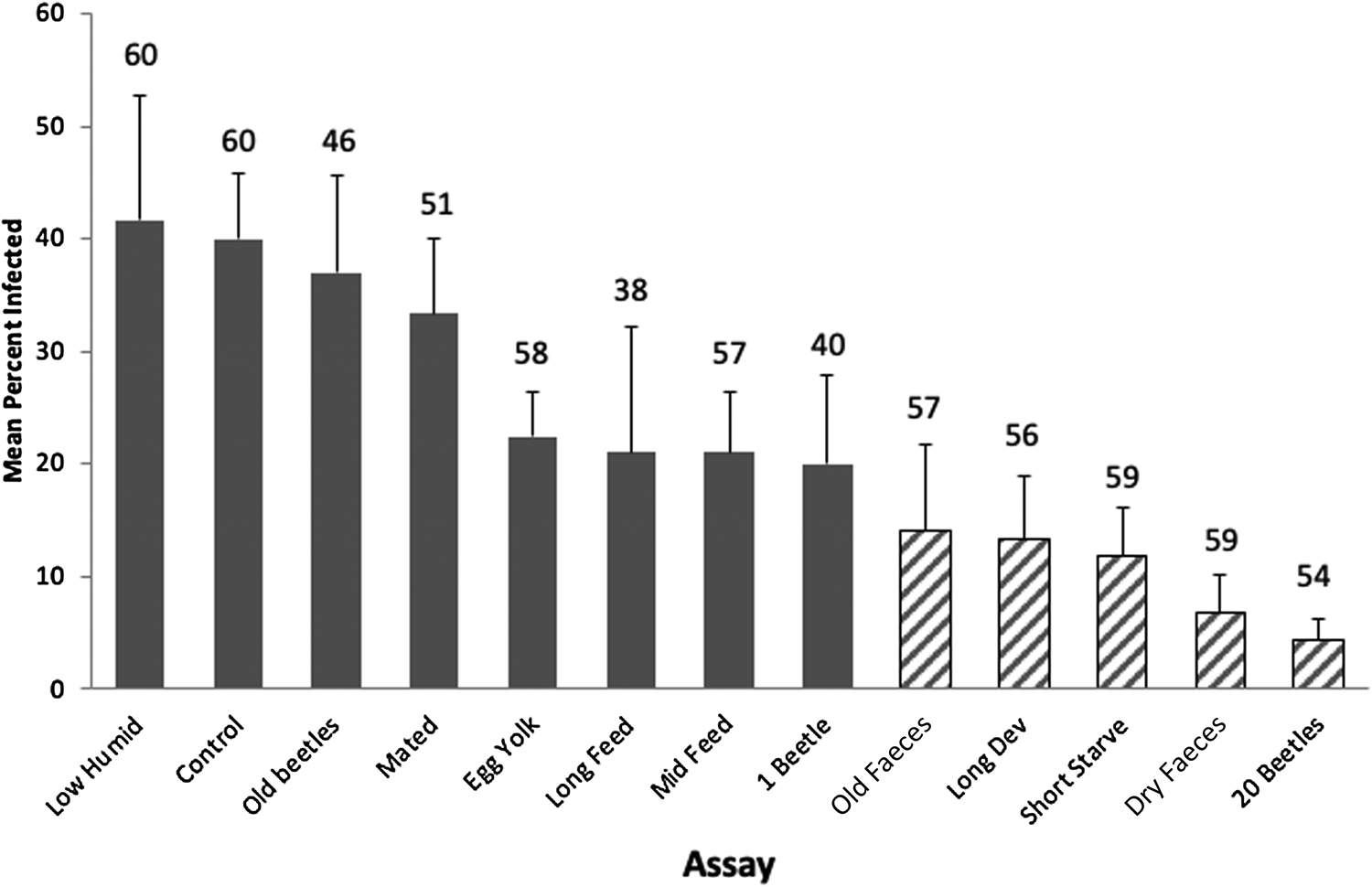
Prevalence (percent of beetles infected) were generally low, with the highest percent infected resulting from low-humidity feeding at only 41.7%. Despite the relatively small range of values, there were significant differences amongst the assays in the percent infected (χ2 = 61.286, df = 12, P < 0.0001) (fig. 3). Comparisons with the control revealed five protocol variations that reduced the prevalence overall: older faeces, a shorter starving time, longer development time, dried faeces and feeding in a higher density of beetles.
Prevalence. The mean percent of beetles infected (having at least one cysticercoid) across the replications in each of the assays. Assays with solid bars did not differ significantly from the control. Those with striped bars were shown to differ from the control via the non-parametric Steel test. Sample sizes are given above each bar.

The greatest difference was seen when 20 beetles fed at one time per Petri dish. Here, infection levels were reduced eight-fold from the control. While most other differences could be attributed to sub-optimal conditions, one surprising result was the reduction of infection when beetles were dissected two weeks beyond the typical allowance for development time.
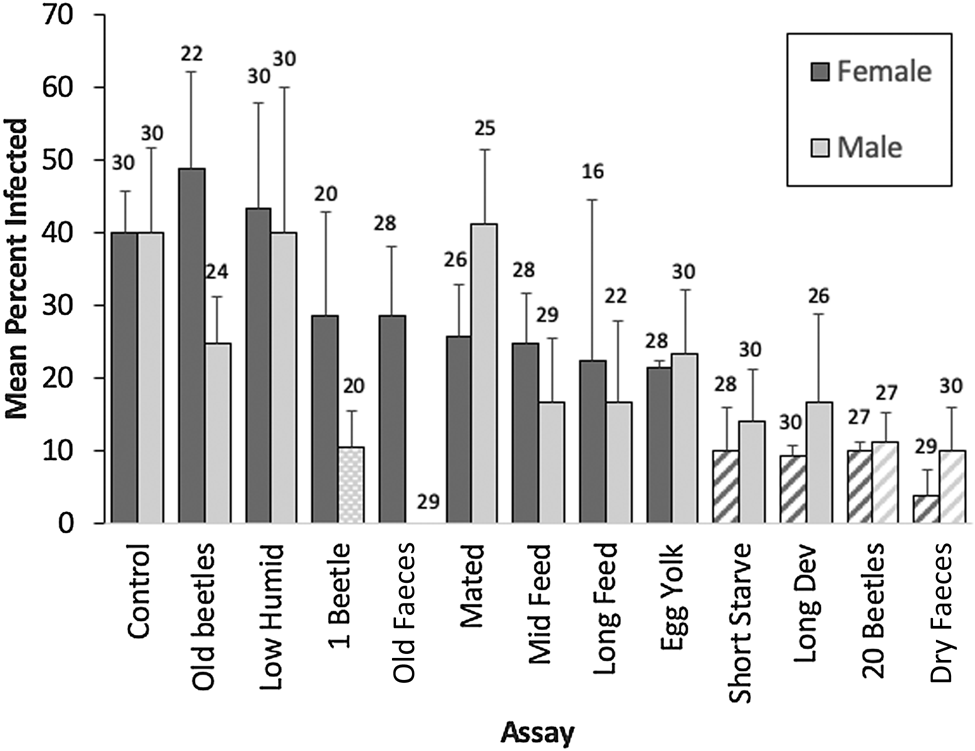
Overall, males and females did not differ in their prevalence of the infection (χ2 = 0.850, P = 0.3566). However, post-hoc testing comparing sexes within assays indicated that, while there was no difference between sexes in the control, sex did affect infection percentage in two assays: older beetles and older faeces (fig. 4). Additionally, when the assays were compared separately by sex, it was found that higher-density beetles and dry faeces differed from the control in both sexes, but shorter starving and longer development were only different from the control in females. There was a trend (P = 0.0695) for a difference between the control and a density of one beetle per dish, but only in males.
Prevalence by sex. The relative percent of beetles infected in each assay sub-divided by sex. Females are dark-grey bars and males are light-grey bars. Assays with solid bars did not differ significantly from the control. Those with striped bars were shown to differ from the control via the non-parametric Steel test. The stippled bar denoting the comparison between the control and isolated male beetles indicates a marginal P-value (0.0695). Sample sizes are given above each bar.

Intensity
The distribution of parasite load (intensity) values was extremely statistically skewed. Also, unequal variances were noted amongst assays (See Figure 5). This is not surprising since only infected beetles are included in load counts; thus, survivorship and infection levels greatly affect this measurement and reduce sample sizes (only 153 infected beetles from the original 780 could be included in this analysis). Additionally, two assays – the dry faeces and the 20 beetles per dish groups – had too few infected beetles to be included in this comparison. Overall, there was a significantly positive correlation between mean intensity and overall variance (r 2 = 0.936, df = 12, P < 0.0001) as has been noted in a previous meta-analysis of studies (Shostak, Reference Shostak2014). Therefore, it is expected that high infection levels will necessarily lead to greater variances in load.
Intensity. The mean cysticercoids per infected beetle in each assay ± standard error of the mean. Assays with solid bars did not differ significantly from the highest level seen in the old beetle group. Those with striped bars were shown to differ via the Steel method. Sample sizes are given above each bar.

The result of the Welch's ANOVA for parasite load determined that there were differences in load (F = 2.235, df = 10, P = 0.034). However, post-hoc testing via the Steel method indicated that there were no differences between the control and other assays. However, further comparisons found that some assays have lower numbers compared to old beetles: low-humidity feeding, altered feeding time, older faeces, mated beetles and a shorter starving time.
None of the statistical testing found any significant differences for parasite load between sexes of the beetles.
Discussion
Our tested variables encompassed several main categories (fig. 1): preparation of H. diminuta eggs, preparation of Tribolium beetles, starvation of beetles, feeding of the H. diminuta eggs to the beetles and subsequent waiting period for the cysticercoids to develop before dissection of the beetles for parasite quantification.
Egg condition
Various protocols have attempted to retain viability of the eggs before presentation to the beetles, including isolation of the eggs from the faecal matter (via the method in Lethbridge, Reference Lethbridge1971b), or using additives such as apple pieces (especially with T. molitor) (Granath, Reference Granath1980; Carver & Hurd, Reference Carver and Hurd1998; Hurd & Ardin, Reference Hurd and Ardin2003; Shea, Reference Shea2005), egg yolk (Yan & Phillips, Reference Yan and Phillips1996) or oatmeal (Hitchen et al., Reference Hitchen, Shostak and Belosevic2009; Shostak, Reference Shostak2012). In the only comparative study, extraction from faeces reduced infection, while addition of eggs yolk increased success (Yan & Norman, Reference Yan and Norman1995). Possibly due to the low infection rates, the addition of egg yolk did not significantly alter infection levels in our study.
However, consistent with previous studies (Keymer & Anderson, Reference Keymer and Anderson1979; Keymer, Reference Keymer1982), letting the faeces dry for one week greatly reduced, but did not totally eliminate, the ability of the parasite to infect the beetles. Even if the eggs remain in the faeces, as represented in our ‘Old Faeces’ assay, the levels of infection decrease (figs 2 and 4). Thus, the results suggest using faeces immediately is preferential in any protocol, while the benefit of additives may be negligible.
Beetles
Virtually every previous study segregates their analyses by the sex of the beetles. Therefore, there is an abundance of data sets on the differences between sexes (summarized in Shostak, Reference Shostak2014). However, there are very few consistencies in the previous results. Our study supports this variability, especially in prevalence, as males and females demonstrated contrary results depending on the variable being measured (fig. 4). Therefore, there can be no expectations for differences in sex in any particular study.
Trade-offs between immune system activity and reproduction has been shown previously with Tribolium species and their parasites (Pai & Yan, Reference Pai and Yan2003; Zhong et al., Reference Zhong, Pai and Yan2005; Shostak et al., Reference Shostak, Walsh and Wong2006; Hangartner et al., Reference Hangartner, Sbilordo, Michalczyk, Gage and Martin2013, Reference Hangartner, Michalczyk, Gage and Martin2015; Kerstes et al., Reference Kerstes, Berenos and Martin2013; Kerstes & Martin, Reference Kerstes and Martin2014; Shostak et al., Reference Shostak, Van Buuren and Cook2015). The mating status of the beetles was shown to have an effect on both survivability and infection intensity in our study. Mated beetles' mortality was significantly higher than the unmated beetles used in the control. With the trade-off theories, it follows that mated beetles, when confronted with the metabolic challenge of an infection, will have a shortened lifespan. The percent of beetles infected was not changed by reproductive status, but the parasite load was significantly lower. This seems to go against the trade-off theories. However, studies have shown that parasite load is inversely proportional to fecundity (Keymer, Reference Keymer1980; Maema, Reference Maema1986). Some have suggested that as mated females produce more eggs than unmated females (Ridley, Reference Ridley1988; Drnevich et al., Reference Drnevich, Papke, Rauser and Rutowski2001), the ‘Mated’ category could see a reduction in the number of cysticercoids as the beetle eggs crowd the cysticercoids (Soltice et al., Reference Soltice, Arai and Scheinberg1971; Shostak et al., Reference Shostak, Walsh and Wong2006, Reference Shostak, Walsh and Wong2008). However, others have suggested that it is not the physical space, but rather allocation of resources, as dictated by haemolymph proteins, that explains this trend since large host species such as T. molitor do not have the space limitations of Tribolium species (Hurd & Arme, Reference Hurd and Arme1986; Maema, Reference Maema1986; Cole et al., Reference Cole, Eggleston and Hurd2003).
The age of the beetles in some previous studies has been found to have an effect on the infection as well (Kelly et al., Reference Kelly, O'Brien and Katz1967; Keymer, Reference Keymer1982; Shostak, Reference Shostak2008; Shostak et al., Reference Shostak, Walsh and Wong2008). All of these studies indicated that the prevalence or intensity of the infection was reduced with age of the beetle host. This was not seen in our assay, although the older beetles did not survive the process of infection as well. However, the older beetles did demonstrate a significant difference in prevalence between males and females, with females having twice the percent infection than males. This is contrary to these previous studies. In fact, previous work showed that older females had a greater reduction in prevalence than males (Shostak et al., Reference Shostak, Walsh and Wong2008). This opposite result may, in part, be due to the assay-dependent variability between sexes, but also, in part, because the infection protocols differed greatly between these two studies, especially in how the H. diminuta eggs were provided to the beetles.
Starvation
The timing of each stage of the protocol is also very important in determining the ultimate levels of infection. The starving stage is not only critical in regard to infection success, but also considering the survivorship to the end of the protocol. Obviously, two weeks of starvation is too long, while there is no difference in survivorship between three days and the control of one week. However, while most protocols starve for a matter of days, there is a significant increase in both prevalence and parasite load when the starvation time is increased to one week. This may be species-dependent since a fast of as little as 24 h can lead to successful infection in T. molitor (Pappas et al., Reference Pappas, Marschall, Morrison, Durka and Daniel1995; Shea, Reference Shea2005), but Dunkley & Mettrick (Reference Dunkley and Mettrick1971) suggested that T. confusum need a minimum of four days, probably due to the fact that Tribolium have lower activity levels as well as a lower metabolic rate. Therefore, increasing starvation time to one week not only compromises survival, but also leads to increased infection.
Since starving the beetles requires removing them from their flour environment, studies have suggested that humidity may play a role in egg viability (Voge, Reference Voge1959a, Reference Vogeb; Maki & Yanagisawa, Reference Maki and Yanagisawa1987; Maya et al., Reference Maya, Ortiz and Jimenez2010). Previous studies on the humidity at which the beetles are kept during the process suggest that high humidity can cause developmental problems with the cysticercoids (Voge, Reference Voge1959a, Reference Vogeb). We hypothesized that completing the starving step at low humidity may increase infection levels since the beetles may try to augment lost water by increased feeding. However, in our study, completing the protocol in low humidity resulted in virtually the same survivorship and infection levels.
Feeding
While less taxing to the beetles than the starving stage, the feeding stage timing is also critical to infection levels. Increasing the feeding time from 24 to 72 h did not affect survival; however, one week of feeding resulted in significantly increased mortality. This is surprising since increasing starvation time had less of an effect on survivorship than increasing feeding time. However, this stage is after the beetles have already been stressed during the starvation step. Yet, no matter the increase in feeding time, prevalence did not differ among the treatments. Rather, a decrease in intensity occurred, most likely due to the reduction in parasite egg viability. This result concurs with the previous finding that a 24 h feeding time is satisfactory (Shostak, Reference Shostak2014).
Another variable that has often been studied during the feeding stage is the effect of beetle density. While a greater mortality at high beetle densities can be easily explained by the secretion of their benzoquinone defence chemicals, which are known to be fatal to the beetles themselves (Pappas & Morrison, Reference Pappas and Morrison1995; Yezerski, Reference Yezerski, Raikel, James, Christiansen, French-Constant and O'Brochta2001; Yezerski et al., Reference Yezerski, Gilmor and Stevens2000, Reference Yezerski, Ciccone, Rozitski and Volingavage2007), higher mortality in solitary beetles cannot be readily explained. Although there is a plethora of studies on the effects of population density on numerous variables in Tenebrionid species, there are no studies on the longevity of single beetles.
The greatest difference was seen when 20 beetles fed at one time per Petri dish. Here, infection levels were reduced eight-fold, possibly due to the number of eggs available per beetle or feeding competition. There have been several studies concerning the ratio of beetles to available parasite eggs (Dunkley & Mettrick, Reference Dunkley and Mettrick1971; Keymer & Anderson, Reference Keymer and Anderson1979; Keymer, Reference Keymer1981, Reference Keymer1982). Generally, these studies found, if anything, an inverse relationship between infection levels and beetle density. However, in these studies, this ratio was controlled by extracting the eggs from the faeces, which may reduce the viability of the eggs (Yan, Reference Yan1997). Although this study did not account the number of available eggs, the faecal matter was provided consistently and all from the same stock, but the number of beetles per feeding arena was varied. However, our results did mirror these previous findings in that our densest Petri dishes (20 beetles per dish) had the lowest infections. In fact, the infection level was so low that a prevalence value could not be included. Surprisingly, in males, having a single beetle per dish also resulted in a significant reduction in percent infected, although the parasite load remained the same as the control. The only support for this finding is a study in which the related species, T. molitor, had males that avoided infected faeces (Pappas et al., Reference Pappas, Marschall, Morrison, Durka and Daniel1995). It is not clear why this effect would be more prevalent with a single beetle infection versus multiple beetle infections. However, it should be noted that varying beetle densities did have a significant effect on the survivorship of the beetles towards the end of the study. Both increased and decreased densities reduced survivorship. Increased mortality in higher densities is easily explained by the effects of the benzoquinones produced by these beetles, which are toxic to the beetles, especially when they are housed without flour to absorb them (Pappas & Morrison, Reference Pappas and Morrison1995; Yezerski, Reference Yezerski, Raikel, James, Christiansen, French-Constant and O'Brochta2001). However, no studies have addressed survivorship of an isolated beetle. It should be noted that these beetles died while removed from their normal flour environment and, therefore, a study of survivorship as it relates to beetle density would provide little information about the beetles' natural ecology.
Development
The final stage of the process, the development of the tapeworm's cysticercoid within the beetle, was also considered. This process is thought to take approximately two weeks (Lethbridge, Reference Lethbridge1971a). This optimum is visualized by an increase in the number of cysticercoids to a plateau at two weeks (Keymer, Reference Keymer1982). This assumption is contrary to our findings when we found that doubling the development time did not indicate a plateau, but showed a reduction in prevalence, but not intensity. This suggests that some beetles may be mounting a defence to the parasite and clearing the infection. While previous studies have suggested that there is little to no defence against H. diminuta from Tribolium species (Heyneman & Voge, Reference Heyneman and Voge1971; Lackie, Reference Lackie1976; Richards & Arme, Reference Richards and Arme1985), a more recent study has suggested that an immune reaction is possible in this particular host–parasite relationship (Hitchen et al., Reference Hitchen, Shostak and Belosevic2009). It is possible that this response is also genetically variable and may not be detected equally in all strains or individuals. The beetles used in this study were highly inbred, which reduced genetic variability, but also may have conferred susceptibility traits not documented previously.
Other untested variables
One variable that was not tested was the temperature at which the beetles are held. Our choice of 29°C was based on multiple previous studies (Turner & Voge, Reference Turner and Voge1956; Voge, Reference Voge1959a, Reference Vogeb; Dunkley & Mettrick, Reference Dunkley and Mettrick1971; Soltice et al., Reference Soltice, Arai and Scheinberg1971) and our own personal experiences. However, these studies report success in temperature ranging from 23°C to 34°C. Further study including and beyond this range is warranted.
A very important factor to consider is the species of the intermediate host. In fact, T. confusum has the lowest infection intensities of all possible hosts, even less than its smaller sister species Tribolium castaneum (Oldham, Reference Oldham1931; Soltice et al., Reference Soltice, Arai and Scheinberg1971; Yan & Norman, Reference Yan and Norman1995). With the largest reported number of cysticercoids in this species at only 29, compared to well over 1000 in Tenebrio species, the room for variability is very limited. Therefore, statistical power is reduced for comparisons in this species. Completion of similar studies with other intermediate hosts may be more informative as to the relative strengths of each variable.
Ranges of the number of parasites per host varies greatly with intermediate host species (Evans & Novak, Reference Evans and Novak1976; Rau, Reference Rau1979; Hurd & Arme, Reference Hurd and Arme1987; Yan, Reference Yan1997; Hurd & Ardin, Reference Hurd and Ardin2003; Shea, Reference Shea2005; Worden & Parker, Reference Worden and Parker2005). Additionally, a high variance between individual beetles in several studies have been noted (Shostak, Reference Shostak2014). It is unknown which specific variables led to the generally low infection levels in this study, although the choice of using one particular recombinant inbred line may have contributed. A repeat of the study using several inbred lines (such as recombinant inbred lines we created previously (Yezerski et al., Reference Yezerski, Stevens and Ametrano2003)) could further elucidate relationships amongst the variables as well as the genetic components.
In the end, it is not surprising that the control assay had not only the highest survivorship, but also one of the highest infection levels, as well as one of the highest infection intensities. This assay represents the culmination of trial and error on the variables tested in this study to reach what researchers in this field consider an optimum protocol. However, the individual effects of each variable are easier to compare when measuring them in this context and more powerful than meta-analysis. For the most part, the general effects as reported in previous studies are supported in this study; however, the relative values provide comparisons of the strength of the variables that has not been shown before. Further multi-variable studies that include some of the missing components in this study, including different host species, incubation temperatures and genetics, are recommended.
Acknowledgement
The authors would like to thank Tammy Tintjer PhD for her comments and review of this manuscript.
Financial support
This study was supported by the University of Vermont Biology Department.
Conflicts of interest
None.