


Introduction
Koskarlı Cave was discovered in 2019 (Çalışkan Akgül & Dinçer Reference Çalışkan Akgül and Dinçer2021) and systematic excavations began in 2024 under the joint direction of the Trabzon Museum and Karadeniz Technical University. The cave is situated 40km south of Trabzon, in the Söğütlü (Kale) Valley, and lies 24m above the Söğütlü (Galanima-Kale) Creek—an important watercourse in the district (Figure 1). The cave stands at 1030m above sea level and falls within the Eastern Pontides segment of the Sakarya Zone tectonic unit (Okay & Tüysüz Reference Okay and Tüysüz1999). The cave is a naturally formed cavity shaped through physical weathering processes and the lithic assemblage exhibits typological, technological and chronological attributes consistent with an Epipalaeolithic (c. 12 900–12 000 cal BC) attribution.
a) Location of Koskarlı Cave; b) view of the general landscape surrounding the cave (figure by authors).

In Anatolia, Epipalaeolithic research is anchored by the stratified lithic sequences from Öküzini Cave (Antalya), which provide a key regional reference for technological and chronological discussions (Kartal Reference Kartal2009; Yalçınkaya Reference Yalçınkaya and Kartal2023) and evidence from sites such as Direkli Cave and Pınarbaşı B, which suggest the deliberate organisation of space (Baird et al. Reference Baird2013; Erek Reference Erek2017). Such research is typically concentrated in the south. New excavations at the Koskarlı Cave offer the opportunity to investigate human occupation across the Late Pleistocene–Early Holocene (c. 12 900–12 000 cal BC) transition in the eastern Black Sea region.
The 2024 expedition
The first season of the expedition focused on three areas (Figure 2a): the trenches within the cave (area A; Figure 2b), a lateral section to the east (area B; Figure 2c) and runoff deposits, which were disturbed by illegal excavations, where the path leading to the cave entrance merges with the modern road in the south (Figure 2a).
Excavation areas in 2024: a) overview; b) area A; c) area B (figure by authors).

A total area of 16m2 was excavated in the main trench in area A (Figure 3a). Large ceiling-fall blocks were encountered just below the surface, particularly in the west and south. An upper ashy deposit (0.20–0.60m thick) consists of stony debris mixed with organic material, including dung and modern refuse, and contains a disturbed assemblage combining Epipalaeolithic and Middle Palaeolithic (c. 200 000–45 000 BC) artefacts, likely due to post-depositional processes and recent disturbance (Figure 3b).
a) Plan of the 2024 excavation trench with the positions of recorded features; b) north section of square L19–M19; c) north section of square N19–O19; d) stratigraphy of the northern profile (figure by authors).

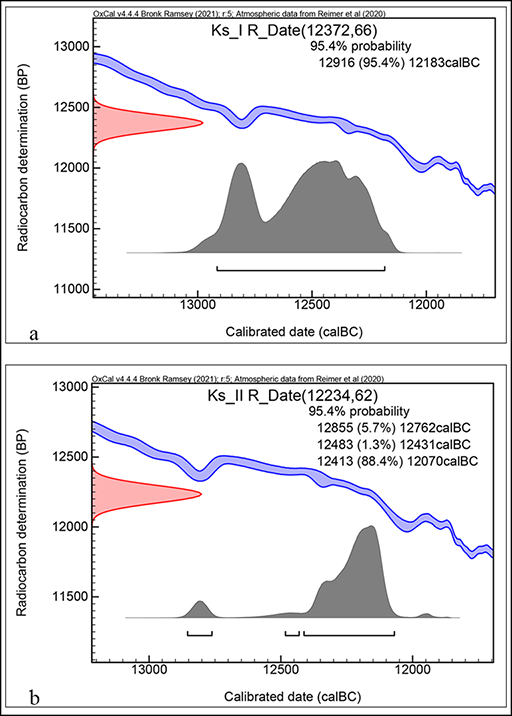
Below this mixed layer, a second deposit (0.20–0.40m thick) represents the earliest intact Epipalaeolithic occupation. It consists of fine grit, ash and carbonised material, and includes burnt sediment and thermally altered flints (Figure 3c & d), suggesting an in situ fireplace (FP1). Radiocarbon determinations obtained from bone and charcoal samples place this layer at the end of the thirteenth millennium cal BC (TÜBİTAK-4157: 12 916–12 183 cal BC at 95.4% confidence; TÜBİTAK-4075: 12 413–12 070 cal BC at 88.4% confidence; C-1/2024; Figure 4a & b). The lithic assemblage supports these dates, although ongoing excavations should provide a better understanding of the cultural context.
Radiocarbon determinations for a) charcoal sample TÜBİTAK-4157; b) bone sample TÜBİTAK-4075 (figure by authors).

In area B, excavations targeted a stratigraphic cross-section in compact sediments; only a few isolated lithics were recovered and no cultural layers were identified (Figure 2c). In the southern runoff deposit, systematic scraping and sieving yielded diagnostic Epipalaeolithic artefacts (lunates, backed blades, cores and points) and faunal remains.
The finds
The 2024 lithic assemblage comprises flint in various colours (predominantly red, green and yellow), obsidian and a small number of blades made from dacitic rocks. Flint and obsidian sources have not yet been identified. Preliminary analysis indicates a blade- and bladelet-based industry. The abundance of cores, crested blades and knapping debris suggests on-site production of tools. Cores are predominantly unipolar prismatic blade and bladelet cores (narrow and broad fronted), with single-platform and opposed-platform variants, as well as sub-pyramidal cores (Figures 5a–b & 6a–b).
Selection of artefacts: a & b) cores; c & d) end-scrapers; e) microgravette point; f) pointed backed blade; g) lunate; h) lunate with bipolar backing; i & j) lunates with Helwan-type retouch; k) grooved antler pendant; l) animal-tooth pendant (figure by authors).

Drawings of selected artefacts: a & b) cores; c) microgravette point; d) pointed backed blade; e) lunate; f) lunate with bipolar backing; g & h) lunates with Helwan-type retouch (figure by authors).

The chipped-stone tool assemblage includes end-scrapers (Figure 5c & d), notched and denticulated pieces, backed blades and bladelets, microgravette points (Figures 5e & 6c), pointed backed blades (Figures 5f & 6d), perforators, burins and lunates (Figure 5g–j & 6e–h). Some lunates show bipolar backing (Figures 5h & 6f), while four specimens display Helwan-type invasive bifacial retouch (Figures 5i–j & 6g–h). Overall, the lithic material is technologically homogeneous, indicating a consistent approach to blank production and tool manufacture. On technological and typological grounds, the assemblage can tentatively be attributed to the Late Epipalaeolithic (c. 13 000–10 000 BC), and the presence of lunates provides additional support for this assignment. In comparative terms, the blade/bladelet-based reduction sequence and microlithic components, including lunates and backed pieces with occasional Helwan-type retouch, show close parallels with Epipalaeolithic industries in Anatolia (e.g. Öküzini, Direkli, Eşek Deresi) and the Levant (e.g. Kebara, El-Wad, Hayonim) (Bar-Yosef Reference Bar-Yosef1998; Erek Reference Erek2012; Kartal Reference Kartal2009; Makarewicz Reference Makarewicz and Eren2012; Yalçınkaya Reference Yalçınkaya and Kartal2023; Gopher et al. Reference Gopher2025). Large-scale production and use of microlithic tools, including lunates, also occur in Late Pleistocene Caucasus sequences (e.g. Dzudzuana layer B, Apiancha, Satanai; Bar-Yosef et al. Reference Bar-Yosef2011; Golovanova et al. Reference Golovanova2014; Korkia Reference Korkia1990).
Identification of a grooved antler fragment and a perforated animal tooth (Figure 5k & l) indicate the use of personal adornment. Faunal remains and mollusc shells, likely of terrestrial origin, were recovered and await species level identification. Comprehensive faunal and botanic analyses are planned for forthcoming seasons.
Conclusion
The ongoing excavations at Koskarlı Cave present a key opportunity to examine the dynamics of human occupation during the transitional period between the Late Pleistocene and Early Holocene. As the first systematic investigation of an Epipalaeolithic context in the eastern Black Sea region, this site holds considerable potential to enhance our understanding of the cultural, technological and subsistence practices and mobility of prehistoric communities in this understudied area. Positioned at a geographically strategic junction between Anatolia and the Caucasus, Koskarlı offers a valuable framework for exploring patterns of regional interaction, technological transmission and environmental adaptation. Continued interdisciplinary research at the site is anticipated to yield significant insights into the broader processes of cultural and ecological transformation that influenced the evolution of hunter-gatherer societies during the terminal Pleistocene.
Acknowledgements
We thank the Ministry of Culture and Tourism of Türkiye for granting the excavation permit, the field team for their devoted work, Dr Erkan Yılmaz for preparing the map and Nursena Paslı (postgraduate student) for producing the cave plan and section. We thank the anonymous reviewers and members of the editorial team for helpful comments on an earlier draft.
Funding statement
This work was supported by the Scientific Research Projects Coordination Unit of Karadeniz Technical University (Project No. SBA-2024-15946).
Author contributions: CRediT categories
Hülya Çalışkan Akgül: Data curation-Equal, Funding acquisition-Equal, Investigation-Lead, Project administration-Equal, Writing - original draft-Equal, Writing - review & editing-Equal; Sidar Gündüzalp: Visualization-Equal, Writing - original draft-Equal, Writing - review & editing-Equal; Raif Kandemir: Investigation-Equal, Writing - original draft-Equal, Writing - review & editing-Equal; Didem Turan: Data curation-Equal, Investigation-Equal, Visualization-Equal, Writing - original draft-Equal; Hasan Umut Kıvrak: Investigation-Equal, Writing - original draft-Equal; Guram Chkhatarashvili: Data curation-Equal, Investigation-Equal, Visualization-Equal, Writing - original draft-Equal, Writing - review & editing-Equal; Levent Alnıak: Funding acquisition-Equal, Investigation-Equal, Project administration-Equal, Writing - original draft-Equal.




 Open access

