

A special editorial in the one hundredth volume of Ghana’s Joy-Ride makes striking claims about the effects of that 1980s literary magazine on its readership. In an explicit address to the reader starting on the front cover, the editors present their text as an affective phenomenon for every potential consumer: an “ultra-slick edition . . . vibrating in your hand with power and beauty and life.”Footnote 1 The editorial goes on to describe the power of this aesthetic form, reporting that, since its inception, the magazine had “put the sunshine in the life of hundreds of thousands of Ghanaians and brought hope into people who were on the verge of a nervous breakdown.”Footnote 2 Though this language seems hyperbolic, the editors do not blindly congratulate themselves; rather, they acknowledge that several “equally interesting magazines” preceded Joy-Ride. But they measure their exceptional success quantifiably: the periodical was “the most consistent, persistent and popular magazine” in Ghana at that time, probably 1989.Footnote 3 It was the first to reach one hundred volumes—an “unrivalled feat” that, to the editors, made that volume worthy of celebration as a “historical document.”Footnote 4 The strength of their achievement is made plain with even a glance at the socioeconomic and political context of Joy-Ride’s publication—a time when the forced austerity measures of a military government, a string of natural disasters, and the mass repatriation of Ghanaians from Nigeria made all facets of life precarious and all kinds of publishing scarce.Footnote 5 That Joy-Ride’s readers held up their demand for, and patronage of, the magazine despite severe economic constraints indicates that the periodical offered them something outstanding.
In drawing attention to the material text with its visual appeal (“ultra-slick”), its haptic energy (“vibrating in [the] hand”), and its moral influence (generating hope), the hundredth-anniversary retrospective volume of Joy-Ride raises essential questions about the relationship between this popular text’s structure and its ethical impulse. At a broader level, the magazine prods us to consider how image-intensive literary periodicals in postcolonial contexts engage their readerships, and, in particular, how the multimodality of such texts may be affective and, thus, culturally effective. Reflecting on theories of affective embodiment and recent comics scholarship, I argue that Joy-Ride attracts a wide and avid readership by transposing the sensational aesthetics of oral narrative performance forms (especially Ananse storytelling and Concert Party theatre) into the printed text. A brief history of popular reading in Ghana and of the political conditions of the 1980s will underscore Joy-Ride’s singular offerings to its readers, while the magazine’s most influential comic strip, Super Mugu Yaro, will illustrate how the hybrid genre’s appeal to a wide audience of varying literacy competencies was so meaningful in this period. Finally, I show that in collaboration with other popular artists, the magazine’s managing director, George Appiah Prah, translated performed genres into print ones—a translation that demonstrates an editorial intention to deliver to Joy-Ride’s readers a print experience infused with the heightened aesthetics of Ghanaian popular performance.
Joy-Ride and Sensational Aesthetics
In their editorial, Joy-Ride’s producers immediately attribute the magazine’s success to the popularity of their graphic-literary texts. It is not accidental that the first three text to which the editors say they owe their historical “feat” are two comic strips—Super Mugu Yaro and Kwame Peter, featuring an “international 20th Century Robin Hood” and a nationalist defender of the “home-made drink” ogloglo, respectively—as well as the serialized novella illustrated with photographed stills, Akwele the Maidservant, a story of the love affair between a man and his wife’s housemaid.Footnote 6 Image-intensity is what sets this magazine apart from other Ghanaian popular magazines. Visual images, photographic and cartoon, comprise approximately half of the magazine’s content in a range of genres: several comic strips, most of them multipage and often serialized; the photonovel Don’t Rush, a comedy about the topsy-turvy relationship of a contemporary urban young couple; current events accounts such as Ghana’s Sefwi Bekwai ritual murder case of 1987;Footnote 7 local fashion displays; popular culture news; and advice columns, jokes, and pen-pal forums. Conspicuous by its absence is the almost complete lack of advertising, which stands in sharp contrast to the 1970s best-selling Ghanaian magazine Pleasure, which sustained its two-year run by doubling its length to forty pages, half of which were advertising.Footnote 8 Joy-Ride’s endurance, like its content, was sensational.
Sensational aesthetics, in my formulation, refers to literary and visual semiotic practices that mnemonically elicit affective associations with a readers’ lived, sensory experience of cultural texts—or, put simply, to the way that texts stimulate deep feelings attached to past lively experiences in public culture. My notion of sensational aesthetics finds affinity with Ben Highmore’s recuperation of aesthetics as it was originally theorized by Alexander Gottlieb Baumgarten in the eighteenth century: as a mode of inquiry into the entangled forces of perception, sensation, affect, and emotion. In Highmore’s words, it is an inquiry into “the way the sensual world greets the sensate body” and “the affective forces that are generated in such a meeting.”Footnote 9 Conceived within the Ghanaian popular cultural context, my notion of sensational aesthetics is specifically concerned with how West African popular arts are experienced bodily, with how new textual instances aesthetically revive those bodily memories, and with what implications. In this respect, the concept is most closely aligned with Birgit Meyer’s notion of “aesthetic formations,” which designates communities that are generated by people’s shared sensorial experience of a common nexus of cultural forms. Meyer proposes that contemporary works of imagination in Ghana gain their valence and meaningfulness through the intersection of their imagery with other cultural texts that are “felt in the bones.”Footnote 10 I am proposing that the “power and beauty and life” of a text like Joy-Ride lies in its aesthetic of immediacy and in its invitation to the reader to indulge in the recognizable and vital life-world of its narratives. In the postcolonial period of structural adjustment, when Ghana’s authoritarian government sought to avoid social ferment by constraining free expression, Joy-Ride’s texts modeled through its sensational aesthetics a vibrant counter-public for its readership. Pertinently, the magazine appealed to the reader through its hybrid content of intersecting verbal and visual material.
Recent interventions into the field of text-and-image studies by comics theorists will also guide this inquiry into the postcolonial popular periodical. Comics theory orients us to the mechanics of reading verbal-visual hybrid texts, praxis that is applicable to all of Joy-Ride’s graphic-narrative material. More importantly, comics scholars show the implications of this reading, which is informed by the “dual discourse of word and image,” to use Stuart Stillars’s words.Footnote 11 I am especially interested in the way that such hybrid texts can act on a reader in terms of drawing the reader into an embodied experience, as detailed in works by Hilary Chute, Tom Gunning, and Katalin Orbán; I will elaborate on their ideas following. The case of Joy-Ride, however, also exposes deficiencies in the scholarship on graphic literature for accounting for the haptic-aesthetic competencies that postcolonial readerships may bring to bear on a text’s meaning.
Literary-Political Perspective on Joy-Ride
A brief discussion of the popular literary and political context out of which Joy-Ride grew will provide perspective on what made the magazine exceptional for Ghanaian readers. It is well understood that Kwame Nkrumah, the first prime minister of independent Ghana and advocate of socialist governance, embarked upon a great nationalist program of promoting and funding education for the newly independent nation-state. This federal and nationalist investment in education created a strong demand for, and production of, literature of all kinds. In the early postcolonial period, when secondary and tertiary education was heavily subsidized, the beneficiaries of higher education formed a substantial base readership for lengthy works of fiction. As everywhere in sub-Saharan Africa, in Ghana the novel was, and continues to be, the literary genre par excellence for asserting a complex representation of cultural identity in the global arena. Ghana’s popular writers from the 1940s to 1970s focused on two main genres, the literary magazine and pamphlet literature they categorized as the “novel” or “novelette”—a title that reveals the writers’ intention to piggyback on the novel’s social prestige by borrowing the terminology associated with the genre. Priebe uses the term novelette to separate the genre from Nigeria’s Onitsha chapbooks, “pamphlets of rougher literary quality and printing than what we find in Ghana.”Footnote 12
But for its readership, the Ghanaian novelette maintained the attraction of its Nigerian precursor, namely, that the genre represented, and invited readers to negotiate, the shifting social norms and ideals that accompanied their new political status as independent from colonial rule and their increasing modernization through Western influence.Footnote 13 As Stephanie Newell describes in her now-classic study of Ghanaian popular fiction, the pre-independence-era pamphlet targeted an aspirational reading public and met their fascination with, and fantasy of belonging to, a British-defined modern culture by offering them narratives that transposed a British cultural lifestyle into the Ghanaian context.Footnote 14 Newell duly notes the class gap between the novelettes’ elite characters and their readers, mostly young adults who have been educated locally to the secondary school level.Footnote 15 What bears emphasizing is that even as the novelette and literary magazine were popular publications, their readers belonged to a Western-educated and upwardly mobile group well above the social status of the average Ghanaian, with considerably different preoccupations. By comparison, in Emmanuel Obiechina’s view, the Onitsha chapbooks appealed to the masses (a reading public whose formal education was, on average, more minimal) precisely because the popular form was more unruly in its negotiation of postcolonial cultural identity. In Obiechina’s words, the genre’s “sensationalizing” tendencies exhibited its readership’s “partak[ing] of the humour, the informality and the openness of life”—one might say, people’s everyday performance—in the marketplace.Footnote 16 As I will submit shortly, with Joy-Ride, Ghana’s popular literary culture would find its way back to the exuberance on display in Onitsha market literature.
The category of the relatively well-educated reader, meaning, in the Ghanaian postcolonial context, those with a secondary school education, swelled in numbers in the early years of independence. Even when Nkrumah’s government deteriorated amid allegations of financial mismanagement and political corruption and after Nkrumah was overthrown in a 1966 military coup, suspected to be orchestrated by the CIA,Footnote
17
these readers kept up the demand for the novelette, a genre well suited for tackling questions of public morality in the confusing aftermath of Nkrumah’s demise in terms of personal morality. Ghana’s literary magazines did not fare as well, and by the 1970s, most magazines were unable to survive longer than an issue or two; even James Moxon’s Pleasure, which had held onto a solid readership for almost two years by offsetting production costs with advertising, in the end was not able to set a price point that readers would meet.Footnote
18
The women’s magazine
 $$\raster="rg1"$$
Sima stands as the one exception, surely in part, as Stephanie Newell argues, because it targeted a very specific audience of middle-class women with an urgent and vested interest in challenging “popular gender ideologies.”Footnote
19
But also, the less elitist rhetorical style of the magazine, which Priebe remarks upon, must also account for the magazine’s “popular appeal.”Footnote
20
Even so, at the end of the 1970s, Richard Priebe rang the death knell for the Ghanaian novellette and literary magazine and, for moving into the 1980s, identified newspapers as the print medium with the best chance of surviving paper shortages and elevated printing costs.Footnote
21
On most counts, he was right. In fact, the subsequent period of the early 1980s was harsher than Priebe could have imagined, marked as it was by catastrophic drought, forest fires, the repatriation of a million Ghanaians from Nigeria, the unprecedented flight of the intellectual and educated classes, massive unemployment, a sudden fall in international terms of trade, and the authoritarian rule of Flight Lieutenant Jerry John Rawlings’ Provisional National Defense Council (PNDC), which implemented the austerity measures of the Bretton Woods’ economic reform policies with a brutally strong arm.Footnote 22 The neoliberal encouragement of foreign imports over domestic exports toward the end of the 1980s created a disproportionate volume of foreign inflows, including those of popular art commodities. With the devaluation of local currency, the price of paper and printing materials—along with everyday essentials—sky-rocketed. Publication of all kinds slowed drastically. While describing the barely tolerable daily life under the watch of the PNDC’s “revolutionary” army, Wilhelmina Prah, the wife of Joy-Ride’s managing director, summed up the state of the literary scene: “You can’t even open your mouth to talk. How can you write?”Footnote 23 Popular publishers and audiences were in the worst position in decades for producing or buying local literature. Yet, unexpectedly, in this period of worsened political, social, and economic conditions, Ghanaian popular literature was effectively revived in the magazine form with Joy-Ride.
The PNDC’s messy enforcement of privatization came with certain benefits. First of all, the eased foreign trade restrictions did result in imports of new print technologies, which provided Joy-Ride’s publisher, the George Appiah Prah Organization (GAPO), and the many publishers who followed after him with opportunities for modernizing print media in Ghana. Second, reforms to international trade also opened the floodgates to imports of foreign media (American and Indian popular movies, Asian martial arts films, American and European magazines, pop music, romantic fiction, photonovels, and so on) and more modern media technologies (handheld video recorders, VHS players, print machinery, and the like). As Carmela Garritano explains, popular artists used these new technologies and networks for disseminating foreign media to create and broadcast their own interpretations of Ghanaian experience, distinct from the protected image of “authentic” Ghana that had been cultivated in the Nkrumah era.Footnote 24
Readers’ new familiarity with, and fondness for, American and European photonovels and comics was especially influential on the development of West African magazine culture. From the 1960s into the 1980s, prior to the introduction of home video technology, the photonovel genre, a type of comic book illustrated with photographic stills and dialogue balloons, was highly popular throughout Africa, as it was in Europe and North America. Continentally circulating weeklies such as African Film, a Drum magazine publication, responded to the readership’s enthusiasm for the trendy, imported genre with serials such as The Spear, featuring a black James Bond type named Lance Spearman.Footnote 25 Imported comic books like Marvel Comics and Tintin also circulated hotly at the time from the small minority who could afford them to the friends or associates who managed to borrow them.Footnote 26 The flashy form of either of these English-language graphic narrative genres would label someone who held the text in hand as “modern.”Footnote 27
Joy-Ride itself very likely took inspiration from Nigeria’s popular comic magazines that sprung up in the late 1970s and also circulated in Ghana, such as Fun Times of the Daily Times newspaper, Ikebe Super by Adewale Adenuga, and Lulu by Akin Lasekan.Footnote 28 Similar to Onitsha market literature, these periodicals attracted zealous readerships through their creative play on topical subjects and their attraction across social classes. Their graphic-narrative content is strikingly similar to that of Joy-Ride, but the latter’s edge was its direct appeal to the Ghanaian experience, its attempt to fashion an identifiable “local” culture and “national” identity—to use terms Joy-Ride uses repeatedly. The magazine retained an unprecedentedly avid readership from the 1980s to mid-1990s because, I suggest, it sought to provide a cultural touchstone for all Ghanaians. By adapting prized performance genres to the page, combining text and image, Joy-Ride created a multimodal literary text that was accessible to, and desired by, readers of all stripes, as I will detail following.
Graphic Narrative’s Democratic Reach
Doubtless one of the magazine’s greatest strengths, and what gained it such an expansive readership, was that it had something for everyone: the less literate readers could enjoy the serialized photonovels and comic strips while the better educated could satisfy themselves with the full range of literary offerings. The bazaar of popular literary forms in Joy-Ride followed through on the title’s promise of a joy ride and, for the nominally educated, took the intimidation out of the literary experience. As many comics scholars have discussed, pictorial narratives are an inherently democratic genre, appealing to mass audiences, across class categories.Footnote 29 In discussing the origins of illustrated print in the English tradition, Stuart Stillars argues that in William Hogarth’s appeal to “a multiplicity of reading levels and experiences,” he exhibited “moral zeal.”Footnote 30 The association Stillars makes between democratic publishing and morality has a particular relevance for postcolonial publishing contexts. Given that the colonial administration used the medium of Western education to create or exacerbate social hierarchies and division,Footnote 31 a postcolonial publisher’s promotion of literary forms that were accessible across language, class, and ethnic divides carried an ethical charge. The integration of visual and written material, I argue, aided the democratising energies of Joy-Ride.
Super Mugu Yaro: A Trickster Hero for All
The graphic-literary text that the editors of Joy-Ride name as their first point of pride, Super Mugu Yaro, clearly illustrates the magazine’s democratic accessibility. With the eponymous character, the editors boasted that they gave “Ghana a name that [would] never be forgotten in any home.”Footnote 32 How Super Mugu Yaro might be embraced so ubiquitously, and intimately, across all social divides, is integrally related to the verbal-visual interplay of the text. “The International Mugu Yaro,” as he is known, is a comic schemer, constantly conspiring for food, money, fame, or women, always profiting from his “sweet mɔf,” meaning, his adeptness with language.Footnote 33 His pidgin English peppered with “lawyer-lawyer talk,” his pretenses to high social stature, his antics to connive a free meal, and his skill in misleading others all recall the trickster figure of Ghana’s well-known Ananse stories, Anansesɛm.
The spider trickster Ananse is one of several West African trickster figures, but in the Akan folk tradition, he is associated with the culture’s entire body of folktales. According to one tale, the creator god Nyankopon endowed him with all of the world’s stories and named them after him.Footnote 34 Originally told at evening fireside gatherings, stories of Ananse and his ludicrously disproportioned children continue to be dramatized in participatory contexts in urban Ghana, particularly primary school storytelling sessions. Joy-Ride’s readers would have maintained strong sensory associations with these tales from their prior physical experiences of storytelling performances, whether as performers themselves in one of the roles or as participating members of an audience singing, clapping, dancing, and throwing out vocal interjections; in either case, such performer-audience interactivity would have engaged their various bodily senses. The graphic physicality of Super Mugu Yaro, I maintain, stimulates associations with such performance experiences.
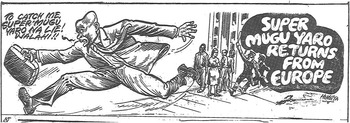
Proficiency in English is no requirement, for instance, for interpreting an iconic image of Super Mugu Yaro that is repeated throughout Joy-Ride’s volumes: his escape from the authorities. The image is particularly well rendered at the start of one episode in Volume 106 [Figure 1].Footnote 35 Here, Mugu Yaro, dressed as a businessman and running with a briefcase, flees from the police, yelling, in a combination of English, pidgin, and Arabic, “To catch me, Super Mugu Yaro, na lie,” it is a lie, “Walahi,” swear to God. The graphic image alone is sufficient to identify this character as a trickster: one who manages to escape those with greater power, and with his bag of tricks still in hand. The sweeping motion-lines in sync with his astonishingly stretched limbs convey the typical swiftness and skill of the trickster’s evasion. And the intensity of his expression matches his exaggerated form to create the sort of farcical impression audiences expect from a comic schemer. Mugu Yaro’s regular pidgin English, which is identifiably Nigerian, and his Arabic cry, which associates him with a minority Hausa-Muslim population in the predominantly Christian south of Ghana and Nigeria, reinforces his trickster nature as an in-between figure like Ananse, who is, accordingly, able to violate social mores and get away with it.Footnote 36 Mugu Yaro is not part-spider-part-man, but part-outsider (Nigerian by birth, Muslim by culture) and part-insider (a Ghanaian resident and, often, pretender). It is unlikely that the comic strip’s written text would have alienated much of the magazine’s audience, either. Super’s retort—and challenge—to the authorities in this panel (“To catch me, Super Mugu Yaro, na lie”), for instance, had already become a refrain over many of Joy-Ride’s volumes. Although the phrase would require initial linguistic comprehension by some readers, its simplicity and humor make it highly amenable to verbal circulation within an oral culture like Ghana’s, where verbally repeating such taglines is a pleasurable commonplace for recalling popular and public figures alike.
“Super Mugu Yaro,” Joy-Ride, vol. 106, p. 2

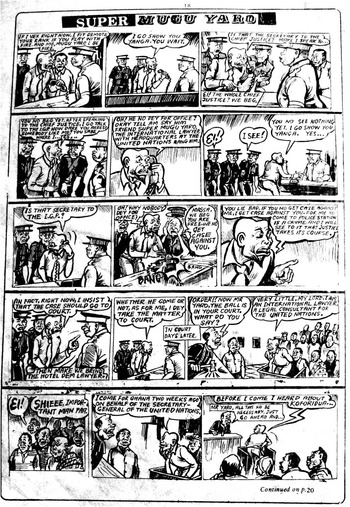
More generally speaking, despite the fact that Super’s proficiency in multiple linguistic registers is essential to his conning nature, a reader does not need to understand the written dialogue in order to comprehend the various ways that Mugu Yaro talks his way to duping one person after another. The effects of his discourse are pictured plainly. In one episode where Super Mugu Yaro is detained for public indecency (gidigidi), for instance [Figure 2], the success of his discursive posturing is measurable by the distance he travels over the panels, from within police custody to the witness stand, where he defends his own case.Footnote 37 Exclamatory text balloons (“EI!”, “I SEE!”, “SHIEEE”) depict the strong impression that Super’s dialogue makes on his listeners: first, the policemen who eavesdrops on his supposed telephone call to the chief justice; and, second, the court audience who hears his self-introduction to the judge. Of course, the richest reading comes from reading text and image together. Readers with a high level of English literacy would delight in Mugu Yaro’s easy switch between pidgin (for communicating comprehensibly to police officers) and British Standard English (for intimidating them and the court). The full absurdity of Super’s pretention as “an international lawyer, a legal consultant for the United Nations” can be appreciated only through his words. But his metamorphosis from a bullying complainer to a confidently composed professional is obvious in one visual sweep of the page as it graphically charts the transformation of Super’s aggressive, finger-pointing stance with the police into the pleasant, supplicating persona he presents in front of the judge. During its run in Joy-Ride, Super Mugu Yaro was entertainment for all readers.
“Super Mugu Yaro,” Joy-Ride, vol. 94, p. 18

Moving through Graphic Narrative
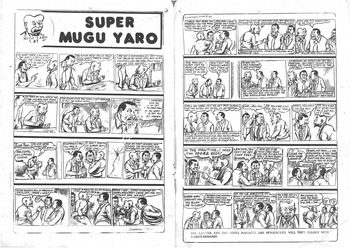
Together with its appeal to a readership of diverse literary competencies, Joy-Ride’s joint attraction, in my view, was the sense of movement it offered its readers in the face of a sometimes suffocating political context. In contrast with the general sense of social confinement and professional stasis that resulted from Rawlings’s PNDC (Provisional National Defence Council) “Revolution,” Joy-Ride, through its multimodal structure, recruited active readers whose very participation in viewing the magazine made them part of change. Comics scholars have discussed various forms of movement that readers experience in their interpretation of graphic narrative.Footnote 38 A few modes of readerly activity stand out for the applicability to West African popular graphic-literary texts, as I will explore with Joy-Ride. First of all, the immersive structure of the magazine—with double-facing image-rich pages that fill the view—draws the reader into its alternative reality. As Hilary Chute says, with reference to Scott McCloud, “Comics as a form requires a substantial degree of reader participation for narrative interpretation, even fostering a kind of interpretive ‘intimacy.’”Footnote 39 In Joy-Ride, such intimacy is fostered by its physical immersiveness. Pages that are already considerable in size (24.5 cm×35 cm) create a formidable narrative landscape when they are doubled—half a meter by a third of a meter. Opening up the two-page spread of Super Mugu Yaro in Volume 90, for instance, a reader is visually submerged in the world of the narrative [Figure 3]. This sort of image intensity is common in the image-rich magazine, giving an immediate impression of cultural fullness and offering the reader a mode of escape. The escape I am describing is not a mindless retreat from reality but, rather, movement away from fixed socioeconomic categories and toward cultural reconstruction and greater social cohesion.
“Super Mugu Yaro,” Joy-Ride, vol. 109, p. 16-17

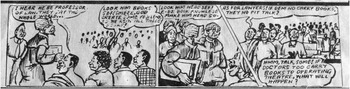
Crucially, in verbal-visual genres including comics, photonovels, and illustrated fiction, a hope for future escape is metaphorically approximated in physical movement as their eyes move between image and text across the material page. In Chute’s words, comics carry the reader “forward in time through the space of the page,” where past, present, and future can be perceived at a glance.Footnote 40 If we return to the Super Mugu Yaro episode in which Super schemes his way out of police custody, we visually track his release, our eyes leading us along in his choreographed escape—or, at least, in the first move toward his escape, which is effected in the next volume as he transforms himself into a robe-and-wig-donning barrister [Figure 4].Footnote 41 Scott McCloud underscores the significance of this readerly participation. He argues that in linking separate frames to “mentally construct a continuous, unified reality,” a phenomenon called closure, the audience becomes “a willing and conscious collaborator” in creating motion and change.Footnote 42 Collaboration with Super carried particular psychological value for readers because he always evaded the figures of authority who sought to constrain him. The character’s creator, George Appiah Prah, insisted to me that, in this, Super is distinct from all Ghanaian trickster figures before and after him: “He never gets caught.”Footnote 43 The repetition across several volumes of the iconic image of Super Mugu Yaro fleeing from the authorities stood as assurance to readers that whatever traps might be laid in Super’s—and via identification with him, their own—way, escape was guaranteed. I am proposing that the sense of movement that these sequential frames of text and image effect provides a key to the notion that Joy-Ride delivered hope to its readers.
“Super Mugu Yaro,” Joy-Ride, vol. 95, p. 19

Tom Gunning and Katalin Orbán offer further insight into the matter with their emphasis on embodiment in the graphic narrative reading event. Discussing the history of comics, Gunning advances the idea that in “fus[ing] reading and viewing,” comics created “a new relation to the viewer in which the act of reading embodie[d] a new participation in an act of movement.”Footnote 44 In comics (and we could extend this to other verbal-visual literary genres), the text is not just read and viewed, but felt. Katalin Orbán also focuses on the “embodied, multisensory reading process” involved in reading comics.Footnote 45 More than simply attending to the kinds of “visual literacy” that comics rely on, Orbán emphasizes the “haptic modality” that comics engage, the “tactile, sensual qualities” of reading comics that work on a reader bodily.Footnote 46 Importantly, she discusses how word and image combine to create associations with other cultural material in convergence culture. Convergence culture refers to the way particular images and figures gain regular circulation in popular culture as a multiplicity of media intertextually reference those specific forms. Karin Barber refers to the same process in the African context as “entextualization.”Footnote 47 What bears underlining is that in many instances the images and figures that converge are experienced physically—materially and bodily. For instance, in the 1980s and 1990s, Mugu Yaro was everywhere: his name was assumed by celebrities like female comedian Amobi Yaro and Hearts of Oak footballer Sam Yeboah, and his figure was featured widely in vehicle and store-front inscriptions, even defining a haircut style.Footnote 48 Embodying Mugu Yaro became regular in popular practice.
More than this straight-forward identification with, and impersonation of, Joy-Ride’s characters, though, I want to draw attention to the performative culture that informed the magazine’s narrative forms. I am suggesting that the movement that Joy-Ride generates is one that correlates with that of familiar performative art experiences. Gunning’s proposal that comics reinvigorate an ancient mode of “imagistic communication” involving physical gesture is fascinatingly in line with my own argument.Footnote 49 His notion reflects his focus on the Euro-American comics tradition even as it points to the potential of comics in the global south—namely, to “poach upon” the energy of still-dominant oral performative narrative traditions (to borrow Stephanie Newell’s apt phrasing).Footnote 50 As is well known in African orality studies, the performative nature of oral narrative and its dependency upon a physically present and responsive audience is essential to the genre.Footnote 51 Accordingly, I am suggesting that Joy-Ride’s hybrid form effects an aesthetic transfer, not simply from oral (spoken verbal) culture to print culture, but from haptic experience to print experience. Joy-Ride’s photonovels and comics mnemonically elicit embodied experiences of performed events to inject their own texts with vitality. Thus, a magazine may well vibrate in one’s hand.
From Ananse Storytelling to Super Mugu Yaro
Super Mugu Yaro’s development from Ananse storytelling performance and the magazine’s photonovel affiliation with Concert Party theatre will illustrate the aesthetic transposition I am referring to. Super Mugu Yaro’s affiliation with Ananse storytelling mirrors the comic’s artistic lineage. Super’s first illustrator, “Homotta” (born Kwadwo Ntiamoah), was well seasoned in the adaptation of oral narrative stylistics into comics, having trained under his father at the Ghanatta College of Art and Design and for years illustrating his father’s strips.Footnote 52 Before Joy-Ride, local cartooning was limited to short newspaper strips, the most well known being Ananse by Ghana’s premier cartoon artist, Yaw Boakye Ghanatta. In Cartooning in Africa, T. O. McLoughlin singles out Ananse as exceptional among other African comic strips at the time for rendering the aesthetic techniques of oral performance in print form while many others opted for Western cartooning stylistics. In Ghanatta’s rendition of Ghana’s traditional trickster figure, he maintains the “gestures, facial expression, animation” of oral narration and “visual detail” that is “specifically African.”Footnote 53 In an interview with Richard Priebe, Ghanatta explains that his illustration intends to capture the dramatic nature of the oral storytelling experience: “After dinner we would gather around the fire in the compound, and the elders would take turns telling these tales. It was always a very dramatic event. They would get up and animate the story with their hands, and sometimes they would even dance around.” Footnote 54 Ghanatta laments that the generation after him is not interested in learning the skills of traditional storytelling performance. The Ananse strip’s popularity with that generation, however, indicates that those youth were still interested in the performance stylistics of that tradition, meaning, the aesthetics of immediacy, the heightened physical expression, and the intense emotional engagement that are inherent in the performed narrative. Ghanatta’s son Homotta (born Kwadwo Ntiamoah) confirmed as much with his cartoon creation of Super Mugu Yaro.
Even though neither the comic’s producers nor its audience are conscious of any traces of the “traditional” in the text, Super Mugu Yaro is clearly a Kweku Ananse for the 1980s. Prah settled on the Hausa name for its inherent humor, explaining that mugu yaro means “bad boy.” Footnote 55 Meaning “bad” in Hausa, mugu was adopted into Nigerian pidgin as “big fool,” and in the early 1980s took on the particular connotation of one who orchestrates (or is the victim of) “419” advanced-fee fraud.Footnote 56 To add yet another topical resonance to Mugu Yaro’s name, the adjective Super echoes the titles of Nigeria’s top magazines Ikebe Super and Super Story. Super Mugu Yaro’s name alone identifies him as a contemporary scammer, quite distinct for local readers from a folktale trickster. It is, however, in his elaborate antics (as discussed previously), sensationally conveyed with heightened physical and emotional expression, that he most tangibly recalls the familiar elevated performance style of the trickster tale. In keeping with a long history of narrative performance practice in West Africa, and consistent with Catherine Cole’s observations of Concert Party theatre, in Super Mugu Yaro figures and motifs of folk traditions are so thoroughly transformed that audiences perceive them as both local and completely new—and, therefore, utterly desirable.Footnote 57
The George Appiah Prah Organization’s (GAPO’s) Transposition of Sensational Aesthetics
In Super Mugu Yaro, the transposition of sensational aesthetics from oral performance genres into popular print is made legible in the dual discourse of text and image. More widely, the creative process of Joy-Ride’s artistic collaborators also demonstrates that the translation of embodied experience into graphic narrative text was intentional. With Joy-Ride, the various popular arts activities of the magazine’s publisher, GAPO, come together. The managing director, George A. Prah, was at the center of Ghana’s popular cultural scene from the 1970s onward, and he credits the collaboration of multiple talents as essential to the success of his publications. Prah drew into his pool of talent musicians, dramatists, writers, and visual artists who produced art with local appeal. Whatever the genre, the imperative for GAPO was to give full expression to the vitality of the cultural present, as felt and experienced by average Ghanaians, in a variety of art forms.
Prah’s professional history reveals how he responds to the inherent interconnectivity of Ghana’s narrative arts with each other and with other art traditions. In the 1960s, he joined many enterprising individuals in traveling to England, and there he gained skills in book publication and music production. When he returned to Accra in the 1970s, he began recording and producing both highlife and Afrobeat funk and quickly became one of Ghana’s leading music producers. On the Gapophone label, Prah began promoting local artists. He collaborated with some of the biggest names in the industry—Afrobeat and highlife legends Pat Thomas and Ebo Taylor, with Taylor serving as his musical director on numerous albums; many esteemed highlife artists, including Jewel Ackah and Papa Kofi Yankson; and eminent producers, such as Monday Oki.Footnote 58 Prah’s achievement in the music industry is undisputed. Against the current of foreign inflows, Prah, together with a handful of other promoters and producers, most notably Dick Essilfie Bondzie and Faisal Helwani,Footnote 59 moored local music by producing albums with distinctively Ghanaian features, such as proverb-rich Akan lyrics, and by legitimizing Ghanaian highlife and Afrobeat as globally recognized genres by drawing public attention to the success of Ghanaian musicians abroad.Footnote 60 GAPO’s high achievement in the music industry drew talent to Prah’s other artistic projects and helped foster critical collaborative projects.
Popular arts production is often not overtly political in fraught postcolonial contexts like that of Ghana under Rawlings’s authoritarian rule due to the potentially devastating risks involved in criticizing the state. Nevertheless, popular arts may politicize their readership by providing resistance to the neocolonial tendencies of the state. Whereas Rawlings effected a betrayal of his originally populist base by facilitating American financial institutions’ restructuring of the state, thereby abandoning the Nkrumist ideal of unifying the nation through social welfare and cultural revitalization, Ghana’s popular arts’ dedication to resuscitating widely appreciated cultural forms drew their audiences back to the vision of establishing a distinctly Ghanaian shared cultural identity. The joint energies of GAPO’s collaborating artists were essential to attracting a broad readership to this vision.
Of particular note is the collaborative power that resulted from Prah’s work with highlife artists, who put him in touch with associated Concert Party dramatists. The most significant of the latter were the Osofo Dadzie Group and its director, Nana Bosompra, who became the director of modeling for Joy-Ride. In 1972, Bosompra took over the direction of the first Akan-language television adaptation of Concert Party theatre, Jatokrom by S. K. Oppong’s guitar band Concert Party. Working with Oppong’s performers and with writer Joris Wartenberg, Bosompra changed the name of their program to Osofo Dadzie.Footnote 61 With a stated objective to “expose the evils of Ghanaian society,” which included political corruption, nepotism, and bribery, the group attracted the attention of certain “guilty people” in state authority, who threatened to remove Bosompra and the program.Footnote 62 Having successfully campaigned to save the TV comedy from being pulled off the air, Prah developed a close working relationship with Nana Bosompra, whom he hired as modeling director for his further adaptation of the popular performance genre into photonovel, or “look-book,” publications.Footnote 63 From the 1960s into the 1980s, prior to the introduction of home video technology, the photonovel genre, a type of comic book illustrated with photographic stills and dialogue balloons, was highly popular throughout Africa, as it was in Europe and North America. So then, at the same time as Osofo Dadzie was being televised, Prah had the group stage tableaus in Studio Bosompra to create photographic narratives in the fashionable genre.Footnote 64 GAPO’s adaptation of Concert Party stylistics to the printed page is crucial for understanding how Prah shaped his publications to cater to his audience’s taste.
As a highly integrative and interactive popular genre, Concert Party theatre thrives by the aesthetic of immediacy it creates for its audience. Though the hybrid genre (a blend of Ghanaian, European, and American theatrical and musical forms) was first played to colonial elites in the 1930s, the Concert Party genre developed into a decidedly democratic form of theatre that was immensely popular with audiences across age and class categories. Until the 1980s, when televised versions largely replaced theatrical ones, the performances typically spanned several hours and incorporated numerous highlife musical pieces with one short comedy sketch and a main theatrical event.Footnote 65 Concert Party audiences, past and present, are dynamically involved in the performances, shouting out praise, insults, or advice to the performers, completing predictable lines of dialogue and singing the well-known highlife songs. To fully engage their audience, actors collaboratively construct their shows by “picking” material from current, everyday life, as Catherine Cole details: “Concert actors gather material from dreams, personal experiences, movies, newspapers, historical events, folk-lore, novels, and local scandals.”Footnote 66 Crucially, she explains, when these topical references, episodes, and narratives are incorporated into the framework of traditional and familiar stories, such new varieties are created that both performers and audience treat the transformed stories as “original.”Footnote 67 Such practices of developing novelty depend upon a participatory audience who help repurpose and re-create cultural texts: by interjecting with comments, calling out current catch-phrases, singing along with the latest popular songs, and so on. As Stephanie Newell elaborates in Ghanaian Popular Fiction, such practices continued in a modified way among readers of popular fiction in the mid-twentieth century, who responded to fictional texts by voicing their judgments and opinions of the texts directly to the authors, who solicited responses from the reading public.Footnote 68 The incorporation of current of-the-moment material that is already circulating and recirculating in popular culture into interactive performances contributes to a vitalist aesthetic that audiences expect of the genre.
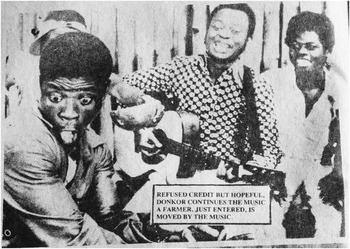
Adopting the collaborative practices of Concert Party artists for his print publications, Prah brought together writers, photographers, dramatists, and cartoonists in an attempt to harness the vitality of the oral narrative performance and transfer it onto the page. A scene from one of GAPO’s first individually published photonovels, categorized as “comics,” illustrates how they transported the stylistics of local performance into the printed text.Footnote 69 Donkor’s Special Love, a 1991 reprint of Osofo Dadzie in Abyssinia (1980), illustrates how GAPO’s photonovel genre aimed to stimulate the audience’s felt experience of lively Concert Party performances, with their heightened physical expression and stimulating highlife music. A tableau near the beginning of the book depicts a farmer “moved by the music” of Donkor, a “master guitarist” who is playing in a palm-wine bar.Footnote 70 With eyes and mouth wide open, and fingers splayed apart, the farmer dances with full abandon [Figure 5]. Readers would have immediately recognized the actor-musician playing Donkor: Samuel Kwesi Oppong, the famed highlife performer whose Concert group was the first to televise Concert shows with Jatokrom. But S. K. Oppong’s guitar band Concert Party had been gathering popular recognition since 1959 for their live performances and recorded albums, and most Ghanaians would have shared the farmer character’s impulse to break out in dance to the band’s familiar highlife tunes.Footnote 71 Mike Afrani relays that Osofo Dadzie had elevated Oppong’s celebrity status further still: “Osofo Dadzie became so popular that Oppong stopped the traffic and drew crowds everywhere he went.”Footnote 72 The excitement associated with the felt experience of Concert Party and highlife, and with the associated cult of celebrity, would certainly have transferred to the photonovel adaptation.
Donkor’s Special Love (Accra: GAPO, 1991), p. 6

The textual adaptation of Concert Party would not only have stimulated readers’ sensory memory of their physical experiences of S. K. Oppong’s Concert and Osofo Dadzie performances; the print form would also have given readers their first opportunity to keep, hold on to, and return at will to a Ghanaian story in a highly esteemed narrative style.Footnote 73 There is no doubt that the photonovels’ English-language text would have alienated some people who enjoyed Osofo Dadzie’s performance in the Akan language. As is the case with the majority of sub-Saharan African states whose administrative language is European, however, Ghana’s readers tend to be far more literate in English than in the nation’s indigenous languages, and the English text made the photonovels available to Ghanaians of various language groups. More than this, as with “Super Mugu Yaro,” Osofo Dadzie’s image panels alone enable a reader to piece together the narrative so that even readers with the barest English-language comprehension might feel that they are able to understand the literary work. These are books that anyone could read.
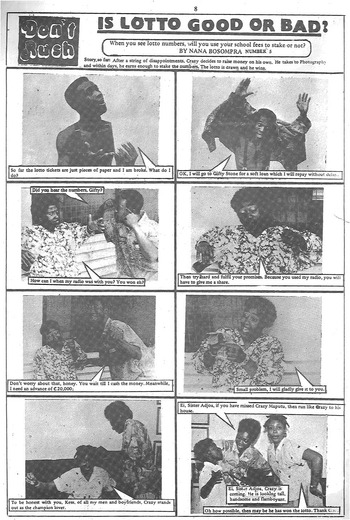
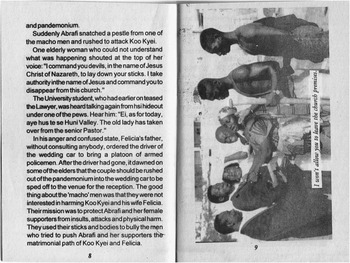
Presumably on the strength of their Osofo Dadzie comics, GAPO transferred the genre of photographed physical comedy, together with its graphic moralizing, into serialized photonovels such as “Don’t Rush” [Figure 6] and into serialized stories with photographic stills, several of which were later adapted into chapbook market fiction, such as Blows at the Wedding [Figure 7].Footnote 74 GAPO’s photonovel adaptation of performance, showcasing moments of heightened drama that the average Ghanaian was likely to encounter in daily life, became a central attraction for the readership GAPO created for Joy-Ride and beyond.
“Don’t Rush, Joy-Ride, vol. 101, p. 8

Nana Fredua Agyemang, Blows at the Wedding (Accra: GAPO, [1985?]), pp. 8–9

Conclusion
Against terrible odds in the 1980s, GAPO publications revived the popular fiction industry, creating a new textual experience for Ghanaian readers based on local identification in a shared sensory aesthetic. In a period of political strife and social disturbance, when the aim of emancipation seemed to slip farther away under the authoritarian rule of Rawlings’s PNDC government, GAPO transposed into Joy-Ride the aesthetics of popular performance, Anansesεm storytelling, and Concert Party comic theatre above all. The magazine’s incorporation of popular visual elements—especially comic strip and photonovel serializations—into distinctly Ghanaian narratives, identifiable as local stories, was pertinent to creating reading publics that, in turn, made the magazine possible, viable, and successful.
This case has several implications for the way we understand postcolonial reading publics. First of all, it asks us to take seriously as a reading public, and not just a consuming public, those readers of popular graphic literary texts. It challenges us to think about the haptic competencies that postcolonial readerships may bring to bear on their interpretation of literary texts, or, to put it the other way around, to think about the way that postcolonial literary texts (especially graphic-literary ones) solicit from their readership interpretive competencies honed from past bodily experiences of performed narratives. Even as the Joy-Ride example is a historical one, the artistic tactic of translating the sensational aesthetics of oral performance into print form is ongoing—as is evident in Ghana’s market fiction, a chapbook genre that GAPO revitalized after Joy-Ride became too costly to continue.Footnote 75 These genres remind us that many postcolonial reading publics are formed within oral-dominant cultures, where a diverse range of oral performance genres (radio shows, street rumor, church testimonials, video film, stand-up comedy, and so on) remain the prevailing modes of narration. The challenge is to look for how literary forms meet these cultural texts and gather readerships to the resultant alchemy.