Implications
Under production systems based on extensive grazing, a major factor limiting production efficiency is lamb mortality, particularly for ewes carrying more than one lamb. An important contributing factor is maternal nutrition because of its effects on the amount of colostrum available at birth. For ewes bearing multiple lambs, the energy requirements are particularly high and their voluntary feed intake is limited because the gravid uterus reduces rumen volume. This problem can be solved by provision of energy-dense supplements during the last week of pregnancy. Such supplements increases the amount of colostrum produced and also reduces its viscosity, making it easier for the neonatal lamb to suck. The outcome is the provision of new-born lambs with adequate nutrients and enhanced resistance to disease. In addition, the extra colostrum in the gut increases the ability of the lamb to recognize its mother, and thus improve mother–young bonding. The combination of these factors should improve lamb survival.
Introduction
Most mammary gland development takes place during the last month of pregnancy but, in the week before parturition, the mammary gland markedly increases in size (Mellor and Murray, Reference Mellor and Murray1985b; Mellor et al., Reference Mellor, Flint, Vernon and Forsyth1987) and this growth accompanies massive colostrum synthesis at the onset of lactogenesis II (Hartmann, Reference Hartmann1973). Growth of the gland and mammary cell differentiation are both strongly influenced by the nutrition of the dam during late pregnancy. Therefore, good nutritional management is important for ensuring adequate udder development and the production of sufficient colostrum for the new-born lambs (Treacher, Reference Treacher1970; Wallace et al., Reference Wallace, Bourke, Da Silva and Aitken2001; Swanson et al., Reference Swanson, Hammer, Luther, Carlson, Taylor, Redmer, Neville, Reynolds, Caton and Vonnahme2008; Tygesen et al., Reference Tygesen, Nielsen, Norgaard, Ranvig, Harrison and Tauson2008; Meyer et al., Reference Meyer, Reed, Neville, Thorson, Maddock-Carlin, Taylor, Reynolds, Redmer, Luther, Hammer, Vonnahme and Caton2011). Poor prepartum nutrition can reduce colostrum and milk production (McCance and Alexander, Reference McCance and Alexander1959; Peart, Reference Peart1967; Treacher, Reference Treacher1970; Mellor and Murray, Reference Mellor and Murray1985b; Mellor et al., Reference Mellor, Flint, Vernon and Forsyth1987; McNeill et al., Reference McNeill, Murphy and Purvis1988; Swanson et al., Reference Swanson, Hammer, Luther, Carlson, Taylor, Redmer, Neville, Reynolds, Caton and Vonnahme2008; Meyer et al., Reference Meyer, Reed, Neville, Thorson, Maddock-Carlin, Taylor, Reynolds, Redmer, Luther, Hammer, Vonnahme and Caton2011), delay the onset of lactogenesis, change the viscosity of the colostrum that accumulates before parturition begins (Banchero et al., Reference Banchero, Quintans, Martin, Lindsay and Milton2004a and 2004Reference Banchero, Quintans, Martin, Lindsay and Miltonb) and reduce the volume of colostrum secreted after lambing (McCance and Alexander, Reference McCance and Alexander1959). In twin-bearing Scottish Blackface ewes, restriction of nutrition during the last month of pregnancy reduced by up to 70% the volume of colostrum secreted (Mellor and Murray, Reference Mellor and Murray1985a and 1985Reference Mellor and Murrayb). In Merino ewes, the viscosity and volume of colostrum are inversely related, and delayed lactogenesis is characterized by a higher incidence of viscous colostrum similar to that secreted early in lactogenesis (McCance and Alexander, Reference McCance and Alexander1959). Highly viscous colostrum can be a significant problem for the new-born lamb because it is more difficult to withdraw from the teat (McCance and Alexander, Reference McCance and Alexander1959), so the lambs need to suck more frequently and for longer to obtain sufficient nutrients (Holst et al., Reference Holst, Hall and Allan1996).
The aim of this article is to review the mechanisms by which nutrition influences colostrum production and analyse the value of supplements of energy or protein for improving the production of colostrum of twin-bearing ewes under grazing conditions.
Mechanism by which nutrition influences colostrum production
In the ewe, the volume of colostrum that accumulates as parturition approaches depends on her general plane of nutrition during late gestation, but litter size and body condition also play important roles. Most of these factors are linked by one hormone: progesterone. Concentration of progesterone is high during pregnancy and, during the last half of pregnancy, most of it is produced by the placenta. Progesterone prevents the initiation of both lactation and parturition. In the last week of pregnancy, the concentration of progesterone starts to fall and the concentration of oestradiol increases. The massive change in the ratio of progesterone to oestradiol (P4/E2) is the principal determinant of the timing of parturition because these two hormones have opposing effects on the sensitivity of the uterus to prostaglandins, catecholamines and oxytocin (Maltier et al., Reference Maltier, Legrand and Breuiller1993). The fall in the P4/E2 ratio is caused by a prepartum increase in foetal production of cortisol that, in turn, enhances the activity of placental 17∝-hydroxylase (Kuhn, Reference Kuhn1983), an enzyme that directs placental progesterone towards the synthesis of oestrogens. However, progesterone does not need to disappear completely from the circulation by the time of parturition, indeed for the ewe. Hartmann et al. (Reference Hartmann, Trevethan and Shelton1973) suggested that the threshold level of progesterone in plasma for the onset of lactogenesis is probably <1 ng/ml.
The rate of decline in progesterone concentrations can vary. For example, in very fat ewes, progesterone withdrawal can be delayed before and during parturition by progesterone stored in the adipose tissue (McCracken, Reference McCracken1964), and twin-bearing ewes with two placentas can produce more progesterone than single-bearing ewes with one placenta (McNeill et al., Reference McNeill, Murphy and Lindsay1998). Underfeeding can also slow down the metabolic clearance of progesterone (Brockhus et al., Reference Brockhus, Nunan and Parr1988; Parr et al., Reference Parr, Davis, Miles and Squires1993a), an effect that can be rapidly reversed by the resumption of normal intake (Mellor et al., Reference Mellor, Flint, Vernon and Forsyth1987; Oddy and Holst, Reference Oddy and Holst1991). The metabolic clearance of progesterone is affected in two ways: (i) a greater rate of catabolism in the liver (Thomford and Dziuk, Reference Thomford and Dziuk1986; Thomas et al., Reference Thomas, Thomford, Crickman, Cobb and Dziuk1987; Sangsritavong et al., Reference Sangsritavong, Combs, Sartori, Armentano and Wiltbank2002); (ii) an increase in hepatic blood flow (Parr, Reference Parr1992; Parr et al., Reference Parr, Davis, Miles and Squires1993b; Sangsritavong et al., Reference Sangsritavong, Combs, Sartori, Armentano and Wiltbank2002). About 96% of all progesterone entering the liver and the gut is removed and the breakdown products are excreted in the faeces (Parr et al., Reference Parr, Davis, Miles and Squires1993b). Parr et al. (Reference Parr, Davis, Miles and Squires1993b) also showed that the rate of blood flow in the hepatic portal vein was directly related to the level of feed intake when ewes consumed rations that provided half the maintenance requirements, full maintenance requirements or double maintenance requirements. They concluded that an increase in blood flow through the gut and to the liver, caused by an increase in feed intake, was responsible for enhancing progesterone clearance (Parr et al., Reference Parr, Davis, Miles and Squires1993b). This conclusion supported previous studies on hepatic blood and clearance in cows (Wieghart et al., Reference Wieghart, Slepetis, Elliot and Smith1986) and ram lambs (Burrin et al., Reference Burrin, Ferrell, Eisemann, Britton and Nienaber1989). However, in contrast, Bedford et al. (Reference Bedford, Harrison and Heap1974) attributed only 27% of the metabolic clearance of progesterone to hepatic uptake in the sheep, and Freetly and Ferrell (Reference Freetly and Ferrell1994) did not detect any relationship between splanchnic clearance of progesterone and the level of nutrition.
Most studies provide evidence that an increase in nutrient intake before parturition increases progesterone clearance and thus helps lactogenesis to begin. The rate of decline in progesterone concentration depends on several factors, but there is general agreement that the level of energy intake is very important. The plasma concentration of glucose mainly depends on the level of nutrition and also affects the production of colostrum because glucose is required for lactose synthesis. The importance of glucose uptake is evidenced by the observation by Linzell (Reference Linzell1974) that milk production is impaired by low blood glucose concentrations. In adequately fed pregnant ewes, the plasma glucose concentration varies from 2.4 to 4.5 mmol/l (Aiello, Reference Aiello1998), and ewes fed to maintain the concentrations at about 3 mmol/l produce fourfold more colostrum than ewes fed to maintain levels of 1.3 mmol/l (Mellor et al., Reference Mellor, Flint, Vernon and Forsyth1987). However, it is difficult to attribute a low level of production of colostrum solely to a low plasma concentration of glucose because undernourished animals would probably also have a delayed progesterone withdrawal as outlined above. Nevertheless, in lactating animals, where plasma concentrations of progesterone are low, lactose synthesis can be rapidly shut down by undernutrition, and it can recover within a few hours of re-feeding (Kuhn, Reference Kuhn1983). For example, Linzell (Reference Linzell1967) found that when goats were fasted their milk yield was halved 8 to 26 h later, and that the uptake of glucose by the mammary gland fell to 30% of pre-fasting values. Mammary glucose uptake could be restored to about 85% of the pre-fasting level by an intravenous infusion of glucose clearly demonstrating the acute role that glucose plays in controlling milk production.
The availability of glucose can be increased by either enhancing the production of propionic acid, the main precursor of glucose in ruminants, or by increasing the post-ruminal supply of glucose (Knowlton et al., Reference Knowlton, Glenn and Erdman1998). Barry and Manley (Reference Barry and Manley1985) infused 175 g of glucose daily into the abomasum of triplet-bearing ewes during the last 6 weeks of gestation and increased colostrum production threefold compared with control ewes consuming a similar amount of metabolizable energy (ME). Rigout et al. (Reference Rigout, Lemosquet, van Eys and Blum2002) infused 0%, 2.3%, 5.3% and 14% of dry matter (DM) intake as glucose into the duodenum of lactating dairy cows over 14 days and found that the concentration of lactose in milk and the milk yield both increased in a curvilinear fashion. Each increase in milk yield was also accompanied by an increase in blood flow to the mammary gland. Similarly, Hurtard et al. (Reference Hurtard, Lemosquet and Rulquin2000) infused 0 to 2.25 kg of glucose/day into the duodenum of lactating cows for 1 week and showed a curvilinear increase in the amount of lactose and protein in the milk, accompanied by a decrease in milk fat yield in linear proportion to the amount of glucose infused. Thus, good nutrition during late pregnancy may have a variety of effects on the synthesis of colostrum in the ewe, first through the metabolism of progesterone and then by providing nutrients that are in high demand at this stage of pregnancy.
Colostrum requirements of the new-born lamb
The amount of colostrum needed by a lamb depends largely on how much fuel it requires for heat production (Mellor and Murray, Reference Mellor and Murray1985a), so any factor that increases its rate of heat production, such as exposure to cold, will increase its requirements for colostrum. Colostrum contains about 10% to 13% fat, 2% to 3% lactose and 7% to 10% non-immunoglobulin protein (calculated from Pattinson et al., Reference Pattinson, Davies and Winter1995), resulting in yields of 6.3 to 7.3 kJ of energy/ml (McCance and Alexander, Reference McCance and Alexander1959). McCance and Alexander (Reference McCance and Alexander1959) calculated that the heat produced by a 3.5 kg fasted lamb under field conditions is 0.19 MJ/h, which equates to about 30 ml/colostrum. On this basis, a new-born lamb requires between 180 and 290 ml of colostrum/kg BW during the first 18 h after birth (Shubber et al., Reference Shubber, Doxey, Black and FitzSimons1979; Mellor and Cockburn, Reference Mellor and Cockburn1986; Mellor and Murray, Reference Mellor and Murray1986; Mellor, Reference Mellor1988), on top of an immediate requirement at birth of 50 ml/kg BW to avoid hypothermia (Robinson et al., Reference Robinson, Rooke and McEvoy2002). Pattinson et al. (Reference Pattinson, Davies and Winter1995) suggested that the weight of colostrum required by a lamb varies from 140 to 175 g/kg of birth weight during the first 24 h of life for lambs born indoors at temperatures between 2°C and 10°C. In windy conditions and when the lamb is wet, the amount of colostrum needed probably increases by 150% (McCance and Alexander, Reference McCance and Alexander1959). Taken together, all of these observations suggest that a lamb requires 200 ml of colostrum/kg of birth weight in mild weather conditions during its first 18 h of life, and 50% more in rainy and windy conditions; 25% of this colostrum should be available at birth in order to improve lamb survival.
Increasing colostrum production by manipulating nutrition
It is clear that nutrition affects the development of the mammary gland, the onset of lactogenesis and colostrum production, either by affecting some of the hormones that control these processes or by contributing nutrients that are in demand at this stage of pregnancy. However, during late pregnancy and particularly for twin-bearing ewes, the volume of the rumen is limited because it is physically compressed by the conceptus/es (Weston, Reference Weston1988), leading to a reduction in the intake of food. In part, the loss of intake is compensated for by a higher rate of passage of digesta from the rumen to the lower gastrointestinal tract, maintaining the flow of nutrients for absorption and helping meet the increased demand for nutrients in late pregnancy (Weston, Reference Weston1988). However, an increase in the rate of passage from the rumen will also reduce the time available for microbial digestion, thus lowering the rate of digestion. Moreover, although ewes may be able to consume enough DM at the end of pregnancy, it would not be enough to meet their requirements for lactogenesis (Ministry of Agriculture, Fisheries and Food (MAFF), 1975) if this DM was obtained from native pastures. Normally, these pastures have a heterogeneous distribution of species and quality varied during and between years (low protein: <100 g/kg of DM and low ME: <8.5 MJ/kg of DM of forage; Bermúdez and Ayala, Reference Bermúdez and Ayala2005)
For these reasons, researchers investigated the value of short-term supplementation of the ewe under grazing conditions at the end of pregnancy (Hall et al., Reference Hall, Holst and Shutt1992a and Reference Hall, Piper, Egan and Bindon1992b; Murphy et al., Reference Murphy, McNeill, Fisher and Lindsay1996; Roeder et al., Reference Roeder, Thomas, Kott, Hatfield and Burgess2000; Banchero et al., Reference Banchero, Quintans, Martin, Lindsay and Milton2004a and Reference Banchero, Quintans, Martin, Lindsay and Milton2004b, Reference Banchero, Quintans, Vazquez, Gigena, La Manna, Lindsay and Milton2007, Reference Banchero, Quintans, Lindsay and Milton2009; Holst et al., Reference Holst, Hall and Lee2005; Fierro et al., Reference Fierro, Olivera-Muzante, Gil, Antognazza, Durán, Sánchez and Banchero2012; Hawken et al., Reference Hawken, Williman, Milton, Kelly, Nowak and Blache2012). Supplements like cereal grains or concentrates would provide high energy/protein in a small volume of feed.
Fortunately, supplementation with grain for a short-term in late pregnancy is not likely to increase the risk of dystocia because the birth weight of the lamb/s is not markedly increased (Murphy et al., Reference Murphy, McNeill, Fisher and Lindsay1996; Murphy, Reference Murphy1999; Banchero et al., Reference Banchero, Quintans, Martin, Lindsay and Milton2004a).
Energy sources for increasing colostrum production in ewes under grazing conditions
Cereal grains
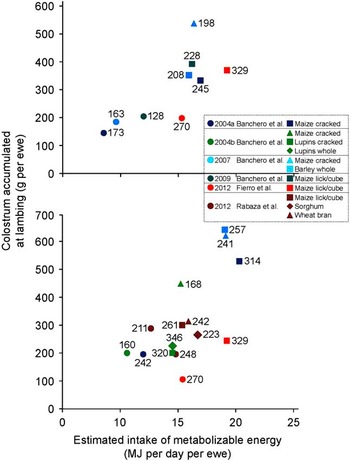
Banchero et al. (Reference Banchero, Quintans, Martin, Lindsay and Milton2004a), working with Corriedale sheep, found that single- or twin-bearing ewes supplemented with 750 g/head daily per day during the last week of pregnancy (2.0- and 1.74-fold the ME required; MAFF, 1975) produced 133% and 172% more colostrum than unsupplemented ewes (Figure 1). The same type of single and twin-bearing ewes supplemented with only 500 g/head daily of cracked maize (1.45 and 1.33-fold the ME required; MAFF, 1975) during the last week of pregnancy produced 185% and 113% more colostrum than unsupplemented ewes (Banchero et al., Reference Banchero, Quintans, Vazquez, Gigena, La Manna, Lindsay and Milton2007). In a similar experiment with twin-bearing Merino ewes, Banchero et al. (Reference Banchero, Quintans, Martin, Lindsay and Milton2004b) reported a 118% increase in the weight of colostrum produced by ewes supplemented daily with 34 g cracked maize/kg of metabolic BW (1.13-fold the ME required; MAFF, 1975) during the last week of pregnancy. Supplementing single- and twin-bearing Corriedale ewes with barley during the last 10 days of pregnancy (1.47 and 1.34-fold the ME required; MAFF, 1975 also increased colostrum production by 90% and 122% (Banchero et al., Reference Banchero, Quintans, Vazquez, Gigena, La Manna, Lindsay and Milton2007). The control or unsupplemented ewes in all of these experiments were fed roughage diets, mainly lucerne hay or chaff, sufficient to meet their requeriments for ME (MAFF, 1975).
Colostrum production in ewes bearing single (upper) or twin (lower) fed with roughages and then supplemented during the last 7 to 10 days of gestation, plotted against the estimated total amount of energy and protein consumed. Circles (○) are unsupplemented ewes and other figures (□, ◊, ∆) are supplemented ewes. Each colour represents a single experiment. The numerical values next to each data point are estimated mass of protein (g) consumed by each ewe daily.

Under grazing conditions, supplementation of twin-bearing Polwarth ewes with whole sorghum grain during the last 10 days of pregnancy (1.13-fold the ME required; MAFF, 1975) increased colostrum production by 136% compared with unsupplemented ewes (Rabaza, Reference Rabaza2012; Figure 1). These ewes were grazing native pastures with 159 g CP and 9.5 MJ ME/kg DM. In other experiments, supplementation of single- or twin-bearing Corriedale ewes with a lick comprising mainly cracked maize grain (~1.38-fold the ME required; MAFF, 1975) increased colostrum production by 92% (Banchero et al., Reference Banchero, Quintans, Lindsay and Milton2009) or 89% (Fierro et al., Reference Fierro, Olivera-Muzante, Gil, Antognazza, Durán, Sánchez and Banchero2012) in single-bearing ewes and by 134% in the twin-bearers (Fierro et al., Reference Fierro, Olivera-Muzante, Gil, Antognazza, Durán, Sánchez and Banchero2012) compared with unsupplemented control ewes. The ewes were grazing native pastures with an average of 70 g CP and 7 MJ ME/kg DM.
Most cereal grains are rich in starch and can be used as supplements for ewes in late pregnancy under grazing conditions to increase colostrum production at the time of birth. The increase in colostrums output in supplemented ewes ranged from 90% to 185% over that of unsupplemented ewes. However, Hall et al. (Reference Hall, Holst and Shutt1992a) and Holst et al. (Reference Holst, Hall and Lee2005) did not detect any increase in colostrum production in Merino ewes supplemented with oats, suggesting that oats did not have the same effects on colostrum production as the other cereals evaluated. The reasons for this difference will be discussed below.
Legumes and oleiferous seeds
Hall et al. (Reference Hall, Holst and Shutt1992a), working with Border Leicester×Merino ewes, found that supplementation with lupin grain (Lupinus angustifolius) or formaldehyde-protected sunflower seed meal at 500 g/day during the last 2 weeks of pregnancy increased colostrum output by 35% and 50%. In this experiment, single-bearing ewes produced similar amounts of extra colostrum with either supplement, but twin-bearing ewes produced more colostrum only when supplemented with sunflower seed meal. Lupins were also tested by Murphy and co-workers and they found that feeding 1 kg/day to single-bearing Merino ewes during the last week of pregnancy increased the amount colostrum produced by nearly 80%, compared with unsupplemented controls (Murphy et al., Reference Murphy, McNeill, Fisher and Lindsay1996). On the other hand, in an experiment with twin-bearing Merino ewes, we detected no increase in the weight of colostrum produced by ewes supplemented daily with 34 g/kg LW0.75 of cracked or whole lupins (Banchero et al., Reference Banchero, Quintans, Martin, Lindsay and Milton2004b). Our view is that, in our study, the lupins provided excessive amounts of rumen-degradable protein (RDP), resulting in toxic plasma concentrations of urea. The synthesis of urea from ammonia has a very high energetic cost for the animal (Tyrrell et al., Reference Tyrrell, Moe and Flatt1970), and high concentrations of ammonia can also impair the uptake and/or utilization of glucose by the cell (Emmanuel and Edjtehadi, Reference Emmanuel and Edjtehadi1981). Consequently, these ewes produce similar amounts of colostrum as the control ewes, despite consuming 35% more energy and 115% more of protein.
In conclusion, supplements of high quality protein from legumes and oleiferous seeds can increase colostrum production but they are less effective than cereal grains. With lupin grain, we need to be careful because large supplements could impair colostrum production and cause health issues.
Levels of energy
Cereal grains are high in ME and starch – for example, about 70% of a maize or sorghum grain is starch, compared with only 60% of barley and 42% of oat (McDonald et al., Reference McDonald, Edwards and Greenhalgh1988; Tamminga et al., 1990). Generally, starch is rapidly fermented in the rumen to the volatile fatty acid, propionate, which is then absorbed and serves as the main source of energy for ruminants (Knowlton et al., Reference Knowlton, Erdman and Glenn1999) because it is the primary precursor for synthesis of glucose by the liver. However, some of the starch escapes fermentation and is instead digested in the small intestine by α-amylase from the pancreas and oligosaccharidases from the intestinal mucosa (Knowlton et al., Reference Knowlton, Erdman and Glenn1999). Amylase hydrolyses starch to oligosaccharides that are then broken down to glucose that becomes available for absorption directly into the portal veins. The capacity for ruminants to digest starch in the small intestine appears to be limited by the supply of pancreatic amylase rather than by intestinal capacity for glucose absorbtion (Knowlton et al., Reference Knowlton, Erdman and Glenn1999).
The amount of starch that is digested in the rumen, or that escapes the rumen and passes to the lower gastrointestinal tract, will vary with the physiological state of the animal, as well as the type of grain and the physical and chemical processing of the grain (Nocek and Tamminga, Reference Nocek and Tamminga1991; Huntington, Reference Huntington1997). Within a grain type, physical processing generally increases the rate of starch digestion in the rumen by breaking down the outer coat of the kernel, giving the enzymes secreted by rumen microbes access to the starch. The starch in similarly processed wheat, oats and barley is generally more fermentable in the rumen than the starch in corn (Nocek and Tamminga, Reference Nocek and Tamminga1991). In fact, 20% of starch is delivered post-ruminally in dry-rolled corn and sorghum, compared with 14% for barley and 5% for oats (Huntington, Reference Huntington1997). Thus, when Knowlton et al. (Reference Knowlton, Glenn and Erdman1998) fed cows with dry-ground corn, starch digestibility increased, as did milk production, but much of the increase in starch digestion was due to an increased disappearance of starch from the large intestine rather than an increase in digestion in the rumen or the small intestine.
The proportion of starch that passes undigested from the rumen is also influenced by the processing of the grain. Landau et al. (Reference Landau, Nitsan, Zoref and Madar1992) found that the ruminal digestion of corn fed to sheep was 60% to 70% for whole grain and 78% to 80% for cracked grain. The starch not digested in the rumen passed to the intestine where it was mostly digested and could account for up to 50% of the glucose available in sheep fed whole or cracked maize (Landau et al., Reference Landau, Nitsan, Zoref and Madar1992). The resistance of the starch in maize to fermentation in the rumen makes this grain a potentially useful source of energy for feeding in the last week of pregnancy, especially if the starch that passes from the rumen is digested to glucose in the small intestine.
Finally, the differences in response in colostrum production in ewes supplemented with various cereal grains may be due to differences in the amount of starch digested post-ruminally. The amount of starch entering the lower digestive tract is 14%, 8.5% and 2% of grain DM intake for maize, barley and oats, respectively. Moreover, it should be expected that ewes supplemented either with maize or sorghum would produce more colostrum than those supplemented with barley, and even more than those supplemented with oats. The lack of response in colostrum production when oats is used as a supplement, mentioned above, seems likely to reflect the need for a threshold level of starch to enter to intestine before any benefit can be obtained.
The importance of protein
The increase in colostrum production after feeding supplements of legumes and oleiferous seeds (lupins and sunflower seed meal) is mainly related to their high protein content, especially their ability to supply undegraded protein to the small intestine (Hall et al., Reference Hall, Holst and Shutt1992a). In contrast, excess protein has been shown to either have no effect or to decrease colostrum production (Ocak et al., Reference Ocak, Cam and Kuran2005). When sheep are fed large quantities of a diet with a high percentage of RDP, as is the case for large lupin supplements, the concentration of ammonia in the circulation can reach toxic levels (Hungerford, Reference Hungerford1990), especially if the intake of digestible carbohydrates is low (Hibbit, Reference Hibbit1988). Although, lupins can supply large quantities of ME, unfortunately much of this energy is used for hepatic detoxification of the ammonia liberated in and absorbed from the rumen, particularly when large quantities of lupins are consumed each day (Lobley et al., Reference Lobley, Connell, Lomax, Brown, Milne, Calder and Farningham1995; Greaney et al., Reference Greaney, Reynolds, Ulyatt, Mackenzie and Harris1996).
On the other hand, a low level of protein in the diet may reduce the utilization of the starch for colostrum synthesis in ewes supplemented with cereal grain. Thus, Taniguchi et al., (1993) reported an increase in the digestibility of starch in the small intestine of sheep in direct response to an increased supply of protein to this organ. With more protein available for digestion in the small intestine there is probably greater secretion of pancreatic enzymes, including those responsible for starch digestion (Huntington, Reference Huntington1997). Therefore, when a large amount of starch is used for supplementation, we recommend the use of 20% to 25% more protein than the National Research Council (1985) recommendation (Banchero et al., Reference Banchero, Quintans, Martin, Lindsay and Milton2004a).
When grazing improved, high quality pastures, ewes can be fed to meet their pregnancy requirements, but twin-bearing ewes will still show a positive response in colostrum production to a short-term prepartum supplement. This suggests that they have a physical limitation that prevents them from consuming enough energy in the form of green plant material. In this case, the supplement could be energy supplied as a cereal grain to provide about 30% of the total diet of the ewe, since sufficient protein is being supplied by the pasture.
However, with low-quality pastures, such as unimproved native pastures, ewes will consume less than their pregnancy requirements and the production of colostrum, in both single- and twin-bearing ewes, may not be enough to cover the requirements of their lambs. In this case, the small amount of colostrum produced by these animals might be a combination of physical limitation of the rumen plus the low quality of the feed consumed. It will then be necessary to supplement both energy and protein. It is important to note that the lower the feed consumption is below pregnancy requirements, the greater the response in colostrum production to supplementation (Figure 1).
Conclusion
Short-term supplementation is a low-cost technology for ewes managed under grazing conditions, especially on native pastures, because it can assure an increase in colostrum production and an improvement in lamb survival. The amount of energy, especially glucose, available at the end of pregnancy plays a major role in the synthesis of colostrums. However, the level of protein consumption is also important with both deficits and excesses of dietary protein impairing the amount of colostrum accumulated at parturition. Cereal grains like corn, barley or sorghum are rich in ME and starch and, when they are used as supplements during the last week of pregnancy, they can double the production of colostrum. These are valuable management options for maximizing lamb survival.
Acknowledgement
The authors thank Andres Vazquez for assistance with the figures and comments on an earlier draft of the manuscript.