Thomas Hempnall, bishop of Worcester, 1337–8, ordained 208 subdeacons, 193 deacons and 213 priests between September 1337 and September 1338. In addition to these ordinations to the higher, or ‘holy’, orders he ordained 301 acolytes and conferred the ‘first tonsure of the clerical army’ (‘prima tonsura clericalis milicie’) on no fewer than 557 boys.Footnote 1 First tonsure was the initial stage in the progress of young men to the priesthood but, as these totals suggest, tonsured boys did not necessarily proceed beyond that first stage, and even those who became acolytes might not advance to the higher orders.Footnote 2
This study seeks to examine in detail the conferring of the tonsure in the first half of the fourteenth century. It is based on those episcopal registers which list the names of boys who received the tonsure.
Sources
Episcopal registers survive for sixteen of the seventeen English dioceses in the first half of the fourteenth century. From their origins a century earlier, their core content was the recording of institutions to benefices, which preserved information of permanent value regarding the status of parochial benefices and the identity of their patrons as well as the names of those instituted and often of the predecessor and the reason for the vacancy. To this core might be added entries of various kinds, predominantly copies or summaries of acts of the bishop but also including copies of some incoming business. The registers were created by binding the written-up quires into one or more volumes, usually following the death of the bishop. They are the products of a sophisticated and experienced registry staff and many of them bear the appearance of systematic and polished scribal activity. This may nevertheless obscure the reality, which was that many of the entries were compiled from drafts or brief notes which were written up periodically and often at some considerable time after the event or the issue of the document, that errors and omissions crept in and that decisions as to which acts to include or exclude offered significant scope for scribal decisions which might not be consistent even within the register or registers of a single episcopate.Footnote 3
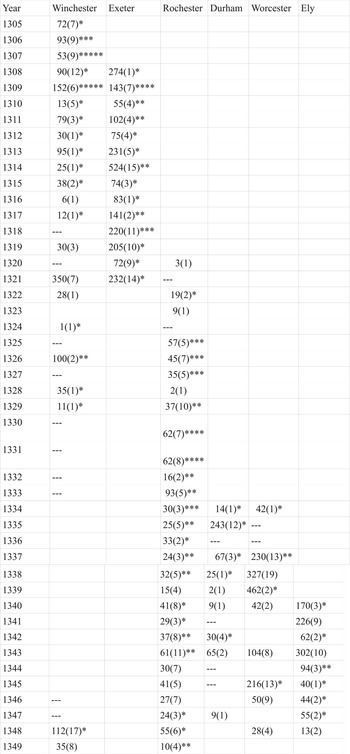
There was scope for either deliberate exclusion or accidental omission or loss at various stages in the creation of the registers and their survival thereafter. Institutions were the core of the registers but, even so, there is considerable evidence of institutions which were not registered.Footnote 4 Certain categories of material, such as royal writs, appear as substantial sections in some registers but are not found in others, either because they were never recorded formally or because the decision was made not to bind the relevant quires into a register. Some kinds of entry appear from time to time in a register but were clearly not recorded systematically there. In some cases, when a register was bound as several volumes, one or more of the volumes may later have been identified as no longer justifying preservation, or may have been accidentally lost or destroyed.Footnote 5 Also, many acts of the bishop were never, or only very occasionally, recorded. Lists of those ordained to the higher orders presumably justified being preserved during the expected lifetime of the ordinands but were of little practical value thereafter. They are found in the registers of only twelve dioceses during this period, and there are significant lacunae in most of these. They usually appear to be tidy and well-organised, but in a few cases we can see that a list was prepared from a number of smaller slips from which the information was to some extent edited.Footnote 6 Those lists which survive may cover only the three holy orders, although most also include acolytes. Ordination to these orders was normally restricted to the Saturdays of the four Ember weeks of the church year and two other permitted days. There was no similar restriction on imposition of the tonsure, which might take place on the day of a general ordination or a day or two immediately before or after it, but might be given to smaller groups as the bishop moved around his diocese or resided at one of his manor houses.Footnote 7 Lists of first tonsures survive for only six dioceses during this period. We cannot know whether lists of those tonsured were, in most dioceses, prepared but not entered into a quire, or whether there were quires of them which were not preserved and registered, or whether, in many dioceses, the names were not recorded. The six dioceses for which they survive are Winchester, Exeter, Rochester, Durham, Worcester and Ely.Footnote 8 Rochester and Ely were two of the three smallest English dioceses, and the other four were dioceses of medium size, each covering approximately the area of two counties. In the largest dioceses, York, Lincoln and Coventry and Lichfield, the number of boys tonsured would have required the expenditure of much time, ink and parchment and, even if there were a need later to establish whether a man had been tonsured, the lists would be difficult to search and it might be impossible to establish that a name in the list referred to the person in question.Footnote 9 Tonsuring was unlikely to hold serious consequences for the bishop or his successors,Footnote 10 and the fact that it often took place away from regular ordinations would make it less of a matter of clerical routine.Footnote 11 Of the six dioceses, the Rochester registers were not systematically divided into sections, and ordinations, including tonsurings, are included in the overall chronological sequence. The registers of the other five dioceses include quires devoted to ordination lists and all but Ely include tonsurings in these sections. Ely tonsurings are entered on separate folios. (See Figure 1 below for the periods covered.)
Numbers of recorded first tonsures (in parentheses, number of occasions on which bishops are recorded as conferring first tonsures).
1. Candidates with letters dimissory are excluded, as are occasions on which a bishop conferred the tonsure only on such candidates, together with occasions on which a bishop conferred the tonsure only on candidates from another diocese by commission from the diocesan bishop. In a few instances, when a tonsuring is undated and the year is uncertain, it has been assigned to the most probable year. In the register of Bishop Bransford of Worcester (1339–49) many lists of tonsurings provide a date and place but not a year. These have been attributed to 1340 and 1343 because of evidence of the bishop's presence in the vicinity at the time and to 1348 on the basis of the late date of Trinity Sunday. 2. The number of asterisks indicates the number of ordinations at which the bishop both conferred the tonsure and ordained to one or more of the higher orders on the same day or within one or two days, although not necessarily in the same place. When more than one tonsuring took place within one or two days of such an ordination only a single asterisk is used.

The lists are usually headed ‘[ordinati] ad primam tonsuram’, whether these are headings for a tonsuring or subheadings within the entry for a general ordination.Footnote 12 When the tonsuring took place on the day of the ordination, the lists of those tonsured normally took their appropriate place in the sequence of orders, preceding the lists of acolytes, subdeacons, deacons and priests, usually without any indication that they had taken place outside the main ordination.Footnote 13 Occasionally ‘coronati’ or ‘benedicti’ is used.Footnote 14 In the margin of one list of those tonsured in Rochester the clerk has written ‘Exorciste’ and in two lists of monks of Furness Abbey granted letters dimissory by Archbishop Melton of York this word is used for what are clearly candidates for the tonsure.Footnote 15
When and where?
At the first ordination by Walter Stapledon as bishop of Exeter on 21 December 1308 more than 1,000 candidates appeared: 246 for the higher orders, 566 to be ordained acolyte and 274 to receive the first tonsure.Footnote 16 They attended from all parts of his diocese: those tonsured comprised 162 from the three Devon archdeaconries (65 from Exeter, 64 from Totnes, 33 from Barnstaple), 106 from the archdeaconry of Cornwall and six from peculiar jurisdictions. This was followed in February and March 1309 by a lengthy itinerary through Cornwall, including the Lent ordination (22 February) at St Germans and one at St Crantock at Sitientes (15 March), both of which included first tonsures (59 and 29 respectively). In addition thirty-four boys were tonsured on 9 March at St Laundy and thirteen on 23 March at Launceston priory.Footnote 17 These ordinations and tonsurings were attended almost exclusively by Cornish candidates. Between December 1308 and September 1309, no fewer than 417 boys were tonsured on eight occasions. Thereafter, Stapledon held at least one major ordination each year, on the day of which he conferred the tonsure as well as ordaining to the higher orders. He also held lesser tonsurings, sometimes for between ten and twenty boys but often for only one, two or three.
In September 1316 Stapledon tonsured eighty-three boys at Paignton, an episcopal manor, in the morning before the main ordination later in the day at Totnes.Footnote 18 It was also quite common for a bishop, having held a major ordination in his cathedral or another large church, to confer the tonsure in the chapel of his castle or manor house on the following day: Richard Bury, bishop of Durham, held a major ordination in his cathedral on 23 December 1335, followed by tonsuring thirty boys in Durham castle chapel on Christmas Eve.Footnote 19
Most bishops conferred the tonsure while they were travelling around their diocese, moving from one of their manor houses to another or carrying out visitations. Thomas Hempnall and Wulstan Bransford as bishops of Worcester can be seen at times conferring the tonsure almost daily. Hempnall, for example, tonsured boys on seven occasions between 8 November and 18 November 1337 at Worcester, Pershore, Beckford, Withington, Bibury, Withington again and Fladbury, and on thirteen occasions between 13 June and 7 July 1338 at Alcester (13 June), Hampton Lucy (14, 21 June), Tredington (23, 25 June), Bishops Cleeve (27 June), Upton (28, 29 June), Leonard Stanley (1 July), Thornbury (2 July) and Henbury Saltmarsh (4, 5, 7 July). Apart from the Bibury tonsuring on 14 November 1337, when sixty-nine were tonsured, the largest number was twenty-seven, and at half of them fewer than ten were tonsured.Footnote 20 Most of these places were less than ten, and almost all less than twenty, miles apart.Footnote 21 In north Northumberland, sparsely populated and fifty or more miles from Durham, Bishop Bury held tonsurings at Alnwick Abbey, Bamburgh parish church and the chapel of the bishop's castle of Norham on 3, 4 and 12 October 1335. These places, thirteen and nineteen miles apart respectively, were presumably convenient for local boys and the coming of the bishop to the most distant part of his diocese was no doubt well publicised: seventeen, twenty-four and sixteen boys attended.Footnote 22
Bishops also conferred the tonsure on boys who came to them when they were staying at one of their residences. Hamo Hethe, bishop of Rochester, carried out most of his tonsurings at his manor houses of Halling and Trottiscliffe and from the mid-1330s did so almost exclusively: he conferred the tonsure frequently, but the numbers involved were usually in single figures.Footnote 23 By contrast, although Simon Montacute as bishop of Ely tonsured boys at his manor houses less frequently than Hethe, the numbers might be considerable: at Fen Ditton forty-seven on 15 July 1341, and then fifty-two on 20 April 1343 when twenty-seven of those tonsured were from nearby Cambridge (town, not gown).Footnote 24
Sometimes a bishop was commissioned to carry out specific episcopal functions in a diocese other than his own. This might be a suffragan, who at this time in England was usually either a bishop with an Irish see or a friar ordained nominally to a see in partibus infidelium.Footnote 25 Alternatively an English diocesan bishop might be commissioned to act on behalf of the bishop of a diocese in which he was temporarily present. This might include conferring the first tonsure as one item in a list of duties including consecrating, dedicating and reconciling churches and churchyards, blessing vestments and chalices, confirming children and ordaining.Footnote 26 Not all commissions mentioned tonsuring and sometimes they specifically excluded it. Sometimes a limit was placed on the number of tonsurings. When Hethe was en route to the detached parishes of his diocese, Freckenham (Suffolk) and Isleham (Cambridgeshire), the bishop of Norwich commissioned him to consecrate and dedicate the newly-constructed parish church of Fouldon (Norfolk) and to confer the first tonsure on twenty suitable and literate persons there on the same day and then a further twenty in Hethe's appropriated parish of Tottington, with its chapel of Brundish.Footnote 27 Stapledon, who was often at his diocesan estate at Faringdon in Hampshire and also often in Surrey, was frequently commissioned by bishops of Winchester to carry out ordinations and tonsurings on their behalf or, in some cases, licensed by the bishop to ordain or tonsure those of his own diocese who were with him or prepared to travel to his temporary location.Footnote 28 In 1336 Archbishop Melton of York commissioned Benedict, bishop of Sardica (Sofia, now Bulgaria), to tonsure suitable people in the deaneries of Ryedale and Cleveland as he travelled north to speak with the pope's ambassadors, and when he was returning.Footnote 29
Completeness of registration
Lists of subdeacons, deacons and priests can usually be assumed to be reasonably reliable when the register bears a general impression of order, when ordinations are recorded as being held regularly, and when we can trace a high proportion of subdeacons progressing, usually swiftly, to the diaconate and the priesthood.Footnote 30
Although the first of these criteria is relevant for tonsurings, the other two are of little value. Frequency or infrequency of tonsuring, an event not dependent on ember days, provides no more than a possible indication of completeness. Also, unlike subdeacons and deacons, many tonsured boys did not proceed further, and most of those who did so waited several years. When few or no tonsurings are recorded over an extended period we cannot know whether this represents a change in policy for tonsuring or in practice of recording, although we may suspect the latter.Footnote 31
One piece of evidence which gives rise for concern is the number of acolytes whom we cannot trace at tonsuring, even when we have a sufficiently long period to search in a diocese for which the evidence might appear to be comprehensive. We can trace only two-thirds of those ordained acolyte in Exeter, 1318–21, at their tonsuring, and a similar proportion at Rochester, 1338–48.Footnote 32 This may indicate that many tonsurings were not recorded.Footnote 33 Alternatively, being tonsured may have been subsumed into the ordination of acolytes. This was clearly the case at Stapledon's first ordination in Exeter, when probably twenty-two appear in the lists of those tonsured and also lists of acolytes. There is no clear evidence of candidates being tonsured and ordained as acolyte at the same ordination at other times and places in Exeter or in other dioceses but it may have occurred without being recorded.Footnote 34
Numbers
Overall, it seems reasonable to assume, from numbers of occasions of tonsuring and numbers of boys tonsured, that for Exeter, Rochester from 1325, and Ely at least from 1340 to 1347, we have a reasonably high proportion of those tonsured being recorded and that for the other three dioceses we have at most an indication, based on the ‘best’ years, of the numbers who might be tonsured when opportunity arose for tonsuring and these events were recorded.
In Exeter 2,431 tonsurings are recorded in fourteen years, an average of over 170 a year. In the much smaller diocese of Rochester the total is 913 in twenty-four years from 1325 to 1348, an average of 35–40 a year. In Ely the total is 993 over the eight years 1340–7, an average of more than 120.Footnote 35
We can form only very tentative estimates for the other three dioceses. In each of them there are years in which considerable numbers were tonsured, showing that many boys were eligible to be tonsured and prepared to come forward when the opportunity arose, but we cannot know whether the absence or paucity of recorded tonsurings in other years reflects failure by the bishop to perform the rite (or commission another bishop to perform it) or of the registry staff to record it. For Worcester, we have high figures for four of the nine years for which we have records: 1,019 in 1337–9 and 216 in 1345. We might reasonably assume that 300 was a plausible annual average, although these years may be exceptional. Under Woodlock there were four years in which ninety or more boys were tonsured in Winchester diocese, but the annual average for his episcopate is only sixty. Thereafter, the only substantial numbers are the 350 tonsured in 1321, 100 in 1326 and 112 in 1348. Finally, Durham presents very variable annual numbers. In both Winchester and Durham there are many years in which only one or two occasions of tonsuring are recorded. The Exeter and Ely numbers, and the 300 annual average suggested for Worcester, relate quite closely to taxable wealth in those dioceses. In Rochester, by contrast, only about two-thirds as many were tonsured in relation to taxable wealth.Footnote 36
Geographical origins
All but a few of the boys were tonsured in their own diocese by their diocesan bishop or a bishop commissioned by him. Ordination outside a candidate's native diocese required letters dimissory from his bishop. Many candidates for higher orders obtained such letters, either because of a hiatus in ordinations in their own diocese or because they had moved elsewhere, but there was rarely any urgency for a boy to be tonsured, and he was unlikely to have moved far from his birthplace.
Letters dimissory specifically for the first tonsure are found only rarely.Footnote 37 More common than the recording of such grants is the dispensation of boys who had failed to obtain them. Sometimes the offence was discovered at an early stage. In other cases it came to light later, because the clerk became afflicted with scruples (‘was troubled in his mind') or perhaps in some cases despite his endeavour to keep it secret. The offence is frequently, and no doubt plausibly, attributed to youthful ignorance. In 1345 the bishop of Hereford dispensed John Pyrie, priest, who, when a pupil at Gloucester grammar school, ‘then an infant or child next to infancy’ (‘tunc infans sive impubes, infancie proximus’), had been tonsured among other ‘parvulos’ there.Footnote 38
The small proportion of boys tonsured with letters dimissory is seen in the ordination lists. In Exeter, only eight boys with letters dimissory were tonsured,Footnote 39 and in Worcester nine. Even in Ely, a small diocese surrounded by much larger ones, where more than half of those ordained to higher orders possessed letters dimissory, only sixteen boys from outside the diocese were tonsured.Footnote 40
Within dioceses, boys came forward from all parts for tonsuring. The extent to which we can establish and quantify this varies according to the different practices of episcopal clerks for recording names. In Rochester and Ely most candidates were given both their surname and their place of origin, although in Rochester 90 out of 954 and in Ely 269 out of 1,006 were given only Christian name and surname. In Exeter names are almost always given either as ‘of’ a place or as surnames and it is rare for both surname and place-name to be given.
In Rochester, at least 91 of the 97 parishes produced boys for tonsuring between 1320 and 1348, and in Ely 129 out of 140 produced at least one boy in the nine years 1340–8.Footnote 41 Candidates from towns came forward in considerable numbers. In Ely, at least sixty Cambridge boys were tonsured and twenty-four from Ely, and in Rochester fifty-five from Dartford, forty-eight from Rochester itself, forty-eight from West Malling and forty from Tonbridge. If the place of origin of all candidates were identifiable, we might be able to increase the number of parishes producing candidates and also the number of candidates coming from the various towns.
Whereas in Rochester and Ely (except in the Isle of Ely) parishes were small in area, most of them with a single town or village at their heart and only few and small outlying communities, Devon and Cornwall were counties with extensive parishes and scattered settlement. In Exeter diocese, therefore, we find that many boys were described as being ‘of’ a minor settlement. In Cornwall, approximately 140 candidates were ‘of’ a place with a name beginning in ‘Tre-’, whereas only four parishes bear such a name. In Devon also there is a preponderance of non-parochial names. It seems that the clerks recorded only Christian names and surnames for boys from Exeter and the larger towns: only one candidate is named ‘de Exonia’ and very few are identified as coming from the towns.Footnote 42
Social and economic background
In 1311 Archbishop Greenfield commissioned Richard Kellaw, bishop of Durham, when he was in the diocese of York, to confirm children and adults and confer the first tonsure of the clerical order on the legitimate children of nobles and magnates and of ‘ceterorum proborum virorum’ of the diocese. He granted a similar licence to Kellaw for three years in 1314. Following Greenfield's death the dean and chapter of York commissioned Kellaw to confer the tonsure on ‘sons of noblemen and those legitimately born’, and on this occasion, in his manor of Welhall, he tonsured Peter son of sir Peter de Maulay and John son of John de Menill, a local gentleman.Footnote 43 Kellaw himself used a similar form in commissioning a suffragan to confer the tonsure in the diocese of Durham: ‘sons of noblemen and the legitimately born, whom you shall have found sufficient to receive the said order’.Footnote 44
These commissions may reflect northern society. Even there on other occasions,Footnote 45 and universally elsewhere, commissions refer to suitability, not status, although sons of nobles and gentry appear occasionally in lists of tonsurings in various parts of the country. In Rochester, Sir Thomas de Cobham's sons Thomas and Reginald were tonsured on 6 April 1337 and 18 June 1343 respectively, and Sir Walter de Huntingfield's sons Aymer, Henry and Hugh were tonsured on 16 February 1334, the day when his son Walter, already rector of Rudgwick in Sussex, was ordained acolyte. In Exeter, members of the Archdekene, Arundell, Servyngton, Deneys, Tauntefer and Hereward families were tonsured, and perhaps sons of the Esse and Treiagu families, although these family names cannot be distinguished from place-names. In Durham, Robert and Thomas de Umfraville were tonsured on 17 November 1335, and Richard, Thomas, William and Gilbert del Haye of Stainton le Street on 28 September 1343. John ‘called of Malton’, son of sir John de Nonington, was presumably not the only tonsured boy to be the illegitimate son of a knight. Sons of the nobility and gentry are a very small proportion of the total and in most cases, if they were to appear in ordination lists again, it would be as rector of a family rectory or other benefice appropriate to their status.Footnote 46
The great majority of those tonsured were from more typical town and village families. The city of Rochester produced candidates named Baker (2), Bowyer, Carpenter (2), Cutler (2), Sadler and Taylor. Cambridge gives us Chandler (4), Lister, Taylor, Barbour, Glasenwright, Pulter, Dovener, Sherman and Cobeler. Even if not all of the parents of these boys followed the callings denoted by their names, it seems probable that the names reasonably reflect their social status. Frequently two or three boys with the same surname, sometimes identified as brothers, were tonsured on the same occasion.
Occupational names form none the less only a small proportion of the names found in the lists. In Ely we can obtain possible evidence of social and economic background by comparing surnames with those found in the lay subsidy. Only 43 per cent of tonsured boys are from families which appear in the 1327 lay subsidy, compared with 52 per cent of acolytes and 62 per cent of men ordained to higher orders. Many of these tonsured boys and acolytes would have proceeded to higher orders, and if we restrict our search to those tonsured in 1340 or ordained acolyte in 1338–40 who are not recorded as receiving further ordination by 1348, only 28 per cent of those tonsured and 44 per cent of acolytes came from families recorded in the subsidy. This suggests that progress to higher orders may have depended to a certain extent on economic status, although we lack sufficient evidence from other dioceses to be able to confirm or challenge this conclusion.
Candidates for entry to the clerical order had to be free by birth or manumission and legitimate or dispensed for illegitimacy. The number of names noted as ‘manumissus’ is small – fourteen in Ely and nine in Worcester – although examination of the origins of those tonsured indicates that many more boys from unfree families must have been tonsured than the few recorded.Footnote 47
Recorded dispensations for illegitimacy are similarly few in the lists: sixteen in Ely, seventeen in Exeter, fourteen in Worcester. Some were dispensed ‘as far as this tonsure’, others were dispensed for minor orders, and in some cases dispensation also covered acquisition of a benefice without cure of souls.Footnote 48 Bishop Woodlock of Winchester ordered an enquiry by the rural dean of Southampton as to the birth, age, manner of life and conversation of John son of John called Miller of Southampton, and ordered the dean of Winchester to enquire of ‘trustworthy men, clerical and lay in competent number’ (‘viros fidedignos clericos et laicos in numero competenti’) as to whether a candidate for the first tonsure was a follower of his paternal incontinence.Footnote 49
Age and education
Under canon law the tonsure could be conferred at the age of seven.Footnote 50 During the twelfth and thirteenth centuries a number of sacraments and commitments which had been regarded as appropriate for infants were postponed to the stage of life, generally between twelve and fourteen, when a greater level of discernment might be expected: confirmation, communion, unction, taking of religious vows.Footnote 51 It would be surprising if tonsuring, by which clerical status was acquired, had continued to be carried out at a much earlier age.Footnote 52 It may be significant that when in 1327 Walter Reynolds, archbishop of Canterbury, at the request of certain parishioners of his deanery of Arches, commissioned the bishop of Krbava to confer the tonsure on thirty boys, each of them was to be over ten years of age, and it seems reasonable to suppose that this was more likely in practice to be the minimum age.Footnote 53
In many cases, boys came forward in groups from a town or village at intervals of a few years. Dartford, in Rochester diocese, produced fifty-five boys for tonsuring between 1325 and 1348: eleven in 1325; two in 1330; six in 1331; one in 1333; six in 1335; four in 1339; four in 1340; one in 1341; six in 1343; five in 1346; and nine in 1348. In most of these years, all the boys attended on the same day, and except for the 1325 ordination, which was in the adjacent parish of Stone, almost all were at Halling or Trottiscliffe.Footnote 54 The intervals suggest that the candidates ranged over at least three to five years in age, most of them being perhaps between about ten or eleven and fifteen or sixteen years old.Footnote 55
Further evidence for the ages of those tonsured may be found in the periods between tonsuring and ordination to the higher orders. In Rochester, the diocese for which our evidence covers the longest span of years, those tonsured took between two and twelve years, and occasionally more, to be ordained acolyte, although about half took between five and eight years. Acolytes were probably mostly ordained in their late teens or early twenties and in Rochester frequently proceeded to higher orders in one to three years, although nationally three to five years was more usual. The minimum, and probably the normal, age for ordination as priest was twenty-four, which is broadly consonant with the age range suggested above.Footnote 56
We do not know the level of literacy generally required, but a mandate of Bishop Grandisson of Exeter in 1357 to masters or instructors ‘puerorum et illiteratorum’ gives priority to teaching of the Lord's Prayer with the Angelic Salutation, the Creed, and the Mattins and Hours of the Blessed Virgin Mary and similar things pertaining to the faith and the salvation of souls. Boys must be able to read and ‘learn literally’ (‘discere literaliter’) and to construe, understand and decline these before they proceeded to other books: masters were to be told that ‘we do not intend to sign with the clerical character any boys unless they are found proficient in this manner’. Until a boy had attained this, it was premature for him to move on to literary works.Footnote 57
Candidates were examined before being tonsured. When Stapledon ordained sixty-two candidates to the first tonsure on 9 December 1313, M. William de Wolleghe was the examiner, and at the ordination in Totnes priory thirteen days later M. Richard de Coleton examined the candidates for the higher orders while M. Nicholas de Hele and M. John de Godrevy examined those to be tonsured. On 20 September 1315 candidates for higher orders were examined by Coleton, who was by then the bishop's official, and Hele, acolytes by M. John de Launceton and those tonsured by Wolleghe.Footnote 58 In other dioceses, references to examination before ordination do not specify tonsurings but most commissions to neighbouring bishops and suffragans refer to candidates for tonsuring being literate and suitable, which suggests that there was some enquiry and testing. Simon Islip, vicar-general of Bishop Burghersh of Lincoln, commissioning John Kirkby, bishop of Carlisle, referred to ‘literates of Lincoln, and of other dioceses having letters dimissory, provided that they are found suitable in letters, character and age’.Footnote 59
Those who presented the boys probably exercised a degree of selection. Hethe was commissioned by the archbishop of Canterbury in 1322 to tonsure five suitable persons from the parish of Cliffe, in Rochester diocese but in the archbishop's immediate jurisdiction, ‘nominated by M. Adam de Murimuth, rector of the same’. The implication is that Murimuth, whose academic credentials were impeccable, had selected the boys as suitably qualified. When Hethe was commissioned by the bishop of Chichester to confer the tonsure in Battle Abbey the ‘free and legitimate and otherwise suitable’ boys were to be nominated by the abbot. Hethe, when tonsuring three boys from Freckenham, received letters from the dean of Freckenham confirming that they were free, legitimate and of good conversation, although there is no reference to literacy.Footnote 60
When a number of boys came forward for tonsuring, either when the bishop came to their parish or was in its vicinity, or when they travelled to one of his manor houses, it seems probable that the local community exercised some form of selection of boys thought suitable.Footnote 61 In 1303 Bishop Pontoise of Winchester issued letters testimonial to Gaillard de Chenval of Villeneuve d'Agen, who, among other boys of the town, had been admitted to the first tonsure when the bishop was passing through Southampton in 1292. Gaillard had been presented by the burgesses as having been brought up among them from infancy and lived for a long time among them. This may have been simply to establish either Gaillard's not needing letters dimissory or more generally his not being an alien, but it seems to imply that the burgesses presented the boys, which may well imply a measure of selection.Footnote 62
There is little evidence in the registers of requirements for further study, but the prior of St Germans mainperned that two candidates would study for three years. At an ordination at Exeter cathedral in 1321 John de Beauchamp and another John mainperned to provide things necessary for study for the next three years to a scholar being tonsured, and one Adam similarly mainperned that a scholar would attend school for the next three years under penalty of 40s.Footnote 63 A few of those tonsured in Exeter were already in a religious house or order: one Franciscan and three Dominican friars, a monk of Tavistock and a monk of Barnstaple, and perhaps the boys for whom the prior of St Germans mainperned. These, like choristers in secular cathedrals and major collegiate churches, would have acquired Latin literacy and song as a matter of course. Exeter was the only one of our six dioceses with a cathedral served by secular canons, and tonsuring of the choristers is recorded on four occasions, always at Exeter.
When Bishop Hethe visited his detached parishes in 1331 he tonsured twelve Freckenham and thirteen Isleham boys. Apart from these, only four Freckenham and four Isleham boys are recorded as being tonsured during Hethe's thirty-two year episcopate: three from Freckenham at Trottiscliffe on 19 December 1320 and one at Wouldham on 20 September 1338, and four from Isleham at Halling on 30 March 1340. No others seem to have considered it desirable to travel to Kent for tonsuring. On his 1331 visit Hethe dispensed Thomas Mundy of Freckenham and John Caythorpe of Isleham for having been tonsured in another diocese without letters dimissory. The lists of boys tonsured in Ely, the diocese in which Feckenham and Isleham people were most likely to be tonsured and ordained, between 1340 and 1348 with letters dimissory, include only three from Isleham and none from Freckenham.Footnote 64 These parishes, distant from the body of their diocese, present an extreme example of a common phenomenon: that tonsuring was sufficiently welcome for boys to attend in considerable numbers when their bishop was in the neighbourhood but, for many, not so desirable that they thought it necessary to travel great distances to be tonsured or to obtain letters dimissory for being tonsured in another diocese.Footnote 65 In the latter respects tonsuring differed from ordination as acolyte, and contrasted even more with ordination to the higher orders.
Tonsuring within the Eastern and Western Churches was significant as a distinguishing mark for those who were, in some sense, set aside for the service of God. Its form and significance changed as the nature of this ‘setting aside’ changed: the form of the tonsure; the ages at which it might take place; varying understandings of the distinction between clerical and lay and between the clerical orders.Footnote 66 The survival of the lists discussed here offers a snapshot of one moment in this long history, the tonsuring of boys in one part of the Western Church when there had for some time been increasing recognition that, apart from baptism, it was undesirable to make a lifetime commitment, for example confirmation, the religious life or, indeed, marriage, before a child had attained what might be considered years of discretion. The distinction between clerical and lay had been sharpened through the enforcement of clerical celibacy but this, by ensuring that ‘clerici-litterati’ did not become a hereditary caste, ‘may have been the chief cause of the dissemination of clerical skills in literacy among all classes of the laity’.Footnote 67 The ‘corona’ was ‘the distinctive mark of the clerical army, the symbol of a heart unveiled and open to the divine rays’, but tonsuring left no permanent mark unless it was regularly renewed. Thirteenth-century synods tried to insist that clerks wore the tonsure and appropriate clothing but required benefit of clergy to be extended to those clerks who did not do so.Footnote 68
Tonsuring therefore represented in one sense entry to a new status and extended one of the privileges of that status but it nevertheless left to the tonsured boy, and perhaps more relevantly the man he would become, the option of living a clerical life or not. Some would fill posts open to those who lived as clerics but did not take higher orders. Many would proceed to become acolytes, most of whom would progress to the priesthood. They might, either before becoming acolytes or before taking higher orders, enter a religious house or order, although the great majority would remain as secular clergy.Footnote 69 Others would live their lives indistinguishably from laymen. Nevertheless, even for those who married and pursued the life and employment of a layman the experience of tonsuring may well have provided a treasured memory of being, in their formative years, the focus of a religious ritual action performed by their bishop.Footnote 70