Morphophonemics in English
Proficient speakers develop language-specific rules about the relationship between particular morphemes and their corresponding phonemes (Plag, Reference Plag2003, p. 166). Morphophonemic processing involves the implicit knowledge of how phonology mediates morphology (i.e., the application of phonetic constraints on morphology) and vice versa (Matthews, Reference Matthews1991). The application of morphophonemic knowledge thus refers to changes in the pronunciation of vowels or consonants as a result of affixation. For example, English speakers learn rules for plurals (cat-s [kæt-s] vs. dog-s [dɒg-z]), or in inflections (house [həʊs] vs. housing [həʊzɪŋ], and derivation (metal [metəl] vs. metallic [mətælɪk]).
Basic morphophonemic rules are applied implicitly by native speakers during all language processing tasks – listening, reading, speaking and writing. Berko (Reference Berko1958), for instance, showed how typically-developing native English-speaking children seemed to produce inflections readily. However, these rules can prove challenging for many ESL (English as a Second Language) bilinguals, especially when the phonological system of their first language is markedly different from that of the second language (see Hua, Reference Hua2002, on Mandarin phonology; Ladefoged, Reference Ladefoged2001, on English phonology). Mohanan's (Reference Mohanan1986) early theoretical work on lexical phonology suggests that phonology and morphology interact, such that when a morpheme is affixed to a word, it triggers the relevant phonological rule specific to that derivational cycle. For example, when the suffix -ity is attached to divine, it triggers the trisyllabic shortening rule [də.vaɪn] → [dəvɪnətɪ] (Chomsky & Halle, Reference Chomsky and Halle1968).
This theory of lexical phonology has been criticized (see Fabb, Reference Fabb1988, or Giegerich, Reference Giegerich1999, for details) but the close link between morphology and phonology, referred to as morphophonemics, is less debatable. In this paper, we investigate whether, and how, the morphophonemics of a bilingual's first language (L1) influences the processing of the second language (L2). We approached this question by designing an experimental task that required Malay–ESL bilinguals to make decisions about the relationship between English morphology and phonology.
Cross-linguistic interactions
Cross-linguistic transfer is a term that has been used to describe how bilinguals apply their knowledge of one language during the processing of another language. Although this can be bi-directional (see Jarvis, Reference Jarvis and Cook2003, on bi-directional morphological effects found in a Finnish–English bilingual child; Fabiano-Smith & Barlow, Reference Fabiano-Smith and Barlow2009; Fabiano-Smith & Goldstein, Reference Fabiano-Smith and Goldstein2005, on bi-directional phonological effects found in Spanish–English bilingual children), most of the research describes how knowledge of the first language influences the acquisition or processing of the second language, e.g., Durgunoglu, Nagy and Hancin-Bhatt (Reference Durgunoglu, Nagy and Hancin-Bhatt1993) on phonological transfer, Koda (Reference Koda2000) on morphological transfer, and Meador, Flege and Mackay (Reference Meador, Flege and Mackay2000) on the possible factors (like age-of-acquisition) that might influence L2 word recognition.
While the interaction between the representations of different languages arises from an individual's perception of the similarities, the extent and nature of any generalization depends on the actual congruity between the two languages (Odlin, Reference Odlin1989, p. 27). Here we focus on substratum transfer whereby a bilingual's implicit and/or explicit knowledge of the L1 (Malay) could influence L2 (English) processing. However, before discussing morphophonemic substratum transfer, with particular reference to Malay–English bilinguals, we will briefly review the evidence for phonological and morphological transfer between L1 and L2.
Phonological transfer
The reported effects of generalization from L1 phonological knowledge to L2 processing appear robust though variable (see Odlin, Reference Odlin, Doughty and Long2003, for a review). Several kinds of non-native adult speakers have been found to perceive and produce English phonologically in a manner that is influenced, either negatively or positively by their respective first languages. A negative example could be found in Japanese–ESL speakers’ tendency to substitute /l/ with /r/ during speech – ladder is pronounced more like radder because these two phonemes are not distinguished in the L1 (Tsushima et al., Reference Tsushima, Takizawa, Sasaki, Shiraki, Kanae, Morio and Best1994; see Escudero & Boersma, Reference Escudero and Boersma2004; Flege, Reference Flege1991; Jared & Szucs, Reference Jared and Szucs2002; and Scholes, Reference Scholes1968, for other related examples). A positive example would be Thai speakers’ advantage in perceiving word-final stops in say, Korean, as the sounds are also found in Thai (Tsukada, Reference Tsukada2006). Positive contact-language interactions involving phonology have also been found for young children's reading and spelling, and adults’ stress placement. Durgunoglu et al. (Reference Durgunoglu, Nagy and Hancin-Bhatt1993) reported that Spanish–ESL children, who perform well on Spanish phonological awareness tests, also apply better decoding skills when reading English words and nonwords; Rickard Liow and Poon (Reference Rickard Liow and Poon1998) examined nonword spellings of Indonesian-L1/English-L2 bilingual children, and showed that having a shallow alphabetic home language, such as Bahasa Indonesia which is similar to Malay, enhances nonlexical processing; finally, Cooper, Cutler and Wales (Reference Cooper, Cutler and Wales2002) reported prosodic transfer from Dutch that facilitated lexical access in English because stress assignment is similar in these two languages.
Morphological transfer
Compared to the well-established body of research on L1-to-L2 generalizations for phonological knowledge, the literature on cross-linguistic transfer of morphological awareness is quite nascent (Kuo & Anderson, Reference Kuo and Anderson2006). An interaction between contact languages at the level of the morpheme is observed when a bilingual's understanding of L2 word meanings is influenced by the structural concatenation of the L1. Nicoladis’ work on French–English bilinguals provides a vivid illustration. In English, compound nouns are right-headed (bookstore), but in French, the compound head is located on the left (e.g., stylo-feutre [pen-felt] for “felt-pen”). Nicoladis (Reference Nicoladis2002) found that French–ESL speakers, but not English monolinguals or English-L1 bilinguals, tend to reverse English compounds like ink pen into pen ink during production. French–ESL bilinguals also produce grammatically illegal English deverbal compounds that are legal constructions in French (Nicoladis, Reference Nicoladis2003).
Evidence of this kind of L1-to-L2 generalization has also been reported for Asian bilinguals with other morphologically dissimilar contact languages. Sze and Rickard Liow (Reference Sze and Rickard Liow2008) investigated two kinds of morphological transfer by comparing the performance of Malay–ESL and Mandarin–ESL adult bilinguals on two intra-word English tasks. Malay has a rich system of affixation (Yap, Rickard Liow, Jalil & Faizal, in press) whereas compounding is pervasive in Mandarin, e.g., the concept of “train” is represented as 火 “huo(3)” meaning “fire” and 车 “che(1)” meaning “car”. Consistent with the morphological structure of their first languages, the Malay–ESL bilinguals were significantly more accurate at judging and counting derivative morphemes, whereas the Mandarin–ESL speakers were better at judging the possible legality of English neologistic compounds. The main point is that, despite prolonged exposure to English in the same English-medium setting, Malay–ESL and Mandarin–ESL bilinguals showed evidence of different kinds of cross-linguistic morphological transfer.
Morphophonemic transfer?
Most of the research relevant to morphophonemics has focused on English monolinguals (e.g., Carlisle & Nomanbhoy, Reference Carlisle and Nomanbhoy1993; Mahony, Singson & Mann, Reference Mahony, Singson and Mann2000; Nagy et al. Reference Nagy, Berninger, Abbott, Vaughan and Vermeulen2003; Shankweiler et al., Reference Shankweiler, Crain, Katz, Fowler, Liberman, Brady, Thorton, Lundquist, Dreyer, Fletcher, Stuebing, Shaywitz and Shaywitz1995) or has examined morphology and phonology separately in different languages (see McBride-Chang et al., Reference McBride-Chang, Cho, Liu, Wagner, Shu, Zhou, Cheuk and Muse2005 on Mandarin, Cantonese and Korean). Languages such as Mandarin and Malay differ markedly from English in terms of their phonological structures, as well as their morphological structures (see Sun, Reference Sun2006; Tadmor, Reference Tadmor and Comrie2009, respectively). This begs the key questions we posed for this study – whether and how morphophonemic knowledge transfers (and possibly interferes) with the acquisition of English as a second language in bilinguals. There is surprisingly little empirical work on the occurrence of L1-to-L2 cross-linguistic interactions for morphophonemics – the critical interface between morphology and phonology, even though the number of ESL bilinguals is increasing rapidly. As noted earlier, in English, morphophonemics is exemplified by the pronunciations of the inflectional morpheme -s during pluralization. For instance, when the preceding phoneme is voiced, [z] is produced (e.g., rag [ræg] → rags [rægz]), compared to situations when the preceding phoneme is voiceless (e.g., rack [ræk] → racks [ræks]). However, if the morpheme -s is attached to a sibilant, [əz] is produced (e.g., match [mætʃ] → matches [mætʃəz]) (see Justice, Reference Justice2004, for other examples). Likewise, when -ing is attached to a noun to form a verb, the final consonant in the stem will tend to be voiced (e.g., house [həʊs] vs. housing [həʊzɪŋ]). Attaching derivational affixes might also induce stress shifts, which in turn affect the phonological form. For example, -ic is a strong retractor, so that whenever it is attached to the stem, the preceding syllable will usually be stressed. As a consequence, the perceived vowel duration in that preceding syllable becomes longer (e.g., formula [fɔ.mjə.lə] vs. formulaic [fɔ.mjə. ˌləɪ.-ɪk]).
Current research on morphophonemics is also based primarily on correlations between measures of morphology and phonology obtained after running batteries of tests rather than from experiments, e.g., Deacon and Kirby (Reference Deacon and Kirby2004), Nagy, Berninger and Abbott (Reference Nagy, Berninger and Abbott2006), Mahony et al. (Reference Mahony, Singson and Mann2000), and Shankweiler et al. (Reference Shankweiler, Crain, Katz, Fowler, Liberman, Brady, Thorton, Lundquist, Dreyer, Fletcher, Stuebing, Shaywitz and Shaywitz1995). Thus the aim of this paper is to augment the current body of work on morphophonemics with an empirical study that involves manipulation of the relevant variables in order to investigate how L1–L2 morphophonemic interaction takes place.
Perhaps the strongest empirical support for morphophonemic transfer comes from the work by Pater and Tessier (Reference Pater, Tessier, Flack and Kawahara2005) based on artificial languages and hence, novice bilingual participants with the artificial language as their second language. The researchers were curious about how L1 phonological knowledge might interfere with the learning of L2 alternations (an example of alternation would be how the plural morpheme -s manifests as the alternating forms, [s], [z] or [əz], as exemplified earlier). They constructed two artificial languages with contrasting morphophonemic alternations, such that one of them (let us call it A1) uses a morphophonemic rule similar to that in English, while the other (A2) does not. Two groups of English-L1 participants were then randomly assigned one artificial language to learn, and then tested on how well they could abstract the morphophonemic alternation rule of that artificial language to novel words. The results showed that participants who acquired A1 were better at rule abstraction, presumably because they enjoyed cross-linguistic support from their English morphophonemic knowledge. Pater and Tessier's approach is interesting but owing to the design of their stimuli (A2's morphophonemics was not attested in natural languages), the researchers acknowledged that they could not rule out competing explanations (e.g., artifices of A2 hindered effective acquisition). In some sense, the study we report here could be seen as an attempt to complement Peter and Tessier's results with bilinguals who had acquired their second language naturally rather than artificially.
Finally, closely-related to morphophonemic transfer, is an emerging group of studies that have employed an auditory task to examine how ESL bilinguals segment continuous speech in English. One of the paradigms used is the word-spotting task. Participants are instructed to listen and detect English words embedded in an otherwise nonsense audio stream (McQueen, Reference McQueen1996). Dutch (McQueen, Reference McQueen1998) and Arabic (Al-jasser, Reference Al-jasser2008) adult ESL learners seem to segment English (L2) words using L1 phonotactic rules as a guide, i.e., they respond positively according to whether a particular consonant cluster aligns with their L1. For example, Dutch listeners were better at segmenting pill [pɪl] from a phoneme sequence that aligned with the structure of Dutch syllable boundary, e.g., [pɪl.vrem], than sequences that violated the alignment, e.g., [pɪlm.rem] (McQueen, Reference McQueen1998). Similarly, Altenberg (Reference Altenberg2005) found that Spanish–ESL bilinguals were less able to segment words using aspiration as a cue, possibly because unlike English, the Spanish phonetic inventory does not include aspiration.
Together, these results from Dutch, Arabic, and Spanish bilinguals demonstrate that L1 phonotactics can influence L2 segmentation. However, in all of these studies, the unit of segmentation was always the entire word (i.e., lexical-level manipulation). In this paper, we examine a smaller and more basic unit, the morpheme. We chose Malay–ESL bilinguals to investigate morphophonemic transfer during written presentation because the orthographies of English and Standard Malay are both alphabetic, and they both concatenate stems and affixes. Note, however, that the morphological structures of Malay and English do differ – in English, prefixation and suffixation ([ætəm] “atom” and [əˌtɒmɪk] “atomic”, etc.) are widely employed, but in Malay, the affixation system is very transparent and agglutinative. Malay has prefixes (menjawab “to reply”), suffixes (terusan “waterway”), and circumfixes (kerajaan “government”) (Koh, Reference Koh1978). Although the use of affixation is very frequent in Malay, the number of possible affixes is relatively small compared to English. In both languages, however, the phonology and morphology interact to forge possible morphophonemic boundaries. For example, Darwinianism is acceptable in English but not Darwinismian (Plag, Reference Plag2003, p. 167). Manipulating the statistical regularities in languages, referred to as probabilistic linguistics, makes it possible to explore Malay–ESL speakers’ sensitivity to morphophonemic boundaries in English. The main assumption of probabilistic linguistics is that judgments about words and sentences are based on the cumulative probabilities of the linguistic parts, such as word frequency (Bod, Hay & Jannedy, Reference Bod, Hay, Jannedy, Bod, Hay and Jannedy2003). This concept of language processing as a function of statistical induction enjoys growing empirical support (see Hay & Baayen, Reference Hay and Baayen2005, or Pierrehumbert, Reference Pierrehumbert2001, for a review).
For our purposes, the work investigating how humans maximize phonological statistics to make judgments on word/morpheme boundaries is the most relevant. Infant studies, such as Bates and Elman (Reference Bates and Elman1996) and Aslin, Saffran and Newport (Reference Aslin, Saffran and Newport1998), have shown that babies as young as eight months old can exploit sequential phonemic statistics to make subword boundary distinctions like syllables. A separate branch of studies extends these findings, by concentrating on adults (whose language is more complex), and shifting the focus from subword/word boundary to morpheme boundary. Hay, Pierrehumbert and Beckman (Reference Hay, Pierrehumbert, Beckman, Local, Ogden and Temple2004) asked a group of native English speakers to rate how morphologically decomposable a set of nonwords might be. They found low transitional phonemic clusters to be statistically more susceptible to morphological segmentation, e.g., the phoneme pairing /ms/ in the nonword klimstil was more likely to be perceived as a bi-morphemic juncture, i.e., greater likelihood of being decomposed into two morphemes (klimstil [klɪmstɪl], like the English word rhymester [raɪmstər]) than to be treated as a single morpheme (klimstil [klɪmstɪl], like the proper name Tamsin [tæmsɪn]). Hay (Reference Hay2003) obtained similar results using both nonwords and real words on a forced-choice task as well as a rating task. This field of research is useful for illuminating the role of phonotactic regularity in morphology.
To summarize, the research outlined here shows that unilingual infants and adults can make morphemic distinctions based on statistical relationships between neighboring phonemes. The main aim of the present study was to extend the body of knowledge on morphophonemic processing to a specific type of ESL bilingual, Malay-L1/English-L2 speakers, using an experimental design. Morphophonemic processing was operationalized as the individual's sensitivity towards phonetic regularities at morphemic junctures. Two morphophonemic variables were manipulated – Transitional Probability (the probability of co-occurrence of two phonemes at a juncture) and Transitional Possibility (whether the co-occurrence of the two phonemes is legal within a bi-morphemic boundary). These two variables were then crossed between two languages (English and Malay), giving rise to two within-participants factors – English Transitional Probability and Malay Transitional Possibility. Details of these morphophonemic variables are provided in the “Method” section below, but note that all the morphophonemic boundaries used are possible in English (Hay, Reference Hay2003), though this is not the case in Malay. This makes Malay–ESL bilinguals ideal participants for investigating the possibility of an L1-to-L2 cross-linguistic morphophonemic interaction.
Forced-choice decisions on invented words, i.e., nonwords, were used as the primary task to remove the possibility of lexical influence. The properties of the nonwords we employed here are (i) appropriately presented in an alphabetic orthography which is familiar to Malay–ESL bilinguals, and (ii) all the junctural morphophonemics in the stimuli are attested in at least a natural language (English, the L2 of the participants). By studying how Malay–ESL bilinguals process the morphophonemics of such English-like nonwords, we can explore how the morphophonemics of their L1 will impact on their judgments of L2 nonwords during language acquisition.
Based on the theory of substratum transfer (Odlin, Reference Odlin1989), i.e., how L1 language-specific knowledge may influence L2 processing, we hypothesized that the Malay–ESL bilinguals would be more sensitive to the L1 morphophonemics (operationalized as Malay Transitional Possibility) than L2 morphophonemics (English Transitional Probability) during the nonword processing task. More specifically, the participants were expected to make morphophonemic judgments similar to those of native English speakers (see Hay, Reference Hay2003), but only for nonwords where the transitional boundaries presented are also possible in Malay. This is because when presented with a foreign linguistic situation, an unbalanced bilingual will rely on the familiar rules of a preferred language, his/her L1, to facilitate language processing. This form of cognitive strategy, unconsciously undertaken, will in turn drive cross-linguistic transfer.
Method
Participants
Twenty-one ethnic Malays (15 females, 6 males; aged between 19 and 24 years) participated in the experiment. All were right-handed with normal, or corrected- to-normal, vision. Their language backgrounds had been screened using L-LEX program (Meara, Milton & Lorenzo-Dus, Reference Meara, Milton and Lorenzo-Dus2001) prior to the main testing session. In addition, only those who reported English to be their second language and Malay their first language were recruited (self-report questionnaire can be found in Rickard Liow & Poon, Reference Rickard Liow and Poon1998). Examination grades and an English vocabulary screening task were then used to verify the self-report. All of the participants obtained grade A1 in Malay (General Certificate of Education (GCE) A- and O-levels) and grade B4 or below in GCE O-level English and A-level General Paper (an internationally recognized qualification, see www.cie.org.uk/qualifications), i.e., they were still more proficient in their home language than English despite having been educated in an English-medium system for at least 14 years. For the vocabulary screening task, the L-LEX program was chosen because it discriminates L1 from L2 speakers, and has content and face validity. All participants scored below 80% on the L-LEX test of English. These scores are consistent with the L-LEX program's guidelines that a performance below 80 is “substantially below what we would expect of native (L1) speakers” (Meara et al., Reference Meara, Milton and Lorenzo-Dus2001).
Materials and apparatus
Stimuli
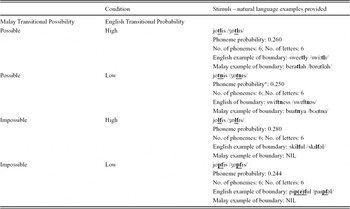
Fifty-six nonsense words (14 nonwords per condition × 4 conditions) were constructed, matched for phoneme probability, number of phonemes and letters, and controlled for syllable frequency (Nimmo & Roodenrys, Reference Nimmo and Roodenrys2002) as far as possible. The critical manipulation here was the type of transitional boundary between syllables. There were four types of transitional boundaries, formed by crossing the two within-participants variables: English (morphophonemic) Transitional Probability (high/low) and Malay (morphophonemic) Transitional Possibility (possible/impossible) (refer to Table 1).
Examples of stimuli from the Morpheme Decision Task with IPA transcriptions. Four conditions generated by crossing Malay Transitional Possibility and English Transitional Probability.

(i) Phoneme probability is calculated using the Phonotactic Probability Calculator (Vitevitch & Luce, Reference Vitevitch and Luce2004) and obtained by summing up the phoneme probabilities of the two syllables.
(ii) Only syllables with high syllable frequency were used (CELEX; Nimmo & Roodenrys, Reference Nimmo and Roodenrys2002).
English Transitional Probability
The statistics for English Transitional Probability were extracted from Hay (Reference Hay2003) and represent the position-specific probability of a given phoneme transition across a morphemic boundary. Transitional Probability is a measure of how decomposable a phonotactic boundary is, i.e., how likely an English native speaker is to treat the syllable boundary as belonging to a single morpheme (high transitional boundary) or to a bi-morphemic word (low transitional boundary). Mathematically, it takes into account the proportion of single morphemes containing that phoneme transition or coda–onset transition, based on the CELEX database corpus.Footnote 1 Taking tactful as an example, the /tf/ Transitional Probability is assessed as the proportion of single morphemes containing the /t/ final coda, followed by a /f/ onset. And to appropriate an example from Hay, the expected probability of /ns/ transition is computed by the proportion of morphemes with /ns/ coda–onset transition. All Transitional Probabilities were also verified by English native speakers (Chapters 2, 3 and the appendix in Hay provide comprehensive details).
Malay Transitional Possibility
The second linguistic factor, Malay Transitional Possibility, refers to the availability of a particular phonemic pairing at the juncture of the stem and its affix. Unlike Transitional Probability, which is based on the relative frequency, Transitional Possibility measures the token presence/absence of two phonemes in a morpheme boundary. Consequently, a /tl/ boundary is deemed transitionally possible because there is a Malay lexical entry containing an attested suffix with a /l/ onset and a root word with a /t/ coda (e.g., Beratlah [an exclamation about heaviness], see Table 1). Possible/impossible morphophonemic transition in Malay was determined by checking against the lexicon (Lim, Reference Lim1969; Tan & Tan, Reference Tan and Tan1980), consulting specialized texts on Malay affixes (Koh, Reference Koh1978; Ministry of Education Malaysia, 1992), and verifying with two native Malay first language users, neither of whom were participants in this study.
Finally, all the nonwords were bi-syllabic. The items were controlled for (i) overall phoneme probabilities, with all calculations based on the Phonotactic Probability Calculator (Vitevitch & Luce, Reference Vitevitch and Luce2004) [M = 0.271, SD = 0.049; F(3,52) = 0.647, p = .588]; (ii) syllable frequency (only syllables with high frequency (>44) were chosen, according to frequencies specified in Nimmo & Roodenrys, Reference Nimmo and Roodenrys2002); (iii) matched for both the number of letters; and (iv) the number of phonemes as far as possible (see Table 1 again). Furthermore, the nonsense words were chosen such that each matched pair contained the same phonetic beginnings and endings. Thus the only difference was their transitional boundaries. All 56 stimuli were programmed into E-Prime, which randomized their order of presentation for each participant.
It should be emphasized that the use of nonwords was important because this removed the possible confounding effect of lexical frequency (Balota et al., Reference Balota, Cortese, Sergent-Marshall, Spieler and Yap2004; Hay & Baayen, Reference Hay and Baayen2005) or semantic transparency (Marslen-Wilson, Tyler, Waksler & Older, Reference Marslen-Wilson, Tyler, Waksler and Older1994; Wurm, Reference Wurm1997). Also, since care was taken to balance and control for each item's internal phonotactics, the participants’ judgment between stimuli (say jotlis – jotnis – jolfis – jopfis) had to be solely based on junctural morphophonemics (operationalized as transitional boundaries).
Design and procedure
The experiment was a fully within-participants design, with English Transitional Probability and Malay Transitional Possibility as the within factors. Participants were allocated to individual workstations in a quiet room and asked to follow the instructions displayed on the screen. Before proceeding to the main experiment, they were briefed on the concept of morphemes. A morpheme identification task was then conducted as a screening test to check participants’ understanding of the instructions. Forty real words (20 single morphemes, 20 derived words with at least two morphemes) from Anglin's (Reference Anglin1993) study on morphology were used for this. As the task was devised to test actual understanding of morphemes, and not inferential ability to deduce patterns amongst the stimuli, 17 prefixed words were added as foils. All participants showed that they understood the relevant concepts, and all performed significantly above chance in this screening task [M = 30.24, SD = 1.76, t(20) = 26.69, p < .01].
For the main experiment, the participants were asked to imagine that they were assisting J. R. R. Tolkien to create an English-sounding Elfish dialect for a Lord of the Rings sequel. During the trials, they were asked whether the nonword shown on the screen sounded like a mono- or bi-morphemic word. If they perceived the nonword to be mono-morphemic, they were asked to press the button labeled “1” on the response box and “> 1” if they thought the nonword was bi-morphemic. After a block of 10 practice trials, the 56 experimental trials were presented as a single block with no breaks.
Both the practice and experimental trials began with a fixation point (+) at the center of the screen. The fixation point stayed online for 1000 ms, and was followed by the stimulus item. The stimulus string remained on the screen until the participant responded. All stimuli were presented in black lower-case print against a white background and accuracy data were collected.
Results
All the stimuli were nonwords so, strictly speaking, there were no right or wrong answers. For the analysis, the participants’ raw responses were coded with reference to the ‘ideal’ performance of a Standard English speaker, i.e., a score of 1 was awarded when the participant responded in the same manner (yes/no) as an English native speaker would according to Hay (Reference Hay2003), and a null score if otherwise. As long a stimulus has high English Transitional Probability, an English native speaker will treat it like a single cohesive morpheme, and press “1”. The reverse is true for stimuli with low English Transitional Probability because English native speakers tend to treat these junctures as sharp and decomposable, and would press “> 1”.
Although English native speakers were not involved in our study, valid direct comparisons can be made because the transitional boundaries in the stimuli had been tested using an English native sample across different tasks (see Hay, Reference Hay2003). This was appropriate because the target language of transfer is English in this study. Thus, the analysis facilitated understanding of how the morphophonemics of Malay (as L1) influences the processing of English (as L2).
A Friedman nonparametric analysis was conducted because the experimental conceptualization did not involve a true criterion. As there is no absolute correct or incorrect answer (the scoring system was devised in reference to English native speakers), it is therefore difficult to justify a parametric analysis which assumes a true criterion with the variance normally distributed around it. For this reason, a Friedman k-related samples nonparametric analysis was used. This statistical test ranks the scores of participants repeated across the four conditions (see Siegal & Castellan, Reference Siegal and Castellan1989, pp. 185–187, on “Small N and k”), and allowed us to evaluate how the Malay–ESL bilinguals perform across all four morphophonemic conditions, i.e., identify the condition(s) in which participants’ performance was consistent with that of an English native speaker.
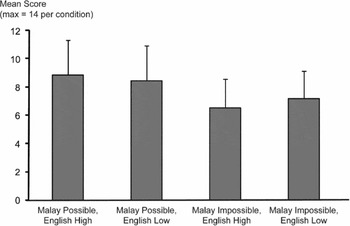
The mean accuracies are presented in Figure 1. For each condition, the results from all the participants were averaged to obtain the mean accuracy (maximum = 14). The results of the Friedman analysis confirmed that the difference across the four conditions was significant [χ2(3, N = 21) = 10.24, p = .017] by participants, with a moderate effect size [Kendall coefficient of concordance = .2], and also by items [χ2(3, N = 56) = 9.10, p = .028]. The outcome of this item analysis is evidence that responses to individual stimuli are consistent within each condition. Thus, taken together, the participant and item analyses indicate that the differences are both robust and reliable despite the relatively limited number of stimuli. Posthoc Wilcoxon, controlling for Type 1 error (α = .008), showed that the difference between “Malay Possible, English High” and “Malay Impossible, English High” [z = –3.40, p = .001] was significant, while the differences between “Malay Possible, English Low” and “Malay Impossible, English High” [z = –2.19, p = .029] as well as “Malay Possible, English High” and “Malay Impossible, English Low” [z = –2.04, p = .04] approached significance. Further testing showed that only the scores for “Malay Possible, English High” [z = –2.80, p = .005] and “Malay Possible, English Low” conditions [z = –2.42, p = .016] were reliably above chance (i.e., score = 7).
Mean score as a function of the four experimental conditions.

Discussion
We manipulated junctural phonetics at morpheme boundaries to examine whether a bilingual's L1 morphophonemic knowledge influences second language processing. More specifically, we predicted that cross-linguistic morphophonemic substratum transfer would occur when Malay–ESL bilinguals were asked to judge whether a nonword shown on the screen sounded like a mono- or bi-morphemic English word. If L1 morphophonemics does influence L2 processing, the Malay–ESL bilinguals would be more likely to perceive the nonword to be mono-/bi-morphemic in a manner similar to Hay's (2003) English native speakers, whenever the transitional boundaries are also present in Malay (L1).
The results provide reliable evidence of L1–L2 substratum transfer in Malay–English bilinguals. Only nonwords in conditions with possible Malay transitional boundaries were distinguished reliably above chance. In other words, as predicted, Malay–ESL bilinguals were better able to discriminate between high/low English Transitional Probabilities if the morphophonemic boundaries were also possible in Malay. Correspondingly, if those boundaries are not found in the Malay language (impossible Malay Transitional Possibility), Malay–ESL bilinguals were less able to capitalize on English Transitional Probabilities to make correct judgments about morphemic structure of the nonwords, resulting in guessing at chance between the two morphological options. In addition, when participants’ scores for the nonwords were ranked by condition, the Malay–ESL bilinguals performed best on the “Malay Possible, English High” and “Malay Possible, English Low” conditions. While results were particularly strong for the “Malay Possible, English High” nonwords, the performance for the “Malay Possible, English Low” nonwords was still better than that for the “Malay Impossible” nonwords. This indicates that, in general, the Malay–ESL bilinguals have acquired English phonotactic statistical regularities if those phonemic pairs are also possible Malay morphophonemic junctures. Based on the pattern of decision-making we observed, it seems that ESL bilinguals do make linguistic judgments about English through the lens of their first language. Such L1 regulation of L2 morphophonemic processing is in line with the hypothesized substratum morphophonemic transfer, a phenomenon that has not been empirically demonstrated before using junctural morphophonemics verified in natural languages.
The experimental results make three important contributions to the knowledge of bilingualism. First, they provide empirical evidence that cross-linguistic transfer of morphophonemics occurs, beyond the transfer of phonology (cf. Scholes, Reference Scholes1968; Tsushima et al., Reference Tsushima, Takizawa, Sasaki, Shiraki, Kanae, Morio and Best1994) and morphology (see Nicoladis, Reference Nicoladis2002, Reference Nicoladis2003). These results also complement Pater and Tessier's (Reference Pater, Tessier, Flack and Kawahara2005) experiment on the acquisition of an artificial language by English monolinguals.
Second, most of the earlier work shows that morphology and phonology are correlated (e.g., Deacon & Kirby, Reference Deacon and Kirby2004; Mahony et al., Reference Mahony, Singson and Mann2000; McBride-Chang et al., Reference McBride-Chang, Cho, Liu, Wagner, Shu, Zhou, Cheuk and Muse2005; Nagy et al., Reference Nagy, Berninger and Abbott2006; Shankweiler et al., Reference Shankweiler, Crain, Katz, Fowler, Liberman, Brady, Thorton, Lundquist, Dreyer, Fletcher, Stuebing, Shaywitz and Shaywitz1995), but the data reported here sheds new light on how the morphology–phonology interaction actually works, and the results are consistent with Hay et al.'s (Reference Hay, Pierrehumbert, Beckman, Local, Ogden and Temple2004) more stochastic view of juncture processing. A major contribution is thus the demonstration of implicit statistical morphophonemic processing originally proposed by Hay (Reference Hay2003). Even though the morpheme-counting task did not require that explicit attention be placed on the site between morphology/phonology, the pattern of the Malay participants’ responses suggested that this was how the decision was made. Moreover, this implicit activation of relevant morphophonemic knowledge during online processing is reliable for nonwords, so it is reasonable to assume that it is based on linguistic deduction rather than specific vocabulary knowledge.
The third and final contribution is that a bilingual ESL speaker's morphophonemics processing is influenced by the characteristics of their L1 – a finding that lends support to previous research centered on monolinguals’ judgment of nonwords (e.g., Hay, Reference Hay2003; Pater & Tessier, Reference Pater, Tessier, Flack and Kawahara2005). We have reported evidence of morphophonemic transfer in Malay–English speakers, but the same kind of phenomenon is likely to be observed in speakers of many other language pairs.
If morphophonemic transfer is widespread amongst bilinguals, there could be interesting pedagogical applications. For example, whenever materials are developed for use by second-language teachers, the positive or negative effects of morphophonemic transfer could be addressed with reference to specific pairs of contact languages. Bilinguals with languages that differ from English may be less sensitive to English morphophonemics than our Malay–ESL participants. This would be consistent with previous research on how Dutch (McQueen, Reference McQueen1998) and Arabic (Al-jasser, Reference Al-jasser2008) ESL users find it difficult to segment English words in connected speech, if the phonotactic boundaries are absent in their L1. Explicit instructions and training could bring the relevant information to the students’ attention. A better grasp of the L2 morphophonemics will in turn strengthen the ESL learners’ ability to understand spoken words, facilitating word segmentation into meaningful units, i.e., morphemes.
In conclusion, we found evidence for cross-linguistic transfer of morphophonemics. Bilinguals’ linguistic judgments for their second language appear to be filtered through their first language. In addition to the phonological and morphological similarities and differences, the morphophonemic relationship between contact languages is important, as the first language rules may facilitate or constrain acquisition of the second language.