Section 1: Introduction
There are two main economic theories of regulation. The first is the public interest theory, which argues that regulation corrects market failures and thereby increases societal welfare. The second is the public choice theory, which argues that regulation benefits particular rent seeking special interest groups at the expense of society overall (Tullock Reference Tullock1967; Stigler Reference Stigler1971). Stigler was one of the pioneers of the latter view and developed what would later be described as the theory of regulatory capture. Stigler argued that it was in the incentive of business interest groups, such as big business, to push for regulations—including discriminatory taxes, barriers to entry, and subsidies—in order to weaken their competitors. Stigler's theory has been extremely influential in the economic literature, and scholars who have criticized and refined Stigler's theory have generally concentrated on the legislative process behind the drafting of a bill for a regulatory agency and showed that it would often be the result of multiple special interest groups and not just one business faction (Posner Reference Posner1974; Peltzman Reference Peltzman1976; Becker Reference Becker1983; Gilligan et al., Reference Gilligan, Weingast and William1989).
Roughly concurrent with Stigler (Reference Stigler1971) was the historical work of Kolko (Reference Kolko1963, Reference Kolko1965). Although working in a different discipline, and from a very different perspective of market forces, Kolko applied the capture analysis to multiple regulatory agencies of the Progressive Era (1900–1917). Traditional historians of the Progressive Era argued that these regulatory agencies were thrust upon a recalcitrant industry and successfully acted in the public good. On the contrary, Kolko argued that for several key agencies and the respective “big business” interest group—the Interstate Commerce Commission (1887) and the railroads, the Federal Reserve System (1913) and the New York City banks, and the Federal Trade Commission (1914) and the trusts—the big business actually supported the regulatory commission and in fact benefited from it at the expense of the public. They benefited from it to the extent that they were able to achieve their goals of cartelizing given markets and blocking hostile legislation.
Scholars have documented the similarity of both authors and argued that Stigler (Reference Stigler1971) provided the classic theory of regulatory capture while Kolko (Reference Kolko1963, Reference Kolko1965) provided the classic empirical evidence (Posner Reference Posner1974, 342; High Reference High and High1991, 2; Novak Reference Novak, Carpenter and Moss2014, 26, 29–31). However, much like how economists have criticized Stigler's theory, historians have criticized Kolko's analysis and argued that he misinterpreted the legislative process behind various regulations and their actual effects (Martin Reference Martin1971, 112–13; McCraw Reference McCraw1975, 164–65, 174–75; Vietor Reference Vietor1977, 66; Sanders Reference Sanders1999, 2; Bradley and Donway Reference Bradley and Donway2013). They have noted that while big business often lobbied for regulation, there were also other players such as rival smaller enterprises, agrarian groups, and progressive reformers. As a result the big business interest did not achieve their main aims in the final draft of a regulation. Moreover, in the early years of a commission sometimes big business favored it, while other times they vehemently attacked it.
Both Stigler (Reference Stigler1971) and Kolko (Reference Kolko1963, Reference Kolko1965) suffer from a tension. If a regulatory agency is often the result of a legislative process involving a coalition of various interest groups, as contended by the later economic literature, and this applies to Progressive Era regulatory commissions, as argued by the later historical literature, then how, if at all, could the prominent regulatory agencies (the ICC, the FRS, and the FTC) have been “captured” by big business? Why did big business sometimes favor the commissions in certain years and other times harshly criticize them?
I argue that the answer lies in understanding who the given president actually appointed to run the Progressive Era regulatory commissions when they were first created and in subsequent years. In the early formative years when the commissions’ mandate and direction were vague and unspecified, the commissioners had enormous leeway in interpreting its rules and how they would be exercised. Therefore, although big business may not have accomplished what they wanted in a given regulatory law, they could still do so if they were able to influence the process behind the appointment of commissioners more than other contending interests. If commissioners interpreted various price, product, and business organization rules favorably, the big business interest group would consequently benefit from the regulation. In other words, the old adage “Personnel is Policy” applies: the policy of a regulatory agency depends on its personnel.
This paper develops a “Personnel is Policy” theory in relation to the public choice theory of regulatory capture and applies it to one of the prominent regulatory agencies mentioned above. It investigates the Federal Trade Commission and analyzes its performance from the perspective of the big business trusts up until the beginning of the Great Depression, when major political and economic forces led to a drastic change in antitrust policy. During the period under study (1914–1929), the trusts, particularly those associated with the investment bank J.P. Morgan & Co., supported legislation that would help control their competitors and eliminate hostile forms of intervention. However, contrary to Stigler (Reference Stigler1971) and Kolko (Reference Kolko1963) the final legislation was somewhat “forced” upon them because there were multiple special interest groups involved in the political process. The result was the Federal Trade Commission Act of 1914 that passed during the progressivist years of President Woodrow Wilson's first term.
The now apprehensive big business community was faced with a vague regulatory commission that could provide either net benefits or net costs depending on how the rules were interpreted and enforced, and this was largely determined by who was appointed to the FTC and other regulatory agencies. The trusts had intermittent success with the FTC, capturing it with friendly commissioners in its early years, only to lose control in the post-World War I years before finally gaining control again by the mid-1920s. Before the Great Depression the agency was sponsoring government enforced trade association cartels through its trade practice conferences. Ultimately, these results show that regulatory capture is a dynamic process that does not follow a deterministic path because control of an agency depends on the commissioners appointed who are continually changing over time.
This paper proceeds as follows. Section 2 develops a capture theory of political appointees to regulatory commissions and shows how an interest group might influence this process in order to control an agency. Section 3 provides the important legislative background behind the FTC, and Section 4 applies the “Personnel is Policy” theory by examining how FTC appointees from 1914–1929 affected regulatory capture from the perspective of the trusts. Section 5 concludes.
Section 2: A regulatory capture theory of commission appointees in the United States
Although Stigler (Reference Stigler1971) was not the first scholar to analyze the phenomenon of regulatory capture, he was the first to provide a formal economic explanation behind it. Essentially, Stigler argued that regulation is a good that can be bought and sold like any other and politicians will “sell” it to respective businesses, who “buy” it through bribes, campaign financing, and other forms of political support. Businesses will lobby for favorable regulations that provide benefits such as subsidies, price controls, discriminatory taxes, and regulatory barriers to weaken their competitors. These beneficial regulations are often provided by a regulatory commission. If the benefits derived from a government regulation are greater than the costs expended, the business interest group will earn a positive return on the regulation. Posner (Reference Posner1974) later called Stigler's theory regulatory “capture”: business interest groups, and not the public at large, are the ones who actually control and benefit from a regulatory agency. Later literature built off of Stigler's insights. Posner (Reference Posner1974) and Peltzman (Reference Peltzman1976) argued that there would often be multiple interest groups participating in the political process who could not only work together but also against each other to secure favorable legislation. Becker (Reference Becker1983) developed a formal model of the regulatory process. Gilligan et al. (Reference Gilligan, Weingast and William1989) followed and showed how the results of the regulatory process depend on the underlying political institutions. In the case of the United States, legislation has to pass both houses of Congress, which are both beholden to many interest groups, and each house has veto power over the other. Unless one interest group dominates both houses, a regulatory commission law will often be the result of a compromise between contending interests.
Generally, capture analysis after the regulatory law has passed has focused on the relationship between Congress, the regulated industry, and the commissioners (Spiller Reference Spiller1990; Laffont and Tirole Reference Laffont and Tirole1991; Martimort Reference Martimort1999). Literature has also focused on the extent to which Congress controls the regulatory commission through additional legislation, supervision, and appropriations (Weingast and Moran Reference Weingast and Moran1983). However, these studies have largely downplayed the actual appointment of commissioners and the president's role in that process. This is an important omission, because how the new regulatory commission behaves after the law is passed depends on the actual individual appointees that interpret and administer the law. In general, the vaguer the law, the more leeway and interpretive power is granted to the specific personnel of a commission. This is especially true during the formative years of a regulatory agency when its objectives have not been clearly defined or after a new law enhances its powers. How the law is interpreted can determine whether or not a particular special business interest derives benefits from the agency. Various clauses on price controls, product controls, rule compliance, and legal forms of business organization and market behavior can often be construed by commissioners as to be hostile, neutral, or favorable to a given industry. If the president wants the commission to behave in a certain manner then they will need to appoint the right people. In other words, “Personnel is Policy”: the policy of a regulatory agency depends on the specific personnel appointed by the president to be in charge (Higgs Reference Higgs, Balch and Powell2017, 26). The term was popularized during the Reagan administration, but the concept has been around since at least the Progressive Era (Kolko Reference Kolko1963, 247–48; Kolko Reference Kolko1965, 37–38; Moffitt Reference Moffitt2001; Faulkner Reference Faulkner2016). “Personnel is Policy” can be broadened and developed into a theory specifically related to the public choice theory of regulatory capture: the actual “capture” of a regulatory commission occurs not only during the legislative process but also during the presidential appointment process of commissioners.
The president is crucial for regulatory capture because they wield an enormous amount of power in the appointment process by nominating commissioners. After the president makes his choice, the Senate must decide to confirm or not confirm through a majority vote after the president's nomination passes through the respective committee. The president can also make recess appointments when the Senate is not in session. This means that similar to a cabinet position, the president has a substantial amount of latitude in deciding the direction of a regulatory agency, especially when the agency is in its infancy (Cohen Reference Cohen1986, 698; Calvert et al., Reference Calvert, McCubbins and Weingast1989, 591; Johnson and Libecap Reference Johnson and Libecap1994, 162). As a result, the president can cater to various interest groups by making sure the right people are appointed to run a regulatory commission. Much like how a congressman's support for legislation is based on their interaction with various interest groups, the president will appoint commissioners that help a given special interest group, such as a big business, in return for future campaign donations, assistance with upcoming elections, and jobs for themselves and family members. In addition, the president's prior career background, advisors, ideology, and their perception of the nominee's chance in the Senate confirmation also influences their choices. In theory, the president can also cater to rival interest groups during the nomination process to maximize their own benefits, especially at different points in time (McChesney Reference McChesney1997; Holcombe Reference Holcombe2018, 122–47). Commissioners will take a particular pro-, neutral, or anti-business approach based on their loyalty to the president, prior career background, ideological outlook, and the “revolving door” phenomenon of future private sector jobs and campaign support for a future political career (Eckert Reference Eckert1981; Cohen Reference Cohen1986).
A particular business or other group's influence over the commission's makeup increases based on their relative influence over the president and members of the Senate. It also increases to the extent there is an information asymmetry between the nominee's actual views and what the Senate and president knows, and between what rival special interests know. If it is difficult to acquire reliable information about a commissioner, or if politicians lack the knowledge about how to run a regulatory agency to best accomplish their goals, then they could unwittingly confirm a nominee that does not conform to their views of a proper commissioner and various rival special interests might also not fight the nomination because they do not know the commissioner will be hostile. Both will have to adopt a “wait and see” approach to how they behave. A special interest can be said to capture a regulatory commission and will thereby earn a positive return on the regulation when it has a majority of the committee members.
However, it is extremely important to understand that the capture of the commission may only be temporary. If regulatory capture depends less on the actual law itself and more on the presiding commissioners who change over time, then regulatory capture is logically a dynamic process and not a static “one-shot” event. Regulatory capture does not follow a pre-determined path after the enactment of a regulatory law, even if the law itself does not change, because a change in the perspective of a given presidential administration or a new presidential administration can lead to a change in personnel and the outlook of the commission. The direction of a regulatory agency can change from friendly to neutral or hostile, and vice versa, simply from the appointment of new commissioners whose beliefs differ from the old ones. Special interest groups must continually incur costs to make sure that the right people are appointed to a given agency, particularly when the tenure of a commissioner is short and not subject to permanent renewal, and these interest groups hold comparative advantages in political parties and presidential administrations.
In contrast to a static analysis where interests only have to invest resources at the beginning to capture an agency, the continual need to monitor commissioners and the adverse effects of interacting with a hostile president leads to higher costs that reduce the return from regulatory capture. In addition, the return is also reduced to the extent that there is a division of power among regulatory agencies that have overlapping jurisdictions, since special interests will often have to make sure that they have control of multiple commissions in order to accomplish their objectives. A lower return will also result if the appointed commissioners have less influence over specific policy, which can occur if the mandate becomes less vague or the commissioners have less influence over their subordinates (Johnson and Libecap Reference Johnson and Libecap1994, 162). Moreover, these increasing costs of regulatory capture reinforce the insights provided by Peltzman (Reference Peltzman1989) about why regulated industries may support deregulation: a regulated industry may support deregulation because it is a more attractive alternative than having to deal with a hostile commission.Footnote 1
Overall, the “Personnel is Policy” theory provides three important insights. First, regulatory capture depends on the specific individuals appointed to run the commission. Second, the president facilitates regulatory capture because they nominate the aforementioned individuals to the commission. Third, regulatory capture is a dynamic process that follows a non-deterministic path because the individuals of the given commission and related agencies continually change over time.
In the next two sections, I apply the “Personnel is Policy” theory by examining how changes in the makeup of the FTC led to favorable or unfavorable policies towards big business, and hence their capture of the commission. Section 3 provides the important legislative background behind the law, while Section 4 analyzes the appointment of commissioners in the first fifteen years of the agency's operations.
Section 3: The Drive for a Federal Trade Commission, 1900–1915
In the Progressive Era (1900–1917) the term “trust” commonly referred to any large business. The goal of these conglomerates was to replace competition in their industry with cartelization and stabilization. They accomplished this through informal arrangements and industry trade associations, which were organizations that tried to police “unfair” methods of competition. Trade association strategies such as uniform cost accounting, open pricing, and product standardization tended to benefit the largest firms in the industry due to their economies of scale, established links to consumers and suppliers, and identifiable product lines (Fligstein Reference Fligstein1990, 13, 34; Gordon Reference Gordon1994, 134–35). However, the trusts’ cartelization attempts were generally unsuccessful because of external pressure in the form of new and innovative competitors and internal pressure in the form of cheating (Kolko Reference Kolko1963, 26–56; Stone Reference Stone1977, 28–32; Lamoreaux Reference Lamoreaux1985, 138–42; Armentano Reference Armentano1990, 49–73, 85–100; Rothbard Reference Rothbard and Newman2017b, 91–107). To make matters worse, big business feared that some of their more radical progressivist critics would use the reinvigorated Sherman Antitrust Act of 1890 to break up their companies.Footnote 2 Both market and government pressure translated into political action: the goal of the trusts was to now lobby the government to revise antitrust laws and coercively sanction cartels in society to prevent the external and internal pressure that plagued voluntary arrangements (a guild system known as corporatism). It was a drive for regulatory capture that would achieve varying levels of success over the next thirty years.
The process initially began with several large firms, particularly those connected with the investment bank J.P. Morgan & Co., trying to work out private arrangements with President Theodore Roosevelt. The House of Morgan formally approached Roosevelt after Attorney General Philander Knox filed an antitrust suit in February 1902 against the Morgan railroad holding company Northern Securities, which was unexpected because J.P. Morgan himself had previously financed Roosevelt's political career and Roosevelt was personally close to Morgan partners George W. Perkins and Robert Bacon. J.P. Morgan & Co. was instrumental in organizing many new “trusts” in the “merger movement” of 1895–1904 and was determined to both stabilize competitive market forces and block hostile antitrust regulation.
In general, despite his rhetoric as a “trustbuster,” Roosevelt only wanted to regulate the trusts. His philosophy was similar to his friend Perkins, who believed there were “good trusts” (those companies that competed “fairly”) and “bad trusts” (those companies that competed “unfairly”). So similar was their philosophy that after the Northern Securities antitrust suit Perkins helped Roosevelt create a new Department of Commerce and Labor in February 1903, which was equipped with a Bureau of Corporations that gave the president investigatory and publicity powers over the “good” and “bad” trusts. As a result of the House of Morgan's continual informal arrangements, the good trusts referred to their companies, such as U.S. Steel and International Harvester, while the bad trusts were those owned by rival financial groups such as Standard Oil, American Tobacco, and the Beef Trust. Consequently, actions were only taken against the “bad trusts” while the Morgan companies could engage in activities forbidden to other trusts (Rothbard Reference Rothbard and Newman2017b, 203–30; Helferich Reference Helferich2018, 32–60, 141–58).
By the end of Roosevelt's second term, the Morgans looked to codify the “gentlemen's agreements” they had made with the president into law. They worked with the National Civic Federation, a peak corporatist association established in 1900. The NCF was a meeting of the minds from big business, the intellectual community, government officials, and labor. The philosophy of the NCF was to strike a middle-of-the-road position between reckless “laissez faire” capitalism and confiscatory socialism and develop a new cartellist political system. Ralph M. Easley, founder of the NCF, succinctly described its position when he wrote “our enemies are the Socialists among the labor people and the anarchists among the capitalists,” and it was important to “help shape the right kind of regulation than to have the wrong kind forced upon” you (Wiebe Reference Wiebe1962, 45–47; Weinstein Reference Weinstein1968, 11, 87).
After holding a National Conference on Trusts and Combinations in October 1907, the NCF and the House of Morgan worked in conjunction with Roosevelt and the Bureau of Corporations to write a legislative bill establishing their goals. After much revision, in March 1908 Representative William P. Hepburn introduced their bill into Congress. The Hepburn bill granted the Bureau of Corporations the power to selectively approve various mergers and activities of corporations and railroads, and suspend antitrust prosecution. In addition, unions were to be exempt from antitrust laws. However, some corporations and many small- and medium-sized businesses objected to the pro-union provision and the implicit licensing power granted to the executive branch. The bill quickly died in the House (Sklar Reference Sklar1988, 228–285; Shaffer Reference Shaffer1997, 135; Sanders Reference Sanders1999, 276–277; Cyphers Reference Cyphers2002, 26; Rothbard Reference Rothbard and Newman2017b, 288–91).
The failure of the Hepburn bill led the trusts to support the creation of a trade commission that would accomplish the same objectives. A regulatory commission could help the trusts cartelize and provide government coercion to enforce the activities of trade association cartels as well as block hostile antitrust actions. In this aim, they were now supported by small- and medium-sized businesses who realized they could also use a commission to strengthen their own trade association agreements, which had recently been growing in prominence and under scrutiny by antitrust authorities. The trust's need for a commission became especially apparent during the presidency of William Howard Taft, when to the surprise of the House of Morgan and the overall big business community Attorney General George W. Wickersham initiated antitrust suits against U.S. Steel in October 1911 and International Harvester in April 1912. The suits surprised the Morgans because they had supported Taft in the election of 1908, and the big business community because the Supreme Court had enunciated the friendly “rule of reason” doctrine in the landmark decision dissolving Standard Oil in May 1911 (Kolko Reference Kolko1963, 180; Helferich Reference Helferich2018, 170–176; Phillips Sawyer Reference Phillips Sawyer2018, 104).
The NCF sent out a business survey in November 1911 and quickly began to draft a bill for a trade commission after their report showed that the overall business community favored such regulation. The president of U.S. Steel, Judge Elbert H. Gary, instructed the legal counsel of the American Iron and Steel Institute to assist the NCF in writing the bill. Perkins and Gary testified in front of Congress on behalf of a federal commission that could license corporations, approve in advance their interstate activities, and support “fair” trade association agreements (Kolko Reference Kolko1963, 175–78; Weinstein Reference Weinstein1968, 87–88; Shaffer Reference Shaffer1997, 134–135).
Big business did not favor a trade commission per se, but the right kind of trade commission. Since the trade commission would be given power to regulate big business it could either be friendly or hostile, and it was important to make sure that it was appropriately staffed with the right men. In 1911 Perkins frankly testified to Congress that “we have got to have here in Washington a controlling commission, composed largely of business men.” It was due to such statements that Woodrow Wilson considered a trade commission the machination “of the very men who are to be controlled,” such as “the men who form the United States Steel Corporation.” Furthermore, he argued that a commission would lead to a “partnership between monopoly and government” and warned “once the government regulates monopoly, then monopoly will have to see to it that it regulates the government” (Davis Reference Davis1969, 32, 36; Winerman Reference Winerman2003, 45–46).
By the election of 1912, the political and intellectual climate was broadly coalescing into two different “progressive” perspectives on the trust problem, with a spectrum in between. The first was the philosophy of Roosevelt and Perkins called the “New Nationalism” that advocated regulating large companies through a trade commission. Although there were differences in opinion of how harsh the trade commission would regulate, pro-big business New Nationalist progressives argued for a friendly commission that would allow the business community to coercively regulate itself. The other doctrine was the “New Freedom” which strongly distrusted a commission and instead wanted more powerful antitrust laws to penalize and break up the trusts. The New Freedom was enunciated in various evolving forms by the Democratic candidate Wilson, the populist radicals William Jennings Bryan and Robert LaFollette, and the “People's Lawyer” Louis D. Brandeis (Winerman and Kovacic Reference Winerman and Kovacic2010, 150–155; Kolasky Reference Kolasky2011b).
After Taft's antitrust suits against Morgan companies, the Republican Party was split in the election of 1912 because Perkins and other Morgan affiliates financed Roosevelt to run for the independent Progressive Party (Helferich Reference Helferich2018, 174–76; Kolasky Reference Kolasky2011c). As a result, Woodrow Wilson won the White House and secured majorities of anti-big business “New Freedom” Democrats in both houses of Congress. While ostensibly a radical populist and New Freedom proponent, President Wilson's sudden rise into politics, surprise victory due to the split in the Republican Party, and links with the big business community caused him to frequently straddle between a pro- and anti-big business outlook. This was seen early on in his political appointees. In one of his last days in office Taft signed legislation that split the Department of Commerce and Labor into two departments. For the Department of Commerce, Wilson initially tried to nominate the anti-big business trade associationalist Louis Brandeis, but it was blocked by pro-big business advisors. Wilson instead settled on someone much more supportive of big business: William C. Redfield, a congressman and New York steel manufacturer who was a trustee of the large Equitable Life Assurance Society and former president of the corporate American Manufacturers Export Association (Sklar Reference Sklar, Rothbard and Radosh1972, 28–29; Burch Reference Burch1981, 211, 235).
After securing tariff and banking reform, in early 1914 Wilson turned to the subject of corporate regulation. Wilson was particularly anxious about this reform since a midterm election was approaching and with a severe recession that began in early 1913 Wilson and the Democrats were viewed negatively by the business community. Consequently, during this time the NCF worked hard to lobby the new administration and successfully established what Davis (Reference Davis1969, 55) called a “cozy relationship” with the head of the Bureau of Corporations, Joseph E. Davies. Davies, in turn, issued a report to the president that apparently converted Wilson to the commission approach. The NCF's current bill was sent to both Davies and Wilson and called for an Interstate Trade Commission to be equipped with investigatory, publicity, and licensing powers over corporations. Although once vigorously protested, by now New Freedom Democrats had warmed up to the basic concept of a trade commission because it could increase business support for the party in the upcoming midterm elections and at the same time appease radicals by enforcing punitive restrictions on big business. Consequently, the Democratic-controlled Congress passed the Federal Trade Commission and the Clayton Antitrust Acts in the fall of 1914. In the November elections, the Democrats maintained control of Congress (Scott Reference Scott2000, 153–199).
The Federal Trade Commission Act created a five man regulatory board appointed by the president and confirmed by the Senate. The commissioners were appointed for seven year terms and no more than three could belong to the same political party (the terms were staggered at the beginning). It subsumed the old Bureau of Corporations and became an independent commission separate from the new Department of Commerce. Importantly, its main feature was a vague and malleable mandate in Section 5 of its constitution stating “unfair methods of competition in commerce are hereby declared unlawful.” The commission could decide what was unfair and issue “cease and desist” orders and even initiate potentially harsh antitrust prosecution. In other words, the legislation was not a one-sided capture by the trusts, as Kolko (Reference Kolko1963, 270, 277) had argued, but instead a compromise one would expect from a bicameral and Democrat-controlled Congress representing multiple special interests.Footnote 3
As Davis (Reference Davis1969, 130) states, “in effect, not one, but two commissions were established in 1914.” The first was the New Nationalism variety—it would be friendly to the big business community and produce “orderly” competition and a cessation of antitrust activities so the government could coercively enforce the trusts and cartel agreements. The second was the New Freedom variety supported by radicals who wanted a heavy handed commission to tame big business and trade associations. Which one the agency would be depended largely on who Wilson appointed to the commission to interpret what constituted “unfair” in Section 5. From the perspective of big business, Wilson recently leaned too much towards the New Freedom proponents, but they were cautiously optimistic about who he would appoint.
Section 4: The Evolution of the Federal Trade Commission, 1915–1929
1. The early years, 1915–1917
Once President Wilson signed the law he began to receive a deluge of letters and advice on who to nominate to the commission. If Wilson wanted to win reelection in 1916 and marshal the nation's resources to the war that broke out in Europe in the summer of 1914, he needed big business on his side (McCraw Reference McCraw1984, 125; Winerman Reference Winerman2003, 93). In early January 1915 Wilson gave speeches stating that the job of the commission, passed by a New Freedom Congress, was actually to provide “a body of men—the majority practical businessmen—to interpret the facts and apply the laws” (Davis Reference Davis1969, 134). His appointees confirm this New Nationalist statement and clearly show the relevance of the “Personnel is Policy” theory for understanding regulatory capture.
It came as no surprise that his first pick was Joseph E. Davies, head of the now defunct Bureau of Corporations who had previously collaborated with the National Civic Federation on a trade commission bill. Davies would also be the commission's first chairman. An even more important choice was Edward N. Hurley, a wealthy businessman who was an early Wilson supporter and former president of the Illinois Manufacturers Association, an organization that had business relations with the Chicago-centric and Morgan-oriented International Harvester and U.S. Steel interests. In addition, he was also a director of the large Morgan and New York influenced Chicago Great Western Railroad. Out of Wilson's appointees, Hurley was by far the most pro-big business and soon succeeded Davies as chairman. Wilson also picked George Rublee, a man instrumental in helping to draft the trade commission bill. Rublee was also a director of the sizable American Coal Products Co. and previously a Wall Street lawyer who was good friends with the corporate lawyer and Morgan partner Dwight Morrow. He was also a member of the special committee on trade legislation of the United States Chamber of Commerce, a peak association of corporate, banking, and commercial interests created in 1912. The final two commissioners were William H. Parry, a former Seattle businessman who was once president of the Morgan Shipbuilding Corporation, and the southerner William J. Harris, a small businessman who was relatively insignificant on the commission (Sklar Reference Sklar, Rothbard and Radosh1972, 23–26; Burch Reference Burch1981, 216–218, 238–239; Sklar Reference Sklar1988, 261; Gordon Reference Gordon1994, 144, 147). Louis Brandeis later remarked that Wilson had squandered the opportunity by nominating pro-business commissioners and it was “a stupid administration” (McCraw Reference McCraw1984, 126; Winerman and Kovacic Reference Winerman and Kovacic2010, 155). However, Wilson had also offered a position to Brandeis, but he turned down the offer in the hopes of getting a better position, which he did when Wilson nominated him to the Supreme Court in 1916.
Aside from choosing commissioners well suited to the big business community, Wilson also picked based on politics. Davies, Hurley, and Harris were Democrats while Rublee and Parry were Progressives. Harris and Parry were chosen to give the South and West representation and Wilson shrewdly chose two Progressives and not Republicans as an apparent bid to woo voters who supported Theodore Roosevelt in 1912. Politics also played an important role in only securing Rublee a recess appointment. Senator Jacob Gallinger was able to block his confirmation because Rublee had unsuccessfully tried to orchestrate Representative Raymond Stevens to run against him in 1914 (Winerman and Kovacic Reference Winerman and Kovacic2010, 156; Kolasky Reference Kolasky2011a, 110).
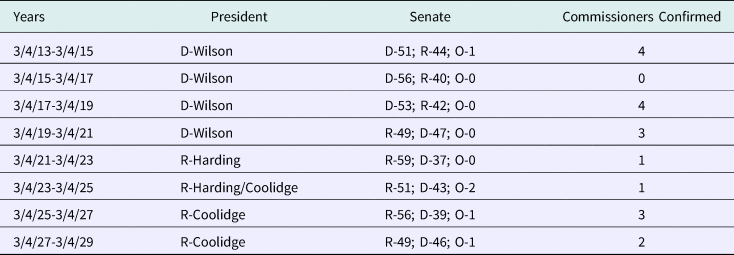
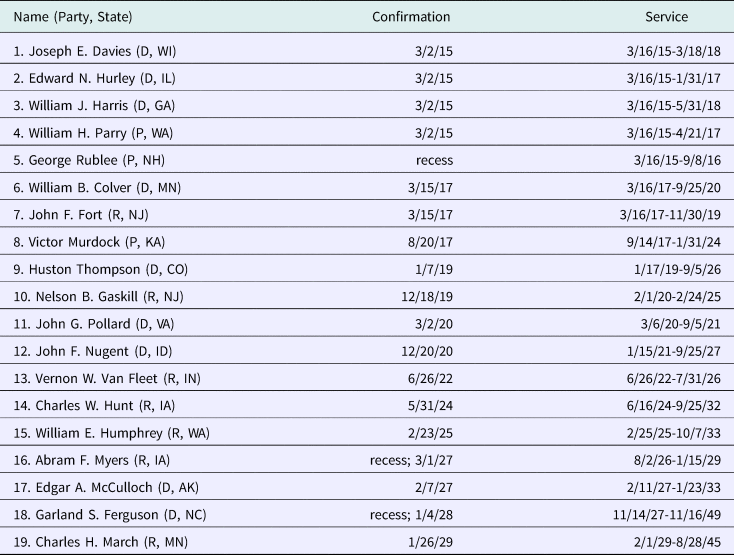
Table 1 presents party control of the presidency and Senate, while Table 2 lists the history of the federal trade commissioners, including their party affiliation, home state, confirmation date, and years served. Table 1 shows that the party that controlled the presidency almost always controlled the Senate, which helped with the confirmation process. Unfortunately, except in rare cases discussed below specific votes were not made public in the Congressional Record, so a more detailed analysis cannot be made regarding how the Senate responded to the president's nominations. Regarding the current nominees, aside from Rublee information asymmetries led the Democrat-controlled Senate to acquiesce to Wilson's choices and adopt a “wait and see” approach. A similar practice would largely occur for Wilson's other appointees and later presidents, which meant that the president exercised substantial discretion in the choice of commissioners and direction of the agency (Webbink Reference Webbink1928).
Control of the Presidency and Senate, 1913–1929
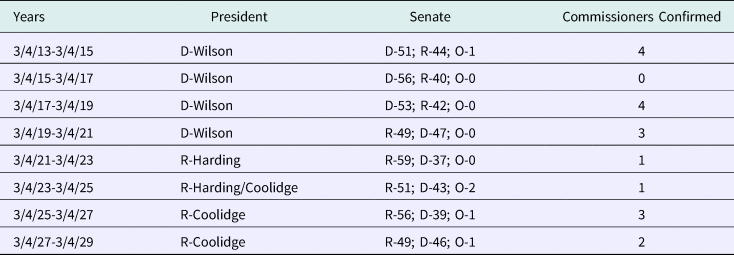
Key: D-Democrat; R-Republican; O-Other Party. Sources: U.S. Department of Commerce (1960, 691).
Federal Trade Commissioners, 1914–1929
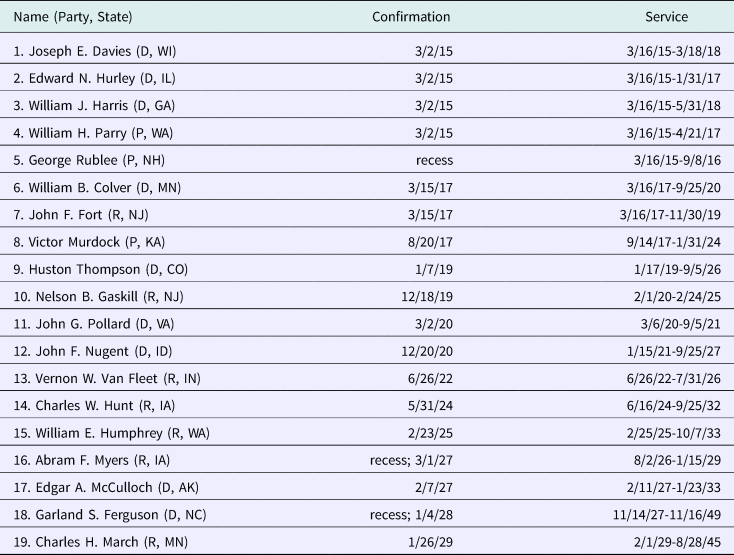
Key: D-Democrat; R-Republican; P-Progressive.
Note: Only the initial recess appointment, if applicable, and initial confirmation are shown.
Sources: (FTC, 2013); U.S. Senate (1915, 5174–75; 1917, 78, 6197–98; 1919, 1105; 1920, 828, 3753; 1921, 569; 1922, 9402; 1924, 10016; 1925, 4416, 4440; 1927, 3173, 5225; 1928, 966; 1929, 2309).
On March 16th 1915 the commissioners met and promptly began their work. Initially, they had a wide degree of latitude in setting up their operations since there was uncertainty over how regulatory power was divided between the FTC, the DOC, and the Justice Department. In April Davies attended a meeting of the USCC and spoke of the need for the FTC and the business community to work together. The USCC even created a division to work with the FTC called the Federal Trade Committee, a nine-member board that included important businessmen such as Harry A. Wheeler, vice president of the Union Trust Company of Chicago. However, it was Hurley by far who gave the most speeches to the business community (Davis Reference Davis1969, 144–52; Moore Reference Moore1980, 73). Perhaps most notable was when Hurley talked to the Association of National Advertisers in December 1915 and declared that
To do for general business that which these other agencies [the Interstate Commerce Commission for the railroads, and the Federal Reserve System for the banks] do for the groups to which I have referred was the thought behind the creation of the trade commission (Kolko Reference Kolko1963, 274–75).
The FTC's friendly stance was quickly appreciated by big business, and the brokerage firm and member of the New York Stock Exchange Clark, Childs and Company wrote confidentially to its customers in May 1915 that “the new Commission seems to run with the main idea of helping business…. sanity is again beginning to govern in … the question of Government relation to ‘big business’” (Davis Reference Davis1969, 148–149). The NCF agreed, as shown by speeches given by Jeremiah W. Jenks, a prominent economist very supportive of trusts, at its annual meeting in January 1917. The FTC, Jenks stated, has carried out “its work with the purpose of securing the confidence of well intentioned business men, members of the great corporations as well as others” (Weinstein Reference Weinstein1968, 90–91).
The business community was pleased with the commission's friendly stance towards trusts and trade associations. First, the FTC initiated promising first steps regarding the practice of “advance advice,” which was when businesses approached the FTC and learned in advance what would be considered “unfair methods of competition” prosecutable under antitrust law. When deciding what to do, the commission invited informal advisors to offer their opinions, including the corporate lawyer Arthur J. Eddy, Morgan lawyer Victor Morawetz, and the “People's Lawyer” Louis Brandeis. All agreed on the practice save Brandeis, who strongly dissented. Although there was nothing in the law that said advice could be given, Eddy shrewdly realized that if the commission was to “prevent” anticompetitive practices, then when a company filed information on a proposed activity that was considered “unfair” the FTC could file a complaint and thereby “prevent” it. This led to a “conference rulings” procedure for future key tasks (Kolko Reference Kolko1963, 270–278; Moore Reference Moore1980, 63–64). Although the advance advice was at this time only informal and selective, it in essence was the inspiration for its 1920s trade practice conferences when it met with businesses to figure out what cartelizing activities would be coercively enforceable by the agency.
Second, largely through the efforts of Hurley the FTC promoted industrial knowledge and uniform systems of cost accounting that would provide industry-wide statistics to help eliminate “ignorant” forms of price competition by firms who “erroneously” sold below “cost.” Both Hurley and trade associations supported standardized accounting practices because they believed it would strengthen cartels. Hurley's efforts were ultimately blocked due to a lack of congressional funds, disagreements within the commission, and bureaucratic rivalry with the DOC. However, his initial efforts were important, because in March 1917 the DOC's Bureau of Foreign and Domestic Commerce absorbed the program and later vigorously promoted a similar agenda in the 1920s (Moore Reference Moore1980, 88–94, 110–111, 193–193; Phillips Sawyer Reference Phillips Sawyer2018, 153).
Lastly, the FTC helped strengthen export trade associations. The export trade had increasingly became a concern of large industrial corporations, who voiced their concerns through associations such as the USCC, the American Asiatic Association, the Pan-American Society, the AMEA, and the National Foreign Trade Council. Hurley understood these concerns as he was prominent in organizing the NFTC and in 1913 had toured Latin America on behalf of the DOC. In May 1916 Hurley addressed the American Iron and Steel Institute and praised the trade association for its model behavior and inspiration for future government-business partnerships. The FTC, Hurley exclaimed, would soon support a bill that created government-enforced export trade cartels. U.S. Steel's Judge Gary agreed and only expressed the logical conclusion that government enforced cartels should also be consistently applied to domestic trade associations. The explicit strengthening of export trade associations was embodied in the Webb-Pomerene Act of April 1918, which U.S. Steel heartily supported. By the end of the year the FTC had a formal export trade division (Urofsky Reference Urofsky1969, 56–59, 71–78; Sklar Reference Sklar, Rothbard and Radosh1972, 26–31, 41; Moore Reference Moore1980, 94–97).
From 1915–1916 the FTC was taking crucial preliminary steps that pleased the big business community and moved the commission in a direction they had long desired. There was a problem, however, and it had to do with the makeup of the commission. In late 1916 when it became clear Gallinger would not budge on Rublee's appointment, Rublee bitterly resigned. In January 1917 Hurley left the commission to return to the private sector and assist the war effort, and in the spring Parry died. In the fall both Harris and Davies expressed interest in running for Senate positions in the upcoming elections and promptly left by early 1918 (Winerman Reference Winerman2003, 95–96). In just three short years the commission would have totally new management. And it came at an unfortunate time for big business because Wilson's reelection was secured and he now needed to placate the radicals his party.
2. The New Freedom Phase, 1917–1925
After America entered the war in April 1917, new independent wartime regulatory agencies were created that supplanted the Federal Trade Commission and worked with trade associations to establish a corporatist system to facilitate the war effort. Most notable was the War Industries Board commanded by Wall Street financier Bernard Baruch, which gave out war contracts and imposed cartelizing rules and regulations for the nation's various industries. The House of Morgan also had extensive underwriting privileges with the Allied governments and steered foreign war contracts to their large firms, such as General Electric, U.S. Steel, and Bethlehem Steel (Weinstein Reference Weinstein1968, 214–233; Higgs Reference Higgs2012, 126–30, 135–43; Chernow Reference Chernow1990, 183–204; Shaffer Reference Shaffer1997, 21–28; Rothbard Reference Rothbard and Newman2017c, 363–382). However, the WIB and the distraction of wartime production masked growing problems at the FTC.
As vacancies opened up after the initial commissioners left, Wilson used the opportunity to placate the New Freedom progressives and populist interest groups in the Democratic Party who helped establish the FTC and had grown disenchanted with it. In March 1917 Wilson appointed John Franklin Fort, a former progressive governor of New Jersey, and William B. Colver, a LaFollette progressive. In September Victor Murdock, a journalist and former congressman skeptical of large firms, also assumed a commissioner post (Davis Reference Davis1969, 179, 183; Winerman and Kovacic Reference Winerman and Kovacic2010, 169–170). Here were the men of the New Freedom big business feared.
The three men presided over the commission until the end of the war and quickly directed it to what the big business community considered troubling practices. The first was when Wilson asked it to help in the war effort by undertaking a detailed investigation of the cost of essential war items, with the insinuation that certain industries might be earning excessive profits. But far more worrisome was the inquisitorial investigation of the Chicago Beef Trust. Since 1916 New Freedom populists and progressives in Congress had demanded an investigation, but Commissioner Hurley was able to block their efforts. When Hurley left in early 1917 President Wilson shortly thereafter directed it to make a detailed study. The result was a report that condemned the large packers for excessive profits and “unfair” competitive practices and advocated major structural changes to the industry including outright public ownership and restrictive regulations. The trusts proceeded to now attack the commission they once considered a promising friend. The U.S. Chamber of Commerce, which the Beef Trust financially supported, bitterly protested the meatpacking investigation. In April 1918 the USCC's Federal Trade Committee issued a report attacking the commission after what was such a promising start, and in December 1918 the Nation's Business, the official organ of the USCC, attacked the “Federal Trade Triumvirate” (Davis Reference Davis1969, 182–190, 234–35; Moore Reference Moore1980 244–45, 276–77).
The USCC initially tried to get Wilson to appoint favorable commissioners for the two vacant positions, but Wilson was unsympathetic. Wilson's choices for the remaining two positions were Huston Thompson and Nelson B. Gaskill, both of whom began in early 1919 and 1920 respectively. Thompson was a Wilson associate and a politically ambitious lawyer who was adamantly against big business, and Gaskill was attorney general of New Jersey while Wilson was governor and a New Freedom progressive. When Fort left in late 1919 and Colver in 1920, Wilson nominated John G. Pollard and John F. Nugent, both Bryanite politicians and lawyers. Moreover, when Commerce Secretary Redfield resigned, Wilson replaced him with Joshua W. Alexander, a small town lawyer from Missouri with no corporate ties. Wilson and the FTC were no longer sympathetic to big business and now catered to the rural populists, small businesses, and progressive reformer interests in both parties. While big business considered the attacks on the meatpackers socialistic, livestock associations and agricultural grocers who complained about “unfair competition,” consumer groups, and radicals such as Senator LaFollette and union leader Samuel Gompers praised the commission's efforts. The trusts’ displeasure with the FTC parallels their failures to maintain wartime cartelization in a peacetime agency, which was strenuously opposed by Wilson and his Attorney General A. Mitchell Palmer (Davis Reference Davis1969, 189–200; Burch Reference Burch1981, 241; Winerman and Kovacic Reference Winerman and Kovacic2010, 170–174; Rothbard Reference Rothbard and Newman2017c, 389–396).
The Republicans in the election of 1920 attacked the FTC, and riding on a wave of public distrust regarding participation in the war Republican Warren G. Harding was elected in a landslide. A compromise candidate due to the gridlocked Republican convention, President Harding had few corporate connections and his administration was a coalition of various interests. To lead the DOJ Harding appointed an old friend and former campaign manager, Harry M. Daugherty. His enforcement of antitrust laws in an effort to garner favorable public support, particularly against trade associations, clashed with the plans of Harding's Secretary of Commerce, Herbert Hoover. The former czar of the Food Administration in World War I and a moderate big-business trade associationalist, Hoover was a self-made millionaire whose two important informal advisors were Morgan partners Thomas W. Lamont and Dwight Morrow. Under the aegis of the DOC, Hoover published valuable information statistics in the monthly Survey of Current Business to help trade association's cartelization efforts, established a waste elimination division to ensure compulsory standardization of products, and reorganized the Bureau of Foreign and Domestic Commerce to house export commodity divisions to assist export trade associations. While Daugherty resisted these efforts, Hoover eventually won out when Daugherty was forced to resign as Attorney General in 1924 in the aftermath of the Teapot Dome scandal (Davis Reference Davis1969, 220–21; Himmelberg Reference Himmelberg1976, 9–12, 23, 37, 43; Burch Reference Burch1981, 251; Rothbard Reference Rothbard and Newman2017a, 520–525; Rothbard Reference Rothbard and Newman2017c, 448–449; Phillips Sawyer Reference Phillips Sawyer2018, 163–167, 180–81).
So far had the FTC drifted during this time that not only did it oppose many of Hoover's efforts, but it actually accused Daugherty of not being strong enough on antitrust. The Harding Administration considered the FTC an embarrassment and tried to weaken it. Although armed with a sizable Senate majority, Harding could only appoint new members when the commissioners’ terms expired, and he was only able to appoint one new member, in 1922: Vernon W. Van Fleet, a former lobbyist for the National Association of Manufacturers who was hostile to the New Freedom agenda. The Republicans in Congress cut the budget and responded forcefully to the meatpacker investigation with the 1921 Packers and Stockyards Act, which transferred oversight of the meatpackers to the friendlier Department of Agriculture and out of the FTC's jurisdiction.
When Harding unexpectedly died in August 1923, his successor Calvin Coolidge accelerated these trends. Unlike Harding, Coolidge was much closer to the corporate and big business community, and like Hoover considered Morgan partner Dwight Morrow a crucial informal advisor. The Coolidge administration was the zenith of the Morgan interests in both domestic and foreign policy. President Coolidge quickly changed the personnel at the DOJ to be more favorable to big business and trade associations, and in 1924 was able to appoint Charles W. Hunt to the FTC. Hunt was later criticized by New York Times on account of information asymmetry in the Senate: “he was supposed to be ‘progressive’ in tendency when appointed, [but] exhibited reaction in his votes and activities after assuming office” (Himmelberg Reference Himmelberg1976, 57–62; Burch Reference Burch1981, 274; McCraw Reference McCraw1984, 150–151; Chernow Reference Chernow1990, 251–255; Winerman and Kovacic Reference Winerman and Kovacic2010, 174–176). But pro-big business commissioners at the FTC were still a minority, and it was only in 1925 that things really began to change.
3. The New Nationalism Phase, 1925–1929
In 1925, proponents of big business had an extremely negative outlook of the Federal Trade Commission. Former Commerce Secretary Redfield protested in the Nation's Business that the FTC was “a disappointment and a scourge to the business world,” and the Wall Street Journal complained of the “crusading, muck-raking body.” On the other hand, LaFollette's Magazine proudly stated that the FTC “has not only restrained the greed of the steel trust, but it has investigated the packers, the harvester trust, grain exchanges, lumber trusts, aluminum trust, fertilizer trust, and other great organizations…. the Commission was the friend of labor, of the farmers, of cooperative organizations, and of the small business man” (Davies Reference Davis1962, 443–445). However, the situation rapidly changed.
In February 1925 President Coolidge announced the pick of William E. Humphrey, a staunch partisan Republican whose actions exemplify the “Personnel is Policy” theory. Humphrey was a former representative from Washington and a strong supporter of President Roosevelt. After his term in Congress ended he failed to obtain a Senate seat, returned to private law, and became a lobbyist for lumber interests in the Pacific Northwest. Humphrey's predilections were known by all, and the New Freedom-oriented The Nation protested his appointment as a “deliberate breaking down of governmental safeguards against the evils of big business,” and warned that “big business has no warmer friend or defender.” Humphrey's nomination was so controversial that a group of progressive senators from both parties futilely tried to stop it and requested that the “injunction of secrecy” placed on the vote be removed, revealing it to be 45–10 (U.S. Senate 1925, 4416). Senator George Norris, who had bitterly fought his confirmation, remarked that he “has changed the viewpoint of the commission. It now stands three to two in favor of the big-business idea.” Humphrey quickly turned the commission away from its previously New Freedom direction to the direction of big business and New Nationalism, and boldly stacked subdivisions of the commission with men of his liking. He responded to congressional criticism in his characteristically truculent and pugnacious fashion:
Do you think I would have a body of men working here under me that did not share my ideas about these matters? Not on your life. I would not hesitate a minute to cut their heads off if they disagreed with me. What in hell do you think I am here for? (Davis Reference Davis1969, 237–250, 251–253, 257).
Coolidge's other major appointee confirmed the shift from New Freedom to New Nationalism. Abram F. Myers, a previous bureaucrat in the Department of Justice, assumed a position in 1926. He was an ardent New Nationalist and associationalist, and was given a recess appointment in 1926 until he could be confirmed in 1927. Coolidge also was able to nominate two other commissioners in 1927, Edgar McCulloch and Garland Ferguson, and one in 1929, Charles H. March. While there were occasional differences among the commissioners, there is no doubt that by and large during the Humphrey years in the 1920s there was a pro-big business cartellist attitude at the FTC, especially when compared to the previous personnel (Davis Reference Davis1969, 261; Winerman & Kovacic Reference Winerman and Kovacic2011, 719–722, 730–731).
What exactly did Humphrey's arrival mean for the FTC? In March 1925 he set out his vision and developed new rules regarding antitrust prosecutions and lawsuits. The commission's investigations would no longer be sweeping and general, something that a progressive Congress often authorized and desired, but instead narrow and directed only towards definite allegations. Moreover, businesses could present their arguments and settle cases informally and confidentially to avoid negative publicity from antitrust violations. This reduced the ability and effectiveness of the FTC to initiate antitrust practices against big business (Daves Reference Davis1969, 245–256; Winerman and Kovacic Reference Winerman and Kovacic2011, 735). In general, during this period the DOJ and the FTC's antitrust prosecutors preferred to use their limited resources in easy cases involving small trade associations and firms engaging anticompetitive practice that were not difficult to identify, which relatively benefited the big business community and helped promote mergers and new “trusts” (Posner Reference Posner1970, 411; McCraw Reference McCraw1984, 144–147; Shughart and Tollison Reference Shughart, Tollison, Mackay, Miller and Yandle1987).
More important was Humphrey's promotion of what were called “trade practice conferences” where the FTC helped various trade associations form cartels. In April 1925 Humphrey created a Trade Practice Conference Division to oversee such arrangements, which were previously uncommon. The process was as follows: a conference meeting was scheduled after the commission approved an application from an industry or trade association. At the conference the firms that attended would write rules of what constituted “unfair methods of competition” that applied to all members in an industry (Group I rules), which a representative of the FTC, usually a commissioner, either approved or disapproved. Firms that deviated from the established rules were then prosecutable by the FTC. The main difference between these rules and the earlier failed voluntary arrangements devised at the beginning of the century was now there was a coercive enforcement mechanism under the stewardship of the FTC. This coercion was masked under the garb of voluntary choice appropriate for the “normalcy” of the 1920s, but there is no doubt that the FTC stood ready to enforce compliance regardless of whether a business agreed to it or later changed its mind (Joseph Reference Joseph2010, 89–90; Winerman and Kovacic Reference Winerman and Kovacic2011, 713).
In the 1920s trade associations had grown in increasing prominence as a way to help provide the rationalization, stabilization, and standardization of the marketplace that larger firms had been trying to impose on smaller and dynamic firms in their industry since the beginning of the Progressive Era. Big business leaders such as Judge Gary of U.S. Steel and Charles Schwab of Bethlehem Steel preached to the American Iron and Steel Institute in the 1920s on the need to end competition and utilize government enforcement. Corporatism was most widely adopted in the early years of Benito Mussolini's Italian fascism, and it is therefore not surprising that big business leaders such as Gary, Morgan partner Lamont, and president of the New York Stock Exchange E.H.H. Simmons lauded Mussolini's leadership. It was hoped that trade practice conferences could serve as an important stepping stone to instituting a more formal corporatism. It is no coincidence that the number of trade associations and trade practice conferences sharply increased during this period. Before 1926 the number of conferences averaged less than three per year, and after 1926 they averaged 16 per year. In 1929 there were 31 such conferences and in 1930 almost sixty (57). This coincided with a general business push to revise antitrust laws in the late 1920s, spearheaded by the old and waning National Civic Federation (Davis Reference Davis1969, 257; Diggins Reference Diggins1972, 144–69; Himmelberg Reference Himmelberg1976, 81–82; Shaffer Reference Shaffer1997, 80–81, 126–136; Joseph Reference Joseph2010, 90).
In 1927 Humphrey boasted that “the businessmen who have come in contact with the Commission during the last year realize [the] change in attitude, and I know that they fully endorse it.” The U.S. Chamber of Commerce approved Humphrey's trade practice conferences, and the prominent New York banker O.H. Cheney wrote in the Nation's Business that the agency finally realized “the only way to regulate business effectively is to let it regulate itself by giving the best thought and character in an industry a chance to come to the top, and to back it up with the police power of the Commission.” The Magazine of Wall Street similarly praised Humphrey's efforts (Davies Reference Davis1962, 451; Shaffer Reference Shaffer1997, 86). Indeed, by the end of the decade the FTC had shifted from the New Freedom to the New Nationalism and was no longer hostile to big business and the corporatist system. The FTC's trade practice conferences of the late 1920s would serve as an important inspiration for the fully fledged corporatist system embodied in the National Recovery Administration (1933). The evolution in policy at the FTC was accomplished not by new regulation, but new personnel appointed to the commission and other agencies.
Section 5: Conclusion: Regulatory Capture and the Progressive Era
The evidence presented in Section 4 clearly shows the importance of the “Personnel is Policy” theory of regulatory capture. First, capture of the commission depended on who the given president appointed. While the Federal Trade Commission Act of 1914 was the result of a compromise big business was apprehensive about, the FTC's vague mandate in Section 5 allowed commissioners to adhere to either a New Nationalism approach that helped institute government enforced cartels clearly in restraint of trade or a New Freedom approach that penalized large firms benefiting from economies of scale. Both approaches were not in the public interest and the agency “got off to a disappointing start, from which it took decades to recover” (Kolasky Reference Kolasky2011a, 110; Posner Reference Posner, Carpenter and Moss2014, 53–54).
Second, the president exercised an enormous amount of power in the appointment process. While the Senate was occasionally able to offer resistance and block nominees, the sitting president was largely able to influence the makeup of the commission based on his own preferences and special interest groups he wanted to promote. In fact, the president could use appointment choices to appeal to rival special interest groups at different points in time. This was the case with President Wilson, who initially appointed commissioners favorable to big business to try and win support for the upcoming election of 1916, only to afterwards switch to anti-big business commissioners. Asymmetric information regarding the particular nominees also played a role in the Senate confirmation process because senators and rival interest groups often did not know how a commissioner would behave. The Senate largely acquiesced to the president's nominations.
Third, regulatory capture followed a non-deterministic path. Control of the FTC was not preordained after the enactment of the initial legislation in 1914, or even after the appointment of the founding commissioners in 1915, because the commissioners continually changed from a revision in the given president's perspective (the Wilson administration) or from an entirely new administration (the Coolidge administration). In general, special interests continually had to monitor the commissioners to make sure the FTC supported their goals. They also had to take into consideration the division of powers between the FTC and competing regulatory agencies, particularly the Department of Commerce, the Justice Department, and the Supreme Court. Capture of the FTC required not only aggressive leaders on the commission such as Edward N. Hurley and William Humphrey, but also favorable personnel and control of the other regulatory agencies to ensure the FTC's activities were not restricted. To the extent that the trusts captured the FTC at all, as the theory of Stigler (Reference Stigler1971) implies and what Kolko (Reference Kolko1963) argued, it was not from winning the legislative battle in 1914 but the commissioner battle afterwards, and this only occurred during 1915–1916 and 1925–1929.
Overall, the “Personnel is Policy” theory provides an important step to better understanding the dynamic and continually changing nature of regulatory capture as outlined by Stigler (Reference Stigler1971). It shows that special interest groups must not ensure the drafting of favorable legislation but also the appointment of favorable commissioners to interpret the law, who can and do change over time. Furthermore, it also modifies Kolko's (Reference Kolko1963) argument that the trusts captured the Federal Trade Commission, because to the extent that they did in the years of 1915–1916 and 1925–1929 it was not from the results of the legislative drive in 1914 but rather in ensuring that the right commissioners were appointed. When the big business community controlled the agency they were able to use it to pursue their goals of controlling competition and blocking hostile antitrust interventions. Overall, the “Personnel is Policy” theory and evidence provided on the history of the FTC shows that regulatory capture is a continual effort that depends on which commissioners run the agency.
Acknowledgements
I would like to thank three anonymous referees, Peter Boettke, Gordon Brady, Joseph Connors, Christopher Coyne, Antony Dnes, Daniel Ernst, Caleb Fuller, Tate Fegley, Vincent Geloso, Julia Norgaard, Ennio Piano, and Louis Rouanet for helpful comments. All errors are entirely my own.