Introduction
Ethanol and tobacco are widely used and abused by women of childbearing age Reference Mullen1–Reference Denny, Tsai, Floyd and Green3 . Even though smoking rates are decreasing worldwide Reference Reitan and Callinan4 , this general trend has not always been evident among women Reference McHugh, Wigderson and Greenfield5 . Regarding ethanol, 32% of women are current drinkers and, among those, 20% are heavy episodic drinkers Reference Hammer, Parent and Spiker6 . Pregnancy is perceived by many women as a window of opportunity to quit drugs of abuse Reference Reitan and Callinan4,Reference Meschke, Holl and Messelt7–Reference Bruin, Gerstein and Holloway9 . Despite that, smoking rates and alcohol drinking prevalence during pregnancy have not changed substantially over the last 2 decades Reference Denny, Tsai, Floyd and Green3,Reference Tong, Dietz and Morrow10 . Recent prevalence values are 8.5%–14.5% of smokers during gestation Reference Tong, Dietz and Morrow10–Reference Curtin and Matthews12 whereas 11%–20% of women drink alcoholic beverages while pregnant Reference Denny, Tsai, Floyd and Green3,Reference Senecky, Weiss and Shalev13–Reference Balachova, Shaboltas and Nasledov15 . Both drugs disrupt the development of the nervous system, producing long-lasting neurological and behavioral outcomes in the offspring Reference Spohr, Willms and Steinhausen16–Reference Kuja-Halkola, D’Onofrio, Larsson and Lichtenstein18 . These include increased risk of attention deficit hyperactivity disorder Reference Eskenazf and Trupln19–Reference Burd, Klug, Martsolf and Kerbeshian21 , learning and memory deficits Reference Rasmussen22–Reference Marquardt and Brigmana24 and impaired sensory processing Reference Sabzalizadeh, Afarinesh and Mafi25–Reference Mccartney, Fried and Watkinson27 .
Of special interest to this work, both prenatal ethanol and tobacco smoke exposure may predispose offspring to subsequent drug use and abuse. Maternal smoking increases the risk of early tobacco experimentation Reference Rasmussen22 , tobacco use Reference Kandel, Wu and Davies28 and accelerates the progress to regular daily smoking in the offspring Reference Buka, Shenassa and Niaura29 with evidence of a faster transition in women Reference Oncken, McKee, Krishnan-Sarin, O’Malley and Mazure30 . Besides, Electronic Nicotine Delivery Systems (ENDS) such as e-cigarettes are becoming progressively more popular at a fast rate Reference Wang, Gentzke, Sharapova, Cullen, Ambrose and Jamal31–Reference Miliano, Scott and Murdaugh33 and maternal smoking during gestation may play a role in this burst in consumption Reference Kaleta, Niedzin, Jankowska and Polańska34 . Regarding ethanol, there is a positive association between prenatal exposure and problematic ethanol consumption in adolescents and young adults Reference Baer, Barr, Bookstein, Sampson and Streissguth35,Reference Baer, Sampson, Barr, Connor and Streissguth36 , as well as evidence for a cross talk, in that prenatal ethanol exposure also increases the risk for tobacco and illicit drug addiction Reference Yates, Cadoret, Troughton, Stewart and Giunta37 . Parallel evidence from animal models corroborates these findings and suggests that early exposure to nicotine or ethanol increases the reinforcing effects of the drug later during postnatal life Reference Levin, Lawrence, Petro, Horton, Seidler and Slotkin38–Reference Chotro, Arias and Laviola40 .
There is a strong association between smoking and alcohol drinking. Accordingly, the prevalence of smoking combined with intermittent consumption of alcoholic beverages is high among reproductive-age women Reference Slater, Haughwout and Castle41,Reference Delgado-Lobete, Montes-Montes and Vila-Paz42 and even during pregnancy Reference Dierker, Lloyd-Richardson and Stolar43–Reference Walker, Al-Sahab, Islam and Tamim45 . This is particularly worrisome since shared detrimental effects of smoking and drinking could lead to worsened outcomes in the offspring. In this regard, our group has recently shown that the dual exposure to nicotine and ethanol during early development of mice leads to more consistent hyperlocomotor effects, memory/learning deficits and cAMP and cGMP signaling disruption than either drug on its own Reference Abreu-Villaça, Carvalho-Graca and Skinner46 . Other consequences of tobacco smoke and ethanol dual exposure, such as the possibility of increased susceptibility to drugs of abuse later in life, still need to be investigated.
Studies in experimental models of co-exposure have specifically assessed negative consequences of combined nicotine + ethanol Reference Abreu-Villaça, Carvalho-Graca and Skinner46–Reference Maggio, Saunders and Nixon48 . However, tobacco smoke contains thousands of components and there has been a growing body of evidence that identifies important contributions of non-nicotine components to tobacco smoke effects in the central nervous system Reference Abreu-Villaça, Filgueiras and Guthierrez49–Reference Villégier, Gallager, Heston, Belluzzi and Leslie60 . Accordingly, an alternative approach to more closely investigate the impact of smoking is to use animal models of tobacco smoke exposure. Despite that, there are scant experimental studies on the effects of tobacco smoke and ethanol co-exposure. This lack of information is particularly disconcerting when one considers that pregnant women who smoke cigarettes as well as drink alcoholic beverages expose themselves and their babies to a substantial number of substances that are present in the tobacco smoke and that may interact with nicotine and/or ethanol in affecting the developing central nervous system.
Considering that: 1) pregnant smoking women may also be intermittent consumers of alcoholic beverages, 2) both epidemiological and animal models suggest that early exposure to nicotine/tobacco or to ethanol increases the susceptibility to drugs of abuse later in life and, 3) exposure to both nicotine/tobacco and ethanol may lead to worsened outcomes when compared to exposure to either drug on its own; here, we investigated the possibility that even an early short-term intermittent exposure to ethanol when combined to chronic exposure to tobacco smoke aggravates susceptibility to nicotine re-exposure later in life. Ethanol exposure was limited to the brain growth spurt, a neonatal period which, in rodents, roughly corresponds to the third trimester of human gestation. As for tobacco smoke, the animals were exposed during the period equivalent to the entire human gestation. Regarding nicotine re-exposure, ENDS such as e-cigarettes are becoming progressively more popular at a fast rate, particularly among adolescents Reference Wang, Gentzke, Sharapova, Cullen, Ambrose and Jamal31–Reference Miliano, Scott and Murdaugh33 . Currently, ENDS are three times more common among adolescents and young adults than among older adults Reference Chadi, Hadland and Harris61 . ENDS contain nicotine as the addictive ingredient Reference Cavallo and Krishnan-Sarin62,Reference Kandel and Kandel63 , which, despite some controversy Reference Schramm-Sapyta, Walker, Caster, Levin and Kuhn64 , has been shown to differentially impact adolescent and adult brain Reference Yuan, Cross, Loughlin and Leslie65 . Accordingly, here, nicotine susceptibility was evaluated both during adolescence and adulthood in the open field (OF) and conditioned place preference (CPP) tests. Considering that the male–female differences in drugs of abuse consumption and associated disorders have decreased over the last decades Reference Keyes, Grant and Hasin66 , plus the evidence of significant gender differences in drugs of abuse susceptibility Reference Dazzi, Seu, Cherchi, Barbieri, Matzeu and Biggio67–Reference Tanapat, Hastings, Reeves and Gould70 , the examination of potentially sex-selective consequences of early tobacco and ethanol dual exposure is critical; therefore, both males and females were tested.
Methods
Animals and treatment
All Swiss mice were bred and maintained in our animal facility at 21°C–22°C on a 12:12 h light/dark cycle (lights on at 1:00 a.m.). Food and filtered water were available ad libitum. Male Swiss mice were paired with females (1:2) and daily exposed either to tobacco smoke or to ambient air. Once pregnancy was confirmed, female mice were housed singly and daily exposure continued until birth. After birth (postnatal day 1 = PN1), dams and pups were exposed until PN10. Tobacco smoke was generated from the burning of reference research cigarettes (University of Kentucky, Lexington, KY, USA) type 3R4F (nicotine = 0.73 mg/cigt; total particulate matter = 11.0 mg/cigt; tar = 9.4 mg/cigt; carbon monoxide = 12.0 mg/cigt). Whole body exposure was for 8 h/d, from 8:00 a.m. to 4:00 p.m., 7 d/week, in a chamber that received the smoke generated in an automatic tobacco smoking machine (Teague Enterprises, Davis, CA, USA). The smoking machine generates a single 35-ml, 2-s puff per min, containing 89% sidestream smoke (smoke released from the burning end of a cigarette) and 11% mainstream smoke (smoke from the puff stream), as a surrogate for active smoking Reference Abreu-Villaça, Filgueiras and Guthierrez49–Reference Abreu-Villaça, Correa-Santos and Dutra-Tavares51,Reference Abreu-Villaça, Cavina and Ribeiro-Carvalho71,Reference Abreu-Villaça, de Carvalho Graça, Ribeiro-Carvalho, de Freitas Naiff, Manhães and Filgueiras72 . The pattern of tobacco smoke exposure used in this study Reference Abreu-Villaça, de Carvalho Graça, Ribeiro-Carvalho, de Freitas Naiff, Manhães and Filgueiras72 generates cotinine (nicotine metabolite) serum levels that are within the range of those found in smokers Reference Christensen, Høyer and Pedersen73–Reference Wrześniak, Królik, Kepinska and Milnerowicz76 . Control mice were exposed to ambient air in a chamber identical to the one used for smoke exposure. As for ethanol exposure, from PN2 to PN10, pups received a single injection of ethanol (5 mg/Kg, i.p., 10% in saline solution) every other day Reference Livy, Maier and West77–Reference White, Ghia, Levin and Scott Swartzwelder80 . The ethanol dose was chosen based on previous studies Reference Abreu-Villaça, de Carvalho Graça, Ribeiro-Carvalho, de Freitas Naiff, Manhães and Filgueiras72,Reference Nunes, Ferreira-Rosa and Pereira78,Reference Filgueiras, Krahe and Medina81 , which have shown that it generates blood ethanol concentrations within the range that a human fetus would be exposed to after maternal ingestion of a moderate to heavy dose of ethanol Reference Eckardt, File and Gessa82 . Control mice were exposed to equivalent volumes of saline. Accordingly, mice were distributed into four exposure groups: VEH (air + saline), ETOH (air + ethanol), SMK (tobacco smoke + saline) and those receiving the combined treatment: SMK + ETOH (tobacco smoke + ethanol).
The period of exposure to tobacco smoke intended to parallel human exposure during gestation. In this regard, the prenatal development of rodents roughly corresponds to the first two trimesters of human pregnancy, while the third trimester comprises the first 10-day period of postnatal life in mice and rats, a period during which the brain undergoes a growth spurt Reference Clancy, Finlay, Darlington and Anand83,Reference Quinn84 . Nicotine interferes with neurogenesis and early synaptogenesis during gestation, as well as with dendritic arborization, late synaptogenesis and migration of multiple neuronal populations, which occur in great intensity during the first 10 days following birth in mice Reference Bandeira, Lent and Herculano-Houzel85–Reference Dwyer, McQuown and Leslie87 . Despite evidence that most women stop drinking when they verify that they are pregnant, it is frequent to resume consumption during the third trimester Reference Ethen, Ramadhani and Scheuerle88 . Given this epidemiological finding, together with evidence of cell loss, reduced neurogenesis Reference Gil-Mohapel, Boehme, Kainer and Christie89,Reference Olney, Tenkova, Dikranian, Qin, Labruyere and Ikonomidou90 , locomotor hyperactivity and memory/learning deficits in animal models of intermittent exposure to ethanol during the third trimester equivalent of human gestation Reference Abreu-Villaça, Carvalho-Graca and Skinner46,Reference Nunes, Ferreira-Rosa and Pereira78,Reference Filgueiras, Krahe and Medina81,Reference Thomas, Fleming and Riley91 , here, ethanol exposure was restricted to the early postnatal period. Exposure on alternate days was chosen to mimic episodic drinking.
At weaning (PN21), animals from each litter were separated by sex and housed in groups of 2–5 mice by cage. Body mass of the dams and pups was monitored every other day during ethanol exposure (PN2–PN10). Offspring body mass was also measured at PN30 and PN90. The timeline of the experiment is shown in Fig. 1.
Timeline of the experiment.

Behavioral tests
Mice from each litter were semi-randomly assigned to the OF or CPP test either during adolescence (PN30) or adulthood (PN90). No more than one male and one female from each litter were assigned to each experimental group, age and behavioral tests. For each experimental group, age and sex, 7 to 12 animals were examined. All tests were performed in a sound attenuated room and the test apparatus was cleaned with paper towels soaked in 35% ethanol and dried before each test.
Nicotine Conditioned Place Preference
The CPP test is a widely accepted model to study the rewarding properties of addictive drugs in rodents Reference Tzschentke92,Reference Yararbas, Keser, Kanit and Pogun93 . In this test, the animals are conditioned to associate the effects of the drug with the environment where the drug is administered. The CPP apparatus (Insight, SP, Brazil) consists of a box with three distinct chambers. Briefly, the animals received, for 2 consecutive days (habituation period), one i.p. injection of saline. On the following day, the animals received the i.p. injection of saline and were allowed to freely explore the apparatus for 15 min (Pre-test). The time spent in each chamber except the central one during the Pre-test was used to determine the preferred and non-preferred chambers. For the next 8 days (conditioning period), mice from each group were randomly assigned into nicotine or saline groups. The nicotine groups (VEHNIC, ETOHNIC, SMKNIC and SMK + ETOHNIC) were administered (challenged with) nicotine (0.5 mg/Kg) paired with the non-preferred side (biased design) in one session and, in the other session, received saline paired with the preferred side. The sequence was alternated along the conditioning period. The saline groups (VEHSAL, ETOHSAL, SMKSAL and SMK + ETOHSAL) received saline in both sessions/chambers. Immediately after each injection, mice were confined to the appropriate chamber for 15 min. On the 9th day (Test day), no injections were administered. The animals were placed in the central chamber and freely explored the CPP apparatus for 15 min. The time spent in each chamber was quantified. The CPP extended from PN28 to PN39 (adolescents) or from PN88 to PN99 (adults).
The CPP effect is expressed as an increase in the time the animal spends in the non-preferred chamber after the conditioning sessions. Both for the Pre-test and the Test, the place preference values ware calculated as follows: %Time NPref = time in the non-preferred chamber in the session/total session time. Considering that the percentage of time spent in the non-preferred chamber in the Pre-test varies as a function of the experimental group, age, sex etc., in order to visualize more clearly differences between groups in the figures, the %Time NPref values of the Test session will be expressed as a function of the values in the Pre-test session (calculated as follows: %Time NPref Test/%Time NPref Pre-test). Therefore, Pre-test values for all groups will be normalized to 100% and Test values (and S.E.M.) will be corrected accordingly.
Open Field test
Nicotine administration enhances locomotor activity and this effect is associated with dopamine release in striatum/nucleus accumbens Reference Mineur, Brunzell and Grady94,Reference Museo and Wise95 . In this sense, locomotor activity in the OF represents a useful model to evaluate the acute reinforcing effects of nicotine. The OF arena (Insight, SP, Brazil) consists of a transparent acrylic box that is equipped with infrared beams. At PN30 or PN90, each animal that was assigned to the OF received an i.p. injection (challenge) of nicotine (0.5 mg/Kg, VEHNIC, ETOHNIC, SMKNIC and SMK + ETOHNIC groups) or saline (VEHSAL, ETOHSAL, SMKSAL and SMK + ETOHSAL groups). Immediately after the injection, mice were individually placed in the center of the arena and were allowed to explore it for 5 min. Spontaneous locomotor activity was determined on the basis of the traversed distance.
Cotinine and ethanol serum levels
Cotinine and ethanol levels were assessed in a separate group of mice. These animals were not used for the behavioral analyses.
To evaluate tobacco exposure, immediately after the last day of exposure (PN10), the animals were individually removed from the exposure chamber, decapitated and trunk blood was collected from SMK (10 males and 10 females) and SMK + ETOH (10 males and 10 females) mice for cotinine (the most important nicotine metabolite in mammalian species) quantification. Cotinine serum levels were determined using a cotinine assay kit from Orasure Technologies (Pennsylvania, USA) in accordance with the manufacturer’s recommendations.
On PN10, 1 h (ETOH: 7 males and 3 females, and SMK + ETOH: 13 males and 14 females) and 18 h (ETOH: 6 males and 5 females, and SMK + ETOH: 6 males and 8 females) after the last ethanol injection, the animals were decapitated and trunk blood was collected. Ethanol serum levels were determined using an enzymatic kit from Alcohol Reagent Set from Pointe Scientific Inc. (Michigan, USA) in accordance with the manufacturer’s recommendations.
Data analysis
The Kolmogorov–Smirnov one sample test (K–S) was used to assess the normality of the distributions of each of the variables. Results on each variable were evaluated first by a global analysis of variance (ANOVA) or a repeated-measures analysis of variance (rANOVA). ANOVAs were performed for adolescent and adult body mass and locomotor activity in the OF. rANOVAs were performed for the analyses of dams’ and pups’ postnatal body mass, as well as %Time NPref data (within-subject factor: Day). Exposure (VEH, SMK, ETOH and SMK + ETOH), Challenge (SAL and NIC), Age and Sex were between-subject factors. Whenever Age or Sex interactions were identified, lower-order ANOVAs on each age and sex were performed. With this one-dimensional design (1-d), in which just one factor accounts for all groups of Exposure, lower-order ANOVAs were followed by planned Fisher’s Protected Least Significant Difference (FPLSD) post hoc tests to investigate which groups were affected by the early drugs of abuse exposure and paired t tests whenever applicable. In order to assess the possibility that tobacco smoke and ethanol interacted, resulting in effects that were either more-than-additive (synergistic) or less-than-additive, a two-dimensional (2-d) ANOVA design was used Reference Abreu-Villaça, Carvalho-Graca and Skinner46,Reference Ribeiro-Carvalho, Lima and Medeiros47,Reference Abreu-Villaça, Guimarães and Nunes-Freitas52,Reference Abreu-Villaça, Medeiros, Lima, Faria, Filgueiras and Manhães96,Reference Slotkin, Skavicus, Ko, Levin and Seidler97 (for details, see supplementary materials). In this design, Smoke (exposed: SMK and SMK + ETOH; non-exposed: VEH and ETOH) and Ethanol (exposed: ETOH and SMK + ETOH; non-exposed: VEH and SMK) are used as two independent between-factors in the analyses.
Data are compiled as means and standard errors of the means. For the body mass analysis, data from males and females of the same litter were averaged separately within each exposure/challenge group to minimize litter effects and avoid over-sampling Reference Wainwright98 . Effects were considered significant when p < 0.05 (two-tailed).
Results
Body mass
Body mass data are shown in Table 1. Dams exposed to cigarette smoke were lighter than VEH ones (e.g. PN2: −8%; PN10: −14%) at all time points evaluated here (Exposure: F(1,112) = 24.1; p < 0.001; Exposure × Day: F(3.2,366.9) = 19.1; p < 0.001).
Body mass (g)

Means ± SEM.
PN, postnatal day; VEH, control group; ETOH, ethanol exposure group; SMK, tobacco smoke exposure group; SMK + ETOH, tobacco smoke and ethanol exposure group.
*p ≤ 0.05, **p ≤ 0.01, ***p ≤ 0.001 vs. VEH group; #p ≤ 0.05 vs. SMK group.
Regarding the offspring, body mass increased during the first 10 postnatal days (Day: F(4,448) = 370.7, p < 0.001). However, this increase was not similar among groups (Exposure: F(3,112) = 6.8, p < 0.001). Body mass gain was reduced in the SMK group when compared to VEH (e.g. PN2: −10%; PN10: −21%) and ETOH (e.g. PN2: −10%; PN10: −16%) ones. Similar reductions were identified in the SMK + ETOH group when compared to VEH (e.g. PN2: −10%; PN10: −18%) and ETOH (e.g. PN2: −10%; PN10: −12%) ones (Table 1).
At PN30, no significant differences were observed among groups, indicating a post-exposure recovery in body mass. However, at PN90, a late-emergent sex-dependent effect was identified (Exposure × Sex: F(3,362) = 3.2; p < 0.05). While in females (Exposure: F(3,180) = 2.8; p < 0.05), ETOH mice were lighter than VEH (−8%) and SMK ones (−7%), in males (Exposure: F(3,182) = 4.1; p < 0.01), SMK mice showed increased body mass when compared to VEH (+5%), ETOH (+6%) and SMK + ETOH (+6%) ones (Table 1).
Cotinine and ethanol serum levels
Cotinine levels did not differ between SMK (females: 91.8 ± 8.0 ng/ml; males: 93.8 ± 8.5 ng/ml) and SMK + ETOH (females: 100.7 ± 9.8 ng/ml; males: 100.1 ± 10.1 ng/ml) offspring.
At 1 h post-injection, ethanol serum levels did not differ between ETOH (females: 151.7 ± 10.4 mg/dL; males: 150.6 ± 10.2 mg/dL) and SMK + ETOH mice (females: 164.2 ± 12.4 mg/dL; males: 181.2 ± 11.0 mg/dL). There were only trace levels of ethanol 18 h post-injection (ETOH – females: 5.8 ± 2.2 mg/dL; males: 6.9 ± 4.3 mg/dL; SMK + ETOH – females: 6.6 ± 2.3 mg/dL; males: 4.7 ± 2.3 mg/dL).
For both cotinine and ethanol serum levels, there were no sex-dependent Exposure effects (no Exposure × Sex interactions).
Conditioned place preference test
The higher-order 1-d rANOVA for the %Time NPref in the Pre-test and Test sessions identified significant Age and Sex interactions (Challenge × Age × Sex: F(1,274) = 4.4; p = 0.036; Exposure × Day × Sex: F(3,274) = 5.7; p = 0.05; Challenge × Day × Age × Sex: F(1,274) = 5.7; p = 0.017). Accordingly, each age was analyzed separately.
Lower-order analyses (1-d rANOVAs) on each age confirmed that in adolescent mice, there were sex-selective effects (PN30 – Challenge × Sex: F(1,134) = 4.6; p = 0.033; Challenge × Day × Sex: F(3,143) = 5.8; p = 0.017), therefore, male and female data were analyzed separately. The analysis of adult mice failed to show significant effects and interactions. However, due to a trend toward a significant Exposure × Day × Sex interaction (PN90 – F(3,131) = 2.6; p = 0.051), lower-order analyses were performed.
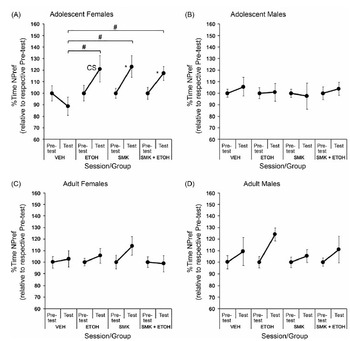
Subsequent analyses on each age and sex indicated that interactions between early exposure to tobacco smoke and/or ethanol and nicotine challenge later in life were only present in adolescent female mice (Exposure × Challenge × Day: F(3,73) = 3.5; p = 0.019; Challenge × Day: F(1,73) = 8.7; p = 0.004). Separate analysis for each challenge group indicated that, as expected, there were no significant differences in saline-challenged animals (data not shown). Distinctively, the analysis of nicotine-challenged adolescent females (Exposure × Day: F(3,34) = 2.9; p = 0.05) indicated that SMKNIC and SMK + ETOHNIC ones significantly increased the time spent in the nicotine-paired chamber after the conditioning sessions (paired t tests, Fig. 2A). For ETOHNIC females, the increase in time spent in the nicotine-paired chamber was close to significant (p = 0.07, paired t test). In addition, ETOHNIC, SMKNIC and SMK + ETOHNIC adolescent females spent more time in the non-preferred chamber in the Test session than VEHNIC ones (Fig. 2A). Consistent with the similar nicotine conditioning profile in all three groups early-exposed to the drugs of abuse, the effect of the combined exposure reflected a less-than-additive outcome (Smoke × Ethanol: F(1,34) = 6.5; p = 0.016 in the 2-d design). This result indicates that the effect of SMK + ETOH on nicotine-induced CPP was equivalent to the effect caused by either drug.
%Time NPref data in the Conditioning place preference (CPP) test. Mice were exposed to tobacco smoke throughout the gestational period until PN10 and/or to ethanol (i.p. injection) every other day from PN2 to PN10. Animals were tested in the CPP either during adolescence (A: females; B: males) or at adulthood (C: females; D: males). Only data pertaining to animals that were nicotine-challenged during the CPP are shown. VEH, control group; ETOH, ethanol exposure group; SMK, tobacco smoke exposure group; SMK + ETOH, tobacco smoke and ethanol exposure group. %Time NPref data in the Test session is shown as a function of respective Pre-test data, which was normalized to 100%. Values are means ± SEM. *p < 0.05, significant difference between Test and Pre-test data within each experimental group. #p < 0.05, vs. VEH Test data. Differences revealed by FPLSD and paired t-tests.

There were no significant main effects or interactions in adolescent males (Fig. 2B) and in adult males and females (Figs. 2C and 2D).
Open field test
The higher-order 1-d ANOVA for locomotor activity identified significant Age (Challenge × Age: F(1,242) = 18.3; p < 0.0001; Exposure × Challenge × Age: F(3,242) = 2.9; p = 0.034) and Sex (Exposure × Challenge × Age × Sex: F(3,242) = 3.5; p = 0.015) interactions. Accordingly, each age was analyzed separately.
Lower-order analyses (1-d ANOVAs) on each age further confirmed that in adolescent (PN30 – Exposure: F(3.115) = 3; p = 0.034; Challenge: F(1,115) = 61.5; p < 0.0001; Exposure × Sex: F(3,115) = 3.0; p = 0.037) and adult (PN90 – Exposure × Challenge: F(3,127) = 3.4; p = 0.019; Exposure × Challenge × Sex: F(3,127) = 2.8; p = 0.045) mice, the impact of early exposure to the drugs of abuse and nicotine re-exposure on locomotor activity was sex-selective, therefore male and female data were analyzed separately.
In adolescent females, early exposure to the drugs of abuse failed to affect basal locomotion. However, as expected, the nicotine challenge resulted in a hyperlocomotor effect (VEHSAL < VEHNIC, Fig. 3A). Early exposure to the drugs of abuse interfered with this effect of nicotine: both tobacco smoke and the dual SMK + ETOH early exposures reduced the hyperlocomotor effect of the nicotine challenge (VEHNIC > SMKNIC, VEHNIC > SMK + ETOHNIC, respectively, Fig. 3A). The increase in locomotion was still significant in the SMK group (SMKSAL < SMKNIC) but not in the ETOH and SMK + ETOH ones (ETOHSAL = ETOHNIC; SMK + ETOHSAL = SMK + ETOHNIC) (Fig. 3A). This is consistent with the 2-d analysis, which showed that the effect of the dual exposure reflected the summation of the effects of tobacco smoke and ethanol (lack of Smoke × Ethanol interaction).
Locomotor activity assessed as distance travelled in the Open Field test. Mice were exposed to tobacco smoke throughout the gestational period until PN10 and/or to ethanol (i.p. injection) every other day from PN2 to PN10. Animals were challenged with nicotine or saline and tested in the OF either during adolescence (A: females; B: males) or at adulthood (C: females; D: males). VEH, control group; ETOH, ethanol exposure group; SMK, tobacco smoke exposure group; SMK + ETOH, tobacco smoke and ethanol exposure group. SAL, saline challenge; NIC, Nicotine challenge. *p < 0.05, significant difference between SAL and NIC mice within each experimental group. #p < 0.05, comparisons among NIC-challenged animals. &p < 0.05, comparisons among SAL-challenged animals. Differences revealed by FPLSD.

In adolescent males, early postnatal exposure to ethanol elicited a reduction in ambulation (ETOHSAL < VEHSAL, ETOHSAL < SMK + ETOHSAL, Fig. 3B). There were no differences in locomotor activity between VEH and SMK + ETOH groups (VEHSAL = SMK + ETOHSAL, Fig. 3B), which, together with the less-than-additive outcome of the 2-d analysis (Smoke × Ethanol: F(1,28) = 9.2, p = 0.005) indicate that the dual exposure mitigated the effect of early ethanol exposure. Early exposure to the drugs of abuse failed to interfere with the hyperlocomotor effect of nicotine. Indeed, irrespective of the early exposure status, locomotor activity of adolescent male mice challenged with nicotine was higher than that of mice that were challenged with the saline injection (NIC vs. SAL groups, Fig. 3B), In addition, there were no significant differences between groups challenged with nicotine (VEHNIC = SMKNIC, ETOHNIC and SMK + ETOHNIC, Fig. 3B.
In adult females, there were no lasting effects of early exposure to the drugs of abuse on basal locomotor activity (VEHSAL = SMKSAL, ETOHSAL and SMK + ETOHSAL, Fig. 3C). However, early exposure still interfered with the response to the nicotine challenge, notwithstanding the pattern of effects was distinct from that identified in adolescent mice. While the nicotine challenge failed to result in a hyperlocomotor effect in control females (VEHSAL = VEHNIC), early exposure to the drugs of abuse potentiated nicotine effects: Both SMK and SMK + ETOH groups when exposed to acute nicotine, exhibited an hyperlocomotor profile (VEHNIC < SMKNIC, VEHNIC < SMK + ETOHNIC, respectively) (Fig. 3C). The 2-d analysis further indicated that the effect of the dual exposure reflected the summation of the effects of tobacco smoke and ethanol (lack of Smoke × Ethanol interaction). These results suggest increased susceptibility to nicotine due to early tobacco smoke and ethanol dual exposure.
In adult males, there were no significant alterations (Fig. 3D).
Discussion
Despite evidence that pregnant smoking women are frequently intermittent consumers of alcoholic beverages Reference Dierker, Lloyd-Richardson and Stolar43,Reference Weitzman and Chen44 and that developmental exposure to either tobacco smoke or ethanol predisposes offspring to subsequent drug use Reference Rasmussen22,Reference Kandel, Wu and Davies28–Reference Oncken, McKee, Krishnan-Sarin, O’Malley and Mazure30 , only limited information exists regarding the consequences of early co-exposure later in life. To the best of our knowledge, this is the first study that investigated the impact of a dual early developmental exposure to tobacco smoke and ethanol on a re-exposure to (challenge with) nicotine during adolescence and adulthood. The assessment of nicotine susceptibility is particularly relevant considering the fast increase of ENDS use among adolescents and young adults Reference Gentzke, Creamer and Cullen32,Reference Miliano, Scott and Murdaugh33,Reference Chadi, Hadland and Harris61 . We showed that even a short-term intermittent exposure to ethanol, limited to the period which, in rodents, roughly corresponds to the third trimester of human gestation, when combined to chronic exposure to tobacco smoke during the period equivalent to the entire human gestation, increases nicotine susceptibility in a sex- and age-dependent manner, with stronger effects in adult females.
Body mass, cotinine and ethanol levels
There is an inverse correlation between maternal cotinine blood levels, cotinine in umbilical cord and birth weight. Ivorra and collaborators Reference Ivorra, García-Vicent, Ponce, Ortega-Evangelio, Fernández-Formoso and Lurbe99 described that infants born to moderate smoking mothers have, on average, a 250 g reduction in body mass Reference Ivorra, García-Vicent, Ponce, Ortega-Evangelio, Fernández-Formoso and Lurbe99 . In the same direction, in our animal model, pups exposed to tobacco smoke (SMK and SMK + ETOH) weighted less and showed less body mass gain during postnatal exposure when compared to controls (VEH and ETOH). Nicotine is known to increase energy expenditure through sympathomimetic actions and suppress food intake by increasing leptin actions in the hypothalamus Reference Audrain-Mcgovern and Benowitz100 .
It should also be noted that dams exposed to tobacco smoke were lighter than control ones, which, per se, may have impacted the offspring response to nicotine. In this regard, there is evidence that, in rats, dams’ undernourishment during the offspring perinatal development leads to an increased response of the mesocorticolimbic dopaminergic pathway to the rewarding effects of cocaine Reference Valdomero, Bussolino, Orsingher and Cuadra101 and morphine at adulthood Reference Velazquez, Valdomero, Orsingher and Cuadra102 . Despite that, nicotine susceptibility was not increased in adolescent mice Reference Dutra-Tavares, Manhães and Silva103 . Even though the models of undernutrition used in the aforementioned studies led to more severe effects on body mass than the small to moderate reductions identified in dams exposed to tobacco smoke in the current study, future studies are needed to investigate whether maternal and offspring undernutrition played a role in our results. Despite the deficits in body mass identified in the offspring during postnatal development, at adulthood, SMK males were heavier than controls. This finding mirrors epidemiological findings of increased body mass index in the offspring born to smoking mothers Reference Goldani, Haeffner, Agranonik, Barbieri, Bettiol and da Silva104 , possibly representing a programming effect. In this regard, the pathophysiology of nicotine-elicited obesity has been associated to hypothyroidism at adulthood Reference Oliveira, Moura and Santos-Silva105 . While, in ETOH females, a small decrease in body mass was identified at PN90, there were no effects during exposure or at adolescence, which again suggests a programming effect of early exposure.
The assessment of cotinine levels confirmed that the level of exposure to tobacco smoke used in this study is equivalent to that of smokers Reference Christensen, Høyer and Pedersen73–Reference Wrześniak, Królik, Kepinska and Milnerowicz76 . As for ethanol blood concentrations, they are comparable to those a human fetus would be exposed to after maternal ingestion of a moderate to heavy dose of ethanol Reference Clancy, Finlay, Darlington and Anand83 . Most importantly, cotinine and ethanol levels did not differ between exposed groups, which indicate that pharmacokinetic interactions do not play a significant role in the outcomes of SMK + ETOH exposure. Interestingly, Lkhagvadorj and collaborators Reference Lkhagvadorj, Meyer and Verweij106 described a male-only increased nicotine metabolism in both neonate and adult mice exposed to tobacco smoke throughout prenatal development Reference Lkhagvadorj, Meyer and Verweij106 . In neonates, this effect was accompanied by a higher Cyp2a5 gene expression, which was correlated with higher DNA methylation. Besides, there is also evidence that hepatic drug metabolism may be altered in low birth weight rats, with reports of both increased and decreased P450 enzymes expression Reference Ni, Wang and Wang107–Reference Zhu, Ni, Wang, Wang, Zeng and Zhao109 . Despite the fact that our data failed to indicate pharmacokinetic interactions between SMK and ETOH by the end of exposure, considering that there is a positive association between nicotine metabolism and nicotine addiction Reference Benowitz110,Reference Ho, Mwenifumbo and Al Koudsi111 , whether there are differences in nicotine pharmacokinetics between SMK and SMK + ETOH mice during adolescence and adulthood is worth further investigation.
Sex- and age-selective effects of both combined and single tobacco smoke and ethanol developmental exposures
Studies in animal models suggest a mechanistic link between early developmental exposure to nicotine or ethanol and the offspring’s susceptibility to drugs of abuse. The ionotropic nicotinic acetylcholine receptors (nAChRs) are the primary cellular mediators of nicotine’s effects and ethanol influences directly the function of various ligand-gated ion channels, including nAChRs Reference Grant112 . In mice, functional nAChRs are identified as early as the tenth gestational day Reference Abreu-Villaça, Filgueiras and Manhães113 . Consistent with these receptors roles in many events that occur during the development of the central nervous system, including the modulation of cell proliferation, neuronal differentiation, synapse formation and maturation and neurotransmitter release, there is evidence of significant structural, functional and behavioral alterations evoked by developmental exposures to nicotine/tobacco smoke and ethanol Reference Abreu-Villaça, Manhães, Krahe, Filgueiras and Ribeiro-Carvalho114–Reference Lotfullina and Khazipov116 .
Lasting effects of early exposure either to nicotine or ethanol in the mesocorticolimbic system have been reported Reference Carneiro, Diógenes and Vasconcelos117,Reference Oliff and Gallardo118 , with potential profound impact in the response of this reward system to a second exposure later in life Reference Levin, Lawrence, Petro, Horton, Seidler and Slotkin38,Reference Klein, Stine, Pfaff and Vandenbergh119 . Nicotine-induced dopamine release in the nucleus accumbens is mediated, at least in part, by nAChRs Reference Fu, Matta, Gao and Sharp120 . Besides, it has been described that ethanol-induced stimulation of locomotor activity and mesolimbic dopamine system also involves nAChR activation Reference Blomqvist, Söderpalm and Engel121,Reference Söderpalm, Ericson, Olausson, Blomqvist and Engel122 . Accordingly, inappropriate stimulation of the cholinergic system by exposure to tobacco smoke and ethanol could disrupt the normal course of brain development, particularly the dopamine reward system, leading to alterations in drug susceptibility later in life. To our knowledge, only two studies focused on the combined exposure to nicotine and ethanol and its consequences on nicotine self-administration and on the mesocorticolimbic system. Matta and Elberger Reference Matta and Elberger123 demonstrated that co-exposure during the period that corresponds to human pregnancy evokes a more intense nicotine self-administration at adulthood than early exposure to either nicotine or ethanol Reference Matta and Elberger123 . Subsequently, Roguski and collaborators Reference Roguski, Sharp, Chen and Matta124 suggested that these effects are associated with the disrupted control of ventral tegmental dopaminergic circuitry by N-methyl-D-aspartate (NMDA) receptors of adolescent animals Reference Roguski, Sharp, Chen and Matta124 . Both behavioral and neurochemical analysis of adolescent mice failed to include nicotine- and ethanol-only groups of exposure. Therefore, whether the combined exposure evoked stronger effects than either nicotine or ethanol still needs further investigation.
Our current study demonstrated that adolescent males and females early exposed to either tobacco smoke or ethanol were susceptible to the nicotine challenge; however, the impact of nicotine in SMK + ETOH mice was either equivalent or diminished when compared to that identified in mice early-exposed to either drug. Distinctively, at adulthood, an increased susceptibility to nicotine was identified only in females and only in the experimental groups that were early exposed to tobacco smoke. This effect was more pronounced in mice from the dual exposure group, which provided evidence that even an early short-term intermittent exposure to ethanol when combined to chronic exposure to tobacco smoke aggravates susceptibility to nicotine re-exposure later in life. A recent study from our group used an experimental protocol of early developmental exposure equivalent to the one used in the current study except that instead of tobacco smoke, mice were exposed to nicotine (chronic developmental exposure to nicotine combined with an intermittent ethanol exposure restricted to the brain growth spurt period) Reference Abreu-Villaça, Carvalho-Graca and Skinner46 . We demonstrated worsened outcomes of the dual exposure for some behavioral and neurochemical variables (locomotor activity, cortical cAMP and cortical and hippocampal cGMP levels) while, for others (memory/learning and hippocampal cAMP levels), the outcomes reflected less-than-additive effects Reference Abreu-Villaça, Carvalho-Graca and Skinner46 . These results suggest that, in the current study, nicotine present in tobacco smoke, per se, play a role in both the worsened and diminished responses in the dual exposure group when compared to either tobacco smoke or ethanol ones. However, the role of nonnicotine components of tobacco smoke cannot be ruled out Reference Abreu-Villaça, Filgueiras and Guthierrez49–Reference Villégier, Gallager, Heston, Belluzzi and Leslie60 and, even though the large number of substances present in tobacco smoke and the lack of data on their psychoactive properties have been delaying progress in this area, recent evidence indicates that tobacco smoke components may interact with nicotine and/or ethanol in affecting the central nervous system Reference Abreu-Villaça, Guimarães and Nunes-Freitas52,Reference Abreu-Villaça, Cavina and Ribeiro-Carvalho71,Reference Abreu-Villaça, de Carvalho Graça, Ribeiro-Carvalho, de Freitas Naiff, Manhães and Filgueiras72 . In this regard, exposure of adult male rats to a cocktail of tobacco smoke minor alkaloids (nornicotine, cotinine, myosmine, anatabine, and anabasine), β-carbolines (harman and norharman) and acetaldehyde did not significantly enhance nicotine self-administration. However, tranylcypromine, an irreversible inhibitor of MAO-A and MAO-B, increased nicotine self-administration independent of other smoke constituents Reference Smith, Schaff and Rupprecht125 . Exposure of rats to both ethanol and tobacco-specific nitrosamine synergistically decreased myelinated fiber density in the frontal cortex Reference Papp-Peka, Tong, Kril, De La Monte and Sutherland126 . Interestingly, exposures restricted to the brain growth spurt resulted in adverse effects on cerebellar development and function; however, tobacco-specific nitrosamine and ethanol exerted independent effects which, in most cases, were not additive Reference Zabala, Silbermann and Re127 . Considering that tobacco smoke contains thousands of components, these results underscore the need of further studies aiming to identify components of tobacco smoke that interact with nicotine and/or ethanol.
Sex differences in response to drugs of abuse, likely emerge as a result of the sexual differentiation of the brain, which begins during prenatal development and extends until the end of adolescence Reference Cross, Linker and Leslie128 . While the exact mechanisms underlying females’ unique sensitivity are poorly understood, there is a growing body of evidence that drugs of abuse impact organizational effects of gonadal hormones on brain cells structure and function Reference Carneiro, Diógenes and Vasconcelos117 . Interestingly, ligand-gated ion channels are influenced by gonadal hormones. Progesterone inhibits function of α4 containing nAChRs Reference Valera, Ballivet and Bertrand129 and 17β-estradiol increases α7 nAChR subunit expression Reference Romero-grimaldi and Moreno-lo130 , providing potential mechanisms for both nicotine and ethanol nAChR-mediated sex-dependent effects. Consistent with this possibility, there is evidence that nicotine inhibits aromatase activity in human trophoblast Reference Barbieri, Gochberg and Ryan131 as well as in the brain of male offspring exposed during prenatal development Reference von Ziegler, Schlumpf and Lichtensteiger132,Reference Sarasin, Schlumpf, Müller, Fleischmann, Lauber and Lichtensteiger133 . Nicotine direct action on the adrenal gland during the prenatal development of rats leads to increased corticosterone levels, which, in turn, diminishes the pivotal testosterone surge during the perinatal period Reference von Ziegler, Schlumpf and Lichtensteiger132,Reference Sarasin, Schlumpf, Müller, Fleischmann, Lauber and Lichtensteiger133 . Increased corticosterone levels were also identified in adolescent females exposed to ethanol during prenatal development, with a positive correlation between corticosterone and estradiol levels Reference Comeau, Lee, Anderson and Weinberg134 .
Common targets of nicotine and ethanol suggest that the increased nicotine susceptibility of adult females submitted to a dual tobacco smoke and ethanol exposure during early development is due to the additive effects of these drugs, which have already been demonstrated when other behavioral and neurochemical endpoints were investigated Reference Abreu-Villaça, Carvalho-Graca and Skinner46 . As discussed above, sex steroid hormones may be important mediators of both tobacco smoke and ethanol differential effects through sex-dependent interactions during critical periods of development, possibly leading to relevant organizational alterations of gonadal hormones on neuronal function in brain regions important to motivation and reward. Future studies are needed to investigate the mechanisms involved. There is evidence that the phase of the estrous cycle could impact behavioral outcomes Reference Marques, Bevilaqua, da Fonseca, Nardi, Thuret and Dias135,Reference Songtachalert, Roomruangwong, Carvalho, Bourin and Maes136 . However, the fact that the age of vaginal opening and of first estrous in small rodents typically occur between PN32 and PN36 indicates that in the current study, it would only be meaningful to verify the phase of the cycle in adult females. In this case, the extra manipulation (to collect the vaginal smears) only of adult females would add an undesirable confounding factor to the analysis. Despite this limitation of the study, there was no evidence that female data variability was higher than that observed for males. In addition, most of our results were female-only. Considering the aforementioned, it seems that any putative variation in behavior associated with the estrous cycle that might have been present in our study was not sufficient to hinder the results from being identified.
Conclusions
Adult female mice exposed to ethanol during the brain growth spurt and to tobacco smoke during the period equivalent to human gestation are more susceptible to nicotine re-exposure at adulthood, representing a worsened outcome from the dual exposure. In spite of the fact that generalizations based on the results from preclinical studies should be considered with care, our data suggest that if a similar effect occurs in humans, smoking and drinking alcoholic beverages during gestation may predispose the use/abuse of nicotine later in life. In this regard, future studies that aim to investigate whether maternal exposure to these drugs of abuse during gestation contributes to the burst of ENDS use worldwide are warranted.
Supplementary material
To view supplementary material for this article, please visit https://doi.org/10.1017/S2040174420001191
Acknowledgements
The authors are thankful to Ulisses Risso for animal care.
Financial Support
This work was supported by fellowships from Coordenação de Aperfeiçoamento de Pessoal de Nível Superior (CAPES-BRAZIL); Conselho Nacional de Desenvolvimento Científico e Tecnológico (CNPq-BRAZIL) and Sub-Reitoria de Pós-Graduação e Pesquisa da Universidade do Estado do Rio de Janeiro (SR2-UERJ) and grants from Fundação Carlos Chagas Filho de Amparo à Pesquisa do Estado do Rio de Janeiro (FAPERJ-BRAZIL, E-26/110.211/2013 and E-26/201.455/2014 to YA-V) and CNPq-BRAZIL (304332/2016-0 to YA-V).
Conflicts of Interest
None.
Ethical standards
The authors assert that all procedures contributing to this work comply with the ethical standards of the Guide for the Care and Use of Laboratory Animals as adopted and promulgated by the National Institutes of Health and has been approved by the Animal Care and Use Committee of the Universidade do Estado do Rio de Janeiro (CEUA0312012).