Cardiovascular diseases demonstrate diurnal variation, with a higher incidence of ST-segment elevation myocardial infarction between 6:00 am and noon.Reference Ammirati, Cristell and Cianflone 1 Although a circadian dependence of infarct size was suggested, the largest multicentric and multiethnic study has thus far been unable to show such an effect.Reference Ammirati, Cristell and Cianflone 1 Surprisingly, Montaigne et alReference Montaigne, Marechal and Modine 2 recently reported that afternoon aortic valve replacement surgery provided perioperative myocardial protection and led to improved patient outcomes compared with morning surgery. This study received much media attention and unsettled patients, who requested to reschedule surgery to the afternoon. Restricting cardiac surgery to afternoons would tremendously challenge the management of operating theatres. If the study is generalizable, daytime varying effect of afternoon perioperative myocardial protectionReference Montaigne, Marechal and Modine 2 might also impact 2 crucial clinical outcomes of cardiac surgery: surgical site infections (SSI) and mortality. Therefore, we investigated whether there is also daytime variation in the incidence of SSIs and mortality.
Methods and results
The Swiss National Center for Infection Control (www.swissnoso.ch) has been running a prospective surveillance module on SSIs after cardiac surgery since 2009. The module includes rigorous postdischarge surveillance with >95% follow-up and regular on-site data quality audits.Reference Troillet, Aghayev, Eisenring and Widmer 3 , Reference Kuster, Eisenring, Sax and Troillet 4 The cohort included 27,563 cardiac surgery patients between 2010 and August 2017 from all 15 Swiss cardiac surgery centers. We excluded 5,258 patients (19%) who had emergency surgeries and/or nighttime surgeries (ie, incision after 4:00 pm and before 8:00 am).
For the entire patient cohort, we assessed the following characteristics: the wound was clean wound prior to incision in 98% of patients; American Society of Anesthesiology score was ≥3 in 95% of patients; the median age was 68 years (interquartile range [IQR], 60–75); the median body mass index (BMI) was 26.8 kg/m2 (IQR, 24.2–29.8); 73% of patients were male; surgical antibiotic prophylaxis was applied a median of 45 minutes before incision (IQR, 35–60); and median surgery duration was 218 minutes (IQR, 180–265). The cardiac surgical procedure included coronary artery bypass graft with internal mammary or thoracic artery in 26% and vein or radial artery bypass in 50%. Care centers included university hospitals (66%), nonuniversity public hospitals (19%), and private hospitals (15%).
The following factors showed significant differences for afternoon surgery (compared to morning surgeries: an increased median BMI (+0.2 kg/m2; P = .001), earlier application of antibiotic prophylaxis (−5 minutes; P < .001), shorter surgery duration (−4 minutes; P = .009), fewer procedures exceeding 75th percentile duration (−2.4%, P < .001), less coronary artery bypass graft surgery with vein graft or radial artery (−7.5%; P < .001), and a shift from private to nonuniversity hospital (P = .001).
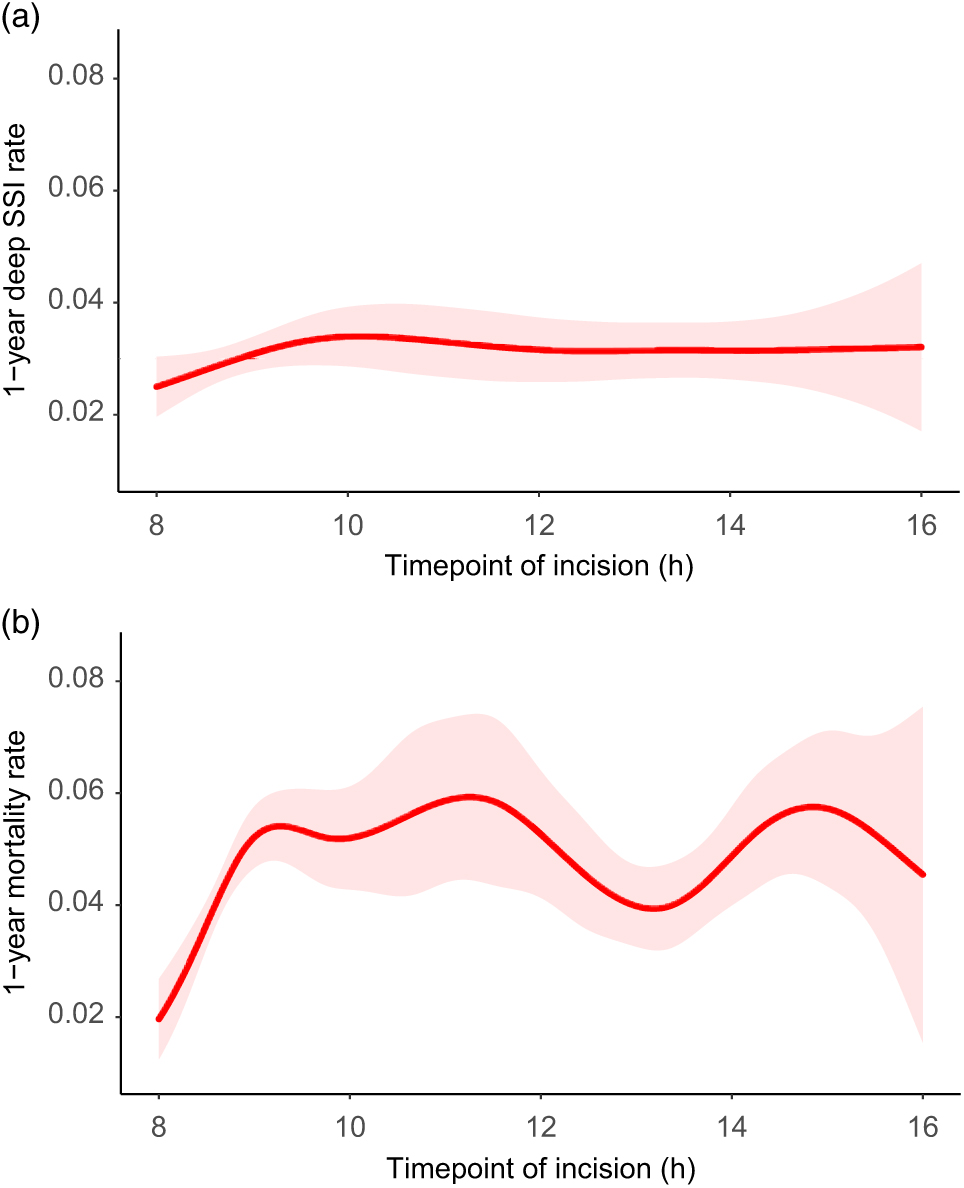
The crude 1-year primary site, deep SSI rate (sternitis and/or mediastinitis and/or endocarditis) was 3.0%, and according to the χ2 test, it did not significantly differ between morning (3.0%) and afternoon (3.1%) surgeries (P = .75). Similarly, the 1-year mortality rate was 4.5% for morning and 4.7% for afternoon surgeries (P = .68). We applied unadjusted generalized additive models using the mgcv package in R computing software (R Foundation for Statistical Computing, Vienna, Austria) with the time of incision as a continuous variable to visualize the 1-year SSI rate (Fig. 1A) and the 1-year mortality rate (Fig. 1B). Both plots demonstrated some daytime variation but excluded a substantially increased risk for morning surgeries.
Daytime variation. The rate of the clinical outcomes according to the time of incision: (A) 1-year deep primary site surgical site infection (sternitis and/or mediastinitis and/or endocarditis) and (B) 1-year mortality. The 95% confidence interval is shaded.

To assess the outcome parameters of SSI and mortality and to account for the specific characteristics of individual healthcare centers in terms of patients, cardiac procedures, and surveillance, we applied mixed-effects generalized linear models with the individual centers entered as a random effect. All other covariables were entered as fixed effects.
The adjusted risk of afternoon surgery for the outcome of deep SSI was not significantly lower (OR, 1.04; 95% CI, 0.87–1.24; P = .686) that for morning surgery. Analogously, afternoon surgery was not significantly associated with lower mortality (adjusted OR, 1.10; 95% CI, 0.94–1.29; P = .217).
A sensitivity analysis did not identify a specific 1-hour period associated with significantly increased SSI risk. However, surgeries with incision between 8:00 and 9:00 am had a marginally lower 1-year mortality when compared with incisions between 9:00 am and 4:00 pm (adjusted OR, 0.85; 95% CI, 0.74–0.99; P = .035). Finally, a subgroup analysis of the 8,903 cardiac surgery patients without coronary-artery bypass yielded a slightly higher deep SSI risk for afternoon surgery (adjusted OR, 1.42; 95% CI, 1.04–1.94; P = .289), but no difference in 1-year mortality was detected.
Discussion
In our large, multicenter, prospective, surveillance cohort of cardiac surgeries with 15 participating centers, we detected neither a significant daytime variation in the rate of 1-year SSI nor an influence on 1-year mortality. The study was limited by lack of data on postoperative markers of myocardial injury and incomplete information on the use and duration of extracorporeal circuit support. Furthermore, we were unable to perform an analysis for aortic valve replacement surgeries alone because this information is not in the Swissnoso database. Finally, we were not able to correct for patient comorbidities beyond the variables included in the Swissnoso database.
The marginal trend of lower 1-year mortality risk for surgeries performed between 8:00 and 9:00 am could be biased; baseline characteristics showed lower ASA scores/wound class contamination for these patients (data not shown). Other biases due to unknown organizational confounders (surgeon, optimal staff, operating room preparation, etc.) are also possible. Further studies with additional clinical variables are needed to resolve this finding.
In conclusion, neither the proposed mechanism of enhanced perioperative myocardial injury for morning surgeriesReference Montaigne, Marechal and Modine 2 nor increased rates of morning myocardial infarctionReference Ammirati, Cristell and Cianflone 1 were associated with an impact on the 1-year deep SSI nor mortality rate. The results of this large observational study suggest that the current evidence is insufficient to promote afternoon cardiac surgeries, even taking into account the inherent limitations of observational studies on confounding variables.Reference Frieden 5
Author ORCIDs
Rami Sommerstein 0000-0003-1011-6878
Acknowledgments
We thank all participating centers for providing their surveillance data.
These data were collected in collaboration with the Swiss National Association for the Development of Quality in Hospitals and Clinics (ANQ). We also thank Andrew Atkinson, Bern University Hospital, and Maurus Thurneysen, University Hospital Basel, for preparation of the dataset used in this study.
Financial support
No financial support other than institutional funding was provided relevant to this article.
Conflicts of interest
All authors report no conflicts of interest relevant to this article.