I. INTRODUCTION
It is well known that the segregation in solidified structure results in poor properties and performances of alloys. Lots of methods have been pursued to control the segregation, such as the solidification under microgravity,Reference Lan and Tu1 the addition of alloying elements,Reference Li, Samuel, Samuel and Ravidran2 the rapid solidification,Reference Nishida, Kawamura and Yamamuro3 the diffusion annealing,Reference Loboda-Cackovic4 and the application of electromagnetic fields.Reference Stelian, Delannoy, Fautrelle and Duffar5 The effect of a static magnetic field on the segregation during directional solidification has frequently been investigated. Youdelis and DorwardReference Youdelis and Dorward6 processed Al–Cu alloys of various compositions (between 0.5 and 4.5 wt% Cu) under a 3.4 T magnetic field and measured the effective partition coefficient,
 $${k_{{\rm{eff}}}} = {{{C_{\rm{S}}}} \over {{C_0}}}\quad ,$$
where C S is the solute concentration in the formed solid and C 0 is the concentration in the bulk liquid. At low growth rates and low concentration, the partition coefficient increased with the field suggesting that the natural convection had been braked. In contrast, at higher growth rates, it decreased. These results were interpreted as the consequence of the variation of the solute diffusion coefficient with the applied magnetic field. A couple of years later, Youdelis and CahoonReference Youdelis and Cahoon7 demonstrated that this interpretation did not agree with the expected orders of magnitude.
Nowadays, a strong magnetic field up to 14 T has been widely used to improve material properties during material processing.Reference Asai8–Reference Lu, Nagata, Watanabe, Nojima, Sugawara and Kamada16 It has been found that strong magnetic fields not only largely increase the value of traditional Lorentz force but also contribute to the likelihood of the use of magnetic force on nonmagnetic materials. Recently, Wang et al.Reference Wang, Lou, Liu, Pang, Nakajima and He17–Reference Liu, Wang, Hirota, Liu, Chen and He19 have studied the effect of a strong magnetic field on the solute distribution and the gravity segregation during volume solidification process and found that the application of the magnetic field can control the solute distribution and segregation. They attributed the effect of the magnetic field to performances of Lorentz and magnetic forces. Moreover, owing to the Seebeck effects, a thermoelectric magnetic force (TEMF) and convection (TEMC) will develop at the vicinity of the interface on the microscopic scale during directional solidification under the magnetic field.Reference Wang, Fautrelle and Ren20 In previous works, it has been proven that the TEMF and convection play an important role to affect the solidification structure during directional solidification under the magnetic field.Reference Yesilyurt, Vujisic, Motalkef, Szofran and Volz21–Reference Lehmann, Moreau, Camel and Bolcato23 In 1979, ShercliffReference Shercliff24 had also forecasted that the TEMC stirring of the molten metal is capable of dispersing the segregation. However, it is hitherto short of experimental investigation on the effect of the thermoelectric magnetic effects (i.e., TEMF and TEMC) on the segregation and the solid solubility during directional solidification under the magnetic field.
This paper aims to investigate the effect of a strong magnetic field on the solid solubility and the microsegregation during directional solidification of Al–Cu alloy at lower growth speeds (1–10 μm/s). The present work may initiate a new method to enhance the solid solubility and to eliminate the microsegregation in Al-based alloys via an applied strong magnetic field during directional solidification.
II. EXPERIMENTAL PROCEDURE
Al–0.85wt%Cu and Al–4.5wt%Cu hypoeutectic alloys used in this study were prepared by melting high-purity Al (99.99 wt%) and Cu (99.99 wt%) in an induction furnace. The constituents were placed in a high-purity graphite crucible 10 cm in diameter and heated to 900 °C. The melts were magnetically stirred for 0.5 h and then poured into a graphite mold to cast specimens with a diameter of 3 mm and a length of 200 mm. The schematic view of the directional solidification apparatus under an axial strong magnetic field is shown in Ref. Reference Li, Ren and Fautrelle25. It consists of a static superconducting magnet and a Bridgman–Stockbarge furnace equipped with a growth velocity and a temperature controller. The magnet can produce an axial static magnetic field with an adjustable intensity up to 14 T. The furnace, made of a nonmagnetic material, has a negligible effect on the magnetic field uniformity. The temperature in the furnace can reach 1600 K and was controlled with a precision of ±1 K. A water-cooled cylinder containing liquid Ga–In–Sn metal (LMC) was used to cool the specimens. The temperature gradient in the specimens was controlled by adjusting the temperature of the furnace hot zone, which was insulated from the LMC by a refractory disc. To perform the directional solidification, the apparatus was designed in such a way that the specimen moves downward, whereas the furnace remains fixed. During the experiment, the samples in the corundum crucible were melted and directionally solidified in the Bridgman apparatus by pulling the crucible assembly at various velocities into the LMC cylinder.
The samples obtained in the experiments were sectioned and mechanically polished both parallel and perpendicular to the solidification direction. The microstructures on both sections of the sample were characterized by optical microscopy and scanning electron microscopy (SEM). Microstructural and crystallographic characteristics were investigated by means of the electron backscattered diffraction (EBSD) in a high-resolution scanning electron microscope equipped with a field-emission gun (FE-SEM). Furthermore, an electron probe microanalyzer (EPMA) was used to measure the distribution of the solute Cu at around 3–5 pct.
III. RESULTS
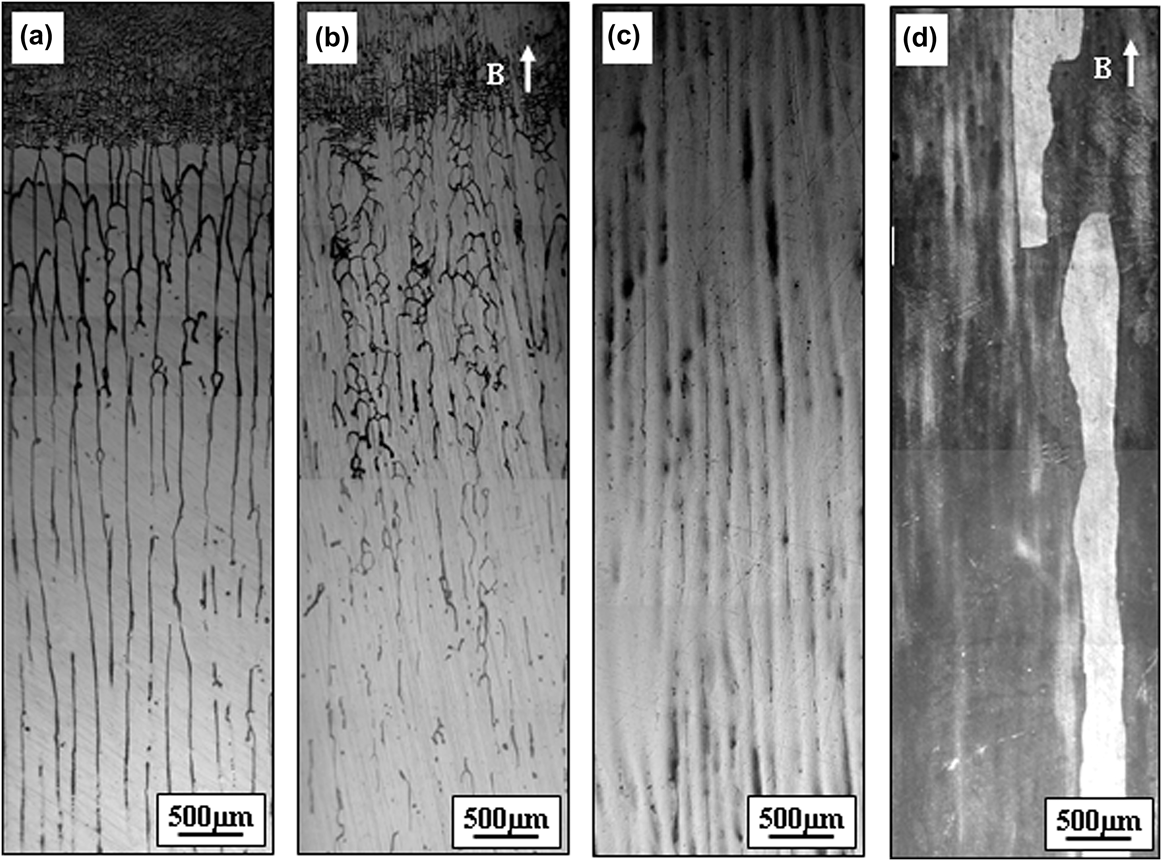
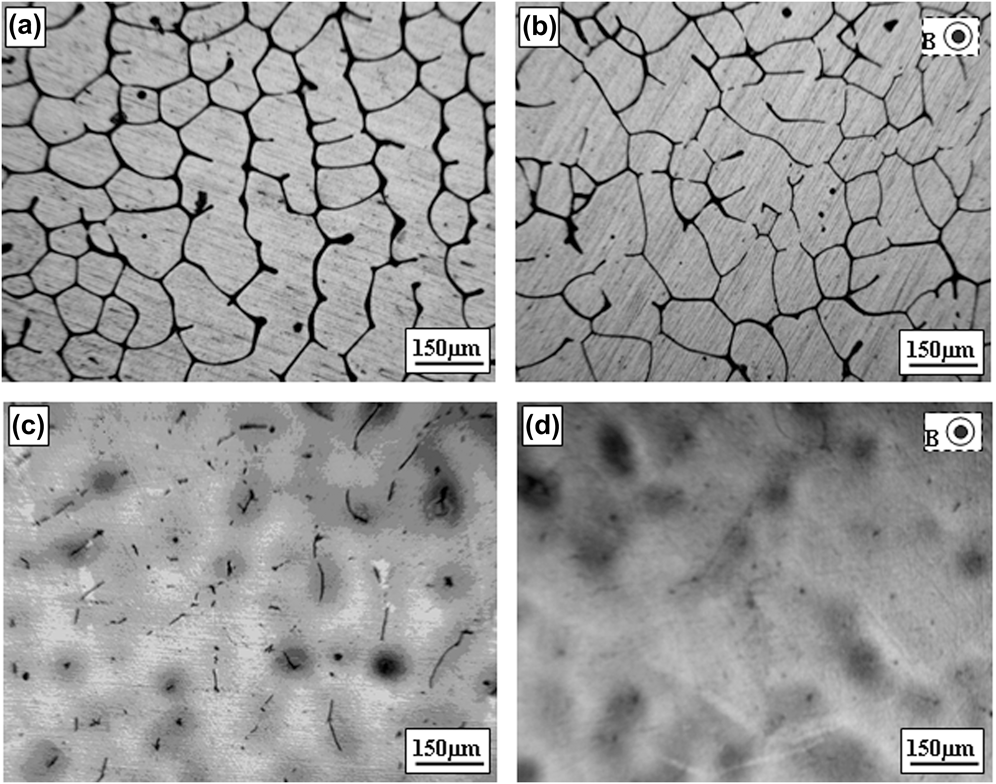
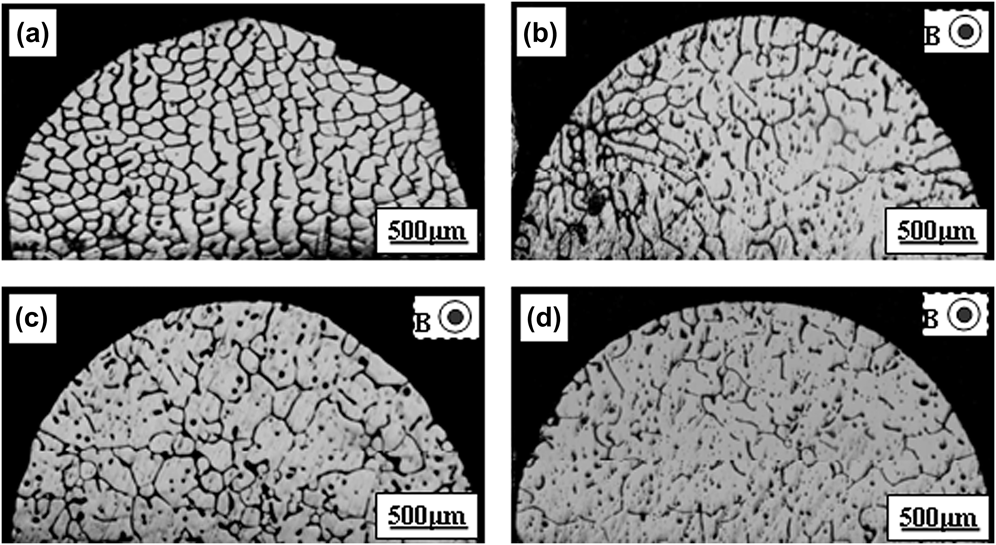
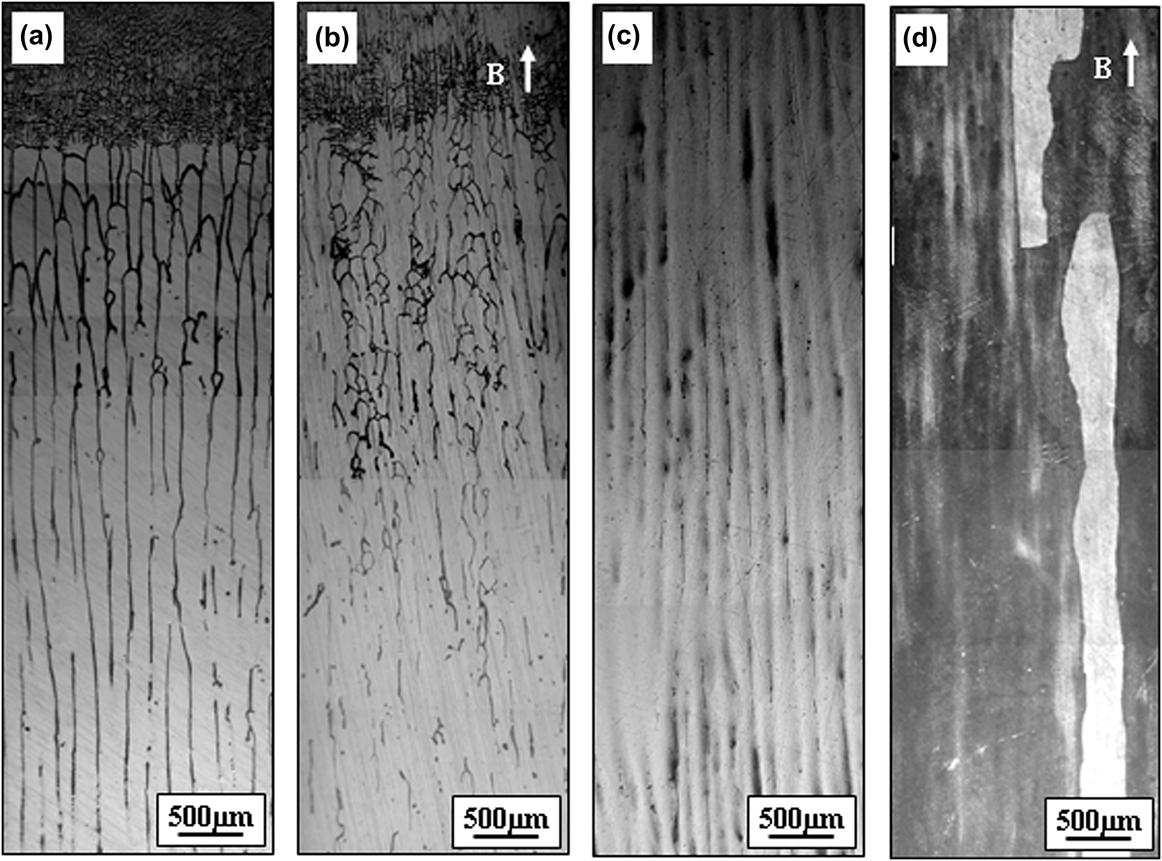
Figure 1 shows the longitudinal structures in directionally solidified Al–0.85wt%Cu alloy at 10 μm/s both with and without a 10 T magnetic field. It can be observed that the application of the magnetic field has promoted the amalgamation of the dendrites/cells. Corresponding transverse microstructures in the mushy zone at various positions reveal that the magnetic field has enhanced the amalgamation of the grains (see Fig. 2). Moreover, the structures under various magnetic field intensities are also observed and compared. Figure 3 shows the transverse structures in the mushy zone at 3 mm from the liquid/solid interface directionally solidified under various magnetic fields. One can notice that with the increase of the magnetic field intensity, the liquid phase at the grain boundaries reduces and the grains amalgamate gradually.
Longitudinal structures in directionally solidified Al–0.85wt%Cu alloy at 10 μm/s both with and without a 10 T magnetic field: (a) and (b) microstructure near the quenched liquid/solid interface both with and without the magnetic field; (c) and (d) microstructure below the eutectic isotherm both with and without the magnetic field.
Transverse microstructures at different positions from the quenched liquid/solid interface in directionally solidified Al–0.85wt%Cu alloy at 10 μm/s both with and without a 10 T magnetic field: (a) and (b) 1 mm; (c) and (d) 8 mm.

Transverse structures in the mushy zone at 3 mm from the quenched liquid/solid interface in directionally solidified Al–0.85wt%Cu alloy at 10 μm/s under various magnetic fields: (a) 0 T, (b) 3 T, (c) 5 T, and (d) 10 T.
Further, an EPMA is used to measure the distribution of the solute Cu both with and without a 10 T magnetic field. Figure 4 indicates the radial distribution of the solute Cu in the mushy zone at 3 mm from the liquid/solid interface directionally solidified at 2.5 and 5 μm/s. Comparison of the distribution of Cu content with and without the magnetic field shows that the application of a strong magnetic field has caused a decrease of the Cu concentration at the grain boundaries and an increase of the solid solubility. Moreover, the solid solubility in directionally solidified Al–0.85wt%Cu alloy at 2.5 μm/s under various magnetic fields is measured. Figure 5 shows the solid solubility as a function of the magnetic field intensity. One can observe that with the increase of the magnetic field intensity and the temperature gradient, the solid solubility of the solute Cu increases significantly.
Radial distribution of the solute Cu in the mushy zone at 3 mm from the quenched liquid/solid interface in directionally solidified Al–0.85wt%Cu alloy at a certain growth speed with and without a 10 T magnetic field: (a) and (b) 2.5 μm/s; (c) and (d) 5 μm/s.
Solid solubility at 3 mm from the quenched liquid/solid interface as a function of the magnetic field intensity during directional solidification of Al–0.85 wt%Cu alloy at 2.5 μm/s.
To investigate the influencing mechanism of a strong magnetic field on the solid solubility, we have conducted the following measurements. Figure 6 indicates the distribution of the solute Cu in directionally solidified Al–0.85wt%Cu alloy at 1.2 μm/s both with and without a 10 T magnetic field. One can see that the magnetic field has substantially increased the solid solubility of the solute Cu. Moreover, comparison of the radial distribution of the solute Cu at 1 and 3 mm shows that there is no significant change in the solid solubility in the case of zero magnetic field, which means that the diffusion in the solid is negligible. However, when a 10 T magnetic field is applied, the solid solubility increases as the distance from the liquid/solid interface increases. This implies that the application of a strong magnetic field has enhanced the diffusion in the solid. Figure 6(b) shows the axial distribution of the solute Cu both with and without the magnetic field. It can be seen that in the case of zero magnetic field, the solid solubility is invariable as the distance from the liquid/solid interface increases. However, when the magnetic field is applied, the Cu concentration in the solid near the liquid/solid interface increases as the distance increases. Here, it should be emphasized that the Cu concentration in the solid in the vicinity of the liquid/solid interface is almost same as the one without the magnetic field. This suggests that the application of a strong magnetic field during directional solidification has not changed the partition coefficient but just modified the diffusion in the solid.
Distribution of the solute Cu near the liquid/solid interface in directionally solidified Al–0.85wt%Cu alloy at 1.2 μm/s both with and without a 10 T magnetic field: (a) radial distribution of the solute Cu in the mushy zone at 1 and 3 mm from the liquid/solid interface; (b) axial distribution of the solute Cu near the liquid/solid interface.
In addition, the effect of a strong magnetic field on the solidification structure and the distribution of the solute Cu during volume solidification process was also investigated. Figure 7 shows the microstructures and the distribution of the solute Cu in solidified Al–4.5wt%Cu alloy both with and without a 10 T strong magnetic field. It can be learned that the application of a strong magnetic field has not significantly modified the solidification structure or the distribution of the solute Cu, which implies that the modifications of the solidification structure and the Cu concentration during directional solidification under the magnetic field should be attributed to complex effects between the magnetic field and the temperature gradient.
Microstructure and distribution of the solute Cu in solidified Al–4.5wt%Cu alloy from 750 °C (above melting point of pure Al) at a cooling rate of 8 K/min both with and without a 10 T magnetic field: (a) and (b) microstructure both with and without the magnetic field; (c) and (d) distribution of solute Cu both with and without the magnetic field.
IV. DISCUSSIONS
A. Effect of the strong magnetic field on the partition coefficient and the diffusion coefficient
The above results reveal that the application of a strong magnetic field has increased the solid solubility and decreased the microsegregation during directional solidification. Now, let us recall the solute redistribution during dendritic growth. In an attempt to predict solute redistribution quantitatively during dendritic solidification, Brody and FlemingsReference Brody and Flemings26 derived an approximate analytical solution to their differential equation, in which back diffusion into the solid was treated, as well as carrying out numerical calculation using the finite difference method. To obtain these analytical solutions, the thickening of the dendrite element was assumed to be linear or parabolic, and an approximation was used for the solute gradient in the solid at the interface. For linear growth, the solution takes the form,
 $$C_{\rm{S}}^ * = {k_0}{C_0}{\left( {1 - {f \over {1 + {\rm{\alpha }}{k_0}}}} \right)^{{k_0} - 1}}\quad ,$$
where  $C_{\rm{S}}^ *$ is the surface composition of the solid when f is the solid fraction, k 0 the partition coefficient, α = 4D St/λ, D S the diffusion coefficient in the solid and λ the dendrite spacing. From Eq. (2), it can be deduced that the solid solubility is related to the partition coefficient and the diffusion coefficient in the solid. Therefore, it is necessary to study the effect of a strong magnetic field on the partition coefficient and the diffusion coefficient in Al–Cu alloy. From the thermodynamic point of view, the influence of a strong magnetic field on the partition coefficient in Al–Cu alloy has been evaluated in our previous works.Reference Li, Fautrelle, Ren, Gagnoud, Moreau, Zhang and Esling27 The results reveal that the change in the partition coefficient under a 10 T strong magnetic field is negligible. This is in agreement with the measurement results shown in Fig. 6(b). Therefore, one can deduce that there exist other factors to affect the solid solubility and the microsegregation during directional solidification of Al–Cu alloy under a strong magnetic field. Here, the effect of the TEMF acting on the solid and the interdendritic TEMC on the solid solubility and the microsegregation has been discussed.
B. Effect of the TEMF on the solid solubility
As the stress acting on the solid is capable of enhancing the solid solubility,Reference Sadigh, Lenosky, Caturla, Quong and Benedict28,Reference Hong, Hong and Mayer29 it is necessary to investigate the stress imposed on the solid during directional solidification under a strong magnetic field. As mentioned in our previous works,Reference Li, Gagnoud, Fautrelle, Ren, Cao, Moreau, Zhang and Esling30 a TEMF is produced on the dendrite/cell during directional solidification under the magnetic field. Now, let us recall the thermoelectric (TE) effects. In any material, a temperature gradient  $\vec \nabla T$ produces a Seebeck electromotive force
 $S\vec \nabla T$, where S is the TE power of the material.Reference Boettinger, Biancaniello and Coriell31–Reference Alboussiere and Moreau33 If the gradients of S and T are not parallel, then a TE current is generated in the system. As the temperature at the tips of the dendrite/cell may be significantly higher than that at their base, a nonisothermal interface will form and the TE current will produce. Thus, when a magnetic field is applied, the interaction between the TE current and the magnetic field will produce a TEMF on the dendrite/cellReference Li, Gagnoud, Fautrelle, Ren, Cao, Moreau, Zhang and Esling30:
 $${\rm{\sigma }}_{\rm{s}}^F = {{{{\rm{\sigma }}_{\rm{L}}}{{\rm{\sigma }}_{\rm{S}}}\,{f_{\rm{L}}}} \over {{{\rm{\sigma }}_{\rm{L}}}\,{f_{\rm{L}}} + {{\rm{\sigma }}_{\rm{S}}}\,{f_{\rm{S}}}}}({S_{\rm{S}}} - {S_{\rm{L}}})GB\quad ,$$
where σL, σS are the electrical conductivities of the liquid and solid phases; f L, f S the liquid and solid fractions; S L, S S the TE power of the liquid and solid phases; G the temperature gradient; and B the magnetic field. Figure 8(a) describes the TEMF in the case of an external magnetic field applied parallel to the solidification direction. Numerical simulation has been done to investigate the distribution and amplitude of the TEMF acting on the dendrite/cell and the detailed numerical process can be found in Ref. Reference Li, Gagnoud, Fautrelle, Ren, Cao, Moreau, Zhang and Esling30. Figure 8(b) shows the distribution and amplitude of the TEMF under a 10 T magnetic field. From Fig. 8(b) and numerical results in Ref. Reference Li, Gagnoud, Fautrelle, Ren, Cao, Moreau, Zhang and Esling30, it can be shown that the value of the TEMF increases linearly with the magnetic field. The value of the TEMF under a 10 T magnetic field is of the order of 105 N/m3, as shown in Fig. 8(d).
TEMF acting on a dendrite/cell and interdendritic TEMC during directional solidification under an axial magnetic field: (a) schematic illustration of TEMF acting on a dendrite/cell and interdendritic TEMC, (b) and (c) computed TEMF and interdendritic TEMC around a modeled dendrite/cell during directional solidification at a 60 K/cm temperature gradient under a 10 T axial magnetic field, (d) maximal value of TEMF as a function of the magnetic field intensity, and (e) maximal value of interdendritic TEMC as a function of the magnetic field intensity.
Furthermore, to prove the existence of the stress on the solid during directional solidification under a strong magnetic field, the high resolution EBSD and TEM are used to investigate the effect of the magnetic field on the substructure. Figure 9(a) shows an EBSD map in directionally solidified Al–0.85wt%Cu alloy at 1.5 μm/s under a 10 T magnetic field. It can be observed that when a strong magnetic field is applied, the larger deformation in the solid has occurred. Figures 9(b) and 9(c) show the TEM light field image, and a large number of dislocation tangles are found. Figures 10(a) and 10(b) show an EBSD map and the corresponding pole figures in directionally solidified Al–4.5wt%Cu alloy at 10 μm/s under a 10 T magnetic field, respectively. One can notice that the columnar dendrite is broken and the [001] crystal direction of the dendrites deflects from the solidification direction. The TEM observation shows that lots of dislocations have formed under a strong magnetic field [see Fig. 10(c)]. Deformation and dislocation certainly originate from the stress caused by the TEMF. Therefore, the change in the solid solubility under a strong magnetic field should partly be attributed to the TEMF acting on the solid. From Eq. (3) and Fig. 8(d), it can be learned that the TEMF acting on the solid increases as the magnetic field (B) and the temperature gradient (G) increase. Therefore, the modifications of the solid solubility under the magnetic field are enhanced as the applied magnetic field and the temperature gradient increase.
EBSD and TEM analysis for the sample in directionally solidified Al–0.85wt%Cu alloy at 1.5 μm/s under a 10 T magnetic field: (a) EBSD map near the liquid/solid interface; (b) and (c) TEM light field image.
EBSD and TEM analysis for the sample in directionally solidified Al–4.5wt%Cu alloy at 10 μm/s under a 10 T magnetic field: (a) EBSD map near the liquid/solid interface, (b) [001] pole figures, and (c) TEM dark field image.
C. Effect of the interdendritic TEMC on the grain boundary and the solid solubility
Moreover, the TEMF in the liquid will induce an interdendritc TEMC. Figure 8(a) describes the interdendritc TEMC in the case of an external magnetic field applied parallel to the solidification direction. It can be observed that a rotary TEMC around the tip of the dendrite/cell will form. Numerical simulation has been done to investigate the interdendritic TEMC and the detailed numerical process can be found in Ref. Reference Li, Gagnoud, Ren, Fautrelle and Moreau34. Figure 8(b) shows the distribution and amplitude of the interdendritic TEMC in Al–Cu alloy under a 10 T magnetic field. From Fig. 8(e) and numerical results in Ref. Reference Li, Gagnoud, Ren, Fautrelle and Moreau34, it can be learned that with the increase of the magnetic field intensity, the interdendritic TEMC increases and extends into the bulk liquid and the mushy zone. Figure 8(c) shows the computed velocity of the interdendritic TEMC as a function of the magnetic field intensity. The interdendritic TEMC in the mushy zone will promote stirring of the liquid at the boundary of the dendrite/cell so as to disperse uniformities. As a result, the interdendritic TEMC will promote the amalgamation of the grains and the increase of the solid solubility. Since the interdendritic TEMC increases with the magnetic field intensity, the modifications of the grain boundary and the solid solubility under the magnetic field are enhanced as the magnetic field increases.
V. CONCLUSION
This work has dealt with the effect of a strong magnetic field on the solid solubility and the microsegregation during directional solidification of Al–Cu alloys at lower growth speeds (1–10 μm/s). It has been found that the application of a strong magnetic field has caused the reduction of the grain boundary and promoted the amalgamation of the grains. EPMA measurement reveals that the magnetic field has increased the solid solubility and decreased the microsegregation during directional solidification. The amalgamation of the grains and the increase of the solid solubility are enhanced as the magnetic field increases. The modifications of the solid solubility and the microsegregation under the magnetic field are attributed to the TEMF acting on the solid and the interdendritic TEMC. The present work may initiate a new method to enhance the solid solubility and to eliminate the microsegregation in Al-based alloys via an applied strong magnetic field during directional solidification.
ACKNOWLEDGMENTS
This work is supported partly by Bl-inter 09_473220, National Natural Science Foundation of China (Grant Nos. 51271109, 51171106, and 2011CB610404) and the Program for Professor of Special Appointment (Eastern Scholar) at Shanghai Institutions of Higher Learning. The authors are indebted to Prof. Thierry Duffar in SIMAP, Grenoble, for helpful and fruitful discussions.