INTRODUCTION
Decapod crustacean fauna of the north-western Indian Ocean have received more attention in the last decades. Comparatively, the fauna of the Pakistani waters (e.g. Tirmizi & Siddiqui, Reference Tirmizi and Siddiqui1982; Tirmizi & Kazmi, Reference Tirmizi and Kazmi1988; Tirmizi & Ghani, Reference Tirmizi and Ghani1996) and the Persian Gulf (Stephensen, Reference Stephensen1946; Apel, Reference Apel2001; Naderloo & Türkay; Reference Naderloo and Türkay2012, Naderloo et al., Reference Naderloo, Türkay and Sari2013) have been well documented. The Gulf of Oman fauna generally have been less studied by marine biologists, therefore few data are available on the decapod crustaceans of this connecting corridor of the Arabian Sea to the Persian Gulf. For filling the data gap, more attention must be paid to the sampling of crustaceans from the Gulf of Oman, which was started in recent years from the Iranian sides (e.g. Siddiqui et al., Reference Siddiqui and Kazmi2003; Yazdani et al., Reference Yazdani, Taheri, Sanjani and Seyfabadi2008; Asgari et al., Reference Asgari, AminiYekta and Izadi2012; Ng et al., Reference Ng, Ghotbeddin and Safaie2012; Momtazi & Sari, Reference Momtazi and Sari2013; Shahdadi et al., Reference Shahdadi, Sari and Naderloo2014).
Xanthid crabs are common animals in shallow marine communities in temperate (McDermott, Reference McDermott1960; Sinclair, Reference Sinclair1977) and tropical regions (Havens, Reference Havens1974). Because of the paucity of faunistic and taxonomic work in the area, the exact number of species of the family Xanthidae MacLeay, Reference MacLeay and Smith1838, is not known. In his unpublished thesis, Apel (Reference Apel2001) reported 19 species of the family from the Gulf of Oman, of which four have occurred on the Iranian coast. Generally, intertidal brachyuran fauna of the northern Gulf of Oman are generally unknown. There are only few records of the brachyuran crabs from the Iranian coast of the region. Stephensen (Reference Stephensen1946) recorded four xanthids from the Gulf of Oman collected by the ‘Danish Expedition’ in 1937/1938 from Iranian waters including: Medaeops granulosus (Haswell, Reference Haswell1882); Atergatis integerrimus (Lamarck, Reference Lamarck1818); Dentoxanthus iranicus Stephensen, Reference Stephensen1946; and Actaea cavipes Alcock, Reference Alcock1898 (currently known as Psaumis cavipes (Dana, 1852); see Apel (Reference Apel2001)).
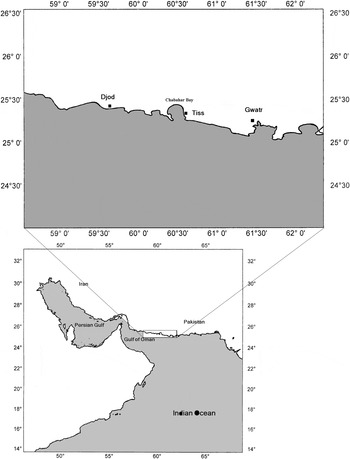
During 2009 and 2010, the brachyuran crabs have been collected at 8 sites in the subtidal zone and 10 sites in the intertidal zone from the northern Gulf of Oman along the Sistan–Baluchistan Province (Figure 1). In the subtidal zone, specimens were collected using a fisheries vessel (‘Ferdous I’) by a beam-trawl. Specimens in the intertidal area were collected mainly using hand and sometimes using a scoop net.
Map of sampling areas along the Iranian coasts of the Gulf of Oman.

In this study, one species Atergatis ocyroe (Herbst, Reference Herbst1801) from the subtidal zone and two species Macromedaeus voeltzkowi (Lenz, Reference Lenz1905) and Macromedaeus quinquedentatus (Krauss, Reference Krauss1843) from the intertidal zone are reported from the Gulf of Oman. Short morphological diagnosis is provided for these three species. Specimens of the study have been deposited in the Zoology Museum, University of Tehran (ZUTC) and the Senckenberg Museum of Frankfurt (SMF).
Abbreviations used: CL, carapace length; CB, carapace breadth; mm, millimetre, cm, centimetre.
RESULTS
SYSTEMATICS
Infraorder BRACHYURA
Family XANTHIDAE MacLeay, Reference MacLeay and Smith1838
Subfamily XANTHINAE MacLeay, Reference MacLeay and Smith1838
Genus Macromedaeus Ward, Reference Ward1942
Macromedaeus voeltzkowi (Lenz, Reference Lenz1905)
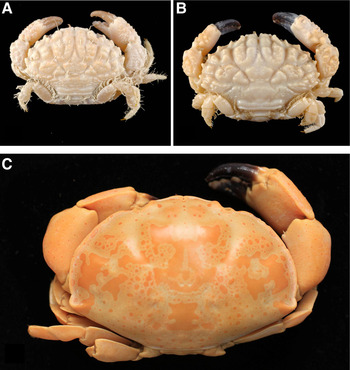
(Figure 2A)
(A) Macromedaeus voeltzkowi, Jod Village, Iran, Gulf of Oman; (B) Macromedaeus quinquendatus, Jod Village, Iran, Gulf of Oman; (C) Atergatis ocyroe, Chabahar, Iran, Gulf of Oman.

MATERIAL EXAMINED
2 females (ZUTC Brach1310), Djod Village, Sistan–Baluchestan, 25°27′N 59°30′E, rocky bed, boulder, sandy, 15 November 2005, coll. R. Naderloo, A. Kazemi; 2 females (1 ovigerous) (SMF 40799), Djod Village, Sistan–Baluchestan, 25°27′N 59°31′E, rocky bed, boulder, sandy, 23 April 2007, coll. R. Naderloo, H. Salehi, A. Sari; 1 female (ovigerous) (SMF 40777), Djod Village, Sistan–Baluchestan, 25°27′N 59°31′E, rocky bed, boulder, sandy, 23 October 2006, coll. R. Naderloo, A. Kazemi; 2 males CL 6–9 mm, CB 9–12 mm (ZUTC Brach1797), Tiss, Chabahar Bay, Sistan–Baluchestan, 25°21′N, 60°35′E, intertidal, rocky shores, under stone, 1 May 2010, coll. N. Ghotbeddin.
DIAGNOSIS
Carapace hexagonal, broader than long; posterior surface moderately convex, markedly uneven, regions well-defined with deep grooves, short setae sparsely set on areoles, long setae densely on lateral margins. Frontal region deflexed downward; front wide, about 2/3 as wide as carapace, bi-lobed, lobes nearly sinuous, separated from orbits by V-shape furrow. Eyestalks stout, short, reaching to end of exorbital angle. Upper orbital margin rounded, one cleft near exorbital angle. Anterolateral margin with four teeth (excluding exorbital angle), all teeth triangle, wide based, first tooth smaller than others. Chelipeds unequal, stout, covered with irregular granules in outer surface, inner surface smooth, granules getting smaller from upper margins to lower margins; palm relatively long, tip of fingers spoon-shape.
Walking legs with long setae along anterior margin of merus; posterior margin of merus with long setae in proximal part; anterior and posterior margins of dactylus, propodus and anterior margin of carpus with long setae; propodus subquadrate; dactylus long, about as long as propodus. Third maxillipeds without any gap between them; ischium about 2 times as long as merus, inner margin of ischium dentate, long setae along inner margin; merus nearly quadrate, inner margin straight, with long setae proximally, outer margin straight, without any seta. Male abdomen with segments 3–5 fused, telson triangular apically rounded and shorter than segment 6, segment 6 with lateral margins straight on most of their length. Gonopods 1 (G1) slender, long, tapering distally, distal part deflexed laterally, short setae along inner surface of distal part.
COLOUR
Carapace, chelipeds and legs are cream; dactylus and pollex of chelipeds are brown.
REMARKS
Macromedaeus voeltzkowi (Lenz, Reference Lenz1905) is very similar to Macromedaeus quinquedentatus (Krauss, Reference Krauss1843) but differs from it by having the carapace regions partially or completely divided. The legs in M. quinquedentatus have spines, areoles have thickly plumose setae (Tirmizi & Ghani, Reference Tirmizi and Kazmi1996) and the granules on the carapace, legs and chelipeds are sparse compared to M. voeltzkowi. In M. voeltzkowi, the legs without any spines, areoles have only short setae, whereas carapace, legs and chelipeds with granules, granules on chelipeds getting larger from the lower margin to the upper margin. This is the second record of the species from the Iranian coast of the Gulf of Oman, but there is still no record from the Arabian coast.
DISTRIBUTION
Western Indian Ocean: South Africa, East Africa, Red Sea, Somalia, Persian Gulf and Gulf of Oman (Naderloo & Türkay, Reference Naderloo and Türkay2012).
Subfamily XANTHINAE MacLeay, Reference MacLeay and Smith1838
Genus Macromedaeus Ward, Reference Ward1942
Macromedaeus quinquedentatus (Krauss, Reference Krauss1843)
(Figure 2B)
MATERIAL EXAMINED
1 female (ZUTC Brach1309), Djod Village, 25°27′N 59°30′E, rocky bed, boulder, sandy, 15 November 2005, coll. R. Naderloo, A. Kazemi; 1 male CL 21 mm, CB 23 mm (ZUTC Brach1486), Tiss, Chabahar Bay, Sistan–Baluchestan, 25°21′N 60°35′E, intertidal, rocky shores, under stone, 1 May 2009, coll. N. Ghotbeddin.
DIAGNOSIS
Carapace hexagonal, broader than long; regions well-defined with deep grooves, granules sparsely on carapace, legs and chelipeds, areoles with thickly plumose setae. Frontal region deflexed downward; front wide, about 1/3 as wide as carapace, bi-lobed by deep groove, separated from orbits by V-shape furrow. Anterolateral margins with five teeth (excluding exorbital angle), all teeth triangle, same sized. Eyestalks stout, short, reaching to end of exorbital angle. Upper orbital margin rounded, one cleft near exorbital angle. Anterolateral margin with four teeth (excluding exorbital angle), all teeth triangle, wide based, first tooth smaller than others. Chelipeds unequal, stout, covered with irregular areoles, granules in outer surface, inner surface smooth; palm relatively long, tip of fingers spoon-shape, cutting edges toothed.
Walking legs with long setae along anterior margin of merus; posterior margin of dactylus and propodus with long setae, propodus subquadrate, dactylus longer than propodus. Male abdomen with segments 3–5 fused, telson triangular, shorter than segment 6. G1 slender, long, tapering distally, distal part deflexed laterally, short setae along inner surface of distal part.
COLOUR
Carapace, chelipeds and legs are cream; dactylus and pollex of chelipeds are brown.
REMARKS
Macromedaeus quinquedentatus (Krauss, Reference Krauss1843) is very similar to Macromedaeus voeltzkowi (Lenz, Reference Lenz1905). For detailed taxonomic remarks see remarks about M. voeltzkowi explained above. This species was recorded from the southern Gulf of Oman in an unpublished thesis of Apel (Reference Apel2001), but this is a new record from the Iranian coast, and meanwhile confirms the occurrence of the species in the Gulf of Oman. Naderloo & Türkay (Reference Naderloo and Türkay2012) recorded the species from the Persian Gulf.
DISTRIBUTION
Indian Ocean: South Africa, Madagascar, Somalia, Gulf of Aden, Dhofar, Gulf of Oman, Pakistan, Bombay, Sri Lanka, Mergui Archipelago, Indo-Malaysian Archipelago and Hawaii (Apel, Reference Apel2001).
Subfamily ZOSIMINAE Alcock, Reference Alcock1898
Genus Atergatis De Haan, Reference Haan and von Siebold1833
Atergatis ocyroe (Herbst, Reference Herbst1801)
(Figure 2C)
MATERIAL EXAMINED
1 male CL 43 mm, CB 63 mm (ZUTC Brach1798), 25° 08′N 25°10′N 60°27′E, 60° 59′E, Chabahar Bay, Sistan–Baluchestan, 32–38 m, 2 July 2009.
DIAGNOSIS
Carapace suboval, broader than long; posterior surface distinctly convex, smooth, regions weakly defined. Frontal region deflexed downward; front wide, about 0.3 as wide as carapace, two-lobed, lobes separated by shallow furrow, convex, extending beyond inner orbital angle, separating from inner orbital angle by deep groove. Eyestalks stout, short, reaching to end of exorbital angle. Upper orbital margin rounded, with two fissures. Pterygostomial region smooth. Anterolateral margins ridgy, arched, broader than posterolateral margins, with three wide lobes, first lobe shorter than second, third longest; distinct blunt tooth on posterior part. Chelipeds subequal, stout; merus smooth in inner and outer surface, anterior margin sharp, ridgy; carpus convex in outer surface, smooth, with distal blunt tooth on inner margin; manus and movable fingers proximally ridgy on upper margin, inner surface of manus smooth, outer surface with shallow fold; fingers with teeth on cutting edge. Walking legs smooth, compressed laterally; posterior margins of coxa and ischium with setal patch distally; merus without any seta, posterior margin with two ridges except proximal part; posterior margin of propodus with long setae near distal part; dactylus with long brown patch of setae on anterior and posterior margins. Third maxillipeds with ischium about 2.2 times as long as merus, long setae along inner and outer margins, with indent near proximal part, tiny pores near inner and outer margins; merus rectangular, anterior margin indent in middle, short setae on anterolateral corner. Male abdomen with segments 3–5 fused; telson apically rounded, shorter than segment 6. G1 slender, long, with tapering, deflexed tip; long setae along inner surface, spinules along inner and outer margins of tip.
COLOUR
Carapace, chelipeds and legs are cream with cream-brown patches of setae; dactylus and pollex of chelipeds are black and cutting edges of fingers are white.
REMARKS
Atergatis ocyroe (Herbst, Reference Herbst1801) is very similar to Atergatis floridus (Linnaeus, Reference Linnaeus1767) and has long been considered a synonym of A. floridus. Ng & Davie (Reference Ng and Davie2007) separated A. ocyroe and A. floridus using differences of the colour patterns of the carapace, the degree of swelling of the carapace branchial region and feature of the third maxilliped. They defined A. floridus as common species in South-east Asia, Australia and the western Pacific whereas the distribution range of A. ocyroe is the northern and western Indian Ocean. The specimen examined here is clearly similar to the specimens from Phuket examined by Ng & Davie (Reference Ng and Davie2007). There are small differences in the colour pattern; the carapace of the present specimen is cream in background with cream-brown setal patches but that of Phuket has reddish-brown to brown patches.
DISTRIBUTION
Indian Ocean: South Africa, Pakistan, India, Thailand (Phuket) and Gulf of Oman (see Ng & Davie, Reference Ng and Davie2007).
ACKNOWLEDGEMENTS
We are thankful to Hasan Salehi (ZUTC) for providing the material to the authors. The anonymous referees who carefully edited the paper are also greatly acknowledged.