Introduction
In Denmark, which has a population of 5.2 million people, the number of vestibular schwannomas diagnosed per year has increased from 26 in 1976 to 101 in 2001Reference Tos, Thomsen and Charabi1–Reference Stangerup, Tos, Caye-Thomasen, Tos, Klokker and Thomsen3 and 118 in 2005. Over the same period, the mean size of the tumour at the time of diagnosis has gradually decreased from 35 mm (extrameatal diameter) to 10 mm.Reference Stangerup, Tos, Caye-Thomasen, Tos, Klokker and Thomsen3 Similar changes in incidence and size have been reported in other studies.Reference Seedat, Claassen and Mol4–Reference Mirz, Jorgensen and Pedersen6 With the decrease in tumour size at diagnosis, the symptoms have become fewer, and unilateral sensorineural hearing loss may be the only symptom.Reference Mathew, Facer, Suh, Houser and O'Brien7–Reference Sauvaget, Kici, Kania, Herman and Tran Ba11 Until 1985, diagnosis of vestibular schwannoma in Denmark was based on X-ray, X-ray tomography and computed tomography. The first magnetic resonance imaging (MRI) scanner became available in Denmark in 1985, and over the following years more MRI scanners were introduced. From 1990 onwards, an increasing proportion of vestibular schwannomas were diagnosed by MRI. Since 1995, all such diagnoses have been made by MRI, except in a few patients with claustrophobia or extreme obesity.
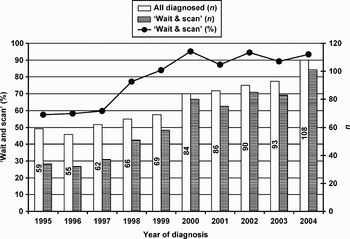
With easy access to MRI, it has become possible to observe the natural history of vestibular schwannoma. Reports of large seriesReference Walsh, Bath, Bance, Keller, Tator and Rutka12–Reference Tschudi, Linder and Fisch16 have shown that, in a substantial proportion of patients, the tumour does not grow during observation. It is acknowledged that patients' quality of life is almost always poorer after surgery, compared with conservative management of a small tumour;Reference Pollock, Driscoll, Foote, Link, Gorman and Bauch17–Reference Inoue, Ogawa and Kanzaki23 therefore, a ‘wait and scan’ policy has become a reasonable option for the treatment of small tumours. Over recent years, an increasing proportion of patients with diagnosed vestibular schwannoma have been managed by the ‘wait and scan’ approach, from 58 per cent in 1995 to 94 per cent in 2004 (Figure 1).
Patients with vestibular schwannomas 20 mm or smaller allocated to ‘wait and scan’ management and other treatment (total n = 636/772).

One argument against conservative management of vestibular schwannoma (e.g. ‘wait and scan’ or radiation therapy) is the reported risk of progressive hearing deterioration over time.Reference Van Dijk, Duijndam and Graamans24–Reference Harner, Fabry and Beatty27 Advocates of hearing preservation surgery claim that if a patient with a small vestibular schwannoma and good hearing is not operated upon, their hearing may deteriorate and they may lose serviceable hearing, and also candidacy for hearing preservation surgery.Reference Cohen28–Reference Moriyama, Fukushima, Asaoka, Roche, Barrs and McElveen31
In order to assess the benefits and risks of a ‘wait and scan’ policy, it is necessary to clarify the natural progression of hearing loss in patients with diagnosed vestibular schwannoma. This was the topic of this study.
In Denmark, all patients diagnosed by MRI as having a cerebellopontine angle tumour, resembling a vestibular schwannoma, are referred to one centre. Data from the MRI and audiological examinations are forwarded from patients' local hospitals to our ENT department in Gentofte, Copenhagen, and are then prospectively entered into our database (Microsoft Access).
Subjects and methods
During the period January 1995 to December 2004, 973 patients were diagnosed with MRI as having a unilateral cerebellopontine angle tumour resembling a vestibular schwannoma. Of these 973 patients, 312 were operated upon soon after diagnosis, 10 received initial irradiation treatment and 651 were managed conservatively. The criterion for allocation to ‘wait and scan’ management was a vestibular schwannoma with a maximum extrameatal diameter of 20 mm. In 15 of the patients managed conservatively, the tumour was larger than 20 mm. In these patients, surgery was not performed because of poor medical condition.
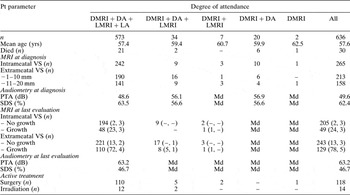
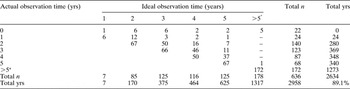
The subjects of this study comprised the 636 patients with a tumour 20 mm or smaller (largest extrameatal extension) who were allocated to ‘wait and scan’ management, with the intention of performing annual MRI scanning and clinical assessment, including audiological examination (Table I). The median age at diagnosis was 57.6 years, ranging from 15 to 85 years. Three hundred and three of the patients were female and 333 were male. At the time of diagnosis, the tumours were categorised as intrameatal in 265 patients and as intra- and extrameatal in 371 patients (Table I). The mean observation time was 3.9 years, with a range of 0.3 to 11.4 years. The total actual observation time (2634 years) represented 89.1 per cent of the total ideal observation time (2958 years, Table II).
Data for 636 patients diagnosed with vestibular schwannoma january 1995 to december 2004 and managed by ‘wait and scan’ approach

Data in parentheses indicate number of patients treated with surgery or irradiation, respectively. Pt = patient; DMRI = diagnostic magnetic resonance imaging scan; DA = diagnostic audiometry; LMRI = last MRI; LA = last audiometry; yrs = years; VS = vestibular schwannoma; Md = missing data; PTA = pure tone audiometry; SDS = speech discrimination score; – = none
Ideal and actual observation time in 636 patients allocated to ‘wait and scan’ management

* Mean = 7.4.Yrs = years; – = none
For a total of 573 patients (90 per cent), at least two MRI scans and two audiograms were available. In some patients controlled locally by a private ENT doctor, speech audiometry was not performed (Table I). In 63 patients, either the last MRI scan (22 patients), the diagnostic audiogram (nine patients) or the last audiogram (63 patients) was missing (Table I).
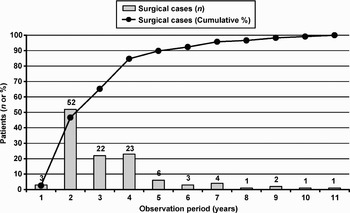
Of the 636 patients, the observation period was terminated by surgery in 118 and by irradiation therapy in 118, in most cases because of significant tumour growth (Table I). Most of the patients undergoing surgery did so within the first three years of diagnosis (Figure 2). The mean observation time before surgery was 2.8 years.
Length of ‘wait and scan’ observation period, from diagnosis to surgery, for 118 vestibular schwannoma patients.

During the observation period, 30 patients died due to reasons unrelated to vestibular schwannoma (Table I). The median age at death was 71.1 years. Also during the observation period, 18.5 per cent of the intrameatal tumours grew to extrameatal dimensions, and 34.5 per cent of the extrameatal tumours increased by more than 2 mm in the extrameatal diameter, compared with the diagnostic MRI (Table I).
The puretone average (PTA) was calculated as the mean sum of 0.5, 1, 2 and 4 kHz hearing thresholds. Speech audiometry was performed in quiet conditions using word lists scoring by phonemes, correctly repeated at the most comfortable level, according to the masking rules. The average time interval between the first audiogram and the diagnostic MRI was 2.2 months. The average time interval between the last MRI and the last audiogram was 0.64 months.
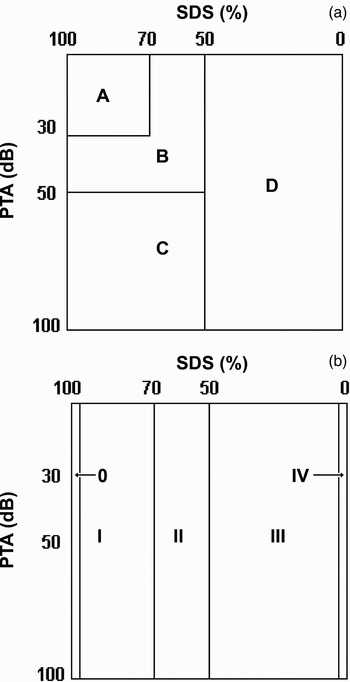
For the classification of hearing, the American Academy of Otolaryngology – Head and Neck Surgery (AAO-HNS) guidelines were used32 (Figure 3), as follows: class A, PTA ≤ 30 dB and speech discrimination score ≥ 70 per cent; class B, PTA ≤ 50 dB and speech discrimination score ≥ 50 per cent; class C, PTA > 50 dB and speech discrimination score < 50 per cent; and class D, speech discrimination score < 50 per cent.
Classification of hearing according to (a) the American Academy of Otolaryngology – Head and Neck Surgery and (b) the word recognition score. SDS = speech discrimination score; PTA = pure tone avarage

Hearing was also classified using the word recognition score system suggested by Meyer et al. Reference Meyer, Canty, Wilkinson, Hansen, Rubinstein and Gantz33 (Figure 3), as follows: class I, speech discrimination score ≥ 70 per cent; class II, speech discrimination score < 70 per cent and ≥ 50 per cent; class III, speech discrimination score < 50 per cent and > 0 per cent; and class IV, speech discrimination score = 0 per cent.
According to the international recommendations on reporting vestibular schwannoma size,Reference Kanzaki, Tos, Sanna, Moffat, Monsell and Berliner34 the tumours were categorised as either intrameatal, or intra- and extrameatal. The size of the intrameatal tumours was scored as 0 mm. The size of the intra- and extrameatal tumours were calculated according to the largest extrameatal diameter, not including the intrameatal proportion.Reference Rosenberg35 Only patients with tumours with a maximum diameter of 20 mm were included in the ‘wait and scan’ group. Our definition of significant tumour growth was either development of an extrameatal extension of a previously purely intrameatal tumour, or an increase in the size of the extrameatal part in an extrameatal tumour exceeding 2 mm, as assessed by a comparison of the diagnostic and most recent MRI scans.Reference Fucci, Buchman, Brackmann and Berliner36 If significant growth had occurred, the patient was advised to undergo either radiotherapy or surgery.
Statistics
The chi-square and Mann–Whitney tests were used for statistical analyses, and p < 0.05 was chosen as the level of significance.
Results
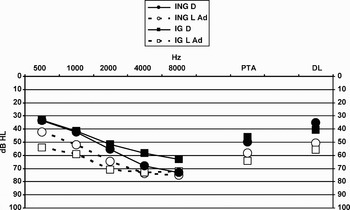
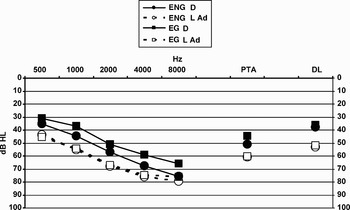
In order to analyse patients' changes in hearing during the observation period, we correlated the pure tone frequencies, PTAs, speech discrimination scores, and AAO-HNS and word recognition score hearing classifications, with parameters such as age, tumour size and localisation, and the presence or absence of significant tumour growth (Figures 4 to 8).
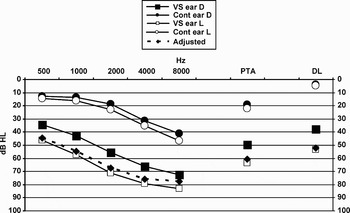
Mean audiogram at diagnosis (D) and last evaluation (L), in the vestibular schwannoma (VS) ear and the contralateral (cont) ear. Adjusted last evaluation values are indicated by the dotted line (see text). PTA = pure tone avarage; DL = discrimination loss

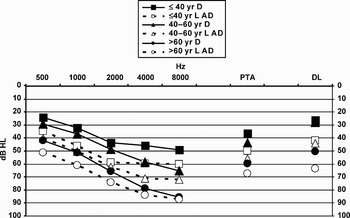
Mean audiogram at diagnosis (D) and at last evaluation, adjusted value (L AD; dotted line), in the vestibular schwannoma ear in different age groups. PTA = pure tone avarage; DL = discrimination loss; yr = years

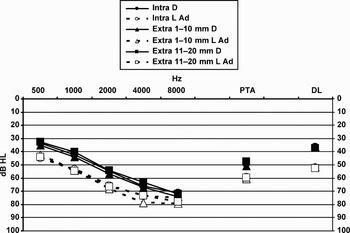
Mean audiogram at diagnosis (D) and at last evaluation, adjusted value (L AD; dotted line), for vestibular schwannomas of various locations and sizes (at largest extrameatal diameter) at diagnosis. Intra = intrameatal; extra = extrameatal; PTA = pure tone avarage; DL = discrimination loss

Mean audiogram at diagnosis (D) and at last evaluation, adjusted value (L AD; dotted line), for static and expanding intrameatal tumours. PTA = pure tone avarage; DL = discrimination loss; ING = intrameatal no growth; IG = intrameatal growth

Mean audiogram at diagnosis (D) and at last evaluation, adjusted value (L AD; dotted line), for static and expanding extrameatal tumours. PTA = pure tone avarage; DL = discrimination loss; ENG = extrameatal no growth; EG = extrameatal growth

Pure tone audiometry
For illustrative purposes, we produced ‘mean’ audiograms for the various parameters which usually affect hearing (Figures 4 to 8). At diagnosis, there was a significant difference (p < 0.001, Mann–Whitney test) in hearing level between the vestibular schwannoma ear and the contralateral ear (Figure 4). For the vestibular schwannoma ear, the mean hearing levels at 500, 2000 and 4000 Hz were 34, 56 and 66 dB, respectively, versus 13, 19 and 31 dB for the contralateral ear, respectively. Hearing deteriorated during the observation period in both ears, but significantly more (p < 0.05, Mann–Whitney test) in the vestibular schwannoma ear. In almost all patients, the puretone hearing was worse in the high frequencies compared with the low frequencies. In eight out of 636 patients (1.3 per cent), the PTA was poorer in the contralateral ear compared with the vestibular schwannoma ear. In 37 patients (5.7 per cent), the PTA was equal in both ears. In 577 patients (90.1 per cent), the vestibular schwannoma ear had the poorer PTA.
In order to analyse the extent to which hearing deteriorated due to the tumour itself; we adjusted the audiograms by subtracting the time-dependent hearing deterioration of the opposite ear from the values for the vestibular schwannoma ear. The adjusted values appear as dotted lines in Figures 4 to 8.
The deterioration of pure tone hearing during the observation period was similar in all three age groups (Figure 5). At diagnosis, there was no significant difference in pure tone hearing level related to tumour size or localisation (Figure 6). There was no significant difference in hearing deterioration between the intrameatal tumours, the 1–10 mm and the 11–20 mm extrameatal tumours, at diagnosis or at the last evaluation (Figure 6).
At diagnosis, the hearing in ears with tumour growth was not different from that in ears without tumour growth. At the last evaluation, there was a significant deterioration of the low frequencies in patients with expanding tumours, compared with those with no tumour growth (Figures 7 and 8).
Speech discrimination
At diagnosis, the mean speech discrimination score in the vestibular schwannoma ear was 62.4 per cent, compared with 46.7 per cent at the last evaluation (Table I and Figure 4). In the contralateral ear, the corresponding figures were 96.3 per cent at diagnosis and 95.3 per cent at the last evaluation (Figure 4).
Looking at the different age groups (Figure 5), it appears that, for patients 60 years or younger, there was no speech discrimination score deterioration, comparing the diagnostic and the adjusted last examination. In patients older than 60 years, the speech discrimination score deteriorated significantly more (15 per cent) than in the younger age groups (p < 0.01, Mann–Whitney test). There was no difference in speech discrimination score deterioration at the last examination, comparing different tumour size groups (Figure 6). There was also no difference in speech discrimination score deterioration between patients with growing and non-growing tumours (Figures 7 and 8).
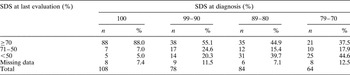
At diagnosis, 108 patients (17 per cent) had 100 per cent speech discrimination (Table III). Of these, 88 still had a speech discrimination score exceeding 70 per cent at the end of the observation period. Of 78 patients with a small speech discrimination loss at diagnosis (1–10 per cent), only 38 (55 per cent) maintained speech discrimination of better than 70 per cent. This difference was even more pronounced in the 64 patients who had speech discrimination of 70–79 per cent at diagnosis, which is still considered to be good, serviceable hearing. In these patients, only 21 (38 per cent) maintained speech discrimination of 70 per cent or better (Table III).
Speech discrimination scores in 334 patients, at diagnosis and last evaluation

SDS = speech discrimination score
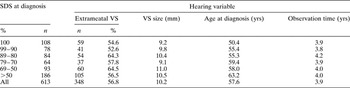
The variables affecting hearing were compared with the different speech discrimination score groups (Table IV). There was no difference in the distribution of localisation or the size of the tumour, comparing the ears with 100 per cent speech discrimination with other speech discrimination score groups. In the group with 100 per cent speech discrimination, 54.6 per cent of tumours were extrameatal, compared with 58.8 per cent in the group with speech discrimination scores of less than 100 per cent. There was no difference in the extrameatal size of the tumours in the 100 per cent speech discrimination group, compared with the group with less than 100 per cent speech discrimination. The mean size of the extrameatal tumours in the group with 100 per cent speech discrimination was 9.2 mm, compared with 10.5 mm in the group with less than 50 per cent speech discrimination (Table IV). The mean observation time for the 100 per cent speech discrimination group was 3.9 years, compared with 4.0 years in the group with less than 100 per cent speech discrimination at diagnosis. The only significant difference between the different speech discrimination score groups was age at diagnosis. The patients in the 100 per cent speech discrimination group were significantly younger (p < 0.05, Mann–Whitney test), with a mean age of 50.4 years, compared with those with speech discrimination scores of less than 50 per cent, whose mean age was 63.2 years (Table IV).
Variables affecting hearing, by speech discrimination score at diagnosis

SDS = speech discrimination score; VS = vestibular schwannoma; yrs = years
Hearing classification
In order to compare pre- and post-operative hearing in vestibular schwannoma patients, several hearing classification systems have been proposed.Reference Wade and House37–Reference Gardner and Robertson39 We chose to display hearing results according to both the AAO-HNS classification32 and the word recognition score classification, as shown in Figure 3.
American Academy of Otolaryngology – Head and Neck Surgery classification
According to the AAO-HNS classification (Table V), 129 out of 636 patients (20 per cent) had class A hearing on the tumour side at the time of diagnosis, compared with 78 per cent on the contralateral side. Of the 129 patients with class A hearing at diagnosis, 62 (48.1 per cent) still had class A hearing at the last evaluation. In 17 patients, hearing improved at least one AAO-HNS class during the observation period. At diagnosis, AAO-HNS class A or B hearing was found in 314 (49 per cent) of the vestibular schwannoma ears. During the observation period, 154 of these ears (49 per cent) maintained class A or B hearing. In 222 patients, hearing deteriorated at least one AAO-HNS class. In 309 patients, the AAO-HNS hearing class was unchanged at the last evaluation.
AAO-HNS hearing class in vestibular schwannoma ears, at diagnosis and last evaluation

Data shown represent number of ears. See text for explanation of hearing classes. AAO-HNS = American Academy of Otolaryngology – Head and Neck Surgery; – = none
Word recognition score classification
By this scoring system, at the time of diagnosis, 334 out of 636 patients (52.5 per cent) had class I hearing on the tumour side, compared with 94 per cent on the contralateral side. Of these 334 patients, 182 (55 per cent) still had class I hearing at the last examination. In 28 patients, hearing improved at least one word recognition score class during the observation period (Table VI). In 212 patients, hearing deteriorated at least one word recognition score class. In 309 patients, the word recognition score class was unchanged at the last evaluation.
Word recognition score hearing class in vestibular schwannoma ears, at diagnosis and last evaluation

Data shown represent number of ears. See text for explanation of hearing classes. WRS = word recognition score; – = none
Discussion
Unilateral hearing loss is the most common symptom of a vestibular schwannoma. In the present study, we found at least a 10-dB PTA difference between the vestibular schwannoma ear and the opposite ear at diagnosis in 91 per cent of patients. In addition, we found a speech discrimination score difference of at least 10 per cent in 74 per cent of the vestibular schwannoma ears, compared with the normal side. When considering serviceable hearing, the hearing level in the contralateral ear is of importance. In patients with normal hearing in the contralateral ear, it is the authors' opinion that vestibular schwannoma ears with speech discrimination of less than 70 per cent should not be considered as having good hearing. In contrast, when the contralateral ear is profoundly deaf even an ear with a discrimination loss of 50 per cent or more should be considered useful. In the present study, the combination of good hearing (AAO-HNS class A) in the vestibular schwannoma ear and poor hearing (AAO-HNS class C or D) in the contralateral ear was found in only two of the 636 patients (0.3 per cent).
Numerous grading scales have been developed to evaluate the hearing capabilities of patients with vestibular schwannoma.Reference Gardner and Robertson39 The most generally accepted is that of the AAO-HNS, which is based on the PTA and speech discrimination scoring (Figure 3).32 According to this classification, ears with class A and class B hearing are considered as having serviceable hearing, whereas ears with class C and D hearing are considered as having non-serviceable hearing. For patients, however, some ears with class B and C hearing may prove useful, since ears with a speech discrimination score of more than 70 per cent may significantly benefit from a hearing aid. Therefore, hearing classification based only on the word recognition score, as suggested by Meyer et al., Reference Meyer, Canty, Wilkinson, Hansen, Rubinstein and Gantz33 seems more reasonable.
In many patients with vestibular schwannoma, hearing loss is progressive over time, and it is a general experience that hearing may deteriorate to a non-serviceable level. In such situations, candidacy for hearing preserving surgery may be lost during the ‘wait and scan’ period. In this study, good hearing (AAO-HNS class A) was found in 20 per cent of the ears at diagnosis, but 48 per cent lost class A hearing during the observation period. At diagnosis, AAO-HNS class A or B hearing was found in 49 per cent of the ears. During the observation period, 49 per cent maintained class A or B hearing. Other authors have reported loss of good hearing during the ‘wait and scan’ period in 50–67 per cent of cases.Reference Walsh, Bath, Bance, Keller and Rutka40 Using the word recognition score classification, 53 per cent of our patients had good hearing (class I) at diagnosis, and 40 per cent lost their class I hearing during the observation period.
• With easy access to magnetic resonance imaging (MRI), it has become possible to observe the natural history of acoustic neuromas
• Reports of large series have shown that, in a substantial proportion of patients, these tumours do not grow during observation
• This study reports the characteristics of 636 patients allocated to ‘wait and scan’ management with annual MRI scanning and audiological examination
• In acoustic neuroma patients with a small tumour and normal speech discrimination, the principal indication for active treatment should be established tumour growth
Some studies of hearing preservation surgery have reported that some degree of hearing preservation may be obtained in 35–60 per cent of cases. Some authors have even found improved hearing after surgery, in about 5 per cent of cases.Reference Meyer, Canty, Wilkinson, Hansen, Rubinstein and Gantz33 A meta-analysis of radiation therapy results showed a similar hearing outcome compared with microsurgery.Reference Kaylie, Horgan, Delashaw and McMenomey41 In the present study, the speech discrimination score improved at least one word recognition score class in 10.4 per cent of patients during the ‘wait and scan’ period. This improvement may be explained by the great variance in measuring speech discrimination values. Usually, this variance is estimated at about 12 per cent. In a recent review article by Khrais and Sanna,Reference Khrais and Sanna42 1003 out of 1993 patients (50 per cent) had AAO-HNS class A hearing before surgery. Of these, only 344 patients (34 per cent) maintained class A hearing after hearing preservation surgery.
Most hearing preservation studies report their results after one year of observation. In a 2003 study,Reference Friedman, Kesser, Brackmann, Fisher, Slattery and Hitselberger43 long term hearing preservation after surgery was evaluated over a five-year period in 38 patients. Of these 38 patients, 23 had class A to B hearing following surgery. Over the next five-year period, 30 per cent lost class A to B hearing.
In the present study we found that, of the ears with a speech discrimination score of better than 70 per cent at diagnosis (word recognition score class I), almost 43 per cent lost their class I hearing during observation. Analysis of the prognostic effect of different degrees of speech discrimination loss within this group of patients with good hearing (word recognition score class I) at the time of diagnosis generated new and interesting results. In ears with a minor speech discrimination loss (1–10 per cent), 45 per cent of patients lost good hearing. However, when ears with a discrimination score of 100 per cent at diagnosis were analysed independently, 88 per cent still had good hearing (word recognition score class I) at the end of the median 3.9 year observation period. To our knowledge, this finding has not previously been described. However, this study cannot supply a reason for the great difference in hearing deterioration between ears with no discrimination loss and those with discrimination loss. There may be differences in the intrameatal localisation of the tumour, and/or increased pressure in the internal auditory canal, as some have proposed.Reference Lapsiwala, Pyle, Kaemmerle, Sasse and Badie44–Reference Caye-Thomasen, Dethloff, Hansen, Stangerup and Thomsen46
It is difficult to understand why the hearing of patients with 100 per cent speech discrimination at diagnosis should subsequently behave differently from that of patients with even a small speech discrimination loss at diagnosis. However, it is well known that there is considerable variability when measuring speech discrimination scores. Nevertheless, we consider the 100 per cent speech discrimination score group to be very well defined, since a 100 per cent correct scoring during speech audiometry is extremely unlikely to occur by chance in cases of impaired speech discrimination. It is more difficult to assess the group with just less than 100 per cent speech discrimination (i.e. 99–90 per cent), as some of these patients may have normal speech discrimination but may have repeated one or two words wrongly in error during testing. In any event, there was a significant difference in the stability of the discrimination scores between these two groups. This difference became even more pronounced with decreasing speech discrimination scores.
In the future, it will be interesting to observe whether hearing preservation surgery outcomes improve if surgical candidates are recruited from patients with 100 per cent speech discrimination.
Because of the different prognostic value of a speech discrimination score of 100 per cent, we propose that the word recognition score classification should be modified, so that a score of 100 per cent should be included in a new class, perhaps class zero. This would result in the following classification: class zero, 100 per cent word recognition; class I, 99 to 70 per cent; class II, 69 to 50 per cent; class III, 49 to 1 per cent; and class IV, 0 per cent.
Conclusion
At the time of diagnosis, 17 per cent of our patients with vestibular schwannoma had a speech discrimination score of 100 per cent. Eighty-eight per cent of these patients maintained good hearing (word recognition score class I). In contrast, 45 per cent of patients with even a small speech discrimination loss at diagnosis lost serviceable hearing during the first few years after diagnosis. Comparing the hearing results of hearing preservation surgery and of radiotherapy with those of ‘wait and scan’ management, it appears to the authors that, in vestibular schwannoma patients with a small tumour and normal speech discrimination, the main indication for active treatment should be established tumour growth.
In summary, following analysis of the speech discrimination score at diagnosis in patients with unilateral vestibular schwannoma, it was shown that 88 per cent of patients with 100 per cent speech discrimination maintained good hearing after a median observation period of 3.9 years. In contrast, 45 per cent of patients with a small discrimination loss at diagnosis lost good hearing during the observation period. In the literature, good hearing is reported to be preserved in 35 to 60 per cent of such patients after one year. Therefore, in conclusion, it appears that, in vestibular schwannoma patients with a small tumour and normal discrimination, the main indication for active treatment should be established tumour growth.