

Introduction
Adolph Hummel arrived in London in either late 1759 or early 1760 with his wife, Catherine, who gave birth to Anne, the first of their four children, on 23 January 1760. Within a few months, he had set up in Soho a music publishing business that lasted 12 years. Leopold Mozart, who visited London in 1764–65 with his wife, and children Wolfgang and Nannerl, tells us a few things about Hummel that we would otherwise not know. Leopold’s diary, recording the names of people upon whom he called between 23 April and 6 August 1764, includes ‘Mr Humel Musikshändler et Sa Feme. King’s [sic] Street. St. An’s Soho’,Footnote 1 and a letter he wrote to Lorenz Hagenauer, his landlord in Salzburg, reveals that Hummel was German, and from Hesse.Footnote 2 The letter also discloses that the Mozarts attended the home baptism of Hummel’s fourth child, Charlotte, on 4 March of that year; furthermore, Frau Anna Maria Mozart acted as one of the child’s godmothers.Footnote 3 Leopold’s letter also tells us that Hummel’s wife was a Swiss Calvinist, and ‘rather strict in her religion’, while Adolph Hummel ‘had no particular religion’ but believed ‘that one must pray to God, must love him and one’s neighbours and be honourable in one’s dealings’. Leopold remarked both on the ‘extraordinary’ fact that the child’s father followed no religion and on the plurality of Christian denominations represented at the ceremony – Calvinist (mother and first godmother), Lutheran (godfather, Commissarius from Brunswick), Catholic (second godmother), and Anglican (the officiating minister).
No definitive records of Hummel’s birth or marriage have come to light. From the birth -dates of his children,Footnote 4 we might guess that he was probably born between about 1730 and 1740. A Johann Friedrich Hummel was an oboist at the Hofkapelle in Kassel from 1720 to 1726,Footnote 5 and while the dates would allow him to be Hummel’s father, no supporting evidence for this has been found. Hummel’s homeland, the Landgraviate of Hesse-Kassel, was at this time ruled by Frederick I of Sweden, and its religious leaning was Calvinist Protestant.
The parish records of St Anne’s, Soho, reveal that baby Anne Hummel was christened on 19 February 1760. This suggests that the Hummels were lodging in the parish at this time, but exactly where is not known. A few months later they established the location of what was to become Adolph’s music publishing business: King Street (today Shaftesbury Avenue), opposite Nassau Street (today Gerrard Place), St Anne’s, Soho. The house was not then numbered, but its position opposite Nassau Street indicates that it was one of the two houses later numbered as 65 and 66 on the north side of King Street, which formed part of the Portland estate. The family moved into the leasehold property some time between 20 June and 3 November 1760, taking over from a Jacob Stoddart.Footnote 6 Stoddart had a separate listing for ‘Workshops’, and the rateable value of his house plus workshops was £37 in June 1760, but for the watch rate in November, the house and workshops are combined and listed as one entity under the name ‘Adolph Hummell’, the rateable value having increased to £40. As we shall see, at some point Johann Christian Bach lodged with Hummel. Adam Smith explained that:
A tradesman in London is obliged to hire a whole house in that part of the town where his customers live. His shop is upon the ground-floor, and he and his family sleep in the garret; and he endeavours to pay a part of his house-rent by letting the two middle stories to lodgers.Footnote 7
Another tenant of Hummel’s was John Clinton, a jeweller, who occupied an apartment in 1766–7.Footnote 8 Hummel’s must have been a large house: only one other ratepayer on the north side of King Street occupied property rated higher than his, and that was Jonas Buttall, assessed for a rateable value of £81 for three adjacent properties, rather than a single one as occupied by Hummel.Footnote 9
In 1720, John Strype described King Street as ‘a pretty good Street, having divers very good Houses fit for Gentry’, and the parish church, St Anne’s Church, as ‘a fair Church (…) furnished with a Pair of Organs, which were given by King William the Third’.Footnote 10 The church, consecrated in 1686, was designed by either Christopher Wren or his assistant, William Talman, or perhaps by both of them:Footnote 11 the gift of the organs encouraged the development of a strong musical tradition. St Anne’s Church was just a short walk away from Hummel’s house in King Street.
Hummel was one of a number of German musicians who were attracted to London in the early 1760s. Two others who lived near him were Carl Friedrich Abel, viola da gamba player, who arrived in the capital in 1759,Footnote 12 and Johann Christian Bach, the youngest son of Johann Sebastian Bach, who followed three years later.Footnote 13 Adolph Hummel printed and/or sold compositions by both of these fellow Germans who became prominent in the musical life of 1760s London, and he was a particular friend of Bach, as will be discussed later.
Apart from gaining respite from warfare in Europe (the Seven Years War lasted from 1756 until 1763), foreign musicians–especially those of German descent–discovered other attractions in the capital. One was that Queen Charlotte, who arrived in 1761 to marry King George III, following his succession to the British throne the year before, was not only interested in music but was herself German. The members of the Queen’s Band, formed shortly after Charlotte’s arrival in England, were native Britons,Footnote 14 but within a few years there became established a Queen’s Chamber Band, with several German musicians as members,Footnote 15 reflecting, as Simon McVeigh remarks, ‘the Queen’s preference both for modern music [i.e. galant style] and for German musicians’.Footnote 16 Some 20 years later, London’s continued attraction for German musicians is illustrated in the advice given to Charles Frederick Horn while he was passing through Hamburg on his way to Paris, where he intended to pursue a musical career. A stranger to whom Horn divulged his plans advised him to travel, instead, to London, because it was ‘the true encourager of German talent’.Footnote 17
Foreign musicians were also drawn to London because it was an incomparably rich city. Music flourished there in the second half of the eighteenth century, with concert series, Italian opera, music in the playhouses, and in the pleasure gardens in the summer, as well as many private concerts in the houses of wealthy patrons and gentlemen’s clubs.Footnote 18 Peter Holman argues that ‘England was the most musical country in Europe in the second half of the eighteenth century’.Footnote 19 Also outside the capital, in provincial centres, there was a diverse and thriving musical scene that had few counterparts in Europe at that time. Instrument makers were attracted, serving both the professional players and the burgeoning domestic market of keen amateur musicians. Gebhard Friedrich August Wendeborn, a German visitor describing various facets of English life as he experienced them during his visit in 1785–6, summed up the view, widely held since the early part of the eighteenth century, that London was a bountiful paradise for foreign-born performers: ‘Many foreign singers, fidlers, and dancers, are extravagantly paid; and if they are [in] the least frugal, they are enabled to retire to their own country, where they may live in affluence, enriched by English money.’Footnote 20
A common way for a foreign musician to introduce himself to the London public was by performing at a concert. Abel had done this, and it seems very likely that the ‘Mr Hummel’ who played a harpsichord concerto at a benefit concert for ‘Mr Heyl and Mr Gaignevaudoux’ at the Great Room, Dean Street, Soho, on 17 March 1760 was Adolph Hummel, for there is no other ‘Hummel’ in London at the time who seems a suitable candidate.Footnote 21 If this identification is correct, Hummel’s appearance would have been a way of bringing himself to the notice of the musical public, thus generating exposure for the music publishing business he was establishing, as well as making the acquaintance of the other performers. These included the German William Herschel playing a violin solo;Footnote 22 the Dutch cellist Emanuel Siprutini; the blind Welsh harper John Parry; and 11-year old ‘Miss Schmeling’, who played a violin concerto.Footnote 23
Hummel’s Royal Privilege (Licence)
The Copyright Act of 1710 granted protection to literary works, but there was no effective protection for musical compositions until 1777.Footnote 24 Despite this, most music publishers did not apply for a royal licence (privilege) to protect their copyright.Footnote 25 Hummel was unusual in applying for a royal licence, which was granted on 17 June 1760.Footnote 26
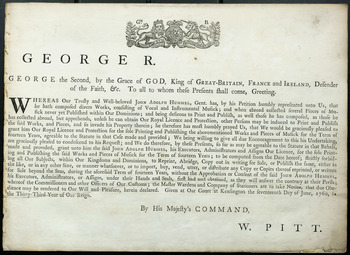
Hummel’s licence (see Figure 1) follows a standard form of wording for the most part, and the period of 14 years granted to protect the applicant’s copyright was the usual one, but whereas the licence to a composer granted protection for that composer’s works, Hummel’s licence adds protection for works he ‘has collected abroad’. This suggests that he arrived in London with music in hand (either manuscript music or prints by foreign publishers) that he was ready to publish on his own account.
Royal licence granted to Adolph Hummel. © Royal College of Music, London. Shelfmark: H362a (the licence reproduced here is within the music print of Wagenseil’s op. 1 harpsichord sonatas at this shelfmark).

Obtaining a royal licence was expensive. In addition, a successful petition required ‘palace contacts and the favour of the monarch’.Footnote 27 Hence the granting of Letters Patent was a ‘fairly rare occurrence’–a statement supported by Hunter’s listing a total of only 19 privileges granted to composers in the 60 years between 1710 and 1770.Footnote 28 Adolph Hummel must have had both money (brought with him to London, since there is no evidence he had set up in business by the time his privilege was granted) and influential contacts. Who the contacts might have been is a matter of speculation. Abel is a possible candidate. Not only was he, like Hummel, a German immigrant, but also at this time Abel was lodging at the Dove and Acorn in Greek Street,Footnote 29 not far from Hummel’s shop, and had obtained his own royal privilege just two months before Hummel was granted his.Footnote 30 The two men certainly knew each other, as evidenced by Hummel’s selling—and, as argued in the final section of this paper, possibly printing—some of Abel’s compositions.
Adolph Hummel’s royal privilege describes him as ‘Gent’. Most licences granted from 1750 to 1760 were to authors (13 licences) and booksellers (26). Of the 51 licences granted during these years, only eight described the recipient as ‘Gent’ (three authors, four composers, and Adolph Hummel). The significance of the appellation is unclear: ‘gentleman’ in the eighteenth century included not only the landed gentry, as formerly, but many professional men and those in trade, as long as their personal reputation and social standing were considered worthy of the designation.Footnote 31 Why Hummel applied for a licence, when other commercial music-publishers were able to operate a thriving business without one, can only be guessed at. Shef Rogers (136) argues that, for books, the granting of a royal licence could be a marketing tool. The licences were markers of status, so that advertising a work as having been granted protection by a licence would appeal to buyers who wished to associate themselves with that status. Hummel, however, never mentioned his royal licence in advertising any of his publications, so the puzzle as to why he troubled to obtain one remains.
Hummel’s licence reveals that his first name was ‘John’ (presumably ‘Johann’ in its German form). This name is never spelt out, nor even hinted at by an initial, in any of his publications, where he always refers to himself as either ‘A. Hummel’ or ‘A. Hummell’. Why he should have concealed the first of his two forenames is a matter of conjecture, but since the Dutch publisher Johann Julius Hummel was active at the same time, doing so would have avoided any confusion between the names of ‘J. J. Hummel’ and ‘J. A. Hummel’. An alternative explanation is that Adolf Hummel was acting in accordance with the custom of dropping the first of two forenames where this was ‘Johann’; thus John Frederick Hintz, who co-published with Hummel a set of trios by Filtz, seldom used his first name, referring to himself in advertisements and other notices as ‘Frederick Hintz’.Footnote 32
In the parish record of the birth of his first child, in January 1760, Hummel’s Christian name is spelt ‘Adolf’, but in the royal privilege, six months later, as well as in his entry for the watch rate in King Street in November 1760, he becomes ‘Adolph’. Later he sometimes, but not consistently, anglicized his surname, spelling it with two ‘l’s (his son Charles invariably used this form for his surname). For clarity, a consistent spelling of the name needs to be adopted here: I will use the form Hummel himself chose for his royal privilege: Adolph Hummel.Footnote 33
Not long after his arrival in London and the start of his publishing career there, Hummel was involved in a lawsuit. Alongside a Jacob Trippells, he was a defendant in a suit brought by the musician Rudolph Straube. A one-page legal document, dated 8 January 1761 and signed by Straube, begins:
Know all Men by these Presents That I Rudolph Straube of the parish of St Martins in the fields in the County of Middlesex Musitian (…) do Remise Release and for ever quitt claime unto Adolph Hummell of the parish of St. Anns in the Liberty of Westm.r in the said County of Middx Gentleman and Jacob Trippells of the parish Musical Instrument Maker (…)Footnote 34
Hummell and Trippells used the same attorney: Thos [Thomas] Mussendine. The document does not reveal what Straube had issued a prosecution for, and no further information about it has come to light. Jenny Nex and Lance Whitehead’s research of legal proceedings of the Old Bailey and the Middlesex Sessions of the Peace during the latter half of the eighteenth century tells us that many of the latter records (wherein the Straube v Hummell and Trippells suit lies) related to assault charges.Footnote 35 Cases meriting a jury trial were sent to the Old Bailey and, where musicians were concerned, usually involved theft or burglary, with fraud also represented (for example, Robert Falkener was accused by Jacob Kirkman of selling harpsichords fraudulently marked as Kirkman’s). Whether the case against Hummel and Trippells fell into a category normally tried at the Old Bailey but prevented from proceeding there by the prior settlement of the suit, or whether the suit involved an assault, as most of the Middlesex Sessions of the Peace Records did, we do not know. No other connection between Straube and Hummel, or Trippells and Hummel, has been found. Straube was a German-born lutenist, harpsichordist, guitar player and composer; he had been a pupil of J. S. Bach and moved to England in 1759.Footnote 36 Trippells’ name does not appear in any of the standard references,Footnote 37 so no information beyond that given in the suit—that he was a musical instrument maker living, like Hummel, in Westminster—is known about him.
Music-selling in 1760s London
The technological advances of the Industrial Revolution had contributed to a growing economy in London, and more people could afford to buy music and the instruments on which to play it.Footnote 38 Of course, talent varied, as did people’s purchasing power in relation to instruments; composers catered to the diverse market by writing pieces of varied difficulty, and publishers would often name alternative instruments on title pages, thereby encouraging amateurs to play on whatever instruments were to hand. For example, ‘German’ flutes (transverse flutes), so called to distinguish them from the older flauto (the ‘common’ flute, or recorder), were regularly interchangeable with violins. The growing demand from a middle-class public, fuelled by the popularity of the new galant style of music, underpinned a surge in music publishing in 1760s London. Hummel’s was one of several family firms setting up in business to supply sheet music to the domestic market. The arrival in London of C. F. Abel and of J. C. Bach, both representatives of the galant idiom, lent impetus to the growing public demand for the ‘new’ music. Galant music, with its tunefulness, reliance on a single prominent melody with transparent supporting harmonies, shorter phrases, and more frequent and emphatic cadences, was found easier to listen to—and perform—than the more convoluted style associated with J. S. Bach that attracted opprobrium from critics at the time.Footnote 39
Around 1760, London, Amsterdam, and Paris were the most important centres printing music from engraved plates (letterpress printing and manuscript copying were still being used in other centres, notably Leipzig).Footnote 40 Hummel’s main connections in London were with Robert Bremner (who arrived in the city in 1762, coming from Edinburgh, where he had established a publishing business), Peter Welcker (who published in London from 1762 to 1774, after which the firm was carried on by his wife, Mary),Footnote 41 the Longman firm (Longman & Co. from about 1767 to about 1769, when it became Longman and Lukey), and the Thompson family (who had started publishing in 1746). With Bremner and with the Longman firm Hummel issued a joint publication,Footnote 42 and all four firms used Hummel’s plates for their own editions at some stage, Welcker acquiring by far the greatest quantity.Footnote 43 As we have seen, Hummel also co-published an item with Frederick Hintz.
Soho was a fashionable area in 1760 when Hummel moved into his property in King Street. Setting up shop there put him within easy reach of the well-heeled clientele he needed to persuade to buy his music. Most of his prices were in the 5s. to 10s. 6d. (half a guinea) range, although one item cost just 2s. 6d. and another as much as 1 guinea.Footnote 44 Half a guinea then was equivalent to roughly £78 at present, while even Hummel’s cheapest music, at 2s. 6d., would have been equivalent to about £20 now.Footnote 45 These prices were well beyond the means of clerks (earning, in 1767, about £1 per week, with necessary expenses of rent, food, candles, clothing, coal, etc., taking up the whole wage), let alone craftsmen such as masons, who earned 14s. to 15s. a week, or lower-paid journeymen such as cabinet makers, earning only between 12s. and 15s. a week.Footnote 46 Those who would be able to afford the publications of music sellers would necessarily have been more prosperous, belonging to the classes described by Daniel Defoe as:
The Great [aristocrats], who live profusely.
The Rich [wealthy merchant class], who live very plentifully.
The middle Sort [professionals such as writers, doctors, lawyers], who live well.Footnote 47
George Rudé (the source of the definitions in square brackets above) points out that Defoe’s classification omits the landed gentry, who were not as wealthy as the ‘Great’, but were more so than the ‘Rich’; this class would also be affluent enough to buy Hummel’s prints.Footnote 48
A music shop usually stocked a variety of instruments, as well as prints of music, and it was costly to establish one. Writing in 1761, Joseph Collyer quotes a figure of £400–£500 ‘to set up a handsome shop’.Footnote 49 To get some idea of the value of this figure in 1761, one might compare it with the £859 that Sir Robert Walpole paid only ten years later to employ 42 servants for an entire year.Footnote 50 Collyer added a caution to prospective apprentices: that they should take care to choose a ‘master [owner of the shop] who plays finely on some instruments; […] as there are some of these who can scarcely hum a tune in proper time, and take apprentices only to keep shop, and not to learn them any thing relating to Music’.Footnote 51 Establishing such a business was a good investment, however, and music publishers (normally synonymous with music sellers) were able to make a good living. The following notice, which appeared in the Morning Herald and Daily Advertiser of 2 March 1781, gives a flavour of how one writer thought publishers took advantage of composers:
NEW FAVOURITE ADVERTISEMENT.
The Composers of music, in London, most respectfully acquaint the nobility and gentry, that henceforth their new music will be sold at their own dwelling houses; the reason of this is, because the music-shop keepers take so much advantage over the composers, viz. 1st when a set of music sells for 10s. 6d. the music shops take half a crown for their trouble of selling it. I think sixpence or a shilling profit is sufficient for a copy, as the only trouble is to sell it to the person that asks for it in the shop. – N.B. As it is customary with the booksellers. 2dly, the music-shop keepers take the seventh copy for their profit, which they call allowance; consequently there remains only 6s. 3d. out of the half guinea, to the composer for his performance, and he is obliged to pay the engraving, printing, paper and other expenses. The composers of music will refer to the impartial judgment of a generous public, if it is just, that when a good composition appears, and is accepted by the public, that the music-shop keepers take the money, and for the composer remains only the honour, by which he is to live. Consequently the shop keepers live by the sweat and labours of the composers, and are, into the bargain, very insolent and impertinent towards them.
Thus much from
APPOLO [sic]Footnote 52
Whether 20 years earlier, when Hummel was active, music sellers operated in the same way is not known. However, Humphries and Smith point out that in 1776, just five years before the date of the quotation above, the successor firm to John Walsh the Younger (viz. Randall and Abell) was charging—for most items in its catalogue—the prices that John Walsh the Elder had done for the same items in the early 1760s,Footnote 53 which suggests that the model being used by music sellers in Hummel’s time was similar to that operating when ‘Appolo’ described it. Certainly, Robert Bremner had accumulated substantial wealth from his publishing business by the time he died in 1789. His effects, sold at auction, included the freehold of two houses plus ‘stabling, &c.’ and six acres of land near Clapham, Surrey; another two freehold houses in Brighton, with some land adjoining; and the lease of his premises in the Strand, London, plus his household furniture and stock in trade.Footnote 54 Although Hummel’s music publishing business in Soho lasted only 12 years, he, too, seems to have done well out of it, as the auction of his effects indicates (see further below).
Whether or not Hummel’s designation as ‘Gent’ in his royal privilege influenced his publishing strategy, he was unusual among London publishers of the 1760s in apparently having refrained from printing a catalogue. Other London firms commonly produced several catalogues (usually included in one or more of their prints) during the years in which Hummel’s business was active in Soho. None of the examples of Hummel’s prints that I have inspected contains a catalogue of his publications; it seems he saw no need to advertise his business beyond the announcements, in contemporary newspapers, of some (but not all) of his publications. Why Hummel should have chosen to eschew printing a catalogue has no easy explanation. Bearing in mind that none of his contemporaries who published catalogues was blessed with a royal privilege, could it be that his shop was a place where the gentry called casually, to converse, to see what was new, and perchance to buy, so that Hummel had no need of aggressive advertising? Certainly, one titled person, Sir Herbert Mackworth, who hailed from Shropshire but acquired, through his marriage to a Welsh heiress, Gnoll Castle in Neath, near Swansea, is known to have purchased several Hummel prints—one, at least, in the year of its publication. He presumably called in at Hummel’s shop during his visits to London (he entered Lincoln’s Inn in 1759) from Wales.Footnote 55 As well as declining to publicise his prints by means of a catalogue, Hummel also seems to have chosen not to make newspaper announcements for certain of his publications—which suggests that he was confident that prospective customers would visit his shop without needing such encouragement.
Hummel’s publishing output
Hummel’s newspaper advertisements indicate that he was most active as a music publisher from 1761 to 1766: in each year within that range he made announcements of his output in contemporary newspapers. He made no announcements in any of the London newspapers in 1767 and 1768. In 1769, just four more items were advertised—a modest output, especially considering that three of the four comprised only a single sonata, rather than the more usual set of six. Thereafter, no more items were announced in the press, although Hummel remained at his music shop for another three years.Footnote 56
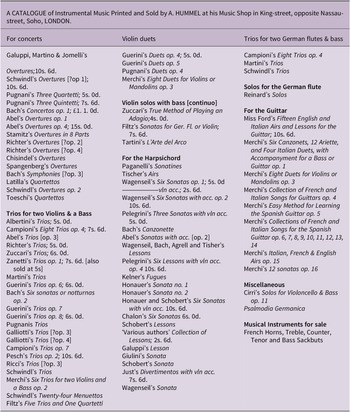
In the absence of any extant Hummel catalogue, it is useful to construct one (Table 1) on the same lines as the catalogues produced by his London contemporaries. A detailed list of Hummel’s publications, arranged in alphabetical order of composer and including, for each one, relevant notes and, where applicable, dates of other publishers’ prints, forms the main focus of this article. The one-page catalogue illustrated in Table 1, laid out using the same genre headings as catalogues of contemporary publishers and, like them, arranging the items within each genre in chronological order of publication or sale, serves the different function of allowing the reader to gain an overview of the genres favoured by Hummel, and to visualize the sequence in which he published individual items within each category over the course of his 12-year-long printing career in London.
Hummel’s publishing and sales output by 1772, the year he left London, in the form of a catalogue constructed by the author and following the same format as catalogues of contemporary London publishers. Titles of musical items, composers’ names, and prices (where available) are as given on the relevant title page or, for works no longer extant, as given in Hummel’s newspaper advertisements or, where no such advertisement has been found, as listed in the imprint for another of Hummel’s publications.

Some items commonly appeared in two different sections of publishers’ catalogues: this applied particularly to trios advertised as for either two violins or two German flutes (with a bass). Thus, in Table 1, trios by Campioni, Martini, and Schwindl are listed in the sections for both German flute trios and violin trios. Merchi’s op. 3 duets for violins or mandolins similarly appear twice: once in the guitar music section, and once in the violin duets section. Publishers commonly used the same plate for several successive catalogues, leaving space at the end of each genre-section to allow additional items to be added as they were issued. Music in each section of Hummel’s catalogue is similarly listed, as far as possible, in the order in which it was published. For those items lacking a known publication date, an estimate of when they were issued has been made, and the basis for this calculation is explained in the later catalogue section. An item’s price is given, if known, in line with the customary practice in publishers’ catalogues.
As is clear from Table 1, Hummel published no vocal music but concentrated on instrumental music by German and Italian composers; he was also most likely the printer of a work by John Chalon, who was probably Swiss. Hummel published nothing by any British composer (though soon after arriving in London, and before he published anything himself, he acted as one of three retailers for Miss Ann Ford’s Fifteen English and Italian Airs and Lessons for the Guittar). Music composed by native composers certainly sold, so perhaps Hummel’s general avoidance of English music was a personal preference. There is also the possibility that, being a recent immigrant, he found it easier to make contacts with his fellow Germans and other foreign-born musicians. Alternatively, he may have made the business decision to concentrate on music by Germans and Italians because he anticipated greater demand for it. None of the music that Hummel printed had been published before in England, so he was issuing compositions that, to English ears, were both new and of foreign origin, for which reasons he could probably expect good sales for them.
It is clear that Hummel sold a fair number of items ‘For Concerts’: these included overtures (synonymous in eighteenth-century England with ‘symphonies’ or ‘sinfonias’), concertos, quartets, and quintets. But the two genres for which Hummel published most music were violin trios (two violins—or a violin and a German flute—and a bass) and harpsichord solos, some of which had an optional violin accompaniment. Since Hummel favoured these three genres of music, ‘For Concerts’, trios, and harpsichord pieces, they merit closer discussion. While the guitar section in Hummel’s constructed catalogue looks substantial, it contains many works by just one composer, Merchi, brought by the composer from Paris to London and sold through Hummel.Footnote 57 Hummel did not act as publisher for any of the guitar items. After he arrived in London, Merchi himself published his opp. 15 and 16: no printer is named on the title page of either, but Hummel was the only music seller who took in subscriptions for the works, so it seems most likely that he was also the printer.Footnote 58 Hummel’s output of guitar music, then, was limited, as was his output of violin solos and duets. He also put out a single set of cello duets (which were entitled ‘solos’, probably because one of the cello lines was so simple that it acted as an accompaniment). It does not follow, of course, that because these genres were ‘minority’ items for Hummel they deserve no attention. Indeed, one—Zuccari’s True Method of Playing an Adagio—has featured prominently in a published conference paper,Footnote 59 but discussion here focuses on the genres that occupied the major part of Hummel’s output.
For Concerts
This section was conventionally the first listed in music publishers’ catalogues and comprised music written for ensembles of four or more players, ranging from quartets to the small eighteenth-century orchestra. The music was not necessarily performed in a large theatre or concert hall, but was more commonly heard at private concerts held in the houses of the nobility and at meetings of gentlemen’s clubs. Such clubs met in various taverns, where a large meeting room suitable for music-making was commonly available. The eighteenth-century orchestra for which ‘overtures’ were written typically comprised two oboes, two horns, and strings. Most of the overtures Hummel advertised had been earlier published elsewhere, most of them by the Amsterdam Hummel firm: except for a single item, the London Hummel’s prints are lost. The only extant example bearing Hummel’s imprint is the set of six overtures by Galuppi, ‘Martino’ (G. B. Martini, or Sammartini) and Jomelli (Jommelli); each overture in this collection is in Italianate form—three movements, fast-slow-fast—and the overtures comprise the only non-German set that Hummel sold. By the middle of the eighteenth century, many of the leading symphonists were working in the capital cities of London, Paris, and Vienna rather than Italy;Footnote 60 others were employed in German-speaking Catholic courts, such as those at Mannheim and Salzburg. It is therefore unsurprising that Hummel sold mostly German-composed works.
Two non-overture items that would, by analogy with the practice of contemporary publishers, have fallen into a ‘For Concerts’ section of a Hummel catalogue merit particular attention. One is J. C. Bach’s op. 1 galant harpsichord concertos, dedicated to Queen Charlotte and published in 1763 with a title page and dedicatory letter in the French language. Apart from Bach himself, Hummel was the only seller named in the several advertisements for this collection,Footnote 61 so it is likely that he was the printer of the original edition, including the sumptuous example originally held in the Royal Musical Library, Buckingham Palace, but now in the British Library. With red leather binding, green leather labels, and intricate gold tooling, this was probably the presentation edition for the queen.Footnote 62 No other English edition of the collection was produced until Peter Welcker’s, two years later.Footnote 63 Bach and Hummel were well acquainted: at one stage of his sojourn in London Bach lodged with Hummel.Footnote 64 Exactly when this occurred is unknown, but by eliminating dates when we know (usually from advertisements of his music, or concert appearances) that Bach lodged elsewhere, it seems most likely to have been when Bach first arrived in London, in the summer of 1762, although by the time the op. 1 concertos were published, Bach was lodging elsewhere (the advertisement gives his address as ‘Signora Mattei’s in Germyn-street, St James’).
The other notable genre in Hummel’s ‘For Concerts’ output comprises the string quartets by Gaetano Pugnani and Gaetano Latilla. The Pugnani quartets had first been issued in Amsterdam in late 1762, with the London Hummel following with his edition less than two months later. The Latilla quartets, however, occupy the unique position of being the earliest purpose-written string quartets published in London. Michael Talbot suggests that they were brought out in 1765.Footnote 65 At that time Latilla was living in Venice. Talbot surmises that the quartets reached Hummel in London in manuscript form via either a British visitor to Venice or else an Italian musician who subsequently travelled to London.Footnote 66 Only two eighteenth-century editions of the quartets are known, and both were issued in London, the first by Hummel, and a second by Welcker using Hummel’s plates. However, despite being the first London publisher of a string quartet, Hummel did not follow this up with further publications of the genre; nor did any other music publisher follow his example, at least in the years immediately after. The output of quartets by Bremner and Welcker, for instance, was very sparse in the 1760s, though they each issued many more in the early 1770s.Footnote 67
Trios
In the 1760s, the trio sonata was essentially a domestic genre. Although orchestral performance, with the instruments doubled up, also occurred, it was not until the 1780s that concert performance of trios became more frequent. The trio sonata, as represented in its classic format by Corelli’s op. 1 and op. 3, was written for two melody instruments and continuo bass; in Hummel’s publications, usually two violins were specified, while, probably to increase sales, titles often offered the alternative of two German (transverse) flutes, or a violin and a German flute. While by about 1760 the trio had gone into relative decline in most Continental countries, in Britain its popularity actually increased from this time. While Hummel did not publish any more trios after 1766 (by which time he had issued 14), his contemporaries Bremner and Welcker each brought out an increasing number of the genre; by 1773 Bremner had published 23,Footnote 68 and Welcker 53 (12 of which had first been published by Hummel).Footnote 69
The trios published by Hummel fell into the two- or three-movement form typical of the galant phase, rather than the four-movement (slow-fast-slow-fast) form typical of the classic sonata da chiesa structure. Nevertheless, most of the trios sport features harking back to the earlier type. Two contain a fugue,Footnote 70 and most end with a minuet (or minuet and trio)—although here some composers betray their galant inclination by dispensing with the plain heading ‘Minuet’ and replacing it with a marking such as ‘Gratioso’, ‘Vivace’, or ‘Cantabile’. While most individual movements of the three-movement trios are in binary sectional form, some dispense with this feature, or disguise it by eschewing repeats. The Zuccari trios, published by Hummel in 1761, when the composer was 57 years old, are more conservative than trios written by the younger Albertini and Pesch, for instance, and show a mixture of ‘Baroque’ features, such as binary sectionalisation, lively counterpoint between the violins, and a figured bass, and galant aspects, such as a bass serving a supporting harmonic function, wide leaps in the violin parts, and ‘sighing’ appoggiaturas, as well as the kinds of markings noted above, such as ‘Spirituoso’.
Hummel’s published trios vary in their technical demands. For example, in many of them, third position is the highest required for the violin, a position well within the competence of players of modest ability. Trios featuring notes requiring fourth, or even fifth, position plus an extension, required a more skilled performer. In some trios, further challenging technical features for violinists include double-stopping with a sustained lower note while the upper part plays a melody, triple and quadruple stopping, wide leaps, and fast passages requiring very nimble fingers for their execution.
Taken as a whole, the trios that Hummel chose to publish reflect the overlap of older and more modern styles. In addition, Hummel’s output provided for a market embracing players with a considerable range of violinistic ability, from modest to advanced.
Harpsichord solos
By the eighteenth century, the harpsichord had become firmly established as the favourite keyboard instrument. In the domestic setting, it was played both as a solo instrument and as the essential continuo instrument, providing the bass line and harmony in chamber music, such as trios for two violins or two flutes and a bass. It was also employed to accompany overtures played on the public stage, where the harpsichordist, who normally worked from a figured bass, commonly also directed the ensemble. The fortepiano, with its hammered strings and capabilities for cantabile and expressive playing, usurped the harpsichord’s position by the end of the eighteenth century, but during Hummel’s publishing career, the harpsichord remained the most common domestic keyboard instrument. It is therefore unsurprising that the title pages of nearly all of Hummel’s publications for keyboard state that they are written ‘for the harpsichord’ (pour le clavecin in those compositions that have a title page in French). In any case, for a long time, the fortepiano was regarded as a ‘species’ of harpsichord, and so naming the harpsichord on a title page did not proscribe the use of a fortepiano to play the music it heralded.
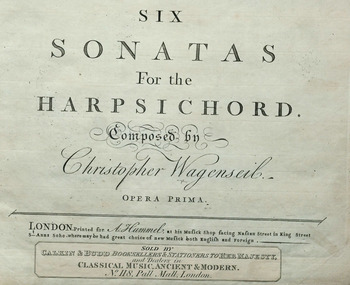
It was not until near the end of 1769 that a ‘swell’ mechanism, allowing crescendo and diminuendo, was invented for the harpsichord.Footnote 71 The compositions published by Adolph Hummel were all written before this mechanism became available, and markings for crescendo and diminuendo are absent from Hummel’s prints. Indeed, most of them contain no dynamic indications at all, and those few that do are limited to loud (variously marked ‘F’ or ‘for’) and soft (‘P’, ‘pia’, or ‘po’) only (unless we include an isolated ‘dolce’ indication in one Wagenseil sonata lacking any other dynamic marking). As will be seen in Figure 2, most of the harpsichord works were described as ‘sonatas’ (or ‘sonatines’) and were published in sets of six. In England the term ‘lesson(s)’ was sometimes used for the same kind of music: for example, Schobert’s ‘Lesson’ (advertised by Hummel in 1769) bears the designation ‘Sonata’ in its caption title, and Wagenseil’s op. 3 ‘Sonatas’ issued by Hummel between 1763 and 1769 were later (1769 or 1770) published by Welcker as ‘Easy Lessons’.
(a). Title page of Adolph Hummel’s publication (1760–1761) of Wagenseil’s op. 1 harpsichord sonatas. © Royal College of Music, London. Shelfmark: H362a.

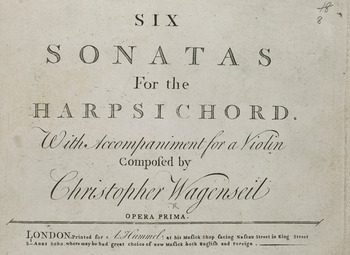
(b). Title page of Adolph Hummel’s publication (1761) of Wagneseil’s op. 1 harpsichord sonatas with added violin accompaniment. © British Library Board. All Rights Reserved. Shelfmark: f.246.a.(8.).

One of the collections published by Hummel makes clear, on its title page, that the target audience was that of young learners. The publisher issued an anonymously authored Collection of favourite Lessons for the Harpsichord in an Easy pleasing Taste, Proper for young Practitioners on that Instrument Composed by Different Authors. Gwilym Beechey points out that while no great technical ability is needed to play these pieces they are, nevertheless, of ‘consistently high quality’ and cover a range of styles.Footnote 72 The anthology would therefore have been both useful and agreeable to young people learning to play the harpsichord.
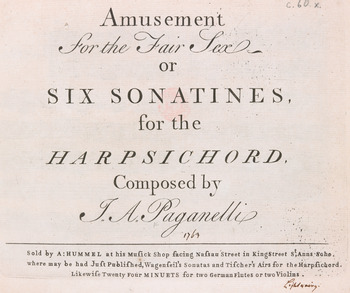
One other collection in Hummel’s output specifically targets ladies, declaring on the title page that it provides ‘Amusement for the Fair Sex’: this was the set of six sonatines by Paganelli, published in Amsterdam in 1759 and sold by Adolph Hummel in London at a later date. The daughters of ‘gentlemen’ did not undertake paid work, which would have compromised the family’s social status, but engaged in various pursuits related to the fine arts, of which one was learning to play a musical instrument, and that most often was the harpsichord. Henry Home, Lord Kames, in 1781 summed up the prevailing view that learning to play the harpsichord not only filled a young woman’s time but also showed off, to advantage, some of her physical attributes:
In this country, it is common to teach girls the harpsichord, which shows a pretty hand and a nimble finger, without ever thinking whether they have a genius for music, or even an ear. It serves indeed to fill a gap in time, which some parents are at a loss how otherwise to employ.Footnote 73
Additionally, a lady’s harpsichord skills demonstrated her family’s wealth, implying not only the leisure required to attain those skills, but also the financial means to pay for the instrument and tuition upon it; this, in turn, enhanced her prospects of making a ‘good’ (genteel) marriage.Footnote 74
Although some men also played the harpsichord, and, moreover, in public (as did J. C. Bach and, as we have seen, probably Adolph Hummel), the market for domestic harpsichord music was principally female. Many eighteenth-century paintings and drawing emphasise this by showing women, but not men, playing (or in the vicinity of) a keyboard.Footnote 75
One old-fashioned feature of Hummel’s prints of Wagenseil’s harpsichord sonatas is the presence of some key signatures lacking one accidental, with the result that the relevant note must be sharpened or flattened each time it appears in the musical text. This practice, a legacy of the modal system of the seventeenth century (the so-called tuoni ecclesiastici), had not entirely died out by the eighteenth century with the adoption of the modern system. It is perhaps surprising that when Hummel produced his edition of Wagenseil’s op. 3 sonatas (published earlier by Bernardi in Vienna as op. 2), he changed the Viennese C clef to the modern G clef but failed to modernise the key signatures, instead retaining those used in the earlier edition.
Accompanied harpsichord sonatas
In the early 1760s, when Adolph Hummel was establishing himself in Soho, the accompanied harpsichord sonata was, as Sadie remarks, ‘still a novelty’.Footnote 76 This domestic genre, which gained increasing popularity in England in the second half of the eighteenth century, had originated in France in about 1734, when Jean Mondonville produced his Pièces de Clavecin en Sonates avec accompagnement de violin, op. 3.Footnote 77 Later followed Rameau’s Pièces de Clavecin en concerts, in which the harpsichord was accompanied not only by a violin (or flute) but also by a second violin (or bass viol); this collection, published in Paris in 1741,Footnote 78 was published in London in 1750 by John Walsh,Footnote 79 who released his edition of Mondonville’s op. 3 sonatas three years later.Footnote 80 However, the first accompanied harpsichord publication to be composed on English soil was probably Giardini’s op. 3, published in late 1751 or early 1752, with an accompaniment for either violin or German flute.Footnote 81 This work was significant for the development of the genre in Britain. As Ronald Kidd points out, Giardini’s sonatas were the first ‘published [in London] for obbligato harpsichord and violin’,Footnote 82 rather than for other instrumental combinations such as the two treble instruments and harpsichord in Rameau’s Pièces, or the violin, cello, and basso continuo favoured by many German composers.Footnote 83 Simon McVeigh observes that accompanied sonatas, being a genre for amateur performers—‘the lady at the keyboard, the gentleman playing the violin’Footnote 84—were only exceptionally performed in public.
By 1761, the second year of Adolph Hummel’s residence in Soho, only five sets of sonatas for harpsichord with violin accompaniment had been published in London.Footnote 85 Perhaps foreseeing a coming trend—which certainly materialised in later years when, as Sadie writes, ‘In England […] it was the accompanied keyboard sonata that stood as the late eighteenth-century form par excellence’Footnote 86—Hummel created violin accompaniments for some works that the composer had written without them. Whether Hummel himself wrote the accompaniments or commissioned them from someone else is not known. Just one year after setting up shop in Soho, Hummel published a violin accompaniment to Wagenseil’s op. 1 harpsichord sonatas, which had been published first (c. 1753) in Vienna as solo works and subsequently (probably in 1760)—still as solo pieces—by Hummel himself in London. Hummel advertised the revised (i.e. with accompaniment) collection as follows:
Wagenseil’s Opera Primo, having met with such general Approbation, and (by the Desire of several eminent Masters) the Accompanyment to it for the Violin is likewise published, and may be had alone, Price 2s. 6d. or together 7s. 6d.Footnote 87
Hummel altered the title page that he had engraved for his edition of Wagenseil’s op. 1 harpsichord solos (see Figure 2(a)) to include the mention of a violin accompaniment (see Figure 2(b)). This has led to confusion in cataloguing the work in RISM, wherein holdings of the original Hummel publication, i.e. without accompaniment, are described as ‘incomplete’.
With only five collections of harpsichord sonatas with violin accompaniment previously published in London, Hummel’s publication can certainly be counted among the earliest of the genre published in Britain. While two of the five earlier collections contained one or more sonatas written in a concertante style, in which the violin part was obbligato,Footnote 88 this was not the case with the Wagenseil sonatas published by Hummel; since Hummel had earlier published the sonatas as solo harpsichord pieces, it is clear that the accompaniment was regarded as optional. As Ronald Kidd remarks, Hummel’s publication was ‘one of the earliest examples in England to apply the optional principle to the duo setting’.Footnote 89
Wagenseil’s op.1 sonatas were not the only works written as harpsichord solos to which Hummel added a violin accompaniment: a Honauer sonata was another composition to be accorded this treatment. From Honauer’s op. 1 set of six sonatas, published for the author in Paris and dedicated to Prince Louis de Rohan, Hummel extracted sonata No. 4, added a violin accompaniment (in score, rather than as a separate, optional, part) and published it as a single sonata, which he called ‘Sonata II’.Footnote 90
As mentioned, the usual partnership for the accompanied sonata was a lady on the harpsichord and a gentleman on the violin (or flute; the two instruments being usually regarded as interchangeable). The violin and flute had traditionally been regarded as ‘male’ instruments.Footnote 91 The flute, which, Johnstone remarks, enjoyed ‘extraordinary partiality […] among eighteenth-century English gentlemen’,Footnote 92 was considered unsuitable for women in view of its creating what Leppert describes as a ‘visual sexual metaphor’.Footnote 93 McVeigh suggests that there were two grounds for the antipathy to women playing the violin. First, not only was it a traditional gentleman’s instrument but, as the instrument of the orchestral leader, the violin was a symbol of dominance; a woman playing it would be challenging the social norm of male superiority.Footnote 94 The second objection was that women were considered incapable of producing the depth of tone that a man could—an opinion expressed in a newspaper review of a violin performance by Agathe-Elisabeth Henriette Larrivée in 1791, which opined that ‘it [violin-playing] requires the more muscular tone of a man, than the delicacy of female nerves to accomplish the instrument’.Footnote 95
Despite the violin’s being an accepted ‘male’ instrument, the standard of violin playing by the average gentleman was not high, as two contemporary accounts make clear. The first, by John Berkenhout, refers to a Mr Roebuck from Yorkshire, whom he describes as ‘a gentleman of fortune and a gentleman-fidler: by a gentleman-fidler, I mean a scraper; for such, gentlemen fidlers generally are’.Footnote 96 Referring to a Mr Tindal, Charles Burney’s friend Thomas Twining praises his playing for being ‘ungentlemanlike’—i.e. not suffering from the common faults of amateur violin-playing:
He plays the fiddle well, the harpsichord well, the violoncello well. Now, sir, when I say ‘well’, I can’t be supposed to mean the wellness that one should predicate of a professor who makes those instruments his study; but that he plays in a very ungentlemanlike manner, exactly in tune and time, with taste, accent, and meaning, and the true sense of what he plays.Footnote 97
Berkenhout, who himself played the violin, advised his son against learning the instrument on the grounds that there is ‘no art that requires more constant labour’.Footnote 98 He stated that to gain sufficient skill ‘to excel (…) as a gentleman performer’ (which he defined as ‘[no] higher than a humble Repiano [sic] in a good band’) would require the sacrifice of one-third of his son’s time, and intimated that such a sacrifice would be too great. Other writers expressed similar doubts about the value of investing sufficient time in practice for a gentleman to reach an adequate standard. Lord Chesterfield’s exhortation to his son, then on a ‘Grand Tour’ of Italy, adds a further caveat that music puts gentlemen into ‘bad company’:
If you love music, hear it; go to operas, concerts, and pay fiddlers to play for you; but I insist upon your neither piping nor fiddling yourself. It puts a gentleman in a very frivolous, contemptible light; brings him into a great deal of bad company; and takes up a great deal of time, which might be much better employed. Few things would mortify me more, than to see you bearing a part in a concert, with a fiddle under your chin, or a pipe in your mouth.Footnote 99
Leppert puts forward additional arguments for the lack of expertise of most gentleman-musicians.Footnote 100 He writes that acceptable occupations for gentlemen were those involving the intellect (thus the ‘science’ [theory] of music was acceptable) and physical pastimes of a military nature, for example, hunting, fishing, and fencing.Footnote 101 Instrumental practice is clearly in neither of these categories, and time spent on it would, inevitably, leave less time for a gentleman to spend on acceptable ‘manly’ activities.
Composers seem to have taken into account the market for the violin accompaniments to their harpsichord sonatas, writing parts fairly easy to play. As mentioned, the accompaniment was often optional, emphasizing its incidental role;Footnote 102 if a lady had no one to play the accompaniment, she could easily, and without much loss of musical interest, play the harpsichord part solo.
Adolph Hummel’s relationships with contemporary music publishers
(a) With the Hummels of the Netherlands
Adolph Hummel was publishing during a century in which composers were at the mercy of printers, who acquired works in various ways (not necessarily from the composer) and published their own (unauthorized) editions. Except for those few composers who were granted a royal licence, there was no effective redress against this practice in Britain until a legal judgement in 1777, and even a royal licence did not always shield the composer from misuse of his work. No royal licence, wherever issued, afforded copyright protection in countries other than the one in which the original publication occurred, so publishers could freely print music they had obtained from outside their borders.
A number of the compositions that Adolph Hummel published were also brought out in Paris, Amsterdam, and The Hague and, for many, the dates of the Continental publication are known. However, tracing the path that these compositions took from one publisher to another is more difficult. For example, if a collection was first published in, say, Paris, then later published by Adolph Hummel in London and later still in the Netherlands by J. J. (Johann Julius) Hummel in Amsterdam, who can say (unless source criticism provides an answer—a rare occurrence) whether the Amsterdam Hummel firm obtained the music from Paris or from the London Hummel?Footnote 103 From the dates of publication it does appear, however, that the Dutch Hummels passed about 18 collections to the London Hummel; this conclusion is supported by the fact that so little time (a few months) elapsed between the publication of the relevant composition in the Netherlands and its subsequent publication by Adolph Hummel in London.Footnote 104 The return ‘traffic’ from the London Hummel to the Amsterdam firm, was, in comparison, very slender, possibly involving only two collections: Just’s op. 1 Divertissemens and perhaps Abel’s op. 3 trios, which the Dutch firm published within about four months of the London Hummel’s edition—which may suggest a direct transfer from London to Amsterdam. The possibility remains that some editions first produced by the London Hummel made their way to the Dutch Hummel firm by indirect means. For example, as has been argued earlier (and will be considered in more detail apropos Adolph Hummel’s catalogue in what follows), the London Hummel was probably the printer of Bach’s op. 1 harpsichord concertos. However, it was not until over a year later that the Dutch Hummel firm published the work; this suggests that the collection might have passed not directly from the London firm to that in Amsterdam but instead via a visitor to the Dutch Republic.
The largely one-way traffic of musical compositions from the Amsterdam Hummel to the London Hummel does not prove anything more than a professional connection, just as a similar connection was evident in London when Adolph Hummel’s publications were followed by those of other printers. One particular print suggests, however, that there may have been a personal connection between the Dutch and London Hummel firms. Except for this single print, all the Amsterdam publications transported, by whatever means, to Adolph Hummel were re-engraved by him.Footnote 105
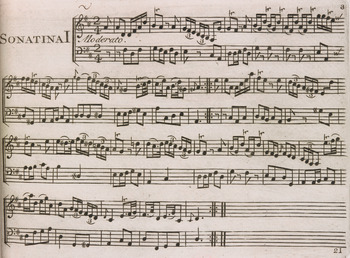
The exceptional print is that of Paganelli’s Amusement for the Fair Sex or Six Sonatines for the Harpsichord, mentioned earlier. J. J. Hummel published this collection with a title page in French and the plate number 21. Adolph Hummel sold the volume in London, but in place of the Dutch Hummel’s title page, the London Hummel engraved a new one, with an English title replacing the French, and he added his own imprint (see Figure 3(a)). However, the London edition was sold with a musical text identical with that of the Dutch edition, including J. J Hummel’s ‘old-fashioned’, somewhat squat signs for sharps (rather like a wide double X), which never otherwise appeared in a print with A. Hummel’s name on the title page (Adolph Hummel always printed the modern ‘slender’ sharp sign), and the Dutch Hummel’s plate number (another practice alien to the London Hummel, who never used plate numbers). Both of these features in the J. J. Hummel publication are shown in Figure 3(b).
(a). Adolph Hummel’s title page for his issue of Paganelli’s Six sonatines for the harpsichord. (A. Hummel’s musical text is identical with that published earlier by J. J. Hummel of the Netherlands.) © British Library Board. All Rights Reserved. Shelfmark: c.60.x.

(b) First page of the musical text of Adolph Hummel’s issue of Paganelli’s Six sonatines for the harpsichord (published first by J. J. Hummel of the Netherlands, and without change by A. Hummel in London). Note the two features that never otherwise appeared in the London Hummel’s prints: the Dutch Hummel’s ‘squat’ sharp accidentals and his plate number (here, 21). © British Library Board. All Rights Reserved. Shelfmark: c.60.x.

A direct link with the Amsterdam firm is in this instance clear. In his imprint, Adolph Hummel did not claim to have printed the collection: he identified himself purely as a retailer. Since J. J. Hummel (and his successors) continued to list the sonatines in the firm’s catalogues for some five decades after their initial publication, the Dutch publisher presumably retained the engraved plates so that more copies could be printed off if needed, which in turn suggests that Adolph Hummel brought paper copies with him to London soon after the collection was published in the Netherlands. (J. J. Hummel’s edition was released in Amsterdam in October 1759, and, as we have seen, Adolph Hummel arrived in London in either late 1759 or very early 1760.) Perhaps the intention was to give Adolph a printed work in hand that he could sell while establishing himself in London, where he would have needed to make contact with composers, with courtiers (to prepare for a successful application for a royal privilege), and with other publishers who might sell his prints; he also needed to find and rent premises with both living accommodation for his family and suitable space to establish his business and set up his shop. However, Hummel did not start by selling just the Paganelli collection: offering just one collection for sale would hardly have made his business look like a going concern. Instead, he waited until he had himself published three collections, which he advertised by listing them in the imprint he engraved on the title page of the Paganelli collection (see Figure 3(a)); none of these volumes had been printed in London before, so Hummel could expect reasonable sales for them.
As well as the Paganelli collection, the works that Hummel brought with him to London included Wagenseil sonatas [op. 1]. Wagenseil was established in Vienna, and most of his works were initially published there. The collection of airs by Tischer listed on the Paganelli title page almost certainly originated from abroad, but there is no extant edition by any publisher. No composer is named for the trios also listed on Hummel’s Paganelli title page: the most likely candidate is Schwindl, who authored a work entitled exactly as on the Paganelli title page and which Hummel published; this edition is extant. Perhaps, too, Adolph Hummel called in at Paris on his way to England, and there obtained Le Clerc’s edition of Tartini’s L’Arte del Arco (published in 1757), which he proceeded to re-engrave in London and publish at an unknown date. Hummel may also have brought with him to London the Wagenseil sonatas that he published as opp. 2 and 3 during his first two years of business in Soho.
In summary: Hummel probably arrived in London carrying at least four, and possibly seven, collections in—the balance of evidence suggests—paper form. For one of the four (Paganelli’s sonatines) he made a new title page to front the musical text printed in Amsterdam, and we know, from his existing edition, that he re-engraved both the title page and the musical text of Wagenseil’s op. 1 sonatas (and, within the next two or three years, Wagenseil’s opp. 2 and 3). The third surviving item listed on Hummel’s Paganelli title page—[Schwindl] trios—are known only from Hummel’s edition and a later one, by the Thompson firm, using Hummel’s plates, so Hummel must have engraved this, too, in his early days in London, as well as Tischer’s Airs, since lost. Engraving took time and money, but by the time Hummel sold the Paganelli sonatines, probably in the second half of 1760—less than a year after his arrival in London and mere months after receiving his royal privilege—it is likely that, as well as the Paganelli title page itself, he had re-engraved three complete volumes, which he then advertised on the Paganelli title page as his own publications. The sale of these pieces must have started to establish his credentials as a music seller. By May of the following year, Hummel had published further compositions, and still more flowed from his shop throughout that year as his printing business became better established.
(b) With contemporary London publishers
The London music publishers must have been well known to one another. Engraving was too expensive for a small publishing firm to operate in-house, and most firms farmed out this part of their printing process, so would have chanced upon each other from time to time at the engravers’ workplaces, as well as meeting at musical events, for which they often sold tickets. Some played in orchestras. Few of Hummel’s prints bear the name of the engraver, and only three can be identified: Richard Alderman, who in 1761 engraved the violin accompaniment that Hummel had added to Wagenseil’s op. 1 harpsichord sonatas;Footnote 106 Thomas Straight, engraver of Martini’s [Sammartini’s] sonatas (published 1762 or earlier), and Chalon’s op. 3 sonatines, issued in 1766;Footnote 107 and Phillips, who engraved Zuccari’s trios (published in 1762).Footnote 108A fourth engraver with whom Hummel may have done business was [John] Caulfield, whose name appears on the title page of Abel’s op. 3 trios and op. 4 overtures, both ‘Printed for the Author’.Footnote 109 Adolph Hummel was the first music seller to advertise each of these works after Abel himself, which makes it highly likely that he printed the original editions. Indeed, in his first advertisement for the Abel op. 4 overtures, Adolph claimed the work as ‘Printed for A. Hummell’, and in his second announcement of Abel’s trios he made the same claim.
London publishers sometimes stocked and sold each other’s prints in their respective shops. Peter Welcker, for example, sold several of Hummel’s prints, as is clear from the stamp, top-centred on the title page, ‘Sold at Welcker’s Musick Shop Gerrard Street S.t Ann’s Soho’. Occasionally, music publishers cooperated to issue a work as a joint publication, so sharing the costs of engraving and printing. Adolph Hummel collaborated with Robert Bremner to publish a set of sonatas by Pelegrini; with Longman, Lukey & Co. to publish a set of keyboard ‘divertissements’ by Johann August Just; and with Johann Christoff (anglicized to John Christopher) Haberkorn, printer in Grafton Street, Soho, to publish an edition of Psalmodia Germanica. The latter was an unusual publication for Hummel to undertake in that it includes little music. The work contains some hymn scores, but most of the hymns in the work are not accompanied by any music. The title had first been published in London in 1722, when its author was Johann Christian Jacobi, who translated it from the High Dutch. By 1756, the work had gone to three editions, and the one published by Hummel and Haberkorn—not announced in the press—is thought to date from 1765.Footnote 110 Haberkorn was involved in the running of St George’s German Lutheran Church in Ayliffe Street (later named Alie Street), Goodman’s Fields, East London. The joint publication seems to have been the only professional contact Hummel had with Haberkorn.
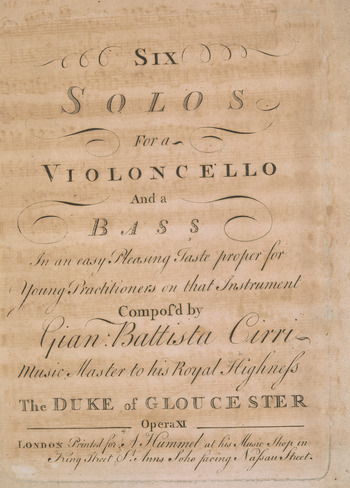
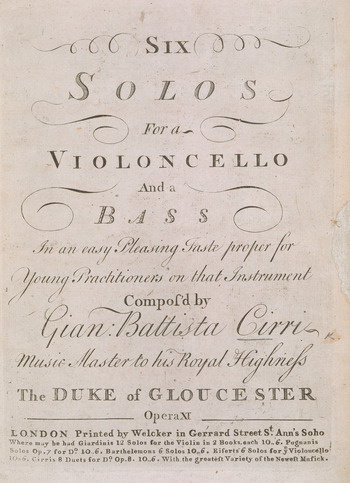
The London publisher with whom Hummel had the closest professional relationship was Peter Welcker, who had started publishing in London in 1762, two years after Hummel, at his music shop on the corner of Gerrard Street. Not only did Welcker stock and sell many of Hummel’s publications, but he also printed editions of his own from Hummel’s plates, as testified by the unaltered engraved musical text combined with title pages identical with Hummel’s, apart from the replacement of Hummel’s imprint with Welcker’s own (see the example at Figures 4(a) and 4(b)).
(a). Adolph Hummel’s title page for Cirri’s op. 11 Violoncello solos with a bass. © British Library Board. All Rights Reserved. Shelfmark: R.M.17.f.16.(5.).

(b). Peter Welcker’s title page for Cirri’s op. 11, Violoncellos solos with a bass. The page is identical with that of Hummel’s edition, except for the imprint, which here is Welcker’s; clearly both publishers made use of the same engraved plate. © British Library Board. All Rights Reserved. Shelfmark: g.500.(3.).

Welcker acquired plates of three of Hummel’s editions before 1767,Footnote 111 while Hummel was still active as a publisher, and 11 more by 1770.Footnote 112 Hummel was still living in King Street while selling these plates, which indicates that he had taken the decision to wind down his business. As we shall see, the auction notices of his effects show that he retained many prints until he left London in 1772. Selling these would have been one source of income in the years 1770–1772, during which he put out no notices of publication.
If Hummel had produced a catalogue in 1768, it would have differed very little from the one constructed for his output by 1772 (Table 1); only four items were advertised in the meantime. In 1768 Peter Welcker and Robert Bremner were each able to list all the works they had published or were selling on a single sheet of paper, just as Hummel would have been able to do. One publisher might favour one genre, and another a different one, so that, for example, Bremner published more overtures than either Hummel or Welcker did, and Welcker published more German flute music than either Bremner or Hummel, but the striking difference between Hummel’s catalogue and those of these two contemporaries is that the latter both included vocal music, a genre that Hummel eschewed. There is no easy explanation for why Hummel, in excluding vocal music from his output, should have gone against the normal practice of London publishers. However, perhaps the fact that his wife was a ‘strict’ Calvinist (as Leopold Mozart described her) had a bearing upon the matter. Possible support for the thesis that Catherine Hummel influenced her husband’s business practice in this regard is the presence of Hummel’s name as co-publisher with Haberkorn on the edition of the hymnal Psalmodia Germanica discussed earlier.
The close of Hummel’s career in London
Hummel lived at the King Street address until some time between 4 May and 22 September 1772; on the latter date the lease of his house was advertised and the newspaper notice makes it clear that Hummel had already departed, since the property is described as ‘late in the Occupation of Mr. Hummell’.Footnote 113 The premises were described as ‘perfectly convenient, and well situated for that [use as a music shop] or any other Business, and contains four Rooms on a Floor’. The notice goes on to state that Hummel’s stock-in-trade ‘will be sold by Auction some Day this Week, if not previously disposed of by private Contract. Enquire at Mr. Hubbard’s, in New-street, near Broad-street; or at Mr. Kirkman’s, in Broad-street, Soho’. In the event, Hummel’s stock-in-trade was not sold by private contract, nor did the public auction take place ‘some Day this Week’, as the advertisement promised. This is clear from the announcement put out by the auctioneer, Joseph Hubbard, about a fortnight later, when he advertised not only Hummel’s stock-in-trade but also all of the music seller’s household effects:
To be Sold by Auction by JOSEPH HUBBARD, On Monday next and the following Day, ALL the genuine Houshold [sic] Furniture, China, Plate, and Stock in Trade of Mr. HUMMEL, Musick-Printer, at his House in King-street, opposite Nassau-street, St. Ann’s, Soho, consisting of all Sorts of Musick for different Instruments, by the most eminent Masters. Likewise Musical Instruments of various Sorts. To be viewed Tomorrow and till the Sale, which will begin at 12. Catalogues at the Place of Sale; and of Mr. Hubbard, in New-Street, near Broad-Street, Carnaby-Market.Footnote 114
‘Monday next’ would have been 5 October, but clearly the sale was postponed, since on that day Hubbard put out a notice to the effect that the auction would be ‘Tomorrow, and the following Day’ (i.e. on 6 and 7 October). On 8 October, a belated newspaper advertisement stated that the auction was to be ‘This Day, the 7th Instant’ (implying a reduction from a two-day sale to a one-day event, which, in turn, perhaps suggests that some items had been sold privately). Unfortunately, no sale catalogue has been found.
So, in 1772, after just 12 years’ residence in Soho, Hummel sold both his business and his household effects and departed. As the advertisement transcribed above reveals, Hummel’s effects included ‘all Sorts of Musick for different Instruments’, which leads to the conclusion that continuing to sell prints he had made in earlier years was one source of income during his latter years in London. Another such source specified in the advertisement was his sale of ‘Musical Instruments of various Sorts’. In The Public Advertiser of 27 August 1762, he had announced the arrival of instruments from Germany:
Music Instruments from GERMANY. A Parcel of curious French horns of an entire new Invention, and approved by the best Masters, they being rather easier than the common Horns, and are so contriv’d that with one Horn you may play in any Tone from B. in Alt to B. below, only by changing the Pieces which put on in the Middle of the Horn, and not next the Mouth Piece […] likewise a Parcel of other Horns of different Tones, and a set of Sackbuts, viz. a Treble, Counter, Tenor and Bass, all which will be sold very reasonable.
Either some of these instruments had not been sold by the date of the auction, or more instruments had arrived in the years between 1762 and 1772, because ‘Musical Instruments of various Sorts’ were advertised in four of the five newspaper notices of the auction.
A sale of stock-in-trade could suggest death (although advertisements usually stated if this were the case) or retirement; however, since Hummel was also selling his household effects, it is more likely that he was either bankrupt or had moved abroad. Insolvencies were normally listed in newspapers, and since Hummel’s name has not been found in any such list, the second of these two scenarios—that he had moved abroad—is the more credible. This thesis is supported by the fact that we know that Hummel’s elder son, Charles, married in Geneva in the 1780s,Footnote 115 so perhaps Hummel moved his family there after leaving London.
But Hummel’s name did not disappear from English records with the 1772 sale of his effects. About three months after the sale, he was cited in a lawsuit brought by J. C. Bach against the publishing firm of Longman, Lukey & Co. for breach of the composer’s copyright, and the documents in this suit add some interesting facts to our knowledge of Hummel.Footnote 116 Bach accused the Longman firm of printing and publishing pirated copies of five of his compositions (two sonatas for harpsichord, one of them with accompaniment for viola da gamba, and three ‘Symphonys’).
The Longman firm’s defence cites the role of Adolph (whom they call ‘Adolphus’) Hummel. They claim that ‘about the Month of December last’ (which would have been December 1772) Hummel, ‘late of Nassau Street Soho’, offered to sell them the two harpsichord sonatas; that Hummel told them that Bach had ‘made him a present of two Harpsichord Sonatas for the many services he had done him [Bach] at Sundrytimes’, and that he, Hummel, was free to use them as he wished. The firm went on to declare that Hummel told them that the sonatas were ‘too trifling to be at the expense of printing them himself’, and that they paid him £2. 5s. 0d. for the manuscripts. (Later, in their defence, they gave the different figure of £1. 1s. 0d (1 guinea) for each manuscript, making a total of £2. 2s. 0d.)
If Hummel really did sell the sonatas to the Longman firm, his integrity is called into question, suggesting a possible contradiction of the ‘honourable’ principle by which, as Leopold Mozart indicated, Hummel aspired to live. However, Bach was not the only composer to accuse the Longman firm of printing works without the author’s permission, so perhaps we cannot rely on their evidence regarding Hummel.
Adolph Hummel had enjoyed a professional relationship with the Longman firm. As mentioned earlier, the two firms collaborated to produce a joint edition of Just’s Divertissemens, but Hummel’s role in selling the Bach sonatas remains unclear. Since Hummel had left his King Street house by 22 September 1772, when the lease was advertised, he would have had to lodge with someone if he was still in London in December 1772—the date Longman, Lukey & Co. claim that Hummel sold them the sonatas. If, on the other hand, he had already left the country, the Longman firm might have cited him because it knew he would be unable to challenge its evidence: it is noteworthy that Bach himself does not mention Hummel in his Bill of Complaint. The case, which Bach won, was decisive in establishing that copyright extended to musical works.
Longman, Lukey & Co.’s defence does, however, tell us three interesting facts about Hummel that there seems no reason to doubt: he was ‘a very intimate acquaintance’ of J. C. Bach; that Bach had lodged at Hummel’s house; and that Hummel had frequently (‘at Sundrytimes’) helped Bach, though we are not told in what ways.
The Bach v. Longman et al. lawsuit is the last mention of Hummel’s name I have found. Where he went after leaving London and when, or where, he died remains a mystery, though as suggested earlier, he might have travelled to, and resided in, Geneva. All four children were young when Adolph and Catherine left London; Anne, the eldest, was 12 years old and Charlotte, the youngest, only seven, so none was independent, and Hummel must have continued to support them somehow. Apart from our knowledge of Charles, no information about the rest of the family has so far come to light, so whether Anne, Adolph (junior) or Charlotte were involved in the musical world, as Charles eventually was, is as yet undetermined.Footnote 117
Newspaper notices by, or otherwise naming, A. Hummel or Mr Hummel (alternatively spelt ‘Hummell’ or ‘Hamell’)
The advertisements transcribed below (all sourced from the 17th–18th Century Burney Collection Newspapers) identify Adolph Hummel in one of his roles: most involve his advertisements for new publications, but he is also encountered as a likely performer (albeit on only one occasion) and seller of musical instruments. The 1772 announcements by the auctioneer Joseph Hubbard provide information about Hummel’s departure from his leasehold house in King Street.
Also included are advertisements in which Hummel is not named, but which refer to publications for which he is believed to have acted as printer; these are identified in the notes accompanying the relevant notices.
Names of composers are transcribed faithfully from the advertisements, which include some different spellings for the same person; for example, Schobert is also encountered as Shoberd, and Schwindl also as Schwindel and Schwindle.
Prices, where given, refer to the British currency of guineas, pounds, shillings, and pence (21 shillings per guinea, 20 shillings per pound, 12 pence per shilling), written gn (guinea) or £ s d (pounds, shillings, and pence), or often just one of the latter if the other denominations are zero, e.g. 5 shillings may be written as 5s. or as 5s. 0d.
The Public Advertiser, Thursday, 6 March 1760.
For the Benefit of Mr. HEYL, and Mr. GAIGNEVAUDOUX, at the Great Room in Dean-street, Soho, on Monday the 17th of this present March, will be a Grand Concert of VOCAL and INSTRUMENTAL MUSIC. To conclude with a ball. The first Violin and a Solo, by Mr Herschell; a Concerto on the Flute, by Sig. Cottesqui; a Concerto on the Violoncello, by Sig. Suprutini; a Solo on the Harp, by Mr. Parry; a Concerto on the Violin, by Miss Schmelling; a Solo on the Hautboy, by Mr. Henckell a Solo on the Guittar, by Mr. Heyl; a Concert on the Harpsichord, by Mr. Hummell. Pit 10s. 6d. Gallery 5s. To begin at Half an Hour past Six precisely. Tickets to be had of Mr. Heyl, at his House in Duke street, St. James’s, next Door to the Rising Sun; at Mr. Gaignevaudoux’s, opposite the White-Bear, in Piccadilly; at Mr. Ervin’s, Confectioner in Berkeley square; at Sam’s Coffee House, Exchange-Alley and the Rummer in Finch Lane, Cornhill; and at the Place of Performance.
N.B. None to be admitted to the Ball but those that pay half a Guinea; and there will also attend a Confectioner with Coffee, Tea, Chocolate, and other Refreshments for such Company as chuse them.
The Public Advertiser, Wednesday, 12 March 1760. [Advertisement for the same concert as described in the PA of 6 March, but with some differences of wording, of spelling of performers’ names, and with additional information.]
AT the Great Room in Dean-street, Soho, on Monday the 17th Instant, will be performed a grand Concert of Vocal and Instrumental MUSIC. To conclude with a BALL. First Violin and a Solo by Mr. Herschel; the Vocal Parts by Miss Schmelings and Signor Abraham, lately arrived from Berlin, in the room of Signora Varasqui, she being taken ill; Concerto and a Solo on the Flute by Signor Cottassqui; Solo on the Harp by Mr. Parry; Concerto on the Violoncello by Signor Suprutini; Concerto Violin by Miss Schmeling, who never performed in public in England; Solo Hautboy by Mr Herschel; Solo Guittar by Mr. Heyl; Concerto Harpsichord by Mr. Hummel, &c. To begin at Half an Hour past Six. Tickets to be had at [continues as in the 6 March advertisement].
The Public Advertiser, Thursday, 26 March 1761.
By Miss FORD, This Day is published, Pr. 10s. 6d. Dedicated to the Right Hon. The Countess of TANKERVILLE, FIFTEEN English and Italian AIRS and LESSONS for the GUITTAR, with Variations to Three favourite Tunes, and full Instructions to attain playing in true Taste, the proper Manner of Fingering is fully explained, the Graces, their Names, and the easiest Manner to execute them; the most graceful Manner of holding the Guittar is shewn, and how the imperfections of the Instrument are to be avoided; with a long Lesson of Arpegio’s [sic] Examples, the attaining of which will render the most difficult Music quite easy. To be had of the Author; of Mr. Davies, the Corner of Sackville-street; Mr. Walsh, in Catharine-street; and Mr Hamell, in King-street St. Ann’s.
The Public Advertiser, Saturday, 9 May 1761.
NEW MUSIC, Just now publish’d, Six favourite Overtures, in six Parts, composed by different Authors of Galuppi, Martino, Jomelli; likewise six Sonatas or Notturnas for two Violins and a Bass, composed by Giuseppe Albertini; eight Sonatas for two Violins or two German Flutes, composed by C.A. Campioni, Opera 4. Printed for A. Hummell, at his Music Shop facing Nassau street, in King-street, St. Ann’s, Soho.
The Public Advertiser, Tuesday, 21 July 1761.
NEW MUSIC, This Day is published, Price 10s. 6d. OPERA SECONDO, SIX Sonatas for the Harpsichord, with an Accompanyment for the Violin. Composed by Christopher Wagenseil. London: Printed for A. Hummell, at his Musick-shop facing Nassau Street, in King-street, St. Ann’s, Soho. Wagneseil’s Opera Primo, having met with such general Approbation, and (by the Desire of several eminent Masters) the Accompanyment to it for the Violin is likewise published and may be had alone, Price 2s. 6d. or together 7s. 6d. Also six favourite Overtures for Violins, French Horn, and composed by Galuppi, St. Martini, and Jomelli; and for two Violins and a Bass, Abel’s Trio, Richter’s Trio, Campioni’s Trio, op. 4 and Albertini’s Trios.
The Public Advertiser, Tuesday, 15 December 1761.
NEW MUSIC. Just now published, ABEL’s Trio for Violins, 10s. 6d. Zuccari of Milan Trios for Violins, 6s. six favourite Overtures for Violins, French Horn, by Galuppi St. Martini and Jomelli, 10s. 6d. Wagenseil’s Sonatas for the Harpsichord, with Accompanyment for the Violins, op. 1, and [illegible] Campioni’s Trios for two German Flutes, 7s. 6d. Albertini’s Trios for two Violins, 5s. Printed for A. Hummell, in King-street, St. Ann’s Soho, facing Nassau-street.
The Public Advertiser, Thursday, 18 March 1762.
NEW Music, This Day is published, Price 4s. THE true Method of playing an Adagio, made easy by twelve Examples; first in a plain Manner with a Bass, then with all their Graces, adapted for those who study the Violin. Compos’d by Carlo Zuccari, of Milan. Printed for A. Hummell, at his Music-Shop, facing Nassau-street in King-street, St. Ann’s, Soho. Of whom may be had, for the Harpsichord, Pelegrini’s sonatas with Accompanyment for a Violin. Wagenseil’s Sonatas, op. 1st, with Accompanyment for a Violin. For two Violins and a Bass. Zuccari’s Trio for two Violins and a Bass. Abel’s Trio for two Violins and a Bass. Richter’s Trio for two Violins and a Bass. Albertini’s Trio for two violins and a Bass. Campioni’s Trios for two German Flutes and a Bass.
The Public Advertiser, Friday, 21 May 1762.
NEW MUSIC. This Day is published, Price 7s. 6d. ZANETTI’S Six Sonatas, for two Violins and a Bass. Printed for A. Hummell, at his Music-Shop facing Nassau street, in King-street, St. Ann’s Soho. Of whom may be had, St. Martini’s Trio, for a German Flute, Violin, and a Bass. Zuccari’s Trio, for two Violins and a Bass. Abel’s Trios for two Violins and a Bass. Richter’s Trios for two Violins and a Bass. Campioni’s Trio for two German Flutes and a Bass. Albertini’s Trio, for two Violins and a Bass.
The Public Advertiser, Friday, 27 August 1762.
Musical Instruments from GERMANY. A Parcel of curious French Horns of an entire new Invention, and approved of by the best Masters, they being rather easier than the common Horns, and are so contriv’d that with one Horn you may play in any Tone from B. in Alt to B. below, only by changing the Pieces which put on in the Middle of the Horn, and not next the Mouth Piece. These excellent Horns are to be sold at Mr. Hummell’s Musick-Shop, facing Nassau-street, in King’s Street, St. Ann’s Soho; likewise a Parcel of other Horns of different Tones, and a set of Sackbuts, viz. a Treble, Counter, Tenor and Bass, all which will be sold very reasonable.
The Public Advertiser, Tuesday, 4 January 1763.
NEW MUSIC. This Day is published, SIX Overtures, Price 10s. 6d. Composed by F. Schwind’t. Three Quintetti, Price 7s. 6d. Composed by Pugnai [sic] Three Quartetti, price 5s. Composed by Pugnani. Abel’s new Overtures, Price 15s. Zanetti’s Trio for Violins, Price 5s. Zuccari’s Trio for Violins, price 6s. Abel’s Trio for Violins, Price 10s. 6d. Albertini’s Trio for Violins, Price 5s. Richter’s Trio for Violins, Price 5s. Guerini’s Trio for Violins, Price 6s. Guerini’s Duetto for Violins, Price 5s. The true Method of playing an Adagio by twelve Examples, with all their graces: Composed by Carlo Zuccari of Milan, Price 4s. Printed for A: Hummell at his Music Shop facing Nassau-street, in King-street, St. Ann’s, Soho. Of whom may be had, for the Harpsichord, Wagenseil’s Sonatas Opera prima, with Accompanyment. Wagenseil’s Sonatas, opera secunda, with Accompanyment. Abel’s Sonatas, with Accompanyment.
The Public Advertiser, Thursday, 10 March 1763.
NEW MUSIC. This Day is published, Price One Guinea. SIX Concertos for the Harpsichord, with Accompanyment, for two Violins and a Violoncello. Dedicated by Permission to her Majesty. Composed by Signor JOHN BACH. Printed for the Author, ahd [sic] to be had of him at Signora Mattei’s in Germyn-street, St. James’s, and at Mr. Hammel’s Music Shop in King-street, St. Ann’s, Soho.
[Warburton, 298, interprets ‘Hammel’s’ as ‘Hanimel’s’: certainly, the print is unclear. On the following Monday, 14 March, Hummel’s surname, in an otherwise similar advertisement to the above, was corrected to ‘Hummel’.]
The Public Advertiser, Saturday, 9 April 1763.
NEW MUSIC. This Day is published, price 5s. SIX sonatas or Notturnas for two Violins and a Bass, composed by Signor JOHN BACH. Printed for A. Hummell, at his Music Shop, facing Nassau-street in King-street, St. Ann’s, Soho. By whom this Day is publish’d, A Collection of Lessons for the Harpsichord, composed by Sig. Wagenseil, Bach, Agrell, Fisher. Bach’s Concertos for the Harpsichord, with Accompanyment for two Violins and Violoncello. With great Choice of New Music, both English and foreign.
[‘Fisher’ is a misprint for ‘Ticher’.]
The Public Advertiser, Wednesday, 18 May 1763.
MUSIC. Price 10s. 6d. SIX sonatas for the Harpsichord, with an Accompanyment for the Violin, composed by Sig. T. Pellegrino. Printed for R. Bremner, opposite to Somerset House in the Strand; and A. Hummell, in King-street, St. Ann’s Soho. Where may be had for the Harpsichord, [Col. 1] Wagenseil’s Lessons 2 sets / Bach’s Concertos / Abel’s Sonatas / Pasquali thorough Bass / [Col. 2] Art of Fingering Dupuis Concertos / The Harpsichord Miscellany.
The Public Advertiser, Saturday, 10 December 1763.
NEW MUSIC This Day is published, Price Six Shillings, Opera 8 SIX Sonatas for two Violins and a Bass, Composed by FRANCOIS GUERINI. Printed for A. Hummell, at his Music Shop facing Nassau-street, in King-street, St. Ann’s, Soho. Of whom may be had, for Violins, Guerini’s two Set Duettos, op. 4 and 5. Guerini’s two Set Trios, op. 6 and 7. Stamitz six Overtures in 8 Parts. Abel’s six Overtures two Set. Schwindl Overtures. Pugnani Quintetti. Pugnani Quartetti. Pugnani Trios. Gallioti a second Set of Trios.
The Public Advertiser, Monday, 4 June 1764.
NEW MUSIC. This Day is published, A second Set of Richter’s Overtures, Price 12s. Guerinis Trio for two Violins, Price 6d. Printed for A. Hummell, at his Music Shop, King’s Street, St. Ann’s, Soho Of whom may be had, Abels Overtures, Chisindels Overtures, Richters, Graun, Spangenberg Overtures; Pugnani Quartetti, Reinard Solos for German Flute. Stamitz Overtures.
The Public Advertiser, Friday, 12 April 1765.
NEW MUSIC. This Day is published, RICHTER’s new Overtures in eight Parts, a second Set, as they were perform’d at Mr. GIARDINI’s Academy, and last Summer at Vauxhall, Price 12s. Printed for A. Hummell, at his Music Shop in King Street, St. Anns Soho, facing Nassau-street. Of whom may be had, Stamitz Symphonies, Schwindels Symphonies. Pugnani Quintettis. Pugnani Quartettis. Abels Symphonies, Bachs Symphonies. In a Fortnight’s Time will be published, Six Sonatas for two Violins and a Bass of Campioni, Opera 7.
The Public Advertiser, Monday, 20 January 1766.
NEW MUSIC. This Day is published, Price 10s. 6d. SIX Trios for two Violins and Violoncello, with a thorough Bass for the Harpsichord. Composed by C. A. PESCH, Musician to his Serene Highness the Prince of Brunswick. Printed for the Author, and sold by A. Hummell, at his Music Shop in King-street, St. Ann’s Soho, facing Nassau-street. Of whom may be had, for the Harpsichord or Organ, Six Sonatas for the Harpsichord, price 10s. 6d., with Accompanyment for a violin, composed by Honauer, and Schobert.
The Public Advertiser, Wednesday, 12 February 1766.
NEW MUSIC. PROPOSALS for publishing by SUBSCRIPTION, TWELVE Sonatas for the Guittar. Composed by G MERCHI. Six of them for two Guittars or Accompanyment, with a Violin, and the other six Solos. A Collection of Italian, French and English Airs, adapted to the English and Spanish Guittar. The Whole to be comprised in sixty Plates, printed on superfine Paper and ready to be delivered the Beginning of March. The Subscription to be Half a Guinea, to be paid at the Delivery of the two Books. Subscriptions are taken in by the Author at Mrs. Vallotton’s, Milliner, in Great James-street, Golden-square; and at Hummell’s Music Shop, in King-street, St. Ann’s, Soho. Of whom may be had, composed by the same Author, Opera 1. Six Canzozets [sic], 12 Ariette, and four Italian Duets, with Accompanyment for a Bass or Guittar. Opera 2. Six Trios for two Violins and a Bass. Opera 3. Eight Duets for Violins or Mandolins. Opera 4. A Collection of French and Italian Songs for Guittars. Opera 5. An easy method for learning the Spanish Guittar. Opera 6, 7, 8, 9, 10, 11, 12, 13, 14. A Collection of French and Italian Songs for the Spanish / Guittar.
[Some letters in this advertisement are illegible but have been supplied here from other souces; e.g. ‘Val[-]oton in the original advertisement is printed ‘Valloton’ on Merchi’s publications, and ‘deliv[-]re[-]’, of the original advertisement cannot, in its context, logically be other than ‘delivered’.]
The Public Advertiser, Saturday, 22 March 1766.
NEW MUSIC. This Day is published, SIX sonatas for one German Flute, or Violin, Violoncello, Obligato, with a Bass. Composed by Sig ANTONIO FILTZ. Printed and sold by A. Humel, in King-street, St. Ann’s, Soho, and by Frederick Hintz, at his Music and Musical Instrument Warehouse, the Corner of Ryder’s Court, Leicester fields, Price 7s. 6d. Where may be had, the newest and best Music for the Spanish Guittar, Mandolins, as also all other Sorts of Music and Musical Instruments.
The Public Advertiser, Monday, 7 April 1766.
[The following advertisement does not mention Hummel, but is included here because it refers to Merchi’s advertisement of 12 February 1766, in which Hummel is named as taking in subscriptions for the ‘New Music’ described here, so the likelihood is that he was the printer.]
NEW MUSIC. This Day is published by Subscription, TWO Books for the Guittar: Price 7s. 6d. each: Compos’d by G. Merchi Book the first, A Collection of French, Italian, and English songs, with Accompanyment for a Guittar or Violin. Book the second, Twelve Sonatas, wh-r: of six with an Accompanyment for a Guittar or Violin. Compos’d by G. Merchi. Printed for the Author, and sold at his Lodgings at Mrs. Vallotton’s, Milliners, in James street, Golden-square. Where may be had all the said Author’s Works, viz. Opera 1st, Six Barcarolla, with an Accompanyment for the Harpsichord, Price 4s. Opera 2d, Six Duets for two Violins or Mandolins, Price 5s. Op. 3d, Duets for the Guittar, Price 6s. Opera 4th. A Collection of French and Italian Airs. Price 6s. Opera 5th, Six Trios for two Violins and a Bass Price 7s. 6d. Opera 6th. A Collection of French Airs, Price 6s. Opera 7th. The easiest Method of learning the Spanish Guittar, Price 5s. Opera 8th and 9th, for singing, or the German Flute, with an Accompanyment for the Harpsicord or Guittar. Operas 11th, 12th, 13th / and 14th, A Collection of French Airs, with an Accompanyment for the Guittar.
[The works were published with title pages in Italian, not the English of this advertisement.]
The Public Advertiser, Friday, 2 May 1766.
NEW MUSIC. This Day is published, SIX Sonatas for the Harpsichord, Price 6s. Composed by J. CHALON. Printed for the Author; and sold at A. Hummell’s Music Shop in King-street, St. Ann’s, Soho, opposite Nassau street. Where may be had, Schoberts Lessons, Filtz Trios for a Violin, Violoncello and Bass; Ricci Trio for two Violins and Violoncello; Schwindle Trios for two German Flutes and Bass; Guerini’s Duets for two German Flutes; Pesche Trio for two Violins and a Bass.
The Public Advertiser, Monday, 11 September 1769.
NEW MUSIC. This Day is published, Price 7s. 6d. SIX Divertimento for the Harpsichord, with Accompanyment for a Violin; composed and dedicated to Her Royal Highness the Princess of Orange and Nassau, by J. A. just [sic] Music Master to her Royal Highness. London, printed and sold by A. Hummell, in King-street, St. Ann’s, Soho. Likewise three single Lessons for the Harpsichord; one by Galuppi, Price 1s. one by Shoberd, 1s. and one by G[-]ulini, 1s. Great Choice of new Music.
The Daily Advertiser, Tuesday, 22 September 1772
TO be lett on Lease, a House in King-Street, Soho, opposite Nassau-Street, late in the Occupation of Mr. Hummell, who kept a Musick-Shop there for many years; the Premises are perfectly convenient, and well situated for that or any other Business, and contains four Rooms, on a Floor; the Stock in Trade, &c. will be sold by Auction some Day this Week, if not previously disposed of by private Contract. Enquire at Mr. Hubbard’s, in New-Street, near Broad-Street; or at Mr. Kirkman’s, in Broad-Street, Soho.
The Daily Advertiser, Friday 2 October 1772.
To be Sold by Auction by JOSEPH HUBBARD, On Monday next and the following Day, ALL the genuine Houshold [sic] Furniture, China, Plate, and Stock in Trade of Mr. Hummel, Musick-Printer, at his House in King-Street, opposite Nassau-Street, St. Ann’s, Soho, consisting of all Sorts of Musick for different Instruments, by the most eminent Masters. Likewise Musical Instruments of various Sorts. To be viewed Tomorrow and till the Sale, which will begin at Twelve. Catalogues at the Place of Sale; and of Mr. Hubbard, in New-Street, near Broad-Street, Carnaby-Market.
The Daily Advertiser, Saturday, 3 October 1772.
To be Sold by Auction by JOSEPH HUBBARD, On Tuesday next and the following Day, ALL the genuine Houshold [sic] Furniture, China, Plate, and Stock in Trade of Mr. Hummel, Musick-Printer, at his House in King-Street, opposite Nassau-Street, St. Ann’s, Soho, consisting of all Sorts of Musick for different Instruments, by the most eminent Masters. Likewise Musical Instruments of various Sorts. To be viewed on Monday and till the Sale, which will begin at Twelve.
[Continues as in the advertisement of 2 October]
The Daily Advertiser, Monday, 5 October 1772.
To be Sold by Auction by JOSEPH HUBBARD, Tomorrow, and the following Day, ALL the genuine Houshold [sic] Furniture, China, Plate, and Stock in Trade of Mr. Hummel, Musick-Printer, at his House in King-Street, opposite Nassau-Street, St. Ann’s, Soho, consisting of all Sorts of Musick for different Instruments, by the most eminent Masters. Likewise Musical Instruments of various Sorts. To be viewed till the Sale, which will begin at Twelve o’ Clock.
[Continues as in the advertisement of 2 October]
The Daily Advertiser, Thursday, 8 October 1772.
To be Sold by Auction by JOSEPH HUBBARD, This Day, the 7th instant, ALL
[Continues as in the advertisement of 5 October]
Adolph Hummel’s catalogue
This catalogue is arranged in three sections: 1. Items that Hummel is known, from extant prints, to have published or, if no print survives, that he claimed to have published; 2. Items that Hummel listed as for sale in his shop, but evidence that he published them is lacking, so they may have been (and in some cases can be identified as) prints of another publisher; 3. A chronological list of Hummel’s publications and sales.
1. Adolph Hummel’s publications
Details of the publications are given in alphabetical order of the composer’s surname. As well as publications bearing Hummel’s imprint, also included are ‘For the Author’ publications for which he was probably the printer (evidence being supplied in each case).
For each surviving work or collection, the following are given: the diplomatic transcription of Hummel’s title; the keys in which the work is written; the Répertoire international des sources musicales (RISM) identification; the siglum (or sigla if appropriate) and catalogue number(s) of library holdings of Hummel prints examined, and, if known, the price charged. For each work are also listed, in chronological order of publication, all known editions by other publishers, with dates of issue. Finally, numbered notes give additional information for each work.
Where Hummel produced a print no longer extant, the title is listed as it appeared in the relevant newspaper advertisement or imprint of another work and its lost status indicated by an asterisk after Hummel’s name in the list of known publications. An asterisk accompanying another publisher’s name similarly indicates that the particular publication has been lost. ‘Date’ followed by a question mark indicates that the publication date of the particular edition under discussion cannot be confirmed, and a question mark before ‘RISM’ indicates that this RISM number seems the most likely identification, but it has not been possible to confirm this; in both these cases the numbered notes give more information.
Library shelfmarks are given for those examples I have examined: editions listed with a RISM number but no shelfmark have not been scrutinized, but are recorded by RISM as being the same music as that under discussion.
In the lists of editions of each work, I have respected the form of his surname that Adolph Hummel used in the relevant title page, which was sometimes ‘Hummel’ and at other times ‘Hummell’. In the accompanying notes, however, his surname is always spelled ‘Hummel’. As explained earlier, all references to ‘Hummel’ without an initial are to Adolph Hummel: references to the Dutch Hummel brothers, Johann Julius and Burchard, always include either their full names or initials, or else refer to their place of work, Amsterdam or The Hague, respectively.
Except for London, the city in which each edition was published is indicated, e.g. Paris, Amsterdam; where no city is named, the edition was published in London.
Dates of London publications have been obtained from advertisements in the 17th–18th Century Burney Collection Newspapers. Where a date of publication is given but no newspaper is named, the source is The Public Advertiser. For those items for which no publication announcement has been found, either a ‘best estimate’ of the year of issue plus an added question mark, with supporting evidence in the accompanying notes, is given or, if it is not possible to pin down publication to within a year or two, the date is written in the form ‘Date?’. It needs to be borne in mind that even newspaper announcements of ‘New Music This Day is Published’ may not give the true date of issue, since publishers frequently used the same wording for announcements months apart. To illustrate with one example: on 12 April 1765 Adolph Hummel advertised as ‘This Day is Published Richter’s New Overtures in eight Parts, a second set’; however, ten months earlier, on 4 June 1764, Hummel had similarly announced the publication ‘This Day’ of ‘A second set of Richter’s Overtures’. The catalogue following gives the earliest date of publication that I have found for each work, but that does not preclude the possibility that Hummel published an item earlier than the given date without making an announcement of it.
Dates of publications of the Dutch Hummels are taken from Cari Johansson’s J. J. & B. Hummel Music-Publishing and Thematic Catalogues. Unless otherwise stated, the dates cited for French editions come from Cari Johansson, French Music Publishers’ Catalogues of the Second Half of the Eighteenth Century (Stockholm: Kungliga Musikaliska Akademiens Bibliotek, 1955).
Except where otherwise stated, the source of the brief notes provided on the composers published by Hummel is Grove Music Online, all accessed August 2019. Where there are variant spellings of a composer’s name, I have listed the name in the form Adolph Hummel used in his first publication for that composer, and given commonly used variant spellings in round brackets after that.
Place of publication
As explained above, where no city of publication is given for a particular edition, that edition was issued in London.
Library sigla
A Aberdeen University Library
B Berlin, Staatsbibliothek-Preußischer Kulturbesitz
Bc Brussels Conservatoire royal de musique, Bibliothèque
Cdu Cardiff University Library, Mackworth Collection
Ckc:Rw Cambridge, King’s College, Rowe Library
DRc Durham Cathedral Library
Gu Glasgow University Library
Lbl London, British Library
Lcm London, Royal College of Music Library
Mbs Munich, Bayerische Staatsbibliothek, Musiksammlung
R University of Rochester, New York, Sibley Music Library
Monetary systems
English:
One pound (£1) = 20 shillings (20s.)
One shilling (1s.) = 12 pence (12d.)
One guinea (1gn) = £1.1.0d. (one pound and one shilling)
Dutch:
One guilder (f.) = 20 stuivers
French (up to 1795):
One livre (l) = 20 sols (sous)
Keys:
Major keys are indicated by capital letters and minor by lower-case letters.
ABEL, Charles Frederick (Carl Friedrich)
b. Cöthen, 22 December 1723; d. London, 20 June 1787.
Abel, virtuoso of the viola da gamba, was a member of the Dresden chapel band for some years before travelling to London in 1758 or 1759, where he first performed in public on 5 April 1759 in the Great Room, Dean Street, Soho. He formed a musical partnership with his fellow countryman Johann Christian Bach: the two instigated the famous Bach-Abel concerts and shared lodgings for some years in London.Footnote 118
While there is no extant composition by Abel bearing A. Hummel’s imprint, Hummel may well have printed Abel’s op. 3 trios and op. 4 overtures (both collections first published in London, as described below).
Six / SONATAS / FOR / Two Violins, or a German Flute / and Violin, with a Thorough Bass / for the HARPSICHORD, / Dedicated / To the Right Honourable / The EARL of ASCHBURNHAM &c. / Composed by / Charles Frederick Abel. / OPERA III / LONDON Printed for the Author and sold at his Lodgings, at the / Dial in Greek Street S.t Ann’s Soho. / Caulfield Sculp: /
Keys: G, C, B-flat, D, A, E-flat.
RISM: A 109.
Lbl: R.M.17.d.2.(7).
Issues:
-
29 May 1761 Abel himself (RISM: A 109).
-
21 July 1761 A. Hummel*, price 10s. 6d.
-
2 November 1761 J.J. Hummel, Amsterdam (RISM: A.114).
-
1762 Breitkopf, Leipzig (RISM: A 112).
-
16 November 1765 Bremner (?RISM: A 110; Lbl: R.M.17.c.5.(1.). See n. (3)).
-
Date? Bremner (RISM: A. 111).
-
2 January 1769 Mr Le Menu de St Philbert, Paris (RISM: A 113. See n. (4).).
Notes:
-
(1) Hummel was the first music seller to advertise this collection (‘Of whom may be had’, on 21 July 1761) after Abel himself (in the Whitehall Evening Post or London Intelligencer of 28 May 1761). Nearly five months later, in the PA of 15 December 1761, Hummel advertised it again, now as ‘New Music’; he added that it was ‘Printed for A. Hummell’, which lends support to the hypothesis that he printed the original edition. In the PA, 4 January 1763, he again advertised ‘Abel’s Trios for Violins, Price 10s. 6d.’ as ‘Printed for A. Hummell’.
-
(2) The name of the engraver, ‘R[ichard] Alderman’ is inscribed below the last system of the second violin part. Alderman also engraved the violin part for Hummel’s edition of Wagenseil’s op. 1 sonatas, published on 21 July 1761, the same date on which Hummel advertised the Abel trios as for sale in his shop.
-
(3) Of the two Bremner editions, one (RISM: A 110) was made using the same engraved plates as the original edition, including the claim that it was printed ‘for the Author’, the only amendment being that Bremner changed the imprint to read ‘and sold by R: BREMNER, opposite somerset-House [sic] in the stand [sic]’. Bremner’s other edition (RISM: A 111) has not been inspected.
Which of the two editions was the one Bremner announced in the PA, 16 November 1765, remains uncertain.
-
(4) The catalogue of the Bibliothèque nationale, Paris, which holds a copy of the Paris edition (RISM: A 113), reveals that p. 11 of the second violin part in that edition bears the inscription ‘Engrav’d by R.d Alderman’, as does p. 11 of the London edition. This suggests that the Paris edition was either produced using the same plates for the musical text as the original ‘for the Author’ edition, or else it comprised paper copies of the musical text of the London edition with a newly engraved title page.
-
(5) The Bibliothèque nationale catalogue also supplies the date of publication of the French edition: 2 January 1769 (announced in the Mercure de France). Cari Johansson reveals that the publisher was Mr Le Menu de St Philbert,Footnote 119 and Facs. 81 in her accompanying facsimile volume shows the entry in that publisher’s 1769 catalogue. (The entry in the French catalogue is without opus number, but Johansson presumes that it refers to op. 3; the entry in the Bibliothèque nationale catalogue supports that view.)
Six / OVERTURES / in Eight Parts / FOR / TWO VIOLINS, TWO HOBOYS, TWO FRENCH HORNS, one TENOR / with a THOROUGH BASS for the HARPSICHORD OR VIOLONCELLO / Dedicated to / His Royal Highness the Duke of York. / Composed by / CHARLES FREDERICK ABEL. / Opera 4 / LONDON Printed for the Author and Sold at his House at the / Dial in Greek Street S.t Anns Soho. / Caulfield Sculp: /
Keys: D, B-flat, E-flat, C, G, D.
RISM: A 59.
Lbl: R.M.16.a.25.(1.).
Issues:
-
26 May 1762 Abel himself (without opus no.), price 15s. (A. Hummel was the printer? See n. (1)).
-
15 November 1762 J.J. Hummel, Amsterdam*; see n. (4).
-
1762 Breitkopf & Sohn, Leipzig (RISM: A 63); see n. (2)).
-
4 January 1763 A. Hummel, price 15s*. See n. (1).
-
1765 (before 16 November) Bremner (?RISM: A 60; Lbl: g.30.(1.). See n. (3)).
-
After 1765? Bremner (another edition) (?RISM: A 61; Lbl: R.M.16.a.25.(2.). See n. (3)).
-
Date? Paris edition (RISM: A 62).
Notes:
-
(1) The engraver, [John] Caulfield, is named on the title page.Footnote 120 In the PA, 4 January 1763, Hummel announced ‘Abel’s new Overtures’, adding that they, along with other items in the list, were ‘Printed for A. Hummell, at his Music Shop facing Nassau-street, in King-street, St. Ann’s Soho’. Hummel’s announcement of publication is the first (except for that made by the author himself) I have found in the 17th–18th Century Burney Collection Newspapers. Although 4 January 1763 was the first day on which Hummel advertised the Abel overtures, the collection was listed in his advertisement in such a way as to suggest an earlier date of publication. Hummel listed Abel’s overtures among a number of items under the heading ‘This Day is published’, but he had certainly published (and advertised) earlier several items recorded there. The known dates of publication suggest that the work, after being issued by Abel in London, was then passed to the Amsterdam Hummel, and from him back to London where Adolph Hummel printed it. This seems an unusual publication path for a work to take. More likely is that Adolph Hummel printed the ‘For the Author’ edition (certainly it must have been a London printer, since the work was issued by Abel when living in London) but did not himself advertise the overtures until 1763; meanwhile, the work passed to the Amsterdam Hummel—either from the London Hummel or even Abel himself, who knew J. J. Hummel, the publisher of his op. 1 overtures.
-
(2) The Breitkopf firm’s edition is listed in RISM but not in the Breitkopf catalogue itself (see The Breitkopf Thematic Catalogue: The Six Parts and Sixteen Supplements 1762–1787, ed. Barry S. Brook (New York: Dover, 1966)).
-
(3) The two Bremner editions have the RISM numbers A 60 (the ‘for the Author’ edition) and A 61. The first mentioned of these (the example examined is at Lbl: g.30.(1.)) has a title page identical with that of the original edition (RISM: A 59), except for the elimination of the rule present in the original and the addition of Bremner’s imprint; the musical text is also printed from the original plates. Bremner’s other edition (RISM: A 61; Lbl: R.M.16.a.25.(2.)) has a re-engraved title page (including the corrected spelling ‘harpsichord’ and removal of ‘Caulfield Sculp.’ that was in the original title page) and re-engraved musical plates for overture IV. No publication date for either Bremner edition has been found in 17th–18th Century Burney Collection Newspapers; however, in the PA of 16 November 1765 Bremner announced his publication ‘This Day’ of Abel’s op. 6 solos for German flute, and also listed Abel’s opp. 1–5 as available at his shop. Bremner must, therefore, have printed one edition of the op. 4 overtures earlier than 16 November 1765; further, that particular edition was almost certainly RISM: A 60, since the example at Lbl: g.30.(1.) contains an imprint listing the same Abel collections as described in the newspaper announcement. Bremner’s other edition, with its re-engraved title page and partially re-engraved music, has the appearance of a later edition.
-
(4) Johansson (J. J. & B. Hummel, i, 21) states that J. J. Hummel advertised the collection as ‘Op. VI’ in 1762, and that this was corrected to ‘Op. IV’ in his subsequent catalogues. J. J. Hummel’s edition has presumably been lost, since it is not listed in RISM (either as ‘Op. VI’ or ‘Op. IV’), but the incipits given in Johansson (J. J. & B. Hummel, iii, 3) (reproduced from the thematic list published by J. J. Hummel) establish that the Dutch ‘Op. IV’ was the same collection as the one published in London as op. 4.
AGRELL, Johann Joachim
b. Löth, Sweden, 1 February 1701; d. Nuremberg, 19 January 1765.
Agrell, composer, violinist and harpsichordist, worked at the court of Kassel from 1734 to 1746, during which time he travelled to other countries, including France, Italy, and England. He composed symphonies, harpsichord concertos and vocal music.
Lessons for the Harpsichord See
WAGENSEIL, Christopher, BACH, Johann Christian, AGRELL, Johann Joachim, and TICHER (TISCHER), Johann Nikolaus
ALBERTINI, Giuseppe (Gioacchino, Joachim)
b. Pesaro, 30 November 1748; d. Warsaw, 27 March 1812.
Albertini was appointed chapel-master to the King of Poland in 1782. In 1795 the king’s nephew granted Albertini a life pension, and around 1796 the composer moved to Rome. By 1803 he had returned to Warsaw. He composed sacred vocal music, opera buffa and opera seria, a symphony, a septet (now lost), and the trios described below (which are not listed among his works in either GMO or MGG but are in Eitner)Footnote 121. Eitner suggests that Albertini ‘probably’ lived in England for a time and points out that three of his collections were published in London.
SIX / SONATAS or NOTTURNAS, / for / Two VIOLINS and BASS. / Composed / BY / Sig:or Giuseppe Albertini. / LONDON: / Printed for A: HUMMEL at his Musick Shop facing Nasau [sic] Street / in King Street / S.t Anns Soho, where may be had Just publishd [sic] Six Favourite Overtures for Violins, French- / Horns &c. Compos’d by Sig.r Galuppi, Sig.r S.t Martini, and Sig.r Jomelli. Likewise great / choice of new Musick both English and Foreign. /
Keys: C, B-flat, A, E-flat, A, E.
RISM: A 685.
Lbl: f.390.uu.(1.).
Issues:
-
9 May 1761 A. Hummel, price 5s.
-
Before 1765? (see n. (2)) Bremner (RISM: A 684; Lbl: g.675), who used the same plates as Hummel, but changed the imprint on the title page to his own.
Notes:
-
(1) That this item retained its popularity for 40 years after publication is suggested by its inclusion in a Preston catalogue with printed date 1803 (Lbl: 7896.h.40.(13.)).
-
(2) The work is listed in the Bremner catalogue dated by Kidd to ‘c. 1765’.Footnote 122
-
(3) Conrad Spangenberg was selling this work at his shop in The Hague on 19 March 1764 (Rasch, 8).
ANON. (‘DIFFERENT AUTHORS’)
A Collection of / favourite / LESSONS / for the / HARPSICHORD / in an Easy pleasing Taste, Proper for young / Practitioners on that Instrument / Composed by Different Authors / LONDON Price 2s. 6d. / Printed for and Sold by A. Hummel at his Music Shop in king [sic] Street / S.t Anns Soho facing Nassau Street /
Keys: A, A, F, F, G, C, E-flat, G. B-flat, F, E, G, G, G, A, B-flat, g, G, e, e, G.
RISM: deest.
Lbl: b.214.g.(1.).
A: Mus. 786.2 Bee. (Facsimile edition by Gwilym Beechey, Oxford University Press, 1981.)
Issues:
-
Before 1767? (see n. (2)) A. Hummel, price 2s. 6d.
Notes:
-
(1) As Beechey points out in his introduction to the facsimile, Hummel’s is the only extant edition of this collection: all the pieces within it are published anonymously, and none of them is known from elsewhere.
-
(2) No announcement of the publication of this collection has been found in any of the newspapers in 17th–18th Century Burney Collection Newspapers by using the search terms ‘Hummel’ or ‘Hummell’. Nor is the collection listed in any of Hummel’s imprints on other publications of his. However, in his spring 1767 catalogue Welcker lists an item with a title very similar to Hummel’s publication and at the same price: ‘Choice Pieces different Authors’: it is likely to be the same collection as Hummel printed, which, therefore, dates Hummel’s publication to a time before April 1767.
-
(3) Minuets, gavottes, a march, ‘bourlesques’, ‘andantes’, a ‘polonoise’, and pieces marked ‘allegro’ or ‘allegro moderato’ are included in this collection; of these, minuets form by far the most numerous component.
BACH, Johann (John, Jean) Christian
b. Leipzig, 5 September 1735; d. London, 1 January 1782.
After his father, Johann Sebastian Bach, died in 1750, Johann Christian Bach moved to Berlin, where his musical education was directed by his brother, Carl Philipp Emanuel Bach. In 1755 J. C. Bach went to Italy; after five years there he was appointed second organist at Milan Cathedral. He composed both liturgical and secular music (especially opera) while in Italy. In 1762 he moved to London, where he lived until his death.
SIX / CONCERTS / pour le / CLAVECIN / Deux / Violons e un Violoncelle / Tres humblement dedies / A SA MAJESTE / CHARLOTTE / REINE La Grande Bretagne &c. &c. &c. / Composes par / Jean Bach / Oevre [sic] Premier / A / LONDRES. /
Keys: B-flat, A, F, G, C, D.
RISM: B 264.
Lbl: R.M.16.b.9.
Lbl: h.32.b (harpsichord part only)
Issues:
-
10 March 1763 Bach himself, with Hummel as co-seller (?also printer (see n. (2)), price 1 guinea.
-
11 June 1764 J. J. Hummel, Amsterdam (RISM: B 266).
-
3 April 1765 Welcker (RISM: B 265; Lbl: h.423.u) used the same plates as the original but made minor alterations to the title page and added his own imprint, price 1 guinea.
-
11 November 1767 J. J. Hummel, Amsterdam; a re-issue of his earlier print, RISM: B 266.
-
13 February 1769 Huberty, Paris (RISM: B 272).
-
Date? Bremner (RISM: B 267; Lbl: R.M.16.6.10 (see n. (4)).
-
Date? John Welcker (RISM: B 268).
-
Date? Preston & Son (RISM: B 269).
-
Date? London edition (RISM: B 270).
-
Date? Paris edition (RISM: B 271).
-
1784 le Duc, Paris (RISM: B 273).
-
Date? London edition (RISM: B 274).
Notes:
-
(1) At the time this work was first published, Bach was lodging at Signora Mattei’s in Germyn Street, St James’s Street, from where he sold copies of the collection. Signora Mattei was the impresaria at the King’s Theatre.
-
(2) The first three advertisements for the collection (PA, 10, 11, and 12 March 1763) spelt Hummel’s name as ‘Hammel’; the subsequent advertisements (PA, 17 and 18 March 1763) used the form ‘Hummel’. The address of Hummel’s music shop was given as King Street, St. Ann’s Soho, which confirms that ‘Hammel’ and ‘Hummel’ were the same person, and that he was Adolph Hummel because we know that is where the publisher lived. Since Hummel was the only seller of the original edition apart from Bach himself, it is likely that he was the printer; Bach’s particular friendship with Hummel in the early 1760s supports this argument, but Hummel probably published only one further collection by Bach (op. 2; see below). Rasch (6) is surely mistaken in thinking that Welcker published J. C. Bach’s opp. 1 and 2: there is no evidence to support this thesis. From op. 3 onwards, however, Peter Welcker took over as the publisher Bach most often employed to print his compositions.
-
(3) Egon Wellesz and F. W. Sternfeld (484) mistakenly ascribe publication to 1767 and credit Welcker as the printer.
-
(4) The musical text of Bremner’s edition is identical with that of the original, except for the addition of ‘for’ [forte] on p. 2 of the second violin part. The title page is identical too, except for the addition of Bremner’s imprint and the correction of ‘un’, in the original, to ‘une’.
-
(5) Johann Conrad Spangenberg was selling this collection at his shop in The Hague on 19 March 1764 (Rasch, 8): presumably this was the English edition, since no other had yet been produced.
Six / SONATAS / OR/ NOTTURNAS / FOR TWO / VIOLINS / With a THOROUGH BASS for the / HARPSICHORD. / Composed by / John Bach / Opera 2.da / LONDON Printed for and sold by A. Hummell at his Music Shop facing Nassau Street in / King Street S.t Ann’s Soho where may be had lately published, / Abel’s Trios for two Violins and Bass. || Albertini’s Trios for 2 Violins and Bass. / Richter’s Trios for 2 Violins and Bass. || Campioni’s Trios for 2 German Flutes & Bass. / || Zanetti’s Trio / Likewise 6 favourite Overtures in 6 Parts composed by different Authors (Viz) / Galuppi St Martini and Jomelli with great choice of new Music both English & Foreign. /
Keys: B-flat, A, E-flat, G, D, C.
RISM: B 327.
Lbl: h.423.p. and (basso only) R.M.16.b.20.
Issues:
-
9 April 1763 A. Hummell, price 5s.
-
1764 Huberty, Paris, price 4l (RISM: B 326; Lbl: h.2851.d.(1.)). The engraving is different from Hummel’s and there are some differences in musical text (see n. (2)).
-
1767 J. J. Hummel, Amsterdam (RISM: B 329, with added flute part and as op. 4), price f.3-.
-
Date? (see n. (5)) Markordt, Amsterdam (RISM: B 331. Ckc: Rw.02.1.8. Sonatas I–IV only, as Quattro Sonate Notturne a Due Violini e Basso o piuttosto Viola, arranged in a different order from that in A. Hummel’s edition), price f.3-10.
-
2 June 1770 James and John Simpson (RISM: B 328; Ckc: Rw.19.201.1.(5.); see n. (6)), price 3s.
-
30 January 1772 (see n. (8)) J. Mol & Co., Amsterdam, (RISM: B 330), price f.3-10.
-
Date? Preston & Son (RISM: B 332, four sonatas as in Markordt’s edition).
Notes:
-
(1) The example at Lbl: h.423.p bears Welcker’s stamp, reading ‘Sold at Welcker’s Musick Shop / Gerrard Street S.t Ann’s Soho /’ centred at the top of the title page, whereas the copy at Lbl: R.M.16.b.20 lacks such a stamp. Four years after Hummel’s edition was published, Welcker listed the item at 10s. 6d.—just over twice the original price—in his catalogue dated to 1767 (explained in n. 111).
-
(2) Johansson (French Music Publishers’ Catalogues, ii, 45) notes that the work appears in a catalogue of Huberty’s that she dates to 1764; the price of the French edition is also from Johansson.
-
(3) Charles Terry correctly states that this collection was advertised in the PA of 9 April 1763, but adds that it was dedicated to Princess Augusta.Footnote 123 This was not so: the ‘Princess Augusta’ op. 2 collection—a different set from the one under discussion here—was not published until nearly a year later, on 1 February 1764.
-
(4) Rasch (10) suggests that, because of the dedication, the ‘Princess Augusta’ Op 2 is the opus authorized by Bach, Adolph Hummel’s publication of op. 2, consequently, being unauthorized. RISM redesignates Hummel’s op. 2 as ‘Op. 4’, as published by the Amsterdam Hummel. It also designates Huberty’s ‘Oeuvre II’ as ‘Op. 4’; however, there are some differences in the music between the ‘Op. 2’ of Adolph Hummel and of Huberty.
-
(5) No advertisement date is available for the 1767 J. J. Hummel issue. Rasch (10) suggests that this edition was published around 11 November 1767, when the printer advertised various works with adjacent plate numbers. Rasch (36) also points out that the Amsterdam edition follows the order of the pieces as in Adolph Hummel’s edition, rather than the different order in the manuscript edition offered for sale in the Breitkopf catalogue of 1766, and, therefore, that Adolph Hummel’s edition was probably the source for the Amsterdam edition.
-
(6) Spangenberg was selling a collection with this title by J. C. Bach at his music shop in The Hague on 19 March 1764. Rasch (8) argues that it was Adolph Hummel’s op. 2 print.
-
(7) Warburton (339) gives the date of the Markordt edition as 1 August 1769, but Rasch (36) claims that this is mistaken, that the collection referred to in the advertisement is by J. M. Bach, and that no date has been found for the Markordt edition. Rasch adds that the collection was printed from a manuscript in the Breitkopf shop in Leipzig.
-
(8) The order of sonatas in the James and John Simpson edition is different from that in A. Hummel’s, as is the engraving and, indeed, some of the musical text.
-
(9) The date of the J. Mol & Co. edition is given in Rasch (19).
CANZONETTE With Variations, 1/ Compos’d by Sig.r Bach. Printed and Sold by A. HUMMELL, in King Street, St Ann’s. /
Key: F throughout, excepting only var. 10, which is in f.
RISM: B 396.
DRc: Music Pr.M.83(8).
Issues:
-
1766 or earlier? A. Hummell (see n. (2)).
-
Before 6 April 1767 (see n. (2)) Welcker (RISM: B 395; Lbl: g.443.s.(2.)). The title and musical text are identical with those in Hummel’s edition; only the imprint differs.
Notes:
-
(1) This is a caption title. There is no separate title page.
-
(2) No publication announcement of this collection has been found in 17th–18th Century Burney Collection Newspapers. In the earliest Welcker catalogue found, dated, as explained earlier, to between 6 April 1767 and 11 May 1767, the publisher lists ‘Bachs Canzonets 1st sett’ and ‘Bachs Canzonets 2d sett’; Welcker’s edition of the first set must therefore pre-date the earlier of these two dates, and Hummel’s edition must pre-date Welcker’s, which would put Hummel’s publication date as 1766 or earlier.
-
(3) On Welcker’s first page plate (obtained from Hummel) is added ‘s’ (suggesting shillings) after the number ‘1’; this is curious because ‘1’ here refers to the page number, not price, as is clear from the similar position occupied by page numbers in the following recto pages. Welcker’s catalogue lists the work at the price of 5s. 0d.
Lessons for the Harpsichord See
WAGENSEIL, Christopher, BACH, Johann Christian, AGRELL, Johann Joachim, and TICHER (TISCHER), Johann Nikolaus
CAMPIONI, Carlo Antonio
b. Luneville, 16 November 1720; d. Florence, 12 April 1788: dates and places as given by Ronald Kidd in GMO. Charles Burney recorded a different place of birth and year of death for the composer, asserting that Campioni was born in Leghorn (Livorno), and died in 1793 (no place indicated).Footnote 124
Campioni, Italian violinist and composer, was Maestro di cappella at Livorno Cathedral by 1752, and to the Grand Duke of Tuscany in Florence from 1763. At some point he was chamber musician to the ruler of Sardinia (as described in the title page of J. J. Hummel’s edition of the composer’s op. 4 trios).Footnote 125 Campioni lived in Paris for a time during 1761–62, when several of his compositions were published there. His output is dominated by instrumental works, predominantly for violin (solos, duets, trios), although he also wrote some sacred vocal pieces and an instruction book on keyboard accompaniment. Much of his string music was published in Paris, Amsterdam, and London, and publishers grouped his sonatas differently in some instances; hence there are various permutations, with some sonatas appearing under one opus number from one publisher and a different opus number from another. The resulting confusion has been dispelled to a large extent by the thematic catalogue of Campioni’s string music made by Thomas Jefferson (first president of the United States of America and keen amateur violinist), who collected the composer’s works.Footnote 126
Eight sonatas for two Violins or two German flutes [and a bass] Opera 4
Issues:
-
9 May 1761 A. Hummell*, price 7s. 6d. ?The same work as those listed below:
-
15 November 1762 J. J. Hummel, Amsterdam (RISM: C 646; Lbl: g.273.(4.))
-
Date? Bremner (RISM: C 648; Lbl: g.420.e.(11.). The order of trios is different from that in J. J. Hummel’s edition).
-
Date? Longman, Lukey & Co. (RISM: C 649).
-
‘c.1763–1767? (Devriès. See n. (5)). Le Clerc, Paris (RISM: C 652).
Notes:
-
(1) Since Adolph Hummel’s edition is not extant, it is not possible to compare it with other publishers’ editions, and therefore to know which sonatas he included, but he advertised Campioni’s op. 4 as ‘Printed for A. Hummell’, so he certainly produced his own edition. The strong likelihood is that the eight sonatas in Hummel’s edition were the same as those in the surviving edition of op. 4 by J. J. Hummel in Amsterdam, since the London Hummel often published the same collections either just before, or soon after, the Dutch Hummel. From the date of A. Hummel’s publication (1761, when Campioni was resident in Paris), a French edition would seem most likely to be the original one, and perhaps this was Le Clerc’s edition of op. ‘VII’ (see n. (5)). Le Clerc was succeeded by La Chevardière, who published Sei sonate a tre due violini e basso (…) opera IV on 30 March 1761 (Johansson, French Music Publishers’ Catalogues, ii, 64). RISM includes this, too, as ‘Op. 4(a)’, although La Chevardière’s opus contains only six sonatas rather than eight, so it cannot be identical with the seven issues, each containing eight sonatas, which RISM also lists as op. 4(a).
This (op. 4) particular selection of sonatas made its way to the London publishing firms of Robert Bremner and of Longman, Lukey & Co., a fact that provides further evidence supporting the suggestion that the London Hummel published the same collection. One of the eight sonatas in the op. 4 published by Bremner and by the Longman firm was included by John Walsh in his edition of Campioni’s six sonatas designated op. 4, published on 8 October 1762 (i.e. after Adolph Hummel had published his edition), and five appeared in Walsh’s op. 5. In all likelihood, therefore, Walsh obtained the sonatas from Adolph Hummel in London, or perhaps from a French publisher (as Adolph Hummel presumably did).
-
(2) A collection entitled Huit Sonates a deux Flutes Traversieres et Basse Continue Par C. A. Campioni Oeuvre V. Prix 7.tt 4. Mises au jour par M.r Hummel A Paris Aux addresses Ordinaires de Musique Gravee par Melle Vendome Vis-à-vis le Palais Royal a la Musique Moderne, held by the Sibley Music Library, University of Rochester, New York (call number M362, C196), comprises, despite its designation on the title page as op. ‘V’, the same collection as the op. 4 published by J. J. Hummel and by Bremner, and is listed in RISM like them, as ‘Op. 4(a)’. The musical text of the Sibley Library’s holding is identical with that in J. J. Hummel’s edition of VIII sonates a deux violons & basse-continue. (…) Oeuvre quatrieme. A Amsterdam chez J.J. Hummel, Marchand & Imprimeur de Musique (Lbl: g.273.e): so, for his two editions of the same Campioni collection the Amsterdam Hummel used the same plates for the musical text, but different title pages, one describing the collection as op. 4 and the other as op. 5.
-
(3) John Walsh’s edition of Campioni’s ‘Op. IV’ (Lbl: g.273.(4.)), which RISM erroneously lists as ‘Op. 4(a)’, is not the same collection as the op. 4 of J. J. Hummel and of Bremner: only the fourth sonata in Walsh’s op. 4 appears in the J. J. Hummel and Bremner editions.
-
(4) Ten editions of the Campioni op. 4 trios are listed in RISM, at least one of them—Walsh’s—erroneous, as described in n. (3) above).
-
(5) The date range given by Anik Devriès is for what Le Clerc described, on his title page, as Campioni’s op. 7, but which RISM identifies as his op. 4(a). Even 1763, the earliest date suggested by Devriès, must be too late, since the London Hummel printed his edition in 1761 and, as is argued in n. (1), probably obtained it from Paris.Footnote 127
SIX / SONATES / A Deux VIOLONS & / VIOLONCELLO Obligato, / Composees / PAR / C. A. CAMPIONI / Maitre de Chapelle au Service de / S. M. I. en Toscane a Livourne: / OPERA VII. / A LONDRES chez A Hummel / Marchand & Imprimeur de Musique. /
Keys: g, D, c, F, g, A.
RISM: C 663.
R: M 412.C196.7.
Issues:
-
17 December 1764 J. J. Hummel, Amsterdam (RISM: C 662; Lbl: g.273.c, but sonata No. 6 is not the same as in A. Hummel’s op. 7, and RISM identifies J. J. Hummel’s edition as ‘Op. 6’), price f.3-10.
-
April/May 1765 (see n. (3)) A. Hummel. Sonatas 1–5 are the same as in J. J. Hummel’s op. 7, but sonata No. 6 = J. J. Hummel’s op. 6 No. 2 (published 15 November 1762).
-
13 September 1765 J. Walsh (RISM: C 659; Ckc: Rw: 19.216 – sonatas 1–5 published as ‘Op. VI’. An inked ‘I’ is added on the title page after ‘V’ to amend ‘Op. V’ to ‘Op. VI’).
-
1769–70 (see n. (4)) Welcker (RISM: C 664; Lbl: g.409.g.(1.)). Welcker used Hummel’s plates: Welcker’s title page is identical with A. Hummel’s up to the imprint, for which Welcker substitutes his own, and the musical text is also identical.
-
Date? Paris edition (RISM: C 661).
-
Date? William Randall (RISM: C 660).
Notes:
-
(1) RISM lists the op. 7 published by J. J. Hummel, by A. Hummel, and by Welcker as ‘Op. 6’, and describes Campioni’s op. 7 as a set of duets for violin and cello (or harpsichord).
-
(2) A Hummel adopts the older practice of omitting an accidental—in this case E-flat—in the key signature of sonata No. 1 (which is in the key of B-flat) and, instead, inserting this accidental before appearances of the relevant note in the musical text.
-
(3) Adolph Hummel advertised, in the PA, 12 April 1765, that ‘In a fortnight’s Time’ he would publish Campioni’s ‘Six Sonatas for two Violins and a Bass (…) Opera 7’, but no publication announcement for his edition has been found in 17th–18th Century Burney Collection Newspapers searched (using the keyword ‘Campioni’) from 12 April 1765 to 22 September 1772 (by which time Hummel had left his London property).
-
(4) This collection is not listed in the Welcker catalogues I date to early 1767 (Lbl: R.M.17.c.6.(8.)) and 1768/69 (Glasgow University Library Sp.Coll.P.B.2), but it does appear in the publisher’s 1770 catalogue.Footnote 128 So the most likely date for Welcker’s publication is 1769–70.
CHALON, John
Eitner (ii, 401) suggests that this composer was ‘perhaps’ the same person as Jan Chalon, born 4 June 1738 in Amsterdam and died in London on 11 June 1765. This identification must be mistaken, however, because John Chalon issued his op. 3 sonatines, described below, in 1766, and he was certainly still living in 1795, as discussed below.
That John Chalon was probably Swiss is suggested by his acting as secretary to a committee set up in London in 1800 by ‘the Swiss settled in this country’,Footnote 129 to gather donations to help the ‘Swiss of the Little Cantons and of the Vallais’ who were suffering great financial hardship as a result of the French occupation of their country. Chalon had also lived in the Netherlands, where his op. 2 ‘clavecin’ trios were published in 1765 by J. J. Hummel,Footnote 130 but he had moved to England by 2 May 1766, when Adolph Hummel published his op. 3 sonatines; by this time Chalon had made sufficient acquaintance of Miss Bagnall of Donnington Castle to dedicate the collection to her—perhaps he was her teacher. Chalon spent most of his life in London and must have been wealthy by 1795, when he sold at auction a valuable collection of pictures, including one by Rubens and one by Rembrandt. Whether he was related to the painter Alfred Edward Chalon (b. 1780 in Geneva; d. 1860 in London) is not known. The ‘Mr Chalon’ whose pictures were auctioned in 1795 had resided ‘Thirty years in France, Holland, and England’.Footnote 131 Clearly this ‘Mr Chalon’ was not A. E. Chalon, the painter, who was only 15 years old in 1795; nor was he the painter’s brother (also an artist) John James (Jean-Jacques) Chalon, who was only 17 years old at the time of the auction.
SIX / SONATINES / for the / HARPSICHORD / Dedicated to / MISS BAGNALL / of / Donnington Castle / BERKSHIRE / Compos’d by / John Chalon / Opera Terza T. Straight Sculp.t / LONDON. Printed for the Author & sold by A. Hummel in King / Street, S.t Ann’s Soho facing Nassau Street /
Keys: F, C, A, G, B-flat, E.
RISM: C 1780.
Lbl: R.M.17.e.5.(7.) and Lbl: g.443.b.(6.). Both of these copies include a letter of dedication after the title page. Unlike the issue at R.M.17.e.5.(7.), however, the one at g.443.b.(6.) features, centred at the top of the title page, a stamp reading ‘Sold at Welcker’s Musick Shop, Gerrard Street S.t Ann’s Soho’.
Issues:
-
2 May 1766 A. Hummel, price 6s.
-
1767 Welcker* (seller of Hummel’s edition, not his own? See n. (3)).
-
1800? (see n. (4)) Harrison, Cluse & Co. (RISM: C 1781).
Notes:
-
(1) Only the gatehouse of Donnington Castle survives. It lies about a mile from Newbury, in Berkshire, England. No information on the occupants of the castle in 1766 has been found, but an Anna Maria Bagnall was born in Berkshire in ‘about 1752’;Footnote 132 she would have been aged about 14 when Chalon published the sonatines, and might well have been his pupil and the ‘Miss Bagnall’ to whom he dedicated his op. 3. Sixty years before Miss Bagnall was born, a ‘Lady Bagnall’ was listed as a resident of Dean Street in London:Footnote 133 perhaps the Miss Bagnall of Donnington Castle was a descendant of the same family.
-
(2) Beneath the last system on p. 2 is inscribed ‘Engrav’d by T[homas] Straight, in Bath Street Cold Bath Fields’. The dedicatory letter also bears Straight’s name: beneath the composer’s name is inscribed ‘T. Straight sculp.’.
-
(3) Welcker listed this collection at the same price that Hummel had charged (6s.) in the catalogue described earlier as dating between 6 April 1767 and 11 May 1767. No edition by Welcker is listed in RISM, nor has any reference to one been found in 17th–18th Century Burney Collection Newspapers; therefore, either he produced an edition that has since been lost, or he was simply a seller of Hummel’s edition. Welcker did, though, announce his own printing of Chalon’s next opus (op. 4, on 21 January 1769).
-
(4) The edition by Harrison, Cluse & Co. (RISM: C 1781) appeared in Piano-Forte Magazine, vol. 13. The British Library catalogue gives the date of 1800 for this publication.
CIRRI, Gian Battista
b. Forlì, Italy, 1 October 1724; d. Forlì, 11 June 1808.
Cirri met the Duke of York, who was travelling in Italy, in Forlì in 1759. He later travelled to Paris, where he lived for three or four years, and in 1764 moved to London, where the Duke of York employed him as a chamber musician. Cirri taught cello to the Duke of York and his brother, the Duke of Gloucester (both were sons of Frederick Louis, Prince of Wales). He took part in the June 1764 benefit concert for the child prodigies Wolfgang Amadeus Mozart and his sister Nannerl, and in many other musical events in the capital. For a time Cirri lodged with the flautist Joseph Tacet, at Meard’s Court, Dean-street, Soho (February 1765 to at least February 1767), and from February 1769 to February 1779 (and possibly later) at Mr Borton’s, apothecary, St James’s Church, Piccadilly.Footnote 134 Cirri returned to Forlì in 1780.
SIX / SOLOS / For a / VIOLONCELLO / And a / BASS / In an easy Pleasing Taste proper for / Young Practitioners on that Instrument / Compos’d by / Gian: Battista Cirri / Music Master to his Royal Highness / The DUKE OF GLOUCESTER / Opera Op. XI / LONDON Printed for A Hummel at his Music Shop in / King Street S.t Anns Soho facing Nassau Street. /
Keys: C, G, F, D, B-flat, F.
RISM: C 2523.
Lbl: R.M.17.f.18.(5.).
Issues:
-
1769? (see n. (3)) A. Hummel.
-
Between 1769 and 1770? (see n. 3) Welcker (RISM: C 2524, Lbl: g.500.(3.), who used the same plates as Hummel’s edition. Price 10s. 6d. in 1770.
Notes:
-
(1) This is clearly a teaching piece, bearing the words ‘easy’, ‘pleasing’, and ‘young practitioners’ on the title page. One part is a simple accompaniment to the other, which is more tuneful. It seems likely that Cirri wrote the piece for him and his pupil, the Duke of Gloucester, to play together.
-
(2) Sonatas 1–3 of this set have appeared in an edition by H. Muller as Drei Sonaten für Violoncello und Basso Continuo (Heinrichshofen, Wilhelmshaven, 1970).Footnote 135
-
(3) On 20 February 1768, Cirri’s op. 10 quartets were advertised as ‘Just composed’ and on sale at the author’s lodgings and at Welcker’s music shop, so we can deduce that Welcker was the printer. It seems logical to deduce that op. 11 was published later than op. 10, but no date of publication for this opus, by either Hummel or Welcker, has been found in the 17th–18th Century Burney Collection Newspapers. No ‘For the Author’ edition is known: the only extant editions are those by Hummel and by Welcker, and which of these came first is impossible to say. The two editions are identical, except for the imprint on the title page (see Figures 4(a) and 4(b)). We have seen that many of Hummel’s plates passed to Welcker, and it seems more likely than not that the Cirri op. 11 plates did too, with Hummel’s edition preceding Welcker’s. The Welcker price of 10s. 6d. is given in his 1770 catalogue in ‘Trios: & Quartets / Violino: Primo / Henry Dashwood /’ held at Cambridge University, King’s College Rowe Library, shelfmark Rw.24.245. Lindgren (154) suggests that Welcker’s issue of op. 11 was ‘c. 1775’; this date is clearly too late.
FILTZ (FILS, FILZ), Anton (Antonio)
b. Eichstatt, bap. 22 September 1733; d. Mannheim, buried 14 March 1760.
Filtz, cellist at the Mannheim court from 1754 until his death, composed substantial quantities of orchestral, chamber, and sacred music. He is not known to have visited London.
Six Sonatas for one German flute or Violin, Violoncello obligato with a bass. Composed by Sig. Antonio Filtz. Printed and sold by A. Humel [sic] in King-street, St. Ann’s, Soho, and by Frederick Hintz, at his Music and Musical Instrument Warehouse, the Corner of Ryder’s Court, Leicester fields.
[Title as it appeared in the publication announcement.]
Issue:
-
22 March 1766 A. Humel and F. Hintz*, price 7s. 6d.
Notes:
-
(1) The wording ‘Printed and sold by A. Humel (…) and by Frederick Hintz’ suggests that this was a co-publication by the two men, rather than a publication by Humel being also sold by Hintz.
-
(2) While this lost publication cannot be identified, the title most closely matches that of Sei sonata [sic] da camera a tre stromenti, violoncello obligato, flauto traverso, o violino e basso published in Paris by Moria in 1762 and, later (1765) by La Chevardière.Footnote 136 No other set of trios listed in RISM under Filtz’s name specifies this particular combination of instruments in its title. However, five of the trios in Sei sonata were published by Hummel in his collection Five Trios and One Quartetti (see below); if Hummel’s lost edition was indeed the same as Sei sonata, it would follow that he issued five of the sonatas in two separate works. He certainly brought out the same three Pelegrini sonatas in two separate publications, issuing them initially as Three Sonatas and later as numbers 1–3 within a larger set of six, so the idea that Hummel would reuse compositions in this way is not fanciful, even if impossible to prove in the given case of Filtz.
Frederick Hintz was described in Mortimer’s 1763 directory as ‘Guitar-maker to Her Majesty and the Royal Family: makes Guittars, Mandolins, Viols de l’Amour, Viols de Gamba, Dulcimers, Solitaires, Lutes, Harps, Cymbals, the Trumpet-marine, and the Aeolian Harp’.Footnote 137 As mentioned earlier, Peter Holman devotes a chapter of his Life after Death to the life and work of Hintz.
Five / TRIOS / And One / QUARTETTI / For a / German flute or Violin / Violoncello obligato / and a Bass / Compose’d By / Antonio Filtz / LONDON / To be had at Hummels Music Shop in King Street / St Anns Soho facing Nassau Street And at Hintz Music Shop / the Corner of Riders Court near Leicester feilds [sic] /
Keys: G, C, G, F, D, G.
RISM: F 790.
Lbl: R.M.17.c.6.(3.). (This copy bears a stamp reading ‘Sold at Welcker’s Musick Shop, Gerrard Street S.t Ann’s Soho’, centred at the top of the title page.)
Issues:
-
?1766 (see n. (1)) A. Hummel & F. Hintz
-
Date? Welcker (RISM: F 791; Lbl: h.2852.a.(14.), see n. (3)).
Notes:
-
(1) No publication date has been found for this composition. A best guess is that it was issued at about the same time, viz. 1766, as the Filtz trios described earlier, since that work, like this one, bears the names of Hummel and Hintz on the title page, whereas no other publications are known to have done. Although the imprint of Five Trios and One Quartetti names no publisher and implies that Hummel and Hintz were retailers only, Hummel’s newspaper advertisements often bore the words’ To be had at [Hummel’s shop]’ for works he had earlier announced as his publications, so the possibility remains that Hummel and Hintz co-published Five Trios and One Quartetti. Furthermore, the print strongly suggests a London provenance: in the musical text, the sharp accidentals, for instance, are modern in appearance, in contrast to the older ‘wide’, X-shaped forms (illustrated in Figure 3(b)) favoured by coeval Dutch and French publishers.
-
(2) Comparison of this edition with Moria’s edition of Filtz’s Sei sonata da camera a tré stromenti, published on 5 April 1762, reveals that the Hummel & Hintz five trios numbered 1–5 are the same as those numbered 3, 1, 5, 4, and 2, respectively, in Sei Sonata. Footnote 138 The quartet in the Hummel & Hintz issue is written for violin or flute, violin, cello, and bass: Eugene Wolf, in his article on Filtz in GMO, asserts that it was first published in 1764 as Simphonia No. 6.
-
(3) As indicated for the British Library holding listed above, Welcker sold the print produced by Hummel & Hintz. He also, presumably later, produced an edition of his own; for this he used the same title page as Hummel & Hintz, except for changing their imprint to his own, and also the same plates for some, but not all, of the musical text.
-
(4) The Library of Congress, Washington, D.C., catalogues Welcker’s edition of this work as ‘Op. 6’.
-
(5) Since Filtz died in Mannheim, c. 1760, and there is no record of a visit by him to England, the music in this London publication must have been obtained from elsewhere. However, the only editions extant (and listed in RISM) are those of A. Hummel & Hintz, and of Peter Welcker, so either an earlier print (from Paris?) has been lost, or the London printers made a compilation of pieces published by Filtz under different opus numbers.
-
(6) Modern editions of the trios were published by Grancino Editions in Fullerton, California, in the 1980s: the trios that Adolph Hummel numbered 1–3 were brought out in an edition by Nona Pyron and Peter Foster, with keyboard realization by Timothy Roberts, c. 1983, and numbers 4 and 5, edited by Pyron alone, but again with keyboard realization by Roberts, c. 1986.
GALLIOTTI (GALEOTTI, GALIOTTI), Salvatore
Valerie Walden, in her article on Stefano Galliotti (‘Galeotti’) in GMO, mentions Salvatore Galliotti as being an Italian violinist ‘probably active in London in the 1760s’, adding that the identification of Stefano Galliotti and Salvatore Galliotti, who were unrelated, is sometimes confused. Since Stefano was a cellist, the ‘S. Galliotti’ named as the composer on the title page of the op. 4 violin duets described below is likely to be Salvatore.
SIX / SONATAS / For Two / VIOLINS / With a / Thorough Bass / for the / HARPSICHORD. / Compos’d by / S. GALLIOTTI. / Opera IV. / LONDON. / Printed for and Sold by A. HUMMELL, at his Music Shop, facing Nassau Street, / in King Street, S.t Ann’s SOHO. / Where may be had / Great choice of new Music, both English and Foreign. /
Keys: F, B-flat, E-flat, G, A, g.
RISM: G 133.
Lbl: g.274.i.(2.).
Issues:
-
Date? Paris edition (as op. 3) (RISM: G 129; Ckc: Rw.24.248 (see n. (1)), price 9l.
-
1763 (see n. (2)) A. Hummell (as op. 4). (RISM: G 133).
-
1769–70 (see n. (3)) Welcker (as op. 4) (RISM: G 132; Ckc: Rw.24.246, item no. 2), price 7s. 6d.
-
16 November 1768 J. J. Hummel, Amsterdam (as op. 3) (RISM: G 131. See n. (4)).
-
1769–70? La Chevardière, Paris (as op. 3; see n. (5)) (RISM: G 130).
Notes:
-
(1) The original Paris edition (as op. 3) is dedicated to ‘Sua Altezza Serenissima La Signora Principessa di Monaco’. The example at Ckc: Rw.24.248 contains a letter of dedication.
-
(2) No ‘This Day is published’ announcement of Hummel’s edition has been found, but he was selling ‘Galliotti a second Set of Trios [Op. 4]’ along with other works, some published earlier, at his shop on 10 December 1763. Hummel’s advertisement in the PA of 4 January 1763 listed trios by several composers, but none by Galliotti. So the publication date for Hummel’s edition of Galliotti’s op. 4 trios probably lay between 5 January and 10 December 1763.
No Hummel print of a ‘first set’ of trios survives, nor does Hummel mention such a collection in any of his publication advertisements or in his imprints. John Walsh had published an op. 2 set of trios by Galliotti on 16 May 1763 (PA); possibly Hummel’s mention of a ‘second’ set was made in order to distinguish his set of trios from Walsh’s op. 2, in which case Hummel’s print would have appeared after the publication of Walsh’s op. 2 on 16 May 1763, but before 10 December of that year, when Hummel advertised the ‘second set’ [op. 4] for sale.
-
(3) Welcker advertised an edition of Galliotti ‘trios’, without giving an opus number, on 29 April 1763. This is unlikely to have been op. 4, since in the imprint to his edition of Ricci’s trios, published in 1767–68 (see entry for Ricci’s trios), the publisher lists two sets of trios by Galliotti; the ‘1st Sett’ at 6s. and the ‘2nd Sett’ at 7s. 6d. Moreover, in his catalogue in ‘TRIOS: & QUARTETS / VIOLINO: PRIMO / HENRY DASHWOOD’, at Ckc: Rw.24.245, Welcker describes the second set as being ‘Opera 4th’; therefore, the ‘1st Sett’ must refer to an earlier opus number (i.e. op. 2 or op. 3, both of which are extant, though not in an edition by Welcker). Welcker’s 1768/69 catalogue does not list the Galliotti op. 4 trios, but the 1770 catalogue does, so the publication date must be 1769–70. The musical text of Welcker’s edition of op. 4 is identical with that in A. Hummel’s edition, as is the title page—excepting only the imprint, so he must have used the same plates as Hummel used.
-
(4) The incipits for J. J. Hummel’s edition (as op. 3) given in Johansson (J. J. & B. Hummel, iii, T. 22) show that this is the same collection that the London Hummel published as op. 4.
-
(5) The item appears in the La Chevardière catalogue dated by Johansson to ‘1770?’ but not in the catalogue she dates to 1768.Footnote 139 No 1769 catalogue is included in her facsimile volume. Therefore, the La Chevardière edition probably dates from 1769 or 1770.
GALUPPI (GALLUPPI), Baldassare
b. Burano, 18 October 1706; d. Venice, 3 January 1785.
Galuppi, keyboard player and composer (especially of opera) spent nearly two years in London, but that was some 25 years before the harpsichord piece listed below was printed.
LESSON for the HARPSICORD del Sig.r Galluppi / Printed for & sold by A. Hummel at his Musick Shop facing Nassau Street in KingStreet [sic] / St Anns Soho /
[Caption title; no separate title page.]
Key: D.
RISM: G 304.
Lbl: Hirsch M.1474.(5.).
Issues:
-
11 September 1769 A. Hummel, price 1s.
-
1769–70 (see n. (2)) Welcker (RISM: G 303; Lbl: e.5.s.(3.)) used the same plates as Hummel but re-engraved ‘del Sig.r Galluppi’ in the caption title and changed the imprint to his own. Price 1s.
-
Date? (see n. (4) J. Johnson (RISM: G 300; Lbl: f.246.c.(2.)) used plates different from Hummel’s.
-
Date? C. and S. Thompson (RISM: G 301; Ckc: Rw.31.1.No. 3) used plates different from both Hummel’s and Johnson’s.
-
18 September 1775 Longman & Co. (RISM: G 302; Lbl: e.101.a) used plates different from previous publishers.
Notes:
-
(1) The publication date for the Longman & Co. edition is from The Morning Post and Daily Advertiser, 18 September 1775.
-
(2) Welcker listed this collection in his 1770 catalogue, but not in his catalogue issued in 1768/69. His edition must therefore have been published in 1769 or 1770.
-
(3) The incipits for J. J. Hummel’s edition (as op. 3) given in Johansson show that this is the same collection that the London Hummel published as op. 4.Footnote 140
-
(4) John Johnson’s catalogue at Lbl: Hirsch IV.111.(10) dated, by himself, at 1770, lists this item priced at 1s. 1770 is therefore the latest date by which Johnson produced his edition.
-
(5) None of the sonatas in Walsh’s editions of Galuppi’s Sonate per cembalo opp. 1 (1756) or 2 (1759) is the same as published by Adolph Hummel.
GALUPPI, Baldassare, MARTINO (MARTINI/ST MARTINI/SAN MARTINI/SAMMARTINI), Giovanni Battista, & JOMELLI (JOMMELLI), Niccolò
(Brief notes on the latter two composers are given under ‘Martini’ and ‘Jomelli’, respectively.)
Six Favourite / OVERTURES / in Six Parts, for / Two Violins, Two French-Horns, / A Tenor and Bass. / Composed by Different Authors, / Vizt: / Galuppi, S.t Martini & Jomelli. / LONDON: Printed for A: HUMMEL at his Musick Shop facing Nassau Street in King Street / S.t Anns Soho. Where may be had Just published, / Six Sonatas or Notturnas for two Violins and a Bass composed by Sig.r Giuseppe Albertini / Wagenseils Lessons for the Harpsichord, with great choice of new Musick, both English, and / Foreign. /
Keys: D, A, G, F, D, E-flat.
RISM: 174:2.
Lbl: g.474.a.(8.). (This example lacks French horn parts.)
Issues:
-
9 May 1761 A. Hummel, price 10s. 6d. on 15 December 1761.
Notes:
-
(1) Overtures I and II are by Galuppi; III, IV, and VI are by S.t Martini; and No. V is by Jomelli.
-
(2) An ‘Oboe solo’ is marked four times, each time for a passage of four bars in the final (3rd) movement of overture No. 1, although the oboe is not mentioned in the title.
-
(3) Jenny Burchell suggests that this collection was ‘possibly’ the one listed as ‘Galuppi, Jomelli and Martini 6 Overtures, with Horns’ in the catalogue of music belonging to the Oxford Musical Society appended to the articles of the society set down in 1757.Footnote 141 The catalogue was very likely added after the formulation of the articles was devised, so the apparent discrepancy between the date of publication and the date of the society’s ownership can be discounted. The Edinburgh Musical Society also owned a copy of the item: Burchell (71) reports that a copy of Hummel’s print was listed in that society’s 1765 catalogue.
GIULINI (Giorgio?)
A Johann Andreas Giulini (1723–1772) is listed in GMO, but his oeuvre (dominated by sacred music) seems not to have included harpsichord music. The most likely composer published by Hummel was Count Giorgio Giulini (not listed in GMO) from Milan, who at one stage had been a pupil of Giovanni Battista Martini. Ernst Ludwig Gerber reports that Giorgio Giulini was born in Milan on 27 July 1714 and died in December 1800 and adds that Giulini was a famous teacher and author who gained general approbation for his musical compositions.Footnote 142
Single Lesson for the harpsichord
[Title as in the publication announcement.]
Issue:
-
11 September 1769 A. Hummell*, price 1s.
Notes:
-
(1) Hummel announced the publication of this work on 11 September 1769 in the last newspaper advertisement for his London publications.
-
(2) The Longman and Broderip catalogue at Lbl: Hirsch IV.1111.(16.) lists, as ‘Guilini’s Lesson’, what is probably the same work as Hummel published. The price was the same as for Hummel’s publication, viz. 1s. The work was still on sale 30 years after Hummel’s issue; Lacking, Allen & Co. included it in their catalogue for 1799–80 (the printed date), listing Giulini’s Lesson for the Harpsichord at the price of 8d., together with Giulini’s Sonatas for Guittar (at 6d.).Footnote 143
GUERINI, François (Francesco)
b. Naples; d. ?London. fl. 1740–70.
Guerini, Italian violinist and composer, was in the service of the Prince of Orange at The Hague between 1740 and 1760. His op. 5 violin duets were published first in Amsterdam (by J. J. Hummel on 29 October 1760), and later in Paris (by La Chevardière in 1761) and later still in London (by A. Hummel in 1763). Guerini’s earlier collections were similarly published in both Paris and Amsterdam; it has not been possible to establish their chronology. The composer settled in London in the early 1760s. Since Adolph Hummel began advertising Guerini’s compositions (starting with the op. 4 violin duets) on 4 January 1763, and produced his own edition of the op. 5 violin duets on 10 December of that year, it seems likely that Guerini arrived in London in late 1762, probably bringing his earlier compositions with him. Adolph Hummel stocked Guerini’s opp. 4, 5, 6, and 7 (all published earlier by J. J. Hummel in Amsterdam, with opp. 4 and 5 also having been published in Paris) on 10 December 1763, when he announced the original publication of op. 8. The London Hummel customarily re-engraved works first published on the Continent, and we know from the surviving example that he certainly did so for Guerini’s op. 5. However, since there are no surviving prints by Hummel of the composer’s opp. 4, 6, or 7, it remains uncertain whether the prints he was selling in London were his own or those of other firms.
Guerini’s output was predominantly for violin: he wrote solos (with bass accompaniment), duets, and trios; he also composed one set of six solos for cello (with harpsichord bass) and one of six solos (now lost) for harpsichord.
Duetto for Violins [op. 4; title as in the publication announcement.]
Issues:
-
Date? Paris edition (RISM: G 4854).
-
29 October 1760 J. J. Hummel, Amsterdam (RISM: G 4855). He advertised that he used Paris plates.
-
4 January 1763? (see note below) A. Hummell*, price 5s.
Note:
Adolph Hummel’s advertisement of 4 January 1763 does not specify an opus number; he merely lists ‘Guerini’s Duetto for Violins’ with its price of 5s. On 10 December of the same year he advertised ‘Guerini’s two Set Duettos Op. 4 and 5’, so it is reasonable to conclude that the January announcement referred to op. 4, since lost.
SIX / Sonatas or Duets / FOR TWO / VIOLINS / Composed by Francois Guerini / NEAPOLITAN / LONDON Printed for & sold by Æ Hummell at his Music Shop facing Nassau Street in King Street S.t Ann’s Soho, where may be had lately published, / Abel’s Trios for two Violins & Bass. || Albertini’s Trios for two Violins & Bass. / Richter’s Trios for 2 Violins & Bass. || Campioni’s for 2 Ger Flutes & Bass. / Zanetti’s Trios for 2 Violins & Basses. / Likewise 6 favourite Overtures in 6 Parts composed by different / Authors (Viz) Galuppi St. Martini, and Iomelli, with great choice / of new Music both English and Foreign. /
Keys: D, G, B-flat, F, E, C.
RISM: G 4858.
Lbl: h.2910.f.(2.).
Issues:
-
29 October 1760 For the author at The Hague (B. Hummel was the likely printer, though he is not named on the title page) and by J. J. Hummel, Amsterdam (RISM: G 4857); Lbl: g.421.r.(4.)). Title page in French. The work is dedicated to the castrato Farinelli.
-
8 January 1761 La Chevardière, Paris (RISM: G 4856).
-
Between 4 January 1763 and 10 December 1763 (see n. (1)) A. Hummell.
Notes:
-
(1) On 4 January 1763, Hummel listed ‘Guerini’s Duetto for Violins’ among the items he had on sale. On 10 December 1763, he was selling ‘Guerini’s two Set Duettos, op 4 and 5’. It seems logical to deduce that the January issue was of the earlier of the two sets of violin duets, i.e. op. 4, and that Hummel published op. 5 before the December date. Comparison of the original Dutch ‘for the author’ print, which gives the opus number (‘V’) on the title page, with A. Hummel’s print, shows that the London Hummel’s publication was, indeed, op. 5.
-
(2) The original Dutch edition was published ‘Chez L’Autheur’ at The Hague (where Burchard Hummel had his shop), and ‘Chez J.J. Hummel, Amsterdam’ at Amsterdam. On both the title page and in the enclosed letter of dedication, the composer’s name was given as ‘François Guérini Napolitain’. The dedicatee was described, on the title page, as ‘Monsieur Charles Broschi Farinelli Chevalier de l’Orde Militaire de Calatrava à Saragusa’. The title of Chevalier de l’Orde Militaire de Calatrava (Knight of the Military Order of Calatrava) was the highest military honour granted in Spain, and bestowed upon Farinelli in 1750 by the king, in whose service he was employed.
-
(3) Differences in engraving style between the London Hummel’s two violin parts show that he employed more than one person for this work. Very likely this expedient was in order to speed up the process of publication.
-
(4) Welcker listed the item in his catalogue included in Nasci’s Sonate sei di Cembalo at Lbl: g.272.c.(5.), which I date to 1772,Footnote 144 but no Welcker edition is recorded in RISM, nor has any newspaper announcement of a Welcker edition been found. The likelihood is therefore that Welcker was just acting as a seller of Hummel’s print, since we know (from the presence of his stamp as seller on the title page) he often did so for a number of other Hummel publications.
Trio for Violins [op. 6; title as in publication announcement.]
Issues:
-
13 January 1762 at latest J. J. Hummel, Amsterdam (RISM: G 4859).
-
4 January 1763 A Hummell*, price 6s.
-
Before 6 April 1767 Welcker*; seller only? (see n. (3)).
Notes:
-
(1) A. Hummel advertised ‘Guerini’s Trio for Violins, Price 6s.‘on 4 January 1763 in a list of works ‘Printed for A: Hummell’. He did not indicate an opus number, but on 10 December of the same year he advertised ‘Guerini’s two Set Trios, Op. 6 and 7’; it is reasonable to conclude that the January advertisement referred to op. 6, and that by December of that year Hummel also had available op. 7.
-
(2) The only extant edition of this collection is that by J. J. Hummel. The item is listed in his 1762 catalogue, which is the earliest catalogue found by Johansson.Footnote 145 J. J. Hummel announced the issue of Guerini’s op. 7 violin trios in ‘s Gravenhaagse (‘s Gravenhaagse, Haagsche, ‘s Gravenhaagsche) courant on 13 January 1762,Footnote 146 and the op. 6 trios under consideration here would have been published before that date, preceding the London Hummel’s issue by some 12 months or so.
-
(3) Peter Welcker included ‘Guerini’s Trios’ (without opus number), priced at 7s. 6d., in the catalogue dated to April–May 1767. It is impossible to ascertain whether the ‘Trios’ comprised Guerini’s op. 6 or op. 7, since op. 7 had also been published by that date. However, no Welcker edition of either opus is extant, nor has any reference to a Welcker edition been found in 17th–18th Century Burney Collection Newspapers; as in the case of Guerini’s op. 4 duets (see n. (4) above for Guerini’s op. 5 violin duets), Welcker was probably selling Hummel’s edition.
Trios for Violins, Op. 7
[Title as in the publication announcement.]
Issues:
-
13 January 1762 J. J. Hummel, Amsterdam (RISM: G 4860).
-
10 December 1763 (or earlier, see n. (1)) A. Hummell*
-
8 March 1766 Bremner* (?seller only; see n. (3)), price 6s.
Notes:
-
(1) Hummel’s advertisement of 10 December 1763 headlines the publication ‘This Day’ of Guerini’s op. 8 trios, and he lists the op. 6 and op. 7 trios as also on sale. The advertisement’s wording ‘Of whom may be had’ might suggest that Hummel was selling someone else’s editions of opp. 6 and 7 rather than his own. However, not only did he earlier (4 January 1763) claim to have printed ‘trios’ by Guerini, which must have been op. 6 (see the entry above), but also Hummel often used this wording to list editions of his own that he had issued earlier. It is likely, therefore, that he also produced his own edition, since lost, of the op. 7 trios.
-
(2) The only extant source of this collection is the edition by J. J. Hummel.
-
(3) Bremner advertised the item as ‘Of whom may be had’ on 8 March 1766. Bremner’s advertisements sometimes clearly stated that he was selling editions made by other firms; he particularly pointed out when he had received editions from Amsterdam. On this occasion he made no mention of another publishing firm; while this suggests that it was not J. J. Hummel’s edition that Bremner was selling, it remains uncertain whether he was selling his own edition, since lost, or someone else’s, possibly Adolph Hummel’s.
Six / SONATAS / For / Two VIOLINS with a / Thorough Bass for the / HARPSICHORD, / Composed by / F. Guerini / OPERA VIII. / LONDON Printed for and sold by A. Hummell at his Music Shop / facing Nassau Street in King Street S.t Ann’s Soho, where may be had / great choice of new Music, both English and Foreign. /
Keys: G, D, E, G, E-flat, D.
RISM: G 4861.
Bc: BBc 26768.
Issues:
-
10 December 1763 A. Hummell, price 6s.
-
1769 or 1770 (see n. (2)) Welcker (RISM: G 4862; Lbl: g.409.t.(2.)) used Hummel’s plates; the musical text is identical with Hummel’s, and Welcker’s title page is identical with A. Hummel’s up to the imprint, for which Welcker substitutes his own.
Notes:
-
(1) The Violino Secondo part has the library reference number ‘Litt.V, N.o 26.768’ handwritten on the otherwise blank page following the title page.
-
(2) This collection is not listed in the Welcker catalogues I date to 1767 and 1768/69, but does appear in his 1770 catalogue. So, the most likely date for Welcker’s publication is 1769 or 1770.
HONAUER, Leontzi
b. Strasbourg, 2 June 1737; d. Strasbourg?, 1790?
Honauer, keyboard player, was resident by 1761 in Paris, probably in the service of Prince Louis de Rohan, member of the French nobility and co-adjutor of Strasbourg, an office requiring him to assist the bishop (his uncle) in the administration of the diocese. The co-adjutor normally succeeded to the bishopric in the Roman Catholic Church, but Prince Louis de Rohan abandoned his duties in Strasbourg for a more exciting life in Paris, before being sent as Ambassador to Vienna in 1772. Footnote 147
SONATE / pour le. / CLAVECIN. / Avec accompagniment. / dun / VIOLON / Composees par / Leontzi Honauer / LONDON Printed for A Hummel at his Music / Shop facing Nassau Street in king street [sic] St Anns soho [sic] /
[SONATA I]
Key: B-flat.
RISM: deest.
Ckc: Rw.R 7901.
Issue:
1766? A. Hummel. (See n. (4).) (This sonata = No. 6 of the set of six published in Paris as op. 1 (RISM: H 6436; Lbl: g.642) in ?1761 (see n. (2)), and No. 6 in J.J. Hummel’s edition of Honauer’s op. 1 (RISM: H 6437) published in Amsterdam on 16 November 1768.)
Notes:
-
(1) The first system of music is indented to provide space for the title ‘SONATA I’. The violin part is written in score.
-
(2) This sonata = No. 6 of the original Paris edition of Six sonatas pour le Clavecin Op. 1 by Honauer and printed for the author; the opus was dedicated ‘A son Altesse Monseigneur le Prince Louis de Rohan Coadjuteur de l’Eveché de Strasbourg’. William Newman gives 1761 as the year of the Paris publication,Footnote 148 as does Elaine Keillor in her doctoral dissertation on Honauer;Footnote 149 neither provides supporting evidence.
A violin accompaniment is described in the Paris edition as ‘ad lib’. Adolph Hummel’s edition includes the violin part (in score) as obligatory, and similarly when the same sonata appears in his edition of Six Sonates pour le Clavecin by Honauer and Schobert. The Amsterdam Hummel’s later (1768) edition of Honauer’s op. 1 sonatas likewise describes the violin accompaniment as obligatory.
-
(3) The example in the Rowe Library has the handwritten addition ‘Schobert’ after ‘Honauer’ on the title page; this is misleading (and has led to confusion in its listing in RISM), since the sonata is taken from a set of six entirely composed by Honauer (see n. (2) above). The addition may have been made by the one-time owner of this example, whose name, written in a similar hand, appears at the top left of the title page: this reads ‘Margaret ‘Att’? or ‘Ott’?uin’. The writer might have been misled by the fact that the sonata also appears as the first in a set of six by Honauer and Schobert (the individual sonatas there are not separately attributed) published by A. Hummel and also by Welcker.
-
(4) A. Hummel engraved his own plate for his edition of the single sonata: the engraving of both the French and Dutch editions of the same sonata (within Honauer’s set of six) is different from his.
A. Hummel’s engraving of this item, which he issued as ‘Sonata I’, is different from that employed for his edition of the same sonata as No. 6 in his publication of the six sonatas by Honauer and Schobert (to be described shortly), indicating that he did not use the same plates. This seems extravagant, since plates were sufficiently costly to encourage their re-use. This raises the possibility that Hummel had already passed the plates of the Honauer and Schobert edition to Welcker (who certainly used them for his own edition of that work), before he decided to re-issue Sonata I as a standalone piece. If this is what happened, it suggests a publication date, which we are otherwise lacking, for the single sonata. It was most probably issued after 20 January 1766, when Hummel advertised the Honauer and Schobert collection as being on sale.
-
(5) The copy at Lbl: Hirsch M.1419 of the J. J. Hummel edition of Honauer’s Six Sonatas op. 1 (RISM: H 6437) was at one stage sold by the London firm of Longman & Lukey, as indicated by the firm’s stamp as sellers—simply ‘LONGMAN & LUKEY’—beneath the doubled rule on the title page, a handwritten price in English currency (‘10/6’ [10s. 6d.]), and, top right, the handwritten name [of a one-time owner?] ‘C. Clive’.
-
(6) This sonata was re-issued by the publisher John Bland (active as a publisher from c. 1776 to early 1778, according to Humphries & Smith, 76) as The Favourite Sonata Composed by MonsR HONAUER For the Harpsichord or Piano Forte (RISM: H 6439; Lbl: g.271.s.(3.)) at the price of 1s. 6d. In addition, there was produced an edition lacking both the name of a publisher and place of publication (RISM: H 6440; Lbl: g.271.s.(4.)).
-
(7) Welcker issued a work by Honauer entitled ‘Six sonatas for the Harpsichord or Piano Forte’ (RISM: H 6438; Lbl: g.271.f.(6.)): none of these sonatas is the same as Adolph Hummel’s Sonata I.
SONATE / pour le. / CLAVECIN. / Avec accompagniment. / dun / VIOLON / Composees par / Leontzi Honauer / LONDON Printed for A Hummel at his Music / Shop facing Nassau Street in king street [sic] St Anns soho [sic] /
[SONATA II]
Key: E-flat.
RISM: deest.
Lbl: R.M.17.e.9.(6.).
Issues:
1766? A. Hummel (see n. (5.)). (This sonata = No. 4 of the 1761 Paris edition of 6 sonatas op. 1 by Honauer and No. 4 of J. J. Hummel’s Amsterdam edition of op. 1 published 16 November 1768. (In both the French and Dutch editions, this sonata lacks the violin accompaniment present in A. Hummel’s edition.)
Notes:
-
(1) The title page is identical with that of the sonata [I] above.
-
(2) As in Sonata I, the first system of music is indented to provide space for the title, here ‘SONATA II’. The music occupies pp. 11–17, indicating that the sonata was part of a collection, so far unidentified.
-
(3) Adolph Hummel presumably commissioned the violin part that he added to the sonata, which had originally been published without an accompaniment.
-
(4) As Keillor (513) points out, the second movement of ‘Sonata II’, published by Adolph Hummel, is the second movement (‘Andante’) of sonata No. 6 in the Honauer & Schobert set of six sonatas (described below), while the third movement of ‘Sonata II’ (‘Allegro’) is the first movement of sonata No. 6 in the same set.
-
(5) While no publication date for this sonata has been found, since the title page is identical with that of ‘Sonata I’, discussed above, it is clear that Hummel used the same plate for both. This makes it more probable than not that he issued Sonata II not long after Sonata I, viz., about 1766.
HONAUER [Leontzi] and SCHOBERT [Johann]
(Brief details on Schobert are given under the heading ‘Schobert’ in this alphabetical list of composers.)
Six / SONATES / pour le / CLAVECIN / Avec accompagnement / de / VIOLON / Composèes par / L: Honauer & Schobert / A: LONDRES / Chez A: HUMMEL, in King Street / S.t Anns Soho Facing Nassau Street /
Keys: B-flat, A, C, G, c, E-flat.
RISM: H 6448; S 2027.
Bc: BBc 12246.
Issues:
-
20 January 1766 or earlier (see n. (2)) A. Hummel, price 10s. 6d.
-
After 21 September 1769 (see n. (3)) Welcker (RISM: H 6449; S 2028; Lbl: R.M.17.e.9.(5.)); musical text identical with that in Hummel’s edition, as is also the title page, except for the replacement of Hummel’s imprint by Welcker’s.
Notes:
-
(1) The authorship of the individual sonatas is not indicated in the print, but on a wholly handwritten page after the title page of the violin part, there is a note to the effect that H[ans] David, (the German-American musicologist (1902–67)) supplied information (in the harpsichord part only) on the attribution of some of the different pieces, as follows:
-
‘Sonata VI del’ Op. I d’Honauer’ is added after ‘Sonata I’;
-
‘Sonate Op. 8II de Schobert – (Hans David)’ is written after ‘Sonata IV’;
-
‘(= 2nd mouvement La Sonata I del’ Op. 6 de Schobert dixit H. David’ is written after ‘Sonata V’.
-
-
(2) No ‘This Day is published’ newspaper announcement of Adolph Hummel’s edition has been found. Hummel’s 20 January 1766 advertisement (announcing ‘This Day’ publication of Pesch’s trios) listed the collection as ‘Of whom may be had’. So his edition might have appeared before this date.
-
(3) Adolph Hummel’s edition has the violin part both in the score and as a separate part fronted by its own title page; this title page also bears, top centre, Welcker’s stamp as a seller, reading ‘Sold at Welcker’s Musick Shop / Gerrard Street S.t Ann’s Soho’. As well as selling this print by Hummel, Welcker also produced his own edition of the collection; his title page is identical with Hummel’s, except that he adds a single rule (Hummel’s has none) before his own imprint in place of Hummel’s.
The imprint of Welcker’s edition lists as available from his shop ‘Paradies’s Lessons’, the plates of which, he announced in the PA of 21 September 1769, he had purchased. His edition of the Honauer & Schobert sonatas must therefore postdate 21 September 1769, a date later than Adolph Hummel’s last known publication announcement in the London press.
-
(4) As described for Hummel’s edition of Honauer’s ‘Sonata I’, when that sonata was first published (as sonata No. 6 in the Paris edition of Honauer’s op. 1 work) it had an optional violin accompaniment. When J. J. Hummel produced his edition of Honauer’s op. 1, the accompaniment was considered integral to the piece (‘La Derniére [sonata] est Accompagnée d’un Violon’). In the example under discussion here—the London Hummel’s edition of the set of six sonatas by ‘Honauer & Schobert’, of which the first sonata is the same as No. 6 in the Honauer op. 1 set—all the sonatas have a violin accompaniment.
-
(5) As explained earlier, the engraving of Sonata I of Hummel’s edition of this collection is different from that employed for his edition of the same sonata as a free-standing piece (Honauer’s ‘Sonata I’).
[JACOBI, Johann Christian]
Psalmodia Germanica or the German psalmody, translated from the High German together with thier [sic] proper tunes and thorough bass
Issue:
-
1765? A. Hummel and I. Haberkorn.
Note:
Psalmodia Germanica was first published in London in 1722; the author was named as Johann Christian Jacobi, who translated it from the High Dutch. In 1732 John Haberkorn had appended his name to a second edition, and a third edition was brought out in 1756. So the volume printed jointly by Hummel and Haberkorn in about 1765 was not an original item. Most of the surviving prints of Psalmodia Germanica dating from 1765 bear Haberkorn’s name only. I have located only two that also bear Hummel’s name: as listed above, they are held at the theological seminaries of Pittsburgh and New York. While I have not scrutinized these prints, both are listed in the Copac National, Academic, and Specialist Library Catalogue (shelfmarks Warr. 1765 and VM25 J61 1765, respectively) with the same mis-spelling of ‘thier’, so they are presumably copies of the same edition. Hummel’s name is given before Haberkorn’s in each case (‘Printed for A Hummel J Haberkorn’).
Maurice Frost, in ‘Books of Psalmody: An Inquiry’, Musical Times, 93 (1952), 376–7 (at 377), referred to the joint publication thus:
1765 ditto [Psalmodia Germanica] Printed for A. Hummel at his music shop facing Nassau street in King Street St. Anns Soho. I. Haberkorn Grafton street, Soho.
Frost goes on to say that he had, at the time of writing, a copy in his possession. Frost bequeathed his collection to the Royal Schools of Church Music (RSCM), the library of which is presently housed in the Royal College of Music, London. The Royal College holds two prints of Psalmodia Germanica, both from the RSCM, one of them in the Maurice Frost Collection (which example bears the handwritten name ‘Maurice Frost’ on the inside front cover, suggesting that it is the print referred to in Frost’s article) and one that had been part of the existing RSCM collection. However, examination of these shows that neither bore Hummel’s name, so the whereabouts of the ‘Hummel’ copy that Frost possessed is unidentified.
Psalmodia Germanica is an unusual publication for Hummel to have undertaken. The title contains some hymn scores, but most of the hymns included are not accompanied by music, but consist of words only. In none of the other prints to which he appended his name did Hummel include text. (Although he probably printed Merchi’s op. 15 airs, Hummel’s name did not appear on the title page.)
JOMELLI (JOMMELLI), Niccolò (Nicolò)
b. Aversa, 10 September 1714; d. Naples, 25 August 1774.
Jomelli, appointed musical director of the Ospedale degli Incurabili in Venice in 1743 or 1745, composed many sacred works, while also producing many operas. So far as is known, he did not visit London (his career was spent mainly in Italy and Stuttgart), although some of his operas were performed there in the 1700s.
Six Favourite Overtures
See
‘GALUPPI, Baldassare, MARTINO (MARTINI/ST MARTINI/SAN MARTINI/SAMMARTINI, Giovanni Battista, & JOMELLI (JOMMELLI), Niccolò’
JUST, Johann August
b. Groningen, c. 1750; d. ?The Hague, December 1791.
Just, harpsichordist and violinist, studied with Frederick Schwindl, among other teachers. In 1767, Just was music master to Princess Wilhelmine, daughter of William V, Prince of Orange and Nassau. He composed some Singspiele; the major part of his output was for keyboard, some of the works being written with violin accompaniment. Just is not known to have visited London, yet the London Hummel seems to have been the first to publish the collection described in the title page transcribed below: this title page, whose imprint makes clear that it is a joint publication by Hummel and Longman, Lukey & Co., is of a print that probably succeeded an earlier print, since lost, by Hummel alone (see n. (1)).
Six / Divertissemens [sic] / Pour le / CLAVECIN, / avec l’accompagnement D’un / VIOLON / Composés et Dediés / A Son Altesse Royale Madame la Princesse / D’Orange et de Nassau &c. &c. / par / J: A: Just. / Maitre de Musique de S. A. R. / Pr. 7.s 6.d / Oeuvre 1. / LONDON. Printe [sic] and Sold by A: HUMMEL in King Street S.t Anns Soho faceing [sic] Nassau Street, / and Mess.rs LONGMAN, LUKEY & C.o N.o 26 Cheapside. /
Keys: D, B-flat, E-flat, G, C, F.
RISM: J 743.
Lbl: R.M.17.c.4.(9.).
Issues:
-
11 September 1769 A. Hummel*, price 7s. 6d.
-
1769–70? (see n. (3)) A. Hummel and Longman, Lukey & Co.
-
1769–70? (see n. (4)) Longman, Lukey & Co. (RISM: J 744; Lbl: h.1729.1.(3.)) used the same plates as were used in the joint Hummel–Longman et al. edition but made minor alterations to the musical text and re-engraved the title page (see n. (4)).
-
1769–70 (see n. (6) J. J. Hummel, Amsterdam (with Italian title page) (RISM: J 7423).
-
J. Bland published three of the divertimenti as single pieces (see n. (7)).
Notes:
-
(1) Adolph Hummel’s publication announcement in the PA of 11 September 1769 gave an English title: ‘Six Divertimento for the Harpsichord, with Accompanyment for a Violin (…) printed and sold by A. Hummell, in King street, St. Ann’s, Soho’. There was no mention of Longman, Lukey & Co., so presumably this edition was by Hummel alone.
-
(2) The violin accompaniment is written as a separate part, not being present in the score.
-
(3) Lukey did not join the James Longman firm until about 1769, so the joint Hummel–Longman, Lukey & Co. print could not have been earlier than that year, presumably dating from after Hummel’s individual print.
-
(4) When it produced its own edition (RISM: J 744; Lbl: h.1729.1.(3.)), the Longman firm engraved a new title page and made the following minor alterations to the musical text that had appeared in the joint Hummel & Longman et al. edition:
-
(a) triplets were marked with ‘3’, as opposed to being left unmarked in the joint edition;
-
(b) in the joint edition the second movement of Divertimento II begins with the misleading title ‘Scherzetto con Variation 1’, followed by Variations 2 to 6. The first variation on the Scherzetto is, in fact, that mis-labelled Variation 2. In the Longman et al. edition the variations are correctly titled: the Scherzetto (which is in binary form) is followed by Variations 1 to 5.
-
-
(5) Since Just probably did not visit London, and the dedication of the collection indicates that he was living in the Netherlands at the time it was composed, it seems unlikely that the item was originally published in London. Yet Adolph Hummel’s publication announcement in September 1769 is the first so far found for this collection. The date of publication of the Dutch edition is not given by Johansson in J. J. Hummel & B. Hummel, but J. J. Hummel’s catalogues suggest that his edition did not appear until late 1769 at the earliest (see n. (6)). The explanation for this conundrum might be—although this is pure speculation—that an earlier Dutch edition has disappeared without trace, and Adolph Hummel had access to this edition.
-
(6) A perusal of the J. J. Hummel catalogue facsimiles in Johansson reveals that the collection was not listed in his 1769 catalogue, but it appeared in the 1771 catalogue (a 1770 catalogue is not included in the facsimile volume). Johansson tells us that J. J. Hummel published Just’s op. 2 on 31 January 1770. The publication of op. 1 must have preceded that date, so the collection was most likely published in late 1769 (after the catalogue of that year was printed) or very early in 1770.
The incipits for this collection in Johansson show that J. J. Hummel’s edition of Just’s op. 1 trios comprises the same work as issued in London jointly by A. Hummel and the Longman firm.
-
(7) The London publisher John Bland produced single editions of the first, second, and fifth divertimenti: respectively, RISM: J 745; Lbl: g.443.s.(9.); RISM: J 746; Lbl: g.271.s.(5.) (imperfect: the example includes music to the end of the first system of Var. III only); and RISM: J 747; Lbl: g.271.s.(6.). Bland’s titles for the 2nd and 5th divertimenti give ‘flute’ as the accompanying instrument, in place of the violin of the Hummel–Longman et al. edition.
KELNER (KELLNER), Johann Christian (Christoff)
b. Gräfenroda, Thuringia, 15 August 1736 (?or 16 August 1735 (Fétis));Footnote 150 d. Kassel 1803.
Fétis reports that Kelner had an ‘honourable’ reputation in Germany as an organist, composer, and teacher. Kelner spent some time in the Netherlands (The Hague and Amsterdam) and later was court organist and Cantor of the Lutheran church at Kassel. Karl Gustav Fellerer in GMO reports that Kelner also spent some years (1795–1800) as court musician at Mannheim. He wrote one opera and various sacred works; his oeuvre was dominated by music for harpsichord and organ.
Six / FUGUES / for the / ORGAN / or Harpsicord / Composed by / J: C: Kelner. / Price 4s/ / LONDON. / Printed for and Sold by A. Hummel at his Music Shop in King Street / St Anns Soho facing Nassau Street. /
Keys: c, C, D, d, F, C.
RISM: K 281.
Lbl: h.3213.g.(5.).
Issues:
-
20 December 1765 B. Hummel, The Hague (RISM: K 279; R: Accession no. 146859 (digitized)), price f.2.
-
1766? (see n. (1)) A. Hummel. A. Hummel’s engraving is different from B. Hummel’s. Price 4s.
-
1770 or later (see n. (5)) J. J. Hummel, Berlin (RISM: K 280).
-
Date? Longman & Broderip (RISM: K 282; Lbl: g.271.x.(6.)) used the same plates as A. Hummel. Price 3s. 6d.
Notes:
-
(1) At the top right of the title page of Hummel’s edition there is a handwritten ‘2/0’ (indicating the price of 2s.). The British Library catalogue suggests a publication date of ‘[1770?]’ for this edition; if this is correct, it would probably be Hummel’s last publication in London. However, the London Hummel usually published items obtained from the Dutch Hummels within months of obtaining them. If he did this with the Kelner fugues, his publication date would have been much earlier than 1770, and more likely 1766, not long after Burchard Hummel’s issue of 1765.
-
(2) The title page of the British Library example bears, above and to the right of ‘Six’, what appears to be the engraving of an octagon with the letters ‘B’ and ‘J’ (or ‘I’) intertwined within it. What this signifies is unclear; while the letters happen to be the initials of first names of the two Dutch Hummel brothers, this seems to be coincidental, since the octagon engraving does not appear on Burchard’s original title page.
-
(3) The non-church organ on which these fugues would most likely have been played as an alternative to the harpsichord, would have been a small, one-manual chamber organ. As Rosamund McGuiness and H. Diack Johnstone remark, this instrument, with ‘soft voicing but sparkling clarity of sound’,Footnote 151 was well suited to the thin, two-part textured music of which the Kelner fugues provide an example.
-
(4) Since Burchard Hummel, in The Hague, published these fugues with a dedication, which Adolph Hummel’s edition lacks, we can safely assume that Burchard’s was the original edition.Footnote 152
The Burchard Hummel edition held by the Sibley Library, University of Rochester, New York, was acquired from the personal library of the Bath organist William Viner, who emigrated to the United States of America in 1859. The collection is included in J. J. Hummel’s catalogues from 1765 onwards, implying that he himself had published it. However, the inscription on the title page makes clear that Burchard was the publisher (‘chez B. Hummel’) and John Julius a retailer (‘On peut les avoir’ – ‘[also] available from’). In J. J. Hummel’s later catalogues of 1773, 1776, and 1778 Burchard’s editions, including this one, were distinguished from his brother’s by being marked with an asterisk.Footnote 153
-
(5) J. J. Hummel set up the Berlin branch of his publishing business in 1770:Footnote 154 thus his edition of the Kelner Fugues could not have been published earlier than that year.
-
(6) The work is not ‘lost’, as claimed in the GMO article on Johann Christoph Kellner. As we have seen, editions by Burchard Hummel, Adolph Hummel, and Longman & Broderip survive.
LATILLA, Gaetano
b. Bari, 12 January 1711; d. Naples, 15 January 1788.
Latilla composed opera, sacred music (little of which survives), and the six string quartets, listed below, which Michael Talbot identifies as the first such purpose-written quartets to be published in London. Latilla was assistant maestro at San Marco in Venice when Charles Burney visited him in 1770. One of Latilla’s pupils was the Englishman Thomas Attwood, later a pupil of Mozart in Vienna.
SIX / QUARTETTOS / For Two / VIOLINS, TENOR, / and / VIOLONCELLO / obligato. / Compos’d by / GAETANO LATILLA. / LONDON. / Printed and sold by A. HUMMELL, at his Music Shop in King Street, facing Nassau / Street, S.t Ann’s, SOHO. /
Keys: C, E-flat, D, A, F, G.
RISM: L 1054.
R: Vault no. M452.L356.
Issues:
-
c. 1765 (see n.(1)) A. Hummell
-
1770–72? (see n. (2)) Welcker (RISM: L 1053; Lbl: R.M.16.f.14(15)) used the same plates as Hummel’s edition, merely changing the imprint from Hummel’s to his own.
Notes:
-
(1) The publication date of Hummel’s edition is that suggested by Talbot, Gaetano Latilla, viii.
-
(2) These quartets are listed in Welcker’s 1772 catalogue but not in the one dated to 1768/69 (i.e. between late 1768 and early 1769), so the likely publication date of his edition lies between 1769 and 1772.Footnote 155
MARTINI (MARTINO, St MARTINI, SAMMARTINI), Giovanni Battista
b. ?Milan, 1700/01; d. Milan, 15 January 1775.
Composer, oboist, organist, and teacher, Martini lived in Milan all his life and played a leading role in the musical life of the city. He knew J. C. Bach, who lived in Milan from about 1755 to 1762. Martini composed sacred music, symphonies, concertos, sonatas, and operas. Among his pupils were Count Giorgio Giulini (see ‘Giulini’ entry) and Christoph Willibald Gluck. Charles Burney visited Martini in Milan in July 1770.
Six / SONATAS / For a German Flute and / VIOLIN / With a Thorough Bass for the / HARPSICHORD / Composed by / Bapt. S.t Martini / OF MILAN / Engrav’d by T. Straight / LONDON Printed for & sold by A. Hummel at his Music Shop facing Nassaw [sic] Street in / King Street St Anns Soho where may be had Just Publish’d / Zuccaris Trios for 2 Violins and a Bass | Zuccaris true Method of Playing an Adagio / Abels Trios for 2 Violins and a Bass | Albertinis Trios for 2 Violins and a Bass / Richters Trios for 2 Violins and a Bass | Campionis for 2 German Flutes and a Bass / Likewise 6 favourite Overtures in 6 Parts compos’d by different Authors (Viz) Galuppi St Martini / and Jomelli with great choice of New Music both English and Foreign /
Keys: D, G, C, D, G, D.
RISM: S 683.
Lbl: g.409.g.(5.).
Cdu: M.C.3.14(8) vols 222 and 223 (violin and continuo parts only).
Issues:
-
21 May 1762 or earlier in 1762 (see n. (1)) A. Hummel.
-
Date? Welcker* (seller only?; see n. (3)).
Notes:
-
(1) On 21 May 1762, Hummel advertised the publication ‘This Day’ of sonatas by Zanetti. The Martini trios appeared beneath this announcement in a list of music that Hummel headed ‘Of whom may be had’. All the works in this list except for the Martini trios are known to have been published earlier, four of them in the previous year. The implication is therefore that the Martini trios had likewise been published before this date, although they were not listed among Hummel’s publications in his advertisement of 18 March 1762. The nearest we can get to a publishing date is to speculate that the Martini trios were issued between 18 March and 21 May 1762.
-
(2) Adolph Hummel’s edition is the only one listed for these trios in RISM.
-
(3) In the imprint to his edition of Ricci’s accompanied sonatas, published on 24 August 1767, Welcker listed the collection as available from his shop at 5s. Whether he was selling his own edition, subsequently lost, or that of another publisher, is not known.
-
(4) A facsimile of Hummel’s edition, with a preface in German by Winfried Michel, was produced in c. 2005 by Mieroprint in Münster.
Six Favourite Overtures See
GALUPPI, Baldassare, MARTINO (MARTINI/ST MARTINI/SAN MARTINI/SAMMARTINI), Giovanni Battista, & JOMELLI (JOMMELLI), Niccolò
MERCHI, Giacomo
b. 1730 Naples; d. 1778 Paris.Footnote 156
The two Merchi brothers, Giacomo and Joseph Bernard, published compositions bearing their surname only, so the two have often been confused. Both were active in Paris in the 1750s and played various stringed instruments: mandolin, lute, theorbo, colascione, violin, cello and guitar.Footnote 157 GMO reports that only one of the brothers remained in Paris after 1760, and suggests that this was Joseph Bernard.Footnote 158 The surmise is certainly correct, since the London newspaper notice inviting subscriptions for the publication of two new collections [opp. 15 and 16] (PA, 12 February 1766) refers to the composer as ‘G. Merchi’—clearly Giacomo. The claim in GMO that op. 15 was first published in Paris is mistaken, as is also the assertion that it was published in 1764. Giacomo Merchi lodged in James Street, off Golden Square, at the time when his opp. 15 and 16 were published. He had also brought with him from Paris copies of all the works he had published there, and in 1766 was selling them through Adolph Hummel, as well as at his own lodgings, as the advertisement reveals.
[Op. 15]
Scelta / D’ ARIETTE FRANCESI, ITALIANE / ed INGLESI / Con Accompagnamento di / CHITARRA / Composte da / GIACOMO MERCHI / E DAL MEDESIMO / Dedicate / all’ ILLUSTRISSIMO SIGNOR / CAVALIERE GUGLIELMO FRANKLAND / OPERA XV / LONDON Printed for the Author at Mrs Valloton’s Millener [sic] in James Street Golden Square / Where may be had all the said Author’s Opera’s / Viz. Opera 1.st Six Baracarolle with an Accompanyment for the Harpsichord Price 4s Shillings / Opera 2.d Six Duetts for 2 Violins or Mandolins Price 5s, Opera 3.d Duetts for the Guitar Price 6,s Opera 4.th A / Collection of French and Italian Airs Price 6s, Opera 5. Six Trios for 2 Violins and Bass Price 7s. 6d., Opera 6 / A Collection of French Airs Price 6s, Opera 7. The easiest Method of learning the Spanish Guitar Price 5s. / Op[er]a 8 & 9 A Collection of French Airs Price 6s Opera 10. 12 Arietts & four Duetts for the Harpsichord. /
[Added is the signature ‘Merchi [G?]’]
Keys: C, F, C, C, C, F, F, F, F, C, C, C, C, C, C, c, C, C, C, C, C, a, F, F, C, F.
RISM: M 2292.
Lbl: g.660.(1.)). (Dedicatory letter included.)
Issues:
-
7 April 1766, op. 15 ‘For the Author’ edition sold by Merchi at his lodgings, price 7s. 6d. ?A. Hummel was the printer (see n.(2)).
-
28 May 1768, R. Bremner (RISM: M 2293; Lbl H.1653.q.(12)) used the same plates as the original ‘For the Author’ edition for the musical text, but re-engraved a new title page (in English, rather than Italian) that omits the dedication in the original.
Notes:
-
(1) The subscription announcement gave an English title for this work: ‘A Collection of Italian, French and English Airs, adapted to the English and Spanish Guittar’.
-
(2) While Merchi, in his advertisement in the PA of 12 February 1766, solicited subscriptions for his opp. 15 and 16 and named both himself and Adolph Hummel as accepting them, he made no mention of Hummel when the collections were published, and the only sales outlet was Merchi himself, at his lodgings. Each opus was printed ‘for the author’, indicating that Merchi retained the copyright, rather than handing the compositions over to the publisher for a fee, and that he paid a printer for engraving the music and running off copies, as was normal practice for an edition published by subscription. Since Hummel was the only person, apart from the composer, to take in subscriptions, and since Merchi had entrusted Hummel with the sale of the published collections that he brought with him from Paris, Hummel is the most likely to have been the original printer of Merchi’s opp. 15 and 16. No list of subscribers appears in the examples inspected.
-
(3) The dedicatee, Signor Cavaliere Guglielmo Frankland was perhaps a Sir William Frankland, Merchi using the Italian form of ‘William’ (i.e. Guglielmo) in the dedication. A baronetcy was created in 1660 for a William Frankland of Yorkshire, and although I have been unable to identify a William Frankland living at the time Merchi composed his collection, it seems likely that the dedicatee was a descendant of that first Sir William Frankland.
[Op. 16]
Dodici / SUONATE / Per la / CHITARRA / Sei a due Chitarre / o con accompagnamento di Violino / e Sei a Solo / Composte / da / Giacomo Merchi / e / Dal Medesimo Dedicate / all’ Illustrissimo Signor Cavaliere / Guglielmo Frankland / OPERA XVI / LONDON Printed for the Author at Mrs Vallotton’s Millener [sic] in James Street Golden Square / Where may be had all the said Author’s Opera’s / Viz. Opera 1st Six Barcarolle with an Accompanyment for the Harpsichord Price 4, Opera 2.d Six Duetts for / 2 Violins, or Mandolins, Price 5s, Opera 3.d Duetts for the Guitar Price 6s, Opera 4.th A Collection of French and / Italian Airs Price 6s, Opera 5, Six Trios for 2 Violins and Bass Price 7s..6d, Opera 6, A Collection of French / Airs Price 6s, Opera 7, the easiest Method of learning the Spanish Guitar Price 5s, Opera’s 8 & 9 A Collection / of French Airs Price 6s. Opera 10. 12 Arietts and four Duetts for Singing or the German Flute with / an Accompanyment for the Harpsichord or Guitar, Opera’s 11, 12, 13 & 14, A Collection of French Airs / with an Accompanyment for the Guitar. /
Keys: C, C, C, C, C, C, C, C, C, C, C, C. [6 guitar duets and 6 solos]
RISM: 2294.
Lbl: g.660 (2.). (Dedicatory letter included.)
Issue:
-
7 April 1766 ‘For the Author’ edition (printed by A. Hummel?; see n. (2)) (RISM: M 2294), price 7s. 6d. (No other edition is listed in RISM.)
Notes:
-
(1) The subscription announcement gave an English title to this work: ‘Twelve Sonatas for the Guittar’.
-
(2) See n. (2) above relating to Merchi’s op. 15 for discussion of Hummel as the likely printer.
PAGANELLI, Giuseppe (Joseph) Antonio
b. Padua, 6 March 1710; d. Madrid?, c.1763.
Paganelli, composer of several operas, chamber music and keyboard works, was director of chamber music for the King of Spain at the time (1759) he composed the collection described below. He is not known to have visited London.
Amusement / for the Fair Sex / or / SIX SONATINES, / for the / HARPSICHORD, / Composed by / J. A. Paganelli / Sold by A: HUMMEL at his Musick Shop facing Nassau Street in King Street S.t Anns Soho. / where may be had Just Published, Wagenseil’s Sonatas and Tischer’s Airs for the Harpsichord. / Likewise Twenty Four MINUETS for two German Flutes or two Violins. /
Keys: D, G, F, d, B-flat, A.
RISM: P 69.
Lbl: c.60.x.
Issues:
-
12 October 1759 J. J. Hummel, Amsterdam (RISM: P 68).
-
1760? (after 17 June (see n. (2)) A. Hummel; musical text identical with J. J. Hummel’s edition, but A. Hummel re-engraved the title page.
Notes:
-
(1) ‘1763’ is handwritten beneath ‘Paganelli’ on the title page. Also handwritten below the imprint and on the right-hand side, is the name of ‘Light[en?]ing’: presumably the name is that of the example’s one-time owner, and 1763 the year in which he/she bought it.
-
(2) A. Hummel does not claim to have published this, but he certainly engraved and printed the title page, so we can consider this his edition. The musical text is identical with that printed by J. J. Hummel, with his ‘wide-X’ form of sharps (never employed by the London Hummel, who used the modern form) and with each page bearing the plate no. 21, as in the Dutch Hummel’s edition (Adolph Hummel never engraved plate numbers). This is the only known instance where A. Hummel sold a J. J. Hummel print, albeit with the London Hummel’s re-engraved title page; the Dutch Hummel’s title page was in French and described the composer as ‘Directeur de la Musique de Chambre de S:M:C: Roi d’Espagne’.
The most likely scenario is that Adolph Hummel carried paper copies of the collection, newly published in Amsterdam, with him to London when he arrived in late 1759/early 1760. He then engraved and printed his own title page to head J. J. Hummel’s musical text.
J. J. Hummel continued to list this collection in his catalogues until his death 39 years later, and the firm, which continued after Johann Julius’s demise, did the same for 16 years after that; so, the firm must have retained the plates (including that of their title page) in order to run off more copies. In his newspaper announcements of new publications, Adolph Hummel never included this collection as among items for sale in his shop (‘Of whom may be had’); this lends support to the hypothesis that he had a limited supply of paper copies of the musical text, which eventually sold out (but probably not until 1763 at the earliest, if Mr/Mrs/Miss Lightening bought this copy directly from Hummel). For some reason, although Hummel re-engraved the title page, he did not engrave his own plates of the musical text.
PELEGRINI (PELLEGRINI, PELLEGRINO), Ferdinando
b. ?Naples c.1715; d. ?Paris, c.1766.
Pelegrini, composer, harpsichordist, and organist, produced compositions almost all for harpsichord, some with a violin accompaniment. Ronald Kidd (in ‘Pellegrini [Pellegrino], Ferdinando’ in GMO) reports that Pelegrini probably visited London c.1763–65.
Three / SONATAS / For the / HARPSICHORD / With Accompaniment for a / VIOLIN / Composed by / Sig..r Pelegrini de / Neapolitano / LONDON / Printed for A.Hummel at his Music Shop facing Nassau Street in King Street S.t Ann s Soho / where may be had Wagenseil’s 6 Sonatas Opera 1mo with Accompaniment for a Violin, likewise / Opera 2da by the same Auther [sic]. Six favorite Overtures for Violins and French Horns compos’d / by Galuppi Martini and Jomelli Zuccarie’s Trios for 2 Violins and a Bass Abels Trios for two / Violins and a Bass Richters Trios for 2 Violins and a Bass Campionis Trios for 2 German Flutes / and a Bass /
Keys: A, F, G.
RISM: P 1174.
Lbl: i.125.
Lcm: LXII.B.2.(4.).
Issues:
-
12 April 1759 La Chevardière, Paris, op. 4 (RISM: P 1157, comprising six sonatas, from which Hummel selected numbers 6, 5, and 2 to be numbers 1, 2, and 3, respectively, in his publication Three Sonatas).
-
18 March 1762? (see n. (2)) A. Hummel.
Notes:
-
(1) On the title page of the Royal College of Music copy of this publication is a handwritten price of 5s.
-
(2) A. Hummel listed the collection as ‘Of whom may be had’ in an advertisement on 18 March 1762, which may indicate that he had published it earlier. However, no earlier announcement has been found, although on 15 December 1761, Hummel advertised another collection of the same genre (Wagenseil’s op. 1 sonatas with violin accompaniment). We can conclude that Hummel probably published Pelegrini’s Three Sonatas between 15 December 1761 and 18 March 1762.
-
(3) Hummel subsequently published the six Pelegrini sonatas that had been published in Paris as op. 4; he published the pieces numbered 6, 5, and 2 in the Paris edition in two separate editions: Three Sonatas, under discussion here, and in Six Sonatas, described below.
Six / SONATAS / For the / HARPSICHORD / With an Accompaniment for a / VIOLIN / Composed by / Sig:r F: Pellegrino. / Opera 4.th / LONDON. Printed for R: Bremner, in the Strand. and A: Hummel, in King Street S.t Ann’s Soho. / where may be had, for the Harp.d /

[The works listed in the imprint appear in two columns, as shown above: the first column contains items printed by A. Hummel, while the second contains Bremner publications.]
Keys: A, F, G, A, D, B-flat.
RISM: P 1159.
Lbl: g.223.d.(2.).
Issues:
-
12 April 1759 La Chevardière, Paris (RISM: P 1157; Lbl: i.215.a).
-
18 May 1763 A. Hummell and R. Bremner, price 10s. 6d.
-
15 June 1763? (see n. (4)) Bremner (RISM: P 1158).
Notes:
-
(1) The original Paris edition was dedicated ‘A Madame Duc Moustier De Vatre His’ and Pelegrini was described there as ‘De Naples’. The date of the La Chevardiére publication is from Johansson, French Music Publishers, ii, 63.
-
(2) The order in which the sonatas appear in the Hummel–Bremner edition is altered from that in the Paris edition. The London edition sonatas numbered 1–6 are the same as the Paris sonatas numbered, in order, 6, 5, 2, 1, 3, 4. Further, the violin and right-hand keyboard parts are, in the two editions, disposed differently in certain places. For example, in sonata 2 of the Paris edition the violin enters at bar 24, whereas in the same sonata (but numbered 3) in the London edition the violin plays from bar 1, but the right hand of the keyboard player rests until bar 24.
-
(3) The newspaper advertisement for the Hummel–Bremner edition mistakenly records the composer’s initial as ‘T’.
-
(4) Bremner advertised the collection as ‘lately published’ on 15 June 1763, less than a month after his joint publication with Adolph Hummel. At first glance one might assume that this advertisement referred to the joint Hummel–Bremner edition, recently published: perhaps it did, but Bremner certainly produced an edition of his own, several copies of which are extant. If the June 1763 announcement referred to the joint publication, Bremner’s own print must have been published later.
PESCH, Carl August
b. c. 1730; d. Braunschweig (Brunswick), August 1793.Footnote 159
Eitner (vii, 386) reports that the composer and violinist Pesch visited London in 1767, but the publication there of his op. 2 trios, advertised as printed ‘for the Author’ in 1766 January, suggests that the composer was in the capital at least a year earlier. In the London newspaper advertisement for his op. 2, Pesch was described as ‘Musician to his Serene Highness the Prince of Brunswick’, and the composer was living, and teaching music, in Brunswick in the year of his death.
SIX / SONATES / A / DEUX VIOLONS / & / BASSO / Composées par / C. A. PESCH / Oeuvre Second / A. LONDRES / Chez A Hummell in King Street / St Anns Soho /
Keys: D, B-flat, F, C, E-flat, G.
RISM: P 1524.
B: DMS 83174
Issues:
-
20 January 1766, ‘Printed for the Author’ and sold by A. Hummell, price 10s. 6d. See n. (1).
-
16 November 1767, Welcker (RISM: P 1523; Bc: BBc 26916 (violin I)) (see n. (1)), price 6s.
-
Date? Longman & Broderip (RISM: 1525; Ckc: Rw. P. 1 3.6) used the same plates as the original issue, but they added their own imprint to the title page, as well as the price of 7s. 6d., which was lower than the original one of 10s. 6d.
-
Date? An issue with no publisher or seller named (RISM: P 1522) is held at Lbl: g.682. Its title page is identical with that naming Hummel as seller, except that there is no text, and therefore no imprint, after ‘A LONDRES’.
Notes:
-
(1) The announcement of the ‘Printed for the Author’ edition named Hummel as the only seller, so we can conclude that he printed the original edition. Welcker, who used the same title page plate but made a minor alteration in the wording (see n. (2) below)) and added his own imprint, advertised his edition on 16 November 1767.
-
(2) In his advertisement of the publication, Welcker gives the composer’s name as ‘Pesco’. His title page is identical with the original, the plate of which he has clearly used, but he made a very minor alteration to the wording; in place of ‘&’ Welcker engraved ‘et’ and added his own imprint.
PUGNANI, Gaetano
b. Turin, 27 November 1731; d. Turin, 15 July 1798.
The composer and violinist Pugnani lived in London from 1767 to 1769 and was conductor at the King’s Theatre during those years. He had been taught violin by G. B. Somis, a pupil of Corelli, and in turn became a teacher of Viotti. Pugnani composed operas, symphonies, and chamber music, as well as works for his own instrument, the violin. On 16 February 1769 Pugnani was lodging at ‘Mr Lombardi’s, operator for the Teeth, in the Haymarket’, as an advertisement in the PA of that date makes clear.
SIX / SONATAS / or / DUETS / FOR TWO / VIOLINS / Compos’d by / GAETANO PUGNANI / Opera IV / LONDON. / Printed for, and Sold by A: HUMMELL, at his Music Shop, facing / Nassau Street, in King Street, S.t Ann’s Soho. /
Keys: A, D, G, C, B-flat, c. (The RISM listing of the penultimate key as ‘B’ is mistaken.)
RISM: P 5622.
Lbl: g.687.(2.).
Issues:
-
18 February 1764 J. J. Hummel, Amsterdam (RISM: P 5623), price f.3.
-
1765? (see n. (1)) Huberty, Paris (as op. 5) (RISM: P 5624).
-
Date? A. Hummell.
-
Date? Welcker* (Seller only? See n. (2).)
Notes:
-
(1) The date when Huberty published his edition is not known; however, the earliest Huberty catalogue to list the collection is the one dated by Johansson to ‘c.1765’.Footnote 160
-
(2) The item is listed in Welcker’s 1770 catalogue, but there is no extant Welcker edition, so whether the catalogue listing referred to a since lost Welcker edition or to a print by another firm—in which case, this was most likely Hummel’s—is not known.
Three Quartetti
[Title as given in Hummel’s newspaper advertisement.]
Issues:
-
15 November 1762 J. J. Hummel (RISM: P5588).
-
4 January 1763 A. Hummell* (see n. (1)), price 5s.
-
1768/69 (see n. (2)) Welcker (RISM: P 5587; Lbl: R.M.16.f.14.(3.). Price 6s. in 1770.
Notes:
-
(1) Hummel’s advertisement of 4 January 1763 headlines the publication ‘This Day’ of overtures by ‘Schwind’t’ [Schwindl], followed by Pugnani’s ‘Three Quintetti’ and ‘Three Quartetti’ which, with a number of other works listed, he claimed were ‘Printed for A: Hummell’. The original source of both the quintets and quartets was most likely Six pièces à plusier parties obligez (RISM: P 5576), published in Paris [n.d.]. The evidence for this comes from examination of extant publications of Pugnani’s quartets and quintets by J. J. Hummel, from whom, as we have seen, the London Hummel obtained many publications soon after they were issued in the Netherlands (as certainly happened with the quartets; see dates of publication above), and of Welcker, who used Hummel’s plates for many of his (later) editions. The first three items in Six pièces comprise quartets in B-flat, E-flat, and A, the same keys as the quartets in both the J. J. Hummel and Welcker editions listed above.
-
(2) Neither this collection, nor the set of three Pugnani quintets discussed below, is listed in the Welcker catalogue I have dated to 1768, but both are included in his 1768/69 catalogue.Footnote 161 Therefore, Welcker most likely published both the quartets and quintets in the second half of 1768 or the first few days of 1769.
Three Quintetti
[Title as given in Hummel’s newspaper advertisement, PA, 4 January 1763.]
Issues:
-
15 November 1762 J. J. Hummel, Amsterdam (RISM: P 5582; Lbl: Hirsch III, 471).
-
4 January1763 A. Hummell*, price 7s. 6d.
-
1768/69 (see n. (2)) Welcker (RISM: P 5581; Lbl: R.M.17.a.1.(5.)), price 7s. 6d.
Notes:
-
(1) Items 4, 5, and 6 in the Six piéces described above are quintets in the keys of E-flat, C, and E. These are the keys of both the J. J. Hummel edition of ‘Tre Quintetti’ by Pugnani, and of Welcker’s edition of Pugnani’s ‘Three Quintets’. (RISM erroneously records the key of the third quintet as A, probably because J. J. Hummel’s edition has a key signature of three sharps, though the music is clearly in E. Welcker’s edition shows four sharps in the key signature.) Because of the close links the prints of these two publishers show with those of Adolph Hummel, these three quintets are likely to be the same music as in the London Hummel’s lost edition (with Welcker’s edition also very likely to have a musical text identical with Hummel’s lost print).
-
(2) The title page of the Dutch edition names the instruments for which the music was intended: ‘Due Violini Due Oboë ò Flauti Traversi obligati Due Corni Alto Viola & Basso Continuo’.
-
(3) Welcker’s three quintets are labelled ‘Quintetto IV, Quintetto V, Quintetto VI’, as in the original edition of the Six pièces: these are the same quintets that J. J. Hummel numbered 1, 2, and 3 in his edition entitled Tre Quintetti (….) Welcker includes the three quintets in his 1768/69 catalogue, but not in the one which I date to 1768 (after 30 May). As for the three Pugnani quartets, Welcker probably published his edition of the quintets in late 1768, in time for the printing of the catalogue brought out at the turn of the year.
RICCI, Francesco Pasquali
b. Como, 17 May 1732; d. Loveno di Menaggio, Como, l7 November 1817.
Ricci composed sacred vocal music, symphonies, trios, quartets, accompanied keyboard sonatas, and a keyboard tutor. Ronald Kidd relates that the composer visited The Hague, London, and Paris, without giving dates for Ricci’s residence in each city.Footnote 162 As indicated on the title page of Burchard Hummel’s print of Ricci’s trios, the composer was Maestro di Capella del Duomo di Como (chapel-master of Como Cathedral) at the time of publication in 1765. Ricci was certainly living in London on 22 May 1767, when he sought subscriptions for the printing of six quintets [op. 5], which were subsequently published by Peter Welcker.
SIX / SONATES / A / DEUX VIOLONS / et / Violoncello Obligato / Composees par / Pasquali Ricci / Ouvre [sic] III / A LONDRES. Chez A. Hummell / In King Street St Anns Soho facing Nassau Street /
Keys: F, B-flat, E-flat, G, C, F.
RISM: R 1256.
Ckc: Rw.19.216 (Violino primo); Rw.19.217 (Violino secondo); Rw.19.218 (Violoncello). (Item no. 11 in each vol.)
Issues:
-
The title page of Burchard Hummel’s edition (RISM: R.1255; Lbl: g.242.(6.)), dedicated ‘A Sua Eccellenza Il Sig.r Don Agostino Litta Conte di Valle, Cavagliere Gerosolimitano e Ciabellano delle L.L.M.M.I.R.’, and the letter of dedication within it, makes clear that his was the original edition. A list of subscribers is included, and the price was f3.10.
-
1766 (before 2 May; see n. (2)) A. Hummell. The engraving of both title page and music is different from that in B. Hummel’s edition and no letter of dedication is included.
-
1767–68 (see n. (4)) Welcker (RISM: R 1257; Lbl: g.409.t.(5.)). The issue is identical with A. Hummel’s edition except for the addition of a rule (Hummel’s has none) on the title page, and the replacement of Hummel’s imprint with Welcker’s.
Notes:
-
(1) The earliest J. J. Hummel catalogue in which this collection is listed is that dated 1765 by Johansson (J. J. & B Hummel, ii, F.3).
-
(2) Adolph Hummel first listed this item in an advertisement on 2 May 1766, but it was not advertised as the item being published ‘This Day’; instead, it appeared in a list of items on sale in his shop (‘Where may be had’), so had probably been published earlier than that date.
-
(3) B. Hummel’s lowest part, marked ‘basso’, is partly figured, and some chords, for example, the combination of C plus E, are impossible to play on the cello, which is indicated as ‘obligato’ on the title page: clearly, a harpsichord was intended to complement the cello, as was usual for trios. The editions of A. Hummel and Peter Welcker in London leave the bass unfigured.
-
(4) Welcker lists Ricci’s trios in his 1768 catalogue, but not in the catalogue in Lbl: R.M.17.c.6.(5.), which I date to the latter part of 1767 (after 24 August).Footnote 163 So the trios must have been published in the latter half of 1767 or in 1768.
RICHTER, François (Franz) Xavier (Xaver)
b. ?Holleschau (now Holešov, Czech Republic), 1 December 1709; d. Strasbourg, 12 September 1789.
Richter sang (bass) in operas at the Mannheim court, but his greater interest lay in church music. He composed orchestral, chamber, and vocal works. Jochen Reutter mentions that Richter played second violin in the Mannheim orchestra, but no further references to his performing have been found.Footnote 164 Richter’s contemporary, William Jackson, credited him as the first person to introduce the Mannheim style to London audiences, ‘being the first instance of attention to the different character of instruments’.Footnote 165 Richter visited England during the 1750s.
Trios for two Violins and a Bass
[Title as given in Hummel’s newspaper announcement of 18 March 1762.]
Issues:
-
1760 J. J. Hummel, Amsterdam, op. 3 (by subscription) (RISM: R 1353).
-
21 July 1761 A. Hummel*, price 5s. on 4 January 1763. ?The same composition as issued by J. J. Hummel in 1760.
-
1766 Huberty, Paris, op. 3 (RISM: R 1354).
-
Before 9 September 1767? (see n. (3)) Thompson & Sons (RISM: R 1352). This collection is the same as the Op 3 published in Paris and Amsterdam.
Notes:
-
(1) Adolph Hummel first listed ‘Richter’s Trio’ on 21 July 1761. (In a later advertisement, on 18 March 1762, he described the work as ‘Trios for two Violins and a Bass’.) Having announced what he was publishing ‘This Day’ (Wagenseil’s op. 2 harpsichord sonatas), Hummel added ‘Also’, followed by a list of music he was offering for sale: all of these collections, except the Richter trios, had been advertised a couple of months previously, so possibly the Richter collection, too, had been published before 21 July 1761. However, it was certainly after 9 May of that year, because Hummel’s newspaper advertisement of that date (his first in a London paper) did not include Richter’s collection among the trios he was then offering for sale. Whereas Hummel did not claim, in his 21 July 1761 advertisement, that he had printed Richter’s trios, so the possibility exists that he was selling another publisher’s print, he did include them among works ‘Printed for A: HUMMELL’ in an advertisement he placed in the PA of 4 January 1763, which supports the hypothesis that he produced his own edition.
-
(2) From the description in RISM, Richter’s op. 3 trios, published first by J. J. Hummel and later by Huberty and by Thompson & Sons, conform most closely to the title of Adolph Hummel’s lost edition.
-
(3) The Thompson firm published Richter’s ‘second Set of six sonatas for two Violins and a Bass’ on 9 September 1767 (PA), so its edition of this earlier set must have been before this date.
Six Sinfonies Opera 4
[Title as given in the imprint of Hummel’s edition of Schwindl’s op. 3 trios.]
On 4 June 1764, Adolph Hummel advertised that he was publishing ‘This Day’ ‘A Second Set of Richter’s Overtures’, while also placing on sale another set of Richter’s Overtures (?op. 2, as published earlier in London by John Walsh). No print by Hummel survives, and Richter had composed four sets of overtures/‘simphonies’/‘sinfonies’ by this date (one, without opus number, in Paris, 1744; op. 2 in Amsterdam, 1759; op. 3 in Paris, 1760; op. 4 in Amsterdam, 1764). In the imprint on the title page of his edition of Schwindl’s op. 3 trios Adolph Hummel listed ‘sinfonies’ by several composers as available from his shop; among these were ‘Richter’s 6 Sinfonies Opera 4’, which is probably the collection he was advertising as the second set. While Hummel’s edition is lost, that of Peter Welcker, who so frequently used Hummel’s plates to produce an edition of his own, is extant. For this reason, Welcker’s title page is transcribed below: it is most likely that his title page for Richter’s op. 4 is identical with what was Hummel’s page up to ‘LONDON’, after which Welcker substituted his own imprint in place of Hummel’s.
Six / SIMPHONIES / a deux Violons, Taille et Basse, deux Hautbois ou flutes Traversieres / deux Cors de Chasse / PAR / FRANCOIS XAVIER RICHTER / Musicien et Compositeur La Chambre / de S.A. S.me Electorale Palatine. &c.&c.&c. / Oeuvre Quatrieme / LONDON Printed by WELCKER in Gerrard Street St Ann’s Soho / Where may be had the greatest Variety of New Musick &c. &c. &c. /
Keys: D, F, C, E-flat, A, G.
RISM: R 1336.
Lbl: g.474.n. (2.).
Issues:
-
18 February 1764 J. J. Hummel, Amsterdam (RISM: R 1337), price f.6.
-
4 June 1764 A. Hummel*, price 12s.
-
1769–70 (see note overleaf) Welcker (RISM: R 1336; Lbl: g.474.n.(2.), price 10s. 6d.
Note:
Welcker listed this collection in his 1770 catalogue but not in his 1768/69 catalogue. Therefore, he probably published his edition in 1769 or 1770.
SAMMARTINI, Giovanni Battista – see ‘MARTINI’ SCHOBERT (SCHOBERD), Johann
b. ?Strasbourg c.1735;Footnote 166 d. Paris, 28 August 1767.
The composer and harpsichordist Schobert travelled to Paris in 1760 or 1761; he served the Prince of Conti, who hailed from a line of the house of Bourbon. The Prince was a keen amateur musician, maintaining an excellent orchestra.Footnote 167 All of Schobert’s known compositions are for harpsichord, two for harpsichord alone, and all others with accompanying instruments, always including at least one violin. The composer is not known to have visited London.
Lessons
[Title as given in Hummel’s advertisement for the work.]
Issues:
-
1766 (before 2 May; see n. (1)) A. Hummel*
-
1770? (see n. (2)) Welcker* (own edition?).
Notes:
-
(1) In his advertisement of 2 May 1766, announcing the publication of Chalon’s harpsichord sonatas [op. 3], Adolph Hummel listed ‘Schoberts Lessons’ among works on sale at his shop. Proof that this was his own edition is impossible to obtain, since his edition appears to be lost, but Hummel is known to have printed his own editions of four of the six other items he listed for sale on that day (the remaining two are, like Schobert’s Lessons, lost).
-
(2) It is difficult to identify the collection Hummel published: no composition entitled simply ‘Lessons’ is listed by RISM. However, since Welcker so often printed collections that Hummel had published before him, probably the item was the same as the one Welcker listed as ‘Schobert’s Six Lessons for Harp.d’ at the price of 10s. 6d. in his 1770 catalogue. No such Welcker print is extant. The only collection of six Schobert sonatas listed in RISM is a publication by Longman, Lukey & Co. (RISM: S 2025), which is designated op. 2: these sonatas have a violin accompaniment.
[Sonata]
Compos’d by Schobert / Printed for A: Hummell in King Street S.t Anns Soho / SONATA /
Key: E-flat.
RISM: S 1955.
Lbl: R.M.16.a.15.(6.). (The only extant example.)
Issue:
-
11 September 1769 A. Hummell, price 1s.
Notes:
-
(1) The title given above is a caption title; there is no separate title page. The title advertised in the PA was Lesson for the Harpsichord.
-
(2) RISM identifies this Hummel publication as the first item from Schobert’s Sonates en quatuor pour le clavecin avec accompagnement de deux violons et basse ad libitum, op. 7. This is incorrect. Herbert Turrentine’s discussion of op. 7 clearly shows that the first piece in that collection comprises different music from that published by Hummel.Footnote 168
SCHWINDL, Friedrich
b. Amsterdam, 3 May 1737; d. Karlsruhe, 7 August 1786 (GMO) or 10 August 1786 (Eitner, ix, 116).
Schwindl, composer and violinist, travelled within Germany, the Netherlands, and Switzerland, but is not known to have visited London. He composed orchestral, sacred, and secular vocal works. One of his pupils was Johann August Just.
Six Overtures [op.1]
Issues:
-
1762 J. J. Hummel, Amsterdam (by subscription) (RISM: S 2547).
-
4 January 1763 A. Hummell*, price 10s. 6d.
-
27 October 1770 Longman, Lukey & Co., price 10s. 6d.
Note:
Adolph Hummel’s publication announcement gave the composer’s name as ‘F. Schwind’t’. He did not give the opus number in this announcement, but in the imprint to his edition of Schwindl’s trios published later (2 May 1766) he listed Schwindl’s op. 1 and op. 2 ‘Sinfonies’, and it is logical to assume that the 1763 announcement refers to the earlier of these two.
Six Sinfonies Opera 2. d
[Title as given in the imprint to Schwindl’s op. 3 trios.]
Issues:
-
1764 J. J. Hummel, Amsterdam (RISM: S 2550).
-
Between 4 Jan. 1763 and 2 May 1766 (see n. (1)) A. Hummel*
-
(25 June 1765 Bremner was selling J. J. Hummel’s edition at 10s. 6d. See n. (2)).
-
17 September 1770 C. and S. Thompson (RISM: S 2549), price 10s. 6d.
Notes:
-
(1) This collection is listed in the imprint on the title page of A. Hummel’s edition of Schwindl’s op. 3 trios, published on 2 May 1766, and therefore must have been on sale before then. Adolph Hummel must, though, have published the op. 2 overtures after bringing out the op. 1 overtures on 4 January 1763.
-
(2) In St. James’s Chron. Or the British Evening Post of 25 June 1765 Bremner advertised on sale several works, including this one, all ‘Printed at Amsterdam’.
Six / SONATAS / FOR TWO / GERMAN FLUTES / with a Thorough Bass for the / HARPSICHORD / Composed by / F. Schwindl / OPERA III / LONDON / Printed for A. HUMMEL at his Music Shop in King Street S.t Ann’s Soho facing Nassau Street / Where may be had / Six Sinfonies Opera Prima Six Sinfonies Opera 2d Richter’s 6 Sinfonies Opera 4 Abel’s Six / Sinfonies Opera 4 Pugnani’s Quintetti’s Pugnani’s Quartetti’s /
Keys: D, G, C, A, G, A.
RISM: S 2571.
Lbl: Hirsch M.1468.(2.). (This copy lacks the harpsichord part.)
Issues:
-
20 December 1765 J. J. Hummel, Amsterdam (RISM: S 2570), price f.3-10.
-
2 May 1766 A. Hummel.
-
1769/70 (see n. (3)) Welcker (RISM: S 2572; Lbl: g.71.f.(6.)), who used A. Hummel’s plates, but changed the imprint on the title page to his own.
Notes:
-
(1) The initials ‘M.R.’ (presumably those of the copy’s former owner) are inscribed at the top of the title page.
-
(2) This collection is listed in Welcker’s 1770 catalogue, but not in the one issued in 1768/69. The most likely date for Welcker’s publication is therefore 1769 or 1770.
XXIV / MENUETTOS / For two / VIOLINS / and a / Bass / Compos’d by / F: Schwindl / Printed, for A: Hummell in King Street / S.t Ann’s Soho, facing Nassau Street. /
Keys: D, D, G, G, C, C, D, G, C, G, D, F, D, F, G, G, A, A, D, G, G, A, D, A.
RISM: deest.
R: Call no. M351.S415M.
Issues:
-
1760? (see n. (4)) A. Hummell.
-
1778? (see n. (2)) S. and A. Thompson (RISM: S 2580; Lbl: g.409.c.(1.)) used Hummel’s plates, and made minor modifications (see n. (2)).
Notes:
-
(1) The title page of each of the three parts bears the handwritten name ‘A. Buchanan’ (presumably of a former owner) centred at the top.
-
(2) The Thompson firm used Hummel’s plates. They modified the title page to display their imprint, rather than Hummel’s, and added ‘Price 2.s’ before the double rule. There is no owner’s name handwritten on the Thompsons’ title pages, and their violin 2 part lacks a title page of its own, whereas one is present in Hummel’s edition. The musical text is identical with that in Hummel’s edition except for a minor detail that appears to be hand-drawn: Hummel’s edition has a bracket grouping each pair of minuets together, whereas the Thompson issue lacks this. However, the brackets are irregular in size and shape and were probably added to an already printed copy. A publication date of 1778 for the Thompson edition is given in RISM.
-
(3) Peter Welcker included this collection (?Hummel’s print, since there is no evidence that Welcker published his own edition), priced at 2s., in the catalogue present in his edition of Nasci’s Sonate sei di Cembalo con Accompagnamento di Violino at Lbl: g.272.c.(5.), and which, as explained earlier, I date to 1772. He described the menuettos as ‘Very usefull for Young Beginners to learn them to Play in Concert’.
-
(4) Adolph Hummel’s imprint on the title page of his Paganelli’s sonatines lists as ‘of whom may be had’ (i.e. on sale in his shop) ‘Tischer’s Airs for the Harpsichord. Likewise Twenty Four MINUETS for two German Flutes or two Violins’. While it seems logical to assume that Hummel’s ‘Likewise’ means that the minuets were composed by Tischer, no such collection by Tischer is extant, nor is such a one mentioned by Fétis. Whether Tischer composed these minuets cannot therefore be verified. The greater likelihood is that Hummel’s title refers to his edition of Schwindl’s ‘XXIV Menuettos’, which are for two flutes or two violins, but also include a bass: the fact that only violins are mentioned on the title page, whereas the alternative of flutes is given in the Paganelli imprint, is not of consequence, since publishers were frequently lax in specifying the required instruments in imprints or newspaper advertisements as opposed to title pages. Similarly, a ‘bass’ was not always mentioned except in title pages. If this identification of the author is correct, it leads us to a date for Hummel’s edition; like other items listed for sale in Hummel’s title page for the Paganelli sonatines, it probably dates from his earliest days in London—1760.
TARTINI, Giuseppe
b. Pirano (Piran), 8 April 1692; d. Padua, 26 February 1770.
Composer, virtuoso violinist, and teacher, Tartini set up in Padua a violin school that attracted students from all over Europe.
L’ARTE DEL ARCO / ou / L’ART DE L’ARCHET / Contenant 38 Variations / Composées sous la plus Belle Gavotte de Corelly / PAR / Giusepe Tartini / Gravées par A. Hummell / Prix 2Sh: 6 pen. / A LONDRES. / LONDON Printed for and sold by A. HUMMEL at his Music Shop facing Nassau Street in King Street S.t [Ann’s] / Soho; where may be had great choice of new Music both English and Foreign. /
[‘Ann’s’ is illegible on the title page, but from Hummel’s other title pages it is clear that this is the missing word.]
Key: F throughout.
RISM: T 283.
Cdu: M.C.2.25.
Issues:
-
28 November 1757 (see n. (1)) Le Clerc, Paris (RISM: T 278; Lbl: e.787.a).
-
Date? A. Hummel (edition newly engraved; not the same as Le Clerc’s), price 2s. 6d. (given on the title page).
-
1772? (see n. (5)) Welcker (RISM: T 284), price 1s. 6d.
-
Date? Le Duc, Paris (RISM: T 279).
-
1776 or later (see n. (6) Longman & Broderip (RISM: T 280).
-
Date? Götz, Mannheim (RISM: T 281).
-
Date? Chemische Druckerei, Vienna (RISM: T 282).
Notes:
-
(1) The date of the Le Clerc edition is given by Anik Devriès-Lesure.Footnote 169
-
(2) On the title page, Hummel’s name is spelt both with one ‘l’ and with two.
-
(3) On the Mackworth copy, M.C.2.25, the former owner’s name, ‘H. Mackworth Gnoll Castle’, is handwritten in the top left-hand corner of the title page, and underneath, in the same hand, ‘No. 9’.
The founder of the Mackworth Collection, Sir Humphrey Mackworth from Shropshire, married a Welsh heiress in 1686 and acquired through her Gnoll Castle in Neath, near Swansea. The ‘H. Mackworth’ written on the title page of this collection was Sir Herbert Mackworth (1737–91), who frequently travelled to London (where he presumably acquired this copy) in connection with his role as M.P. for Cardiff boroughs (1766–90) and his attendance at Lincoln’s Inn (which he entered in 1759).Footnote 170 The publishers who supplied most music to the Mackworths were the London firms of Thompson, Longman & Broderip, and Walsh (18, 19, and 72 prints, respectively). However, five of the 11 other firms patronized by the family each supplied five of their prints and Adolph Hummel, being one of these, is not overshadowed by better-known firms such as La Chevardière of Paris and the London firms of John Johnston and John Bland.Footnote 171 Sir Herbert Mackworth clearly patronized Adolph Hummel’s shop: from his inscription of the date ‘1762’ on a handwritten page bearing the title of Zuccari’s ‘The true Method of Playing an Adagio (…)’ heading the printed copy in the Mackworth collection, we know that Sir Herbert bought the Zuccari work in the year of its publication.
-
(4) A. Hummel’s title page is worded similarly to that of the earlier Le Clerc edition up to ‘Tartini’, including the Venetian dialectal spelling (without the double consonant) ‘Giusepe’, but the engraving is different. Hummel reproduces the original French wording until his imprint.
-
(5) The earliest Welcker catalogue to include this title I date to 1772 (see n. 144).
-
(6) HS (216) gives the dates of operation of the Longman & Broderip firm as 1776–98. This, in turn, suggests that the Longman & Broderip edition of the Tartini work was, at the earliest, produced in 1776.
-
(7) Marescalchi published (date?) in Naples an expanded edition of 50 variations (RISM: T 285), and publishers in Paris and Offenbach followed suit.
TISCHER (TICHER), Johann Nikolaus
b. Böhlen, 1707; d. Schmalkalden, 3 May 1774 (?or after 1784, Eitner, ix, 412).
Tischer played several instruments: organ, piano, violin, viola d’amore, and oboe. His compositions included church, orchestral, and keyboard music. He spent his life in Germany, his final appointment being Konzertmeister at the court of Saxe-Coburg-Meiningen in Schmalkalden, where he was also town organist. In the year 1726 he was a pupil of J. S. Bach.
Airs for the Harpsichord
[Title as given in the imprint on the title page of Paganelli’s sonatines.]
Issue:
-
1760? (see n. (1)) A. Hummell*
Notes:
-
(1) This collection is listed as ‘Just Published’ in Adolph Hummel’s imprint on the title page of the Paganelli sonatines, which were themselves probably issued by Hummel in 1760 (see entry for Paganelli). Therefore, the Tischer collection must have been published by Hummel in 1760 (it could not have been earlier, because he did not start his London publishing until that year).
-
(2) There is no extant edition by any publisher, and no collection with this title is listed in Tischer’s oeuvre as reported by Fétis (viii, 231). Perhaps the title was an anglicized version of one of the several collections Tischer composed for ‘le clavecin’. A modern edition of his harpsichord works, entitled Opera completa per clavicembalo, edited by Laura Cerutti, has been published in the series ‘Convivio musicale’.
Lessons for the Harpsichord See
WAGENSEIL, Christopher, BACH, Johann Christian, AGRELL, Johann Joachim, and TICHER (TISCHER), Johann Nikolaus
TOESCHI, Carlo Giuseppe (Joseph)
b. Ludwigsburg, bap. 11 November 1731; d. Munich, 12 April 1788.
Composer and violinist, Toeschi was taught by both Johann Stamitz and Anton Filtz and was a member of the Mannheim court orchestra from 1752 to 1759, becoming Konzertmeister in the latter year. He composed symphonies, ballets and chamber music.
SIX / QUARTETTOS / for a / VIOLIN and GERMAN / FLUTE / Tenor and / VIOLONCELLO / OBLIGATO / Composed by / Joseph Toeschi / OPERA PRIMA / LONDON / Printed for A: HUMMEL at his Music Shop in King Street S.t Ann’s Soho facing Nassau Street / And may be had at F: HINTZ’S Music Shop the corner of Rider’s Court /
Keys: G, F, C, D, G, D.
RISM: T 887.
Lbl: g.391.c.
Issues:
-
20 December 1765 J. J. Hummel, Amsterdam (RISM: T 886; Ckc: Rw.27.230 (violin parts), Rw.27.232 (bass parts), price f.4 (see n. (2).
-
1768 or earlier? (see n. (3)) A. Hummel.
-
1769–70 (see n. (3)) Welcker (RISM: T 888, Lbl: R.M.16.f.14.(7.)), who used the same plates as Hummel but changed the imprint to his own, price 7s. 6d.
-
(8 March 1766 Bremner was selling J. J. Hummel’s edition at 7s., but see n. (4).)
-
Date? Bremner (RISM: T 889).
Notes:
-
(1) The wording in the imprint ‘And may be had at Hintz’s Music Shop’ seems to suggest that Frederick Hintz was a retailer, and not a co-publisher, of this collection, as he had been for Filtz’s trios and Filtz’s Five Trios and One Quartetti. In no other extant print of Hummel’s, though, did Hummel name on the title page a music seller who was not also a co-publisher, so the possibility remains that the Toeschi work was also a co-publication between Hummel and Hintz, but there is as yet no proof.
-
(2) J. J. Hummel’s title page is in French, as opposed to the English of the London Hummel’s edition, and on it Toeschi is described as ‘Maitre de Concert de S.A.S. Monseigneur l’Electeur Palatin’. The price on the violin parts in the Rowe Library example examined was ‘f4–’, and on the bass part ‘f5–’.
-
(3) Welcker included this item in his 1770 catalogue, but not in his 1768/69 catalogue. So he most probably published it in 1769 or 1770, and Hummel’s edition would have been earlier.
-
(4) Bremner clearly stated, in his advertisement of 8 March 1766, that he was selling the edition ‘Printed at Amsterdam’. On the first page of his catalogue with the printed date ‘March 1782’ (Lbl: Hirsch.IV.111.(2.)) he priced this item at 7s. 6d., but in the attached ‘Additional Catalogue’, where he lists works ‘formerly the Property of the late Mrs Johnson of Cheapside, Mrs. Welcker, of Gerrard-street, Soho, and others’, the item is again listed, but at 6s. 0d. The latter print was probably Welcker’s, reduced in price by Bremner (as he reduced several other items listed in the additional catalogue). However, the printer of the item he was listing in the main catalogue, at the higher price, is not known: it could have been J. J. Hummel’s edition, originally sold by Bremner for 7s. in 1766 (PA, 7 March 1766). Presumably Bremner did not notice the discrepancy in price between the two prints he was offering simultaneously. A confounding factor is that Bremner produced an edition of his own at some point, but the date of its publication is not known.
WAGENSEIL, Georg Christoph (Christopher)
b. Vienna, 29 January 1715; d. Vienna, 1 March 1777.
Composer and keyboard player, Wagenseil held the appointment of composer at the Viennese imperial court from 1739 until his death. His oeuvre included opera and sacred vocal works, orchestral compositions, and chamber works. As far as is known Wagenseil did not visit London, so Adolph Hummel must have obtained the composer’s works from abroad; since Hummel published them early in his London career, he almost certainly brought them with him when he came to England. (Other London publishers, for example John Walsh, had published works by Wagenseil before Hummel did, but none were the same compositions as Hummel brought out.)
SIX / SONATAS / For the / HARPSICHORD. / Composed by / Christopher Wagenseil. / OPERA PRIMA. / LONDON. Printed for A: Hummel, at his Musick Shop facing Nassau Street in King Street / St Anns Soho where may be had great choice of new Musick both English and Foreign.
Keys: E-flat, D, F, C, E, D.
RISM: W 26.
Lcm: H.362.
Issue:
-
1760–61 (see n. (1)) A. Hummel, price 5s.
Notes:
-
(1) No publication announcement by Hummel has been found for this collection, but he advertised the publication of Wagenseil’s op. 2 ‘This Day’ on 21 July 1761, and in the same advertisement referred to his op. 1 edition. In addition, the Royal College of Music print listed above contains a copy of Hummel’s royal privilege, granted on 17 June 1760: from this it follows that the Lcm print was issued after 17 June 1760. As we saw earlier, Hummel had produced both a violin accompaniment for the op. 1 sonatas and Wagenseil’s op. 2 sonatas by 21 July 1761, so Hummel’s edition of op. 1 was most likely issued early in the period 17 June 1760 to 21 July 1761.
-
(2) Beneath the imprint this example bears a stamp, which reads:
SOLD BY / CALKIN & BUDD BOOKSELLERS & STATIONERS TO HER MAJESTY, / and Dealers in / CLASSICAL MUSIC, ANCIENT & MODERN. / No. 118, Pall Mall, London: /
HS (96) describe Calkin & Budd as operating at the Pall Mall address from about 1828 to 1853. This indicates that Hummel’s edition of Wagenseil’s collection remained popular for at least 60 to 70 years after its initial publication.
-
(3) In two of the sonatas, A. Hummel’s edition follows the older practice, discussed earlier, of omitting one accidental from the key signature and, instead, placing it before each appearance of the relevant note in the musical text: in the second sonata, the Andantino in D minor lacks a Bb in the key signature; in the fifth sonata the key is E major, but only three sharps appear in the key signature.
-
(4) Hummel charged 5s. for his edition in 1761 (advertisement in the PA of 21 July 1761); the print sold by Calkin & Budd sixty-odd years later bears a handwritten price of ‘4/’ [4s.] on the title page.
-
(5) RISM lists three different collections by Wagenseil that were each designated ‘Op. 1’ by their respective publishers: Hummel’s op. 1 in London; Bernardi’s op. 1 in Vienna; and Haffner’s op. 1 in Nuremberg.
Regarding the London op. 1, with which we are concerned here, the listing in RISM (which describes the collection as having a violin accompaniment) disguises the fact that Hummel’s ‘edition’ (RISM: W 26) comprises, in truth, two editions: one (the first) for harpsichord only, and another (published later) with an added violin accompaniment: comparison of the title pages of the two ‘editions’ makes it clear that mention of the violin part was interpolated into the title page plate prepared for the earlier, solo harpsichord, edition (see Figures 2(a) and 2(b)). It is possible, therefore, that some library holdings described in RISM as being incomplete, or as having the harpsichord part only, may be (complete) examples of the earlier Hummel publication.
SIX / SONATAS / For the / HARPSICHORD. / With Accompaniment for a Violin / Composed by / Christopher Wagenseil / OPERA PRIMA. / LONDON. Printed for A: Hummel, at his Musick Shop facing Nassau Street in King Street / S.t Anns Soho where may be had great choice of new Musick both English and Foreign. /
Keys: E-flat, D, F, C, E, D.
RISM: W 26.
Cdu: M.C.29.
Lbl: f.65.b.(14.). (This copy lacks the violin accompaniment.)
Issues:
-
21 July 1761 A. Hummel published a violin accompaniment to op. 1, which he had earlier issued without it. Price of violin accompaniment alone was 2s. 6d; price of the whole work 7s. 6d.
-
1770? Welcker (RISM: W 27; Ckc: Rw.12.36 (harpsichord part) and Rw.12.37 (violin part)—but see n. (3)). Welcker charged the same prices as Hummel had, i.e. 5s. for the harpsichord part and 2s. 6d. for the violin accompaniment.
Notes:
-
(1) As explained in n. (5) for the previously listed collection, what RISM indicates as a single edition under the number W 26 strictly comprises two separate editions; one with, and one without, violin accompaniment. The collection under discussion here is the version with added violin accompaniment.
-
(2) Adolph Hummel must have arranged for someone—so far unidentified—to write the violin accompaniment that he published. It was engraved by Richard Alderman (the words ‘Engrav’d by R.d Alderman’ appear on the last page (13)), and published in July 1761.
-
(3) The only editions of the collection listed in RISM are by Hummel (several extant copies) and by Welcker (a single copy only, held by the Rowe Library at Cambridge), but the Welcker listing is misleading. It is incorrect on two counts. First, it suggests that the edition is incomplete and contains the harpsichord part only, whereas there is a violin part also present. Second, it names the edition as ‘Welcker’s’, when, in fact, the harpsichord part of this edition is entirely Hummel’s, with Hummel’s title page—including his imprint—and the musical text identical with his. It is only the accompanying violin part that bears Welcker’s imprint, and even here it is clear that the title page is printed (as the title pages of several Welcker editions are) from the same plate as Hummel’s title page; the only modifications are that ‘P. Welcker’ is inserted into the space in the imprint formerly occupied by ‘A. Hummel’, and the publisher’s address is changed from ‘facing Nassau Street in King Street’ to ‘in Gerrard Street’; the engraving of all other words in the imprint, and the spacing between them, are unaltered from Hummel’s edition, as is the musical text. This ‘Welcker’ issue is, therefore, a ‘hybrid’ edition, bearing the imprints of the two different publishers on the separate parts while the musical text in both is identical with Hummel’s edition.
SIX / SONATAS / For the / HARPSICHORD, / With Accompaniment for a / VIOLIN / Composed by / Christopher Wagenseil / OPERA 2da / LONDON Printed for A. Hummel at his Music Shop facing Nassau Street / in King Street S.t Ann’s Soho, where may be had, Wagenseil’s 6 Sonatas Opera prima / with Accompaniment for a Violin. Six favourite Overtures for Violins & French Horns / composed by Galuppi Martini and Iomelli. Likewise a great Choice of new Music, both / English and Foreign. /
Keys: A, B-flat, C, E-flat, B-flat, A.
RISM: W 28.
Lbl: R.M.17.e.1.(2.).
Issues:
-
21 July 1761 A. Hummel, price 10s. 6d.
-
1770? Welcker (seller only? See n.(2)), price 10s. 6d.
Notes:
-
(1) Hummel’s is the only edition of this item listed in RISM.
-
(2) Welcker priced this item at 10s. 6d. in his 1770 catalogue, but no Welcker edition is extant, nor has any reference to one been found in 17th–18th Century Burney Collection Newspapers. However, since there are surviving Welcker editions of the works Hummel published as op. 1 and op. 3, it seems odd that Welcker would choose to omit op. 2. Perhaps he printed an edition since lost.
SIX / SONATAS / For the / HARPSICHORD / Compos’d by / Christopher Wagenseil. / Opera III. / LONDON. Printed for A: Hummell, at his Music Shop facing Nassau Street, in King Street, St Ann’s / Soho. Where may be had great Choice of New Music both English and Foreign /
[‘5s’ is added by hand]
Keys: C, G, F, c, G, E.
RISM: W 40.
Lbl: e.282.c.(14.).
Issues:
-
After 4 January 1763 (see n. (1)) A. Hummell.
-
1769–70? (see n. (5)) Welcker (RISM: W 39; Ckc: Rw.12.36 (item no. 2)), who used Hummel’s plates for the musical text. He re-engraved the title page, including the altered title ‘Six Easy Lessons for the Harpsichord or Piano Forte’, and priced the edition at 5s.
Notes:
-
(1) In an advertisement placed in the PA of 4 January 1763, Hummel lists Wagenseil’s opp. 1 and 2, but does not include op. 3, which must therefore have been published later. No publication announcement for his edition of op. 3 has been found.
-
(2) RISM suggests that Hummel’s edition is the same as the op. 2 ‘divertimenti’ brought out in Vienna by Bernardi (RISM: W 35; published in 1755). However, this is not so. The Bernardi edition comprises five sonatas that show similarities in key and musical content to those in Hummel’s edition, but there are also differences. The Bernardi five are not presented in the same order as those in Hummel’s print; moreover, some individual movements are of different music, while Hummel’s sonata No. 5 has no equivalent in the Bernardi publication. Clearly, Hummel took the Bernardi edition, found a substitute for one sonata in its totality, replaced certain other individual movements that occurred within the Bernardi collection, and engraved the musical text anew, along with a new title page to form his own edition.
-
(3) The violin accompaniment is included in the score, rather than as a separate part such as the one Hummel published for his edition of Wagenseil’s op. 1 sonatas.
-
(4) The sixth sonata has only three sharps in its key signature, but the key is E, with the note ‘D’ sharpened each time it appears within the musical text, a legacy of the older practice.
-
(5) Welcker included the collection in his 1770 catalogue, but not in the one issued in 1768/69. The likely date of publication was, therefore, 1769 or 1770.
[Sonata]
Compos’d by Christopher Wagenseil. / Printed for A. Hummell in King Street S.t Anns Soho /
[The word ‘SONATA’ appears in the indent to the first system of music. There is no separate title page. The piece has a violin accompaniment in score.]
Key: C.
RISM: deest.
Lbl: g.61.s.(2.).
Issue:
-
Date? (see n. (1)) A. Hummell.
Notes:
-
(1) No date of publication has been found for this edition, so it cannot be dated more precisely than to say that it appeared while Hummel was active in London, i.e. between 1760 and 1772.
-
(2) Although not mentioned in the title, this keyboard piece has an accompaniment written in the score. The accompaniment (which has the compass g–d3) was probably intended for the violin, as was fashionable at the time of its publication in London. The piece has a total of 292 bars in its three movements: All.o moderato; Menuetto; Andante with 5 variations.
WAGENSEIL, Christopher, BACH, Johann Christian, AGRELL, Johann Joachim, and TICHER (TISCHER), Johann Nikolaus
A Collection of / LESSONS / FOR THE / HARPSICHORD, / Compos’d by / Sig.r WAGENSEIL. BACH. / AGRELL. TICHER. / BOOK FIRST. / Price, 5.sh / LONDON Printed for A: HUMMELL at his Musick Shop facing Nassau Street in King Street S=t Anns Soho. / Where may be had lately Publish’d for the Harpsichord: / Wagenseil’s Sonatas Op: 1mo with an Accompanyment / Pelegrinis Sonatas with an Accompanyment. / Wagenseil’s Sonatas Op: 2do with D.o / Abels Sonatas with D.o /
Keys: B-flat, F, G, F, C, D.
RISM: deest.
Lbl: e.5.gg.(7.).
Issue:
-
9 April 1763 A. Hummel, price 5s.
Notes:
-
(1) The authorship of the six sonatas is not indicated individually.
-
(2) A copy of this edition was sold at Sotheby’s, London, on 28 May 1986, for £1600.Footnote 172
ZANETTI (ZANNETTI), Francesco
b. Volterra, 27 March 1737; d. Perugia, 31 January 1788.
Composer and violinist, Zanetti held the post of maestro di cappella at Volterra and, later, at Perugia Cathedral, and directed music at the two theatres of Pavone and Aquila. [Sainsbury] A Dictionary of Musicians (ii, 552) claims that in 1790 Zanetti resided in England, where he published several collections of violin music: clearly the year 1790 is not correct, since Zanetti had died by then; whether in fact he resided in England is, as yet, unconfirmed, but the large number of his works published in London supports the belief that he spent some years in that city.Footnote 173
Six / SONATAS / For two / VIOLINS / With a Thorough Bass for the / HARPSICHORD / Composed by / Sig.r Zanetti. / LONDON Printed for & sold by A. Hummell at his Music Shop facing Nassau / Street in King Street S.t Ann’s Soho, where may be had lately published / Abel’s Trios for two Violins & Bass. || Albertitini’s Trios for 2 Violins & Bass. / Richter’s Trios for Ditto. || Campioni’s for 2 German Flutes & Bass. / Likewise 6 favourite Overtures in 6 Parts composed by different / Authors (Viz.) Galuppi St Martini and Iomelli with great choice of / new Music both English and Foreign. /
Keys: G, A, B-flat, D, E-flat, g.
RISM: Z 63. (RISM designates this set as op. 1.)
Lbl: h.2851.e.(6.).
Lbl: R.M.17.c.5.(3.). (This copy has Welcker’s stamp as seller centred at the top of the title page.)
Issues:
-
21 May 1762 A. Hummel, price 7s. 6d. (but 5s. on 4 Jan. 1763).
-
Before November 1762? (see n. (3)) Bremner, Edinburgh (RISM: Z 62).
-
23 November 1762 Bremner, London (RISM: Z 61; Lbl: g.434.a), who engraved his own plates, which are different from both Hummel’s and Walsh’s. Sonatas I and II are in reverse order, compared with editions by Walsh and Hummel. Price 5s.
-
Date? (see n. (2)) Walsh (RISM: Z 64; Lbl: g.434.c.(2.)).
Notes:
-
(1) The engraver has misspelt Albertini’s name in the imprint.
-
(2) Smith and Humphries suggest that Walsh’s edition was in ‘c. 1760’. However, a search using the search term ‘Walsh’, in 17th–18th Century Burney Collection Newspapers, has not revealed any advertisement by Walsh for this work during the years 1757–1770, so the 1760 date remains unverified.Footnote 174
-
(3) Bremner moved to London and set up his printing business there in autumn 1762, so the Edinburgh edition is likely to predate his London edition.
-
(4) Welcker first listed this collection in his 1770 catalogue. Only a single copy of Welcker’s edition is extant, held at the University of Pennsylvania.
-
(5) No composition by Zanetti appears in any J. J. Hummel catalogue;Footnote 175 we can conclude that the Dutch firm did not publish this composer.
-
(6) Rasch (8) reports that Spangenberg, in The Hague, was selling this item, which must have been one of the English editions, on 19 March 1764.
ZUCCARI, Carlo
b. Casalmaggiore, 10 November 1704; d. Casalmaggiore, 3 May 1792.
Composer and violinist, Zuccari’s career took him to Austria, Germany, and London for various periods of time, but he spent most of his life in his native Italy.
Six / SONATAS / For two / VIOLINS, / With a Thorough Bass for the / HARPSICHORD / Composed by / Carlo Zuccari / OF MILAN. Phillips Sculp. / LONDON. / Printed for & sold by A. Hummell at his Music Shop facing Nassau Street / in King Street S.t Ann’s Soho, where may be had lately published Abel’s Trio for two Violins & Bass. || Albertini’s Trios for two Violins & Bass / Richter’s Trios for 2 Violins & Bass || Campioni’s for 2 German Flutes & Bass /
Likewise 6 favourite Overtures in 6 Parts composed by different / Authors (Viz) Galuppi, S.t Martini, and Iomelli, with great choice of / new Music both English and Foreign. /
Keys: A, F, A, G, F, A.
RISM: Z 354.
B: MUS 13882R.
Issues:
-
Between 21 July 1761 and 15 December 1761? (see n. (1)) A. Hummell, price 6s. on 4 January 1763.
-
1767? (see n. (2)) Bremner (RISM: Z 354; Lbl: g.210).
Notes:
-
(1) In his newspaper advertisement of 15 December 1761, Adolph Hummel listed several collections as ‘Just now published’. He had advertised all of these except for the Zuccari trios earlier in the same year. Since the Zuccari collection was not distinguished in any way from the others (it was not described as ‘This Day is published’, for instance), it seems likely that, in common with the other items listed, it had been published by Hummel before the December date. However, it was not included in Hummel’s advertisement of 21 July 1761, although all the other collections listed in the December advertisement were, so Hummel most probably brought out the Zuccari trios between the July and the December dates.
-
(2) The engraver ‘Phillips’ was probably either John Phillips or his wife, Sarah, who were in business at the Harp, St Martin’s Court, near Leicester Fields, from about 1740 to 1765 (HS, 256–7). The layout of the imprint—a double line separating two columns and the ‘6 favourite Overtures’ listed beneath them—is very like that in Hummel’s editions of J. C. Bach’s op. 2 trios, Zanetti’s trios, and Guerini’s op. 5 violin duets; the items listed in the columns are also the same as in those collections, but in the Bach and Guerini collections Zanetti’s trios are added, though in the right-hand column in the former and the left-hand one in the latter. While at first glance, this general similarity might appear to indicate that the same engraver was responsible for these four editions, differences in the engraving of certain individual letters on the title pages throw doubt upon this suggestion.
-
(3) Bremner listed this collection in his catalogue that I date to early 1767,Footnote 176 included in the example, at Lbl: R.M.16.f.16.(21.), of his edition of Abel’s Six Simphonies a deux Violons, deux Hautbois, deux Cors de Chasse, alto Viola e Basse (…) Oeuvre VII, but Bremner may have published the work before 1767. At all events, he published his edition after Adolph Hummel brought out his: this must necessarily be true, since Hummel’s publication dates from 1761, while Bremner did not start publishing in London until 1762. Bremner’s title page is identical to Hummel’s except for the imprint, where Bremner substitutes his own in place of Hummel’s, and deletes ‘Phillips Sculpt.’ Bremner must have used Hummel’s plate. Likewise, the musical text that has been scrutinized is identical in the two editions, indicating that Bremner used Hummel’s plates for his edition.
-
(4) Rasch (8) reports that Spangenberg was selling this collection from his shop in The Hague on 19 March 1764. No editions other than those by Hummel and Bremner are known, so presumably it was one of these on sale in Spangenberg’s shop.
THE true METHOD of PLAYING / an Adagio / Made Easy by 12 Examples / First. in a plain Manner with a Bass / Then with all their Graces / Adapted for those who Study the / VIOLIN / Composed by / Carlo Zuccari / OF MILAN / LONDON Printed for & sold by A. Hummell at his Music Shop facing Nassau Street in King Street S.t Ann’s Soho where may / be had lately Publish’d Zuccaris Trios for 2 Violins [and a] Bass: Abels and Richter’s Trios for 2 Violins and a Bass / Albertini’s Trios for 2 Violins and a Bass: Campioni’s Trios for 2 German Flutes and a Bass Likewise 6 favourite Overtures / in 6 Parts Compos’d by different Authors (Viz) Galuppi St Martini and Jomelli with great choice of new Music both English & Foreign /
Keys: D, B-flat, C, F, a, g, e, E-flat, A, d, c, G.
RISM: Z 355.
Cdu: M.C.2.7.
Issues:
-
18 March 1762 A. Hummell, price 4s.
-
Date? Bremner (RISM: Z 354; Lbl: e.269.d.(1.)) used the same plates as Hummel. See n. (3).
Notes:
-
(1) There is a handwritten price of ‘£–4–‘ [4s.] at the top right of the title page of the example inspected.
-
(2) The key signatures of Zuccari’s 10th and 11th ‘Examples’, which are in the keys of D minor and C minor, respectively, each lack the final accidental that modern practice requires: the D minor section has no accidentals in its key signature, but the note ‘B’ is flattened and the note ‘C’ sharpened within the musical text; the C minor section has a key signature of two flats only, the note ‘A’ being flattened within the musical text.
-
(3) The musical text in Bremner’s edition is identical with that in Hummel’s. Bremner’s title page is also identical up to the rule, which is double in Bremner’s edition but single in Hummel’s. Bremner replaces Hummel’s imprint with his own, which reads: ‘LONDON. Printed by R: BREMNER, at the Harp and Hautboy, opposite Somerset House in the STRAND.’
-
(4) Michael Talbot discusses this manual in his paper “’Full of Graces”: Anna Maria receives ornaments from the hands of Antonio Vivaldi’, Arcangelo Corelli tra mito e realtà storica. Nuove prospettive d’indagine musicological e interdisciplinare nel 350o anniversario della nascita. Atti del Congresso Internazionale di Studi, Fusignano, 11–24 settembre 2003, eds. Gregory Barnett, Antonella D’Ovidio and Stefano La Via (Florence 2007), 253–68.
-
(5) The date ‘1762’ is inscribed on an entirely handwritten page fronting the Mackworth copy at Cdu: M.C.2.7, indicating that the copy was bought in the year of its publication.
2. Publications of other firms that Hummel sold, plus items that he may himself have published but for which evidence is uncertain
Titles are as given in Hummel’s advertisements, except for Ann Ford’s work, where Hummel is named on the title page and for which a diplomatic transcription is given.
ABEL, Carl Friedrich
Abel Overtures [op. 1]
Issues:
-
23 February 1759 J. J. Hummel, Amsterdam (by subscription).
-
29 March 1760 Thompson & Son, London.
-
4 January 1763 A. Hummel was selling the work.
Note:
Hummel did not claim to have issued an edition of this work. He was presumably selling either J. J. Hummel’s edition or that of the Thompson firm.
Abel’s Sonatas [= Six sonatas for the harpsicord with accompanyments for a Violin or German Flute and Violoncello dedicated to the Right Hon.ble The Earl of Buckinghamshire, Op 2]
Issues:
-
30 July 1760, Abel himself (with J. Walsh, J. Johnson and Thos. Smith as co-sellers).
-
18 May 1763, Hummel listed the work on sale in his shop.
Note:
This was printed ‘For the Author’. The only sales outlet mentioned on the title page was the author’s lodgings, the Dove and Acorn in Greek Street, Soho; however, three others were listed in the first newspaper advertisement for the collection, and one of these (Walsh, Johnson or Smith) is likely to have been the printer. Hummel listed the work on sale at his shop only once, on the date given above.
BACH, Johann Christian
Symphonies [op. 3]
Bach solicited subscriptions for this collection in the PA of 1 December 1764, and the composer announced its publication on 3 April 1765: ‘Dedicated (by Permission) to His Royal Highness, the DUKE of YORK, Six new Overtures, in 8 Parts; as they were performed at the Wednesday Subscription-Concert, in Soho-square. Price 15s.’ The composer was described as ‘J. C. Bach, Music-Master to Her Majesty’.
Issues:
-
3 April 1765 Bach himself, by subscription, with himself (at his lodgings) and Welcker (at his shop) as sellers, price 15s.
-
12 April 1765 A. Hummel was selling the work (see n. (2)).
Notes:
-
(1) Apart from the composer himself, Welcker was the only seller of the original edition, so he was almost certainly the printer of it.
-
(2) Since no other existed, it must have been Welcker’s print that Hummel was selling on 12 April 1765, less than ten days after publication.
CHISINDEL [First name not known.]
Overtures
Issue:
-
4 June 1764 A. Hummel advertised the work for sale in his shop.
Note:
Chisindel remains unidentified. No music by him is listed in RISM, nor does he appear in GMO, Eitner, Fétis, Gerber, MGG, or Sainsbury. It is possible that Hummel printed his edition (since lost) of this work, since the list of works described in the newspaper advertisment of 4 June 1764 as ‘Of whom may be had’ certainly included some that he is known to have issued earlier.
ANN FORD
b. London, 1737; d. London, 1824. Known as Mrs Thicknesse after she married Philip Thicknesse in 1762.
For a brief period ‘Miss Ford’ performed in public on the English and Spanish guitars, the viola da gamba, the archlute, and musical glasses. She also accompanied her own singing and composed a few works for guitar. About six weeks before Adolph Hummel announced his first publications in London, Ann Ford named him as one of the sellers of a collection she announced in the PA of 26 March 1761. The title page of the publication held at the British Library, shelfmark i.160.c reads:
LESSONS / AND / INSTRUCTIONS / FOR PLAYING ON THE / GUITAR. / By MISS FORD. / To be had of the AUTHOR, at Mr. DAVIES’S, the Corner of Sackville- / Street, Piccadilly; Mr. WALSH, in Catherine-Street; and Mr. HUMMEL, in / King-street, St. Ann’s. /
Issue:
-
26 March 1761 Hummel was selling the work, alongside Miss Ford herself and John Walsh. Either Hummel or Walsh is likely to have been the printer.
Notes:
-
(1) The publication announcement named ‘Mr. Hamell’ as one of the sellers. It is clear, from the address given for him, that he is the ‘Mr. Hummel’ named on the title page of the edition described above.
-
(2) The collection includes a letter of dedication to the Right Hon. Countess of Tankerville.
-
(3) Ann Ford’s newspaper announcement on 26 March 1761 described the work as ‘Fifteen English and Italian Airs and Lessons for the Guittar (….)’, but the actual title page makes no mention of the English and Italian Airs, which occupy a supplement to the ‘Lessons’.Footnote 177
GRAUN, ?Carl (Karl) Heinrich or Johann Gottlieb
Overtures
Issue:
-
4 June 1764 Hummell was selling the collection.
Note:
The collection is unidentified, as is its author, since there are problems of attribution between Carl Heinrich Graun and his brother Johann Gottlieb Graun. Eitner (iv, 344–6) records that both brothers were born in Wahrenbrücke, Johann Gottlieb in about 1698 and Carl Heinrich on 7 May 1701. Carl Heinrich died on 8 August 1759 in Berlin, and Johann Gottlieb on 27 October 1771 in the same city. The Breitkopf catalogue for 1762 includes five sets of ‘sinfonie’ by C. E. [= Carlo Enrico] Graun and six sets by G. A. [= Giovanni Amadeo] Graun. Neither brother is known to have visited London.
PUGNANI, Gaetano
Trios [op. no?]
Issue:
-
10 December 1763 A. Hummel offered the work for sale.
Note:
By the time that Hummel advertised this work as available in his shop, Pugnani’s op.1 trios had been published in Paris by La Chevardière (on 17 August 1761) and his Op. 3 trios by J. J. Hummel in Amsterdam (on 21 March 1763). Either of these collections could have been the one Hummel was selling in 1763 December. Equally, Hummel might have printed his own edition, since lost. The list of items he described, in the 10 December 1763 advertisement, as ‘Of whom may be had’, and which included the Pugnani trios, certainly included items he is known to have published himself at an earlier date.
REINARDS (REINARD?), ?William
Little is known about this composer. Eitner (viii, 107) records a ‘W… Reinards’, who was living in London in about 1780 and published some works for flute there. RISM also lists William Reinards and works by him. The Dutch Hummels published several works by Reinards—all for flute combined with various other instruments, so we can conclude that Reinards was almost certainly a flautist. It is not certain that Hummel published, rather than simply sold, the Reinards title listed below; this is discussed in the accompanying note.
Solos for a German Flute [op. 2?]
Issues:
-
Late 1763/early 1764 B. Hummel, The Hague, published op. 2.
-
4 June 1764 A. Hummel* ?op. 2.
-
Date? J. Fentum op. 2.
Note:
William Reinards’ Sei sonate a flauto traversiero solo e basso continuo, Op. 2, published originally in The Hague by Burchard Hummel and later in London by J. Fentum, seems, from its title and date of publication, the most likely to have been the work Adolph Hummel advertised as available from his shop. This suggestion is based on the fact that the date on which the London Hummel advertised that he was selling Reinards’ composition—4 June 1764—came not long after the original publication of the collection by Burchard Hummel, in late 1763/early 1764. (Adolph Hummel’s newspaper announcement of the work gave the composer’s name as ‘Reinard’, but all other sources name him as ‘Reinards’.) As far as is known, Adolph Hummel never sold a print by Burchard Hummel, and as Burchard’s is the only print known to have been issued before the date of the London Hummel’s announcement of the work for sale, it is more likely than not that Adolph Hummel produced his own edition of it. (On 14 March 1764 J. J. Hummel in Amsterdam published Reinards’ op. 3, but this collection comprised ‘concerts’ for a flute with two violins, cello, and bass accompaniment, so its title is quite unlike that of the item Adolph Hummel placed on sale.)
SPANGENBERG, Johann Conrad
The music seller Spangenberg had a shop on the Korte Poten, The Hague. Rasch (8) quotes an advertisement in ‘s-Gravenhaagsche Courant of 19 March 1764, in which Spangenberg lists music he has for sale. This list includes much of the music that Adolph Hummel had printed, but by the time that Spangenberg was stocking the same titles, most of the works had also been published by firms other than Adolph Hummel’s, so it is impossible to tell whether the Dutch shop was selling the London Hummel’s editions.
Overtures
Issue:
-
4 June 1764 A. Hummell advertised the work as on sale.
Note:
Adolph Hummel advertised this collection only once. Whether it was his own edition, since lost, or another publisher’s print is unknown. Spangenberg’s ‘Overtures’ are not included in the music seller’s own advertisement, referred to by Rasch, neither are they listed in RISM, and they remain unidentified.
STAMITZ, ?Johann
b. Nemecky Brod, bap. 19 June 1717; d. Mannheim, ?27 March 1757.
Johann Stamitz played violin, viola d’amore, cello, and double bass. As an influential figure in the music of the Mannheim court, moving from the position of first violinist to Konzertmeister, and finally to director of instrumental music, he composed orchestral and chamber music for performance at court as well as sacred music for the chapel. It was under his tutelage that the Mannheim court orchestra became renowned for its precision of playing and vivid dynamic effects (especially the ‘Mannheim crescendo’).
Six Overtures in 8 Parts
Issues:
-
10 December 1763 A. Hummell advertised the work as on sale.
Note:
Since no edition by Hummel is extant, and by the date he advertised this work for sale Stamitz, who had died by this time, had composed a number of sets of six overtures, identification of the work Hummel was selling is impossible. From the date of Hummel’s advertisement, perhaps the likeliest identification is that it was ‘Six Grand Orchestra Trios proper for small or great Concerts’, as advertised by Bremner on 23 March 1763 in Lloyds Evening Post and British Chronicle, but without supporting evidence, this must remain speculation. It is worth noting, though, that Hummel and Bremner cooperated to produce a joint publication (Pelegrini’s op. 4 sonatas) in May of that same year (1763), and the imprint on the title page of that work lists issues by each publisher as available in their separate shops, so we know that they were selling each other’s prints. The possibility that Hummel made his own edition (since lost) of the Stamitz overtures cannot be ruled out: as described above for the Chisindel overtures and Pugnani trios, in his newspaper advertisement Hummel listed the Stamitz overtures among other items for sale (‘Of whom [i.e. Hummel] may be had’), and he is known to have himself published several items in this category at an earlier date.
Chronology of Hummel’s publications and sales
Since details of each item are given in the preceding section, for most of them abbreviated titles only are listed here, for example, ‘Trios’ in place of titles such as ‘Six sonatas for two violins and a bass’, and are not italicized. Lost issues for which the published title is not available, and whose listing comes from newspaper advertisements, are likewise not italicized. Within each year publications are arranged in alphabetical order of composer name, and not in the order in which they were issued. ‘Also on sale’ includes prints by other publishers that Hummel advertised for sale. A question mark preceding the name of the composer of a particular work indicates that the composition was most probably published during the year in which it is listed but proof is lacking.
1760
?Paganelli: Amusement for the Fair Sex or Six Sonatines for the Harpsichord; ?Schwindl: Twenty-four Trios; ?Tischer [Ticher]: Airs for the Harpsichord; ?Wagenseil: Six Sonatas for the Harpsichord op. 1.
1761
Abel: Trios [op. 3]; Albertini: Trios; Campioni: Trios op. 4; Galuppi, Martini & Jomelli: Six Favourite Overtures (….); Richter: Trios [op. 3?]; Wagenseil: op. 1 Violin accompaniment; Wagenseil: Six Sonatas for the Harpsichord with Accompaniment for a Violin op. 2; Zuccari: Trios.
Also on sale: Ann Ford: Lessons and Instructions for Playing on the Guitar [with ‘Fifteen English and Italian Airs’, included in the issue]
1762
Martini: Trios; Pelegrini: Three Sonatas for the Harpsichord with Accompaniment for a Violin; Zanetti: Trios; Zuccari: The True Method of Playing an Adagio (….)
Also on sale: Musical Instruments from Germany.
1763
Abel: Overtures op. 4; J.C. Bach: Six Concertos for the Harpsichord op. 1; J.C. Bach: Trios op. 2 (redesignated op. 4 in RISM); Galliotti: Trios op. 4; Guerini: Violin Duets op. 4; Guerini: Violin Duets op. 5; Guerini: Trios op. 6; Guerini: Trios op. 7; Guerini: Trios op. 8; Pellegrino [Pelegrini]: Six Sonatas for the Harpsichord with an Accompaniment for a Violin op. 4 (printed jointly by R. Bremner and A. Hummell); Pugnani: Trios; Pugnani: Three Quartetti; Pugnani: Three Quintetti; Schwindl: Six Overtures [op. 1]; ?Schwindl: Six Sinfonies op. 2 (possibly later than 1763 but before May 1766); Wagenseil, Bach, Agrell and Ticher: A Collection of Lessons for the Harpsichord; ?Wagenseil Six Sonatas for the Harpsichord op. 3 (publication date unknown, but after 4 Jan. 1763).
Also on sale: Abel: Overtures op. 1 (probably Welcker’s print); Abel: Harpsichord Sonatas with Accompaniment [op. 2]; Dupuis: Concertos op. 1 (publication by Bremner); Bremner: The Harpsichord Miscellany (publication by Bremner); Pasquali: Thorough Bass (publication by Bremner); Pasquali: The Art of Fingering the Harpsichord (publication by Bremner); Stamitz: Six Overtures in 8 parts [op. ?]
1764
Richter: Overtures second set [op. 4].
Also on sale—and whether these were Hummel’s editions or those of others is not known: Chisindel: Overtures; Graun: Overtures; Reinard: Solos for German flute [op. 2?]; Spangenberg: Overtures.
1765
?Campioni: Trios op. 7; Latilla: Six Quartettos for Two Violins, Tenor and Violoncello Obligato; Psalmodia Germanica (psalmody, co-published by Hummel and I. Haberkorn; first edition was by J. C. Jacobi in 1722).
Also on sale: Abel: Overtures, op. 1; J. C. Bach: Symphonies op. 3 (probably Welcker’s edition).
1766
?Anon. (‘Different Authors’): Favourite Lessons for the Harpsichord (date unknown, but probably before 1767); J. C. Bach: Canzonette with Variations (date unknown, but earlier than 1767); Chalon: Six Sonatines for the Harpsichord; Filtz: Trios (co-published with F. Hintz); ?Filtz: Five Trios and One Quartetti (….) (co-published with F. Hintz); ?Honauer Sonate pour le Clavecin avec accompagniment dun Violon [Sonata I]; ?Honauer Sonate pour le Clavecin avec accompagniment dun Violon [Sonata II]; Honauer and Schobert: Six Sonates pour le Clavecin Avec accompagnement de Violon (latest date for publication 20 Jan. 1766; might have been published 1765); ?Kelner: Six Fugues for the Organ or Harpsicord; Merchi: French, Italian, and English Airs op. 15; Merchi: Twelve Sonatas for the Guittar op. 16; Pesch: Trios op. 2; Ricci: Trios op. 3; Schobert: Lessons; Schwindl: Trios op. 3.
Also on sale: Merchi: opp. 1, 2, 3, 4, 5, 6, 7, 8, 9, 10, 11, 12, 13, 14.
1768
?Cirri: Six Solos for a Violoncello and a Bass (…) op. 11; ?Toeschi: Six Quartettos for a Violin and German Flute Tenor and Violoncello Obligato op. 1 (possibly earlier than 1768; ?co-published with F. Hintz).
1769
Galuppi: Lesson for the Harpsichord; Giulini: Single Lesson for the harpsichord; Just: Six Divertimento for the Harpsichord with Accompanyment for a Violin; Schoberd [Schobert]: Lesson for the Harpsichord;
Unknown date:
Pugnani Duets for two Violins op. 4; Tartini: L’Arte de Arco (….); Wagenseil [single] Sonata [for the Harpsichord, with violin accompaniment in score].
Acknowledgements
I am indebted to the British Library, which made available to me much of the music examined for this project and granted permission to publish images from its collection. Peter Linnitt and Michael Mullen kindly supplied, and gave me permission to publish, images from the library of the Royal College of Music, London. I am also grateful to the staff of the following libraries for their assistance in accessing music or other relevant documents: the University of Aberdeen Library; the Staatsbibliothek-Preußischer Kulturbesitz, Berlin; Conservatoire royal de Bruxelles Library; Rowe Library, King’s College, Cambridge; Cardiff University Music Library; the Dean and Chapter Library of Durham Cathedral; the University of Glasgow Library; Nederlands Muziek Instituut, Den Haag; the University of Liverpool Library; Bayerische Staatsbibliothek, Munich; Sibley Library, University of Rochester, New York. I owe particular thanks to Michael Talbot for his helpful comments on an early draft of this article, and to the reviewers whose suggestions I have adopted in the final version.
Note on Contributor
Joyce Simlett-Moss is an independent scholar living in Southport, Lancashire, UK. She was awarded her doctorate at the University of Liverpool in 2013 for her research on three generations of the ‘English’ Hummell family. A paper on Adolph Hummel’s grandson, performer Louis Hummell, was published in 2009 and a paper discussing granddaughter Fanny, child-performer, composer, and teacher, is in preparation.