INTRODUCTION: HERITAGE PRESERVATION
Intangible heritage is a relatively new concept in the cultural property protection domain emerging at the interface of international law and concerns about the loss of local traditions and cultural practices. In 2003 UNESCO adopted the Convention for the Safeguarding of Intangible Heritage with the view of establishing an international instrument for mitigating the effects of globalization on traditional cultures.Footnote 1 The rationale was that the cultural diversity of the world, manifested for example, in distinct languages, customary ceremonies, festivals, and oral traditions, is threatened by the rapid pace of life, technological and economic development, and the growth of urban culture. UNESCO, as the “guardian” of world heritage is faced with the moral and ethical responsibility to protect these aspects of cultural heritage that because of their fragility could fade away and disappear.
The adoption of the 2003 Convention was the culmination of longer processes of heritage designation developing in the course of the twentieth century. With the end of World War II the protection of monuments, archaeological sites, and other material traces of the past of national or regional importance became the subject of international attention and a central preoccupation of UNESCO. Inherent in legal frameworks, such as the 1954 Convention for the Protection of Cultural Property in the Event of Armed Conflict, the 1970 Convention on the Means of Prohibiting the Illicit Import, Export and Transfer of Ownership of Cultural Property, and the 1972 World Heritage Convention was the fear of loss. International or civil warfare, profit-driven illegal behavior and uncontrolled development constitute major threats to the world's cultural heritage. Bound up in the above are, of course, deeper anxieties about identity formation, as historic sites, monuments and relics are tangible expressions of a strong past and present cultural continuity.Footnote 2 It is along those lines that nation building (initially in nineteenth-century Europe and North America and subsequently around the world) included the designation and protection of cultural heritage. The loss of heritage through war, illicit trade, and other global forces is thus often equated to loss of national or cultural identity and viewed as a blow to a nation's pride and sovereignty.Footnote 3 The designation and protection of cultural heritage is therefore deemed of vital national importance.
Once the 1972 World Heritage Convention came into force and the prestigious World Heritage List began to be populated, the international community was faced with a rather disturbing fact. What had been defined as world heritage or the cultural heritage of humanity did not actually represent the whole world, but rather adhered to a predominantly Western ethos of scientific and historical authenticity.Footnote 4 As a consequence the majority of the sites on the World Heritage List were archaeological sites, cathedrals, and historic town centers situated in Europe.Footnote 5 For a significant number of UNESCO member states the World Heritage Convention and List were thus considered excluding and contributing to the perpetuation of the West and non-West divide. Moreover, they suggested that nations without monuments and sites falling within the criteria of the Convention were people without a heritage.
It was largely against this backdrop that a more inclusive definition of cultural heritage was sought; one that in principle would not prioritize Western canons of authenticity and materiality, but that would be able to encompass more subtle processes of intergenerational transmission through the human body. Here earlier efforts by Japan and Korea in the 1950s and 1960s to protect folk traditions and cultural practices were an important source of legislative inspiration. By the early 1990s it was thus officially recognized that the cultural heritage of humanity is not only embodied in monuments, sites, and material relics of the past (as suggested by the World Heritage Convention), but also in a diverse range of oral traditions, ceremonies, and practices that are passed on from one generation to the next. Beginning in the 1980s, the international organisation set a new heritage protection initiative by using methodological frameworks from the social sciences, most notably, anthropology, linguistics, ethnomusicology and folklore studies.
Like the previous cultural property conventions, the idea of heritage in danger is again a key characteristic of the intangible heritage narrative. This time, though, the threat comes from a more abstract notion of globalization and abandonment of traditional ways of life rather than the tangible threats of warfare or illicit trade. Intangible heritage thus emerges as a set of fragile premodern traditions and practices that cannot be crystallized into a static form and are increasingly endangered by modern civilization; an argument that brings to mind early twentieth-century anthropologists and their collecting and recording efforts to salvage the traces of the disappearing races from the advent of Western modernity.Footnote 6 And while these ideas have been rejected by the reflexive turn of contemporary anthropologyFootnote 7 and the indigenous cultural revival of the 1960s and 1970s, the rationale of UNESCO's intangible heritage is very much embedded in that late nineteenth- and early twentieth-century preservationist discourse of dying traditions and overpowering modernity.Footnote 8
The aim of this article, then, is to problematize the discourse of cultural preservation and endangerment that seems to dominate understanding of intangible heritage. In so doing I explore alternative negotiations in critical discussions around cultural change and transformation. The main argument of the article is that thinking about intangible heritage in terms of preservation and disappearance limits the possibilities for this new understanding of cultural heritage to express the complexities of contemporary identities. The argument is further taken forward with the examination of the Quai Branly Museum and the National Museum of New Zealand Te Papa Tongarewa, two museums that emerge as contested zones for the performance of indigenous heritage, past and present.
Brought under academic scrutiny in the last decades, museums offer critical perspectives for examining issues of identity construction and cultural representation.Footnote 9 The Quai Branly and Te Papa Tongarewa are part of two very different social and political realities entangled in the histories of France and New Zealand Aotearoa respectively. Yet, both institutions are spaces that inform public perceptions of indigenousness and charged with the mission to preserve and present the heritage (tangible and increasingly intangible) of different communities: Tangata Whenua and Tangata Tiriti for Te PapaFootnote 10 and the more ecumenical and difficult to define “world cultures” for the Quai Branly. The aim then is to place the debate on cultural preservation and transformation in these two museums and in so doing to further explore how two distinct national heritage institutions project notions of indigenousness and authenticity in response to the wider global narratives of heritage protection. Taking forward the debate on “comparative museology,”Footnote 11 the article drills, in its latter part, into the exhibitionary and performative narrative of two seemingly different public spaces to explore contemporary negotiations of cultural identity in the face of intercultural communication and global mobility. While the Quai Branly represents a museum practice that is strongly embedded in France's colonial past and Western perceptions of self and other,Footnote 12 Te Papa's discourse of biculturalism and equal partnership between indigenous groups and subsequent settlers has placed it firmly in the field of late twentieth-century inclusive, postcolonial museology.Footnote 13 Considering therefore how indigenous identity is constructed and performed in those two historically and geographically distant museums offers a further opportunity not only to examine how global heritage concepts are translated on the ground, in actual heritage and museum-work, but also to reflect on the dividing lines between Western and “bicultural” or indigenous museological models.Footnote 14
INSTITUTIONAL HERITAGE
Building on Weiner's concept of “inalienable possessions”Footnote 15 and how material culture informs social interactions and the sense of belonging, Simon Harrison explores the ways “symbolic practices” rather than objects construct and express social and cultural identity.Footnote 16 He thus discusses how identity is nowadays negotiated as a scarce resource and how symbols of identity, such as Australian Aboriginal customs and traditions, the disputed figure of Alexander the Great, and the Notting Hill carnival, are viewed by relevant social groups or descendant communities as being endangered and threatened with misappropriation. In the face of uncontrolled capitalism and international politics, a group's history and identity and the associated practices emerge as treasured symbols that need to be protected from theft, exploitation, and unethical use. Harrison's parallel analysis of different symbolic practices from India, South Africa, and the Pacific further reveals how intellectual property and heritage protection initiatives are tightly bound with contemporary identity politics: A group, a community, or a nation demarcates their place in the world and in relation to other groups, communities, and nations through the construction and expression of certain distinct and valuable symbolic practices. The misappropriation of these practices by other competing groups is ultimately viewed as harmful to that community's or the nation's well-being.
Harrison's text is part of a broader critical examination of how history, traditions, and customs are appropriated, revived, or invented to suit political claims and identity narratives. In the early 1980s Hobsbawm and Ranger's edited volume on “the invention of tradition” led social scientists and historians to adopt a more reflexive view toward the ways in which communities and groups engage with the past to express distinctiveness, seek recognition, and celebrate identity.Footnote 17 It is those processes of community or nation-building that have required the deployment of tools and the construction of categories for the definition and demarcation of heritage.Footnote 18 The concomitant rise of the heritage industry expressed in the conservation of material culture or the revival of traditional ceremonies and craft movements was thus seen as part of wider efforts to designate cultural boundaries and express a sense of coherent and cohesive identity.Footnote 19
UNESCO with its heritage protection portfolio has been a key player in the above processes. As discussed earlier it is with regards to the protection of social practices, rather than objects, monuments, and sites that the idea of the intangible heritage of humanity came to the fore. This, of course, raises the question of whether such a thing as the intangible heritage of humanity can exist, since the cultural practices that fall within the definition of intangible heritage are typically related to specific places and communities and therefore express distinct and clearly nonuniversal social and cultural identities. Interestingly the tensions and contrasts between the local and global dimensions of intangible heritage further reveal the problematic connotations of the institutionalization of culture as heritage.
The global narrative of intangible heritage within the context of UNESCO and the 2003 Convention has thus been primarily written by a powerful bureaucracy charged with the mission to translate ways of life and traditions into an institutional format. This institutional heritage has meant that elements and types of intangible heritage need to meet some predetermined criteria about the content of the practice, the social space, and the practitioners. For example, the Proclamation of Masterpieces of the Oral and Intangible Heritage of Humanity, which was a forerunner of the 2003 Convention with regards to the identification of intangible heritage, set specific criteria as to what intangible heritage is.Footnote 20 These involved aspects such as the rootedness of the practice in specific communities over a long period of time, excellence in the application of skills and technical qualities, ongoing practice by contemporary generations and most interestingly, an explanation of why the viability of the practice is endangered.Footnote 21 Inherent in the above are deeper concerns about cultural authenticity, in other words, the fact that intangible heritage consists of “pure” and “uncontaminated” traditions that have not been spoiled by modern civilization and global hybridization.
The institutionalization of culture was further expressed in how intangible heritage is documented and ultimately safeguarded. A key prerequisite of the 2003 Convention was the creation of regional and national inventories of cultural expressions that constitute the heritage of specific communities, the nation, and by extension, the entire world. Parallel to the international list, which is administered by UNESCO and an international committee of experts, each state party to the convention is required to establish separate lists of local and national intangible heritages. This again raises a multitude of questions as to who is to decide and monitor the content of those lists. Although the Convention underlines the importance of community participation in the identification and safeguarding of intangible heritage, recent research has revealed that such heritage designation initiatives are often driven in a top-down manner by cultural bureaucrats rather than tradition-bearers and practitioners.Footnote 22
Another area that is still vague is the use of the intangible heritage inventories. The documentation of a song or of a cultural performance on video tape or a DVD cannot guarantee the ongoing transmission of the practice to future generations. Rather, the recording of the practice on a permanent format risks turning it into a fixed representation frozen in space and time. This raises questions as to the relevance and importance of inventory-making and the negative connotations of cultural stagnation inherent in such documentation methodologies.Footnote 23 In other words, rather than safeguarding cultural practices, an inventory that is not actively used and updated by practitioners may well lead to the death or abandonment of the practice. Documentation is therefore a key aspect of modern technologies of preservation that needs to be more critically thought through.
Two recent ethnographies of cultural performances in West Africa and Mexico have brought under examination the impact of heritage designation on traditional practices and performers. Writing about the proclamation of the Kankurang, a masquerade from Senegal and Gambia as a masterpiece of the intangible heritage of humanity, Ferdinand de Jong examines the different regimes of concealment and visibility of the ritual performance.Footnote 24 Traditionally acted out as an initiation ritual for young men who would spend a certain period in the bush and then storm out in villages, the Kankurang is described by de Jong as “a local practice that was generally seen as degenerated”Footnote 25 and often dangerous for the bystanders. He further describes the masquerade as “the ultimate secret” of the initiation ritual that protects the young initiates from witches and the intrusive eyes of noninitiates. The increased popularity of the masked performance in the last decades has gradually taken it away from the bush and secret initiation channels and thrown it in new forms of visualization such as annual heritage festivals. For de Jong the transformation of the performance from a once-secret and marginal practice to a public spectacle not only increased its visibility, but also detracted from its authenticity. While previously feared and avoided, the involvement of cultural bureaucrats and entrepreneurs meant that the Kankurang was gradually celebrated and showcased as “heritage.”
It is against this backdrop that in 2005 the masked performance was proclaimed by UNESCO as a masterpiece of intangible heritage. In line with the rationale of the proclamation, the Kankurang was found to be under threat. The main factors endangering the practice had to do with its increased “banalization,” which was driven by the wider and more abstract notions of urbanization, globalization, and modernization.Footnote 26 Part of the safeguarding plan, which was compiled in the format of UNESCO action plans, was the adoption of legislative measures and the implementation of grass-roots initiatives, such as “the establishment of museum programs, summer camps and the publication of initiation songs” and the “making of videos, catalogues, postcards, theatrical performances, an annual festival and a web site on the Kankurang.”Footnote 27 The designation of the Kankurang as national and then international heritage rather than maintaining its “sacred aspects” seems according to de Jong to contribute to its “increased commodification” and further banalization. Embedded therefore in his analysis are fears about the transformation of the secret and “degenerated” performance into a sanctified and commoditized spectacle. This of course raises again the issues of cultural authenticity and how and if traditional practices defined as cultural heritage are allowed to change.
Nancy Churchill's study of the working class carnival in the historic center of the Mexican city of Puebla offers parallel points to consider.Footnote 28 The naming of the historic city center as a world heritage site in 1987 and the local mobilization against the proposed urban regeneration of the area resulted in tensions within the community about the designation of the working class carnival as heritage. Churchill carefully retraces the carnival's “dignification” as part of the local community's effort to gain acceptance and recognition from the government. Interestingly heritage designation in Puebla led to the creation of two opposing camps within the local practitioners, which Churchill defines as the “dignifiers” and the “ludists.” The main point of disagreement of the two camps is the authenticity of the carnival's performance: While for the ludists the carnival's essence is “merrymaking, color and delight” expressed, for example, in original costumes, public alcohol consumption, and the provocative representation of the female figure, the dignifiers have stricter rules about the performance of the carnival often banning the use of non-Mexican designs. As Churchill remarks, “the Tweety Birds and Fred Flintstones popular with youth dancers are now being replaced with Aztec warriors and princesses.”Footnote 29 And while the dignification of the carnival constitutes a further exercise in heritage politics and the “invention of tradition,” the carnival's authenticity is bound up with wider issues about the social well-being of the community and calls for tourist or economic development, which is likely to direct the agendas of the government.
A key theme permeating both ethnographies is that the designation of a cultural practice as heritage is caught up in deeper issues of power, control, and authority. Although cultural practices and performances like the Kankurang or the carnival in Puebla are unimaginable without the participation of local practitioners, it is the involvement of cultural experts and bureaucrats that eventually directs how the practice will be defined as heritage and further preserved and perpetuated. And it is this process of bureaucratization and institutionalization that risks turning these practices into commoditized spectacles that have lost their original meaning for the practitioners. Why do these practices, then, need to be conserved, safeguarded, and showcased as regional, national, or international heritages? And are there any other ways for negotiating cultural heritage beyond the institutional sphere of top-down action plans, power, and control?
THE HERITAGE OF ERASURE
Academic discussions on cultural heritage or cultural property protection have in the last decades shifted toward a more critical examination of cultural preservation. The reasons why governments take measures and initiatives for the protection and revival of cultural heritage, and also the broader political entanglements of the cultural heritage discourse on global and local levels have come under scrutiny. Beverley Butler has examined, for example, the construction of the New Library of Alexandria as an international project embedded in myths of homecoming, but also in complex political contestations and negotiations.Footnote 30 While the project was quickly endorsed by the Egyptian government and UNESCO as a way for showcasing the ongoing cultural legacy of the Ancient Library, Butler traces the contestations and oppositions that the project met with on the ground, in the daily realities of the citizens of Alexandria. The costly revival of the Bibliotheca meant that other more pressing needs of the local people, such as clean water, sanitation, and hospital care had to be sidelined.
The political entanglements of the preservation and revival of the past in the form of archaeological sites and antiquities have also been problematized by a number of critics.Footnote 31 In his collection of essays, Yannis Hamilakis,Footnote 32 for example, examines the ways that the material culture of Ancient Greece has been redeployed in the process of modern Greek nation-building. His discussion of the cultural biography of the Parthenon or Elgin Marbles illuminates the political dimensions of the repatriation debates not only in the context of Greek and UK governmental negotiations, but also with regards to protests and manifestations at the British Museum led by Greek students, and how these are embedded in ongoing arguments about national identity and the politics of the past. But the discourse of cultural preservation is not only mobilized for the protection and ownership of monuments, sites, and material culture. In a series of publications, Michael Brown has raised questions around the issue of “who owns Native culture?”Footnote 33 Taking forward the dialogue on intellectual property rights, Brown problematizes the wish of many indigenous groups to legally protect their traditional knowledge, oral history, and cultural practices and expresses his objections to ideas of “inherent permanent right of cultural ownership.”Footnote 34 In a more polemical tone Adam Kuper questions the indigenous peoples movements and struggle for recognition of cultural difference.Footnote 35 For him the land or seabed claims of indigenous peoples on the grounds of ethnic or cultural affiliation are based on racist ideologies of culture and identity that privilege some groups and exclude others, while assertions of primordial bonds with the land are often fabrications based on folklore rather than fact.
While the above debates have revolved around the issue of the ownership and protection of cultural property and identity, a parallel line of investigation has explored ideas of heritage embedded in acts of destruction. Using as an example the bombing of the Bamiyan Buddhas in 2001 by the Taliban, archaeologists Cornelius Holtorf has problematized in a provocative article the contemporary ethics of heritage preservation that prioritizes the protection of the material above all else.Footnote 36 He is thus critical of the way that the international community condemned the destruction of the Buddhas as “a crime against culture” through the mouth of former UNESCO Director General Koichiro Matsuura. For him the discourse of heritage preservation is restrictive because it denies “the legitimacy of certain uses and engagements with that heritage.”Footnote 37 To explain this he discusses different examples of heritage-in-use and further argues that the destruction or loss of cultural heritage “can indeed be desirable to accommodate fairly as many genuinely claims to that heritage as possible.”Footnote 38
The destruction of the Bamiyan Buddhas has also been analyzed by Lynn Meskell in her analysis of the antipathy between heritage preservation and the respect for cultural difference.Footnote 39 For her, the World Heritage Convention is an “extension of the colonial project”Footnote 40 and a top-down discourse that ignores local claims to cultural heritage. Critical of the Metropolitan Museum's director offer to purchase the Bamiyan Buddhas rather than see them blown to dust, she views the destruction of the Buddhas as an effort from the Taliban to raise attention to the fact that the international community placed higher importance on the two statues than on the people of Afghanistan. This raises the issue of the heritage of absence or what Meskell calls “negative heritage” that in the case of the Bamiyan Valley and the empty caves where the Buddhas used to sit acts as a point of recall and reflection on what actually happened.
The creative potential of the destruction of material culture has also been analyzed by performance theorist and practitioner Rustom Bharucha in his discussion of the “politics of erasure.”Footnote 41 Writing from the perspective of South Asia and the vision of a new Asian museum, he underlines the problematic notion of preservation in which the Western discourse on museums and cultural heritage is rooted. For him, the new Asian museum should engage with ideas of erasure, impermanence, and renewal and build on local traditions and practices that are still alive and perpetuated by living communities. As an example of the heritage of erasure he talks about the Hindu festival of pujas in Kolkata, where statues of the deities Durga, Kali, and Lakshmi are discarded into the Hooghly River at the end of the celebrations. The erasure of the statues does not signify the loss of cultural heritage, but actually allows for its renewal during the next season of the celebrations.Footnote 42
The above critique of heritage preservation does not relate only to the conservation of archaeological sites, monuments, and objects, but also to those aspects of culture that have been labeled as intangible heritage: traditional practices and ceremonies, cultural performances, technical skills, and know-how. For example, Alexander Bauer introduces the concept of terroir to reflect on the short-term view of the preservation ethos that permeates the 2003 Intangible Heritage Convention.Footnote 43 Borrowed from the food and wine domain, terroir implies the intersection of culture and region and according to Bauer demonstrates how “cultural traditions have the capacity to persist in the face of change, even if that persistence may be difficult to see from a present view.”Footnote 44 Using examples from archaeological fieldwork in the Black Sea Region, he discusses the idea of longue durée to show how “… the current “traditions” that we seek to preserve may not disappear as fast or as easily as we think.”Footnote 45 In his discussion of terroir and longue durée, Bauer raises the issue of cultural change and transformation that I will also examine in a museological context in order to explore alternative frameworks of cultural heritage transmission.
On this issue both Bauer and Brown refer to the work of economist Tyler Cowen on “creative destruction” to explore how global flows and influences rather than limiting the cultural output of groups and communities ultimately provide the ground for the development of new forms of creativity.Footnote 46 Cowen uses different examples from around the world to assess the impact of globalization on the world's cultures and how cultural diversity is often supported by forces of international trade and cross-cultural exchange. He explains, for example, that although condemned as a threat, modern technologies can have positive impact on traditional practices. The example of Indian hand-weaving is a case to consider: Although it was fiercely debated that the introduction of massively produced textiles from England in the early twentieth century would harm Indian production, Cowen argues that the trading in new materials led to the increase and improvement of the quality of Indian hand-weaving. Moreover, the development of the railway system resulted in the wider diffusion and increased demand for locally produced handwoven textiles. Cowen uses other examples of food, dance, music, arts, and craft production to illustrate how outside influences often result in new creative output. Among other cases he refers to intercultural exchanges leading to the reinvention of traditional practices expressed in the creation of Navajo rugs, Jamaican music, and Persian carpets. A key objective is to debate ideas of “pure” traditional practices and argue that synthesis is a key aspect of cultural vitality.Footnote 47
What emerges is that far from the idea of an endangered and uncontaminated body of cultural practices that need to be safeguarded through the adoption of special measures and the implementation of action plans, a parallel line of thought projects heritage as a set of cultural processes in constant change and thus open to external influences and transformations. Building on the above, in what follows I further explore the relationship of cultural preservation and change with regards to intangible heritage and contemporary indigenous identity politics acted out in two major contemporary cultural establishments in Paris and Wellington. The aim is to place the theoretical dialogue between preservation and erasure in the context of museum practice through the display of material and visual culture that emerges as an avenue of contemporary heritage reclamation and cultural representation. Surprisingly and despite their historical and spatial distances, the two institutions engage in their own respective ways with international agendas of heritage preservation, respect for cultural diversity and intercultural dialogue, and provide critical perspectives for reflecting on the boundaries of Western and non-Western museologies.
HERITAGE PRESERVATION AND TRANSFORMATION AT TE PAPA TONGAREWA AND THE QUAI BRANLY
In the last decades the visual and performative narratives of museums have become the subject of academic enquiry.Footnote 48 Since the late 1980s a generation of “new museologists” has pursued the critical examination of museums and their role in societies,Footnote 49 while the parallel development of material culture studies has cast further light on the interpretation of artifacts and their incorporation into exhibitionary complexes.Footnote 50 The category of museums most commonly referred to as “ethnographic” has been a significant field of academic investigation with critique focusing on issues of cultural representation and the unequal relationship between the West and the disempowered “other.”Footnote 51 Bound up with European colonialism and the exploitative North-South relationship, ethnographic museums, or museums conserving and presenting collections of “world cultures” have in the last decades been faced with the challenge of reinventing themselves along the discourse of postcolonialism and intercultural dialogue.Footnote 52
The National Museum of New Zealand Te Papa Tongarewa in Wellington and the Quai Branly Museum in Paris are cultural institutions that have largely emerged out of such processes of reflexivity and critical engagement with past museum practice. What is interesting, however, is that they have responded to the above in quite distinct ways that ultimately reveal the local complexities and political entanglements of their work and their historical trajectories. While the first has been driven by a strong political narrative of national reconciliation and bicultural partnership, the latter is the culmination of a long history of displaying “tribal arts” rooted in colonial narratives bound up with the early cabinets of curiosities and the late nineteenth-century international exhibitions. Yet, in a museum world that is becoming more interconnected and accountable to international standards and codes of ethics, both museums emerge as contested venues for the exploration of how the global discourses of cultural preservation and diversity are negotiated on the ground and in relation to the representation of indigenous cultureFootnote 53 and contemporary multifaceted identities.
Opened in 1998 on the Waterfront of Wellington, Te Papa is not only the national, but also the first bicultural museum of New Zealand Aotearoa. Permeated by noble ideas of respect and dialogue between Maori and Pakeha, or the indigenous and settler populations of the islands, Te Papa has been bound up with Maori activism and cultural revival much related to late twentieth-century postcolonial politics of recognition. A key aspect of the museum is its inclusiveness of Maori ideas, beliefs, and knowledge in all aspects of its practice, an approach that has been both praised, but also problematized.Footnote 54 For a number of critics the museum's bicultural rhetoric of community participation is a strategy for pacifying deeper disputes of cultural ownership and rights.
Conversely the Quai Branly is a political project that has been driven by former French President Jacques Chirac and his cultural entourage both as a response to the controversial French ethnographic museology of the past, but also as an exercise in international diplomacy. Designed by acclaimed architect Jean Nouvel, the Quai Branly is, in Chirac's words, a way for restoring dignity “to peoples who were too often humiliated, oppressed or even destroyed by arrogance, ignorance, stupidity and blindness.”Footnote 55 Although the presidential discourse is purposefully vague alluding in general to the arts and civilizations of Asia, Africa, Oceania, and the Americas, a key theme emerging is that the Quai Branly has been established to serve aesthetic universalism by celebrating the beauty of non-Western material culture but also as a versatile scene that in the name of cultural diversity promotes the “dialogue of cultures.”Footnote 56 In this sense the global narratives of cultural diversity, indigenous rights, and sustainable development that lie at the heart of modern preservation are key aspects of its founding discourse.
These are articulated in a mixture of exhibitions, events, public activities, and other display mechanisms that have been crafted by a predominantly French team of anthropologists and cultural managers.Footnote 57 The late Jacques Kerchache, a close friend and adviser of Jacques Chirac, was instrumental in the development of the aesthetic approach dominating the permanent exhibition. This is presented in a large and long gallery that suspends above the museum's gardens and has been divided by color coding in four main areas, one for each of the four continents covered by the museum. There are about 3500 objects on display. These are displayed first according to geographical and then typological classifications. The main idea of the exhibition described in interviews I conducted with members of staff was to “shock and provoke” viewers and raise their curiosity. Therefore, entering the gallery one is situated in an environment of low lighting that has been set up so as to create the feeling of being in a tropical forest or cave.Footnote 58 The space has been filled with free-standing objects and objects in glass cases. As different curators acknowledged in our conversations, the aim was to present the most beautiful and remarkable objects in the collection. Their display would not support a wider narrative or theme, but rather they would be presented as art objects to be admired primarily for their aesthetic qualities. It was argued that the beauty of the pieces would lead visitors to seek further information in the technology and multimedia stations nearby.
The majority of the objects on display in the permanent exhibition were made in the nineteenth and early twentieth century and collected through different processes of colonial encounter, exploitation, and exchange. Headdresses and slit-drums from the Pacific previously part of the collections of the Musée de l'Homme and the Musée des Arts d'Afrique et Océanie Footnote 59 are presented under spotlights, but with little information apart from geographical origin (Figure 1). Maori greenstone pendants and clubs and Australian Aboriginal bark-cloth paintings are displayed nearby again with little reference to their original context and use. Further along the exhibition masks and carved figures from different parts of sub-Saharan Africa are on display according to regional or tribal affiliation with minimal mention to the peoples associated with them. And similarly Northwest Coast totem poles and Amazonian feathered decorations are showcased as artworks to be admired for their beauty rather than as ritual objects. As an outcome of this display method, there is an overall feeling of loss and lack of understanding. Moreover, confusing messages are conveyed about the originating communities most commonly along the lines of a precious indigenousness and tribal peoples endangered by modernity.
Feathered headdresses and ornaments from the Pacific on display in the permanent exhibition of the Quai Branly Museum. Their presentation highlights their formal and aesthetic qualities, but provides little contextual information (picture taken by the author in 2008)

The aesthetic approach has also been used in the visual discourse of Te Papa's permanent Maori exhibition, Mana Whenua. Mana Whenua, which means the power or prestige of the land and opened in 1998, has been one of the inaugural and longest exhibits of the museum. Built around key Maori concepts of whakapapa (genealogy) and whenua (land), the exhibition showcases cherished taonga (treasures) from different iwi (tribes) of the North, South, and Chatham Islands. The exhibition was created in partnership with tribal representatives and community groups whose interpretation of taonga is presented in different panels, labels, and multimedia stations. The atmosphere is dark and respectful (Figure 2). Dominating the space is the display of one of the most treasured pieces of the museum, the wharenui (meeting house) Te Hau ki Turanga from the Gisborne area of the North Island. The troubled history of the house and how it was acquired by the Dominion Museum, Te Papa's predecessor, as well as the ongoing claims for its repatriation are silenced.Footnote 60 What emerges is a quasi-religious space for the contemplation of the important tribal treasures. Similar gaps and silences surround the history of the Moriori, the tribal peoples living on the Chatham Islands. Extensive reference is made to their beliefs and customary practices in relation to the sea, but as was discussed in interviews with members of staff, no discussion of the painful Maori and Moriori conflict is made. Rather than a historical or contextual approach, the curators have chosen to present collections as treasured and beautiful pieces, to be admired for their beauty, spirituality, and important role in tribal societies.
The meeting house (warenui) Te Hau Ki Turanga and the raised storehouse (pataka) Te Takinga are displayed in a dark and respectful atmosphere at the Mana Whenua exhibition of Te Papa Tongarewa (picture taken by the author in 2007)

Concerns expressed about the lack of historical context and living realities of contemporary Maori led to the addition of a smaller exhibit on one side of the gallery. This addresses social and political issues around the protection of Maori cultural heritage, traditional knowledge, and customary practices. It explains how Maori images and symbols have been appropriated and commercialized at the expense of the people who created them and how the use of such symbols needs to be controlled. Several panels and a multimedia installation tell the story of Wai 262, the claim made to the Waitangi Tribunal by six iwi for the protection of Maori intellectual property rights related to indigenous fauna and flora and how traditional ways of life are endangered by uncontrolled development.Footnote 61 The ongoing political struggles and important achievements of Maori iwi are discussed in further detail and tribal representatives are given space to express their views. Interestingly, the discourse of heritage in danger, fragile indigenousness, and the need of preservation is a potent theme underlying the exhibition.
This section of Mana Whenua leads on to Rongomaraeroa, Te Papa's marae (meeting place), which was often described in my interviews as the heart of the museum. Building on the traditional use of the marae in Maori communities, Rongomaraeroa has been conceived as a public space of encounter and dialogue. The space is used, on the one hand, as an exhibit of what a marae is and, on the other, as a space for ceremonies and events. When entering the marae, one is struck by the vibrant colors, bold design, and carvings of the Te Hono ki Hawaiki, the wharenui (meeting house) that dominates the space. This is quite different from the nineteenth-century wharenui in Mana Whenua, and it was created to express the spirit of biculturalism that permeates the museum. It has therefore been decorated with carvings of Maori ancestral figures like the sea god Tane, but also of early Europeans explorers like Abel Tasman. Near the wharenui a pool with a large piece of greenstone, a symbolically charged mineral, represents the land of New Zealand. Yet the bicultural spirit of Rongomaraeroa has met with criticism both from displeased iwi and also from museum critics. Paul Williams has described it as a “customary non-space”Footnote 62 and further quotes the objections of local iwi whose land was not only taken, but also whose authority as resident iwi has not been recognized. In the name of biculturalism, he explains that, traditional protocol has not been respected, and local problems and past injustices have been masked behind a vague rhetoric of reconciliation and respect.
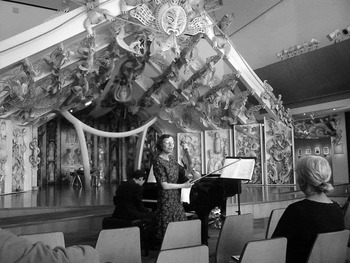
In interviews with members of staff the role of the marae was much discussed. For most of my informants who were curatorial, educational, communication, and administrative staff, the marae expressed the contemporary face of New Zealand and how the lives and beliefs of Maori and Pakeha have been mutually informed. “It is as if we are being told that we are not allowed to change,” observed a Maori member of staff in relation to comments that Rongomaraeroa is not authentic, while a New Zealander of Asian origins observed that the marae is a contemporary scene where Maori, Pakeha, Pacific, or Asian New Zealanders can express who they are. The breadth of events and ceremonies taking place in Rongomaraeroa was a further interesting topic for discussion. The marae is used for traditional Maori practices like welcoming ceremonies (powhiri), meetings (hui), and performing arts (kapa haka), but also for educational workshops, waita (song) rehearsals, and more mainstream cultural performances, like classical music concerts, youth activities, and celebrations. Upon entering the marae explanations are provided about the relevant protocol and meaning of the place and its role in Maori culture. This is then followed by a discussion of why Rongomaraeroa is different and how it is not just the marae of the museum or of a single iwi, but rather the marae of the nation. During my fieldwork I witnessed different events in the marae from waiata practices and educational workshops to classical music concerts and Maori cultural performances (Figure 3). Both in the context of interviews with Te Papa staff members and in relation to what takes place in it and in contrast to the permanent exhibitions, Rongomaraeroa emerges as a cultural scene for the performance of complex and changing contemporary identities.
A violin and piano duet at the marae of Te Papa Tongarewa. Interestingly, the space is used for different types of events and activities and not only traditional Maori cultural performances (picture taken by the author in 2007).

The negotiation of identity via performance has also been a key aspect of the Quai Branly. Indoor and outdoor spaces are used throughout the year for the hosting of ceremonies, events, and cultural performances. Since 2006 different cultural groups have traveled to Paris to present what the museum describes as their “intangible heritages,” which have included traditional performing arts from Asia, masked performances from Western Africa, Latin American and South Asian dances, and Polynesian ceremonies, but also more contemporary cultural practices, like jazz and hip-hop. The vision of the museum's director was to create a cultural scene, much like the center Pompidou, which would not only focus on the presentation of material culture, but present films, organize workshops and educational activities, and also showcase performing arts from around the world. And while many curators were skeptical about such performances that for many hinted at the human zoos of the nineteenth- and early twentieth-century international exhibitions, today these performances and cultural events offer an interesting point of comparison to the permanent exhibitions. While the latter are more keen to present traditional ethnographic pieces of peoples that seem to have had little or no contact with modern, Western civilization, the cultural performances presented in the museum theater often reveal the vibrancy, change, and creative transformation related to intercultural contact and exchange.Footnote 63 “Intangible heritage is the richness of the living, not Bela Bartok collecting the last Hungarian folksongs” observed in our discussion the museum's director and further highlighted the differences between exhibition and performance spaces.
My fieldwork in the Quai Branly and Te Papa has therefore revealed the multiple levels on which contemporary indigenous identities and perceptions of cultural heritage are negotiated visually and performatively in each museum. These unfold mainly along a political discourse of cultural recognition,Footnote 64 the presentation and interpretation of material culture, and the performance of cultural practices and ceremonies defined as living heritage.
Recognition is a key aspect of the narrative of the two museums that has been appropriated and reworked in the two local contexts. Behind the multicolored façade and tropical galleries of the Quai Branly lies Jacques Chirac's vision of “rendering justice” to the world's excluded and misrepresented cultures. In the context of the Quai Branly justice is given through the acknowledgment of the aesthetic beauty and value of objects that for the largest part of the twentieth century had been viewed as curiosities or anthropological pieces. It is interesting to note that the inauguration of the Quai Branly followed the inauguration of the Pavillon des Sessions in the Louvre in 2000. This gallery, which contains about 100 pieces from Asia, Africa, Oceania, and the Americas and was curated in a minimalist style by the late Jacques Kerchache, was regarded as the first step in the process of cultural recognition. Advertised among other media through posters of Melanesian wooden sculptures declaring “Je suis au Louvre,”Footnote 65 the gallery communicated the message that non-Western arts were as important as the masterpieces of Western civilization. And while this step has been widely heralded as breaking down colonial and racist walls, the celebration of these objects as universal art silences their previous lives and social meanings and expresses Eurocentric views that often further perpetuate the divide between the West and the non-West. Indigenous heritage and identity in this context are very much negotiated as precolonial traditions and practices that are fragile and threatened by globalization and development.
Recognition permeates also the bicultural museology of Te Papa. Here it was not the vision of a powerful figure, but rather wider social forces and political agendas that led to the reinvention of the old Dominion Museum as an inclusive, bicultural institution. Recognition therefore is not only manifested through aesthetic mechanisms of display, but rather through the celebration of Maori material culture as taonga, precious treasures and living ancestors. This, of course, involved a well-planned indigenization of the museum that is most notably manifested in its bicultural name and in the space of the marae. More subtle museological aspects like the presentation of Maori views and knowledge (Matauranga) reveal that recognition is further expressed in the process of empowering and seeking the participation of iwi. In Mana Whenua recognition is therefore articulated in the aesthetic and respectful display of taonga and in the interpretation of these pieces through the voices of iwi and community representatives. Moreover, recognition is further enacted through the adoption of the international discourse of heritage preservation presented in the smaller display on the protection of Maori heritage from unethical use and illegal exploitation. This then reveals that indigenous heritage and identity are again negotiated as a precious legacy from the past that is threatened and needs to be placed under protection.
Interestingly both museums project different understandings of heritage and identity with regards to cultural performances and live arts. What is prioritized is not the preservation of disappearing practices, but rather the celebration of ongoing traditions that are reworked and renegotiated by contemporary generations. The range of performances in Te Papa's marae and in the different venues of the Quai Branly reveals that traditions are open to change and reinterpretation by practitioners and performers. In this sense the museum becomes a space for the expression of these new identities that are not monolithic, but complex and comprised of a combination of elements and cultural influences; an idea that further supports the argument that change and synthesis are fundamental aspects of cultural vitality and that cross-cultural exchange often revives rather than threatens cultural heritage.
CONCLUSIONS: INTANGIBLE HERITAGE RETHOUGHT
The emergence of intangible heritage in the global cultural scene has been founded on the premise that peoples' traditional ways of lives, practices, and ceremonies are in need of safeguarding. This has been part of the broader theme of heritage protection endorsed and put into practice internationally by UNESCO and nationally by the majority of its member states. Inherent in the preservationist framework of the international organization are broader issues concerning the protection of the world's cultural diversity and the rights of special groups and communities that are the bearers of these traditions. Rapid processes of economic development and modernization have led to a global cultural homogenization with peoples' traditional ways of life being abandoned for more mainstream and modern ways of life. The aim of this article has been to critically examine the concept of preservation on which the intangible heritage initiatives of the organization have been constructed. A key theme emerging is that heritage designation has required not only the establishment of an international discourse of cultural preservation and antiglobalization, but also the invention of mechanisms and structures adhering to a widespread bureaucratic format. The intervention of government agencies and experts has been a key characteristic of this format that is also expressed in the establishment of formal inventories of intangible heritage, the adoption of legal, financial, and administrative measures and action plans.
I have further argued that museums are not unresponsive to those international narratives of cultural preservation. The Quai Branly's founding discourse of intercultural dialogue and “doing justice” to groups and communities that had previously been maltreated resonates the international agendas for the protection of cultural diversity promoted by the UN and UNESCO. And similarly, the presentation of Wai 262 in the context of the permanent Maori exhibition at Te Papa makes a strong point about the threats that surround the indigenous peoples of New Zealand and their cultural heritage, much in the spirit of international instruments for the rights of indigenous peoples.Footnote 66
But the designation and protection of intangible heritage has several problematic undertones embedded in the preservationist remit of heritage institutionalization. The participation of local communities and practitioners in decision-making is recognized by the 2003 Convention and relevant programs. Yet, there is little doubt that the language of heritage preservation requires specialist technical knowledge often communicated in a top-down approach through different international, national, and regional networks. Usually this also requires the renegotiation and mediation of cultural practices through new frameworks in order to meet the criteria set out by the international organization.Footnote 67 A look, for example, at the List of the Intangible Heritage of Humanity on the web site of UNESCO reveals clearly the format of uniqueness, excellence, and endangerment that constitute key characteristics of the inventoried expressions.Footnote 68 Moreover, it also suggests that inherent in heritage designation and preservation is a projected notion of cultural authenticity. For example, as discussed earlier, Churchill's examination of the conflict between ludists and dignifiers clearly demonstrates how disagreements about the authentic way to perform the carnival are bound up with acts of cultural reification and reinvention. And de Jong's analysis of the Senegambian masquerade reveals the processes of cultural authentication embedded in the proclamation of cultural expressions as intangible heritage of humanity. The question that is raised then is if this projected notion of cultural diversity inherent in the formalized approach to intangible heritage puts forward a homogenizing vision of pure, endangered, and authentic cultural expressions.
This article has critically examined the relevance of preservationist mechanisms bound up with the protection of intangible heritage. Drawing on the politics of erasure and the creative interplay of heritage destruction and renewal, I have argued for the opportunities offered by rethinking intangible heritage as cultural practices and performances that are constantly transformed and recreated by performers and practitioners. A central argument of the article has been that processes of globalization and cross-cultural hybridization often revive rather than endanger cultural heritage and make it more relevant to contemporary multifaceted social and cultural environments. By exploring the complexities of cultural representation taking place in the Quai Branly and Te Papa, I have examined how contemporary indigenous culture performed in these museums by groups and practicing communities often escapes the criteria of heritage designation and offers new frameworks for engaging with the realities of global flows and continuities—something which interestingly is harder to identify in the permanent exhibition spaces. Here, ethnographic research in the two museums has revealed that the discourse of preservation and endangered indigenousness is strong and less flexible in the exhibitions. The way forward I would argue then is twofold: on the one hand, to further explore the components of museological practice that would allow for such complexities to come to the fore; and on the other, to seek alternative ways of cultural transmission that are driven from the bottom up and emerge in response to contemporary realities rather than predetermined criteria and dubious political motivations.