Because the ideological landscape of the present does not match the ideological configurations of the past, the past and present of national monuments often collide in ways that complicate their utility as “patrimony” and “heritage.” In Spain, Islamic monuments such as the Alhambra Palace (built in Granada by Nasrid monarchs in the 13th and 14th centuries) exist in the present as popular tourism sites and points of entry for an imaginative encounter with the Iberian peninsula's Andalusi past. The past evoked is a recognized part of Iberian history and yet, as patrimony, it is simultaneously admired as something that distinguishes Spain from the rest of Europe and resisted as something belonging to an exiled people who left long ago for places like Fez and Istanbul. Under Franco's dictatorship (1947–73), Spain was adamantly Catholic and, despite a small wave of conversions to Islam and the recent immigration of Muslims from northern Africa, it remains predominantly Christian.Footnote 1
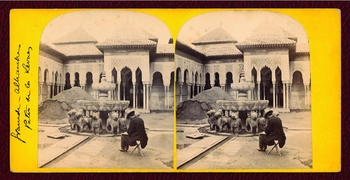
Between present and past there is a cleavage, both in the sense of a split between temporal moments and in the sense of an adherence, in that they occupy the same ground. This is seen in a stereoscopic photograph of the Court of the Lions in the Alhambra, made ca. 1870 by the photographer Pierre Eleonor Ernest Lamy (1828–91). The image shows a dark-frocked figure seated on a folding stool, bent over his sketchbook, his back to us, facing the lions fountain next to which stands an enormous and enigmatic pile of earth (see Figure 1).Footnote 2 The mound was probably a result of the excavations ordered by Rafael Contreras, during his tenure as Alhambra restoration architect from 1847 to 1888, to remove the irrigation system installed by Napoleon's French troops when they used the vacant fortress as their barracks in 1810–12. The pipes, installed to water the garden that the French planted, caused damage to the surrounding halls. The areas where the stucco dissolved and the tile fell from the lower portion of the walls are clearly visible in later photographs. Unlike countless prints and photographs in which the courtyard appears iconic and timeless, as though perfectly preserved since the moment of its construction in the mid-14th century, this photograph reminds us that the Alhambra was constantly decaying and being repaired, and that it was an object of architectural, artistic, literary, and touristic attention.
Stereoscopic Photograph of the Court of the Lions. Ernest Lamy, 1863. From the collection of José Tito Rojo.

No site in Spain attracts more tourists. The Alhambra has had this spellbinding effect for centuries, attracting such literati as Washington Irving in 1829 and designers such as Owen Jones in 1834. Architecturally, it has had a mixed reception. For the first half of the 20th century, modern architects disdained its exuberant ornament, but in the postmodernism of the 1960s, architects and historians no longer judged the Alhambra against principles of purism and formalism and could appreciate its decorative program of pierced stucco and multicolored glazed tile. Moreover, after the death of Franco, Spain emerged from virtual isolation and experienced a new surge of national pride, accompanied by a resurgent interest in symbols of cultural identity. The 1992 celebration of the quincentenary inspired new international interest in Spanish history and monuments, particularly of the period around 1492. Thus it is that two million visitors now annually pour through the ticket gate of this celebrated palace.
The photograph provokes the question of how the present—whether in the 19th, 20th, or 21st century—receives and shapes the past, as objects are literally remade to better represent an imagined history. The French carried out substantial repairs during their brief occupancy and installed a garden in the Court of Lion's dusty courtyard (1810–12); site director José Contreras scraped the surfaces of its columns and lion figures to “restore” them to a putative whiteness (1841–43); under the direction of José's son Rafael Contreras, the conservation architect Juan Pugnaire put a fancifully tiled cupola on the roof of the Court of the Lions and replaced the floor tile of the surrounding gallery (ca. 1858).Footnote 3 While there is no doubt that the buildings were in dire need of repair—photos from the 1850s show wooden beams propping up collapsing walls—it is remarkable that in 1858 the budget for repairs to the ornament was four times greater than that allocated for structural work.Footnote 4 Improving the building's appearance clearly outweighed structural stabilization. It is difficult to imagine the standard of authenticity that these early restorers had in mind as they worked on the Alhambra's buildings, given that few scientific studies of Islamic monuments had been carried out in Spain before the 20th century. Lacking such information, the French made their repairs solely to improve the site's function and appearance. José Contreras had the purity of classical models in mind. Pugnaire seems to have been influenced by Turkish (and possibly Moroccan) models.
In Spain, the agents who have taken charge of the remaking (or “restoration”) of Islamic monuments have been European Christians, which is to say that they have no direct self-identification with the Muslim and Arab past that the Alhambra commemorates. Indeed, Spain as a nation-state was founded on the expulsion of the Muslims whose history is reflected in the Alhambra. How then can the Alhambra serve as Spanish national patrimony?
The issue of how the present looks at the past, and how ideology is addressed or repressed in that process, is central to the practice of history and especially the history of East-West relations. It is specifically reflected in the restoration campaigns at the Alhambra where, after the buildings had slowly fallen into ruin following the conquest of 1492, they were revived by 19th- and early 20th-century architects who understood their mission to be one of replacing missing stucco and tile and reviving the gardens, not simply in order to strip away later accretions but to recreate the absent original. A restoration with tastefully rendered details, even if it is more invention than conservation, is often accepted by both the viewing public and experts as an authentic object. Whereas true material accuracy lies in the ruin that discloses the passage of time, reveals material absences, and admits the distance from the original, restorers know that the human imagination welcomes the object that has been dressed to persuade us of its timeless completeness.
The photograph reveals all of this. The Islamic object and Western viewer are conjoined in the eyes of the man in European coat and hat who serves as the projected presence of the photographer (and the photograph's beholder, since the man's study of the courtyard duplicates that of the photograph's viewer). When we look at the image, we are mentally able to separate the temporary intrusions of mound and man from the setting, seeing them as distracting signs of the present, whereas we accept the cupola, fountain, and barren courtyard surface as well as the touched up stuccowork, the replaced floor tiles, and the stripped surface of the lion figures as belonging properly to the architecture. In fact, like the mound, these are all post-Islamic alterations and additions, yet we are persuaded of their authenticity because they fulfill our fantasy of history.
This process is about more than architectural restoration and shifts in time. It is also about a shift in cultures, whereby one people comes to own and even rewrite a past that may be equally claimed by another. The concept of patrimony becomes exceedingly complex here, especially when we reflect on the term's implicit gender and its meaning as the inheritance of property through the male line, with the sense of legacy but also birthright. Modern Spain can and does claim Andalusi legacy, but the birthright—if we even accept such a concept—belongs to the descendants of the actual builders, patrons, and occupants of the Alhambra, most of whom were Muslim. The big question thus may not be how past and present coexist in the material fabric of the Alhambra, but the extent to which modern Spaniards see themselves as the Alhambra's descendants and whether the Alhambra reveals or occludes that identification.