


1. Introduction
The Chinese Altai is a key part of the Central Asian Orogenic Belt, the largest Phanerozoic accretionary orogenic belt in the world (Sengӧr et al. Reference Sengör, Natalín and Burtman1993; Xiao et al. Reference Xiao, Windley, Badarch, Sun, Li, Qin and Wang2004). It is famous for hosting around 100000 pegmatite dykes and dozens of pegmatitic rare-metal mineral deposits (Zou & Li, Reference Zou and Li2006). These pegmatites are divided into three types: muscovite (476–426 Ma, Wang et al. Reference Wang, Chen and Xu2001); muscovite-rare-element (muscovite-REL) (369 Ma, Wang et al. Reference Wang, Chen and Xu2003, Reference Wang, Zou, Xu, Yu and Fu2004); and rare-element (REL) pegmatites (275–154 Ma, Chen et al. Reference Chen, Li, Wang, Cai and Chen2000; Wang et al. Reference Wang, Chen, Zou, Xu, Li, Chen, Chen and Tian2000, Reference Wang, Chen and Xu2003, Reference Wang, Zou, Xu, Yu and Fu2004, Reference Wang, Qin, Tang, Zhou, Shen, Guo and Guo2015; Zhu, Zeng & Gu, Reference Zhu, Zeng and Gu2006; Wang et al. Reference Wang, Tong, Jahn, Zou, Wang, Hong and Han2007c ; Ren et al. Reference Ren, Zhang, Tang and Lv2011; Lv et al. Reference Lv, Zhang, Tang and Guan2012; Liu et al. Reference Liu, Zhang, Tang, Tang and Lv2015; Zhou et al. Reference Zhou, Qin, Tang, Tian, Cao and Wang2015 a). The REL pegmatites, considered as the more evolved pegmatites, are distributed in nine pegmatite fields (Zou & Li, Reference Zou and Li2006) and could be summarized by heterogeneous Li-Be-Nb-Ta-Cs-Rb-Hf mineralization. However, the range of formation ages is not well constrained and it is unclear if an evolutionary trend is observed in the geochronology data relating to rare-element pegmatites of differing mineralization types. The available geochronology could help explain the regional tectonic setting of the Chinese Altai and may also help in the exploration of REL pegmatites in the Chinese Altai.
Here, we present new data on the geochronology of the representative REL pegmatite dykes of the Chinese Altai using laser ablation inductively coupled plasma mass spectrometry (LA-ICP-MS) columbite-tantalite U–Pb, LA-ICP-MS zircon U–Pb and muscovite 40Ar–39Ar dating methods. On the basis of these systematic age results and previous work, we attempt to determine the formation ages of the rare-element pegmatite dykes, reveal the time frame and evolution sequence of the rare-metal mineralization of pegmatites and then shed light on the magmatic history of the Chinese Altai during post-collisional extension.
2. Geological setting
The Altai orogenic belt, comprising Mongolian, Chinese and Russian Altai, forms part of the larger Central Asian Orogenic belt (Xiao et al. Reference Xiao, Tang, Feng, Zhu, Li and Zhou1992). It is situated between the Sayan and Gorny Altai of southern Siberia to the north and the Junggar block to the south (Xiao et al. Reference Xiao, Tang, Feng, Zhu, Li and Zhou1992; Sengör et al. Reference Sengör, Natalín and Burtman1993; Jahn et al. Reference Jahn, Wu and Chen2000a ). The Chinese Altai, composed of variably deformed and metamorphosed Vendian–Palaeozoic sedimentary, volcanic and granitic rocks (Xiao et al. Reference Xiao, Windley, Yuan, Sun, Han, Lin, Chen, Yan, Liu, Qin, Li and Sun2009), is divided into six fault-bounded integral parts that are the Altaishan terrane, the NW Altaishan terrane, the Central Altaishan terrane, the Qiongkuer–Abagong terrane, the Erqis terrane and the Perkin–Ertai terrane (Fig. 1) (Windley et al. Reference Windley, Kröner, Guo, Qu, Li and Zhang2002). Each terrane shows different stratigraphy, metamorphism, deformation patterns and age relations (He et al. Reference He, Han, Yue and Wang1990; Qu & Zhang, Reference Qu and Zhang1991). The Altaishan terrane (I) consists predominantly of Middle–Upper Devonian – Carboniferous metasediments and the oldest rocks are greenschist facies (Windley et al. Reference Windley, Kröner, Guo, Qu, Li and Zhang2002; Wang et al. Reference Wang, Hond, Jahn, Tong, Wang, Han and Wang2006b ). The NW Altaishan terrane (II) consists largely of Neoproterozoic–Ordovician sedimentary and volcanic rocks: metasandstone, -siltstone, -shale, marble and limestone, tuff, andesitic breccia, etc. (Yuan et al. Reference Yuan, Sun, Long, Xia, Xiao, Li, Lin and Cai2007a ). The Central Altaishan terrane (III) contains Neoproterozoic–Silurian rocks which are amphibolite- and greenschist-facies metasediments and metavolcanics, including metasandstone, -siltstone, -shale, marble, schist, gneiss, etc. The Qiongkuer–Abagong terrane (IV) contains upper Silurian – Lower Devonian arc-type volcanic and pyroclastic rocks (Xiao et al. Reference Xiao, Windley, Badarch, Sun, Li, Qin and Wang2004) and Middle Devonian turbiditic sandstone-shale sequence (Windley et al. Reference Windley, Kröner, Guo, Qu, Li and Zhang2002). The Erqis terrane (V) is covered by Quaternary in the west and contains a high-grade gneisses and schists and Late Carboniferous sedimentary rocks (Windley et al. Reference Windley, Kröner, Guo, Qu, Li and Zhang2002). The Perkin–Ertai terrane (VI) consists of Devonian felsic-intermediate basic lavas and tuffs with some Carboniferous volcanics (Mei et al. Reference Mei, Yang, Wang, Yu, Liu, Bai and Tu1993; Windley et al. Reference Windley, Kröner, Guo, Qu, Li and Zhang2002). The northern and southern parts of the Chinese Altai were formed in an arc setting, while the central parts contain no island arcs (Qin, Reference Qin2000; Windley et al. Reference Windley, Kröner, Guo, Qu, Li and Zhang2002; Xiao et al. Reference Xiao, Windley, Badarch, Sun, Li, Qin and Wang2004; Qin et al. Reference Qin, Xiao, Zhang, Xu, Hao, Sun, Li, Tosdal, Mao and Bierlein2005; Wang et al. Reference Wang, Hond, Jahn, Tong, Wang, Han and Wang2006b ). The Chinese Altai underwent a complex process of subduction and accretion during Palaeozoic time (Xiao et al. Reference Xiao, Tang, Feng, Zhu, Li and Zhou1992, Reference Xiao, Windley, Badarch, Sun, Li, Qin and Wang2004; Sengör et al. Reference Sengör, Natalín and Burtman1993; He et al. Reference He, Li, Liu and Zhou1994; Windley et al. Reference Windley, Alexeiev, Xiao, Kröner and Badarch2007) and finally progressed into relatively stable continent development with alternating periods of extension and compression (Li & Poliyangsiji, Reference Li and Poliyangsiji2001), after finishing the formation of its basic tectonic framework no later than middle Carboniferous time (He et al. Reference He, Li, Liu and Zhou1994; Windley et al. Reference Windley, Kröner, Guo, Qu, Li and Zhang2002; Li et al. Reference Li, Xiao, Sun, Gao, Mao, Goldfarb, Seltmann, Wang, Xiao and Hart2003; Xiao et al. Reference Xiao, Windley, Badarch, Sun, Li, Qin and Wang2004; Wang et al. Reference Wang, Hong, Tong, Han and Shi2005).
Geological sketch map of the Chinese Altai terranes, showing the locations, geological setting and formation ages of the rare-element (REL) pegmatites and related granites (modified from Luan et al. Reference Luan, Mao, Fan, Wu and Lin1995; Windley et al. Reference Windley, Kröner, Guo, Qu, Li and Zhang2002; Wang et al. Reference Wang, Hond, Jahn, Tong, Wang, Han and Wang2006b , Reference Wang, Tong, Jahn, Zou, Wang, Hong and Han2007 c; Zou & Li, Reference Zou and Li2006; Cai et al. Reference Cai, Sun, Yuan, Long and Xiao2011a ). I, Altaishan terrane; II, NW Altaishan terrane; III, Central Altaishan terrane; IV, Qiongkuer–Abagong terrane; V, Erqis terrane; VI, Perkin–Ertai terrane. 1, Qinghe pegmatite field; 2, Keketuohai pegmatite field; 3, Kuwei–Jiebiete pegmatite field; 4, Kelumute–Jideke pegmatite field; 5, Kalaeerqisi pegmatite field; 6, Dakalasu–Kekexier pegmatite field; 7, Xiaokalasu–Qiebielin pegmatite field; 8, Hailiutan–Yeliuman pegmatite field; 9, Jiamanhaba pegmatite field. The references of ages of pegmatites and granites are a, Chen et al. (Reference Chen, Li, Wang, Cai and Chen2000); b, Liu et al. (Reference Liu, Zhang, Li, Zhang and Li2014); c, Lv et al. (Reference Lv, Zhang, Tang and Guan2012); d, Ren et al. (Reference Ren, Zhang, Tang and Lv2011); e, Sun et al. Reference Sun, Li, Yang, Li, Zhu and Yang(2009a); f, Tong (Reference Tong2006); g, Tong et al. Reference Tong, Wang, Hong and Dai(2006a); h, Tong et al. Reference Tong, Wang, Kovach, Hong and Han(2006b); i, Wang et al. (Reference Wang, Chen, Zou, Xu, Li, Chen, Chen and Tian2000); j, Wang et al. (Reference Wang, Chen and Xu2003); k, Wang et al. Reference Wang, Hond, Jahn, Tong, Wang, Han and Wang(2006b); l, Wang et al. (2007); m, Wang et al. (Reference Wang, Qin, Tang, Zhou, Shen, Guo and Guo2015); n, Zhou et al. (Reference Zhou, Zhang, Luo, He, Wang, Yin, Zhao, Li and He2007); o, Zhou et al. (Reference Zhou, Qin, Tang, Tian, Cao and Wang2015 a); p, Zou et al. (Reference Zou, Zhang, Jia, Wang, Cao and Wu1986).

Magmatism played an important role in the development of the Chinese Altai (Zou, Cao & Wu, Reference Zou, Cao and Wu1989; Wang et al. Reference Wang, Chen, Li, Xu and Li1998) because c. 200 granitoid plutons occupy at least 40% of the Chinese Altai (Zou, Cao & Wu, Reference Zou, Cao and Wu1989; Cai et al. Reference Cai, Sun, Yuan, Zhao, Xiao, Long and Wu2011b ). The emplacement of these granites took place from 479 Ma to 150 Ma discontinuously with peak ages of 460 Ma, 408 Ma, 375 Ma, 265 Ma, 210 Ma and 150 Ma (Liu, Reference Liu1990, Reference Liu1993; Zhang et al. Reference Zhang, Sui, Li, Liu, Yang, Liu and Huang1996; Chen & Jahn, Reference Chen and Jahn2002; Wang et al. Reference Wang, Hong, Tong, Han and Shi2005, Reference Wang, Hond, Jahn, Tong, Wang, Han and Wang2006 b, Reference Wang, Tong, Jahn, Zou, Wang, Hong and Han2007 c, Reference Wang, Tong, Li, Zhang, Shi, Li, Han and Hong2010, Reference Wang, Qin, Tang, Zhou, Shen, Guo and Guo2015; Tong et al. Reference Tong, Wang, Hong and Dai2006a , b, Reference Tong, Wang, Hong, Dai, Han and Liu2007; Yuan et al. Reference Yuan, Sun, Xiao, Li, Chen, Lin, Xia and Long2007b ; Zhou et al. Reference Zhou, Zhang, Luo, He, Wang, Yin, Zhao, Li and He2007; Liu et al. Reference Liu, Yang, Mao, Chai and Geng2009, Reference Liu, Dong, Gao, Chen, Zhao, Wang, Song, He and Qin2010 b, Reference Liu, Zhang, Li, Zhang and Li2014; Sun et al. Reference Sun, Li, Yang, Li, Zhu and Yang2009a ; Chai et al. Reference Chai, Dong, Yang, Liu, Geng and Huang2010; Li et al. Reference Li, He, Wu and Wu2010; Cai et al. Reference Cai, Sun, Yuan, Zhao, Xiao, Long and Wu2011b ; Shen et al. Reference Shen, Zhang, Wang, Wyman and Yang2011). The synorogenic granites, which were emplaced earlier than 300 Ma, are widely distributed and dominant granitic intrusions in the Chinese Altai, while the post-orogenic and anorogenic granites mostly occur as small linear, approximately circular and irregular granite plutons (Fig. 1). The synorogenic granites are metaluminous to peraluminous in composition (Wang et al. Reference Wang, Hond, Jahn, Tong, Wang, Han and Wang2006b ; Yuan et al. Reference Yuan, Sun, Xiao, Li, Chen, Lin, Xia and Long2007b ; Sun et al. Reference Sun, Yuan, Xiao, Long, Xiao, Zhao, Lin, Wu and Kröner2008; Cai et al. Reference Cai, Sun, Yuan, Zhao, Xiao, Long and Wu2011b ), derived from a mixture of continental sources and mantle-derived components (Zhao et al. Reference Zhao, Wang, Zou, Masuda and Tu1993; Jahn et al. Reference Jahn, Wu and Chen2000b ; Chen & Jahn, Reference Chen and Jahn2002; Wang et al. Reference Wang, Hond, Jahn, Tong, Wang, Han and Wang2006b , Reference Wang, Jahn, Kovach, Tong, Hong and Han2009 b; Yuan et al. Reference Yuan, Sun, Xiao, Li, Chen, Lin, Xia and Long2007b ; Sun et al. Reference Sun, Yuan, Xiao, Long, Xiao, Zhao, Lin, Wu and Kröner2008, Reference Sun, Long, Cai, Jiang, Wong, Yuan, Zhao, Xiao and Wu2009 b; Cai et al. Reference Cai, Sun, Yuan, Long and Xiao2011a ). The post-orogenic and anorogenic granitic intrusions include biotite, two-mica and muscovite granites, monzogranite, granodiorite and syenites, etc., which belong to calc-alkaline to alkaline types with different K and Na contents (Chen & Jahn, Reference Chen and Jahn2002; Wang et al. Reference Wang, Hong, Tong, Han and Shi2005, Reference Wang, Qin, Tang, Zhou, Shen, Guo and Guo2015; Tong, Reference Tong2006; Tong et al. Reference Tong, Wang, Hong and Dai2006a , b; Zhou et al. Reference Zhou, Zhang, Luo, He, Wang, Yin, Zhao, Li and He2007; Sun et al. Reference Sun, Li, Yang, Li, Zhu and Yang2009a ; Liu et al. Reference Liu, Zhang, Li, Zhang and Li2014). The new juvenile mantle-derived materials, besides subducted juvenile ocean crust or arc rocks, probably contributed to the generation of the post-orogenic and anorogenic granites (Wang et al. Reference Wang, Hong, Tong, Han and Shi2005; Tong et al. Reference Tong, Wang, Kovach, Hong and Han2006b ). Compared with the synorogenic granites, they were derived from a deeper crustal level where juvenile crust may predominate (Chen & Jahn, Reference Chen and Jahn2002). Some magma chambers experienced composite assimilation and fractional crystallization processes (Liu, Liu & Masuda, Reference Liu, Liu and Masuda1997; Tong, Reference Tong2006). Some of the post-orogenic and anorogenic granites are spatially and temporally related to the pegmatites (Fig. 1). Geochemical research demonstrates that the source of the Aral and Asikaerte granites are possibly genetically linked to the Koktokay No. 3 and Asikaerte pegmatites, respectively (Zhu, Zeng & Gu, Reference Zhu, Zeng and Gu2006; Zou & Li, Reference Zou and Li2006; Cao et al. Reference Cao, Zhou, Qin, Tang and Evans2013; Liu et al. Reference Liu, Zhang, Li, Zhang and Li2014; Wang et al. Reference Wang, Qin, Tang, Zhou, Shen, Guo and Guo2015). The relationship of the post-orogenic and anorogenic granites and pegmatites in the Chinese Altai needs further research.
3. Brief review of the pegmatite dykes in the Altai orogenic belt
There are more than 100000 pegmatite dykes in the Chinese Altai. Some of these dykes have been found to have a variety of mineralization associations: muscovite, Li, Be, Nb, Ta and Cs (Wang et al. Reference Wang, Zou, Xu, Yu and Qiu1981; Zou et al. Reference Zou, Zhang, Jia, Wang, Cao and Wu1986; Zou & Li, Reference Zou and Li2006) and have been explored. These pegmatite deposits, divided into nine pegmatite fields (Fig. 1) (Zou & Li, Reference Zou and Li2006), are concentrated in the Central Altaishan and Qiongkuer–Abagong terranes and are hosted in metagabbros, granites and metasediments. From SE to NW, the nine pegmatite fields are Qinghe (1), Keketuohai (2), Kuwei–Jiebiete (3), Kelumute–Jideke (4), Kalaeerqisi (5), Dakalasu–Kekexier (6), Xiaokalasu–Qiebielin (7), Hailiutan–Yeliuman (8) and Jiamanhaba (9) (Fig. 1) (Zou & Li, Reference Zou and Li2006). Each pegmatite field holds pegmatite deposits with different mineralization types and sizes. Three types of pegmatite deposits are identified: muscovite pegmatite, muscovite-REL (rare-element) pegmatite and REL (rare-element) pegmatite (Fig. 1). The REL pegmatite deposits include mineralization types of Li (e.g. Kukalagai in Kelumute–Jideke pegmatite field), Be (e.g. Husite and Qunkuer in Kelumute–Jideke pegmatite field), Nb-Ta (e.g. Baicheng in Qinghe pegmatite field), Be-Nb-Ta (e.g. Dakalasu in Dakalasu–Kekexier pegmatite field), Li-Nb-Ta (e.g. Xiaokalasu in Xiaokalasu–Qiebielin pegmatite field) and Li-Be-Nb-Ta-(Rb-Cs) (e.g. the Koktokay No. 3 pegmatite in Keketuohai pegmatite field) (Fig. 1). The geochronological studies show that the pegmatites in the Chinese Altai formed during Ordovician–Jurassic time (e.g. Wang et al. Reference Wang, Chen, Zou, Xu, Li, Chen, Chen and Tian2000, Reference Wang, Chen and Xu2003, Reference Wang, Zou, Xu, Yu and Fu2004; Ren et al. Reference Ren, Zhang, Tang and Lv2011; Zhou et al. Reference Zhou, Qin, Tang, Tian, Cao and Wang2015 a). The H-O isotopes indicate that the formation of the muscovite pegmatites are characterized by incorporation of meteoritic water, while the REL pegmatites are probably from granitic magma with high δ18O values (Zou & Li, Reference Zou and Li2006). The muscovite pegmatites mostly originate from metamorphic differentiation, and the muscovite-REL and REL pegmatites are genetically related to magmatic crystallization and fractionation (Zou & Li, Reference Zou and Li2006).
4. Description of the rare-element pegmatites studied
The REL pegmatite dykes investigated are located in the Qinghe, Kelumute–Jideke, Dakalasu–Kekexier and Xiaokalasu–Qiebielin pegmatite fields (Fig. 1).
4.a. Qinghe pegmatite field
The Talate Li-Be-Nb-Ta pegmatite dyke, Baicheng Nb-Ta pegmatite dyke and barren Kangmunagong pegmatite dyke are distributed around Qinghe county in Xinjiang, NW China (Fig. 1). These pegmatite dykes occur in quartz-biotite schist. The contacts between the Talate and Baicheng pegmatites and country rocks are irregular with deformation of country rocks, while the Kangmunagong pegmatite occurs along schistosity with a sharp contact.
(1) The Talate Li-Be-Nb-Ta pegmatite dyke extends over about 150 m NW–SE, with a maximum width of 10 m and a subvertical dip to the NE. Holmquisite occurs in the altered wall rock. It shows a complex internal zoning structure. The wall zone comprises fine-grained albite-quartz-muscovite-garnet-beryl (1–2 mm) with tourmaline and columbite-tantalite as accessory minerals. Following the wall zone, the outer intermediate zone comprises graphic microcline-quartz-tourmaline intergrowth with garnet, muscovite and columbite-tantalite and coarse quartz-muscovite-beryl assemblage. The inner intermediate zone is composed of coarse (up to 30 cm in length), green spodumene and grey quartz, with aggregates of medium-grained lepidolite and cleavelandite. This grades into a core zone comprising blocky K-feldspar and milky quartz.
(2) The Baicheng Nb-Ta pegmatite dyke, 50 m long and 20 m thick with an E–W trend and subvertical dip to the north, is a lens-shaped pegmatite. It is dominated by medium–coarse-grained assemblage of K-feldspar, albite, quartz and muscovite (0.5–3 cm) that grades into blocky K-feldspar with discontinuous lenses (20 cm to 1 m in length) and the replacement zone. The lenses are composed of quartz, muscovite, albite, columbite-tantalite and green tourmaline. The replacement zone comprises saccharoidal assemblages of albite, quartz and muscovite.
(3) The Kangmunagong pegmatite dyke extends over 1 km E–W, with a maximum width of 50 m with a dip of 60° to the north. It is a relatively homogeneous body. The pegmatite is not enriched in rare elements and is formed by a coarse-grained assemblage of K-feldspar, albite, quartz and muscovite (1–3 cm), with common black tourmaline as the main accessory mineral and increasing amounts of garnet in the margins.
4.b. Kelumute–Jideke pegmatite field
The REL pegmatites studied in the Kelumute–Jideke pegmatite field are Be pegmatite dykes, referred to as Husite and Qunkuer.
(1) The Husite Be pegmatite dyke is situated 38 km SE of the township of Aletai. It extends over 700 m with a width range of 20–30 m and a NW–SE trend, and sharply cross-cuts the foliation of the schist which has an E–W trend. It shows a classic symmetrically zoned internal structure. The border zone is fine-grained assemblage of albite, quartz and muscovite (1–2 mm), followed by a wall zone of coarse muscovite-quartz-beryl-garnet that grades into an intermediate zone of blocky microcline with graphic K-feldspar-quartz intergrowth and replacement aggregate of albite.
(2) The Qunkuer Be pegmatite dyke is located 48 km ESE of the city of Aletai. The ore body has been mined and exhausted. The pegmatite cross-cuts the schist with an irregular contact. The rocks of different zones in the ore heap are saccharoidal albite-quartz-muscovite, coarse garnet and cleavelandite intergrowth, K-feldspar block, coarse-grained assemblage of muscovite (1–2 cm), smoky quartz and green beryl (0.5–2 cm in cross-section) with residual blocky K-feldspar.
4.c. Dakalasu–Kekexier pegmatite field
The REL pegmatite studied in the Dakalasu–Kekexier pegmatite field is a Be-Nb-Ta pegmatite dyke from the Dakalasu Be-Nb-Ta deposit, which is located 36 km SSE of the city of Aletai. It cross-cuts the Dahalasu porphyraceous biotite granite which is dated by zircon U–Pb method, yielding a weighted mean age of 248±4 Ma (Tong, Reference Tong2006). It is a symmetrically zoned dyke, c. 10–20 m thick and 200 m long, with a NNE–SSW trend and a gentle dip. From the contact inwards, the pegmatite consists of: (1) a border zone that is a fine-grained assemblage of albite, quartz, muscovite, garnet (1–2 mm) and tourmaline (3–5 mm in length); (2) a wall zone of graphic pegmatite with columbite-tantalite; which evolves to (3) an intermediate zone of blocky microcline-book-like aggregates of muscovite-quartz with beryl columns (up to 50 cm in length) and columbite-tantalite; and (4) a discontinuous replacement aggregate of cleavelandite situated close to (5) a quartz core (mainly white-pink quartz).
4.d. Xiaokalasu–Qiebielin pegmatite field
In the Xiaokalasu–Qiebielin pegmatite field, the Xiaokalasu (Li-Nb-Ta) and Taerlang (barren) pegmatite dykes cross-cut the quartz-biotite schist with irregular contacts, and the Weizigou (Be) pegmatite occur in two-mica granite.
(1) The Xiaokalasu Li-Nb-Ta pegmatite dyke, located 10 km SW of the city of Aletai, is c. 150 m long and 5–20 m wide with a N–S trend and a dip of 65–70°. In the north, it is formed of a wall zone of blocky K-feldspar with fine albite-quartz-muscovite-garnet (1–2 mm), outer intermediate zone of quartz-muscovite-K-feldspar with garnet, and inner intermediate zone of coarse-grained white-green spodumene (3–10 cm in length) -albite-quartz-muscovite with blocky K-feldspar. In the middle, it is mainly fine-grained assemblage of albite, quartz and muscovite (1–2 mm) with pink spodumene. In the south, it is formed of a wall zone of fine albite-quartz-muscovite-garnet with columbite-tantalite as accessory minerals that grades into intermediate zone of coarse white-pink spodumene (3–8 cm in length) -quartz-albite-muscovite with blocky K-feldspar.
(2) The Weizigou Be pegmatite dyke, situated 45 km NNE of the township of Buerjin, extends c. 200 m discontinuously with a maximum width of 10 m and a NE–SW trend. The country rock is two-mica granite and the thickness of the altered wall rock with tourmaline is c. 5–20 cm. The border zone is an assemblage of muscovite, quartz and black tourmaline. The wall zone is composed of fine albite, quartz and muscovite (1–2 mm) with black tourmaline and garnet as the accessory minerals. The intermediate zone as the main part of the pegmatite dyke is dominated by blocky K-feldspar with beryl as an accessory mineral and lenses of quartz, muscovite, beryl and green tourmaline. Locally, the blocky K-feldspar is albitized.
(3) The Taerlang barren pegmatite dyke, which is located 54 km NE of the township of Buerjin and is hosted in schist, extends over 100 m discordantly with a width of 5–10 m and an E–W trend. It is composed of a border zone of microcline-quartz-muscovite-biotite-tourmaline-garnet, and a wall zone of graphic K-feldspar-quartz intergrowth with nest-like assemblages of quartz-muscovite.
5. Samples and analytical methods
5.a. Samples and preparation
Nine pegmatite dykes with different REL-mineralization types were dated: Talate (Li-Be-Nb-Ta), Baicheng (Nb-Ta), Kangmunagong (barren), Husite (Be), Qunkuer (Be), Dakalasu (Be-Nb-Ta), Xiaokalasu (Li-Nb-Ta), Taerlang (barren) and Weizigou (Be). The samples investigated here were mainly collected from wall zone and the intermediate zone, which are mostly REL-mineralized rocks (Fig. 2). These samples are described briefly (Table 1; Fig. 2). They were analysed by columbite, zircon LA-ICP-MS U–Pb dating and muscovite 40Ar–39Ar dating. Samples for columbite-tantalite LA-ICP-MS U–Pb dating are 12DKLS-10, 12XKLS-9 and 12XKLS-12 (Fig. 2d, g, h). The columbite-tantalite grains collected from the wall zone of the Dakalasu pegmatite are assembled with microcline, quartz and garnet (Fig. 3a), while those collected from intermediate zones of the Xiaokalasu pegmatite are assembled with fine albite (Fig. 3b) or coarse albite (Fig. 3c). The columbite-tantalite grains are mostly euhedral crystals (Fig. 3). Samples for zircon LA-ICP-MS U–Pb dating are HST-P, QKE-2-1 and TEL-1 (Fig. 2k, c, f, respectively). Samples for muscovite 40Ar–39Ar dating are TLT-2, BC-4, KMNG-1, HST-P, QKE-2-1, XKLS-2, WZG-4 and TEL-1 (Fig. 2a, b, j, k, c, i, e, f, respectively).
Photographs of samples: (a) TLT-2; (b) BC-4; (c) QKE-2-1; (d) 12DKLS-10; (e) WZG-4; (f) TEL-1; (g) 12XKLS-9; (h) 12XKLS-12; and (i) XKLS-2. Field images of: (j) the Kangmunagong pegmatite; and (k) internal zone of the Husite Be pegmatite. Ab – albite; Mc – microcline; Qz – quartz; Ms – muscovite; Spd – spodumene; Brl – beryl; Col-Tan – columbite-tantalite; Tur – tourmaline; Grt – garnet.

Descriptions of the studied samples in the Chinese Altai.

Note: The numbers in brackets represent percent contents; 1, LA-ICP-MS Columbite-Tantalite U–Pb dating; 2, LA-ICP-MS Zircon U–Pb dating; 3, Muscovite 40Ar–39Ar dating; WZ – wall zone; IZ – intermediate zone; OIZ – outer intermediate zone; Ab – albite; Mc – microcline; Qz – quartz; Ms – muscovite; Spd – spodumene; Brl – beryl; Col-Tan – columbite-tantalite; Tur – tourmaline; Grt – garnet.
Thin-section photomicrographs of occurrences of columbite-tantalite: (a) sample 12DKLS-10, columbite-tantalite grains associate with microcline, quartz, and garnet; (b) sample 12XKLS-9, intergrowth of columbite-tantalite grains and fine-grained albite; (c) sample 12XKLS-12, columbite-tantalite associate with coarse-grained albite. Ab – albite; Mc – microcline; Qz – quartz; Col-Tan – columbite-tantalite; Grt – garnet.

The columbite-tantalite and zircon grains were separated, hand-picked and mounted in an epoxy resin disc. The grain mounts were then polished to expose the grains which were microphotographed in the transmitted and reflected light, and imaged by back-scattered electron (BSE) and cathodoluminescence (CL) using a LEO 1450VP SEM at the State Key Laboratory of Lithospheric Evolution, Institute of Geology and Geophysics, Chinese Academy of Sciences. These images were used to choose potential target sites for U–Pb dating and to characterize the internal features of minerals, including zones of alteration, inclusions and cracks. Samples of muscovite were crushed and sieved. About 100 mg were further purified by hand-picking under a binocular microscope to remove all visible impurities for muscovite 40Ar–39Ar dating.
5.b. EMPA
Major-element compositions of the columbite-tantalites in polished grain mounts were determined using a Shimadzu Corporation EPMA-1600 electron microprobe at the Laboratory of Geoanalysis and Geochronology, Tianjin Geological Survey Center, China Geological Survey. An acceleration voltage of 15 kV and a beam current of 20 nA with beam diameters of 5 μm were used for quantitative analysis. The following standards were used for the quantitative analyses: scheelite (W-Kα), LiTaO3 (Ta-Kα), LiNbO3 (Nb-Kα), rutile (Ti-Kα), ZrO2 (Zr-Kα), cassiterite (Sn-Kα), YP5O14 (Y-Kα), Sb2S3 (Sb-Kα), garnet (Fe-Kα), bustamite (Mn-Kα), diopside (Ca- Kα) and PbS (Pb-Kα). Peaks and backgrounds were measured with counting times of 20 s or 40 s per element. The ZAF routine was used for data reduction (Armstrong, Reference Armstrong1989).
5.c. LA-ICP-MS U–Pb analyses
5.c.1. LA-ICP-MS columbite-tantalite U–Pb dating
U–Pb isotopic analyses were carried out on an Agilent 7500a Q-ICPMS with a 193 nm laser ablation system hosted at the Institute of Geology and Geophysics, Chinese Academy of Sciences in Beijing. A detailed description of the Q-ICPMS can be found in Xie et al. (Reference Xie, Zhang, Zhang, Sun and Wu2008). To monitor the stability of the instrument and to ensure the reliability of the measured results the zircon standards (91500 and GJ-1), the coltan standard (Coltan 139) and the standard (NIST SRM 610) were measured once for every five sample points. Coltan 139 is a large unzoned columbite-(Fe) crystal from an unknown loacation in Madagascar (Gäbler et al. Reference Gäbler, Melcher, Graupner, Bahr, Sitnikova, Henjes-Kunst, Oberthür, Brätz and Gerdes2011; Che et al. Reference Che, Wu, Wang, Gerdes, Ji, Zhao, Yang and Zhu2015a , b; Melcher et al. Reference Melcher, Graupner, Gäbler, Sitnikova, Henjes-Kunst, Oberthür, Gerdes and Dewaele2015). It is used as an in-house reference sample by the Federal Institute for Geosciences and Natural Resources, Germany (Gäbler et al. Reference Gäbler, Melcher, Graupner, Bahr, Sitnikova, Henjes-Kunst, Oberthür, Brätz and Gerdes2011), and yielded an age of c. 506 Ma on the basis of TIMS and LA-ICP-MS dating (Melcher et al. Reference Melcher, Graupner, Gäbler, Sitnikova, Henjes-Kunst, Oberthür, Gerdes and Dewaele2015). In this study, 207Pb/206Pb, 206Pb/238U, 207U/235U (235U=238U/137.88) and 208Pb/232Th ratios were corrected using the Coltan 139 as the external standard. The fractionation correction and results were calculated using GLITTER 4.0 (Macquarie University). All of the measured isotope ratios of Coltan 139 during the process of sample analysis were regressed and corrected using reference values. The relative standard deviations of reference values for Coltan 139 were set at 2% (Che et al. Reference Che, Wu, Wang, Gerdes, Ji, Zhao, Yang and Zhu2015a ). The Concordia and weighted mean U–Pb ages were processed using ISOPLOT/Ex Version 3.0 (Ludwig, Reference Ludwig2003). The contents of U, Th and Pb were also calculated by GLITTER 4.0, with 93Nb as the internal standard and NIST 610 as an external reference material.
5.c.2. LA-ICP-MS zircon U–Pb dating
U–Pb dating analyses of zircon were conducted by LA-ICP-MS at the State Key Laboratory of Geological Processes and Mineral Resources, China University of Geosciences, Wuhan. Detailed operating conditions for the laser ablation system and the ICP-MS instrument and data reduction are the same as those described by Liu et al. (Reference Liu, Hu, Gao, Günther, Xu, Gao and Chen2008, Reference Liu, Gao, Hu, Gao and Wang2010 c) and Hu et al. (Reference Hu, Gao, Liu, Hu, Chen and Huan2008). Each analysis incorporated a background acquisition of approximately 20–30 s (gas blank) followed by 50 s data acquisition from the sample. The Agilent Chemstation was utilized for the acquisition of each individual analysis. Off-line selection and integration of background and analyte signals, as well as time-drift correction and quantitative calibration for trace-element analyses and U–Pb dating, were performed by ICPMS DataCal (Liu et al. Reference Liu, Hu, Gao, Günther, Xu, Gao and Chen2008, Reference Liu, Gao, Hu, Gao and Wang2010 c).
Zircon 91500 was used as external standard for U–Pb dating, and was analysed twice every five analyses. Time-dependent drifts of U-Th-Pb isotopic ratios were corrected using a linear interpolation (with time) for every five analyses according to the variations of 91500 (Liu et al. Reference Liu, Gao, Hu, Gao and Wang2010c ). Preferred U-Th-Pb isotopic ratios used for 91500 are from Wiedenbeck et al. (Reference Wiedenbeck, Alle, Corfu, Griffin, Meier, Oberli, Quadt, Roddick and Spiegel1995). The uncertainty of the preferred values for the external standard 91500 was propagated to the ultimate results of the samples. Concordia diagrams and weighted mean calculations were achieved using Isoplot/Ex_ver3 (Ludwig, Reference Ludwig2003).
5.d. Muscovite 40Ar–39Ar dating
40Ar–39Ar measurements were performed at the State Key Laboratory of Lithospheric Evolution, Institute of Geology and Geophysics, Chinese Academy of Sciences (IGGCAS) in Beijing. Details of the method are given by Wang et al. (Reference Wang, Zhou, Zhang, Ying, Zhang, Wu and Zhu2006a , Reference Wang, Lu, Lo, Wu, He, Yang and Zhu2007 a).
Aliquots of mineral separates were wrapped in aluminium foil and stacked in quartz vials along with the neutron flux monitor GA1550 biotite, which has a K–Ar age of 98.5±0.8 Ma (Spell & McDougall, Reference Spell and McDougall2003). The samples were irradiated at the H8 position in the 49-2 Reactor at the China Institute of Atomic Energy in Beijing, with a neutron flux of c. 6.5×10¹² n cm−2 s−1. Samples were heated stepwise with a double vacuum resistance furnace. Following five additional minutes of released gas purification on Zr–Al getters, the isotopic data were measured using a MM5400 mass spectrometer. After correcting for mass discrimination, system blanks and radiometric interference, 40Ar–39Ar ages were calculated according to 40Ar*39ArK ratios, and the J value was obtained by analyses of the monitors. Plateau ages were determined from three or more contiguous steps comprising >50% of the 39Ar released, revealing concordant ages at the 95% confidence level (2σ). The raw data were processed using the ArAr CALC-software of Koppers (Reference Koppers2002).
The correction factors of interfering isotopes produced during irradiation were determined by analysis of irradiated pure CaF2 and K2SO4. Mass discrimination was monitored using an on-line air pipette from which multiple measurements were made before and after each incremental-heating experiment. The decay constant used is λ = 5.543×10⁻¹⁰ a–1 (Steiger & Jäger, Reference Steiger and Jäger1977). All 37Ar abundances were corrected for radiogenic decay (half-life 35.1 days). The uncertainty for each apparent age is given at one standard deviation. The inverse isochrones were calculated from the plateau steps using the York regression algorithm (York, Reference York1969).
6. Results
6.a. Major-element compositions of columbite-tantalite
BSE imaging was used to illustrate chemical heterogeneities for further dating. Representative BSE images of the columbite-tantalite grains from samples 12DKLS-10, 12XKLS-9 and 12XKLS-12 are presented in Figure 4. The columbite-tantalite crystals studied are mainly euhedral and subeuhedral (Fig. 4). Most columbite-tantalite grains from sample 12DKLS-10 are homogeneous, while those from samples 12XKLS-9 and 12XKLS-12 are homogeneous with or without a narrow Ta-rich alteration/growth rim (Fig. 4). The homogeneous targets in the columbite-tantalite grains were primary and selected for U–Pb isotope analyses.
Representative back-scattered electron (BSE) images of columbite-tantalite grains from the Dakalasu (Be-Nb-Ta) and Xiaokalasu (Li-Nb-Ta) pegmatites for in situ U–Pb dating.

The EMPA results indicate that the columbite-tantalite grains of the Dakalasu (Be-Nb-Ta) pegmatite and the Xiaokalasu (Li-Nb-Ta) pegmatite belong to Fe-columbite and Mn-columbite, respectively (Table 2; Fig. 5). Also, one grain from sample 12DKLS-10 shows a composition of Fe-tantalite (Fig. 5). The Ta/(Nb+Ta) values range from 0.12 to 0.52. The Mn/(Fe+Mn) values are different for the Dakalasu pegmatite (0.23–0.33) and Xiaokalasu pegmatite (0.74–0.92). Compared with the columbite-tantalite grains from the Xiaokalasu pegmatite, those from the Dakalasu pegmatite have higher TiO2 (2.62–4.41 wt%), WO3 (2.78–3.61 wt%) and ZrO2 (0.49–0.88 wt%) concentrations, coupled with lower contents of PbO (≤0.24 wt%). The crystals investigated also contain extremely low amounts of Y2O3 (≤0.09 wt%), Sb2O3 (≤0.04 wt%) and CaO (≤0.05 wt%).
The EMPA data averages (wt%) of columbite-tantalite in the Dakalasu (Be-Nb-Ta) and Xiaokalasu (Li-Nb-Ta) pegmatites.

Compositions of columbite-tantalite from the Dakalasu (Be-Nb-Ta) and Xiaokalasu (Li-Nb-Ta) pegmatites.

6.b. LA-ICP-MS columbite-tantalite U–Pb ages
The U–Pb data of columbite-tantalite can be seen in online supplementary Table S1 (available at http://journals.cambridge.org/geo). A total of 14 spot analyses of 12 columbite-tantalite populations from sample 12DKLS-10 were obtained (Fig. 6). The columbite-tantalite grains analysed have extremely high U concentrations (1083–4291 ppm) and variable Th contents (19.24–101.6 ppm) and Th/U ratios (0.018–0.024). The 206Pb/238U ratios for these 14 spots yield a weighted mean age of 239.6±3.8 Ma with a MSWD of 2.8 (Fig. 6). A total of 18 analyses of 13 columbite-tantalite grains from sample 12XKLS-9 were obtained (Fig. 6). The U contents are relatively low (307.3–1341 ppm), accompanied with low Th contents (2.79–28.03 ppm) and similar Th/U ratios (0.007–0.022). The 18 spot analyses show a concordia age of 258.1±3.1 Ma with a MSWD of 0.45, and a weighted mean age of 258.4±4.6 Ma with a MSWD of 3.2 (Fig. 6). A total of 18 spots of 14 columbite-tantalite crystals from sample 12XKLS-12 were analysed (Fig. 6). The U, Th contents and Th/U ratios range over 608.4–3270 ppm, 4.71–42.99 ppm and 0.007–0.019, respectively. The 18 spot analyses produce a concordia age of 262.3±2.5 Ma with a MSWD of 0.16, and a weighted mean age of 262.7±3.6 Ma with a MSWD of 2.5 (Fig. 6).
Concordia and weighted mean prism diagrams displaying the LA-ICP-MS U–Pb ages of columbite-tantalite grains from the Dakalasu (Be-Nb-Ta) and Xiaokalasu (Li-Nb-Ta) pegmatites in the Chinese Altai.

6.c. Zircon characteristics
The zircon populations in samples HST-P, QKE-2-1 and TEL-1 are mainly spongy, euhedral to subhedral grains, with variable sizes (HST-P: 100–161 μm; QKE-2-1: 62–107 μm; TEL-1: 95–207 μm) in CL imaging (Fig. 7). Some zircon grains have oscillatory cores with a black mantle (e.g. grain 15 in sample HST-P) (Fig. 7). Some zircon grains display irregular mantles or heterogeneous rims (e.g. grains 1 and 4 in sample TEL-1) (Fig. 7). These zircon characteristics, especially the spongy and porous parts on CL images, suggest that zircons from the Husite, Qunkuer and Taerlang pegmatites have suffered metamictization or recrystallization, likely due to high U concentrations. This is commonly observed in REL pegmatites (Ding et al. Reference Ding, Hu, Zhang, Ni and Xu2010; Soman et al. Reference Soman, Geisler, Tomaschek, Grange and Berndt2010).
Cathodoluminenscenece (CL) images of dated zircon grains from the Husite (Be), Qunkuer (Be) and Taerlang (barren) pegmatites in the Chinese Altai. Analysed spots are circled and the codes correspond to the results in online supplementary Table S2.

6.d. LA-ICP-MS zircon U–Pb ages
The analyses of zircon U–Pb dating are shown in online supplementary Table S2 (available at http://journals.cambridge.org/geo). The zircon U–Pb ages are plotted in Figure 8. A total of 18 analyses of 14 zircons from sample HST-P were obtained (Fig. 8). Zircons analysed have variable U concentrations (2743–8408 ppm), Th contents (45.74–2687 ppm) and Th/U ratios (0.014–0.320). The 206Pb/238U ratios for these 14 spots yielded a weighted mean age of 198.5±2.5 Ma with a MSWD of 4.3 (Fig. 8). A total of 16 analyses of 16 zircons from sample QKE-2-1 were obtained (Fig. 8). The 16 analyses have variable U concentrations (3548–28581 ppm), Th contents (15.60–248.5 ppm) and Th/U ratios (0.003–0.009). The 206Pb/238U ratios for these 16 spots yielded a concordia age of 194.3±1.6 Ma with a MSWD of 2.9, and a weighted mean age of 195.0±2.1 Ma with a MSWD of 2.7 (Fig. 8). A total of 14 analyses of 14 zircons from sample TEL-1 were obtained (Fig. 8). Zircons analysed from sample TEL-1 have highly variable U concentrations (3663–20712 ppm), Th contents (28.80–413.7 ppm) and Th/U ratios (0.004–0.068). The 206Pb/238U ratios for these 14 points yielded a concordia age of 248.2±2.2 Ma with a MSWD of 7.2 Ma, and a weighted mean age of 247.5±2.6 Ma with a MSWD of 2.6 (Fig. 8).
Concordia and weighted mean prism diagrams showing the LA-ICP-MS U-Pb ages of zircon grains from the Husite (Be), Qunkuer (Be) and Taerlang (barren) pegmatites in the Chinese Altai.

6.e. Muscovite 40Ar–39Ar ages
40Ar–39Ar dating of muscovite from samples TLT-2, BC-4, KMNG-1, HST-P, QKE-2-1, XKLS-2, WZG-1 and WZG-4 were performed. The muscovite 40Ar–39Ar dating results can be seen in online supplementary Table S3 (available at http://journals.cambridge.org/geo).
The muscovite 40Ar–39Ar dating of sample TLT-2, obtained at temperatures of 800–1300°C, displays a fairly flat age spectrum with a well-defined plateau, giving a plateau weighted age of 286.4±1.6 Ma (2σ) (MSWD=0.83) and an inverse isochron age of 286.4±2.1 Ma (MSWD=0.94) with over 96.30% of 39ArK released (Fig. 9). The 40Ar–39Ar step-heating results (750–1140°C) of muscovite in sample BC-4 provide a plateau weighted age of 297.0±2.6 Ma (2σ) (MSWD=9.69) and an inverse isochron age of 295.3±2.8 Ma (MSWD=6.78) with 92.23% of 39ArK released (Fig. 9). The muscovite 40Ar–39Ar dating of sample KMNG-1 step heated over 700–1230°C yield a plateau weighted age of 265.2±1.5 Ma (2σ) (MSWD=1.70) and an inverse isochron age of 264.5±1.7 Ma (MSWD=1.26) with 100% of 39ArK released (Fig. 9). The muscovite 40Ar–39Ar dating of sample HST-P, obtained at temperatures of 650–1300°C, shows a fairly flat age spectrum with a well-defined plateau, giving a plateau weighted age of 178.8±1.0 Ma (2σ) (MSWD=1.68) and an inverse isochron age of 178.4±1.4 Ma (MSWD=1.78) with over 100.00% of 39ArK released (Fig. 9). The 40Ar–39Ar step-heating results (750–1130°C) of muscovite in sample QKE-2-1 provide a plateau weighted age of 162.2±0.9 Ma (2σ) (MSWD=0.78) and an inverse isochron age of 162.9±2.5 Ma (MSWD=0.85) with 93.77% of 39ArK released (Fig. 9). The muscovite 40Ar–39Ar dating of sample XKLS-2 step heated over 650–1300°C gives a plateau weighted age of 237.7±1.3 Ma (2σ) (MSWD=1.45) and an inverse isochron age of 237.6±2.0 Ma (MSWD=1.60) with 100% of 39ArK released (Fig. 9). The muscovite 40Ar–39Ar dating of sample TEL-1 step heated over 650–1300°C produces a plateau weighted age of 231.9±1.2 Ma (2σ) (MSWD=1.11) and an inverse isochron age of 232.0±2.5 Ma (MSWD=1.22) with 82.29% of 39ArK released (Fig. 9). The muscovite 40Ar–39Ar dating of sample WZG-4 step heated over 650–1300°C yields a plateau weighted age of 237.4±1.2 Ma (2σ) (MSWD=0.95) and an inverse isochron age of 237.4±1.4 Ma (MSWD=1.05) with 98.07% of 39ArK released (Fig. 9).
Weighted plateau and inverse isochron 40Ar/39Ar ages of muscovite for the REL pegmatites in the Chinese Altai.

The inverse isochron ages of these samples are coincident with corresponding plateau ages (Fig. 9). The analyses forming remarkably flat age plateaus suggest the absence of excess argon or any diffusive argon loss. The ages of 286.4±1.6 Ma, 297.0±2.6 Ma, 265.2±1.5 Ma, 178.8±1.0 Ma, 162.2±0.9 Ma, 237.7±1.3 Ma, 231.9±1.2 Ma and 237.4±1.2 Ma for samples TLT-2, BC-4, KMNG-1, HST-P, QKE-2-1, XKLS-2, TEL-1 and WZG-4 are reliable for the crystallization age of muscovite from the REL pegmatites in the Chinese Altai.
7. Discussion
7.a. Interpretation of columbite-tantalite U–Pb ages
The columbite-tantalite minerals are good targets for U–Pb dating of pegmatites and related mineral deposits (e.g. Romer, Smeds & Černý, Reference Romer, Smeds and Černý1996; Smith et al. Reference Smith, Foster, Romer, Tindle, Kelley, Noble, Horstood and Breaks2004; Melcher et al. Reference Melcher, Sitnikova, Graupner, Martin, Oberthür, Henjes-Kunst, Gäbler, Gerdes, Brätz, Davis and Dewaele2008, Reference Melcher, Graupner, Gäbler, Sitnikova, Henjes-Kunst, Oberthür, Gerdes and Dewaele2015; Deng et al. Reference Deng, Li, Zhao, Hu, Hu, Selby and Souza2013) because they occur widely in pegmatite dykes (e.g. Černý & Ercit, Reference Černý, Ercit, Möller, Černý and Saupé1989; Beurlen et al. Reference Beurlen, Da Silva, Thomas, Soares and Olivier2008; Linnen, Van Lichtervelde & Černý, Reference Linnen, Van Lichtervelde and Černý2012; Badanina et al. Reference Badanina, Sitnikova, Gordienko, Melcher, Gäbler, Lodziak and Syritso2015; Melcher et al. Reference Melcher, Graupner, Gäbler, Sitnikova, Henjes-Kunst, Oberthür, Gerdes and Dewaele2015) and have high U content but low common Pb content (e.g. Romer & Wright, Reference Romer and Wright1992; Romer & Smeds, Reference Romer and Smeds1994, Reference Romer and Smeds1996, Reference Romer and Smeds1997; Romer & Lehmann, Reference Romer and Lehmann1995). Moreover, the columbite-tantalite minerals are ore minerals in pegmatites which are mineralized by Nb and Ta, and are then considered to be unequivocally bound to the ore-forming system or its remobilization (Romer & Lehmann, Reference Romer and Lehmann1995). It is advisable to use columbite of textural relation with primary phases in the host pegmatite to obtain an accurate date of the primary columbite generation, because columbite U–Pb age data from primary and secondary columbite differ by 20–30 Ma (Romer & Smeds, Reference Romer and Smeds1994; Romer & Lehmann, Reference Romer and Lehmann1995; Smith et al. Reference Smith, Foster, Romer, Tindle, Kelley, Noble, Horstood and Breaks2004). In this study, the columbite-tantalite grains are assembled with primary phases and euhedral crystals (Fig. 3). Although some grains are accompanied with weak hydrothermal alteration growths (Fig. 4), the analysed targets are homogeneous parts of the grains. The columbite-tantalite grains are primary and the columbite-tantalite U–Pb dating results that we found are reliable, including a weighted mean age of 239.6±3.8 Ma for the Dakalasu (Be-Nb-Ta) pegmatite and two concordant ages of 258.1±3.1 Ma and 262.3±2.5 Ma for the Xiaokalasu (Li-Nb-Ta) pegmatites. We interpret these ages as the emplacement age and the REL mineralization age of the Dakalasu (Be-Nb-Ta) and Xiaokalasu (Li-Nb-Ta) pegmatites.
The columbite-tantalite U–Pb weighted mean age of 239.6±3.8 Ma is the emplacement age of the Dakalasu (Be-Nb-Ta) pegmatite, since the sample 12DKLS-10 is from wall zone of the pegmatite. Nevertheless, this age does not correspond to the earlier zircon U–Pb age determinations (272.5±1.4 Ma and 270.1±1.7 Ma; Ren et al. Reference Ren, Zhang, Tang and Lv2011) and is even later than muscovite 40Ar–39Ar plateau age (248.4±2.1 Ma; Wang et al. Reference Wang, Chen and Xu2003). Actually, there are many pegmatite dykes located in Dakalasu, some of which are REL mineralized (Zou & Li, Reference Zou and Li2006). The pegmatite dyke dated in this study and the pegmatites dated previously are possibly distinct dykes, but all in Dakalasu (Fig. 1). On the other hand, the granites which are located around the Dakalasu pegmatites (<10 km) formed in two age ranges of 248±4 Ma (Tong, Reference Tong2006) and 275–276 Ma (Wang et al. Reference Wang, Hond, Jahn, Tong, Wang, Han and Wang2006b ; Sun et al. Reference Sun, Li, Yang, Li, Zhu and Yang2009a ) (Fig. 1), indicating that there were at least two magma events. In accordance with these coeval granites, there might be at least two generations of pegmatite formation in the Dakalasu deposit of early Permian and Middle Triassic age.
The samples 12XKLS-9 and 12XKLS-12 come from the intermediate zones of the middle and northern parts of the Xiaokalasu (Li-Nb-Ta) pegmatite (Table 1). The columbite U–Pb concordia ages of 258.1±3.1 Ma (12XKLS-9) and 262.3±2.5 Ma (12XKLS-12) represent Nb-Ta mineralization time which is of middle–late Permian age. The columbite grains in 12XKLS-9 are assembled with fine albites, but those in 12XKLS-12 with coarse albites. These two concordia ages, which are close but different, suggest that the assemblages of fine albites in the intermediate zone are related with replacement and formed later than assemblages of coarse-grained spodumene and albite.
7.b. Interpretation of zircon U–Pb ages
The zircon U–Pb system is commonly used to date the igneous rocks including pegmatite dykes. Although the zircon U–Pb dating of granitic pegmatites has some problems, such as strong metamictization of zircons (Dickin, Reference Dickin1995; Romer Smeds & Černý, Reference Romer, Smeds and Černý1996), which is possibly caused by extremely high U and Th contents (up to 7.1 wt% U and 2.4 wt% Th; Deng et al. Reference Deng, Li, Zhao, Hu, Hu, Selby and Souza2013) and hydrothermal alteration (Mezger & Krogstad, Reference Mezger and Krogstad1997; Soman et al. Reference Soman, Geisler, Tomaschek, Grange and Berndt2010; Adetunji et al. Reference Adetunji, Olarewaju, Ocan, Ganev and Macheva2016), or containing amounts of inherited zircon (e.g. Marsh et al. Reference Marsh, Gerbi, Culshaw, Johnson, Wooden and Clark2012), the U–Pb zircon geochronometer is one of the most important dating methods for pegmatites (e.g. Wang et al. Reference Wang, Tong, Jahn, Zou, Wang, Hong and Han2007c ; Liu et al. Reference Liu, Robinson, Gerdes, Xue, Liu and Liou2010a ; Lupulscu et al. Reference Lupulscu, Chiarenzelli, Pullen and Price2011; Ren et al. Reference Ren, Zhang, Tang and Lv2011; Deng et al. Reference Deng, Li, Zhao, Hu, Hu, Selby and Souza2013; Zhou et al. Reference Zhou, Qin, Tang, Tian, Cao and Wang2015 a; Adetunji et al. Reference Adetunji, Olarewaju, Ocan, Ganev and Macheva2016). The zircons analysed here suffered some degree of radiation damage, but they are not inherited (Fig. 7). These zircons were collected from the Be and barren pegmatites which are less fractionated than those of complex REL mineralized (Be-Nb-Ta, Li-Nb-Ta and Li-Be-Nb-Ta-Cs), accordingly accompanied with relatively weak hydrothermal alteration. The zircon U–Pb ages are therefore reliable. They are a weighted mean age of 198.5±2.5 Ma for the Husite (Be) pegmatite and two concordia ages of 194.3±1.6 Ma and 248.2±2.2 Ma for the Qunkuer (Be) pegmatite and Taerlang (barren) pegmatite, respectively. These ages are interpreted as the emplacement ages of pegmatites, since the closure temperature of zircon U–Pb system is close to the temperature of magmatic stage of pegmatites (e.g. Zhu et al. Reference Zhu, Wu, Liu, Li, Huang and Zhou2000). Consequently, the Be pegmatites in the Kelumute–Jideke pegmatite field emplaced during Early Jurassic time, whereas one barren pegmatite in the Xiaokalasu–Qiebielin pegmatite field intruded during Early Triassic time.
7.c. Implications of muscovite 40Ar–39Ar ages
It is commonly believed that a late hydrothermal fluid stage is one of the parts of the formation process of pegmatites (e.g. London, Reference London1986; Lu, Wang & Li, Reference Lu, Wang and Li1997; Zou & Li, Reference Zou and Li2006; Wang et al. Reference Wang, Hu, Zhang, Fontan, Parseval and Jiang2007b , Reference Wang, Che, Zhang, Zhang and Zhang2009 a; Zhang et al. Reference Zhang, Wang, Jiang, Hu and Zhang2008; Zhu et al. Reference Zhu, Wu, Liu, Li, Huang and Zhou2000; Zhou et al. Reference Zhou, Qin, Tang, Ding and Guo2013, Reference Zhou, Qin, Tang, Wang, Tian and Sakyi2015 b), because pegmatitic magmas are fertile and enriched in H2O and fluxes (e.g. Jahns & Burnham, Reference Jahns and Burnham1969; London, Reference London2005, Reference London2009; Simmons & Webber, Reference Simmons and Webber2008; London, Reference London2014), leading to increased fluid exsolution during crystallization, fractionation and evolution (e.g. Thomas & Davidson, Reference Thomas and Davidson2012; Zhang et al. Reference Zhang, Wang, Jiang, Hu and Zhang2008; Zhu et al. Reference Zhu, Wu, Liu, Li, Huang and Zhou2000). The closure temperature of Ar–Ar isotope systems of muscovite is low (c. 358°C) (Hames & Bowring, Reference Hames and Bowring1994), but close to the temperature of the end stage of pegmatite evolution (c. 300–450°C, e.g. London, Reference London1986; Lu, Wang & Li, Reference Lu, Wang and Li1997). Although muscovite is susceptible to late fluid (Sun & Higgins, Reference Sun and Higgins1996), the muscovite 40Ar–39Ar age of pegmatite is closely related to the age of late hydrothermal stage and therefore represents the lower limit of the end of pegmatite formation.
In this study, we found eight muscovite 40Ar–39Ar ages for the typical REL pegmatites in the Chinese Altai (Fig. 9). In the Qinghe pegmatite field, the muscovite 40Ar–39Ar plateau ages of the Talate (Li-Be-Nb-Ta), Baicheng (Nb-Ta) and Kangmunagong (barren) pegmatites are 286.4±1.6 Ma, 297.0±2.6 Ma and 265.2±1.5 Ma, respectively, indicating an early–middle Permian REL pegmatite-forming event. In the Kelumute–Jideke pegmatite field, the muscovites from the Husite (Be) and Qunkuer (Be) pegmatites display 40Ar–39Ar plateau ages of 178.8±1.0 Ma and 162.2±0.9 Ma, respectively, suggesting that the end of evolution of these Be pegmatites occurred around Early–Late Jurassic time. The pegmatites in the Xiaokalasu–Qiebielin pegmatite field, including the Xiaokalasu (Li-Nb-Ta), Weizigou (Be) and Taerlang (barren) dykes, have similar muscovite 40Ar–39Ar plateau ages of 237.7±1.3 Ma, 237.4±1.2 Ma and 231.9±1.2 Ma, respectively. The muscovite 40Ar–39Ar plateau ages of the Xiaokalasu (Li-Nb-Ta) in this study are close to that previously reported (233.8±0.4 Ma; Wang et al. Reference Wang, Chen and Xu2003). The formation of REL pegmatites in the Xiaokalasu–Qiebielin pegmatite field ended around Middle–Late Triassic time.
7.d. REL pegmatite formation times and their tectonic implications
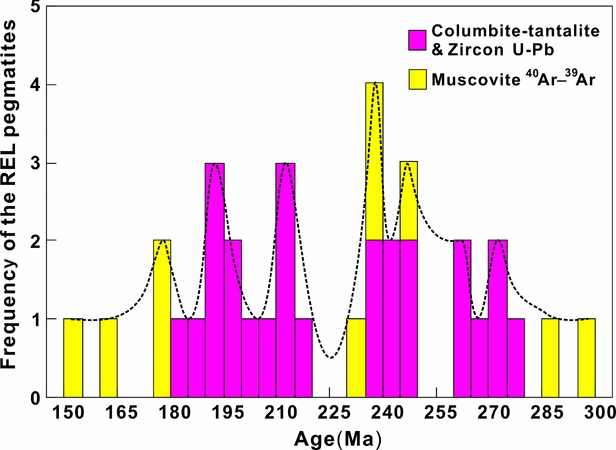
The previous geochronological studies and the ages in this research of the REL pegmatites (33 pegmatite dykes) in the Chinese Altai are summarized in Table 3. The formation of the REL pegmatites in the Chinese Altai generally continued over early Permian – Late Jurassic time, and is mainly concentrated in strata of early Permian, Middle Triassic and Early Jurassic age (Table 3; Fig. 10). Differently from the muscovite pegmatites which formed in an orogenic setting (e.g. Wang et al. Reference Wang, Zou, Xu, Yu and Fu2004), the REL pegmatites in the Chinese Altai mainly formed in a post-orogenic and anorogenic setting.
Geochronological results of the REL pegmatites in the Chinese Altai.

Note: I-1, zircon U–Pb weighted mean ages; I-2, zircon U–Pb concordia ages; II-1, columbite-tantalite weighted mean ages; II-2, columbite-tantalite concordia ages; III, uranmicrolite U–Pb weighted mean ages; IV, molybdenite Re-Os isochron ages; V, muscovite 40Ar–39Ar plateau ages.
Formation times of the REL pegmatites in the Chinese Altai, shown on the basis of both zircon and columbite-tantalite U–Pb and muscovite 40Ar/39Ar dating results. Only one U–Pb age or one U–Pb age accompanied with a muscovite 40Ar/39Ar age are chosen to represent the formation time for a single REL pegmatite dyke. Age data from Chen et al. (Reference Chen, Li, Wang, Cai and Chen2000), Wang et al. (Reference Wang, Chen and Xu2003, Reference Wang, Lu, Lo, Wu, He, Yang and Zhu2007), Ren et al. (Reference Ren, Zhang, Tang and Lv2011), Lv et al. (Reference Lv, Zhang, Tang and Guan2012), Wang et al. (Reference Wang, Qin, Tang, Zhou, Shen, Guo and Guo2015), Zhou et al. (Reference Zhou, Qin, Tang, Tian, Cao and Wang2015 a) and this study.
On the basis of dating for pegmatites mineralized by muscovite, muscovite-REL and REL in the Chinese Altai, it is believed that the more evolved the pegmatites are, the later they formed (Wang et al. Reference Wang, Zou, Xu, Yu and Fu2004). However, the pegmatites of various REL mineralization types (e.g. Be, Be-Nb-Ta, Li-Nb-Ta, Li-Be-Nb-Ta-Cs), accompanied with different degrees of fractionation, do not show a unified evolution trend from simple Be type to complex Li-Be-Nb-Ta-Cs type (highly fractionated and evolved) (Fig. 11). The simple Be pegmatites formed during Permian–Jurassic time with a wide age range, and the complex Li-Be-Nb-Ta-Cs pegmatites formed during both Permian and Jurassic time (Table 3; Fig. 11). Regarding the Chinese Altai, the relationship between REL types (evolution degree) and formation times complicates interpretation.
Geochronological data for the REL pegmatites v. REL mineralization types in the Chinese Altai. Data sources: Zou et al. (Reference Zou, Zhang, Jia, Wang, Cao and Wu1986), Chen et al. (Reference Chen, Li, Wang, Cai and Chen2000), Wang et al. (Reference Wang, Chen and Xu2003, Reference Wang, Lu, Lo, Wu, He, Yang and Zhu2007, Reference Wang, Qin, Tang, Zhou, Shen, Guo and Guo2015), Ren et al. (Reference Ren, Zhang, Tang and Lv2011), Lv et al. (Reference Lv, Zhang, Tang and Guan2012), Wang et al. (Reference Wang, Qin, Tang, Zhou, Shen, Guo and Guo2015), Zhou et al. (Reference Zhou, Qin, Tang, Tian, Cao and Wang2015 a) and this study.

Actually, the REL pegmatites in the same and adjacent pegmatite fields commonly have similar formation ages in the Chinese Altai (Table 3; Figs 1, 12) and the REL pegmatites are coeval to or formed a little later with granites nearby (Figs 1, 12). In the Central Altaishan terrane, the Koktokay No. 3 pegmatite (Li-Be-Nb-Ta-Rb-Cs-Hf) and the Asikaerte pegmatite (Be) are adjacent to and genetically related to the Aral granite (Zhu, Zeng & Gu, Reference Zhu, Zeng and Gu2006; Cao et al. Reference Cao, Zhou, Qin, Tang and Evans2013; Liu et al. Reference Liu, Zhang, Li, Zhang and Li2014) and the Asikaerte granite (Zou & Li, Reference Zou and Li2006; Wang et al. Reference Wang, Qin, Tang, Zhou, Shen, Guo and Guo2015), respectively, due to similar formation times, evolved compositions and a common source. In the Qiongkuer–Abagong terrane, the Shaerbulake granite (275±2 Ma; Sun et al. Reference Sun, Li, Yang, Li, Zhu and Yang2009a ) and the Dahalasu granite (248±4 Ma; Tong, Reference Tong2006) are near the Dakalasu pegmatites and coeval to the Be-Nb-Ta pegmatite (270–272 Ma; Ren et al. Reference Ren, Zhang, Tang and Lv2011) and Be pegmatite (239.6±3.8 Ma), respectively (Fig. 1). The Mayin'ebo granite (283±4 Ma; Zhou et al. Reference Zhou, Zhang, Luo, He, Wang, Yin, Zhao, Li and He2007) is spatially and temporally close to the Talate (Li-Be-Nb-Ta-Cs) and Baicheng (Nb-Ta) pegmatites (286–297 Ma) (Fig. 1). The formation of REL pegmatites is in correlation with the coeval and nearby granites. The REL pegmatites, which are considered as products of granitic magmatism (e.g. Romer & Lehmann, Reference Romer and Lehmann1995; Wang et al. Reference Wang, Zou, Xu, Yu and Fu2004; Hulsbosch et al. Reference Hulsbosch, Hertogen, Dewaele, André and Muchez2014), and their coeval and adjacent granites might be products of a common granitic magma activity.
Geochronological data for the REL pegmatites v. pegmatite fields in the Chinese Altai. Data sources: Zou et al. (Reference Zou, Zhang, Jia, Wang, Cao and Wu1986), Chen et al. (Reference Chen, Li, Wang, Cai and Chen2000), Wang et al. (Reference Wang, Chen, Zou, Xu, Li, Chen, Chen and Tian2000, Reference Wang, Chen and Xu2003, Reference Wang, Hond, Jahn, Tong, Wang, Han and Wang2006 b, 2007, Reference Wang, Qin, Tang, Zhou, Shen, Guo and Guo2015); Tong (Reference Tong2006), Tong et al. Reference Tong, Wang, Hong and Dai(2006a , b), Zhou et al. (Reference Zhou, Zhang, Luo, He, Wang, Yin, Zhao, Li and He2007, Reference Zhou, Qin, Tang, Tian, Cao and Wang2015 a), Sun et al. (Reference Sun, Li, Yang, Li, Zhu and Yang2009a ), Ren et al. (Reference Ren, Zhang, Tang and Lv2011), Lv et al. (Reference Lv, Zhang, Tang and Guan2012), Liu et al. (Reference Liu, Zhang, Li, Zhang and Li2014) and this study.

The formation of the REL pegmatites and these granites in the Chinese Altai are indicative of the frequent and strong magmatic activities in the post-orogenic and anorogenic setting. It has been determined that the REL pegmatites from Qiongkuer–Abagong terrane (of early Permian – Middle Triassic age) mostly formed earlier than those from Central Altaishan terrane (of Middle Triassic – Jurassic age), and the REL pegmatites in the SE part of Qiongkuer–Abagong terrane (of early–middle Permian age) have older formation ages than others in Qiongkuer–Abagong terrane (middle Permian – Middle Triassic) (Figs 1, 12). The granites that are almost temporally identical to the pegmatites also display a similar formation sequence spatially (Figs 1, 12). Consequently, coupled with the coeval granites, the REL-pegmatite-forming events reflect that the magma activity start from the SE (of early–middle Permian age), then to the NW (of middle Permian – Middle Triassic age), and finally to the central part (of Middle Triassic – Jurassic age) of the Chinese Altai in the post-orogenic and anorogenic setting (Fig. 13).
Tectonic implications of geochronological work for the pegmatites in the Chinese Altai. The spatial and temporal distribution of pegmatites and granites reveals the magmatism path of the Chinese Altai during synorogenic and post-orogenic setting. AT – Altaishan terrane; NW AT – NW Altaishan terrane; CAT – Central Altaishan terrane; QAT – Qiongkuer–Abagong terrane; ET – Erqis terrane; PET – Perkin–Ertai terrane.

8. Conclusions
We analysed nine REL pegmatite dykes in the Chinese Altai using LA-ICP-MS columbite-tantalite and zircon U–Pb dating and muscovite 40Ar–39Ar dating methods. (1) The Talate (Li-Be-Nb-Ta), Baicheng (Nb-Ta) and Kangmunagong (barren) pegmatites formed during early–middle Permian time, with muscovite 40Ar–39Ar plateau ages of 286.4±1.6 Ma, 297.0±2.6 Ma and 265.2±1.5 Ma. (2) The Xiaokalasu (Li-Nb-Ta) pegmatite was mineralized by Nb-Ta during late Permian time on the basis of columbite U–Pb concordia ages of 258.1±3.1 Ma and 262.3±2.5 Ma. The Taerlang (barren) pegmatite emplaced during Early Triassic time with a zircon U–Pb concordia age of 248.2±2.2 Ma. The formation of these two pegmatite dykes and the Weizigou (Be) pegmatite ended no later than Middle Triassic time, as shown by muscovite 40Ar–39Ar plateau ages of 237.7±1.3 Ma, 231.9±1.2 Ma and 237.4±1.2 Ma. (3) The Dakalasu (Be-Nb-Ta) pegmatite formed during Middle Triassic time with a zircon weighted mean 206Pb/238U age of 239.6±3.8 Ma, indicating that there are at least two pegmatite-forming events of early Permian and Middle Triassic age. (4) The Husite (Be) and Qunkuer (Be) pegmatites emplaced during Early Jurassic time with a zircon weighted mean 206Pb/238U age of 198.5±2.5 Ma and a concordia age of 194.3±1.6 Ma. The formation ended no later than the Middle Jurassic Period based on muscovite 40Ar–39Ar plateau ages of 178.8±1.0 Ma and 162.2±0.9 Ma.
These new dating results, combined with previously published data, indicate that the formation times of the REL pegmatite in the Chinese Altai span the early Permain – Late Jurassic periods. The REL pegmatites correlated with the coeval and adjacent granites. The REL pegmatites and these granites reflect that magmatic activity continue in the post-orogenic and anorogenic setting, and start from the SE (early–middle Permian), then to the NW (middle Permian – Middle Triassic), and finally to the central part (Middle Triassic – Jurassic) of the Chinese Altai.
Acknowledgements
The work was financially supported by key projects in the National Science and Technology Pillar Program (grant number 2011BAB06B03) and Geology Survey second-level program of China Geological Survey (grant number 121201011000150003). The authors are grateful to Professors Yueheng Yang and Fei Wang for their help with the LA-ICP-MS zircon U–Pb dating and muscovite Ar–Ar dating, respectively. We thank Dr Xudong Che for providing a columbite-tantalite standard (Coltan 139) and valuable suggestions that improved the quality of this manuscript. We also thank Zhenglin Guo, Maode Shen and Xuji Guo for their help with fieldwork.
Supplementary material
To view supplementary material for this article, please visit https://doi.org/10.1017/S0016756816001096.



