Introduction
The network of protected areas, Natura 2000, represents the main European tool for the conservation of rare and threatened species and of rare natural habitat types listed under both the Birds Directive (Directive 2009/147/EC) and the Habitats Directive (Council Directive 92/43/EEC). This system consists of Special Areas of Conservation (SACs) designed according to the presence of habitats and animal and plant species reported in Annex I and II, respectively, while fungi (including lichenized fungi) are not yet considered among the target species. Lichens are listed only in Annex V, in which the collection of species and their exploitation may be subject to management measures. However, only terricolous lichens belonging to the genera Cladonia L. subgenus Cladina (Nyl.) Vain are included in this list. Therefore, there is no SAC currently designed to directly protect lichens. This contrasts with recent literature showing that, in Europe, it is mainly epiphytic lichens that are severely threatened by air pollution, forest management and climate change (Ellis et al. Reference Ellis, Coppins, Dawson and Seaward2007; Nascimbene et al. Reference Nascimbene, Marini and Nimis2007; Aragón et al. Reference Aragón, Martínez, Izquierdo, Belinchón and Escudero2010; Ellis & Coppins Reference Ellis and Coppins2010; Allen & Lendemer Reference Allen and Lendemer2016).
We can explain this situation by the fact that, when the Natura 2000 European legislation was adopted, lichens were still under-represented in the Red Lists, and such lists are an important tool for planning nature conservation actions, from global to local scales (Sérusiaux Reference Sérusiaux1989; Gärdenfors et al. Reference Gärdenfors, Hilton-Taylor, Mace and Rodriguez2001; Rodrigues et al. Reference Rodrigues, Pilgrim, Lamoreux, Hoffmann and Brooks2006; Mace et al. Reference Mace, Collar, Gaston, Hilton-Taylor, Akcakaya, Leader-Williams, Milner-Gulland and Stuart2008; Nascimbene et al. Reference Nascimbene, Nimis and Ravera2013). One of the main reasons for this was the difficulty in applying IUCN criteria to lichenized fungi, particularly for the concepts of mature individual, generation length, location, fragmented distribution, and how uncertainty and absence of data should be handled (Scheidegger & Goward Reference Scheidegger, Goward, Nimis, Scheidegger and Wolseley2002; Dahlberg & Mueller Reference Dahlberg and Mueller2011). However, in the last two decades, there has been a positive change and adaptations of IUCN criteria to overlooked organisms, such as lichens, are rapidly increasing. Today, at the global level, 93 lichen species are included in the IUCN Red List, providing new perspectives on their management and conservation. In Italy, the Red List of Italian Flora (Rossi et al. Reference Rossi, Montagnani, Gargano, Peruzzi, Abeli, Ravera, Cogoni, Fenu, Magrini and Gennai2013) includes a further 17 lichen species, mainly epiphytic, in addition to the 12 species already present in the Habitats Directive that are among the most threatened species in the peninsula. Meanwhile, other national lichen red lists have been published in Italy and Europe (see e.g. Atienza & Segarra-Moragues Reference Atienza and Segarra-Moragues2000; Pišút et al. Reference Pišút, Guttová, Lackovièová, Lisická, Baláž, Marhold and Urban2001; Cieśliński et al. Reference Cieśliński, Czyżewska, Fabiszewski, Mirek, Zarzycki, Wojewoda and Szeląg2006; Gnüchtel Reference Gnüchtel2009; Nascimbene et al. Reference Nascimbene, Nimis and Ravera2013; Lõhmus et al. Reference Lõhmus, Marmor, Jüriado, Suija, Oja, Degtjarenko and Randlane2019; Gheza et al. Reference Gheza, Di Nuzzo, Nimis, Benesperi, Giordani, Vallese and Nascimbene2021).
Despite this, the Natura 2000 network has not yet implemented these updates and direct conservation measures for epiphytic lichens, such as sustainable forest management taking into account the conservation of their microhabitat, are still lacking. Therefore, the conservation of these organisms within this network currently depends on protected areas designed for other target species, while the protective role these areas offer lichens has been tested by very few studies and with different results. According to Martínez et al. (Reference Martínez, Carreño, Escudero and Rubio2006), the Spanish Natura 2000 network, mainly based on vascular plants, can protect key habitats for 11 threatened cyanolichens. By contrast, Rubio-Salcedo et al. (Reference Rubio-Salcedo, Martínez, Carreño and Escudero2013) showed that the same network cannot ensure the protection of 18 Mediterranean lichens, including terricolous, saxicolous and epiphytic species. Both works were carried out by relating maps of the potential distribution of lichens to the distribution of the protected areas.
Our work fits into this research line by focusing on what happens at the local level, selecting a case study with half of the territory included in protected areas. To date, despite the existence of a national red list and the protection of species based on regional legislation (Alonzi et al. Reference Alonzi, Ercole and Piccini2006), lichens are not considered as target species for land management. Our starting hypothesis is that the Natura 2000 protected areas network in the study area, designed for other target species, is not effective in promoting the conservation of epiphytic lichen species. We aim to quantify the level of protection with respect to the occurrence (species richness) of all epiphytic lichens and of the nationally rare species.
The following features make our study area, located in southern Tuscany (Central Italy), particularly suitable to test our hypothesis: 1) there is wide environmental variability, with an altitudinal range from the hilly to the submontane belt; 2) it is mainly covered by forest areas (oak and sweet chestnut woods); 3) there is a generally low level of human impact (towns with < 5000 inhabitants); 4) half of the territory is located in protected areas, offering an opportunity to evaluate their impact on lichen diversity.
Materials and Methods
Study area
The study area extends into the Monte Amiata geothermal field (Tuscany, Central Italy; Fig. 1). It covers 289 km2, including several municipalities in the provinces of Siena and Grosseto. The survey was carried out in the hilly and submontane belt, dominated by oak woods (downy oak, Quercus pubescens Willd. and Turkey oak, Quercus cerris L.) and sweet chestnut (Castanea sativa Mill.) traditional orchards for fruit production. Elevation ranges from 350 to 1100 m above sea level (a.s.l.). The climate is humid sub-Mediterranean, with a mean annual rainfall between 1000–1555 mm and mean annual temperatures of 9.7–11.3 °C. The study area includes five protected areas, covering 47% of the territory: SAC Cono vulcanico del Monte Amiata (IT51A0017), SAC Monte Labbro e alta valle dell'Albegna (IT51A0018), SAC Alto corso del Fiume Fiora (IT51A0019), SAC Foreste del Siele e Pigelleto di Piancastagnaio (IT5190013), and Riserva Regionale Poggio all'Olmo.
Study area of Monte Amiata (Tuscany, Central Italy), with the distribution of the 27 sampling sites in relation to the Protected Areas (PA). NPA = Non-Protected Areas. In colour online.

Sampling sites
Twenty-seven sampling sites (Supplementary Material Table S1, available online) were selected following the field manual described in ANPA (2001), based on the systematic distribution of sampling sites. Of these sites, 16 fell within the network of protected areas (Fig. 1).
Lichen sampling
The field survey was carried out in autumn/winter 2021. For each of the 27 investigated sites, the diversity of epiphytic lichens was assessed on 3–4 standard trees (DBH ≥ 16 cm, bole inclination < 30°) belonging to the main tree species (Castanea sativa, Quercus cerris and Q. pubescens), for a total of 80 trees. The occurrence of each lichen species was sampled within a 10 × 50 cm observation grid, placed at each of the four cardinal points of the trunk (N, S, E, W) at a height of 100 cm above the ground (ANPA 2001; Asta et al. Reference Asta, Erhardt, Ferretti, Fornasier, Kirschbaum, Nimis, Purvis, Pirintsos, Scheidegger, Van Haluwyn, Nimis, Scheidegger and Wolseley2002; Comité Européen de Normalization 2014). Nomenclature, functional traits and commonness-rarity (in the humid sub-Mediterranean belt) follow Nimis (Reference Nimis2022).
Data analysis
We studied lichen species diversity and composition in relation to the level of protection of the sampled sites. Two groups of sites were distinguished: Protected Areas (PA, 16 sites, 48 sampled trees) and Non-Protected Areas (NPA, 11 sites, 32 trees).
The statistical differences in species richness (gamma diversity) between PA and NPA were tested using the non-parametric Mann-Whitney test.
Compositional differences in lichen communities between the two groups (PA vs NPA) were tested by multi-response permutation procedures (MRPP) using the Euclidean distance measure and rank transformation of the distance matrices. The separation between groups was calculated as the chance-corrected within-group agreement (A) and the P-value was used to evaluate how likely an observed difference was due to chance (A = 1 indicates perfectly homogenous groups, while A = 0 indicates within-group heterogeneity equal to that expected by chance). In community ecology, values for A statistics are commonly below 0.1, even when the observed data differ significantly from the expected (McCune & Grace Reference McCune and Grace2002).
The pattern of species composition was visually evaluated by non-metric multidimensional scaling (NMDS; McCune & Grace Reference McCune and Grace2002) using the Bray-Curtis distance measure. This iterative ordination method is based on ranked distances between sample units in the data matrix. It does not assume normally distributed data and is therefore suited for most ecological data. A final 3-dimensional solution was selected (final stress: 0.147). The two most explanatory axes were used for representing the spatial ordination of the data. A PERMANOVA (999 permutations) was carried out to test the significant differences between the two groups of sites (PA and NPA). To reduce noise from poorly represented species, those occurring on < 10% of the trees were excluded (59 species).
Indicator Species Analysis (ISA; Dufrêne & Legendre Reference Dufrene and Legendre1997) was used to determine how strongly each species was associated with each group (PA vs NPA). The Indicator Value (INDVAL) ranges from 0 (no indication) to 1 (maximum indication). The statistical significance of INDVAL was evaluated using a Monte Carlo test, based on 999 permutations. The software R was used for all statistical analyses (RStudio Team 2020).
Results
Lichen species list
The list includes 102 lichen taxa (Supplementary Material Table S2, available online), with 58 (57%) easily recognizable macrolichens (i.e. 27 broad-lobed and 22 narrow-lobed foliose lichens, and 9 fruticose species) and 44 crustose species (also including two leprose lichens and one squamulose). Sexually reproducing lichens represented half of the species pool (49%; 50 species), while 52 (51%) were vegetatively-reproducing species (38 sorediate and 14 isidiate species). Lichens with green algae were the most common (91%), but seven cyanolichens were also found (Collema furfuraceum (Arnold) Du Rietz, C. subnigrescens Degel., Lobarina scrobiculata (Scop.) Cromb., Parmeliella triptophylla (Ach.) Müll. Arg., Pectenia plumbea (Lightf.) P. M. Jørg. et al., Peltigera collina (Ach.) Schrad. and Ricasolia amplissima (Scop.) De Not.: cyanomorph). Only one species with Trentepohlia was present (Bactrospora dryina (Ach.) A. Massal.). The last two functional groups include rare to extremely rare species in the humid sub-Mediterranean bioclimatic belt. Nationally common species represented almost half of the list (52%; 53 species), while the remaining 48% (49) were rare species (including 22 very rare to extremely rare species). The list includes 10 species in the Italian Red List (Nascimbene et al. Reference Nascimbene, Nimis and Ravera2013): Bacidia rosella (Pers.) De Not., Bactrospora dryina, Blastenia herbidella (Hue) Servít, Lepra slesvicensis (Erichsen) Hafellner, Lobaria pulmonaria (L.) Hoffm., Lobarina scrobiculata, Parmeliella triptophylla, Pectenia plumbea, Ricasolia amplissima: chloromorph and R. amplissima: cyanomorph). Four of these are also European red-listed lichens (Sérusiaux Reference Sérusiaux1989).
Lichen diversity and protected areas
Considering the level of protection of the sampling sites, PA showed a richer floristic list than NPA (96 vs 70 lichen taxa), with a higher proportion of rare (46 vs 25) and exclusive (18 vs 14) species.
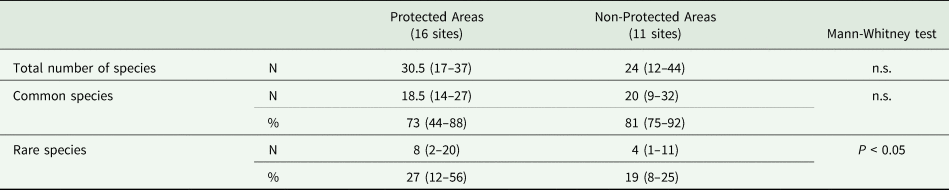
No significant differences in the median number of species were evident between PA and NPA (30.5 vs 24, P > 0.05; Table 1). The same result was obtained for nationally common species (18.5 vs 20 species, P > 0.05). Although common lichens were predominant in both PA and NPA, PA showed a lower proportion of these species (73%; range 44–88%) than NPA (81%; range 75–92%).
Descriptive statistics (median, range min–max) of lichen diversity in terms of number of species and proportion of common and rare species in the two groups of sites (Protected Areas: 16 sites, Non-Protected Areas: 11 sites) in the study area of Monte Amiata (Tuscany, Central Italy). Commonness-rarity of the lichen taxa in the humid sub-Mediterranean belt of Italy follows Nimis (Reference Nimis2022). Results of a Mann-Whitney test are also reported (n = 27; 1 df). n.s.= not significant (P > 0.05).

Despite being poorly represented, the number of nationally rare species was significantly higher in PA than in NPA (8 vs 4, P < 0.05), representing 27% and 19% of the lichen diversity of the two groups of sites, respectively. Moreover, most of the nationally rare species (16 out of the 22 very and extremely rare species) were exclusive to PA (see Supplementary Material Tables S1 & S2, available online).
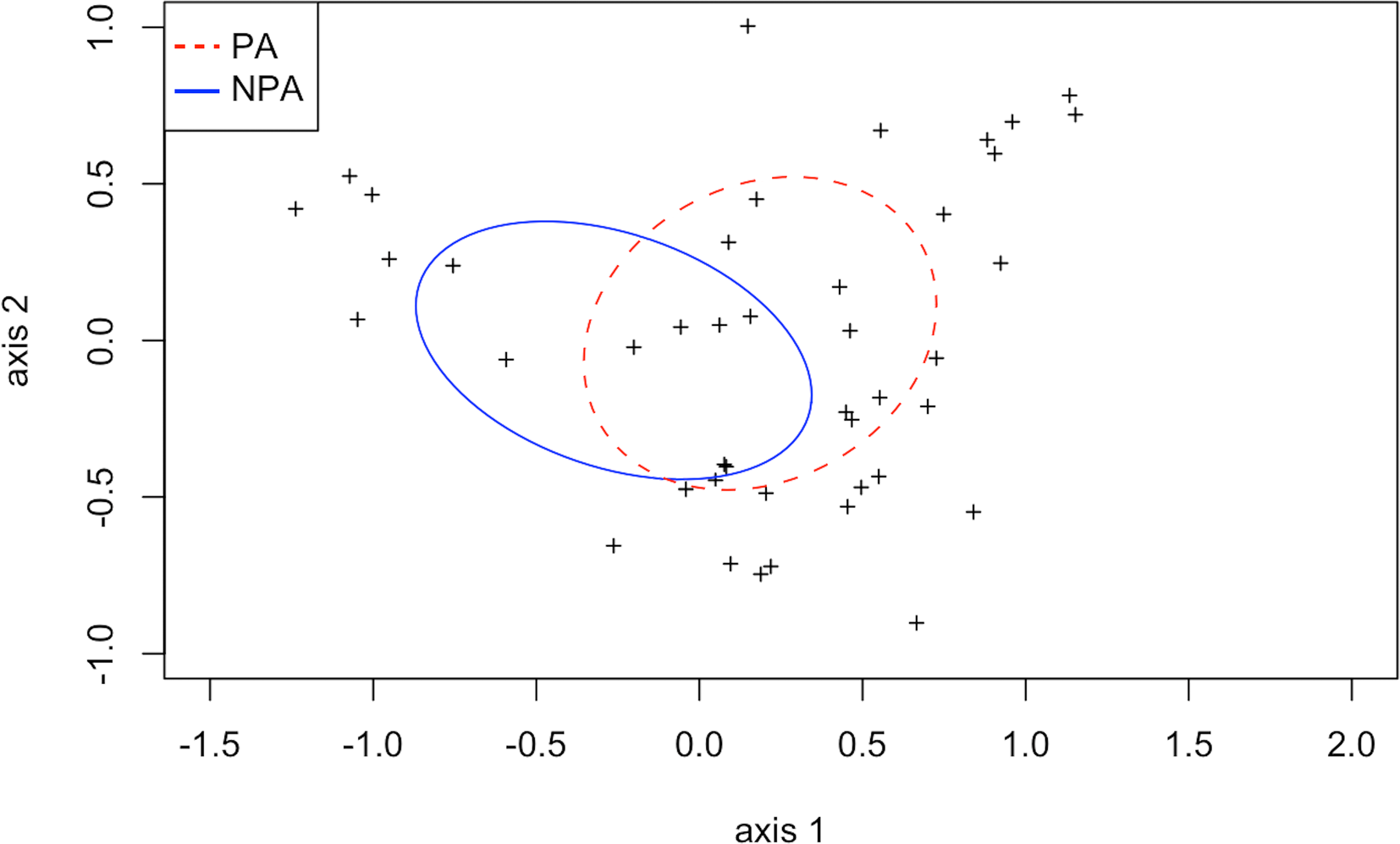
MRPP revealed significant differences between PA and NPA (P < 0.01; 999 permutations), even if the small A statistic (A = 0.013) indicated that there was a broad overlap between lichen communities growing on trees sampled in the two groups of sites (Berryman & McCune Reference Berryman and McCune2006). A significant difference in species composition between the two groups and their overlap was also confirmed by the NMDS ordination (PERMANOVA R 2 = 0.138, P < 0.01; Fig. 2).
Non-metric multidimensional scaling (NMDS) ordination of the pattern of lichen species composition (43 species × 80 trees) in Protected Areas (PA) and Non-Protected Areas (NPA) in Monte Amiata (Tuscany, Central Italy). Analysis showed a significant difference in species composition between the two groups and their overlap (PERMANOVA R 2 = 0.138, P < 0.01). The species are represented by ‘+’ symbols. In colour online.

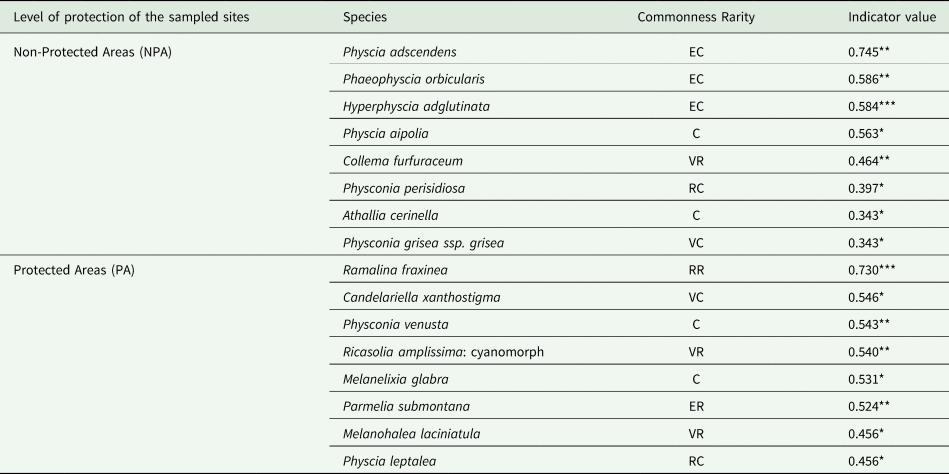
Indicator analysis identified a small number of indicator species (P < 0.05), eight for NPA and eight for PA (Table 2). With the exception of C. furfuraceum, which is very rare in the humid sub-Mediterranean belt, the species significantly associated with NPA were mostly (87.5%) categorized as common to extremely common. In contrast, half of the PA indicator species were nationally rare, showing a less defined commonness-rarity pattern in these sampled trees. However, it should be noted that most of them were very to extremely rare species (R. amplissima: cyanomorph, Melanohalea laciniatula (H. Olivier) O. Blanco et al., Parmelia submontana Hale), with one red-listed cyanolichen (R. amplissima: cyanomorph).
Indicator species in relation to the level of protection of the sampled sites (Protected Areas and Non-Protected Areas) in the study area of Monte Amiata (Tuscany, Central Italy). Indicator values, derived from Indicator Species Analysis (Dufrêne & Legendre Reference Dufrene and Legendre1997), range from 0 (no indication) to 1 (maximum indication). EC= extremely common, VC= very common, RC= rather common, C= common, R= rare, RR= rather rare, VR= very rare, ER= extremely rare.

* P < 0.05; ** P < 0.01; *** P < 0.001
Discussion
The high number of fruticose and broad-lobed foliose lichens (35%) and rare species (48%) found in this study denotes a floristic list typical of well-developed and mature communities, independent of the level of protection of the sampling sites. This result confirms the low human impact of the area, mainly characterized by forest stands. Indeed, forest ecosystems represent particularly favourable environments for lichen diversity, particularly if they are well-preserved forests and managed according to Sustainable Forest Management (SFM) criteria (Nascimbene et al. Reference Nascimbene, Marini and Nimis2007; Aragón et al. Reference Aragón, Martínez, Izquierdo, Belinchón and Escudero2010; Ardelean et al. Reference Ardelean, Keller and Scheidegger2015; Kubiak & Osyczka Reference Kubiak and Osyczka2020).
Although the network of PAs in the study area was designed for other target species, our findings show that it also has a positive effect on the conservation of epiphytic lichen diversity. In fact, despite the broad overlap between epiphytic lichen communities of NPAs and PAs and a similar number of total and common species, PAs contain a significantly higher number of nationally rare and extremely rare species, including cyanolichens. In addition, the results of the indicator analysis confirm that rare species are preferentially associated with the PA network. Cyanolichens are a functional group of species especially sensitive to habitat quality, occurring in sites with high humidity (Lange et al. Reference Lange, Green and Ziegler1988) and low levels of nitrogen (Palmqvist Reference Palmqvist2000) and management intensity (Nascimbene et al. Reference Nascimbene, Marini and Nimis2007; Aragón et al. Reference Aragón, Martínez, Izquierdo, Belinchón and Escudero2010; Brunialti et al. Reference Brunialti, Frati and Ravera2015). Most of the other rare species in the study area prefer isolated trees in open situations or humid open forests, and usually avoid disturbed habitats and air pollution (Nimis Reference Nimis2022). Usually, these environmental conditions are more easily guaranteed in protected than in non-protected areas because of the sustainably managed land, both in ecological and economic terms (Wiersma et al. Reference Wiersma, Duinker, Haider, Hvenegaard and Schmiegelow2015). In this regard, the recent European Commission LIFE Programme funded project ‘FutureForCoppiceS’ included lichen diversity among the SFM indicators in the context of Mediterranean coppice forests (Cutini et al. Reference Cutini, Ferretti, Bertini, Brunialti, Bagella, Chianucci, Fabbio, Fratini, Riccioli and Caddeo2021). By adopting a modelling approach, the authors suggested that lichen species could represent suitable indicators in long-term studies concerning complex and interconnected aspects of SFM (Brunialti et al. Reference Brunialti, Frati, Calderisi, Giorgolo, Bagella, Bertini, Chianucci, Fratini, Gottardini and Cutini2020; Frati et al. Reference Frati, Brunialti, Landi, Filigheddu and Bagella2022).
Contrary to our findings, Vicol & Mihăilescu (Reference Vicol and Mihăilescu2022) observed no significant differences in the red-listed lichen species number between NPAs and PAs in Romania. This result was attributed to the lack of anthropogenic impact: in Romania, many NPAs are situated in remote areas where the main land-use management is based on traditional practices that do not have a major negative impact on the environment.
Similar results to those in our study were obtained by Martínez et al. (Reference Martínez, Carreño, Escudero and Rubio2006), who showed the ability of the Natura 2000 network to protect key habitats for 11 cyanolichens in Spain. The authors suggested that the effectiveness of the European network is probably related to the scarcity of well-preserved forests in the Mediterranean area, the majority of which are included in the network. In a similar study, Rubio-Salcedo et al. (Reference Rubio-Salcedo, Martínez, Carreño and Escudero2013) tested the protective role of the Natura 2000 network for 18 terricolous, saxicolous and epiphytic lichens in Spain. They found that Mediterranean lichen species growing in forests are better protected than species occurring in coastal, drier and warmer areas, concluding that the Natura 2000 network is not entirely effective for Mediterranean lichens. Both works were carried out by relating maps of the potential distribution of lichens to the distribution of the network of protected areas. They suggested that the effectiveness of the Natura 2000 network for lichen conservation depends mainly on land use. In our study, the same issue was explored at the local scale, by collecting data on species richness within systematically distributed sites. Indeed, the land use of PAs and NPAs in our study area is the same, suggesting that PA management policy is probably the main reason for the observed differences in rare species distribution. Compared to the former studies, which are more informative at a wide scale, our approach is more effective in setting conservation measures at a local to regional scale. The spatial information based on detailed field data can better identify the groups of target species to consider for possible conservation monitoring and management. Moreover, our approach avoids the bias of results induced by the effect of false zeros, which may influence the results of models developed from records collected in national databases (Blasco-Moreno et al. Reference Blasco-Moreno, Pérez-Casany, Puig, Morante and Castells2019).
Some additional considerations on the approach used in this study can be made. Our method is based on the systematic survey of a portion of the trunk (100–150 cm above the ground), using a sampling grid placed at each of the four cardinal points. This reduces subjectivity and therefore the influence of expert assessment, making the results more reliable from a statistical point of view (Ferretti Reference Ferretti2009; Brownstein et al. Reference Brownsteina, Louis, O'Hagan and Pendergast2019). On the other hand, this approach does not enable a more detailed floristic analysis to be performed, for example, through the exploration of other ecological microniches of the trunk. Indeed, evidence shows that the distribution of epiphytic lichens varies based on vertical gradients in relation to different microhabitats (Ellis Reference Ellis2012). Usually, temperature, light availability and wind speed increase from the tree base to the tip, while moisture and nutrients decrease (Barkman Reference Barkman1958; Meinzer & Goldstein Reference Meinzer, Goldstein, Mulkey, Chazdon and Smith1996). Lichen functional groups have a strong preference for specific vertical zones, for example, cyanolichens for the basal and more humid part of the trunks (Ellis & Coppins Reference Ellis and Coppins2006; Li et al. Reference Li, Liu, Li, Song, Shi and Lu2015). For all these reasons, a more marked difference between the two groups of sites (PA and NPA) might also be possible, with a further increase in reports of rare forest-dwelling species in the protected sites.
Conclusions
Although the Natura 2000 network does not explicitly address the conservation of lichens, our findings show that the protected areas in our study can play a role in protecting the diversity of epiphytic lichens, especially for nationally rare and endangered species. Nevertheless, the future inclusion of red-listed epiphytic lichens among the target species of Annex II of the Habitats Directive would be welcome, as already suggested by Slovakia two decades ago (Lisická et al. Reference Lisická, Lackovicová, Lisický and Guttová2000). This would allow land managers to establish SACs specifically designed to protect this group of lichens and consequently to obtain European funding (e.g. through the LIFE Programme) to better promote their conservation.
Acknowledgements
We are grateful to the anonymous reviewer and the Associate Editor Lucia Muggia for their useful suggestions. This work was partially funded by the LIFE Programme of the European Commission under Grant Agreement LIFE20 GIE/IT/000091 - LIFE MODERn (NEC) (new MOnitoring system to Detect the Effects of Reduced pollutants emissions resulting from NEC Directive adoption).
Author Contributions
Conceptualization, data collection, lichen identifications, data analyses, writing, review and editing: L. Frati and G. Brunialti. Both authors have read and agreed to the published version of the manuscript.
Author ORCIDs
Luisa Frati, 0000-0001-8684-9280; Giorgio Brunialti, 0000-0003-3080-1725.
Competing Interests
The authors declare none.
Supplementary Material
The Supplementary Material for this article can be found at https://doi.org/10.1017/S0024282923000282.