Antimicrobial resistance among bacterial pathogens is a growing public health threat. 1 Combating antimicrobial resistance is a national priority, 2 and treatment strategies for bacterial infections that prevent or limit the development of antimicrobial resistance are urgently needed. Urinary tract infections (UTIs) are among the most common bacterial infections treated in the ambulatory care setting, resulting in approximately 8 million antibiotic prescriptions each year in the United States.Reference Shapiro, Hicks, Pavia and Hersh 3 Treatment of UTIs is increasingly difficult due to the emergence of antibiotic-resistant gram-negative bacteria.Reference Gupta, Hooton and Naber 4 Fluoroquinolone (FQ) resistance among uropathogens such as Escherichia coli is particularly problematic.Reference Lautenbach, Strom and Nachamkin 5 , Reference Johnson, Sabel and Burman 6
Although FQs are effective treatment options for UTIs, their use has been associated with the emergence of antimicrobial resistance among both gram-negative and gram-positive pathogens,Reference Johnson, Sabel and Burman 6 – Reference Lautenbach, Larosa, Kasbekar, Peng, Maniglia and Fishman 10 the development of Clostridium difficile infection,Reference Stevens, Dumyati, Fine, Fisher and van Wijngaarden 11 – Reference Zilberberg, Reske, Olsen, Yan and Dubberke 13 and potentially serious side effects. 14 Because of this potential for so-called “collateral damage,” the 2010 update to the Infectious Diseases Society of America (IDSA) guideline for acute uncomplicated cystitis recommends first-line treatment with alternative agents such as nitrofurantoin (NFT), fosfomycin, or trimethoprim-sulfamethoxazole.Reference Gupta, Hooton and Naber 4
At Denver Health, an urban, integrated public healthcare system, resistance to trimethoprim-sulfamethoxazole among urinary E. coli isolates reached 24% in 1999.Reference Burman, Breese and Murray 15 In response, an institutional guideline for the treatment of outpatients with acute uncomplicated cystitis was developed recommending FQs as first-line therapy. This change resulted in a marked increase in outpatient FQ use, which was associated with a rapid increase in FQ resistance among urinary E. coli isolates from 1% in 1999 to 9.4% in 2005.Reference Johnson, Sabel and Burman 6 The guideline was therefore revised in 2007 to direct providers to use NFT for acute uncomplicated cystitis and to reserve FQs for complicated UTIs. This treatment strategy, which mirrors the current IDSA guideline recommendations, has been in place at Denver Health since 2007, offering a unique opportunity to evaluate its long-term impact on antimicrobial resistance. The objectives of this study were to evaluate changes in FQ and NFT use following the change in recommended first-line therapy and to assess the effects on antimicrobial resistance among outpatient E. coli isolates.
METHODS
Study Design, Setting, and Population
We conducted a retrospective, preintervention–postintervention study. Denver Health is an urban, integrated, safety-net healthcare system with a 477-bed hospital, an emergency department and urgent care center, 8 community health clinics, and 15 school-based clinics.Reference Gabow, Eisert and Wright 16 The study population included adults who visited the emergency department, urgent care center, or an outpatient clinic for acute cystitis during 2 periods: January 2003–June 2007 when FQs were the recommended first-line agents for acute uncomplicated cystitis (preintervention period) and July 2007–December 2012 when NFT was the recommended first-line agent (postintervention period). This study was approved by the Colorado Multiple Institutional Review Board.
Outcome Measures
The primary outcomes of interest were the changes in FQ and NFT use for acute cystitis and the changes in FQ- and NFT-resistant E. coli between the 2 periods. Secondary outcomes included the change in total outpatient FQ use, the appropriateness of FQ prescriptions, and the occurrence of UTI-related clinical events in the 28 days following the index visit.
Data Collection
Cases were included for analysis when a visit with a primary or secondary International Classification of Diseases, 9th Revision (ICD-9) diagnosis of acute cystitis (595.00, 599.00) was associated with an antibiotic prescription dispensed in the Denver Health system within 3 days of that visit. Pregnant women, prisoners, and patients <19 or >89 years of age were excluded. Cases in which the antibiotic prescription was filled >3 days after the index visit or where incomplete documentation prevented identification of the prescribed antibiotic were also excluded.
Antibiotics prescribed for acute cystitis were aggregated quarterly and expressed as the proportion of total antibiotic prescriptions for acute cystitis over time. To evaluate changes in FQ use for all possible indications that could have potentially impacted antimicrobial resistance, total quarterly FQ prescriptions were aggregated and expressed as prescriptions per 1,000 outpatient visits.
To assess the appropriateness of FQ use during the period when NFT was the recommended first-line agent, we manually reviewed the medical records of 100 randomly selected patients prescribed an FQ during this period. Use of an FQ was deemed appropriate in the following scenarios: documentation of an allergy, intolerance, or contraindication to NFT, history of infection with an organism resistant to ≥2 antibiotic classes (ie, a multidrug-resistant organism), treatment of cases meeting criteria for complicated UTI as recommended in the institutional guideline (Supplemental Figure), or documentation of a coinfection in which NFT monotherapy would be considered inappropriate (eg, pneumonia). Nitrofurantoin was considered contraindicated when the estimated creatinine clearance was <60 mL/min or when the most recent serum creatinine was >1.4 mg/dL. Early and late return visits were defined as hospitalizations or emergency department, urgent care center, or outpatient clinic visits associated with a diagnosis of UTI, pyelonephritis, or renal abscess within 1–7 days and 8–28 days after the index visit, respectively.
To evaluate the association between changes in antibiotic use and antimicrobial resistance, all outpatient E. coli isolates in the Denver Health system during the study period were identified electronically from the microbiology laboratory database. Data were expressed as the proportion of E. coli isolates resistant to an FQ or NFT over time, by quarter.
Statistical Analyses
Interrupted time-series analysis was used to assess changes in FQ and NFT use for acute cystitis, total outpatient FQ use, and FQ and NFT resistance among outpatient E. coli isolates over time. For each outcome, we constructed an autoregressive integrated moving average model to evaluate the following: (1) the trend during the preintervention period; (2) the immediate effect of the intervention; (3) the trend during the postintervention period; and (4) the change in slope between the pre- and postintervention periods. The maximum likelihood estimate method was used to construct each model. Correlation was assessed using the Durbin-Watson statistic. If the Durbin-Watson statistic was significant (P<.05) for either positive or negative autocorrelation, a lag was inserted into the model (starting with n=1 lag) until the statistic became nonsignificant (P>.05). As secondary analyses, we compared the aggregate use of individual antibiotics and the frequency of early and late return visits between the preintervention and postintervention periods using the χ2 test for proportions. All analyses were performed using SAS version 9.3 software (SAS Institute, Cary, NC).
RESULTS
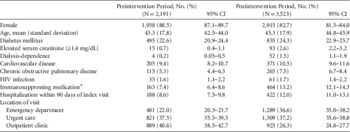
We identified 45,099 visits involving a primary or secondary ICD-9 diagnosis of acute cystitis during the 10-year study period. Of these, 5,714 were associated with an antibiotic prescription filled at a Denver Health pharmacy and were included for analysis. Demographic and clinical characteristics of patients in the preintervention and postintervention periods were similar (Table 1). Patients were predominantly female. Diabetes mellitus was the most prevalent comorbid condition, present in nearly 1 in 4 patients. Compared with the preintervention period, visits to the emergency department were more common during the postintervention period, while visits to outpatient clinics were less common (Table 1).
Demographic and Clinical Characteristics of the Study Population

NOTE. CI, confidence interval; HIV, human immunodeficiency virus.
a Includes corticosteroids, antineoplastic agents, monoclonal antibodies, immunomodulators, and anti-rejection immunosuppressants.
Antimicrobial Use
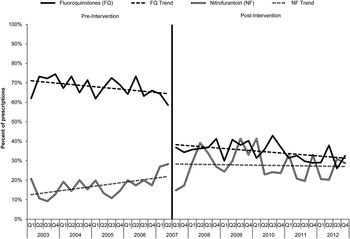
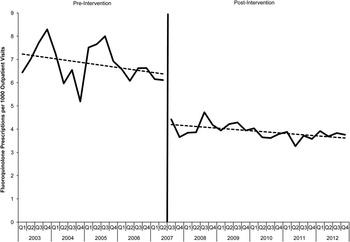
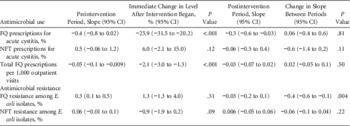
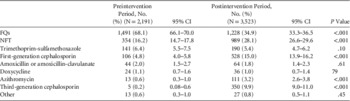
After the change in institutional guidance recommending NFT over FQs for acute uncomplicated cystitis, an immediate 25.9% (95% CI, 20.2–31.5%) decrease in FQ use (P<.001) and a 6.0% (95% CI, −2.1% to 15.0%) increase in NFT use (P=.12) was observed (Figure 1, Table 2). There were no subsequent significant trends in use during the postintervention period. Collectively, FQs accounted for 68.1% (95% CI, 66.1%–70.0%) of total prescriptions for acute cystitis during the preintervention period compared with 34.9% (95% CI, 33.3%–36.5%) during the postintervention period (P<.001) (Table 3). Nitrofurantoin accounted for 16.2% (95% CI, 14.7–17.8%) of total prescriptions for acute cystitis during the preintervention period and 28.1% (95% CI, 26.6–29.6%) during the postintervention period (P<.001). Notably, use of first- and third-generation cephalosporins also increased significantly during the postintervention period (Table 3). In a pattern similar to FQ use for acute cystitis, total outpatient FQ use for any indication significantly decreased immediately following the change in institutional guidance (P<.001) without a subsequent significant trend in use (Figure 2, Table 2).
Fluoroquinolone and nitrofurantoin prescriptions for acute cystitis over time. Data are expressed as the proportion of all antibiotic prescriptions for acute cystitis per quarter.

Overall fluoroquinolone use in the Denver Health system over time. Data are expressed as the total number of fluoroquinolone prescriptions (for any indication) per 1,000 outpatient visits.

Fluoroquinolone (FQ) and Nitrofurantoin (NFT) Use and Resistance Among Outpatient E. coli Isolates by Time-Series Analysis

NOTE. CI, confidence interval.
Aggregate Antibiotic Prescriptions for Acute Cystitis by Study Period

NOTE. CI, confidence interval.
According to our review of 100 postintervention period cases where an FQ was prescribed, the FQ was deemed appropriate in 80% of cases. The indication for an FQ was typically the presence of an institutional guideline criterion for complicated UTI, including male gender (35%), diabetes mellitus (25%), evidence of pyelonephritis (15%), presence of an indwelling urinary catheter (13%), recent treatment failure (10%), or an elevated serum creatinine (≥1.4 mg/dL; 6%).
Antimicrobial Resistance
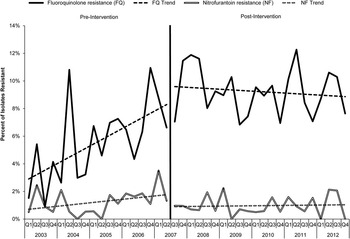
From 2003 through 2012, a total of 11,367 outpatient E. coli isolates with antibiotic susceptibility testing were available for analysis. The overall proportion of E. coli isolates resistant to an FQ increased from 1.5% in 2003 to 7.6% in 2012 (P<.001). By time-series analysis, there was a significant change in the trend of FQ-resistant E. coli (P=.004) between the pre- and postintervention periods (Figure 3, Table 2), from a steady increase from 2003 to 2007 to a plateau and slight decline thereafter. In contrast, there was no significant change in NFT-resistant E. coli from 2003 to 2012.
Fluoroquinolone and nitrofurantoin resistance among outpatient E. coli isolates over time. Data are expressed as the proportion of isolates resistant to the respective antibiotic per quarter.

Clinical Outcomes
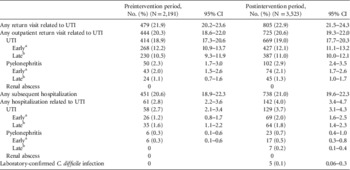
Overall, during the 28-day follow-up period after the index visit, early outpatient return visits (1–7 days after discharge) and late outpatient return visits (8–28 days after discharge) for UTI and pyelonephritis occurred with similar frequency during the preintervention and postintervention periods (Table 4). Hospitalizations for any reason, as well as early and late hospitalizations for UTI and pyelonephritis, did not differ significantly between the 2 study periods. No cases involved the development of a renal abscess. There were 5 cases of laboratory-confirmed C. difficle infection during the postintervention period and no cases during the preintervention period.
Clinical Outcomes Within 28 Days of the Index Visit

NOTE. CI, confidence interval; UTI, urinary tract infection.
a Occurred within 7 days of the index visit.
b Occurred 8–28 days after the index visit.
DISCUSSION
At our institution, a marked increase in FQ-resistant E. coli prompted a change in the recommended treatment for acute uncomplicated cystitis from FQs to NFT. This change in prescribing guidance was associated with an immediate and sustained reduction in FQ use and a modest increase in NFT use. These prescribing changes were associated with stabilization of the previously increasing trend of FQ resistance among outpatient E. coli isolates and no significant change in the trend of NFT resistance.
The IDSA recommends NFT as a first-line agent for acute uncomplicated cystitis;Reference Gupta, Hooton and Naber 4 however, to our knowledge, the impact of widespread NFT use on community resistance patterns has not previously been evaluated. Notably, we did not observe an increase in NFT resistance among E. coli over more than 5 years despite almost a 75% relative increase in NFT use. This finding is in stark contrast to the previous observation at our institution in which a substantial increase in FQ use was associated with a marked increase in FQ-resistant E. coli.Reference Johnson, Sabel and Burman 6 In the present study, we also found that reductions in the use of FQs for acute cystitis and in total FQ use were associated with a stabilization in the rate of FQ-resistant E. coli. Taken together, these findings lend support to the IDSA recommendation to preferentially use NFT over FQs for acute uncomplicated cystitis,Reference Gupta, Hooton and Naber 4 and they have potential relevance to national efforts aimed at reducing antimicrobial resistance. 2
Our findings linking a decrease in FQ use with a decrease in FQ resistance among E. coli are similar to previous reports.Reference Gottesman, Carmeli, Shitrit and Chowers 17 – Reference Lamikanra, Crowe and Lijek 20 In combination with the lack of an increase in resistance to NFT observed in our study, these findings may reflect important underlying differences in the mechanisms for developing antimicrobial resistance between FQs and NFT. For example, FQs can induce the development of multidrug efflux pumps. In addition, plasmid-mediated FQ resistance can be transferred easily, leading to resistance across different antimicrobial classes.Reference Wong-Beringer, Nguyen, Lee, Shriner and Pallares 21 , Reference Peterson 22 In contrast, NFT resistance may come at a significant fitness cost to replicating E. coli; a trait ill-fitted to the widespread development and transfer of resistance genes.Reference Sandegren, Lindqvist, Kahlmeter and Andersson 23 , Reference Poulsen, Johansson, Granholm, Kahlmeter and Sundqvist 24
Several limitations to the present study warrant further discussion. First, the preintervention–postintervention design is subject to period effect. It is therefore possible that the stabilization in the trend of FQ-resistant E. coli was an epidemiologic trend unrelated to the observed change in FQ use in the Denver Health system. For example, the Food and Drug Administration banned FQs from animal agricultural in 2005, 25 which could have affected resistance trends. However, the observed decrease in the trend in FQ resistance in this study was sudden and closely temporally associated with the institution-wide reduction in FQ use (Figure 3) suggesting that they may be related; however, it is important to note that this association does not prove a causal link.
Next, the identification of visits using ICD-9 codes did not allow for the distinction between acute uncomplicated cystitis and complicated UTIs where prescribing recommendations differ. The manual chart review of patients treated with FQs demonstrated that a large proportion of cases met criteria for complicated UTI. This is likely why NFT, recommended only in cases of acute uncomplicated cystitis, accounted for fewer than one-third of prescriptions in the postintervention period.
Another limitation is that a large number of visits with an ICD-9 diagnosis of acute cystitis were not were not associated with an antibiotic prescription. Because our ICD-9 search identified visits with either a primary or secondary diagnosis of cystitis, we captured visits that were not the initial presentation of cystitis (ie, follow-up visits where a recent episode of cystitis was already treated), overestimating the number of actual episodes of acute cystitis. Second, because we were only able to identify antibiotic prescriptions filled at a Denver Health pharmacy (~30% are filled outside of our system), the proportion of visits with an associated antibiotic prescription reflected in our data is an underestimate of the true proportion.
Importantly, we could not identify E. coli isolates specifically from cases of acute uncomplicated cystitis, where urine cultures are most often not sent; our microbiological data therefore represent a broader range of UTIs (eg, uncomplicated and complicated, upper and lower urinary tract) than was included for the antibiotic utilization assessment. Nevertheless, a reduction in FQ use for acute cystitis appeared to have an impact on antimicrobial resistance among E. coli isolates from a broad group of UTIs. Because we did not collect resistance data for other antibiotics such as cephalosporins, it is not known whether the observed increase in use of cephalosporins was associated with increased resistance to these agents, such as through the emergence of extended-spectrum β-lactamase-producing organisms.
We did not have complete data on the effectiveness, safety, or tolerability of the antibiotic regimens used during the 2 periods. We therefore cannot conclude based on the results of this study that the use of NFT, despite its apparent lower impact on E. coli resistance, is the optimal treatment for acute uncomplicated cystitis. Notably, although C. difficile infection was infrequent in both time periods, cases were only identified during the NFT period. The continued use of FQs in a substantial proportion of cases and the fact that our microbiology laboratory changed to a more sensitive C. difficile diagnostic test during the NFT period limit the conclusions that can be drawn from these data.
In summary, these findings add to the evidence that local changes in antimicrobial use may impact antimicrobial resistance in the community. Specifically, we observed that in a large, integrated healthcare system, a reduction in FQ use for acute cystitis was associated with stabilization of a previously increasing trend of outpatient FQ-resistant E. coli. However, a modest increase in NFT use did not have an apparent impact on NFT-resistant E. coli. The longer-term impact of FQ-sparing strategies for acute uncomplicated cystitis on community antimicrobial resistance will require further study. This study lends support to the IDSA recommendation to preferentially use NFT over FQs because of a lower likelihood of inducing resistance. This study helps to inform ongoing national antimicrobial stewardship initiatives aimed at addressing the growing threat of antimicrobial resistance.
ACKNOWLEDGMENTS
The authors thank Ron Cake, Matthew Archer, and Debora Gardner for their assistance with data acquisition as well as Mike Doody for his support in the initial conception and study design.
Financial support: This work was supported in part by the National Institute of Allergy and Infectious Diseases, National Institutes of Health (grant no. K23 AI099082 to T.C.J.).
Potential conflicts of interest: All authors report no relevant conflicts of interest.
SUPPLEMENTARY MATERIAL
To view supplementary material for this article, please visit https://doi.org/10.1017/ice.2016.315.