


A wealth of epidemiological data indicates that a high intake of whole grains is associated with a reduced risk of CVD, obesity, type 2 diabetes and certain cancers(Reference Jonnalagadda, Harnack and Lai1, Reference Harris and Kris-Etherton2). Despite such potential health benefits, whole grain intakes are low(Reference Richardson3–Reference Thane, Jones and Stephen6). In the last decade there have been significant efforts by the food industry to increase the availability of whole grain foods and assist consumer choice, for example by highlighting whole grains on front-of-pack labelling and pursuing whole grain health claims. There is, however, little qualitative research on attitudes to whole grains(Reference Chase, Reicks and Smith7–Reference Zhang, Malik and Pan11). Nearly all existing qualitative research emanates from the USA which has different dietary guidance regarding whole grains and different legislation regarding health claims compared with the UK and Europe. The USA has a quantitative whole grain recommendation to ‘consume three or more ounce-equivalents of whole grain products per day’(12). In contrast, the UK has a more general recommendation: ‘Eat plenty of bread, rice, potatoes, pasta and other starchy foods every day. Choose whole grain varieties when you can’(13). For a food to be truly ‘whole grain’, it must contain the three main components, i.e. the endosperm, bran and germ, in almost the same proportions as they exist in an intact grain(14).
The aim of the present study was to use focus groups to explore current attitudes to and awareness of whole grains, perceived barriers to and facilitators of whole grain consumption and feelings about how best to promote whole grain consumption.
Materials and methods
Focus group recruitment
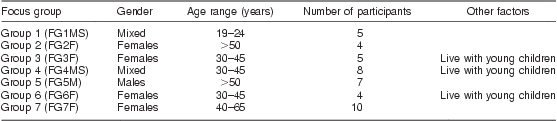
Seven focus groups were conducted between February and October 2009 with participants aged 18–65 years who had some responsibility for food shopping in the household. Purposive sampling techniques were used to recruit a mix of female and male participants of different ages within Northern Ireland. Due to the pivotal role parents play in the promotion of healthy dietary habits among children(Reference Schwartz, Scholters and Lalanne15), discussions were also conducted with groups of parents with young children to identify if, and how, parents incorporate whole grains into their children's diets and the reactions these products and strategies receive. Participants were recruited through word of mouth, community groups, church groups and businesses. The groups consisted of four to ten participants, all of whom provided informed verbal consent. The study protocol was approved by the Queens University of Belfast Ethical Committee.
Focus group questions
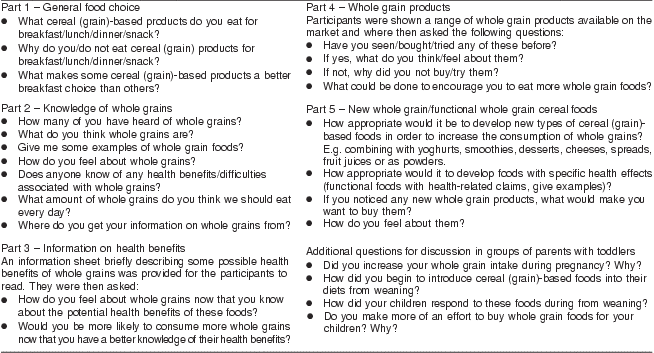
A semi-structured discussion guide (Table 1) was designed to investigate the current whole grain foods consumed (in broad descriptive terms) and the participants’ knowledge and perceptions of whole grains. The guide was based on the questions from the EU HEALTHGRAIN study(Reference Arvola, Lähteenmäki and Dean16), with the addition of specific questions relating to whole grain and parenting practices. The main topic areas covered were: participants’ use of whole grains (part 1), their knowledge of whole grains (parts 2 and 3), their familiarity with whole grain products (part 4), their perceptions of whole grain functional foods (part 5) and, for the groups of parents with children, their use of whole grains while pregnant, during weaning, etc. Prompts were used when necessary to redirect or promote discussion. Questions were pretested for format, clarity, flow and duration with a pilot focus group and refined prior to implementation.
Semi-structured focus group guide
Focus group procedures
Focus group discussions were facilitated by the moderator (E.M.) in an informal setting convenient to participants. During the introduction, participants were told that the purpose of the study was to investigate ‘eating behaviour relating to cereal grain foods’. As an ice-breaker, participants were asked to introduce themselves on a first name basis and describe their eating habits. The moderator then gave instruction on ground rules (e.g. allowing everyone to speak, confidentiality), sought input from all participants (e.g. any other views?) and encouraged elaboration on the issues. After the knowledge section participants were given an information sheet which informed them of the benefits of eating whole grain foods (discussion guide part 3). Then a wide variety of whole grain products such as flapjacks, pumpernickel bread, rye crisp bread, etc. were presented to gauge consumer perception and knowledge, stimulate discussion and focus the discussion on whole grains (discussion guide part 4). Each focus group session was audio recorded, and lasted between 45 and 60 min. Subsequently, participants were thanked and were informed that they could speak to the moderator about any issues raised.
Analysis of focus group transcripts
The focus group recordings were transcribed verbatim. An inductive thematic analysis framework, as outlined by Braun and Clarke(Reference Braun and Clarke17), was applied to the data to code and identify themes. The qualitative data analysis software NVivo 8 (QSR International) was used to manage the coded data. E.M. and one author (M.D., a psychologist) independently developed an early coding structure after reading and re-reading three of the transcripts. This was followed by a discussion and comparison of the codes to verify the validity and reliability of their application; this iterative process was repeated several times until all discrepancies were resolved satisfactorily. The coding framework was then applied to the remaining transcripts. Previous transcript codes were adjusted as needed. E.M. and M.D. grouped the codes (and related data) into similar categories and constructed the corresponding themes with quotations to illustrate typical views.
Results
The demographic characteristics of the forty-three focus group participants are shown in Table 2. This section presents the findings from the thematic analysis, which covered barriers to increasing whole grain consumption, facilitators of whole grain consumption, attitudes towards new whole grain foods and strategies to increase whole grain intake.
Demographic details of the study participants: adults aged 18–65 years, Northern Ireland, February–October 2009
Barriers to increasing whole grain consumption
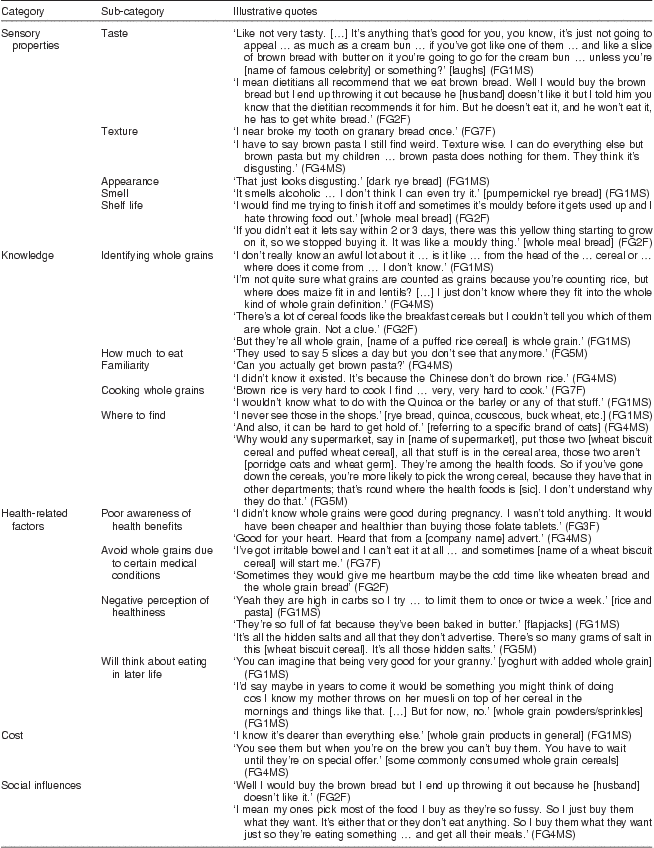
Focus group participants were aware of the term ‘whole grain’ and their current grain consumption appeared to be mainly from breads and cereals. The main barriers to increasing whole grain consumption related to their sensory properties, knowledge factors, health benefits, perceived cost and family interactions (Table 3).
Barriers to increasing whole grain consumption among the study participants: adults aged 18–65 years, Northern Ireland, February–October 2009
Sensory properties
Many participants disliked the organoleptic properties (i.e. the taste, texture, appearance and smell) of certain whole grain foods, with taste being the most dominant barrier. Some stated that they did not follow the advice of health professionals because of a dislike of the sensory properties of the whole grain foods recommended:
Like not very tasty. It's anything that's good for you, you know, it's just not going to appeal … as much as a … cream bun. (FG1MS)
In addition many participants viewed whole grain breads as having a shorter shelf life than their refined counterparts:
If you didn't eat it [wholemeal bread] let's say within 2 or 3 days, there was this yellow thing starting to grow on it, so we stopped buying it. It was like a mouldy thing. (FG2F)
Knowledge factors
Many participants admitted that they knew very little about whole grain foods and could only provide basic definitions of whole grains such as ‘contain the whole of the grain’ (FG1MS), ‘natural’ (FG2F) and ‘there's nothing else added’ (FG7F). Many were uncertain about the difference between whole and refined grain foods and were reliant on product advertising or on-pack labelling to help them identify whole grains. Few were able to identify a whole grain food from an ingredient list:
I'm not quite sure what grains are counted as grains because you're counting rice, but where does maize fit in and lentils? I just don't know where they fit into the whole kind of whole grain definition. (FG4MS)
Participants were unfamiliar with most of the whole grain foods displayed during the discussions and there also seemed to be a low level of knowledge regarding how to cook some whole grain foods or how to incorporate them into meals:
I wouldn't know what to do with the Quinoa or the barley or any of that stuff. (FG1MS)
Health benefits
The majority of participants seemed to have only a basic awareness of the health benefits of whole grain foods, mainly stating that they were ‘filling’ and ‘good for your heart’. Some stated that they avoided whole grains because of health problems (such as heartburn, bloating and irritable bowel syndrome):
‘I've got irritable bowel and I can't eat it at all … and sometimes [name of a wheat biscuit cereal] will start me. (FG7F)
In addition, some reported concerns that some grain foods, particularly processed foods such as some cereals, may be high in calories, fat, sugar or salt:
It's all the hidden salts and all that they don't advertise. There's so many grams of salt in this [wheat biscuit cereal]. It's all those hidden salts. (FG5M)
Perceived cost
Participants perceived whole grain foods to be more expensive than their refined counterparts. In particular, many found it difficult to be able to afford to buy whole grain foods at full price; therefore they limited what they purchased and relied on supermarket special offers:
Yes like porridge … it's one the plainest, most natural breakfast foods you can eat, but it's twice the price of a box of cereal. (FG6F)
Family interactions
Some reported that they did not buy certain whole grain foods if other family members (spouses, children) did not like them, even if the participant preferred the whole grain variety:
Well I would buy the brown bread but I end up throwing it out because he [husband] doesn't like it. (FG2F)
Facilitators of whole grain consumption
Conversely, many of the barriers to whole grain intake acted as facilitators for some people, as shown in Table 4. For example, participants claimed that sensory properties, knowledge factors, health benefits and family interactions were some of the main reasons why they consumed whole grain foods. In addition, habitual diet and convenience were cited as facilitators.
Factors that facilitate the consumption of whole grain foods among the study participants: adults aged 18–65 years, Northern Ireland, February–October 2009

Sensory properties
An appreciation of the sensory properties of whole grains, particularly taste, was the most influential facilitator and outweighed the cost for some participants, as they felt it was worth paying the extra money for the foods they liked:
Porridge oats can be more expensive than those boxes of cereal and the muesli too but again, they're nicer so I get them anyway. (FG2F)
Knowledge factors
Those who consumed whole grain foods regularly had a good level of knowledge in relation to identifying whole grains, locating them in shops and distinguishing between whole grain and high-fibre grain foods:
I would say it's the actual grain and it's crushed. And you get the husk, the content of the husk and all in it combined, the whole seed. (FG5M)
The big supermarkets have a good range of whole grain stuff. (FG7F)
Health benefits
The majority of those who reported that they ate whole grain foods regularly viewed whole grains as ‘healthy’, ‘filling’, ‘natural’ and ‘nutritious’. Also, many stated that they consumed various whole grain foods to alleviate certain medical conditions, such as high cholesterol, to promote good health and to reduce risk of chronic diseases:
Well this is why I started eating whole meal bread because my cholesterol levels were too high. (FG4MS)
Many participants reported making a conscious effort to get their children to eat more whole grains as part of a healthy diet and to establish good eating habits:
‘I want to keep my kids healthy so they will grow up well and I also want to teach them the importance of eating well and looking after their health. (FG6F)
In addition, after reading information relating to the health benefits, many but not all claimed that they would be more willing to buy whole grain varieties as they were now aware of their importance in the diet, for example:
I suppose I would make more effort to eat them now, certainly for the wee ones. (FG3F)
In addition when consumption of whole grains was considered relevant to themselves or their family, these participants were willing to start increasing their whole grain consumption. A participant in a group of parents with young children said:
See that heart disease and diabetes, they are all in my family so I better start eating more brown bread. (FG4MS)
Other facilitators
Participants also mentioned that they found whole grain foods to be convenient:
I give mine [porridge] 4 min in the morning in the microwave and plump it up. (FG5M)
Also, some claimed they had been influenced to eat more whole grains due to family and friends’ preferences, or advice from health professionals:
Well this is why I started eating whole meal bread because my cholesterol levels were too high. (FG4MS)
Further, many reported eating whole grain foods out of habit, having always consumed them since childhood:
I use jumbo oats and pumpkin seeds, and this is what I was reared on by the way. (FG5M)
All my family would eat brown bread. (FG7F)
Attitudes towards new whole grain foods
There was mixed opinion as to whether various types of novel whole grain foods would be acceptable to the participants. Products such as spreads, yoghurts, pizzas and cakes with added whole grains appeared to be acceptable to participants; however, products such as fruit juices, smoothies, milk and cheeses were not. These opinions were, as expected, based on views about the anticipated sensory properties of the novel whole grain products. Many participants described these foods as being ‘unnatural’, with one participant adding:
I think it would be too weird for some people. It would maybe spoil the food itself. (FG3F).
Moreover, many participants expressed concern that these products would be very expensive and those on tight budgets would not be able to afford them, for example:
I'm sure they wouldn't be cheap like. They would cost a good 50p more than the plain alternative. I couldn't afford that. (FG4MS)
Strategies to increase whole grain intake
The participants discussed various strategies that would help to increase whole grain intake. The main barrier to whole grain intake was the sensory properties of whole grain foods and it was felt that if whole grain products were made more palatable, this would increase their appeal to a wider range of people:
Make them more attractive … I suppose … for kids to eat. (FG3F)
Another issue discussed was competitive pricing to make whole grains more affordable to all:
You would really see more people going for them if they were cheaper, or the same price as like the white bread and all. (FG4MS)
Participants also argued for better nutrition labelling with more use of the term ‘whole grain’ on-pack as well as for more attractive packaging and media advertising to help consumers identify what whole grains are:
If they had more labels on it saying why it was better than the other. (FG1MS)
Getting people more aware of the different types available would be very important, so people would know what's out there. (FG3F)
Further, participants wanted more education about the health benefits of whole grains and also on how to identify them and incorporate them into their diet:
But I think too that people need to hear more about whole grains either on TV like health adverts or programmes and from their doctors and all. (FG4MS)
Finally, participants also wanted more variety and availability of whole grain foods with better placement on the supermarket shelves:
Some of those things you couldn't get in a local shop, in fact most of them you couldn't get so maybe if they sold them in local shops as opposed to bigger stores. (FG1MS)
Discussion
Relatively little qualitative research has explored attitudes to whole grains. The present study was conducted against a background of increased availability, promotion and marketing of whole grain foods in the UK. Although awareness of the term ‘whole grain’ was good, many barriers to whole grain consumption were still very evident. The most prominent barriers were a negative perception of the sensory properties of whole grains, a lack of knowledge of what they are, where to find them and how to incorporate them into meals, and also a lack of awareness of their health benefits and how much should be consumed. Hence, while participants were aware of the term ‘whole grain’, many did not like the sensory properties of whole grains or they lacked the level of knowledge needed to facilitate increased intake of these foods. The sensory properties of whole grains are generally recognized as the most prominent barrier to whole grain intake(Reference Chase, Reicks and Smith7, Reference Burgess-Champoux, Marquart and Vickers9, Reference Zhang, Malik and Pan11, Reference Arvola, Lähteenmäki and Dean16, Reference Dean, Raats and Shepherd18–Reference Gellar, Rovner and Nansel20), as was the case in the present research. However, there are also individuals who prefer the taste and texture of whole grain foods and, interestingly, some of these stated that they were prepared to pay a bit extra for them. This seems to imply that if sensory properties are acceptable then cost may not be a barrier to some. The sensory properties of whole grains were also highlighted within participants’ suggested strategies on how to help consumers increase their whole grain intake, where they requested that whole grain foods should be made more palatable. This is a possible avenue that could be explored by industry.
In addition, participants desired more information about whole grains in terms of health benefits and practical assistance in identifying whole grain foods and how to incorporate them into their diet. Further, there were requests for more diversity with regard to general nutrition messages which some felt had become increasingly focused on fruit and vegetables in recent years. When information on the potential health benefits of these foods was presented, participants who saw relevance displayed openness towards trying whole grains, despite sensory aversions. This is in line with Mialon et al.'s findings(Reference Mialon, Clark and Leppard21), where sensory-, health- and nutrition-related ratings increased for whole meal bread, multigrain muffins and fibre-enriched white bread, and decreased for low-fibre white bread, after participants received nutritional information on the fibre content of each food. A small number of studies have been conducted to evaluate the effects of various nutrition education interventions to increase consumer confidence by improving their knowledge and awareness of whole grains(Reference Roth-Yousey, Barno and Caskey22–Reference Lafferty, Marquart and Reicks32), with promising results being observed in all studies. Some studies have shown that the establishment of the USA's ‘3 a day’ whole grain recommendation(12) and the promotional activity surrounding whole grain products had a positive impact on the consumption of whole grain foods(Reference Mancino, Kuchler and Leibtag33, Reference Kolodinsky, Harvey-Berino and Berlin34).
It was apparent in the focus group discussions that some participants still appeared to be unwilling to consider whole grain consumption even after reading the information on potential health benefits. It is possible that such individuals may not consider the message to be relevant to them and feel sensory enjoyment to be paramount. Others have also noted that different subgroups of people exist in relation to their views and behaviours towards cereal grain foods(Reference Arvola, Lähteenmäki and Dean16, Reference Dewettinck, Van Bockstaele and Kühne19, Reference Knol and Lily35, Reference Pohjanheimo, Paasovaara and Luomala36). For instance, a Belgian study showed that consumers could be grouped into clusters depending on how they valued the health and sensory properties of bread(Reference Dewettinck, Van Bockstaele and Kühne19). The clusters included those who were: health averse (i.e. valued the sensory enjoyment of bread higher than the health aspect); health and sensory positive (valued both aspects positively); and sensory averse (valued the healthiness of bread higher than the sensory attributes). Consequently, different marketing strategies may need to be employed to increase whole grain sales in different segments of the population. More novel and surreptitious approaches may be required to enable the health averse to increase their whole grain intake. Children are likely to fall into this category; parents in a study by Burgess-Champoux et al.(Reference Burgess-Champoux, Marquart and Vickers9) indicated that providing whole grains ‘in disguise’ is one strategy they were keen to employ in order to increase their children's whole grain intake. In the long run, however, such a strategy would not help to address the sensory barrier to whole grain consumption and development of good whole grain habits. The importance of habitually consuming whole grains was something that came up in the present research; participants who had always consumed whole grains from childhood talked very positively about these foods. As with all areas of nutrition, it is likely that incorporation of whole grains into the diets of children from a young age, as part of a balanced diet, may encourage sustained consumption of these foods. Studies have shown that increased exposure to an unfamiliar food can increase a child's liking for it and can even break down resistance to foods that were initially disliked(Reference Moore, Tapper and Murphy37–Reference Birch, Savage and Ventura39). It was noteworthy and encouraging that, after reading the information on health benefits, mothers of young children discussed introducing children to whole grain foods in order to establish lifelong habits; this possible motivation towards whole grains is something that could be investigated further and potentially harnessed in future educational activities.
The food industry is already making significant advances in terms of incorporating whole grains into an increasing variety of products, as well as disguising or diluting some of the sensory properties that people find unacceptable; given the discussions reported here, there appears to still be further mileage in this approach for children and adults alike(Reference Toma, Omary and Marquart40, Reference Chan, Burgess Champoux and Reicks41). Participants perceived cost would be high for new whole grain products and some expressed concern that while products may be marketed as whole grain, they may also be high in fat, sugar or calories. This is a further challenge for the food industry; how to make whole grains more acceptable without compromising the nutritional integrity of their new or improved whole grain products or making the cost prohibitive for consumers.
Owing to the lack of data in this area, particularly outside the USA, the present study chose a qualitative approach to gain an in-depth insight, from a broad spectrum of ages, into attitudes to whole grains. Purposive sampling techniques were used to recruit a mix of female and male participants of different ages; however, owing to the fact that recruitment specifically targeted individuals who were at least partly responsible for food shopping, females were over-represented in the sample. The researchers felt that saturation of ideas and themes had been reached after seven focus groups. Quantitative approaches could now be usefully employed to explore the relative prominence of and the interactions between the various barriers identified; for example, the relationship between sensory properties and perceived cost. This further research will help to guide the development of targeted interventions to increase whole grain intake.
Conclusions
Participants in the present research were generally aware of the term ‘whole grain’; however, even against a background of increased availability and promotion of whole grain foods in the UK, many key barriers to whole grain consumption are still evident. Continued efforts are needed to address these barriers and encourage increased consumption to all. Alongside general education, opportunities and challenges exist for the food industry to develop novel, but affordable, food products that maintain their nutritional integrity and are able to deliver whole grains in a wide variety of forms, including whole grains ‘in disguise’ for those who are unlikely to accept the sensory properties of whole grains in their more obvious forms. Increasing use of the term ‘whole grain’ on food packaging will also help consumers overcome the fundamental barrier of identifying whole grain products. Although a number of barriers to whole grain intake were identified in the present qualitative work, many of these are not insurmountable. Action on multiple levels will be required to help more people consume more whole grains; basic but practical education of the general public is just as important in this regard as investigating novel food products.
Acknowledgements
This research received no specific grant from any funding agency in the public, commercial or not-for-profit sectors. There are no conflicts of interest to disclose. M.D., J.V.W. and M.C.M. conceived of and designed the study; E.M. carried out the focus groups; E.M., M.D. and M.C.M. analysed the data; E.M. and M.C.M. drafted the manuscript and all other authors contributed to editing and proofreading. The authors thank all of the participants who took part in the study and the community organizations that helped facilitate the focus group discussions.



