Introduction
Sleep problems are common in elderly persons, with over half of community-dwelling adults reporting at least some chronic sleep complaint (Ryff et al., Reference Ryff, Singer and Dienberg Lover2004; Goldman et al., Reference Goldman2007). Studies have shown that sleep disturbance is a risk factor for poor mental, social and physical functioning, and for morbidity and mortality from causes as diverse as road and work-place accidents to illness and deaths caused by dangerous self-treatment regimens (Åkerstedt, Reference Åkerstedt2006; Altena et al., Reference Altena, Van Der Werf, Strijers and van Someren2008; Edinger et al., Reference Edinger, Means, Carney and Krystal2008). One factor which consistently has been found to impair sleep is stress (Hall et al., Reference Hall2000; Åkerstedt et al., Reference Åkerstedt, Kecklund and Axelsson2007). Stress responses which are caused by people in one's closest network are often related to perceived threats to belongingness needs (Flanders, Reference Flanders, Peplau and Perlman1982; Baumeister and Leary, Reference Baumeister and Leary1995). Such perceived threats have been shown to predict a wide range of subjective health complaints. Thus, living in troublesome social relationships has detrimental effects on health and functioning (Mittelmark et al., Reference Mittelmark, Aaro, Henriksen, Siqveland and Torsheim2004; Aanes et al., Reference Aanes, Mittelmark and Hetland2010). When experiencing social distress, cognitive arousal at bedtime and poor sleep quality are plausible consequences (Cacioppo et al., Reference Cacioppo2002; Reference Cacioppo, Fowler and Christakis2009) with related daytime dysfunctions (Kelly, Reference Kelly2003; Hawkley et al. Reference Hawkley, Preacher and Cacioppo2010). One state which is often associated with social distress is loneliness. Loneliness is regarded as an unpleasant feeling which arises when belongingness needs are not fulfilled (Mellor et al., Reference Mellor, Stokes, Firth, Hayashi and Cummins2008) leading to social pain (Cacioppo and Patrick, Reference Cacioppo and Patrick2009). One suggested long-term effect of loneliness is a weakened restorative process (sleep) that serves to repair, maintain, recover and enhance psychological capacities. Sleep is essential for restoration, and sleep deprivation has consequently been shown to have dramatic effects on individuals’ abilities to cope with daily living. Studies by Cacioppo and his colleagues have consistently demonstrated that sleep is poorer in lonely than non-lonely individuals across all age groups. Differences were found for sleep efficiency, sleep latency, sleep quality, sleep duration and daytime sleepiness (Cacioppo et al., Reference Cacioppo2002; Hawkley and Cacioppo, Reference Hawkley and Cacioppo2007). In individuals experiencing loneliness, psychological activation (cognition) is likely to be centered on the insufficiency of social relationships. Research suggests that cognitive arousal and worries, such as intrusive thoughts at bedtime as well as feelings of emotional isolation at bedtime, play a key role in the development and maintenance of sleep difficulties (Tang and Harvey, Reference Tang and Harvey2004; Harvey et al., Reference Harvey, Tang and Browning2005; Åkerstedt et al. Reference Åkerstedt, Kecklund and Axelsson2007). In one study it was shown that worry about relationships, compared to other worry domains, was the strongest correlate of decreased sleep length (Kelly, Reference Kelly2003).
Different underlying mechanisms are suggested to explain the effects of loneliness. The mediation of intermediate variables has long been considered of primary importance in understanding individuals’ social, psychological and behavioral outcomes (Blunch, 2000). The study of loneliness as a mediator in the relation between interpersonal stress and psychological distress and somatic symptoms has already been undertaken by our research group (Aanes et al., Reference Aanes, Mittelmark and Hetland2010). We have found loneliness partially to mediate the link between interpersonal stress, depressive symptoms, anxiety symptoms and somatic health complaints to various degrees. The idea that loneliness may act as a mediating variable in the stress-sleep link is therefore plausible, both according to earlier research, and with regard to theoretical aspects from the belongingness, social cognition and health behavior literature.
With these considerations in mind, we propose a mediation model in which loneliness mediates the relationship between interpersonal stress and sleep problems. In addition we also propose direct paths from interpersonal stress to sleep problems. Another important point of interest when investigating the stress-sleep relationship is consistency in the underlying pattern across age. However, it is well documented that feelings of loneliness increase with age (Carsentsen et al., Reference Carstensen, Pasupahti, Mayr and Nesselroade2000). Sleep problems are also more common in older adults (Goldman et al., Reference Goldman2007), and both Rook (Reference Rook, Qualls and Abeles2000) and Ryff et al. (Reference Ryff, Singer and Dienberg Lover2004) report that amongst older adults, positive relationships are associated with good sleep and that negative social interactions are associated with poor sleep. Research on social aging indicates a change in the patterns of social interactions as people age (Sorkin and Rook, Reference Sorkin and Rook2006). Two opposing processes have been identified when it comes to the relationship between the quality of social relationships and age. First, the number of social relationships decreases and social events triggering loneliness increase with age (Sorkin and Rook, Reference Sorkin and Rook2006; Newsom et al., Reference Newsom, Mahan, Rook and Krause2008). Second, the emotional closeness in relationships seems to increase with age (Carstensen et al., Reference Carstensen, Pasupahti, Mayr and Nesselroade2000; Fung et al., Reference Fung, Carstensen and Lang2001). Accordingly, being concerned about one's decreasing social engagement and being worried about being left alone in later life could affect both the direct influence of interpersonal stress and loneliness on sleep, and the possible mediating role loneliness has on the interpersonal stress-sleep relation in older adults. On the other hand, it is expected that daytime activities would be somewhat less influenced by nocturnal sleep problems in older adults due to retirement and reduced social obligations. But we do not think that this will necessarily affect the underlying pattern being investigated.
As far as we are aware, the joint effects of interpersonal stress and loneliness on sleep quality have not been previously investigated. Nor has previous research investigated these relationships across age. Against this background we conducted a study with the aim of investigating the relationships between interpersonal stress, loneliness and two types of subjective health complaints, namely nocturnal sleep problems and daytime sleepiness. Specifically, the aim was to examine whether loneliness is a mediator of the link between interpersonal stress and nocturnal sleep problems and daytime sleepiness and to study these relations in two age samples.
Methods
Study design and samples
This study is an ancillary cross-sectional analysis of survey data gathered in the second round of the Hordaland Homocysteine Study (HHS II). HHS II was conducted in 1997–2000 as part of the Hordaland Health Study (HUSK). Of the total sample of 9187 men and women born between 1925 and 1927 (older adults), and 1950 and 1951 (middle-aged adults) who were invited into the main study, 7,074 (77%) participated. Of these, 3341 were in the older adult group and 3733 were in the middle-aged group. The study protocol was approved by the regional Committee for Medical Research Ethics and the Norwegian Data Inspectorate.
Measurements
All study measures have been used in previous studies and their psychometric properties are published as referred to below.
Interpersonal stress
Interpersonal stress was measured by the Bergen Social Relationships Scale (BSRS) (Mittelmark et al., Reference Mittelmark, Aaro, Henriksen, Siqveland and Torsheim2004). The scale consists of six items, which are broadly representative of the universe of indicators of interpersonal stress, and meaningful for people of various backgrounds and situations. Each item represents one of six general situations that could be seriously distressing to average people, let alone persons who are vulnerable because of frailty, acute stress, serious physical illness and the like. These situations are labeled “helpless bystander”, “inept support”, “performance demand”, “role conflict”, “social conflict” and “criticism”. In earlier studies, the scale has demonstrated high internal consistency (Cronbach's α = 0.76; see Mittelmark et al., Reference Mittelmark, Aaro, Henriksen, Siqveland and Torsheim2004). The Cronbach's α of the BSRS in the present study is 0.79.
The six items of the BSRS are prefaced by the written instruction: “Think about everyone (children, parents, siblings, spouse or significant other, neighbors, friends, colleagues and others you know) while you answer the following: “There are people in my life whom I care about, but who dislike one another”(BRSR1); “There is a person in my life who needs my help, but whom I don't know how to help”(BSRS2); “There is an important person in my life who wants to support me, but who hurts my feelings instead” (BSRS3); “There is a person that I have to be with almost daily who often henpecks me” (BSRS4); “There are people who make my life difficult because they expect too much care and support from me”(BSRS5); “There is a person I care about who expects more of me than I can manage”(BSRS6). The response choices were: “this describes me very well”; “describes me quite well”; “does not describe me very well”; “does not describe me at all”.
Loneliness
Loneliness was measured by a six-item Loneliness scale (x = 4.3; SD = 3.8; Cronbach's α = 0.77), modified slightly from a scale developed for use in population-based studies in Western Norway (Kraft and Loeb, Reference Kraft and Loeb1997). The items are: “I feel I have enough contact with people who care about me”(Lone1); “I often feel lonesome”(Lone2); “I feel it is difficult to talk with people I have not met before” (Lone3); “I feel lonely even when I am around other people”(Lone4); “I often feel that others do not understand me or my situation”(Lone5); “I feel that others care about me” (Lone6). The response alternatives are: “very much”; “quite a bit”; “somewhat”; “only a little”; “not at all”.
Sleep
Sleep was measured by two single items which differentiated between daytime sleepiness and nocturnal sleep: (1) Daytime sleepiness: “During the last three months, have you experienced sleepiness during the day?” The respondents were provided with five possible responses from never to always; (2) Nocturnal sleep problems: “How is your sleep in general?” The response possibilities were: “very good”, “good/fair”, “neither good nor poor”, “rather poor”, and “very poor”.
Data analysis
To test the hypothesized model, AMOS 7.0 was used to conduct structural equation modeling (SEM). All analyses were stratified by the two age-groups (middle-aged and older adults). Initially, measurement models of the study constructs in the two groups were estimated. Subsequently, total, direct and indirect effects between the study variables were tested in a structural model. The direct paths from interpersonal stress to sleep problems, as well as the indirect paths mediated by loneliness, were estimated in the model. Significance levels of the indirect effects were examined by conducting a Sobel test. To evaluate the goodness of fit of the models the following indices were examined: χ2 statistics, Root-Mean-Square Error Approximation (RMSEA) and Comparative Fit Index (CFI). Conventionally, a value of RMSEA less than 0.05 indicates a good fit, while values as high as 0.08 represent a fair fit (Browne and Cudeck, Reference Brown, Cudeck, Bollen and Long1993). A CFI above 0.90 has been considered to be representative of a well-fitting model (Bentler, Reference Bentler1992).
Missing cases were treated by Full-Informational Maximum Likelihood (FIML) within the Amos 7.0 software, where missing values are imputed by estimating the likelihood functioning for each individual based on the variables present in the model. Maximum likelihood based methods, like FIML, have been shown to produce unbiased parameter estimates and standard errors, when data are missing at random (Roth, Reference Roth1994).
Results
Preliminary analyses
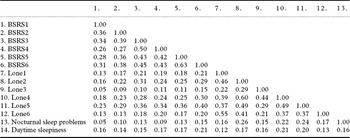
Inter-correlations between study constructs are presented in Table 1. All the correlation coefficients were significant at p < 0.01.
Inter-correlations between observed variables

All correlations p < 0.001; BSRS = Bergen Social Relationships Scale. See text for definition of Lone1–Lone6.
The total measurement model was tested by imposing correlations between the study constructs. In the model interpersonal stress and loneliness were modeled as latent constructs, while sleep problems were estimated by two single observed indicators. In the construct of loneliness two of the items in the scale were reverse-worded (Lone1; Lone6), and recoding was required. Assuming that the differential co-variation of the reverse-scored items was due to method effect rather than the existence of another meaningful construct, one can allow the residuals of these items to co-vary (Brown and Cudeck, Reference Brown, Cudeck, Bollen and Long1993). A residual co-variation for the recoded items was therefore added when estimating the measurement model to account for the possible method effect.
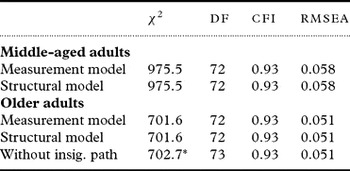
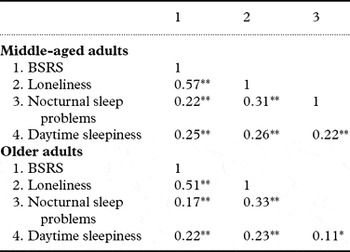
The fit of the measurement models and structural models are presented in Table 2. In both groups, middle-aged and older adults, the measurement model showed an acceptable fit (RMSEA = 0.058; CFI = 0.93; RMSEA = 0.051; CFI = 0.93, respectively), which indicates that the models fit the data adequately. All the factor loadings for the latent constructs in the model were acceptable. Furthermore, significant correlations were found between all of the constructs (Table 3). The correlations between loneliness and the other constructs in the model varied from 0.26 to 0.57 in the middle-aged group, and from 0.23 to 0.51 for the older adults.
Fit statistics by age groups

*ΔDf = 1; Δχ2 = 1.1, n.s.
CFI = Comparative Fit Index; RMSEA = Root-Mean-Square Error Approximation
Correlations between latent study variables in the measurement model (CFI) by age groups

* p <0 .05; p <0 .01
BSRS = Bergen Social Relationships Scale
Direct and indirect effects
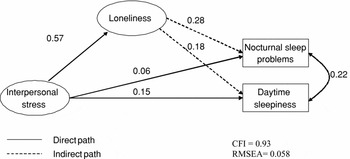
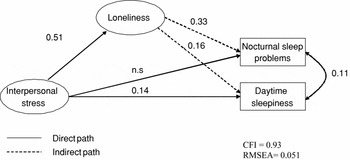
As shown in Table 2, when estimating the structural model with imposed direct and indirect effects in the middle aged group an acceptable fit to the data was found (RMSEA = 0.058; CFI = 0.93). In the older adult group an acceptable fit was found when estimating the structural model. However, the path from interpersonal stress to nocturnal sleep problems was not significant. Consequently, a structural model without this path was estimated. Omitting this path did not cause a significant increase in χ2 (ΔDf = 1; Δχ2 = 1.1, n.s.) indicating that this model is superior to the initial model based on the principle of parsimony. The final model showed good fit to the data (RMSEA = 0.051; CFI = 0.93). The paths in the structural model are presented in Figure 1.
Structural equation model of the direct and indirect effects of interpersonal stress, loneliness, nocturnal sleep problems and daytime sleepiness in middle-aged adults. The circles represent latent variables. The squares represent observed variables. All path coefficients are significant at p< 0.01.

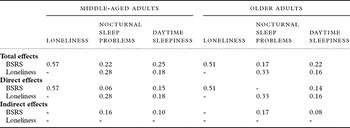
Substantial total effects were found between interpersonal stress and loneliness, nocturnal sleep problems, and daytime sleepiness, as well as between loneliness and the two sleep variables for both age groups (Table 4).
Standardized total, direct and indirect effects by age group

All effects p< 0.01; BSRS = Bergen Social Relationships Scale
In the middle-aged group the total effect between interpersonal stress and nocturnal sleep problems was 0.22. As shown in Table 3 and Figure 1, a direct effect of 0.06 (26.3% of the total effect) and an indirect effect of 0.16 (73.7% of the total effect) was found. In order to test the significance of the indirect effect a Sobel test was conducted, showing that the indirect effect was significant (z = 9.53, p< 0.01). The total effect from interpersonal stress and daytime sleepiness was 0.25. Between these constructs, a direct path of 0.15 (60% of total effect) and an indirect path of 0.10 (40.0% of total effect) were found. The Sobel test showed that the indirect effect was significant (z = 6.49, p < 0.01).
As shown in Figure 2, the total effect between interpersonal stress and nocturnal sleep problems was 0.17 in the older adults group. While no significant direct effect was found, a significant indirect path of 0.17 (100% of the total effect) was revealed (z = 11.25, p < 0.01). Furthermore, a total effect of 0.22 between interpersonal stress and daytime sleepiness in older adult group was found. The direct effect was 0.14 (63.6% of the total effect), while the indirect effect was 0.08 (36.4% of total effect). The Sobel test showed that the indirect effect was significant (z = 5.34, p < 0.01).
Structural equation model of the direct and indirect effects of interpersonal stress, loneliness, nocturnal sleep problems and daytime sleepiness in older adults. The circles represent latent variables. The squares represent observed variables. All path coefficients are significant at p< 0.01.

Discussion
This study was designed with the aim of investigating the relationships between interpersonal stress, loneliness and sleep problems in two age groups. Interpersonal stress and loneliness were found to be significantly associated with nocturnal sleep problems as well as daytime sleepiness in both middle-aged and older adults. These results indicate that troubled relationships and the feeling of loneliness have negative effects on sleep at night and alertness during the day. The association found between interpersonal stress and sleep quality fits well with the general findings in the literature on stress and sleep (Hall et al., Reference Hall2000; Åkerstedt et al., Reference Åkerstedt, Fredlund, Gillberg and Jansson2002). These findings are also in accord with previous research by Cacioppo et al. (Reference Cacioppo2002), showing that the recuperative functions of sleep appear to be influenced by an individual's perceived social context. Thus, Cacioppo and Hawkley (Reference Cacioppo and Hawkley2003) found that socially isolated individuals report everyday events as more intensely stressful and exhibit less effectual repair and maintenance of psychological functioning, including poorer sleep efficiency. As a result, frequent awakening and loss of deep sleep, which thereby cause daytime somnolence, have a subsequent negative impact on work performance and on social and family life (Cacioppo et al., Reference Cacioppo2002). A recently published longitudinal study by Hawkley et al. (Reference Hawkley, Preacher and Cacioppo2010) indicates that loneliness predicts daytime disfunctioning (but not vice versa).
In the present study we found that loneliness was a partial mediator in the analysis of daytime sleepiness in both samples and was a partial mediator in the analysis of nocturnal sleep problems in the middle-aged sample. In the older sample, loneliness fully mediated the stress/nocturnal sleep problems relationship.
For both groups there was a significant path between interpersonal stress and nocturnal sleep problems. One plausible explanation for this connection could be that cognitive arousal at bedtime caused by the negative feeling of being socially disconnected or rumination concerning insufficient relationships is an attempt to search for ways of avoiding aversive or threatening events (Borkovec et al., Reference Borkovec, Robinson, Pruzinsky and Dupree1983; Kelly, Reference Kelly2003). In the process, chronic invasive thoughts about the insufficiency of one's interpersonal relationships needs (interpersonal stress as a threat to belongingness) might disturb one's sleep pattern. The consistency of findings in this study across the two age groups suggests that there is hardly any change with age concerning the effect of living in chronic stressful relationships on sleep (Rook, Reference Rook, Qualls and Abeles2000). This is supported by evidence, reviewed earlier, that the experience of chronic interpersonal stress activates the same processes across age, and is in line with evidence that social connectedness is essential for health and well-being over the life span (Baumeister and Leary, Reference Baumeister and Leary1995).
Regarding mediation, loneliness was found to mediate the interpersonal stress-sleep relationship to various degrees in the two age groups, suggesting that the importance of loneliness for nocturnal sleep problems is greater than for daytime sleepiness. With the latter, loneliness partially mediates the link in both age groups. This is consistent with evidence that depression symptoms and anxiety cause problems with daytime alertness. This result indicates that the social environment conceptualized through loneliness, or lack of social connectedness, has a major effect on health and health behavior. Loneliness, like the experience of depressive symptoms and anxiety, may exhaust an individual directly, aside from daytime exhaustion caused by nocturnal sleep problems. It can also be argued that such exhaustion might develop into a negative cycle of stress-sleep-stress with daytime napping. In particular, older people who have the opportunity to nap during the day (middle-aged people might take a power nap in the afternoon) may develop habits that interfere with the quality of nocturnal sleep and which may even give rise to additional worries about not getting to sleep.
Neither theory nor previous research indicates how interpersonal stress, loneliness and sleep problems interact at various periods in the lifespan. In older adults in the present study, loneliness fully mediated the link between interpersonal stress and nocturnal sleep problems, whereas 74% was mediated through loneliness in the middle-aged group, suggesting that the relationship between interpersonal stress, loneliness and sleep problems are relatively stable over the life cycle. As Hall et al. (Reference Hall2000) show, there is a positive correlation between stress-related intrusive thoughts and sleep onset latency, and the more stress-related intrusive thoughts experienced, the more time it takes to fall asleep. Accordingly, such cognitive arousal involved could be explained by social cognitive theory; when experiencing loneliness one's reflections on one's current social engagements can be seen as an attempt to cope with social deficits. If the feeling of loneliness is an alarm response, as Flanders (Reference Flanders, Peplau and Perlman1982) claims, the cognitive arousal would be a signal of social deficiency as well as a motivation for the individual to return to the optimal social level. Worrying would in this sense be seen as a constructive attempt to solve current problems. Following this line of reasoning, lonely individuals may translate external events into meaningful internal representations as a necessary mechanism in coping with worrisome social relationships (Pennebaker, Reference Pennebaker1982). Another explanation holds that we are highly social animals and that we are by nature disposed to co-sleeping (for the sake of safety) and that in lonely people sleeping alone in itself disturbs the quality of sleep. The possibility that the salubrious effect of sleep as a restorative behavior could be diminished by loneliness may help to explain in part how social isolation is related to morbidity and mortality (Cacioppo et al., Reference Cacioppo2002).
Limitations
Certain limitations of the present study should be noted, particularly the fact that the SEM models presented in this paper are not full latent models. This would have an impact on the strength of the associations, but should not affect the underlying pattern investigated.
Although the direction of the association between the study constructs is hypothesized in structural equation modeling, the use of cross-sectional data in this study limits the validity of statements of causation, and we conceptualize our findings in terms of associations only. The longitudinal study by Hawkley et al. (Reference Hawkley, Preacher and Cacioppo2010), showing that loneliness predicts daytime disfunctioning indicative of poor sleep quality but not vice versa, indicates that the direction of the associations between the study constructs are theoretically and empirically well founded.
Some attention should also be given to the problem of omitted variables in this study: factors not included in the analysis could contribute to the relationship between interpersonal stress and sleep problems. Examples of such factors could be psychological distress such as depression, anxiety or somatic health complaints. Perhaps more importantly, this study did not include any measures of intrapersonal resources for coping with stress, or measures of personality traits potentially correlating with reports of sleep problems. Examples of the former include self-efficacy or social support whereas positive affectivity is an example of the latter.
The reliance on self-report data weakens the study, as it allows for systematic misreporting of information. However, with regard to illness behavior, in which a person's perceptions and actions may be more relevant than a formal diagnosis, the use of self-reported information might actually be a better alternative than objective health measures. In any case, no objective measures of constructs such as interpersonal stress exist.
In conclusion, this paper indicates that troublesome social relationships and the feelings of loneliness have a negative effect on restorative processes (sleeping at night) as well as daytime functioning (sleepiness) and ties in well with the literature on stress and subjective health complaints. The present paper also shows that loneliness plays an important role as a mediator in the relation between interpersonal stress and sleep problems. This supports the assumptions that sufficient social relationships and being connected to significant others are of paramount importance for health and functioning in daily activities. Similarly, it indicates that loneliness has a profound effect on health and that unfulfilled social needs represent an important health risk with great cost to the individual and society. Consequently, it is essential that health practice takes these social dimensions into consideration when planning sleep quality interventions.
Conflict of interest
None.
Description of authors' roles
M. M. Aanes designed the study, carried out the statistical analysis and wrote the paper. J. Hetland assisted in designing the study, was responsible for the statistical design of the study and assisted in carrying out the statistical analysis. S. Pallesen assisted in designing the study and gave feedback in the writing process of the paper. M. B. Mittelmark designed the measurement (BSRS), supervised the data collection, and assisted in all the stages of the process.
Acknowledgments
The data collection was conducted as part of the Hordaland Health Study (1997–1999) in collaboration with the Norwegian National Health Screening Service and the Department of Nutrition, Institute of Basic Medical Sciences, University of Oslo, Norway. Mette Aanes was supported by a grant from the Norwegian Health and Rehabilitation Foundation.