Methicillin-resistant Staphylococcus aureus (MRSA) infections among patients in the neonatal intensive care unit (NICU) are associated with increased mortality risk, prolonged hospital stay, and excessive financial burden.Reference Song, Perencevich, Campos, Short and Singh 1 MRSA prevention has been a priority and serves as an important quality and safety indicator in NICUs. Of the myriad prevention strategies, active MRSA screening in conjunction with early isolation and use of contact precaution on MRSA patients has been a common practice with proven effectiveness.Reference Karchmer, Durbin, Simonton and Farr 2 However, the accrual of MRSA carriers on a unit has been identified as an independent risk factor for MRSA transmission.Reference Merrer, Santoli, Appere de Vecchi, Tran, De Jonghe and Outin 3 – Reference Williams, Callery, Vearncombe and Simor 5 , Reference Pierce, Lessler, Popoola and Milstone 6 Hence, eradicating MRSA carriage, or decolonization, has garnered increasing interest in the NICU setting.
In adult patients, decolonization using nasal mupirocin and daily bathing with a chlorhexidine gluconate (CHG) product has been widely adopted.Reference Huang, Septimus and Avery 7 – Reference Ridenour, Lampen, Federspiel, Kritchevsky, Wong and Climo 10 However, its use in NICUs has mostly been limited to outbreak settings.Reference Song, Perencevich, Campos, Short and Singh 1 , Reference Back, Linnemann, Staneck and Kotagal 11 – Reference Khoury, Jones, Grim, Dunne and Fraser 13 The lack of safety data for CHG in neonates, especially in those under 2 months of age, is the primary limiting factor, with skin irritation being the most commonly reported side effect of CHG in neonates.Reference Nelson, Bizzarro, Dembry, Baltimore and Gallagher 14 , Reference Chapman, Aucott and Milstone 15 Systemic absorption of CHG in preterm infants has been documented, although its clinical relevance remains unknown.Reference Chapman, Aucott and Milstone 15 , Reference Chapman, Aucott, Gilmore, Advani, Clarke and Milstone 16
At Children’s National Medical Center (CNMC), a multipronged approach has been successful in preventing MRSA transmission in our NICU. To further augment the practice and to reduce transmission risk, we added a decolonization protocol using mupirocin and CHG bathing. In this study, we aimed to assess the impact of this protocol on MRSA transmission and to identify factors associated with recolonization.
Methods
Study design, patients, and setting
Following approval by the institutional review board, we conducted a retrospective review of all NICU patients who underwent MRSA screening between April 1, 2015, and June 30, 2018. The NICU at CNMC is a level IV unit serving as a referral center for neonates born at facilities in the Washington metropolitan area that are in need of intensive or subspecialty care to manage neonatal complications.
Following the successful remediation of a MRSA outbreak in 2005, the unit has maintained a vigorous MRSA prevention process. This process includes the following elements: (1) active screening by testing nasal swabs upon admission and weekly thereafter until positive or discharge, (2) placing MRSA patients on contact precaution (thus staff are required to wear isolation gown and gloves upon entry to the patient’s room), (3) cohorting nursing staff assignment such that a nurse only cares for MRSA patient(s) throughout the shift, (4) frequent environmental cleaning, which requires nursing staff to clean and disinfect their work environment at the beginning of their shift, (5) terminal cleaning if a room has been continuously occupied by the same patient for 3 weeks or longer, and (6) strict adherence to hand hygiene by all providers. Parents and visitors were only required to sanitize their hands upon entry and exit from a patient room and before holding the patient but were not required to wear an isolation gown and gloves in the patient room.
Decolonization protocol
With all of the aforementioned measures in place, the MRSA decolonization protocol was added in April 2015. It included twice daily intranasal mupirocin application and daily bathing with CHG impregnated cloths for 5 consecutive days. Patients were eligible for decolonization if they (1) were MRSA positive, (2) weighed >1,000 g, and (3) were >32 weeks gestational age at birth or were at least 30 days old.
After completing decolonization, patients continued to be screened weekly for MRSA. Based upon testing results, patients were classified into 2 groups. Group 1 was successfully decolonized as determined by 3 negative MRSA tests in 3 subsequent weeks. Group 2 failed the decolonization assessment if 1 or more MRSA tests were positive in the 3 weeks following decolonization. If a patient in group 1 had 1 or more positive MRSA tests before their unit discharge, they were considered recolonized. Patients were censored if they were discharged before completing the decolonization or the 3 consecutive MRSA screening tests.
Notably, after the decolonization protocol was instituted, the unit hired a technician in March 2016 to enhance the equipment cleaning process. This technician was dedicated to cleaning shared medical equipment including isolettes, warmers, and cribs between patient uses.
MRSA detection and classification
Nasal swab specimens collected for the MRSA screening were processed using Xpert MRSA platform (Cepheid, Sunnyvale, CA). Specimens that were collected for routine clinical diagnosis were processed using MicroScan WalkAway plus System (Beckman Coulter).
We applied the National Healthcare Safety Network definition and classified a positive MRSA result as community acquired (CA) if MRSA was detected for the first time within 3 days following the admission (with the day of admission as day 1). If MRSA was detected after 1 or more negative screening, it was defined as hospital acquired (HA).
If MRSA was detected in a specimen that was collected for clinical diagnosis, the patient’s chart was reviewed to determine whether the patient had a MRSA infection or colonization, based on the presence or absence of clinical symptoms, respectively.
Data collection and analysis
Chart reviews were performed for patients who were successfully decolonized and for those who were recolonized prior to discharge. Data regarding potential sources contributing to MRSA acquisition (eg, frequency of imaging, surgeries, diagnostic procedures, use of invasive devices, and code events) were collected. To identify factors predicting recolonization, the distribution of these potential sources was compared between the 2 groups using the Fisher exact test for categorical variables and t test for continuous variables.
The MRSA acquisition rate was calculated as the number of HA-MRSA cases per 1,000 patient days. Poisson regression was employed in 3 analyses to examine the statistical significance of changes in the MRSA acquisition rate. The first analysis measured the overall impact of this study by comparing the rate at baseline (2013 and 2014 combined) and during the study period (April 2015 through June 2018). The second analysis measured the impact of decolonization alone by comparing the rate at baseline and after adding the decolonization protocol (April 2015 through February 2016). The third analysis measured the impact of enhanced equipment cleaning with a dedicated technician by comparing the rate before (April 2015 through February 2016) and after (March 2016 through June 2018) adding the technician and when the decolonization protocol was present in both periods.
All of the statistical analyses were performed using Stata software (StataCorp, College Station, TX).
Results
Impact on MRSA acquisition rate
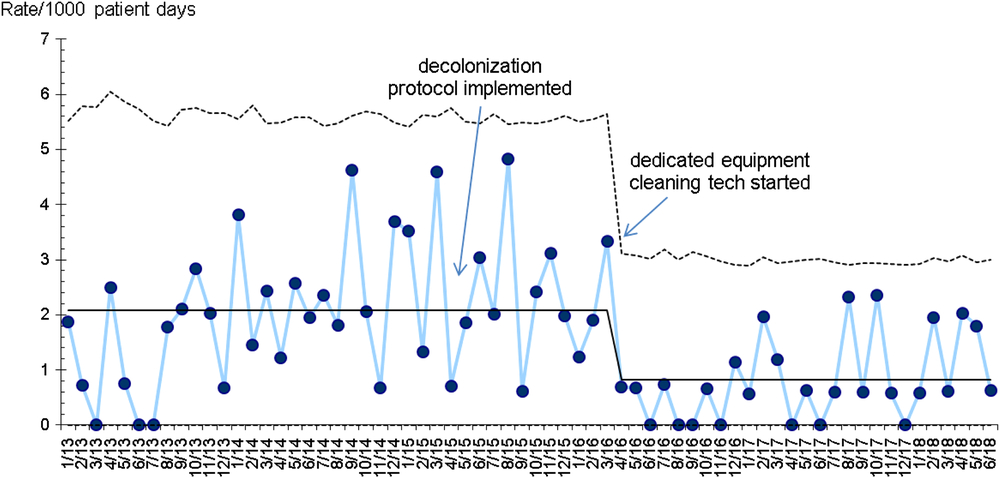
During the study period from April 2015 through June 2018, 151 patients were found to have MRSA. Of these 151 patients, 78 (51.6%) were HA-MRSA, resulting in an overall MRSA acquisition rate of 1.27 per 1,000 patient days. Compared to the baseline rate of 2.00 per 1,000 patient days, the overall HA-MRSA acquisition rate decreased by 37% during the study period (incidence rate ratio [IRR], 0.63; 95% confidence interval [CI], 0.46–0.87).
However, between April 2015 and February 2016, with the implementation of the decolonization alone, the HA-MRSA acquisition rate increased to 2.38 per 1,000 patient days, but the increase was not statistically significant (IRR, 1.85; 95% CI, 0.80–1.73). After adding the dedicated cleaning technician in March 2016 in addition to decolonization, the acquisition rate decreased to 0.92 per 1,000 patient days. The decrease was statistically significant compared to the rate measured during the period when the unit had added decolonization alone (IRR, 0.39; 95% CI, 0.24–0.58) (Fig. 1).
MRSA acquisition rate (u-chart) for the Children’s National Medical Center NICU.

Impact on individual MRSA status
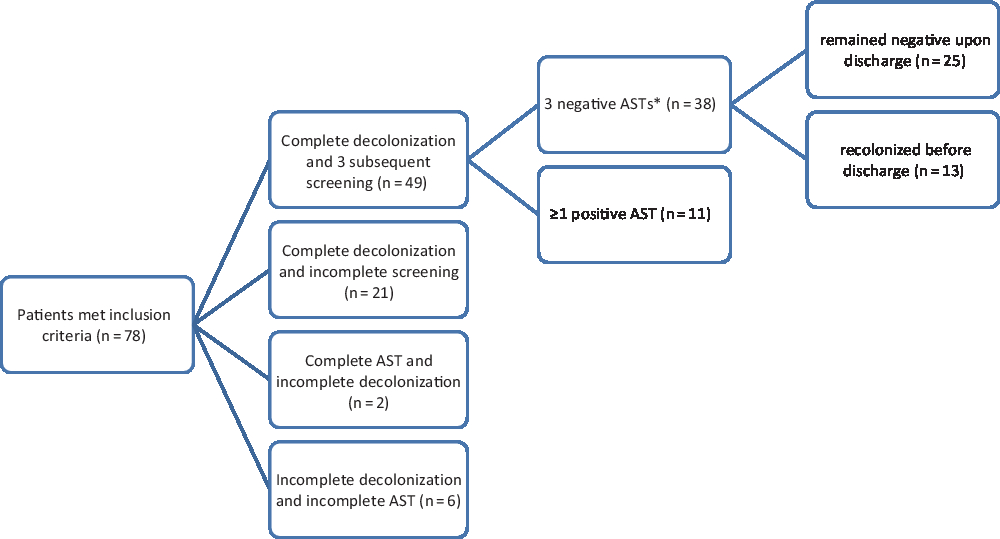
As illustrated in Figure 2, 78 patients with either CA-MRSA or HA-MRSA were started on the decolonization protocol, and 49 patients (62.8%) completing the protocol. Despite the decolonization, 11 patients (14.1%) remained colonized. Of the 38 patients that were successfully decolonized, 13 (16.7%) were recolonized prior to discharge, at an average of 23 days (range, 18–33 days) after completing the decolonization. In contrast, the remaining 25 patients stayed on the unit for an additional 22 days (range, 8–35 days) and were free of MRSA at the time of discharge.
Patients Enrolled for the Decolonization Protocol. *AST: active screening test

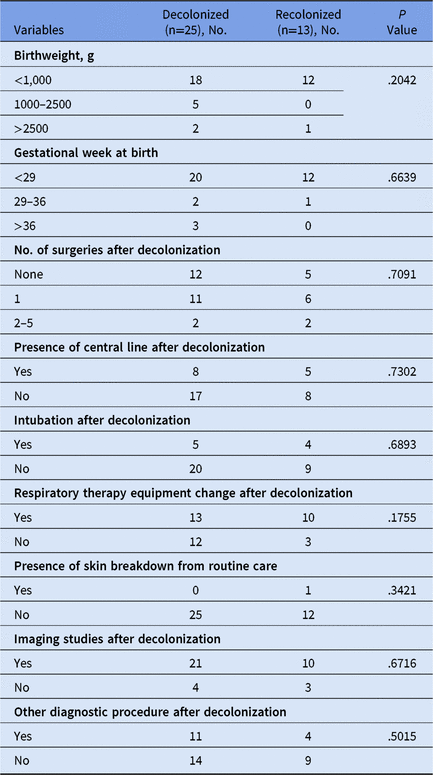
Factors Predisposing a Patient for MRSA Recolonization and Comparison of Staphylococcus aureus Infections by Decolonization Result

Factors predisposing patients to recolonization
To identify predisposing factors for MRSA recolonization, we compared the 13 recolonized patients with the 25 patients who remained decolonized till discharge and found no statistical differences in the 2 groups regarding birth weight, gestational age at birth, frequency of imaging, surgical procedures, diagnostic tests, or use of invasive devices.
Staphylococcus aureus infections
Of the 38 patients who were successfully decolonized, 1 patient had a MRSA infection and 1 patient had an infection caused by methicillin-susceptible Staphylococcus aureus (MSSA) prior to decolonization. After completing decolonization, an additional 2 patients (7.9%) developed a MRSA infection and 8 (21.0%) patients developed MSSA infections. The 3 MRSA infections included 1 neck abscess, 1 tracheitis, and 1 pneumonia. The 9 MSSA infections included 4 respiratory tract infections requiring antibiotic treatment, 2 bloodstream infections, 1 wound infection, 1 abscess, and 1 eye infection.
Discussion
In this retrospective review, we demonstrated that in a NICU with multiple established infection control strategies, the addition of MRSA decolonization with nasal mupirocin, and CHG bathing did not significantly impact MRSA transmission until they were combined with the enhanced cleaning of reusable equipment. In our study, MRSA transmission was defined solely based upon the timing when MRSA was first detected; thus, we were unable to exclude the possibility that these were sporadic MRSA cases resulting from contact with individuals and/or fomites.
Notably, 31% of patients in this cohort failed decolonization or were recolonized within an average of 3 weeks, resulting in an overall success rate of 69%. Previous studies have shown a success rate ranging from 39%Reference Sai, Laurent, Strale, Denis and Byl 9 to 65%Reference Kohler, Bregenzer-Witteck, Rettenmund, Otterbech and Schlegel 17 and up to 80%,Reference Baratz, Hallmark, Odum and Springer 18 varying by patient population, study setting, and the body site from which MRSA was detected. In addition to the unsuccessful eradication of MRSA, 32% of patients in this study developed a Staphylococcus aureus infection, and most were MSSA strains. This finding raises the question of whether the observed MRSA acquisition rate represented a combination of MRSA and MSSA strains and whether family members in close contact with the neonate were potential causes of decolonization failure and reacquisition of Staphylococcal strains.
Notably, this study took place in a setting where stringent MRSA prevention measures have been in place for more than a decade. In the presence of these comprehensive prevention measures, adding dedicated personnel to clean shared equipment significantly reduced MRSA transmission. We recognize that the environment can facilitate transmission of important healthcare-associated pathogens, including MRSA, and cleaning of medical equipment can be complicated. Although the benefits of equipment cleaning remain to be defined, it is nearly always mentioned as an important control component for outbreaks lacking an identified common source.Reference Donskey 19 A UK study reported that having a dedicated technician focused on cleaning clinical equipment significantly reduced MRSA infection risk and saved nearly $51,000 per year.Reference Dancer, White, Lamb, Girvan and Robertson 20 Therefore, having dedicated personnel to clean shared medical equipment could be a cost-effective strategy to mitigate MRSA transmission risks in NICUs.
As a single-center observational study, our major limitations were the small sample size and insufficient statistical power to identify independent factors predisposing a patient for decolonization failure or recolonization. Nonetheless, data are urgently needed to determine the best strategy for MRSA management in NICUs. Thus, a multicenter trial to discern a clear path forward for patients hospitalized in NICUs is needed.
In summary, this study supports the fact that basic infection control strategies remain crucial in controlling MRSA in the NICU setting, while the use of advanced tactics like decolonization should be preserved as a last resort measure and exercised with careful planning and monitoring.
Financial support
No financial support was provided relevant to this article.
Conflicts of interest
All authors report no conflicts of interest relevant to this article.