In the German national election this fall, based on the forecast of the Chancellor Model, the governing coalition will score a resounding victory. Chancellor Angela Merkel enjoys a high approval rating, which puts her at a 2-1 advantage over the challenger, Peer Steinbrück. Although Germany is not a presidential system, where voters elect the chief policymaker, chancellor support has proved to be a strong predictor of vote choice in German national elections. Our forecast model also includes long-term partisanship, which provides a broad base for the governing parties in this election, and length of tenure, which exacts a modest penalty after two terms of office. Since its premiere in 2002, the model has predicted the winner in each election. In a case of perhaps beginner's luck, the 2002 forecast scored a bull's-eye with 47.1%, the exact share of the governing parties; the forecast was posted three months before Election Day. No poll or other model, not even the Election-Day exit polls, came close to this performance; in fact, most people predicted a defeat for Schröder's red-green coalition (Norpoth and Gschwend Reference Norpoth and Gschwend2003).
THE CHANCELLOR MODEL
Our forecast model (Norpoth and Gschwend Reference Norpoth and Gschwend2010) combines predictors of the vote that are familiar to students of elections anywhere (PS 2012, Stegmaier and Norpoth Reference Stegmaier, Norpoth and Valelly2013). The key predictor in our model is chancellor support, hence the sobriquet “Chancellor Model.”Footnote 1 Chancellor support correlates very strongly (0.79) with the incumbent vote in the 16 federal elections.
To capture the long-term partisanship of the German electorate, we use past election returns. For the most part, we take the average vote in the last three Bundestag elections. This measure of partisanship correlates quite strongly (0.54) with the incumbent vote in the 16 federal election. Finally, our forecast stipulates a penalty for length of tenure in office. The federal governments in Germany, on average, have lasted three terms. The number of terms a government has been in office (or the leading party, in the event that the coalition composition changed), is the third and final predictor of our forecast model. It correlates to a moderate extent with the incumbent vote (−0.39).
MODEL ESTIMATES
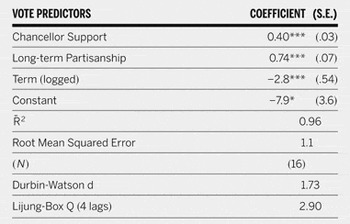
As seen in table 1, all three vote predictors prove to be statistically significant beyond any doubt, with signs that are all in the expected directions. Each predictor brings something distinct to the voting table. Taken together the three predictors capture the actual vote of incumbent parties in Bundestag elections from 1953 to 2009 with an average error no larger than 1.1%. By another measure of fit, the explanatory power of the vote equation with the three predictors reaches 96%. Such a performance inspires strong confidence that the model can make reasonably accurate forecasts about future elections.
Statistical Estimates of Vote Predictors

Note: Model estimation based on elections 1953–2009.
* p < .05;
** p < .01;
*** p < .001
THE FORECAST FOR THE 2013 ELECTION
The latest poll numbers on chancellor support available at this writing show Chancellor Merkel leading her challenger Peer Steinbrück by a 61-29 margin (April II Politbarometer of the Forschungsgruppe Wahlen). This lead is no fluke. Merkel has enjoyed a 30-point edge throughout the year so far. The April level of support, along with the long-term partisan base of the governing coalition and two terms of office, yields a forecast of 51.7% for the parties in Merkel's government.Footnote 2 Given a forecast error estimate of only 1.2 points, we can say with better than 99% certainty that Merkel will win the 2013 Bundestag election. Note that it does not take 50% to “win” an election in Germany. With a good deal of votes going to parties that fail to win seats in the Bundestag, the winner needs no more than 48% of the votes cast; in 2002, the red-green coalition managed to win with 47.1%. There is, of course, a wild card in the German election game this year. It is the Free Democratic Party (FDP), Chancellor Merkel's junior partner. Polls have shown it consistently falling short of reaching 5% of the vote, the minimum to get seats in the Bundestag. Our model provides no forecast of the shares of each party in the governing coalition, just the combined share. If the FDP were to fall short of the 5%-vote requirement, Merkel's party (the Christian Democrats) might not win a majority in the Bundestag. As a matter of historical record, the FDP has never suffered that fate in more than 60 years of Bundestag elections. It is well established that the FDP benefits from “loaned” votes coming from supporters of its major partner. But even in the unlikely event of an FDP elimination, our forecast makes it highly unlikely that Merkel would fail to win a majority of seats. In such a scenario, the threshold for winning would be quite a bit lower than 48%.