Contracts shape relationships. Their optimal design and enforcement continue to draw the attention of historical and theoretical economists. Investigations of business contracts, such as franchises, intra-community relational contracts, and apprenticeships, testify to the varied forms and uses of contracts in informationally poor and institutionally flexible environments.1
On contracts, see Greif, “Contract Enforceability”; on apprenticeships, see Hamilton, “Market.”
Although contracts represent dyadic microeconomic relationships, they can have long-term, macro consequences. Douglass North and others, for example, have described that the evolution of third-party institutions to enforce contracts and protect merchants as crucial to the rise of Western economic ascendancy in general.
2 North and Thomas, Rise; North, “Institutions'; and Milgrom, North, and Weingast, “Role.”
Since Armen Alchian and Harold Demsetz described the firm as a collection of contracts, the history of the firm has become closely associated to the history of contracts, which enable the firm to cohere.
3 Alchian and Demsetz, “Production.”
In the case of English chartered companies, the “merchant empires” of the seventeenth and eighteenth centuries, the form and resilience of underlying contracts made possible these early corporate forms.4
The companies devised contracts (both formal and informal) to deal with the problem of managing their agents abroad. The most notable joint-stock companies, the East India, Royal African, and Hudson's Bay companies, stationed their employees across the Indian Ocean littoral, the West African coast, and northern Canada. Although they operated in different markets and engaged different cultures, the companies faced the common problem of “managing the manager.”
5 Carlos and Nicholas, “Managing the Manager.”
The employment relation between company directors and agents had to withstand the tensions arising from diverging incentives and private information. The temporal and spatial distance between agents and directors also bore heavily upon the relationship in an era of slow communication and hazardous travel.
This classic agency problem has been the subject of much recent attention.6
Carlos, “Principal-Agent Problems” and “Bonding”; and Carlos and Nicholas, “Agency Problems” and “Managing the Manager.”
The literature, focusing on the Hudson's Bay and Royal African Companies, explores the incentive and monitoring systems used by the companies to address the agency problem. Oaths, pre-employment bonds, relatively high wages, surprise searches of incoming ships, and performance indices were used to ease the inherent tensions associated with risk sharing and incentive alignment. In the case of the Hudson's Bay Company, argue Ann Carlos and Stephen Nicholas, the company fostered a social system that encouraged solidarity and loyalty.
7 Carlos and Nicholas, “Agency Problems,” p. 872.
When agents violated orders against private trade or did not fulfill performance expectations, the directors took the matter seriously. Agents were dismissed, rotated, and their bonds and property were subject to forfeit. Carlos and Nicholas present the case that managerial initiatives effectively controlled agent behavior and that opportunism did not exist.
8 In a debate with Carlos and Nicholas (“Theory”), Jones and Ville (“Efficient Transactors” and “Theory”) take issue with this position. Their criticism turns on Carlos and Nicholas's lack of specific evidence indicating that transactions cost considerations justified the hierarchical organization of the chartered companies. Jones and Ville instead view the firms' hierarchy as enabling better extraction of monopoly rents in their product markets. However, they too provide no direct evidence to support their alternative hypothesis.
Scantly covered in this literature is the overseas trading firm that bestrode London's commercial world like a colossus: the English East India Company.9
Anderson and Tollison (“Adam Smith's Analysis”) and Anderson, McCormick, and Tollison (“Economic Organization”) explore the case of the East India Company to redefine and defend Adam Smith's theory of the firm, and to argue that the company was a multidivisional enterprise similar to those observed in the United States in the 1920s. In both articles the well-articulated economic arguments are not complimented by an equally careful attention to historical sources and literature.
Founded in 1600, the company held a royal (and later Parliamentary) monopoly over English trade with Asia, contributed significantly to state finance, and for a time played an important role in the evolution of joint-stock organizations.
10 Alborn, Conceiving Companies, chapter 2; Baskin and Miranti, History, chapter 2; and Harris, Industrializing English Law, chapter 2.
The company's commercial activities are also writ large in the establishment of British rule of the subcontinent, 1757–1772.
11 Sen, Empire; and Watson, Foundation.
The primary focus of the article is to answer the question “what sustained the employment relationship in the first half of the eighteenth century?” The employment contract did not vary across employees, called “servants,” and therefore the present objective is not to explain the determinants of contract form. Instead, the reverse view is taken. The nature of the employment contract will be carefully delineated and the different features will be assessed in terms of their ability to mitigate principal-agent problems. In an informationally poor environment, which incentive and control mechanisms were empirically important?
Company employees were expected to trade on behalf of the directors in London and also to trade on their own account. This article argues that the permission to trade privately coupled with the use of dismissal were the pivotal elements keeping the employment relationship intact and functional in a period of economic growth and political stability in Bengal, India.12
The Bengal establishment was characteristic of the company's presidency-factory system. Only in Canton, China and briefly in Mocha, Aden was the company's trade restricted to on-board transactions managed by a supercargo.
Private trade provided high-powered incentives for employees at low cost to the company. The positive probability of dismissal encouraged employees to devote effort to company trade and thereby retain access to profitable intra-Asian market.
The simultaneous pursuit of both “public” trade and “private” trade is formally called multitasking.13
Geraghty, “Technology,” pp. 536–40, describes the “factory system” during Britain's Industrial Revolution as the result of the multitask agency problem faced by manufacturing entrepreneurs. For contemporary applications of the multitasking problem, see Slade, “Multitask Agency”; and Casas-Arce and Hejeebu, “Job Design.”
The analysis of the multitask principal-agent problem, was first articulated by Bengt Holmstrom and Paul Milgrom, but has recently been expanded by Pablo Casas-Arce.
14 Holmstrom and Milgrom, “Multi-task Principal-Agent Analyses”; and Casas-Arce, “Essays.”
Holmstrom and Milgrom argue that the weaker an agent's performance incentives, that is, the less responsive the agent's wage is to changes in firm profits, the more effort he will put in private trade—should it be allowed. Hence allowing private trade makes sense only when the agent is financially responsible for company trade. Extending the Holmstrom-Milgrom result, Casas-Arce has shown that when synergies between public and private trade exist, the discretion to pursue private trade can itself serve as an incentive mechanism even when company wages are flat.
15 In the East India Company, synergies between public and private trade arose from the private use of company assets, most importantly the company's trading privileges in Bengal. The economic rational behind private trade, benefiting both principal and agent, will be described fully in the sections that follow.
Throughout the article contrasts will be drawn between the East India Company and the English chartered monopolies trading the Atlantic, the Royal African and Hudson's Bay companies. Contrast will also be drawn between the East India Company and its larger Dutch rival the Verenigde Oost-Indische Compagnie (VOC), the United East India Company. Although each company wrote contracts aimed at a common purpose—mitigating tensions inherent in the principal-agent ties—the mechanisms that worked for one did not necessarily work for another. Fixed salaries were the norm in all the companies, but in the present case they were considered little more than a retainer. The use of formal contracts and pre-employment bonds was also common. However, in the English company bonding had little currency as an enforcement mechanism. The VOC, unlike the EIC, denied its dienaren profit opportunities in the intra-Asian trade because the VOC participated in that trade as a corporate body.
The present focus on the centrality and economic coherence of the English system of private trade further contrasts with the ambivalence toward private trade found in the historical literature. For Ian Bruce Watson, private trade was initially indulged because the inability of the directors to enforce its prohibition.16
Watson, Foundation, p. 74.
He argues against the idea of “effective control” especially when directives from London threatened the “exigencies of private trade.”
17 Watson skeptically interprets private trade as a signal of managerial weakness, the powerlessness of the directors to control far-flung employees. Yet Watson contradicts himself in concluding that “the Company managed to exercise tangible and relatively effective controls through its regulations.”
18 Such ambiguity is echoed in K. N. Chaudhuri's position. He acknowledges that “the problem of exercising effective control remained endemic.”
19 Chaudhuri, “English East India Company,” p. 118.
Yet overall he emphasizes the company's bureaucratic success. Both authors highlight the extended temporal and spatial distance between directors and servants.
20 The outbound voyage took from seven months to a year. The total transport time by sea therefore was between one-half and two years (though longer durations were possible). From an economic perspective, the time gaps and resulting information asymmetries imply contract incompleteness rather than contract failure.
Peter Marshall's doubts arise in part from his careful attention to the mortality risks faced by Europeans in eighteenth-century India.
21 Marshall, East Indian Fortunes, p. 217.
Unlike Watson, Chaudhuri and Marshall accept the overall resilience of the servant-director relationship. Yet they are unclear on what the basis of that resilience may be.
Although the relationships between company directors and servants were indeed subject to severe constraints, the overall contract took such constraints into account. East India contracts were successful in their main intent, the acquisition of Asian commodities through the agency of employees. The argument advanced here is that skepticism of managerial control in the pre-Plassey (1757) period is unwarranted. Contracts were successful because they were based upon a coherent design of economic incentives (private trade) and controls (dismissals) that kept employee malfeasance within tolerable bounds.
The findings are empirically grounded in an array of primary sources available at the India Office Library, the British Library, and the Public Record Office. Data such as company correspondence, minutes of directors' meetings, and records of legal cases initiated in the Court of Chancery and the Mayor's Court of Calcutta are utilized. In addition, several datasets were constructed including a panel dataset that profiles the work histories of all servants who joined the company's service in Bengal between 1700 and 1756; one that provides the year and cause of departure for the same servants; and one that tracks all 1,493 remittances made in the form of bills of exchange by the British community from 1746 to 1756. Together the material provides a comprehensive view of the employment experience within the English East India Company.22
The three are in fact subsets of larger datasets that tracks all 682 employees, their job assignments, reasons for exiting, and remittances, through 1784. We restrict our attention here to contract arrangements obtaining from 1700 through 1756.
COMPANY'S COVENANTED SERVICE
Between 1700 and 1756 the directors sent 303 civil or “covenanted” servants to Bengal, the company's principle input market. Aspirants to the service, typically about 17 years of age, petitioned an individual director among the 24-member Court of Directors.23
The total number of servants in Bengal is derived from annual rosters of covenanted servants (OIOC L/F/10/1-2). A sample of 212 servants from 1755–1765 (OIOC Home Miscellaneous Series 78, 83, 85, 107, 129, 288, 324) indicates that the average age at the time of appointment was 17 years and 5 months.
Overseas employees were grouped into four ranks of increasing responsibility: writer, factor, junior merchant, and senior merchant. Within each rank were numerous job assignments, called “stations.” Thus a factor might work in the station of Assistant to the Warehouse Keeper or Assistant to the Accountant whereas positions on the presidency councils were reserved for those who held the rank of senior merchants. The highest position was that of Governor, also called President. He along with an 11-member Council of senior merchants jointly cast ballots on operational decisions. Each servant was assigned to one of three presidencies, Bengal, Madras, or Bombay—the largest and most important in the eighteenth century being Bengal. The presidencies were independent of each other and each communicated directly with the directorate in London. Within each presidency were smaller factories, such as Casimbazar, Patna, and Dacca, that reported to the seat of the presidency, in this case Calcutta.
The employment contract linking servants with Directors had two parts: a “covenant of indenture” and a bond, signed by two sureties on the employee's behalf.24
Covenants and bonds available at the Oriental and India Office Collection (O/1/1-2) begin in the year 1740 although the practice of formal contracting begins in the earliest years of the company. See First Letter Book of the East India Company 1600–1619 for examples of covenants in the era of terminable joint stocks. An index of covenants and bonds between 1607 and 1770 is available at the John Rylands Library, Manchester. The index, entitled “List of EIC Covenants and Bonds” (Eng. MS 153), unfortunately does not contain the actual covenants or bonds. For a transcription of MS 153, see Peter Bailey, 1986, O.I.R. 354.5p in the British Library. The covenants and bonds of Lord Clive and Harry Verelst are available in Mayor's Court Proceedings (OIOC P/154-5 series). One covenant dating from 1759 appears in the Home Misc. Series H/78. An example of an oath dating from the 1690s can also be found in the Goldsmith's-Kress Collection, item number 2796.9.
Formal contracts reveal those aspects of the relationship most crucial to the contracting parties: duration, specification of duties and responsibilities, “zones of tolerance” of acceptable behavior, incentive schemes, and specification of contingencies that might lead to termination or legal action. A common form was used for all servants regardless of for which overseas settlement they were destined. A lengthy, printed form, the covenant of indenture for new writers would last for five years and would be automatically renewed as long as the servant remained with the company. The servant promised to obey the court's orders, to keep accurate accounts and diaries, and to inform the court of the names and practices of anyone intending to deceive or hinder it. The court expressly prohibited the servants from trading goods between the East Indies and Europe, from wasting or misusing the company's treasure, and from supplying capital or in any way aiding a foreign trading company. Servants guilty of such practices would be liable to dismissal, suspension, or to prosecution in the Courts of Chancery or Exchequer. Furthermore servants caught carrying goods between Europe and the East Indies, according to the covenant, would be fined 200 percent of the value of the goods shipped (100 percent if he confessed to violating the company's monopoly).
25 A detailed review of 43 specific clauses in all 561 surviving covenants between 1740 and 1813 has revealed a remarkable continuity. Only in two instances, both occurring after 1757, are the changes significant.
The contract specified the following incentive schemes: a fixed annual salary, promotion based on seniority, and the privilege of trading privately within Asia. A writer earned £5 per year. After five years he was promoted to the rank of factor and received £15 per year. After three more years he qualified for promotion to junior servant at £30 per year. After another three years he could become senior merchant earning £40 per year.26
Despatch Book, vol. 95, p. 530. Carlos, “Bonding,” pp. 320–24, shows that the salaries for the Royal African Company began at £40 per annum in the late seventeenth century. After three years of service, a factor would be promoted to the next rank and receive as much as a five-fold increase in salary. According to Lequin, “Het Personeel,” chapter 2 and appendix 2, VOC salaries were higher than salaries in the corresponding ranks of the East India Company. At the lowest rank of “assistant,” the VOC paid nearly six times higher than the East India Company's writer. With promotion, however, the gap narrowed dramatically. The VOC's Directeur van Bengalen in Chinsura was paid £216 per annum whereas his English counterpart, the President of the Council in Calcutta, was paid £200 per annum between 1738 and 1760. At the entry level, East India Company salaries were paltry by the standards of the African Company and the VOC. As one moved higher up the ranks, African salaries remained significantly higher, whereas the differential with the VOC narrows.
After leaving the service, servants received no regular pension.
27 The Company's hospital, and later church and school, at Poplar was founded in 1627. It provided housing and allowance for food to the company's former seamen. The Poplar Fund began providing pensions to ex-Directors and civil servants from 1718. Admission to the facilities and grants of pensions were given as a charity and decided by the directors on a case-by-case basis. See Foster, John Company, chapters 10 and 12.
The meaning of private trade is made explicit in the covenant itself: “the said Company doth accordingly license the said [servant's name] … freely to trade and traffic for his own account only, from port to port in India, or elsewhere within the limits aforesaid … without any let, hindrance, or interruption from them the said Company.”28
OIOC O/1/1 covenant of John Hall. The private trade of company servants is to be distinguished from the private trade of ships captains. Captains were allocated a certain amount of tonnage or specified quantities of different goods he could legally take out and return from the Indies. These allowances varied over time and across ranks of a ship's crew. See An abstract of the orders and regulations of the Honourable Court of Directors of the East-India Company, British Library 1568/6220.
The private trade clause acknowledged and lent support to the servants' pursuit of fortune. It injected an entrepreneurial element in the servants' activities in Asia, allowing them to run their own side businesses. Servants invested in numerous commodities such as rice and raw silk, purchased in one port and sold in another. Investment in sea loans,
respondentia, and bottomry, between Calcutta and Madras and Calcutta and Surat were also popular.
29 Saxe, “Fortune's Tangled Web,” p. 13.
Precious gems, in particular diamonds and corals, traded well within Asia and had the advantage of being easily transported back to Europe.
30 Yogev, Diamonds, chapter 8.
English servants participated in the Asian emporium trade to China and the Archipelago, from coastal India to the Persian Gulf and Red Sea. They also played a significant role in redirecting Asian maritime trade to European-controlled enclaves.
Directors also frequently reminded servants that they enjoyed the value of the company's “privileges and protection.”31
Servants enjoyed these as part of the terms of employment. By contrast, English freeman licensed to trade in Asia had to pay 2 percent consulage on their imports and exports at English settlements. For an articulation of this point see Despatches from England, 1681–1686, Letter to Hugly, 3 October 1684, p. 125.
Enjoyment of the company's protection meant that all the security measures associated with the company's trade. Its forts and secure warehouses for example, could also be used to protect the servants' personal property and business dealings. “Privileges” referred to trading concessions, important intangible assets, acquired from both the English government and from several Asian governments. From the English government, the company of course acquired its charter that protected it from English competition in Asia. From the Mughal government and from the
Nizamat of Bengal the company obtained concessionary rates on customs and inland transit taxes. The company's privileges in India extended
de facto to their servants' private trade.
Augmenting the permission of private trade, the company' protection and its privileges, the directors provided a mechanism for remitting money home: bills of exchange. The bills operated like modern checkable deposits. Servants deposited rupees in the company's treasury in Calcutta and the company paid the sterling equivalent to designated beneficiaries in London. As early as 1680, the directors make an unqualified commitment to honor bills drawn on them “for the encouragement of the Company's presidents, agents, chiefs, and factors to dispose their estates in India upon their return for England … notwithstanding any pretension, claim, or demand whatsoever.”32
Despatches from England, 1680–1682, p. 9.
By 1705, the directors acknowledge that remitting savings on bills has the added advantage that it avoids the necessity of servants' sending their savings home in the form of commodities.
33 See Court Minutes OIOC B/49-52, especially B/49 Report by the Committee of Treasury, pp. 683–86, for the directors' concern that bills be encouraged so as to avoid the servants' remitting their savings in the form of “prohibited goods.”
Thus bills of exchange were mutually beneficial: savings from private trade could be safely remitted in forms that posed no competition at the company's quarterly auctions.
The second formal part of the contract was the bond. Upon appointment by the court, the new employee had to enter into a bond with two sureties in the amount of at least £500.34
£500 applied to the rank of writer, £1,000 for factor, £2,000 for junior merchant, £4,000 for senior merchant, and £10,000 for the position of governor (O/L/1-O/L/27). Bonding within the Hudson's Bay and Royal African companies is described in Carlos, “Principal-Agent Problems” and “Bonding.”
A technique common among the English chartered companies, bonding gave the company the right to sue the sureties in the event the servant failed to honor the terms of his covenant.
35 The practice of having two persons stand for surety dates at least to the seventeenth century. The person who stood for surety for students studying at Lincoln's Inn was called a manucaptor. Lincoln's Inn required manucaptors to be members, thereby limiting admission to those with family or social connections with existing members (Peacey, “Led by the Hand”). I thank Henry Horwitz for this reference.
If a servant were caught embezzling funds overseas, for example, the company could legally proceed against the sureties in Chancery for restitution up to the amount stated on the bond. If the sureties were living in Bengal, action could be taken against them in the Mayor's Court of Calcutta.
36 Founded in 1727 by royal charter, the Mayor's Court adjudicated over merchant's disputes, criminal concerns, and civil matters such as registration of wills. The mayor and three ranking alderman were always senior covenanted servants who also sat on the presidency council. See OIOC Despatch Books E/3/105-109 on the directors' specific advices on modeling the Mayor's Court after the Court of Chancery. Fawcett, First Century of British Justice, also provides much useful information on English courts in India before 1800.
Theoretically the bond insured the company against costly violations of the contract.
Although bonds had the potential to constraint opportunism, they did not. There is no evidence to suggest that the bond played a role in sustaining the employment relationship. Directors never exercised the ability to reclaim losses from a bond sponsor. Neither in Chancery nor in the Mayor's Court of Calcutta did the company ever sue any of the bond sponsors despite knowledge of servant malfeasance.37
Based on existing Chancery records (PRO C11 and C12), the company filed suits against 52 individuals between 1714 and 1800. In evaluating 32 of the 52 cases, I found not a single case in which the defendant is a surety for a company servant. The issue of forfeiture of the bond simply did not arise in the Chancery records. Nor did a single suit against a bond sponsor arise in the records of the Mayor's Court. The following Mayor's Court Proceedings were reviewed: OIOC P/155/10-13 and P/154/46-47. The first group refers to the first three years of the court and the second group refers to the years 1746-1747. I also reviewed proceedings against individuals known to be covenanted servants, P/155/23 and P/155/42.
In letter after letter between the directors and servants in Bengal, furthermore, directors never invoked the bond as a cost of noncompliance with company orders. Thus the bond did not mitigate opportunism by threatening the servant's social standing with his sponsor.
38 Carlos and Nicholas, “Theory,” p. 922, view the lack of evidence on suits brought against bond sponsors in the Hudson's Bay Company and Royal African Companies as evidence for the effectiveness of bonds in attenuating opportunism. They maintain that because bonding was so successful, legal action was unnecessary. Yet they offer no evidence to corroborate such an interpretation.
Instead of bonding, directors had more direct means to discipline servants. As elaborated in the sections ahead, dismissal was certainly available and implemented. The company could also directly recover financial loses from the estates of servants who died in India. Prior to the establishment of the Mayor's Court of Calcutta, the company confiscated the property of servants who died in India.39
Fawcett, chapters 12 and 13.
Claims against an estate were settled before family members could have access to it. The company could also sue the servant directly for violation of the covenant. Of the 32 Chancery cases examined, 23 cases directly involved the violation of the terms of the covenant. The company sued the servant directly or the executor of his estate for breach of covenant. If the proportion in my sample, 23/32, holds for the total population of suits, then one might expect to find a total of 37 cases involving violations of covenants. This would suggest legal action against roughly 1.8–3.6 percent of the total population of civil servants over the eighteenth century.
40 The estimate is based on an all-Asia civil population estimate ranging from 1.5 to three times the Bengal civil population. I have calculated the total population of civil servants for Bengal based on civil establishment lists OIOC L/F/10/1-2.
Consider the case of Wadham Brooke, a senior merchant with 28 years of service. In India in 1746, Brooke was accused of embezzling C.Rs. 51,654 from the company during the sale of its imports. He had an updated bond at the time registered with the company in England. Instead of suing his sureties, the company dismissed him from service and brought legal action against him in the Mayor's Court of Calcutta. Even with the company's own senior servants presiding, the Mayor's Court could not find sufficient evidence of malfeasance and the case against Brooke was dismissed.41
The company thus had three direct means to contain malfeasance and recover losses: dismissal, possession of the servant's property, and legal action on the covenant itself.
42 The expense and time involved in proving irrefutably that breach of covenant had occurred may explain the company's reluctance to sue the bond sponsors, a third party to the employment contract. Most of the Chancery Court cases against servants were initiated by the company five or more years after the alleged violation took place. The earliest interval between an alleged violation and the initial filing of a bill of complaint against the party was three years. After the initial filing, years might pass before the court's investigation was complete. Some defendants died before the case was settled and the company attempted to revive the suit against the defendant's estate. In E.I.C. vs. Spencer (PRO C/11/848/78) the company attempted to revive a complaint nearly two decades after the original incident. Suing a servant for breach of covenant was an expensive, cumbersome affair. Suing a third party for breach of covenant would not have been easier.
Access to cheaper and more direct enforcement mechanisms explains why bonding was unimportant.
So why the East India Company continued with the practice of bonding well into the nineteenth century remains obscure. In 1785 not even the company's solicitor could explain the reasons for bonding. When asked to explain the practice, he and the company's Secretary indicated “the form of the covenant had in this respect been ever what it now is and that there had at first been some good cause for it but they did not intimate even a guess what it might be.”43
1785 HMS vol. 79, 99 43-60. Based on a review of the sureties of all extant bonds, a market for bond signing appears to have arisen among the cloth and produce stalls behind the company's Leadenhall offices. Between 1798 and 1813, a single slop seller, Daniel Stalker, signed 50 bonds.
Although bonding appears not to have brought social pressure on servants to obey directors, it remains possible that servants nonetheless internalized implicit social expectations of fidelity and diligence. The mechanism that could have brought this about was insider hiring. Investigations by Marshall, James G. Parker, and James M. Holzman demonstrate that bonds of friendship and kinship between Directors and servants were commonplace.44
Marshall, East Indian Fortunes; Parker, “Directors”; and Holzman, Nabobs.
Insider hiring gave directors better information on the potential trustworthiness of their servants. Especially given the speed of communication between the directors and servants, “judgement of character really mattered.”
45 Grassby, Business Community, p. 178.
Yet the incidence of insider hiring does not itself imply that social and family ties aided corporate goals. Patronage ties could have encouraged directors to be exceptionally tolerant of bad behavior or large variations from the order lists, for example. To infer that the company's hiring practices systematically aided contract enforcement requires more corroborating evidence than is currently available.
Bonding and insider hiring were both part of the employment relationship in the East India Company, yet neither can be shown to have a played a pivotal role in sustaining that relationship. The sustainability of East India contracts owed primarily to the valuable privilege of private trade and the use of dismissals. These mechanisms were sufficiently powerful to withstand the exogenous constraints on the relationship.
CONSTRAINING THE CONTRACT: INFORMATION AND MORTALITY RISK
The contractual relationship integrated both incentives and control mechanisms. These were put in place to mitigate the problems of information flows and mortality—problems which were outside of the control of both principal and agent yet bearing heavily upon the relationship. The one-to-two-year lags in communication saturated the relationship with information asymmetries and raised the cost of enforcing contracts. The asymmetry revealed itself directly as when the servants failed to provide adequate detail on transactions or when standards of legibility, of narrative form, and of bookkeeping were not met.46
Kitty Locker, “Creating Formula,” argues that the company created formulae to respond to recurring rhetorical problems including determining what the audience already knows. One formula used throughout the century was structuring the letters under fixed headings or topics. In the letter from the directors to the President and Council of Bengal, dated 29 November 1700, they write, “as we would have you collect all matters under several heads as we have determined to do … First touching upon ships and goods sent from home, Second concerning our investments from India and wherein deficient if they are so, Thirdly of the trade in general and our accounts in particular, Fourthly of the revenues and fortifications, Fifthly of factors and writers of officers and soldiers, Sixthly of any matters relating to the New Company our Competitors. By this method we may have at once a full view of our affairs” (OIOC Despatch Books vol. 93, pp. 373–74).
Indirectly, the information problem revealed itself through an incessant inspection and complaining of costs. As few directors had first-hand experience in India, they insisted upon full clarification of how transactions were being conducted and how the company's interest was being served. With delayed, filtered information on decisions taken by agents, directors had an approximate idea of true costs.
In 1731/32 the directors felt annoyed that the servants were not following the order lists for textiles and had sent home far more fine varieties of cloth and less coarse ones than had been demanded.47
The 42-paged letter of 11 February 1731/32 belongs to a set of 30 years of correspondence examined for this project. Typically the early years of each decade in the period were chosen. All of the correspondence during the 1740s was reviewed. For each year there was at least one and sometimes three General Letters to the President and Council.
The products received were also considered to be overpriced. In a previous letter the servants had mentioned that the Indian merchants were badly affected by the present dearness of cotton. The directors marveled at that excuse “calculated purely to amuse us and to lay asleep our so just complaints of the large quantity of fine goods … in which the dearness or cheapness of cotton so little varies the price, a small quantity being required in the piece of such goods.”
48 OIOC E/3/105, letter of 1731/32, para. 75.
In another instance the issue was the increased price of raw silk (purchased for Europe). The price rise had been in past years explained by the death of worms (OIOC E/3/105, letter of 1731/32, para. 54). The directors apparently tired of that excuse. They wondered at the servants' obtaining raw silk for their private trade and “to let us have but very little and that little at excessive high prices, gradually rising upon us year after year.”
The persistent problem of trying to decide if an action taken more than half a year ago in India reflected “mature consideration” or malfeasance imposed limits on the contractual relation. It meant that the directors could not provide financial incentives for reported cost reductions. Transactions in the input markets were observable, but not verifiable from London. Consequently rewards based on cost-savings in Bengal would not be viable.
The second exogenous constraint on the sustainability of the employment contract was the high degree of mortality of Europeans in Asia. Mortality interacts with contract enforcement by lowering the duration of the relationship. Claude Ménard explains that duration is a signal of the commitment of both parties to the relationship.49
Ménard, “Enforcement Procedures.”
Thus the risk of mortality undermines the servant's ability to commit and thereby makes enforcement inherently more difficult. Death in active service accounted for 184 or roughly 61 percent of the departures from employment.
50 In addition to the 184 who died while in active service, 40 were dismissed, 71 left the service voluntarily and eight left for unknown reasons. The dismissal information was derived from Peter Marshall's unpublished biographical summaries of company servants. Marshall used the summaries in his 1976 study East Indian Fortunes. The two data items borrowed from the summaries are the year of departure and reason for departure for each servant. Marshall originally obtained that data from well-known archival series such as Coast and Bay Abstract of Letters Received, Bengal Letters Received, Bengal Public Consultations, and Fort William-India House Correspondence. I have verified the accuracy of Marshall's year of departure information against my own estimates of the year of departure using the Bengal Establishment Lists. I have also reexamined the reasons for departure mentioned in the Fort William-India House Correspondence. Marshall's careful summaries proved to be a model of precision.
As
Figure 1 shows, mortality affected employment most crucially in the first 15 years.
DURATION OF EMPLOYMENT, COMPANY SERVANTS IN BENGAL 1700–1756
The median length of service was 11.3 years. Death explains the departure of a full 78 percent of those who left within the first five years and 80 percent of those who left in the second five years, 53 percent in the third five-year period. Francis Wollaston's case was not uncommon: At age 17 he boarded an East Indiaman bound for Bengal. Upon arrival in September of 1750 he was assigned to work in the accounts office. He died less than nine months later. Given that most young men joined the company between the ages of 15 and 19, many did not live beyond the age of 30.
A high risk of dying means that the servant does not know when the relationship will end, this year or next. Calcutta merchant and brother-in-law to President John Stackhouse, Henry Harnett expresses this sad point in his will, “The uncertainties of this present life, and the certainty of being deprived of it, I know not when.”51
So familiar were company servants to death's door that at Bombay, there arose the saying that “two monsoons are the age of man.” I have found that for the cohort of servants who entered the Bengal service between 1700 and 1725, the probability of an involuntary departure in the first five years of service was 31 percent.
52 Hejeebu, “Microeconomic Investigations.”
Those who survived the initial years had a 38 percent chance of “dying” in the second five years. The number falls to 32 percent in the third five-year period of service. These magnitudes would not have been known to servants at the point of signing the contract. Upon arrival, however, Wollaston's mates would have certainly revised downward their expectations.
As with the temporal and spatial gaps, the high mortality risk had contractual implications. The regular presence of disease and sickness constantly reminded a servant of the end of his employment. The closer one operates to the point of termination of his contract, the shorter will be his decision-making horizon.53
In the organizational economics literature, the “horizon's problem” is associated with a CEO who may, on approaching retirement, cut back on long-term expenses in order to boost the short-term earnings on which her compensation is based. See Dechow and Sloan, “Executive Incentives”; and Baber, Kang, and Kumar, “Accounting Earnings.”
It meant that myopic servants could not be motivated by the low and relatively flat wage scale the company offered. Mortality risk meant that servants needed an incentive scheme that rewarded work effort with high short-term earnings, rising with job tenure.
MECHANISMS THAT WORKED: PRIVATE TRADE AND DISMISSALS
The contract features that provided work incentive while mitigating opportunism were the permission of private trade and the positive likelihood of dismissal. In the period under review, private trade was a deliberate incentive mechanism.54
Indeed private trade was well established before 1700. After a series of attempts to allow limited private trade in the 1660s, the company shifted to a system of complete freedom of trade in the Indies in the 1680s. In November and December 1667 directors found positive and negative reasons for allowing it: “to encourage persons to undertake and proceed cheerfully in the management of the Company's affairs” and to discourage servants from participating in the company's calico and pepper markets, for example (Sainsbury, Calendar, pp. 396–415). The initial shift out of the intra-Asian trade and toward full private trade occurred over three decades. A detailed analysis of the company's seventeenth-century strategy of abandoning its corporate role in intra-Asian trade thus exceeds the scope of this article.
In a letter to Bengal dated 12 Feb 1730, the directors write, “Private trade, the indulgence that we allow to our covenanted servants to trade freely from one port to another without restriction, is what no other company ever allowed with the same latitude, but ourselves. However if we find that this indulgence is abused to our prejudice we can and will restrict it.”
55 E/3/105, p. 209, para. 45.
Directors clearly understood the value of this indulgence.
Dreams of fortune from private trade attracted young men to the India service. Private trade gave them a reason to join and, more importantly, to stay with the company and obey its orders. What exactly a fortune meant of course varied with individuals and over time. In 1714 Joseph Collett, while President at Bencoolen, reportedly earned £2,000 per year.56
Hamilton, “New Account,” p. xiv.
By contrast in the flush decade after Plassey, Colonel Rennell, the company's Surveyor-General in Bengal, apparently considered £6,000–8,000 in six or seven years obtainable for all civil servants. If trading opportunities were favorable, “£30,000 or £40,000 was possible.”
57 Spear, Nabobs, p. 157, n. 94.
Relying on anecdotal and impressionistic evidence, the secondary literature is unanimous in the view that enormous sums could be earned through private trade.
58 Marshall, East Indian Fortunes; and Watson, Foundation, provide numerous examples on the returns from private trade.
To illustrate the instrumental role of private trade, data on individual remittances were collected.59
Fourteen hundred ninety-three individual bills from 1746 through 1756 can be traced in the E/4 series and in the Fort William India House Correspondence. The original correspondence before 1746 contains summaries of the bills and does not separately identify payer, account holder, and beneficiary. The information presented is based on the account holder's name. Bills were purchased by all members of the British community in Bengal including those outside of the covenanted service. To identify and link the bills of exchange transactions data with the known members of the company's service, several criteria were established. In addition to having to match first and last names, the bill remitter, called “account holder” in the sources, could not have a personal title, such as “Mrs” or “Lt. General” that disqualified him from the civil service; must have purchased the bill at least one year after arrival; and must have purchased the bill within one year from departure from Bengal. Finally, miscellaneous biographical information known about individual servants had to corroborate the possibility that the bill purchaser was an active civil servant, otherwise the transaction was ignored. This method resulted in matching the 1,493 bills to 50 members of the civil service.
Remittances on company bills of exchange are the best proxy for the returns of private trade, according to Holden Furber.
60 Furber, Private Fortunes, pp. xi, 9.
They offer a lower bound on the level of private earnings, because they reflect savings rather than actual earnings and because funds could be remitted back to England in other, less safe methods.
Figure 2 makes concrete the systematic benefits of private trade. During the 11-year period 1746–1756, 136 persons passed through the company's Bengal service. Of the 136, 50 individuals, or 37 percent, purchased bills of exchange on the company in London.61
The use of bills by 50 of a possible 136 servants reflects a high utilization rate. The number of persons ever in the service between 1746 and 1756 is a flow measure. The majority of flows in and out of the service were by persons in their first ten years of seniority. This was the same group that faced the highest mortality risk and was the least like to purchase bills.
The average amount sent per person was £12,462. These individuals had an overall average career length of 15 years during which time their official salaries would have amounted to a mere £320. It is clear that those servants with greater seniority and responsibility were the ones who gained the most by private trade.
REMITTANCES INCREASE WITH SENIORITY, 1746–1756
Whereas Figure 2 illustrates remittances on a per person basis, Table 1 examines remittances made in particular years of service. Table 1 disaggregates the total remittances made over the course of a career. It presents the volume of remittances made in five-year intervals, revealing the service years when an employee was most likely to remit his fortunes and how the value of remittances changed over his career.
Service year six through year 15 saw the highest frequency of remittances, accounting for nearly 60 percent of all transactions per person. Employees in service year 15 remitted the most, a peak of £3,892 per person. After service year 15 the value and frequency of remittances inexplicably drop and then rise again for those who survive into the twenty-fifth service year and beyond. It will be recalled that these individuals had an average career length of 15 years. It may be the case that servants tended to remit most in the year of or the year prior to their expected departure from the company. The overall trend remains positive. Figure 2 and Table 1 reach a common conclusion: private trade raised the value of the employment relationship over time.
The case of Richard Becher (1744–1758) is illustrative. Becher arrived in Bengal in 1744 at the rank of factor. Over the course of his 15-year career, he purchased a total of 19 bills valuing £8,781 against the company in London. However he made no remittances in the first eight years. In his eleventh year, 1754, he sent three bills totaling £607, in the next year six bills worth £926. In his last year, Becher, now a member of the Calcutta Council and serving as the company's accountant, sent four bills worth £6,648. The close details of Becher's pattern of remittances, and many others like it, reveal that for servants in the field the value of company employment increased with seniority. This in turn made the threat of dismissal an effective way to discipline powerful veterans.
Punitive Actions: Dismissals
If private trade illustrates the carrot in the relationship, dismissal illustrates the stick. Dismissal enabled the directors to deal directly with suspected graft and insubordination without the cost of third party enforcement. Typically, those who were dismissed had one season to settle their accounts in India and were absolutely required to board the following year's ships to Europe. In 1731 the directors' suspected that members of the Calcutta Council were selling their own goods at inflated prices to the company. “We absolutely forbid,” they wrote, “this practice in the future and if it shall appear to you that any of our servants are guilty thereof, dismiss them from our service.”62
OIOC E/3/105, para. 113. The letter of 11 February 1731/2 was written shortly after dismissing President John Deane for persistent returns of low quality goods. The letter reveals the Directors' frustration with Deane's successor, again for low quality returns. In their letter to Bengal of 6 Feb 1732/3, the Directors explain, “We shall only say that when our orders cannot be complied with, we must submit, and shall always be satisfied if we can perceive that our interest is studied and promoted as far as the circumstances of things will admit” (E/3/105 p. 667, para. 38).
Dismissal was the directors' ultimate punishment for persistent variation from their order lists, the central measure by which a servant's performance could be judged. The order lists were very carefully drawn to maximize the company's expected profits at the quarterly auctions. “Only such shall be entitled to the Court's favor who obey our orders and show by the goods they send, that they have the interest of the Company at heart and are mindful of their oath and covenants.”63
OIOC E/3/105, para. 107. “The goods they send”—the dozens of varieties of textiles, their cost, quality, and quantity—affected not just net sales revenues but also solvency. The company relied exclusively on debt financing and had no expansion of the equity base in the period under consideration. Furthermore the interest and debt repayments were scheduled at the same time as the quarterly auctions (Baskin and Miranti, History, p. 72). Poor quality goods, therefore, threatened the very financial basis of the company.
Hugh Barker, then in his twenty-fifth year of employment and serving as Chief of the Factory at Casimbazar, apparently did not have the Company's interest at heart. “We cannot pass by the extravagant price of the raw silk at Casimbazar and the exceeding badness of the taffetys from thence. Therefore we may let our servants see that we can distinguish betwixt them who serve us faithfully and well and those who only pretend to do so, we do dismiss the said Hugh Barker from our service.”
64 E/3/106 letter to Bengal 23 January 1735, para. 138.
Although minor variations from the order lists and sample cloths were tolerated, dismissal met any servant, regardless of seniority, who took the order lists lightly.
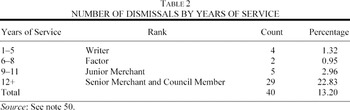
The threat of dismissal was made credible by its exercise: Of the 303 persons who entered the Bengal service from 1700 to 1756, 40 (13.2 percent) were dismissed or suspended. Of those 40, 29 dismissals occurred before 1757 and the remaining 11 occurred after our period. As Table 2 shows, with greater responsibility came a higher probability of being dismissed.
The senior servants faced the highest likelihood of dismissal and the greatest potential payoff from avoiding it. They were the most heavily engaged in private trade. Senior servants enjoyed the greatest authority over the company's resources, its privileges and protection. They arranged contracts with company suppliers, negotiated treaties with local officials, and determined the exact distribution of company assets. They were also the ones who made the greatest human capital investments in Indian commerce. By the time a servant reached the highest rank, he would have nurtured long-term relationships with Indian creditors, brokers, and suppliers. Like Barker, he would have developed a mature understanding of local trading conventions, currencies, and weights. He would have acquired some facility in locally used languages, particularly Portuguese, the lingua franca of Euro-Asian commerce. The potential benefits of access to company resources in India and the benefits of their own specific human capital would evaporate with dismissal. Dismissal blocked the paths to making a fortune in private trade.
SYNERGIES BETWEEN COMPANY AND PRIVATE TRADE
In the first half of the eighteenth century the company promoted the servants' private trade because the company gained by it. Specifically, the discretion to pursue private trade provided high-powered incentives for the employee to exert effort in fulfilling the company's orders and avoid dismissal. Private trade gave servants a reason to care about the Company's order lists. It gave servants a reason to value their employment despite the mortality environment and the poor salary structure.
Private trade brought second order benefits to the company as well. It redirected the servant's myopic interests away from clandestine participation in the company's textile market in Europe and toward active participation in Asian commodity and shipping markets. Consequently, private trade gave servants an incentive to develop their competency in Indian commerce, to become smart shoppers of Bengal products.65
For an illustration of the human capital involved in the cloth trade, see the company's directions in 1732 related to flowered muslins (E/3/105 pp. 593–94). The company made exacting requests as to a cloth piece's thread, length, breadth, weave, color, pattern, stiffness, sorting, and packing.
It also lowered the company's payroll expense, the cost of otherwise attracting employees to the India trade. Through the purchase of bills of exchange, the servants' private trade supplemented the company's cash flow in Bengal and thereby reduced the amount of bullion necessary from Europe.
66 In a letter to the directors in 1716 Joseph Collet explained that servants found the company bills desirable “for sake of security and speedy payment and because it would be a service to provide the Company's cash” (E/4/2 p. 90).
At the most general level, “the advantages of a thriving private trade in the Indian settlements lay in the attractions for population, which in turn led to better defensive postures and increased revenues through civil levies, quit rents, ground rents, and customs duties.”
67 Watson, Foundation, p. 77.
For all these advantages, the company took positive steps to facilitate private trade. The most important synergy between the company's public and the servants' private trades emerged from their common use of government trading privileges, which the company called “purchased privileges.”68
Recent advances in the theory of job design have identified a range of interlinkages between company and private activities that render the private activities mutually advantageous to employee and employer. Such interlinkages include technical, reputational, and asset complementarities. Both Dewatripont et al., “Economics”; and Casas-Arce and Hejeebu, “Job Design,” formally illustrate how the private trade can be a strategic complement to company trade. The present historical case illustrates asset complementarities. In general, work incentives will increase whenever the returns from private trade vary with the performance of inside activities.
These intangible assets ensured the legal basis of the company's trade in India. Whereas royal and later Parliamentary charters and letters-patent granted the company exclusive English access to Asian waters, the company needed local recognition of the right to trade. They sought and obtained several such decrees, some from the Mughal court in Delhi and applicable over the province of Bengal, some from the provincial government itself.
The most notable of such assets was the firman of 1717. Awarded by the Mughal Emperor Faruksiyar, the firman or imperial grant gave the company the right to trade in Bengal free of customs and in-land transit tax in exchange for an annual payment of Rs. 3,000.69
This corresponds to about £375 on a volume of purchases averaging over £300,000 per year between 1717 and 1760 for textiles alone (Chaudhuri, Trading World, pp. 544–45). Much has been written about the firman of 1717. For a recent review, see Sen, Empire. For an informed account of the abuse of dastaks, see the editorial introduction to Fort William India House Correspondence, Volume 1.
Even though the treaty was not originally intended to apply to the private trade of company employees, the servants insisted and the directors acquiesced to the notion that the company's privileges applied to all Englishmen in Bengal whether in their public activities or in their private activities. After 1717, company servants began issuing passes called
dastaks that exempted the holder, company employee or not, from paying customs and in-land taxes. The directors in London were indeed aware that their servants were creatively using the company's trading privileges and on occasion warned against it. Yet their sentiments never translated to action: no explicit prohibition of it was ever made in the contract and no individual was ever dismissed on the basis of private appropriation of corporate trading rights.
70 See E/3/105 pp. 672–77, para. 55–70. The directors permitted servants to use dastaks for their private trade. In the case of President Deane, mentioned earlier, abuse of dastaks was suspected but his dismissal owed expressly to the poor quality of goods sent back to London.
The directors encouraged servants in their use of company privileges and protection.
In addition to the private use of intangible assets, two additional asset complementarities facilitated private trade. The company allowed agents to use its physical assets in ways that were privately beneficial. The company provided increased security from its army and its fortified settlements. Private trade goods could be kept Ft. William with the same security afforded company goods. Likewise servants acquired reputational assets through employment. The directors understood clearly that the company was the presumed guarantor of many of its servants' private trade debts. “Our servants in general obtain their extensive credit in the country merely from being such,” they acknowledge.71
OIOC E/5/105, p. 686, para. 93.
Company employment thus gave English servants use of assets important for success in Asia's emporia trades.
Servants utilized company assets at little or no expense to the company. The private use of Mughal's trade privileges did impose a cost on the provincial government, the Nizamat of Bengal, but not on the company. The company's warehouses were a sunk cost and use by servants did not contribute to marginal costs. Implicitly using the company's reputation to obtain private loans could impose a cost on the firm. However, this seems to have been unlikely as the company could refuse to acknowledge the debt and deny payment to the Indian creditor. If the servant died before his debts were paid, the company could also make claims against his estate.
The logic of private trade rests on the mutual advantages arising from the private use of company assets. The servants' use of firm-specific assets imposed no additional cost to the firm. Yet these assets, particularly the ability to trade customs-free, gave employees a competitive advantage in Asian trade. Finally, the servants' active involvement in the country trade gave them a reason to value the company employment, to cultivate their skill in Indian commerce, and to avoid dismissal. The handsome returns on private trade depended on remaining in office, which in turn was related to actively fulfilling the company's order lists. Thus, the value of outside employment was positively related to inside productivity.
By contrast, the company's chief rival, the gigantic VOC, forbade private trade. As Om Prakash writes, “the one characteristic feature that more than other distinguishes the Dutch Company from the other European enterprises operating in Asia was its large-scale official involvement in a highly profitable network of intra-Asian trade.”72
Prakash, European Commercial Enterprise, p. 90.
How could employee participation in the intra-Asian trade have been so crucial to the English Company and not to the Dutch? The VOC operated in many of the same pepper and textile markets that the English did. The Dutch servants endured equally severe mortality risks: 25 percent returned to Europe alive after an average length of service of more than 21 years. The VOC lacked a regularized system of promotions for its qualified civil servants and its pay scales were regarded as static and stingy.
73 See Frank Lequin's “Het Personeel.” The estimates of mortality (p. 208) refer to the 115 members of the qualified civil service, the Bengal Directorium, corresponding to the English covenanted service. Chapter 2 describes the hiring and promotion practices within the company. VOC salaries remained unchanged for most of the eighteenth century and were uniform across the numerous factories in Asia. Lequin's appendix 2 lists in hierarchical order the six main categories of the VOC's qualified civil service and the corresponding salaries.
Under such employment conditions and given the strong synergies between company and private trade, how did the VOC manage to contain private trade?
The literature strongly suggests that the VOC failed to do so: Clandestinely private trade went on in a big way. According to Prakash the Bengal-Batavia route was particularly notorious for private trade in opium, raw silk, and silk textiles.74
Prakash, Dutch East India Company, pp. 83–89.
He documents for the second half of the seventeenth century numerous attempts to curb private trade.
75 These included sending high-level commissioners on investigative missions, appointing as Director of Bengal persons with a reputation for integrity, empowering commissioners to deport the guilty, and even threatening servants with the death penalty.
None of these were successful. Company employees used the profits on private trade and smuggled funds from Holland to purchase bills of exchange or
assignaties.
76 Prakash, European Commercial Enterprise, p. 88, believes that the first source predominates. Until 1738 assignaties carried an implicit interest rate of 24 percent as the silver ducaton, valued at 63 stuivers in Holland, was valued at 78 stuivers in Batavia.
Frank Lequin's detailed profile of 115 members of the Bengal Directorium, 1700–1795, provides a glimpse of the extent of remittances on VOC bills.
77 Lequin, “Het Personeel,” chapter 7.
Twenty-three percent or 27 of the 115 employees purchased 123 bills valued in total at
f3,586,786 or roughly £339,658.
78 Ibid., p. 155. The VOC remittances reflect those made by VOC dienaren and do not include English remittances on the VOC in Bengal. See note 38. The conversion was based on the exchange rate for the year 1760 of 35.21 schellingen = 1 pound provided by McCusker, Money, p. 60.
Purchases in Bengal of English bills were considerably larger: £2.3 million for the period under review and £10.4 million from 1710 to 1784.
79 Marshall, East Indian Fortunes, p. 255.
Although the British servants in Bengal were remitting far more on bills of exchange than the Dutch, the Dutch remittances significantly exceed VOC salaries. The failure to recognize and exploit the strategic complementarities between public and private trades was expensive. According to Jan de Vries and Ad van der Woude the combination of low salaries and no sanction for private trade led to the “demoralization and deterioration of the Company's performance.”
80 de Vries and van der Woude, First Modern Economy, p. 451.
Prudence and economic self-interest enabled VOC directors to change course: In 1743/44 the VOC shifted to the English policy of permitting private trade.
WAS AN INDIA CAREER WORTH THE RISK?
By carefully delineating the mechanisms that worked for the East India Company, contrasts can be made between the East India and other chartered trading companies. Private trade, unique to this chartered monopoly, provided overseas agents with high powered incentives to exert effort in the company's public trades. Private trade, not salaries, offered a degree of personal gain that made the hazards of a career in the tropics worth considering.81
Company salaries were lower than that offered by other chartered companies. They were also paltry, however, by the standards of middle-class England in the eighteenth century (Williamson, “Structure,” p. 48; Langford, Polite and Commercial People, p. 63; and Grassby, Business Community, pp. 258–62). Williamson estimates that in 1737, barristers and solicitors earned annually £178 and bank, commercial, or law clerks £68. However, it is unknown at what point in the careers of clerks and barristers these figures represent. Langford suggests that middle-class membership would require an annual family income of at least £40 per annum, obtainable in the company's service only after 11 years.
But were the returns from private trade high enough to compensate for the mortality risk and still provide a premium over income opportunities closer to home? Using survival probabilities calculated for the cohort entering the service between 1725 and 1749 and the individual bills of exchange data summarized in Table 1, an estimate of the weighted value of salary plus remittances can be obtained.82
Survival probabilities are from Hejeebu, “Microeconomic Investigations,” chapter 3.
explores the value of total compensation from the East India Company after adjusting for mortality.
83 As mentioned, the estimate adjusts only for the probability of involuntary departure. It does not include the business risk associated with private trade. The author cautions against attempts to calculate the present value of lifetime earnings based on the information above. Because such a calculation depends on identifying a discount factor for Englishmen in eighteenth-century India, it would be purely conjectural. Certainly there is always some level of discounting and some degree of risk aversion for which agents would not prefer an India career. Table 3 involves no discounting and the discussion assumes incoming servants are risk-neutral.
Table 3 leaves no doubt that East India employment provided a secure route into the middle classes. Adjusted for mortality, total compensation exceeded £100 per year in the first five years, more than doubled in the next five years, and approached £1,000 per annum in the third five-year interval. Salaries alone would not have brought a servant anywhere near a middle-class income. Private trade was essential to attract workers. Even if remittances were halved, private trade returns would still make a career with the company a very attractive proposition.
CONCLUSION
The East India Company's contracts withstood the vagaries of long distances and slow communication. Despite contract incompleteness, moral hazard, and high servant mortality, the contract structure was sufficiently viable to produce one of the great forerunners to the modern multinational firm. The directors helped sustain the relationship by allowing servants to use company resources in the pursuit of private trade in the Asian market. By encouraging the servants' private business in India, the company encouraged them to stay with the company and cultivate the requisite skills required to fulfill the company's orders. Those who failed to devote sufficient effort to the company's business were dismissed from the service and thereby cut off from the avenues that could lead to private fortune. The coupling of private trade with dismissal proved a masterful strategy well-suited to the constraints of Euro-Asian trade in the early eighteenth century.
A sincere thanks to seminar participants at Northwestern, Warwick, and Wisconsin-LaCrosse universities and at the 2001 Economic History Association Conference. I am grateful to Huw Bowen, Ann Carlos, Pablo Casas-Arce, K. N. Chaudhuri, Carol Fethke, Femme Gaastra, Henry Horwitz, S. R. H. Jones, Deirdre McCloskey, and especially Peter Marshall for instructive comments on an earlier version of the article. I thank Mr. Srinivas Murthy and Dr. Sriram Pemmaraju for research assistance. Ms. Lillian Gratama kindly assisted in translating Dutch. Generous support from the MidAmerican Energy Research Award, Tippie College of Business, University of Iowa, and from the Arthur H. Cole Research Grant, Economic History Association is gratefully acknowledged. Any remaining errors are my responsibility.