Since the end of World War II, a strong transatlantic partnership has been a cornerstone of Western geopolitical strategy. This does not mean that transatlantic relations have always been cordial. The North Atlantic Treaty Organization (NATO) was beset by periodic crises and disagreement throughout the Cold War and into the 1990s. Recent disagreements centered on the deployment of intermediate-range nuclear missiles in Europe during the 1980s, and on NATO involvement in the former Yugoslavia during the 1990s. In the immediate aftermath of the terrorist attacks of September 11, 2001, NATO enjoyed a brief resurgence as its member nations voted unanimously to activate their mutual defense commitments under the North Atlantic Treaty (see Kaplan 2004). However, this was soon eclipsed by the subsequent dispute over U.S.-led military intervention in Iraq, the rancor rising out of which has struck such seasoned observers as Henry Kissinger and Colin Powell as being an order of magnitude worse than from past NATO crises (cited in Pond 2004, ix). Kaplan (2004, ix) describes it as a “near death” experience that threatened “to dissolve an entity that had survived over half a century.” Others argue that the alliance can and should be “saved”1
Gordon and Shapiro 2004, 186.
While survey data suggest that transatlantic differences in fundamental values may be exaggerated (Baas 2004, 192; Gordon and Shapiro 2004, 187–93), shared values may have little purchase in the absence of mutual confidence and respect. We suspect that efforts to rebuild a transatlantic alliance will be complicated by an unprecedented erosion in European goodwill toward the U.S. Though the recent drop in positive sentiment about America in Europe has been well documented, some observers do not appreciate that this represents a dramatic departure from even the worst Cold War-era crises in European opinion. Typical of this sanguine view, Gordon and Shapiro (2004, 189) argue in the aftermath of the Iraq invasion that “dramatic declines represent a spike typical of transatlantic crises rather than secular trends. By June 2003 they had already begun to reverse.” The spike, however, stands out both for its magnitude and apparent persistence beyond the spring of 2003. In some cases, opinions about the U.S. were actually worse in 2005 than they were in June 2003.
Figure 1 displays the trends in net favorable opinion about the U.S. in France, Germany, and the United Kingdom from 1954 to 2006. Seen against a half century of varying, but positive evaluations of the U.S., the decrease in favorable opinions about the U.S. between 2002 and the spring of 2003 is striking. Following the invasion of Iraq, the U.S. was evaluated negatively in all three of these nations. In previous crises, such as the Euromissile dispute of the 1980s, European public opinion of the U.S. did not approach this level of animosity. Net evaluations are not yet returning to the pre-Iraq levels. Hopes that European disaffection would be brief and contained seem misplaced for several reasons. While the rapid U.S.-led military victory in the spring of 2003 was followed by a brief improvement in attitudes toward the U.S., the subsequent failure to find WMDs coupled with surging violence in liberated Iraq have prevented the war from being self-legitimizing. The argument that Europeans draw a distinction between the disliked policies of one U.S. president (George W. Bush) and their evaluation of the U.S. as a whole has lost traction following the reelection of President Bush in November 2004. Large majorities in France, Germany, and the UK report that the reelection of Bush had a negative effect on their perceptions of the U.S. (PIPA 2005).

Trends in Net Opinions of the U.S. in 3 European Nations
Points represent percentage of respondents with a positive/good opinion of the U.S. minus percentage of respondents with a negative/bad view of the U.S. Data taken from Merritt and Puchala 1968; United States Information Agency 1970, 1976, 1982; Gallup 1978; Eurobarometer surveys # 17, 22, 24, 27, 28, and 32; Smith and Wertman 1992; Hastings and Hastings 1992, 1996; Pew 2004, 2006; PIPA 2004, 2005.
Negative evaluations of the U.S. can be expected to reduce support for NATO and accelerate the movement of Europeans toward a collective security solution built around the European Union. Support for NATO in Western Europe had been eroding since the end of the Cold War. As Figure 2 demonstrates, from 1997 to 2004, there has been a marked decrease in preferences for a NATO-based defense policy. In France and the UK, this erosion in support was momentarily reversed in 1999 with the NATO intervention in Kosovo, and in 2002 at the height of U.S.-NATO cooperation in the War on Terror. But with the invasion of Iraq in 2003 the erosion in NATO support resumed. Although NATO was not formally involved in the invasion, the perception that NATO is an instrument of American foreign policy, reinforced by intense American efforts to obtain NATO involvement, created a strong link between NATO and U.S. Iraq policy. The popularity of the alliance suffered as a result. The low levels of support for NATO in 2003 and 2004 are more than the extrapolation of preexisting trends in eroding post-Cold War support for NATO. As Figure 2 indicates, a linear trend using the pre-2003 data predicts that in April of 2004, NATO would be preferred by 10% of the French, 28% of Germans, and 30% of UK respondents. In each case, the observed proportion preferring NATO is lower than expected, remarkably so in the UK (9%) and Germany (13%). In the UK and Germany, support has remained well below the pre-invasion trend.

Trend in Preferences for NATO-led Defense
Data are proportion preferring defense decisions made by NATO rather than by the EU or national governments.
Trend lines are linear extrapolations using the pre-2003 data.
Source: Eichenberg 2003; Eurobarometer surveys # 56, 58.1, 59.1, 60, 61.1, and 62.
Dimensions of European Anti-Americanism
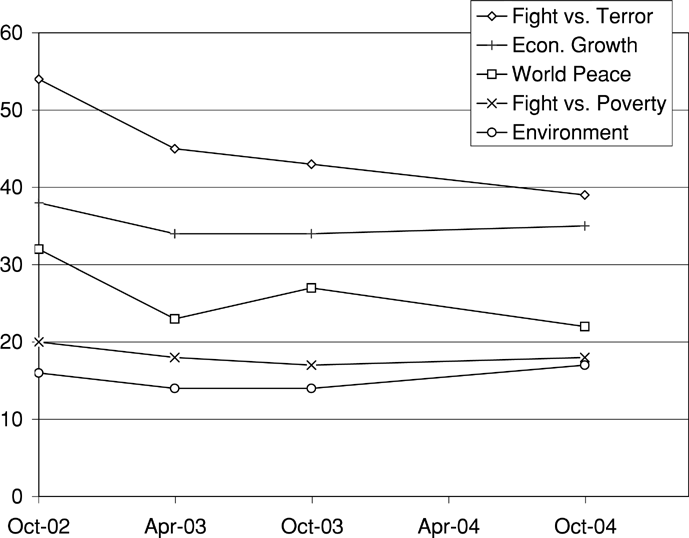
Since 2000, the Eurobarometer survey series has included a series of questions which elicit a more nuanced evaluation of public opinion on the U.S. than do questions asking for an overall “positive vs. negative” rating. The Eurobarometer asked a representative sample of EU residents to evaluate the role played by the U.S. in the following five areas: the fight against terrorism, world peace, the fight against poverty, global economic growth, and protection of the environment. Positive evaluations of the U.S. role declined across all five of these indicators when Iraq was invaded. Subsequently, this decline in positive evaluations has continued for the two issues most directly linked to the conduct of the Iraq War—the fight against terror, and the U.S. role in world peace; evaluations on the other dimensions have stagnated or recovered slightly. Figure 3 presents the evolution of European evaluations of the U.S. in these five issue areas.

Percent of Respondents with Favorable View of the U.S. Role in Five Issues
Source: Eurobarometer surveys # 58.1, 59.1, 60, and 62. Data refer to the entire EU population.
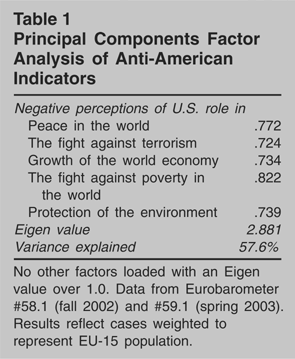
In order to demonstrate the connection between anti-American attitudes and preferences for European defense policy at the individual level, we use these five evaluations of the U.S. to construct an index of anti-Americanism. As this is an index of negative (anti) evaluations of the U.S., we recoded the data so that negative evaluations are coded “1”, and positive evaluations “−1”, with neutral responses coded “0”. A principal components factor analysis on the data from 2002 and 2003, reported in Table 1, indicates that there is a strong common element to these responses. A single factor accounts for over 50% of the variance across the five indicators. The factor loadings exhibit a high degree of stability when the analysis is run separately in all 15 EU countries.2
The one factor solution provided a good fit in each of the member states of the EU, and the second factor never had an Eigen value above 1. The lowest factor loading observed for any indicator in the country-specific analyses was .564. Most loadings were above .7.
Principal Components Factor Analysis of Anti-American Indicators

Anti-Americanism and Support for a European Defense Policy
As Everts (1995) has demonstrated, the belief that a U.S. military presence is necessary for the continued safety of Europe is highly correlated with support for NATO. During the Cold War, the threat posed by the Soviet Union provided a powerful incentive for transatlantic cooperation. Without the constraint of the Cold War, are Europeans more likely to translate disaffection with American policy (such as that in Iraq) into dissatisfaction with the NATO alliance, and thereby turn to alternative arrangements? Even in the months preceding the Iraq War, a plurality of Europeans supported the idea of making the EU a superpower rather than leaving the U.S. as the world's only superpower (Chicago Council on Foreign Relations 2002, 25).
Coordination of security policy has been an explicit goal of the EU since the Common Foreign and Security Policy (CFSP) was institutionalized in the Treaty of Maastricht of 1992. While the CFSP would not replace national foreign policies, it would require countries to seek to coordinate their foreign policy positions. The CFSP provides a vehicle for an independent EU foreign policy, though as recent events show, this coordination has been difficult in practice.3
See Rees (2000) and Wiessala (2000) for a more detailed discussion of foreign policy coordination in Europe.
Eurobarometers 58.1 and 59.1 each asked respondents: “In your opinion, should decisions concerning European defense policy be taken by national governments, by NATO, or by the European Union?” This question forces respondents to choose between the EU, NATO, or national-level responsibility for defense policy. We believe that our measure of anti-Americanism (the factor scores from Table 1) will be negatively associated with support for NATO. Those who are more anti-American may split between supporting national defense policy and supporting European defense policy, anti-Americanism should be positively associated with both support for a more European defense policy and a more national defense policy.4
Our dependent variable differs from a straightforward expression of support for CFSP by forcing respondents to choose between the EU and NATO. For this reason, it is a particularly appropriate variable given our interest in anti-Americanism. Because we are looking at choices between Atlantic and European defense policy, rather than between defense spending and social welfare spending, standard “guns vs. butter” models (see Carrubba and Singh 2004) would be inappropriate.
We control for a number of other relevant attitudinal variables. If defense policy is designed to protect against perceived threats, then the fears of Europeans should be relevant here as well. Europeans who fear another global conflict may be concerned that allies will drag them into the conflict rather than protect then from it. This leads us to expect fear of another world war to be negatively associated with support for both NATO- and EU-based defense policy, and positively related to the more isolationist option of a strictly national defense policy.
We do not expect a similar aversion toward alliances to apply to individuals who fear terrorism. The transnational nature of terrorist networks, and their propensity to strike targets in a wide variety of geographical locations, makes isolationism an unrealistic option. We expect that Europeans who fear terrorism believe that some form of alliance with other countries who can share intelligence, extradite dangerous individuals, and cooperate in other ways is necessary. For these reasons we believe that fear of terrorism will be positively associated with support for both NATO and the EU, and negatively associated with support for strictly national defense policy.
Our assessment of fear of weapons of mass destruction follows a similar logic. An attack using WMD, whether from terrorists or as an act of war from another state, is made less likely by having allies who will both share information and stand together, hopefully preventing or deterring such attacks. Therefore, we believe that like fear of terrorism, fear of WMD will be positively associated with support for both NATO and the CFSP, and negatively associated with support for strictly national defense policy.
Finally, we expect nationalism to increase support for a national defense policy, and support for the EU to increase support for EU defense policy. We control for these attitudinal factors as well as the national, ideological, and demographic controls.
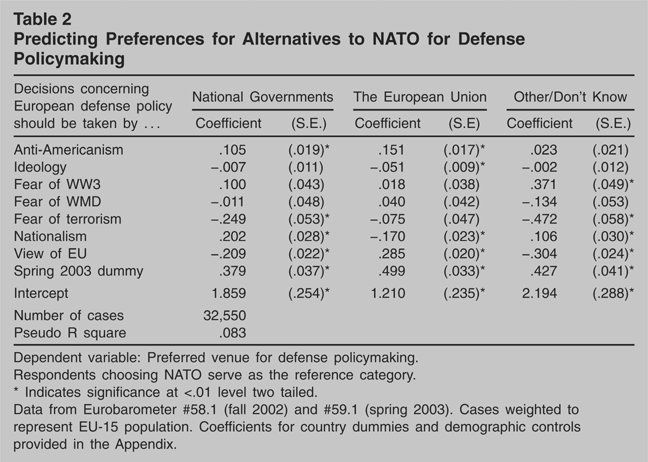
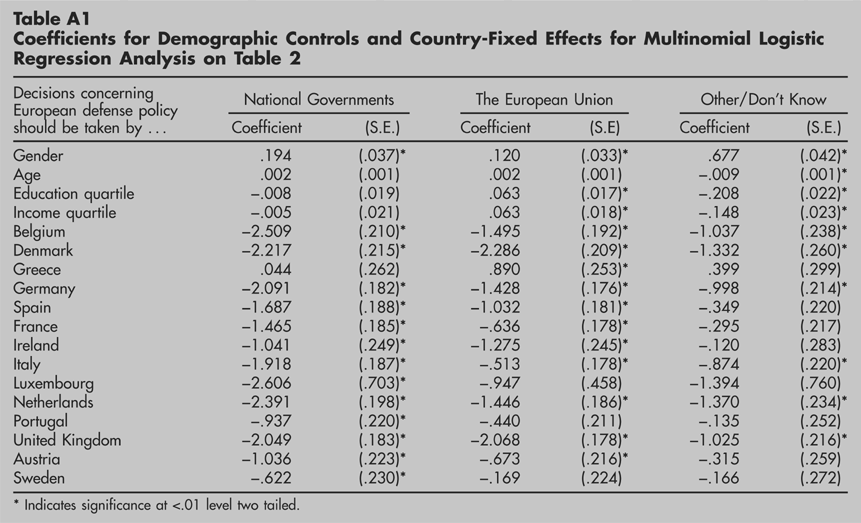
Table 2 presents the results from the multinomial logistic regressions. The parameters reflect the impact of each variable on the likelihood that a respondent will support a given defense policy alternative versus preferring the reference category of support for NATO. Negative coefficients indicate that a variable tends to push respondents away from an alternative and toward a pro-NATO response, and positive ones indicate that a variable increases the likelihood that a respondent will select the given alternative over NATO.
Predicting Preferences for Alternatives to NATO for Defense Policymaking

The raw parameters tell us only about the direction and significance of the effects of our independent variables. We present the substantive effects of selected variables below. Looking first at the model predicting support for an EU-level defense policy, anti-Americanism clearly affects the defense policy preference of Europeans, with greater anti-Americanism associated with more support for EU-led defense rather than NATO policymaking. Ideology also has an effect, with those on the left leaning toward EU responsibility for European defense policy while the right is more likely to favor NATO. None of the fear variables have a significant effect, suggesting that these perceived threats do not alter Europeans' preference for NATO- versus EU-multilateralism. Nationalism and attachment to supranational Europe have the expected negative and positive associations with support for EU-led defense. Finally, independent of all other variables, support for an EU-led defense was greater in the spring of 2003 than in the fall of 2002.
The model predicting support for defense policy centered by national governments also behaves as expected. The effects of anti-Americanism are positive and significant, though not as strong as the effect on support for EU policymaking. While the largest effect of anti-Americanism is to increase support for an EU-led defense policy, anti-Americanism does push some Europeans away from multilateral defense policymaking altogether. Of the fear variables, only the fear of terrorism has a significant effect in the expected direction, suggesting that Europeans who fear terrorism desire a multilateral defense policy rather than an isolationist policy. Both nationalism and a positive view of the EU behave as expected, with nationalism positively related and “Europeanism” negatively related to support for national-led defense. Lastly, support for defense policy made by national governments is significantly higher in the spring of 2003 than in the fall of 2002.
Discussion
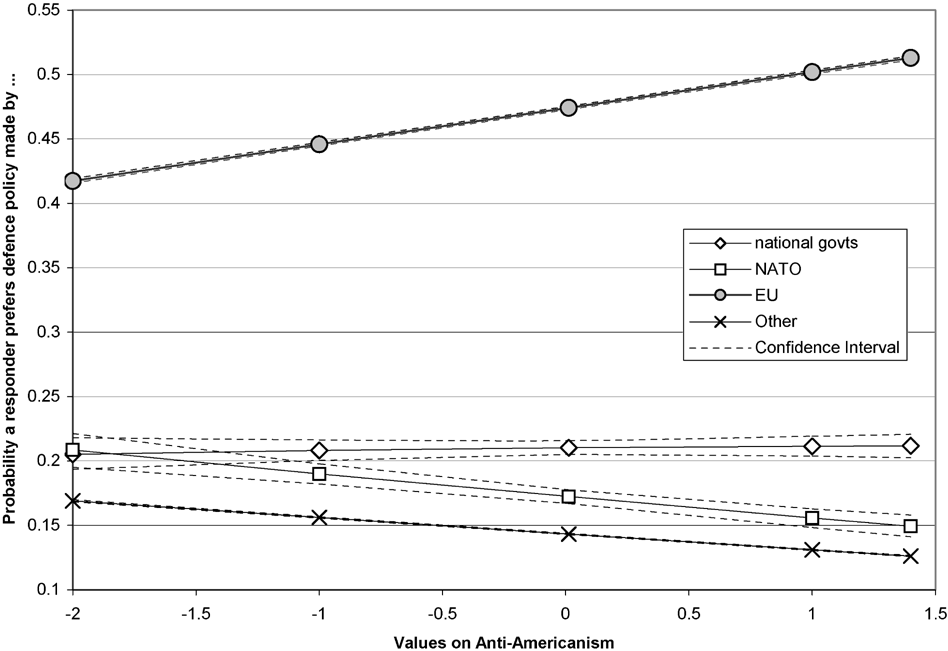
Even before the collapse of the Soviet bloc, Eichenberg (1989) predicted that public opinion would increasingly support the “European pillar” regarding defense and security policy in Western Europe. This would not be the result of some tectonic shift in the international security regime, but rather a natural result of a gradual European integration led by increasing cooperation of French and German elites, which according to Eichenberg, would lead the European public to more readily adopt the CFSP. It would seem that this process has been accelerated by American policy in Iraq, and the consequent degradation in perceptions of the U.S. The magnitude of the effect of anti-Americanism is presented in Figure 4. This figure plots levels of anti-Americanism against a respondent's predicted preference for defense policymaking.5
Predicted probabilities as well as confidence intervals for those predictions were generated using CLARIFY (Tomz, Wittenberg, and King 1999). Details of this procedure available from King, Tomz, and Wittenberg (1998).

Effect of Anti-Americanism on Preferences for Defense Policymaking
Data are predicted values from the multinomial logit regression reported in Table 2.
Data refer to population of the European Union.
Source: Eurobarometer surveys #54, 56, 58.1, 59.1, 60, 61.1, and 62.
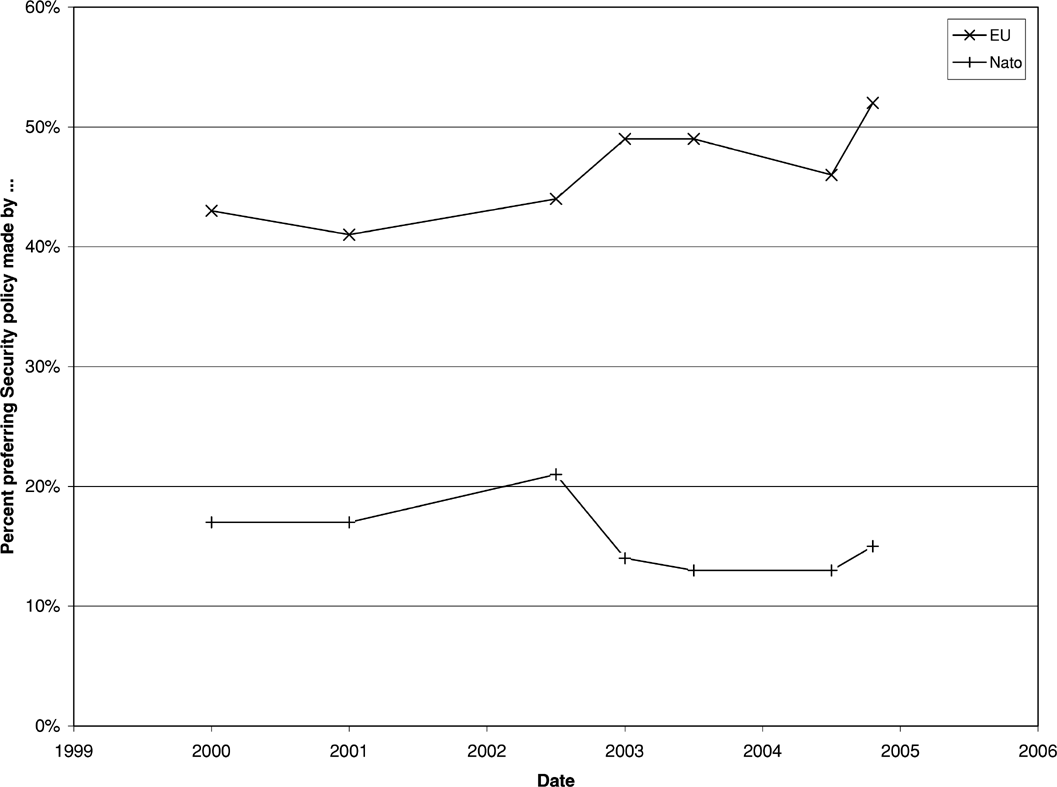
These individual-level effects are echoed at the aggregate level. Since 2000, support for EU-level defense decision making has risen while support for NATO has stagnated or fallen. Figure 5 demonstrates the steady increase in support for an EU-led rather than NATO-led defense policy.

Preference for Security Policy Made by NATO or EU
This trend has some important implications for the future of the CFSP, something that, as we discussed earlier, already has widespread support from the people of Europe. While European elites have been reluctant to cede control over foreign and defense policy to the EU, the people of Europe support coordination of foreign policy more than any other issue surrounding the integration process (Hooghe 2003). In a democratic EU this can be expected to constrain, if not shape, future foreign policy decisions. While Hill and Hurley (1999) argue that public opinion about foreign policy does not necessarily affect policy outcomes, Sobel (2001) contends that public opinion about salient foreign policy issues places important constraints on policy decisions. Governments who pursue policies at odds with the preferences of the electorate face the real possibility of punishment at the ballot box, and policy change may be accomplished through the replacement of the policy makers.
Author Bios
Leonard Ray is associate professor of political science at Louisiana State University. His primary research agenda focuses on public support for European integration. His current projects include a study of the link between religion and support for Turkish EU membership.
Gregory Johnston is currently an instructor at Southern Illinois University, Edwardsville.
Appendix: Operationalization of Variables for Multinomial Logit Analysis
Independent Variables
Components of anti-American index:
“In your opinion, would you say that the United States tends to play a positive role, a negative role, or neither a positive role nor a negative role regarding …
–peace in the world
–the fight against terrorism
–growth of the world economy
–the fight against poverty in the world
–protection of the environment”
The battery of fear items begins: “Here is a list of things that some people say they are afraid of. For each of these, please tell me if, personally, you are afraid of it, or not?”
Respondents were asked to answer this question regarding a series of items, which included: “A world war,” “Spread of nuclear, bacteriological or chemical weapons of mass destruction,” and “international terrorism.” Responses are coded “1” for “afraid,” “0” for “not afraid,” and don't know.
Nationalism. “In the near future, do you see yourself as … ?” Responses are coded “4” for “[nationality] only,” “3” for “[nationality] and European,” “2” for “European and [nationality],” “1” for “European only.” Missing cases were set to the median value 2.5.
View of the EU. “In general, does the European Union conjure up for you a very positive, fairly positive, neutral, fairly negative, or very negative image?” Responses are coded “5” for “very positive,” “4” for “fairly positive,” “3” for “neutral and don't know, “2” for “fairly negative,” “1” for “negative.”
Dependent Variable
“In your opinion, should decisions concerning European defense policy be taken by national governments, by NATO, or by the European Union?”
Survey Methodology
“Standard Eurobarometer surveys cover the population of the respective nationalities of the European Union member states. The basic sample design applied in all member states is a multi-stage, random (probability) one. In each EU country, a number of sampling points is drawn with probability proportional to population size (for a total coverage of the country) and to population density.
For doing so, points are drawn systematically from each of the ‘administrative regional units’, after stratification by individual unit and type of area. Hence, they represent the whole territory of member states according to EUROSTAT NUTS 2 (or equivalent) and according to the distribution of resident population of the respective EU nationalities in terms of metropolitan, urban, and rural areas. In each of the selected sampling points, a starting address is drawn at random. Further addresses are selected as every Nth address by standard random route procedures, from the initial address. In each household, respondent is drawn at random. All interviews are face-to-face in the respondent's home and in the appropriate national language.” (From the Basic English Questionnaire, Eurobarometer 59.1, p. 34):
Sample sizes range from 1,075 to 1,000 for all countries except Luxembourg (600), Germany (2,071), United Kingdom (1,319), and Belgium (1,112).
Fieldwork for Eurobarometer # 58.1 was conducted 10–11/2002, for Eurobarometer # 59.1 3–4/2003.
Table A1: Coefficients for Demographic Controls and Country-Fixed Effects for Multinomial Logistic Regression Analysis on Table 2