Introduction
Genetic testing (GT) has become commonplace in healthcare and is likely to become even more so in the future (Reference Pitini, De Vito and Marzuillo1;Reference Wysocki and Osier2). The impacts of GT vary depending on whether the test is for screening, diagnosis, or prognosis (i.e., predictive testing). The high accuracy of diagnostic and prognostic testing for germline variants makes them particularly impactful. GT requires careful consideration on the part of providers and evaluators because results can affect not just the individual being tested, but also their offspring and other living relatives (Reference Postolica, Chirica, Negura, Azoicai and Gavrilovici3;Reference Emery4). GT can also produce impactful incidental findings, namely findings unrelated to the initial purpose of testing. This article aims to highlight some negative impacts of diagnostic and prognostic GT for germline variants for people given an option of GT. The highlighted impacts apply to both GT (analysis of one gene) and genomic testing (analysis of all genes), and some may be greater in the case of genomic testing, for instance with increased possibilities of incidental findings. The impacts highlighted in this article can be both under-acknowledged and difficult to assess as part of health technology assessment (HTA), but are worthy of consideration for the progress of HTA methodology.
The task of the HTA analyst is to determine the benefits, harms, and costs of a health technology in the process of advising funders and users on its value for money while also trying to understand how patients experience the value of the technology (Reference Garrison, Mestre-Ferrandiz and Zamora5). GT impacts can be classified as health-related or non-health-related. For example, some writers discuss enhanced autonomy and enhanced equity as positive impacts (benefits) of GT (Reference Gil-Arribas, Herrer and Serna6). These impacts can be considered non-health-related (and also called psychosocial, family, or societal effects). These contrast with health-related impacts, which may include benefits such as increased healthy behaviors (Reference Aspinwall, Taber, Leaf, Kohlmann and Leachman7) and avoidance of the harms of unnecessary treatment (Reference Gil-Arribas, Herrer and Serna6). Many health-related impacts of GT have been objectively measured with success (Reference Kessels, Morona and Mittal8;Reference Newton, Schubert, Morona, Fitzgerald and Merlin9), but non-health-related impacts are typically harder to measure and are considered less often by the HTA analyst (Reference Pitini, De Vito and Marzuillo1;Reference Wade, Wilfond and McBride10). For example, it is difficult to measure the effects of GT on autonomy, which can be positive, negative, or not clearly either, and which can change over time.
Equity refers to “the fair allocation of resources or treatments among different individuals or groups, such that they each get what they are owed or what they are entitled to” (11). Meanwhile, autonomy refers to the general ability and right of individuals to direct their own lives and to freely make their own informed decisions. For example, one’s autonomy can be enhanced by finding out one’s genetic status when the information is deemed relevant to self-understanding or decision-making about one’s health or future (Reference Fulda12).
Genetic information is sometimes assumed to be an unqualified good by increasing the information available to you, but things are not so straightforward. In many instances, there may be clear benefits in getting a genetic test. For example, GT may direct your cancer treatment, inform your reproductive planning, or lead to you making helpful lifestyle decisions. However, we highlight some negative non-health-related impacts associated with GT and knowing one’s genetic status to argue that non-health-related impacts should be assessed more carefully by the HTA analyst when weighing the benefits and harms of a genetic test.
The burden of decision-making associated with genetic testing
Decision-making is an inherent component of genetic and genomic testing for germline variants. However, there is unlikely to be a single decision. Because of the inheritability of germline variants, there is more likely to be a cascade of decisions that follow a genetic test result, especially a positive result (Reference Emery4). You may be faced with decisions such as whether to tell your children of a test outcome, and at what age; whether to tell other relatives; how to tell them; whether to purchase life insurance; whether to make or change particular plans for the future; and whether to terminate a pregnancy in the case of a positive test result relating to the fetus. An incidental finding, such as unexpected paternity or health risks, can introduce even more decision-making.
Deciding whether to pass GT information onto others can be difficult. One cannot assume that to pass the information on simply increases the autonomy of genetic relatives by giving them the option of getting tested. The same relatives may feel that, being informed, they have lost autonomy, as they now have the knowledge of a genetic variant of concern in their family and will never have the option to not know. There is a tension between the autonomy gained and lost by the same genetic information, creating a burden for the tested individual (Reference Manzini and Vears13;Reference Hildt14), in that they must decide whether to bring the knowledge of serious disease risk to their family or to leave them unawares to get on with their lives, which may in fact never be impacted by the genetic variant of concern. If the tested individual decides to share information with relatives, those relatives will go on to make further decisions, some of which may lead to bad outcomes, for which the first-tested individual may feel some responsibility. This burden of decision-making may be a source of psychological distress or harm.
Measuring the Burden of Decision-making
In the scientific literature, decision-making around GT is extensively discussed within specific disease contexts. Writers discuss who is making decisions, how, and with what reasoning (Reference Hildt14–Reference Nicholls, Wilson and Etchegary19). But the specific burden of decision-making for the individual or what it means for the health service is typically not pinpointed, which makes assessment difficult for the HTA analyst.
One approach used to assess the impact of decision-making is to include it in general discussion of anxiety and distress associated with GT. For example, Castellani et al. (Reference Castellani, Macek and Cassiman15) list “complex and confusing decision-making” among disadvantages of cystic fibrosis carrier screening. Cicero et al. (Reference Cicero, De Luca and Dorangricchia20) find that individuals experience “a moderate level of psychological distress” before counseling for GT for hereditary breast cancer. But studies do not tend to evaluate the burden of decision-making specifically, despite acknowledging its psychological effects. Specific instruments to evaluate decision-making burden, which could be useful to HTA analysts, are scarce, although one instrument assessing decision fatigue in a health care setting has the potential to be adapted to a diagnostic context (Reference Hickman, Pignatiello and Tahir21). Articles that evaluate decision aids in GT contexts may also provide some guidance in designing a tool to measure decision-making burden in future (Reference Reumkens, Tummers and Gietel-Habets22;Reference Williams, Jones, Elwyn and Edwards23). The reason we highlight this is not to encourage paternalistically sparing people the burden of complex decision-making, but to raise awareness of impacts when it comes to evaluating the benefits and harms of GT as part of HTA.
The option of not testing
To avoid the decision-making cascade, a person can choose not to use a genetic test, but many people may find this difficult. Within a family, choice is arguably never completely free of influence, and one’s choice does influence someone else’s autonomy (Reference Cowley18). Moreover, in the social environment of advanced economies, where more information is generally assumed to be an unqualified good, it may be difficult to opt out of the information loop (Reference Nicholls, Wilson and Etchegary19;Reference Kater-Kuipers, de Beaufort, Galjaard and Bunnik24). But choosing not to undertake GT spares a person the negative non-health-related impacts associated with GT and knowing one’s genetic status, which go beyond the burden of decision-making. In particular, authors highlight the potential harms of predictive testing in children, including damage to a child’s self-esteem, increase in stigma-related anxiety, and discrimination against the child in education, employment and insurance (Reference Manzini and Vears13;Reference Borry, Shabani and Howard25).
Despite the potential harms of GT, those who choose to not get tested in family groups are often frowned upon. For example, in a kinship group at risk of Lynch Syndrome, the group members who opted against GT tended to be ostracized, were thought to lack courage, and were sometimes asked to justify their decision (Reference Cowley18). Although acknowledging the right to not know, families tend to consider members who opt against GT as irresponsible or having their “head in the sand” (Reference Hildt14;Reference Cowley18), which creates familial tension or rupture.
Comparing Benefits and Harms for People Who Choose GT and People Who Choose Not to Test
There are some examples of helpful comparisons when it comes to psychosocial impacts. In particular, Lammens et al. (Reference Lammens, Aaronson and Wagner16) conducted a study to evaluate GT uptake and the psychosocial impact of undergoing or not undergoing GT for Li-Fraumeni syndrome (LFS). They used the Impact of Event Scale (IES) to measure LFS-specific psychological distress, and the Short-form 36 (SF-36) and an adapted version of the Cancer Worry Scale to assess psychosocial impacts for family members at 50 percent or greater risk of being carriers of LFS when offered GT. There are few treatments available to people testing positive for LFS; therefore, the motives of individuals choosing whether or not to get tested may be expected to be largely based on the value of knowing, unrelated to a possible health benefit. The study found that, following genetic counseling, 55 percent of participants took up GT. Some motives for not taking up GT were: wanting to avoid problems obtaining a mortgage or life insurance, fearing the result, and seeing no advantage in the genetic test. The analysis of psychosocial impact measured by the tools found that there were similar levels of LFS-related distress in both those who chose to get tested and those who chose not to, and the SF-36 results showed that there was a comparable quality of life between those who were carriers, non-carriers, and those at risk (not tested).
This provides an example of how the benefits and harms of GT versus no GT may be compared in quantitative terms when there is no measurable health-related benefit. A genetic test result may be valued by some people, though not all, simply in terms of the value of knowing (Reference Neumann, Cohen and Hammitt26). Simply knowing is seen by some as autonomy enhancing, and in many cases this may only be presented in qualitative terms. HTA analysts should be aware of the need to assess the value of knowing and incorporate it into GT contexts where little health benefit is offered by being tested, and they should emphasize the need for genetic counseling.
The need for empirical evidence
Researchers observe that empirical evidence is needed to compare non-health-related benefits and harms, while conceding that measuring these is impeded because, for instance, families can reason differently about the benefits and harms of GT (owing to different cultural and social contexts, say) (Reference Manzini and Vears13). Non-health-related impacts are also not obviously measurable in clinical trials, or even observational studies. New frameworks for HTA have only begun to address this problem.
A recent review of the frameworks used to assess genetic tests in HTAs found that the majority of frameworks (22 of 29 frameworks identified; 76 percent) include an ethical, legal, and social impact (ELSI) component (Reference Pitini, De Vito and Marzuillo1). The most common framework used was the ACCE Framework (named for its components: analytic validity, clinical validity, clinical utility, ethical, legal, and social implications). However, only two (the Expanded ACCE and the HTA Susceptibility Test) of the frameworks assessed evidence of the direct experiences of patients and other affected individuals, such as evidence collected via surveys or qualitative studies. Other frameworks extended the concept of clinical utility to personal utility, which can include a broad range of personal impacts such as improved understanding of the disease and more informed reproductive decisions (ACHDNC, Complex Diseases). In spite of these frameworks existing, Pitini et al. (Reference Pitini, De Vito and Marzuillo1) argue that the ELSI components of an HTA report are less likely to influence the final funding decision than the technical components quantifying safety, effectiveness and cost-effectiveness.
It marks an improvement on past HTA practice to see these expanded evaluations include consideration of some of the non-health-related impacts of GT. HTA analysts should take care to choose an appropriate framework when conducting an evaluation of a genetic test. Our own HTA group (Adelaide Health Technology Assessment) uses the EUnetHTA HTA Core Model (27) as a framework for writing HTAs in the new HTA Guidelines for preparing assessments (28) for the Australian Department of Health. The Guidelines also highlight the need to consider the “value of knowing” a genetic test result and social and organizational issues, such as how funding for the genetic test may affect carers or regional populations (i.e., in terms of service access) (28).
Presenting a Summary of the Evidence
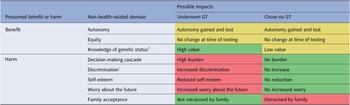
A new approach may be useful to present a summary of the evidence on non-health-related impacts in an HTA report (see Table 1). Table 1 serves two functions – first to summarize the potential non-health benefits and harms of choosing GT or no GT discussed so far, and secondly to provide a reporting tool for HTA. The table provides a novel visual comparison of impacts between people who undergo testing and people who choose not to. Table 1 summarizes the evidence in a hypothetical scenario where an extended family is offered GT for a late-onset disease with variable penetrance. The first two columns list some possible non-health-related impacts grouped into what can be presumed to be benefits and harms prior to evaluation. The third column represents the actual impacts on the people who choose to undergo GT, and whether those impacts are positive (highlighted green) or negative (highlighted red). Amber highlight represents a tension between positive or negative impacts, or a neutral impact. In the fourth column, positive and negative impacts on the people who choose not to undergo GT are represented for comparison with the people who underwent GT. The HTA evaluator will need to make a considered judgment informed by the relevant literature to populate the colored cells. By presenting a visual summary of evidence that has not always been easily highlighted, this novel reporting tool may assist in giving the ELSI component a greater influence on funding decisions, where warranted.
Reporting tool for non-health-related impacts of genetic testing a

Key: Green = positive impact (benefit); Red = negative impact (harm); Amber = a tension between positive and negative impacts, or a neutral impact.
a Notes: The colored cells reflect impacts in a hypothetical example only. The tool comprises the headings in the uncolored cells, and can be adapted to represent a range of non-health-related impacts in a health technology assessment.
b The value of knowing can include impacts on career or finance planning, reproductive planning, or understanding one’s future health care needs.
c For example, discrimination in education or employment when genetic status is known.
There is research on how patients can value a technology for reasons that do not relate to health gains, but there are still methodological gaps for measuring such dimensions of value (Reference Garrison, Kamal-Bahl and Towse29). HTA analysts should note that not all outcomes are being measured currently in empirical studies (for example, implications for autonomy are not being measured). If the measurement is not possible, then these outcomes should at least be discussed in the HTA report. In future, evaluators should increase their awareness of non-health-related impacts of GT reported in studies, choose appropriate frameworks to assess them, and find rigorous methods for assessing them. HTA understandably places emphasis on measurable clinical outcomes, but there is the risk of a scenario where a genetic test is funded because it offers a clinical benefit at a reasonably low cost despite there being other, difficult-to-measure outcomes such as burdens associated with complex decision-making and harms that can be avoided by choosing not to get tested. It is also possible that funding the genetic test will itself result in more testing (due to default bias on the part of patients and practitioners, for instance), thus creating a culture around GT that is pro-testing and insufficiently apprised of the burdens and potential harms of GT. The other possibility is that a genetic test may provide no health-related benefit but still warrant funding in how it enhances autonomy for some people.
Conclusions
By highlighting the burdens of complex decision-making associated with GT, and the potential harms that can be avoided by choosing not to undertake GT, we have endeavored to raise awareness of hard-to-measure non-health-related outcomes. Awareness of these outcomes should help the HTA analyst to choose suitable evaluation methodologies and reporting frameworks, such as the novel reporting tool that we present in this article. In turn, this should help the audience for HTAs (funders, clinicians, and genetic counselors) to appropriately consider the pros and cons of GT.
Conflicts of interest
The authors declare that they have no conflicts of interest.