

Anxiety disorders are the most common group of childhood disorders, with worldwide-pooled prevalence of 6.5% for any anxiety disorder (Polanczyk, Salum, Sugaya, Caye, & Rohde, Reference Polanczyk, Salum, Sugaya, Caye and Rohde2015). Anxiety disorders are often first seen in early childhood (Mian, Godoy, Briggs-Gowan, & Carter, Reference Mian, Godoy, Briggs-Gowan and Carter2012), and the symptoms displayed cluster into diagnostic-specific groupings similar to those of older children and adolescents (Hirshfeld-Becker, Micco, Mazursky, Bruett, & Henin, Reference Hirshfeld-Becker, Micco, Mazursky, Bruett and Henin2011; Sterba, Egger, & Angold, Reference Sterba, Egger and Angold2007). Research has shown that social anxiety, separation anxiety, specific phobia, and generalised anxiety are common disorders in young children (Edwards, Rapee, Kennedy, & Spence, Reference Edwards, Rapee, Kennedy and Spence2010). Without intervention, childhood anxiety disorders tend to have a chronic course, predisposing children to the future risk of anxiety disorders (Bittner et al., Reference Bittner, Egger, Erkanli, Costello, Foley and Angold2007; Feng, Shaw, & Silk, Reference Feng, Shaw and Silk2008) and depression (Lavigne, Hopkins, Gouze, & Bryant, Reference Lavigne, Hopkins, Gouze and Bryant2015).
The school environment is seen as an ideal context for the delivery of prevention and early intervention programs targeting anxiety symptoms and coping skills. School-based interventions provide ample opportunities to help children learn and generalise the skills needed to cope with real-life challenges such as separating from parents, approaching unfamiliar peers and adults, and speaking up in social situations (Herzig-Anderson, Colognori, Fox, Stewart, & Masia-Warner, Reference Herzig-Anderson, Colognori, Fox, Stewart and Masia-Warner2012). Although systematic reviews have indicated the efficacy of school-based cognitive behavioural therapy (CBT) anxiety programs for older children and adolescents (Neil & Christensen, Reference Neil and Christensen2007, Reference Neil and Christensen2009; Werner-Seidler, Perry, Calear, Newby, & Christensen, Reference Werner-Seidler, Perry, Calear, Newby and Christensen2017); less well known is the efficacy of such programs with young children below 8 years. In recent years, several Australian studies have demonstrated the effectiveness of school-based CBT for the reduction of anxiety symptoms in preschool (Anticich, Barrett, Silverman, Lacherez, & Gillies, Reference Anticich, Barrett, Silverman, Lacherez and Gillies2013; Pahl & Barrett, Reference Pahl and Barrett2010) and early primary school children (Ruocco, Gordon, & McLean, Reference Ruocco, Gordon and McLean2016). The CBT programs for younger children employ a play-based approach to teach CBT skills and may include parent psychoeducation and parenting skills training (Hirshfeld-Becker et al., Reference Hirshfeld-Becker, Micco, Mazursky, Bruett and Henin2011). One such program is the CBT group intervention called Get Lost Mr Scary (MacGregor & Herger, 2001, 2007, Reference MacGregor and Herger2011). Unlike universal school-wide prevention programs that target all students regardless of their risk status (e.g., Fun FRIENDS; Barrett & Pahl, Reference Barrett and Pahl2006), Get Lost Mr Scary was designed as a small group program (4–6 children) for children with elevated symptoms of at least one type of anxiety. The group program aims to address anxiety symptoms and improve coping skills by including: (a) affective education to distinguish between core emotions; (b) cognitive restructuring skills to address unhelpful thinking patterns; (c) vicarious exposure including role play, modelling, and rehearsal to challenge fears; and (d) relaxation skills for physiological symptoms. Get Lost Mr Scary has been widely disseminated in Western Sydney public primary schools for more than a decade, has an established evaluation protocol in its facilitator manual, and has a published study that provides support for its efficacy in reducing anxiety symptoms postintervention and at 12-month follow-up (Ruocco et al., Reference Ruocco, Gordon and McLean2016). These findings support the effectiveness of Get Lost Mr Scary as a school-based anxiety intervention for young children, but further empirical validation is required.
Emerging evidence suggests young children can demonstrate the cognitive capacity to engage in basic elements of CBT when age-appropriate strategies are used (Grave & Blissett, Reference Grave and Blissett2004; Hirshfeld-Becker et al., Reference Hirshfeld-Becker, Micco, Mazursky, Bruett and Henin2011). In the school-based program Get Lost Mr Scary, core CBT skills, such as positive cognitive restructuring, are taught using a play-based approach. For example, ‘green balloons’ are used to concretely represent the ‘helpful thoughts’ that we keep and ‘white balloons’ represent the ‘unhelpful thoughts’ that we can let go. The ‘Scary Rhyme’ song is used to teach children the relationships between feelings and body sensations and the concept that people can experience and think about the same situation in different ways. Similarly, the school-based universal program Fun FRIENDS (Anticich et al., Reference Anticich, Barrett, Silverman, Lacherez and Gillies2013; Pahl & Barrett, Reference Pahl and Barrett2010) trains children to use a traffic light analogy to distinguish unhelpful ‘red’ thoughts from helpful ‘green’ thoughts. Likewise, the clinic-based program Taming Sneaky Fears (Monga, Young, & Owens, Reference Monga, Young and Owens2009) teaches children to ‘ignore scary thoughts’ and think of alternative or ‘brave thoughts’.
It is posited that graded exposure is the primary means of desensitisation (MacGregor & Herger, Reference MacGregor and Herger2007) and anxiety reduction (Hirshfeld-Becker et al., Reference Hirshfeld-Becker, Masek, Henin, Blakely, Pollock-Wurman, McQuade and Biederman2010). In contrast to group CBT programs designed for older primary school children in which the children are asked to complete a fear hierarchy and apply graded exposure exercises (e.g., Cool Kids; Rapee et al., Reference Rapee, Lyneham, Schniering, Wuthrich, Abbott, Hudson and Wignall2006), the Get Lost Mr Scary program uses vicarious exposure activities to conduct desensitization with young children. In the Get Lost Mr Scary program the children use bibliotherapy, pantomime, and role-plays to identify unhelpful and helpful ways of coping, and thus are vicariously exposed to anxiety scenarios similar to their situations.
Although an underlying assumption of CBT is that specific coping strategies such as positive cognitive restructuring, problem solving, and the ability to confront fears (in vivo or vicarious exposure) are responsible for the desired change in anxiety (Hogendoorn et al., Reference Hogendoorn, Prins, Boer, Vervoort, Wolters, Moorlag and de Haan2013; Prins & Ollendick, Reference Prins and Ollendick2003), few studies explore coping and the mechanisms of change within these programs. Of those studies available, most have been conducted with children in late childhood and adolescence. For example, Hogendoorn et al. (Reference Hogendoorn, Prins, Boer, Vervoort, Wolters, Moorlag and de Haan2013) examined potential mediators of CBT, and their findings indicated that an increase in the three coping strategies — positive cognitive restructuring, direct problem solving, and seeking distraction — preceded a decrease in anxiety symptoms. There is scant research on coping in young children (Chalmers, Frydenberg, & Deans, Reference Chalmers, Frydenberg and Deans2011). However, evidence from parental reports has indicated significant improvements in young children's coping ability and anxiety after participating in a CBT intervention (Hirshfeld-Becker et al., Reference Hirshfeld-Becker, Masek, Henin, Blakely, Pollock-Wurman, McQuade and Biederman2010).
Noticeably absent from the CBT efficacy literature is the perspective of young children of their anxiety and coping skills. A barrier to the inclusion of the perspective of young children on their developmental issues is the lack of age-appropriate self-report measures (Lagattuta, Sayfan, & Bamford, Reference Lagattuta, Sayfan and Bamford2012). In recognition of the need to design developmentally sensitive instruments, several researchers have investigated the utility of pictorial instruments, and the results indicate children as young as 4 years can provide reliable and valid reports of their anxiety symptoms (Dubi, Lavallee, & Schneider, Reference Dubi, Lavallee and Schneider2012; Muris et al., Reference Muris, Meesters, Mayer, Bogie, Luijten, Geebelen and Smit2003) and can evaluate their coping efforts (Chalmers et al., Reference Chalmers, Frydenberg and Deans2011; Muris, Merckelbach, Ollendick, King, & Bogie, Reference Muris, Merckelbach, Ollendick, King and Bogie2001). In contrast, the Lagattuta, Sayfan, and Bamford (Reference Lagattuta, Sayfan and Bamford2012) study found parents of 4- to 11-year-olds underestimated child worry and anxiety and overestimated their optimism compared to the child's self-report. Studies using multiple informants also report a lack of consensus between parent, teacher, and child ratings of internalising problems such as anxiety (Cleridou, Patalay, & Martin, Reference Cleridou, Patalay and Martin2017; Langer, Wood, Bergman, & Piacentini, Reference Langer, Wood, Bergman and Piacentini2010; Miller, Martinez, Shumka, & Baker, Reference Miller, Martinez, Shumka and Baker2014). Although informant discrepancies may reflect problems with lack of reliability or bias (Miller et al., Reference Miller, Martinez, Shumka and Baker2014), the evidence suggests that each informant may contribute a unique perspective about the child's difficulties and coping skills in different contexts (Achenbach, Reference Achenbach2006; De Los Reyes, Reference De Los Reyes2011). In light of these findings, and in the context of the hidden nature of anxiety, the inclusion of a child self-report as part of a multi-informant assessment can play an important and valid role when making decisions about diagnoses and treatment (Lagattuta et al., Reference Lagattuta, Sayfan and Bamford2012).
Given the potential benefits of including child self-reports and the scarcity of research in this area, the current study aimed to examine young children's self-reported coping, emotions, and anxiety symptoms as part of a multi-informant evaluation of participation in the Get Lost Mr Scary intervention. In particular, this study aimed to add to the literature by using the pictorial Child Anxiety and Coping Interview (CACI; Ruocco, Freeman, & McLean, Reference Ruocco, Freeman and McLean2018) to examine the effects of the Get Lost Mr Scary program on children's perceptions via self-reports across pre- and postintervention. The CACI was purposefully developed to elicit children's perceptions of their anxiety symptoms, emotions, coping strategies, and coping efficacy. In line with objectives of the Get Lost Mr Scary program and the CBT principles that underpin its approach, it was anticipated that following participation in the program, children's self-reported coping responses would reflect improvements in their cognitive and behavioural coping skills. Specifically, it was hypothesised that child coping responses would indicate less use of behavioural avoidance, greater employment of cognitive restructuring, and increased coping efficacy. Improvements in the children's perceptions of their anxiety symptoms and overall negative emotional distress were also expected. Consistent with findings from the previous evaluation of the Get Lost Mr Scary program, it was hypothesised that parent and teacher ratings of child anxiety symptoms and internalising behaviour would show significant reductions.
Method
Participants
Participants in the current study were part of a larger project evaluating Get Lost Mr Scary, a school-based group CBT early intervention program (MacGregor & Herger, Reference MacGregor and Herger2007, Reference MacGregor and Herger2011). The 65 children (27 males, 38 females) in this study represent the subgroup of children who participated in a semistructured pictorial child interview before and after the intervention program. The children were aged 5 to 7 years (M = 6.50 years, SD = 0.75), and were attending general education classes (Kindergarten to Year 2) in one of 13 public primary schools located in Western Sydney, Australia. In terms of living arrangements, 74% lived with their two parents, 19% lived with a sole parent, with the remaining 8% living with extended family such as grandparents. The majority of children were born in Australia (88%). The parents of 76% of children identified their ethnicity as Australian, 19% as Asian (e.g., Chinese, Thai), and 5% described as ‘Other’ included a diverse range of ethnicities. Data on parental education indicated that 23% were university educated, 9% had completed a technical and further education course, 34% completed Year 12, 22% had completed the Year 10 certificate, and 12% had completed less than 10 years of education.
The Socio-Economic Indexes for Areas
(SEIFA; Australian Bureau of Statistics, 2011) uses census data such as household income, education, housing, and employment as indicators of advantage and disadvantage. SEIFA scores for the current study were calculated using the family postcode. The SEIFA is standardised against a mean of 1,000 (SD = 100), with the middle two-thirds of scores approximately falling between 900 and 1,100. SEIFA scores below 900 indicate greater disadvantage and those above 1,100 indicate a greater advantage. The SEIFA scores in the current study ranged from 829 to 1,150 (M = 1013.53, SD = 91.77).
Measures
Child Anxiety and Coping Interview (CACI)
The pictorial CACI (Ruocco et al., Reference Ruocco, Freeman and McLean2018) is semistructured in format and contains a mixture of open and closed questions that are used to explore children's perceptions about their anxiety symptoms, emotions, coping strategies, and coping efficacy. Interview questions explore their experiences in four scenarios: the classroom, school playground, community park, and home. Each scenario is illustrated in a coloured picture. Twelve unlabelled feeling faces (e.g., happy, angry, sad, and scared) and a Floor Scale response set with five numbered A4 sheets from 0–4 (none to big amount) are used as visual prompts to help children name and rate the intensity of their feelings. The A4 sheets are placed in scale order (0–4) on the floor and the child walks along the scale to the selected rating. The children also use the Floor Scale to rate the perceived helpfulness of their coping strategies (range 0–4, no help to big help).
The scenario pictures were designed for children to report on both pleasant and unpleasant experiences in the context. For example, in the community park scenario, children can report on a pleasant experience (e.g., playing on the swing) or report on the images that may act as potential fear stimuli (e.g., an image of a dog or spider). The scenario questions include ‘Which feeling face shows how you feel about [scenario picture]?’ and ‘What feeling does this face show?’. The children are invited to ‘Let's use this scale (i.e., Floor Scale) to see how much [child's feeling word] feeling you have when [pleasant experience or anxiety symptom]?’ If the child's responses did not include the anxiety symptoms that were indicated in the preintervention parental report, a direct question was asked; for example, ‘Kids have different feelings about playing in the park. How do you feel about [park problem: e.g., dogs, spiders]?’ Children's coping strategies are explored by asking ‘What do you do when you feel [child feeling word] about [anxiety symptom]?’ and ‘What else do you do?’ The Floor Scale is used to rate the children's perceived helpfulness (i.e., coping efficacy) of their coping strategies. Preliminary research on the CACI (Ruocco et al., Reference Ruocco, Freeman and McLean2018) with early primary school children (N = 195) indicated that children can articulate their views. A total of 13 anxiety symptoms and 18 coping strategies were identified.
Spence Children's Anxiety Scale — Parent Report (SCAS-P)
Parent-reported anxiety symptoms were measured using the 38-item SCAS-P (Nauta et al., Reference Nauta, Scholing, Rapee, Abbott, Spence and Waters2004). The school age (ages 6–12 years) rather than preschool format (ages 3–6 years) was chosen because the items captured the issues that were relevant to the primary school context where the participants attended. Most children below 6 years of age were within the designated age range by the end of the assessment period. However, there were seven children who were below the designated age range at postintervention (age range, 5 years 3 months to 5 years 9 months).
Parents were asked to rate the frequency that each symptom occurs on a 4-point scale (range = 0–3). The total anxiety score was used in the current study (range = 0–114) with higher scores indicating higher levels of anxiety. A score of 1.0 standard deviation above the mean for the normal control (cut-off score 24) would warrant further clinical investigation (Nauta et al., Reference Nauta, Scholing, Rapee, Abbott, Spence and Waters2004). The total score was reported to have high internal consistency (α = .89; Nauta et al., Reference Nauta, Scholing, Rapee, Abbott, Spence and Waters2004). The evidence for convergent and divergent validity of the total scale was satisfactory, as indicated by a high correlation with a parent report on internalising behaviour (r =.59) and a lower correlation with a parent report of externalising behaviour (r = .33; Nauta et al., Reference Nauta, Scholing, Rapee, Abbott, Spence and Waters2004). The internal consistency for the total score at preintervention in the current study was strong (α = .90).
School-Anxiety Scale — Teacher Report (SAS-TR)
Teacher-reported anxiety symptoms were measured using the 16-item SAS-TR (Lyneham, Street, Abbott, & Rapee, Reference Lyneham, Street, Abbott and Rapee2008), designed to assess anxiety of 5- to 12-year-old children. Teachers were asked to rate the frequency of each symptom on a 4-point scale (range = 0–3; never to always). The total score was used in the current study (range = 0–48). A score of ≥17 was identified as the high anxious cut-off (Lyneham et al., Reference Lyneham, Street, Abbott and Rapee2008). The total SAS-TR scale has been shown to have high internal consistency (α = .93) and satisfactory convergent validity as evidenced by the strong correlation with the emotional subscale of the Strengths and Difficulties Questionnaire – Teacher Report (SDQ; r = .76; Lyneham et al., Reference Lyneham, Street, Abbott and Rapee2008). In the current study, the internal consistency of the total score at preintervention was strong (α = .92).
Child Behaviour Checklist (CBCL) and Teacher Report Form (TRF)
Child internalising behaviour symptoms were measured using the CBCL-TRF (Achenbach & Rescorla, Reference Achenbach and Rescorla2001). As described previously, the school age (ages 6–18 years) rather than the preschool format (ages 1½–5 years) was chosen because the items captured the issues that were relevant to the primary school context. The total score for the internalising subscale was of interest in this study. Respondents were asked to rate items on a 3-point scale (range = 0–2). A t score above 63 is in the clinical range (Achenbach & Rescorla, Reference Achenbach and Rescorla2001). The CBCL and TRF internalising scales have been shown to have strong internal consistency (α = .90; Achenbach & Rescorla, Reference Achenbach and Rescorla2001). The test–retest reliability for the CBCL and TRF internalising subscales was also high (r = .86–.91; Achenbach & Rescorla, Reference Achenbach and Rescorla2001). In the current study, the internal consistency for the CBCL and TRF internalising subscales at preintervention was strong (α = .87).
Procedure
Ethical clearance and permission to conduct research in schools was obtained from the Monash University Human Research Ethics Committee and the State Education Research Applications, New South Wales State Department of Education and Communities.
Recruitment and setting
The parents of 73 children returned consent forms after responding to school newsletter advertisements about the Get Lost Mr Scary program. Due to variability across the schools in terms of existing school calendar and staff availability, schools delivered the program in the school term that best suited their needs. Parents completed a demographic questionnaire and the preintervention questionnaires in the first parent session and postintervention questionnaires at the final parent session held at week seven. Teachers completed the questionnaires independently, but they were timed to coincide with the parent assessment points. Depending on the timing of the Get Lost Mr Scary program, the teacher's knowledge of the children ranged from 5 weeks to 10 months.
Children who did not have parent baseline assessments (n = 4), missed the child interviews (n = 3), or who did not have proficient English language skills (n = 1) were excluded from the research analyses but were able to participate in the CBT intervention. Hence, a total of 65 participants were included in the final analyses.
Design and CBT implementation
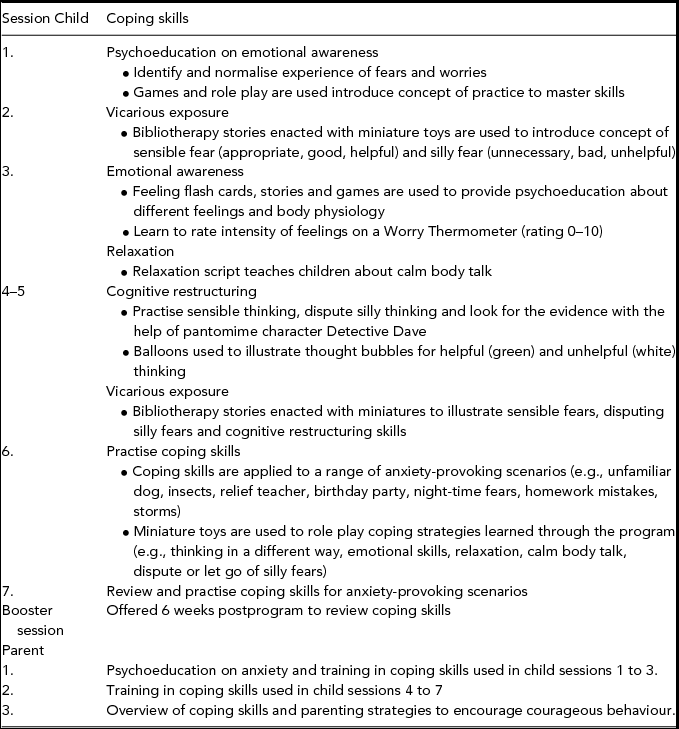
This study used a quasi-experimental design without a control group. The Get Lost Mr Scary group program consisted of seven 1-hour weekly child sessions and one booster session (MacGregor & Herger, Reference MacGregor and Herger2007, Reference MacGregor and Herger2011). Parents attended three separate sessions, each approximately 1 hour in length. Table 1 provides a summary of the session content.
Outline of Coping Skills in Get Lost Mr Scary Program

The Get Lost Mr Scary early intervention program (MacGregor & Herger, 2001, 2007, Reference MacGregor and Herger2011), was designed to be a school-based program to address the unmet mental health issues of young anxious children aged 5 to 7 years transitioning to the school environment. Although typically cofacilitated by pairs of school counsellors, the facilitator manual also includes recommendations for how the program can be delivered by mental health clinicians in the community health setting. Facilitator training workshops are organised through the authors and are regularly provided through the professional development program of the NSW Department of Education.
In the current study, each group program was cofacilitated by pairs of school counsellors, with a total of 26 trained in program delivery across the 13 participating schools. All of the school counsellors facilitating the program were registered school psychologists.
After each session, facilitators were required to complete a program checklist. The main facilitator was required to check off each of the session objectives that were completed. All 13 main facilitators submitted the checklist. The percentage of objectives completed by facilitators in the current study ranged from 93% to 100%, suggesting strong intervention fidelity for the program.
Child interview
Individual pre- and postintervention interviews with the children took place in a private room in their school and were conducted by the first author, a registered psychologist with 8 years of school counselling experience. The duration of the interview was approximately 20 to 30 minutes depending on the number of problems explored.
Data Analysis
The coding of the pictorial semistructured child interview involved a mixed-method qualitative and quantitative approach. The quantitative data from the child interview and the parent and teacher questionnaires were analysed using IBM SPSS Statistics 23 (IBM Corp, 2015).
CACI qualitative analyses
The coding approach for the CACI was piloted in a previous study with 195 children (see Ruocco et al., Reference Ruocco, Freeman and McLean2018). The coding schemes for the various components of the interview (anxiety symptoms, emotions, and coping) were theoretically derived from existing classification schemes in the anxiety (Nauta et al., Reference Nauta, Scholing, Rapee, Abbott, Spence and Waters2004), emotion (Fabes, Eisenberg, Hanish, & Spinrad, Reference Fabes, Eisenberg, Hanish and Spinrad2001) and coping (Ryan-Wenger, Reference Ryan-Wenger1992; Zimmer-Gembeck & Skinner, Reference Zimmer-Gembeck and Skinner2011) literature. In the pilot study (Ruocco et al., Reference Ruocco, Freeman and McLean2018), there was moderate to strong interrater agreement for the coding procedure adopted (K = .72–.90).
CACI quantitative analyses
The children's interview ratings for emotional distress and coping efficacy were summed to derive a negative emotional distress score and a coping efficacy score. A paired samples t test was used to determine whether there were significant mean differences between the children's pre- and postintervention scores.
Generalised linear mixed models (GLMM) or generalised linear models (GLM) were used for the child self-report data that involved frequency counts. The rate ratio (coping strategies, emotion clusters) or odds ratio (problem types) was used to test the effects of CBT intervention. The alpha was set at .05 for all analyses.
Parent and teacher measures
To test the effects of CBT intervention, a series of linear mixed-effects models were performed using the parent and teacher scores for child anxiety and internalising behaviour. Mixed-effects models can integrate all the data available for all child participants while adjusting estimates for any missing data points (Fortney, Luchterhand, Zakletskaia, Zgierska, & Rakel, Reference Fortney, Luchterhand, Zakletskaia, Zgierska and Rakel2013). Effect size was calculated using Cohen's d (Thalheimer & Cook, Reference Thalheimer and Cook2002).
Preliminary analyses
Preliminary tests indicated that the distribution of all continuous measures were substantially normal. A one-sample t test comparing the mean to the trimmed mean revealed that the outliers did not have significant influence on the data and they were subsequently retained in analyses (Pallant, Reference Pallant2009).
Results
CBT Program Attendance
Children attended a mean 6.65 (SD = 0.55, range 5–7) out of 7 child sessions and their parents attended a mean 2.39 (SD = 0.81, range 1–3) out of 3 parent sessions.
Child Self-Reported Anxiety Symptoms
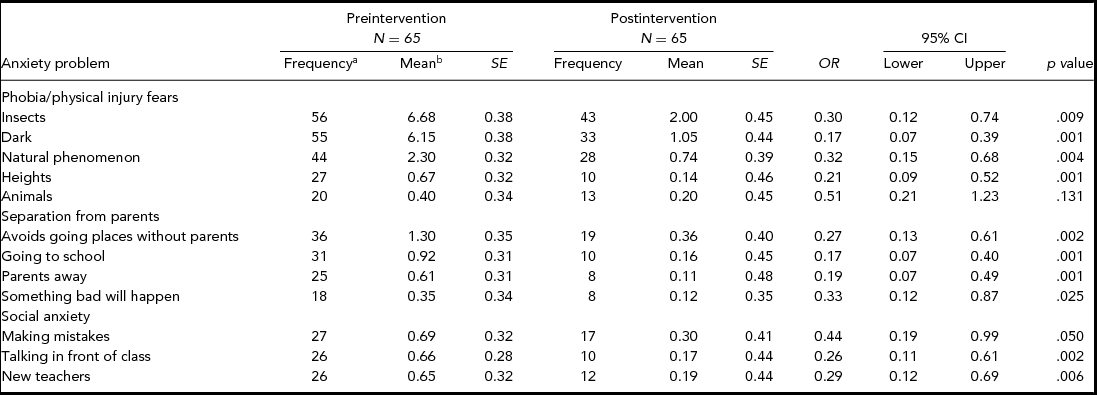
Twelve anxiety symptoms and a diverse range of general problems relating to friendships, the classroom, and the playground were identified through the CACI at baseline. Table 2 provides a summary of the means, standard errors, and odds ratios for the GLMMs that were applied to the anxiety areas as these were specifically targeted in the CBT intervention. The results indicated that the CBT intervention significantly reduced the likelihood of children reporting 11 out of the 12 anxiety symptoms. The exception was animal fears. At preintervention, fear of insects, the dark, and natural phenomenon (e.g., thunderstorms, rain) were the three problems most frequently reported; at postintervention, the odds ratios indicated that children mentioned these problems 70%, 83%, and 68% less often respectively.
Means, Standard Errors, and Odds Ratios for Child-Reported Problems at Pre- and Postintervention

Note: OR = odds ratio; CI = confidence interval. aFrequency = number of children who reported the anxiety problem. bMean = mean number of times that children mentioned the anxiety problem.
Child Self-Reported Coping Strategies
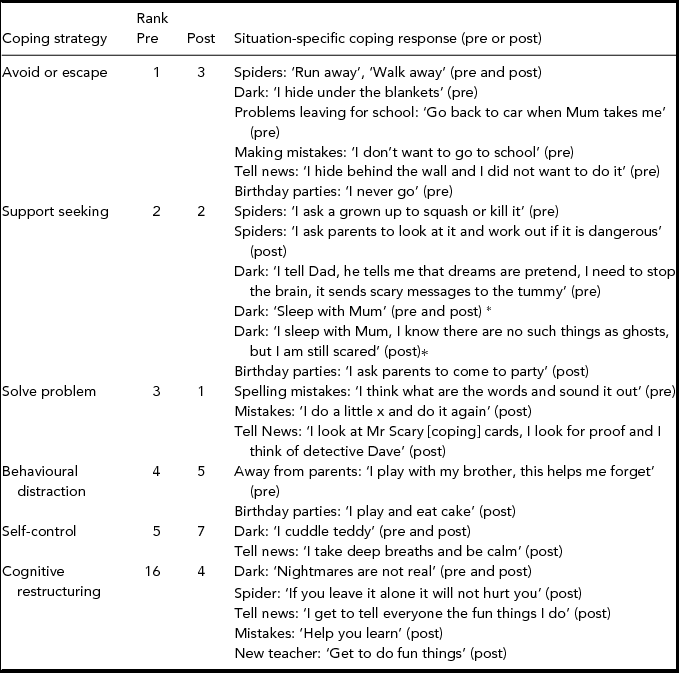
Eighteen coping strategies were identified at baseline and the coding of the children's responses at postintervention did not reveal any further strategies. Table 3 provides verbatim examples of the children's situation-specific responses for coping strategies that ranked in the top five at pre- or postintervention.
Examples of Child Situation-Specific Responses for Coping Strategies Ranking in Top Five at Pre- or Postintervention

Note: *‘Sleeping with others’ was not ranked in the top five but was included as it was a unique support-seeking strategy for fear of the dark.
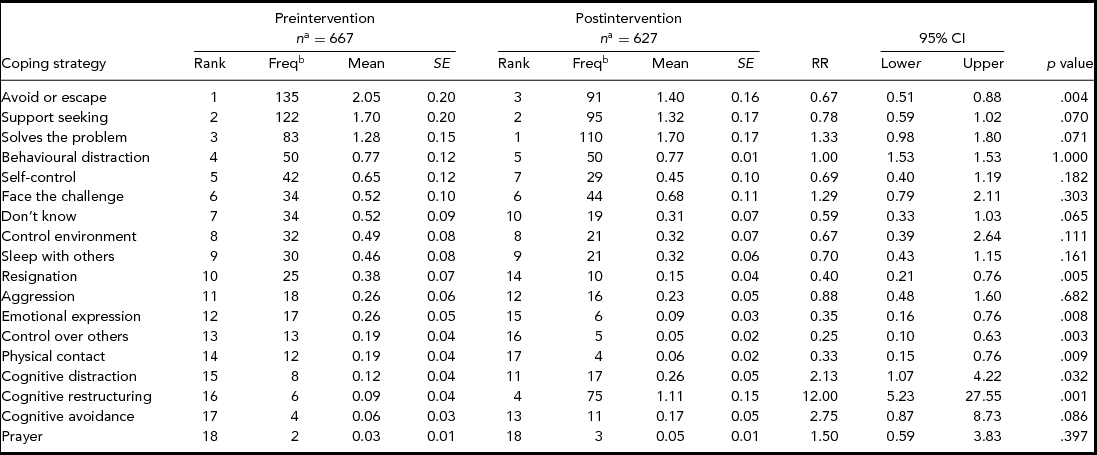
Table 4 depicts the means, standard errors, and rate ratios for the GLMM and GLM quantitative analyses. Although behavioural avoidance as a strategy (e.g., attempts to stay away or leave problem) was still commonly reported postintervention, the odds of using it had significantly reduced to two-thirds that of their preintervention rate. There was a statistically significant increase in the postintervention rate for ‘Cognitive Restructuring’ (e.g., helpful thoughts that alter perspective) and ‘Cognitive Distraction’ (e.g., use imagination to avoid thinking about problem), being used 12 and 2.13 times higher than the rate obtained at preintervention respectively. ‘Sleep with Others’ was a strategy that was exclusively used for children's fears of the dark. The children's postintervention rate of reporting this strategy did not differ significantly from their preintervention rate.
Rank, Frequencies, Means, Standard Errors, and Rate Ratios for Child Reported Coping Strategies at Pre- and Postintervention

Note: RR = rate ratio; CI = confidence interval an = total number of responses, children could report more than one coping type for each problem. bFreq = Frequency.
Child Self-Reported Emotions
The emotion word that children used to describe their feelings about specific problem situations (e.g., dark, dogs, mistakes) was categorised into an emotion cluster (e.g., anxiety, sadness, anger, happy). A series of GLMM or GLM using a Poisson distribution and log link function were applied to each emotion cluster.
After the intervention, the rate of reporting feelings of anxiety was approximately two-fifths lower than the children's preintervention rate (RR = 0.59, range = 0.47–0.73, p < .001) and the rate had halved for sadness (RR = 0.51, range = 0.38–0.67, p < .001). Conversely, the children's rate of reporting feelings of happiness had almost doubled after intervention (RR = 1.95, range = 1.78–2.14, p < .001).
Child Self-Reported Ratings for Negative Emotional Distress
An emotional intensity composite score was derived from the sum of the children's negative emotional intensity ratings. From pre- to postintervention there was a significant decrease in the mean scores (M pre = 21.03, SD pre = 8.83; M post = 12.71, SD post = 7.98) for negative emotional intensity, t(64) = 9.695, p = .001. The effect size was large (d = 1.00).
Child Self-Reported Ratings for Coping Efficacy
Overall, the children rated their preintervention coping strategies as ‘some help’ (M pre = 2.83, SD pre = 1.50) for reducing emotional distress and their postintervention strategies were rated as ‘a lot’ helpful (M post = 3.23, SD post = 1.21).
A coping efficacy composite score was derived from the sum of the children's coping ratings. The paired samples t test revealed that the mean difference in the total coping efficacy scores from preintervention (M pre = 29.85, SD pre = 14.69) to postintervention (M post = 31.54, SD post = 14.24) was not statistically significant, t(63) = -1.300, p = .198, d = -0.12.
Parent and Teacher Ratings of Child Anxiety (SCAS-P; SAS-TR) and Internalising Behaviour (CBCL, TRF)
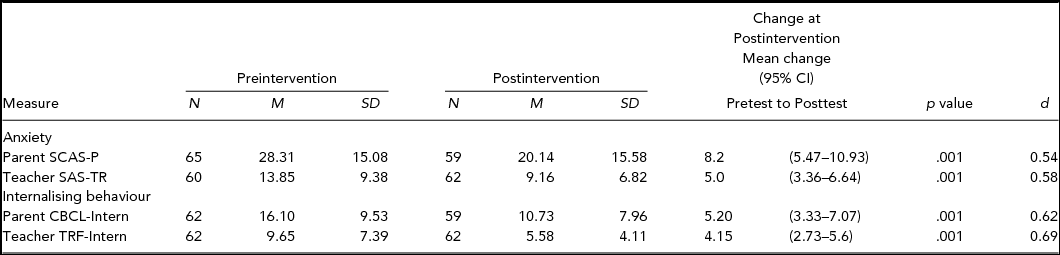
Table 5 depicts the means and standard deviations for the parent and teacher measures at pre- and postintervention. The results of the linear mixed-models analyses showed a statistically significant decrease in mean anxiety scores from pre- to postintervention for both parent, F(60) = 36.06, p < .001, and teacher ratings, F(59) = 37.29, p < .001. The effect sizes for parent (d = 0.54) and teacher ratings (d = 0.58) were moderate.
Means, Standard Deviations for Parent and Teacher Measures at Pre- and PostIntervention

Note: SCAS-P = Spence Children's Anxiety Scale Parent Report; SAS-TR = School Anxiety Teacher Report; CBCL-Intern = Child Behaviour Checklist — Internalising Scale; TRF-Intern = Teacher Report Form, Internalising Scale.
A series of linear mixed-effect model analyses were conducted to explore pre- to postintervention changes in parent and teacher ratings of child internalising behaviour. There was a statistically significant decrease in mean scores on both parent, F(1, 59) = 30.97, p < .001, and teacher ratings of internalising behaviour, F(1, 61) = 34.38, p < .001. The effect sizes for the change in parent (d = 0.62) and teacher (d = 0.69) ratings were in the moderate range.
Change in Clinical Status
The pre- and postintervention raw scores for parent and teacher ratings of internalising behaviour (i.e., CBCL, TRF) were converted to T scores to examine change in clinical status. McNemar tests applied to parent and teacher T scores showed statistically significant improvements in clinical status following CBT intervention. On the parent ratings, the percentage of children who had internalising T scores in the clinical range reduced from 55.4% (n = 36) to 26.2% (n =17) after the intervention, McNemar χ2(1) = 11.13, p < .001. At preintervention, 40% (n = 26) of students were rated by their teachers as having internalising behaviour within clinical range, compared with 10.8% (n = 7) after the intervention, McNemar χ2(1) = 13.14, p < .001.
Discussion
The primary aim of the current study was to examine whether Get Lost Mr Scary, a school-based CBT group intervention, had a beneficial impact on child-reported anxiety symptoms, emotions, negative emotional distress, coping strategies, and coping self-efficacy. In line with the study hypotheses, the overall results indicate that the CBT intervention significantly reduced the likelihood of children reporting problems with phobia (e.g., insects, dark, heights), separation anxiety (e.g., avoids going places without parents), and social anxiety symptoms (e.g., speaking up in class). As hypothesised, children also showed a lower postintervention rate of reporting behavioural avoidance as a coping strategy and a higher postintervention rate of using cognitive restructuring. A similar pattern emerged for child reports of negative emotions and emotional distress. Children's responses indicated a lower postintervention rate of reporting negative emotions such as anxiety and sadness, and a higher postintervention rate of reporting feelings of happiness. Consistent with the previous evaluation of the Get Lost Mr Scary program (Ruocco et al., Reference Ruocco, Gordon and McLean2016), parent and teacher ratings of child anxiety and internalising behaviours were at significantly lower levels following the intervention.
Children generally rated the perceived effectiveness of their coping strategies as ‘some help’ in reducing their emotional distress at preintervention and increased to ‘a lot of help’ after the intervention. However, the study hypothesis was not supported, as the change in their coping effectiveness ratings was not significant. These findings could reflect the children's pre- and postintervention perceptions that maladaptive coping strategies such as avoidance do provide some short-term relief from their anxiety symptoms. For some children the act of facing their fears, although an example of improved coping skills, may in itself increase anxiety symptoms.
Although prior research has demonstrated the utility of visual analogue 5-point rating scales with young children (Ernst, Cookus, & Moravec, Reference Ernst, Cookus and Moravec2000; Lagattuta et al., Reference Lagattuta, Sayfan and Bamford2012), there is conflicting evidence regarding the reliability of their responses, with some suggesting they tend to respond to the extremes of the scale (Chambers & Johnston, Reference Chambers and Johnston2002). Other researchers have reported on the utility of a variety of scale points and have indicated that young children can provide reliable ratings when they are given adequate training (Dubi et al., Reference Dubi, Lavallee and Schneider2012; Lagattuta et al., Reference Lagattuta, Sayfan and Bamford2012; Muris et al., Reference Muris, Meesters, Mayer, Bogie, Luijten, Geebelen and Smit2003). An item-response analysis of the children's scale ratings was not conducted in this study. Future research efforts could conduct an item-response analysis to determine whether children do tend to respond to the extremes of the scale. Additionally, research is needed to explore the effectiveness of various child-friendly methodologies (e.g., picture aids, rating scales, interview procedures) to determine those that best capture the young child's perspectives.
Evidence for the efficacy of Get Lost Mr Scary as a mechanism of change is provided in the study findings. There was a significant increase in adaptive coping strategies such as cognitive restructuring and cognitive distraction. The findings also showed a significant decrease in maladaptive coping strategies such as avoidance, resignation, and control over others. The majority of the children's preintervention coping responses suggested they were either not equipped or unaware of their cognitive restructuring skills for anxiety management, confirming that the strong emphasis on these skills in the CBT intervention was appropriate. Moreover, the postintervention results showed that some children also understood they could deploy a behavioural avoidance strategy in a helpful way. For example, the children reported they felt happy about the spider because they could ‘just walk away’. This finding underscores the need to explore the underlying factors that trigger behavioural avoidance, as it is clear from this example that avoidance is not always a sign of maladaptive functioning (Spirito, Reference Spirito1996).
Although the rate of children's reported problems with fears of the dark had significantly improved after intervention, some children's responses indicated that this fear was an ongoing struggle, and sleeping with their parents or other family members remained an option. Noteworthy is the finding that in some cases where children had not resolved their night-time fear, there was improved insight, as illustrated in this kindergarten student's comment: ‘I sleep with Mum, I know there is no such things as ghosts, but I am still scared’. Culturally, this child's response may not be a problem, as family sleeping arrangements vary and sleeping apart may not be a goal for this family (Blunden, Thompson, & Dawson, Reference Blunden, Thompson and Dawson2011). Developmentally, young children commonly experience transient and mild night-time fears such as fear of ghosts and monsters as part of normal development (Gordon, King, Gullone, Muris, & Ollendick, Reference Gordon, King, Gullone, Muris and Ollendick2007; Muris et al., Reference Muris, Merckelbach, Ollendick, King and Bogie2001), and the need to seek help and be close to their parents is considered an adaptive coping response (Zimmer-Gembeck & Skinner, Reference Zimmer-Gembeck and Skinner2011). However, persistent night-time fear and anxiety symptoms can pose a serious challenge for some young children, with the risk of developing poor sleep quality that may further compromise their psychological wellbeing and quality of family life (Kushnir & Sadeh, Reference Kushnir and Sadeh2011).
In the case of severe clinical anxiety symptom presentations, research has indicated that 12 to 20 weeks of individual CBT therapy may be required (Hirshfeld-Becker et al., Reference Hirshfeld-Becker, Masek, Henin, Blakely, Pollock-Wurman, McQuade and Biederman2010; Rapee, Reference Rapee and Rey2012). This level of intensive specialist one-on-one support would be an unrealistic expectation in schools. As a generic anxiety program and a first line of intervention, Get Lost Mr Scary has demonstrated its short- and long-term effectiveness as an early intervention with children who have shown early signs of anxiety (Ruocco et al., Reference Ruocco, Gordon and McLean2016). An advantage of the CBT program is that it is brief and can fit within the school's timeframe. When the CBT program is also considered in the context of a stepped care approach, the school psychologists who facilitate the program are well placed to identify children with severe anxiety disorders, and can consult, collaborate, and refer on to other community mental health specialists when children require more intensive treatment.
Limitations and Directions for Future Research
Although the CACI provided some insights into the children's perceptions of their coping and anxiety management, the investigation was exploratory in nature, and several methodological issues require consideration. Despite the inclusion of domain-specific questions about children's experiences of anxiety in real life situations, their coping responses may reflect what they think they should do or would prefer to do in the situation, rather than the reality of what happens. It is possible that the children's responses may be confounded by a social desirability bias, although there is a lack of research that supports whether this issue is a factor for young children. To explore the potential problem of social desirability bias, the use of observational methods that capture the child's coping behaviours in real life challenges would confirm whether the children are applying their self-reported coping skills (Chalmers et al., Reference Chalmers, Frydenberg and Deans2011; Zimmer-Gembeck & Skinner, Reference Zimmer-Gembeck and Skinner2011). The inclusion of parent- and teacher-coping measures in future investigations would also expand our understanding of the children's coping efforts. The validity and reliability of the CACI has not yet been established, hence future research on its psychometric properties is also needed.
This study used a pretest–posttest design, and although this was a useful first step in examining the link between participation in CBT intervention and improvements in anxiety symptoms and coping skills, it was unable to establish whether the intervention changes were due to the child sessions, parent sessions, or a combination of both. Previous studies suggest that the involvement of young children and parents in CBT interventions is more efficacious than working with parents alone (Lau, Rapee, & Coplan, Reference Lau, Rapee and Coplan2017; Monga, Rosenbloom, Tanha, Owens, & Young, Reference Monga, Rosenbloom, Tanha, Owens and Young2015).
Children in the current study were a heterogeneous group whose symptoms of anxiety and internalising behaviours ranged from normal to clinical and their diagnostic status was unknown. When the aim of program implementation is early intervention and prevention, this symptom profile is common (Anticich et al., Reference Anticich, Barrett, Silverman, Lacherez and Gillies2013; Pahl & Barrett, Reference Pahl and Barrett2010). Although the child participants were drawn from schools in the same geographic region, they lived in families from diverse socio-economic backgrounds, ranging from disadvantaged to advantaged. This finding suggests that the Get Lost Mr Scary program has general applicability with children, regardless of their socio-economic background. Replication studies are required in different school and community settings with groups of children and their parents across cultural, ethnic, and socio-economic backgrounds. Future studies should also consider investigating the effectiveness of the Get Lost Mr Scary intervention using a randomised controlled trial design and diagnostic measures to determine its benefits for children with known anxiety disorders. Furthermore, as noted in previous research with young children, there is clear need for standardised instruments that assess anxiety (Hirshfeld-Becker et al., Reference Hirshfeld-Becker, Masek, Henin, Blakely, Pollock-Wurman, McQuade and Biederman2010; Ruocco et al., Reference Ruocco, Gordon and McLean2016) and coping symptoms (Chalmers et al., Reference Chalmers, Frydenberg and Deans2011), particularly for children in the 5- to 7-year shift, a period that marks the start of school and its unique academic, cognitive and social-emotional challenges (Compas, Connor-Smith, Saltzman, Thomsen, & Wadsworth, Reference Compas, Connor-Smith, Saltzman, Thomsen and Wadsworth2001; Zimmer-Gembeck & Skinner, Reference Zimmer-Gembeck and Skinner2011).
Clinical Implications
Although the findings from the CACI are exploratory, preliminary results indicate that the interview was able to capture important clinical information about the child's perspective of their anxiety symptoms, emotions, and coping. Given the CBT emphasis on anxiety management and cognitive restructuring skills, it was encouraging to note that enhancement in these skills was reflected in the children's postintervention reports. The results suggest that a semistructured interview containing pictorial cues (i.e., scenario cues, feeling faces, and visual rating scales) and language that reflects the children's terms and phrases may be a useful addition to a multi-informant assessment of children's anxiety symptoms and coping abilities. As a relatively language-free instrument, future research efforts could also explore whether the CACI has utility with children who present with selective mutism or language disorders.
Conclusion
In summary, the present study differed from previous trials of CBT interventions with children aged 5 to 7 years due to the inclusion of a child self-report on anxiety symptoms and coping as part of its multi-informant evaluation. The results from the child, parent, and teacher reports suggest that a school-based group CBT program can have a positive impact on young children's anxiety symptoms and coping skills. Child self-reports indicate significant improvements in adaptive coping skills, especially cognitive restructuring, a skill that was a specific focus in the Get Lost Mr Scary program. Taken together, the findings for the child, parent, and teacher reports contribute further support to the body of evidence demonstrating the effectiveness of CBT interventions for early childhood anxiety and coping; and provide preliminary insights into young children's views of their anxiety symptoms and coping repertoire.
Financial Support
This research received no specific grant from any funding agency, commercial or not-for-profit sectors.
Conflicts of Interest
None.
Ethical Standards
The authors assert that all procedures contributing to this work comply with the ethical standards of the relevant national and institutional committees on human experimentation and with the Helsinki Declaration of 1975, as revised in 2008.