INTRODUCTION
Studies of adults with attention deficit hyperactivity disorder (ADHD) have consistently found an elevated prevalence of substance use disorders (SUDs): 17–45% of ADHD adults have histories of alcohol abuse or dependence and 9–30% have histories of drug abuse or dependence (reviewed by Wilens, Reference Wilens2004). The study by Biederman et al. (Reference Biederman, Wilens, Mick, Milberger, Spencer and Faraone1995) of never-treated adults with ADHD found that the risk of SUD developing over the lifespan in an ADHD individual is twofold compared to non-ADHD adults (52% v. 27%). Although a history of conduct or bipolar disorders increases that risk (Weiss et al. Reference Weiss, Hechtman, Milroy and Perlman1985; Mannuzza et al. Reference Mannuzza, Klein, Bessler, Malloy and LaPadula1993), ADHD is an independent risk factor for later SUD (Biederman et al. Reference Biederman, Wilens, Mick, Milberger, Spencer and Faraone1995). Comparisons of ADHD adults with SUDs and non-ADHD adults with SUDs show no differences in preference for specific substances (Biederman et al. Reference Biederman, Wilens, Mick, Milberger, Spencer and Faraone1995).
Likewise, the substance abuse literature shows that ADHD is elevated among substance users. Studies of alcohol abusers report the prevalence of ADHD to range between 35% and 71% (Wilens, Reference Wilens1998). Studies of substance-dependent populations report the prevalence of ADHD to range between 15% and 25% (Wilens, Reference Wilens1998). For example, Schubiner et al. (Reference Schubiner, Tzelepis, Milberger, Lockhart, Kruger, Kelley and Schoener2000) found that 24% of 201 in-patients in a substance abuse treatment facility had ADHD. Levin et al. (Reference Levin, Evans and Kleber1998) found that 10% of cocaine-dependent adults met strict full criteria for ADHD.
The literature suggests that SUD in ADHD adults may be more severe than SUD in the absence of ADHD. For example, adults with both ADHD and SUD have been reported to have earlier onset of substance abuse relative to adults without ADHD (Wilens et al. Reference Wilens, Biederman, Abrantes and Spencer1997) and a greater severity of SUD has been reported in ADHD adults compared with non-ADHD adults (Carroll & Rounsaville, Reference Carroll and Rounsaville1993; Schubiner et al. Reference Schubiner, Tzelepis, Milberger, Lockhart, Kruger, Kelley and Schoener2000). For instance, Carroll & Rounsaville (Reference Carroll and Rounsaville1993) showed that compared to cocaine abusers without ADHD, those with ADHD had an earlier onset of cocaine use and a more severe history of cocaine use. Similarly, Schubiner et al. (Reference Schubiner, Tzelepis, Milberger, Lockhart, Kruger, Kelley and Schoener2000) reported higher numbers of motor vehicle accidents and prior treatments for SUD in SUD adults with ADHD relative to those without ADHD.
ADHD also appears to affect the developmental pathways of SUD in adults with ADHD from two perspectives (Biederman et al. Reference Biederman, Wilens, Mick, Milberger, Spencer and Faraone1995). Consistent with prior reports, ADHD adults exhibited a twofold increased risk for SUDs. Among adult ADHD patients with alcohol use disorders, ADHD increased the risk for subsequent drug abuse or dependence. In addition, compared with non-ADHD controls, ADHD patients were at increased risk for a chronic course of SUD that could not be accounted for by psychiatric co-morbidity. Thus, in addition to predicting SUD, ADHD also predicts developmental sequences among different types of SUD. This work is particularly important because the discovery of developmental SUD pathways associated with ADHD might lead to improved primary prevention, which could reduce the risk for SUD in ADHD subjects. Such data could also be used to justify secondary prevention efforts to stop or mitigate transitions from milder to more severe SUDs.
The biological model of ‘kindling’, in which exposure to illicit drugs modifies the brain to increase the likelihood of addiction, motivates the hypothesis that stimulant treatment of ADHD increases the risk for SUD among ADHD patients. This issue cannot be studied in a controlled clinical trial because the development of SUDs requires many years. Fortunately, prospective, naturalistic follow-up studies have provided useful information on this topic by tracking the development of SUD in ADHD patients who had and had not been treated with stimulants. These studies have produced what appear to be contradictory results; some suggest that the stimulant treatment of ADHD is a risk factor for SUDs (Lambert & Hartsough, Reference Lambert and Hartsough1998), while others suggest it has no effect (e.g. Barkley et al. Reference Barkley, Fischer, Smallish and Fletcher2003), and some find that it protects ADHD youth against subsequent substance use (Katusic et al. Reference Katusic, Barbaresi, Colligan, Weaver, Leibson and Jacobsen2005). For example, Wilens and colleagues conducted a meta-analysis that used statistical methods to determine the most sensible conclusion to draw from a group of studies (Faraone & Wilens, Reference Faraone and Wilens2003; Wilens et al. Reference Wilens, Faraone, Biederman and Gunawardene2003). The meta-analysis identified two studies that followed ADHD youth into adolescence (Biederman et al. Reference Biederman, Wilens, Mick, Spencer and Faraone1999; Molina et al. Reference Molina, Pelham and Roth1999) and four that followed ADHD youth into adulthood (Huss, Reference Huss1999; Paternite et al. Reference Paternite, Loney, Salisbury and Whaley1999; Lambert, Reference Lambert, Jensen and Cooper2002; Loney et al. Reference Loney, Kramer, Salisbury, Jensen and Cooper2002). The analysis showed that stimulant-treated ADHD youth were half as likely to develop SUD than those that had not been treated with pharmacotherapy. The magnitude of risk reduction was such that the ultimate risk of SUD in the stimulant-treated group was similar to the risk in individuals without ADHD. These data show that stimulant treatment of ADHD, rather than causing SUD, may protect ADHD youth from developing SUD. Of note, the preventive effect of stimulants was significant for studies that followed subjects into adolescence but not for those following subjects into adulthood. For these latter subjects, prior stimulant treatment had no effect on the onset of subsequent SUDs.
We recently replicated the association of SUDs with adult ADHD and also showed that the association held for adults who met all DSM-IV criteria for ADHD except the age at onset criterion (Faraone et al. in press). We found that full-threshold ADHD and late-onset ADHD showed an elevated prevalence of SUDs and more impairment due to SUDs. Nearly half had used marijuana at least once in the past month and 15% had used it more than 20 times. Between 10% and 20% of the ADHD patients had used lysergic acid diethylamide (LSD), mescaline or cocaine during the prior month. In the present report, we use this sample to assess the impact that prior pharmacotherapy for ADHD had on substance use disorders in this sample. We hypothesized that subjects who had been treated for their ADHD would show less evidence of substance use and abuse/dependence than those who had not been treated.
METHOD
Subjects
Males and females between the ages of 18 and 55 were eligible for the study. Potential subjects were excluded if they had major sensorimotor handicaps (deafness, blindness), psychosis, inadequate command of the English language, or a full-scale intelligence quotient (IQ) less than 80. No ethnic or racial group was excluded. Two ascertainment sources were used to recruit ADHD subjects: referrals to psychiatric clinics at the Massachusetts General Hospital (MGH) and advertisements in the greater Boston area. All subjects provided written informed consent.
Assessment measures
Trained, lay interviewers, blind to ascertainment status, interviewed all adults with the Structured Clinical Interview for DSM-IV (SCID; First et al. Reference First, Spitzer, Gibbon and Williams1997) and modules from the Schedule for Affective Disorder and Schizophrenia for School-Age Children Epidemiologic Version (Kiddie SADS E; Orvaschel, Reference Orvaschel1994). When asking questions about childhood disorders (e.g. ADHD), subjects were first queried about childhood symptoms, and if they were present, were asked about continuation of these symptoms into adulthood and the emergence of others. Age at onset was defined as the first emergence of impairing symptoms. Pharmacologic treatment was established during the SCID at the conclusion of each disorder's module; subjects were queried for any medications prescribed to treat the disorder in question, along with ages of onset and offset. Any medication prescribed to treat ADHD was considered to be ‘pharmacologic treatment’ for the current study. Subjects in the current analysis were categorized into three groups based on their current treatment and treatment history: no treatment, meaning no pharmacologic treatment currently or in the past; past pharmacologic treatment; and current and past pharmacologic treatment. Other forms of therapy, including psychosocial treatment, are not considered in this classification scheme.
The interviewers had undergraduate degrees in psychology and were extensively trained. First, they underwent several weeks of classroom style training, learning interview mechanics, diagnostic criteria and coding algorithms. Then, they observed interviews by experienced raters and clinicians. They subsequently conducted at least six practice (non-study) interviews and at least three study interviews while being observed by senior interviewers. Trainees were not permitted to conduct interviews independently until they executed at least three interviews that achieved perfect diagnostic agreement with an observing senior interviewer. During the study, all interviews were audiotaped for random quality control assessments. A senior investigator (J.B.) supervised the interviewers throughout the study. This supervision included weekly meetings and additional consultations as needed. We computed κ coefficients of agreement by having experienced, board-certified child and adult psychiatrists and licensed clinical psychologists diagnose subjects from audiotaped interviews. Based on 500 assessments from interviews of children and adults, the median κ coefficient was 0·98. κ coefficients for individual diagnoses included: ADHD (0·88), conduct disorder (1·0), and substance use disorder (1·0).
Final diagnostic assignment was based on the SCID. Initial diagnoses were prepared by the study interviewers and reviewed by a diagnostic committee of board-certified child and adolescent psychiatrists or licensed psychologists. The diagnostic committee was blind to the subject's ascertainment group, all data collected from other family members, and all non-diagnostic data (e.g. cognitive functioning). Diagnoses were made for two points in time: lifetime and current (past month). The interviewers took extensive notes about the symptoms for each disorder. The committee reviewed these notes and the structured interview data to make a best-estimate diagnosis as described by Leckman et al. (Reference Leckman, Sholomskas, Thompson, Belanger and Weissman1982).
Definite diagnoses were assigned to subjects who met all diagnostic criteria. Diagnoses were considered definite only if a consensus was achieved that criteria were met to a degree that would be considered clinically meaningful. By ‘clinically meaningful’ we mean that the data collected from the structured interview indicated that the diagnosis should be a clinical concern due to the nature of the symptoms, the associated impairment and the coherence of the clinical picture. ADHD subjects were classified into two strata based on a lifetime assessment of psychiatric history: full ADHD subjects met all DSM-IV criteria for childhood-onset ADHD, and late-onset ADHD subjects met all criteria except the age at onset criterion; subjects in both groups endorsed some impairment and cross-situational symptoms.
The diagnosis of substance use disorder was based on the SCID: SUDs are reported here as alcohol abuse or dependence, drug abuse or dependence and cigarette smoking. Structured interview data reflect DSM-IV diagnoses of psychoactive substance use disorders (PSUDs) and do not include cigarette smoking. In addition to the SCID, we administered the Drug Use Screening Inventory (DUSI; Tarter & Kirisci, Reference Tarter and Kirisci1997), a self-report measure designed to identify problematic alcohol and drug use and to evaluate their associated functional impairments. The DUSI assesses six features of drug use for specific drugs and classes of drugs: any use in the past month, use more than 20 times in the past month, having had a problem due to drug use, functional impairments due to drug use, preferred drug, and reasons for use of the preferred drug. We report on combined stimulant (non-prescription stimulants or cocaine) usage in addition to categories queried by the DUSI (non-prescription stimulants and cocaine separately).
Statistical analyses
No treatment, past treatment, and past and current treatment groups were compared on potentially confounding demographic variables, using Pearson χ2 tests for sex and marital status, ordered logistic regression on socio-economic status (SES), and linear regression for age. The five-point Hollingshead scale was used to measure SES. Logistic regression was used to assess categorical variables (prevalence, reporting a problem, preference for a particular drug) and ordered logistic regression for motivation for use: subjects ranked ‘getting high’, ‘changing mood’ and ‘to sleep better’ on a four-point scale with 1 meaning very true and 4 meaning not true. Dummy variables indicating group membership were the independent variables, along with covariates in all regressions. A p value threshold of 0·05 was used to assert statistical significance; all statistical tests are two-tailed. Fisher's exact test was used to replace logistic regression in the case of low-frequency responses.
RESULTS
We ascertained 206 adult subjects with late-onset (n=79) and full DSM-IV ADHD (n=127). No significant differences were found in the frequency of male subjects between late-onset ADHD [n=38 subjects (48%)] and full ADHD [n=67 (53%); χ2(1)=0·4, p=0·5] or in marital status between late-onset ADHD [n=21 (27%) married, n=13 (17%) divorced] and full ADHD [n=33 (27%) married, n=18 (15%) divorced; χ2(2)=0·2, p=0·9]. No significant differences were found in age between late-onset ADHD (36·5±10·8 years) and full ADHD (36·1±10·8 years; t=0·3, p=0·8).
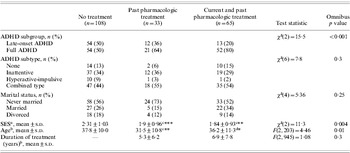
Subjects were grouped into no treatment (n=108), past pharmacologic treatment (n=33), and current and past pharmacologic treatment (n=65). No differences were found across these groups in sex or marital status (Table 1). However, there were significant differences across the three groups in SES: no-treatment subjects had the lowest SES, significantly lower than both past treatment and current treatment groups. There were no significant differences in SES between the two treated groups. We found significant differences in age between the three treatment groups: the no-treatment group was significantly older than the past pharmacologic treatment group, which was also significantly younger than the current treatment group. We found no significant difference in age between current and past treatment and no-treatment groups. Duration of treatment in the treated groups was analyzed using linear regression with group membership as the independent variable. No significant difference was found between past treatment and current and past treatment subjects in years of treatment; as this measurement may have been confounded by age, we controlled for age in a subsequent linear regression and again found no significant difference between the two treated groups [linear Wald test for treatment group F(1, 95)=0·7, p=0·4]. All analyses below were corrected for age and SES.
Demographic features

ADHD, attention deficit hyperactivity disorder; SES, socio-economic status; s.d., standard deviation.
a Ordinal logistic regression.
b Linear regression.
For pairwise comparisons: cversus no treatment; dversus past pharmacologic treatment.
* p⩽0·001; ** p⩽0·01; *** p⩽0·05.
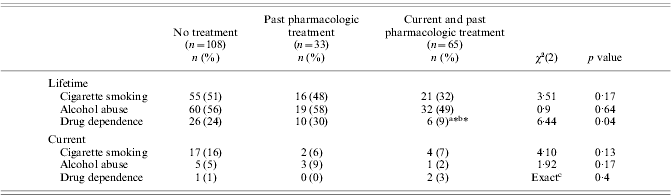
No differences were found across the three groups in past or current rates of alcohol abuse, drug abuse or cigarette smoking (Table 2). There were no differences in rates of past or current alcohol dependence, or current drug dependence. We found significantly lower rates of lifetime drug dependence in the current and past treatment group compared with the two other treatment groups. Because we had previously found that full ADHD subjects were more likely to have had ADHD treatment relative to the late-onset ADHD group, we reassessed statistical significance after including ADHD diagnostic category (full ADHD versus late-onset ADHD) in the regression model. This analysis is useful because it addresses an inherent confound in naturalistic studies; that is, that treatment intensity is positively associated with severity (Faraone et al. Reference Faraone, Biederman, Spencer, Mick, Murray, Petty, Adamson and Monuteaux2006b). When ADHD diagnostic category (full ADHD versus late-onset ADHD) was included in the model, the effect of treatment on drug dependence was no longer significant. None of the results in Table 2 gained significance when we included ADHD diagnostic category in the regression model.
Overall prevalence of cigarette smoking, drug and alcohol abuse
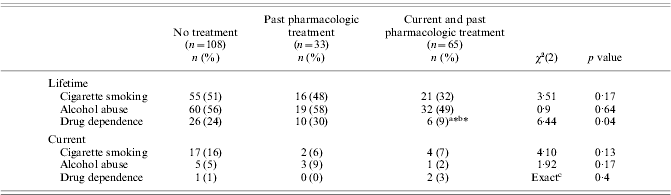
Logistic regression controlling for age and socio-economic status (SES); for pairwise comparisons: aversus no treatment; bversus past pharmacologic treatment.
c Fisher's exact test.
* p⩽0·05.
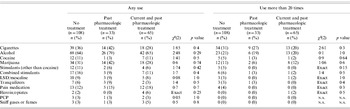
DUSI responses show that the most frequently used substances were alcohol, cigarettes and marijuana. We found no differences in the 1-month prevalence of any use (Table 3) across the three treatment history groups for any drug queried by the DUSI. Similarly, for the 1-month prevalence of use more than 20 times, we found no significant differences across the three groups (Table 3). Non-prescription use of stimulants was more frequently reported by the no-treatment group compared with the other groups, but this result did not reach statistical significance. None of the results in Table 3 gained significance when we included ADHD diagnostic category in the model.
One month prevalence of use (not including prescribed use)

LSD, Lysergic acid diethylamide; PCP, phencyclidine; Exact, Fisher's exact test; n.a., not applicable.
Logistic regression controlling for age and socio-economic status.
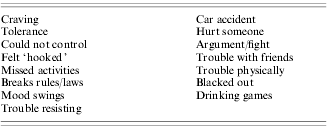
The DUSI questions respondents on problems due to use in two sections: the first asks if they ever perceived a problem with their use of a specific drug; the second queries respondents on specific sequelae related to use (listed in Table 4). No subjects reported a problem due to phencyclidine (PCP) use. No significant differences were found across treatment history groups in frequency of reporting a problem due to all other specific substances. None of these results gained significance when we included ADHD diagnostic category in the model.
List of complications and sequelae of alcohol and drug use (not including cigarette smoking)
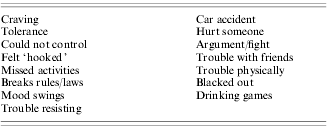
One hundred and seventy-two of the 206 subjects reported use of one of the substances mentioned on the DUSI [no treatment (n=90), past pharmacologic treatment (n=30), and current and past pharmacologic treatment (n=52)]. In each group, the most commonly reported problem associated with use of any drug except cigarettes (DUSI Section B) was ‘craving or strong desire’ [no treatment n=30 (30%); past treatment n=11 (37%); current and past treatment n=18 (35%)]. The least frequently reported problem was car accidents, all in the no-treatment group [n=4 (4%)]. We found no significant differences across groups for any DUSI problem. None of these results gained significance when we included ADHD diagnostic category in the model.
Among subjects reporting use, the most preferred drug was alcohol [no treatment n=29 (43%); past treatment n=8 (33%); current and past treatment n=20 (45%)]. No subjects reported tranquilizers or painkillers as their most preferred drug. We found no significant differences across the three treatment history groups in preferred drug. None of these results gained significance when we included ADHD diagnostic category in the model.
The DUSI also queries respondents on motivation for first use and continued use of a preferred drug. We found no differences across the three treatment history groups in first use to get high [ordered logistic regression controlling for age and SES: χ2(2)=5·42, p=0·07], change mood [χ2(2)=3·44, p=0·2], or sleep better [χ2(2)=2·11, p=0·4]. Similarly, we found no differences across the three groups in continued use to change mood [χ2(2)=1·51, p=0·5] or sleep better [χ2(2)=0·6, p=0·7]. We found a significant difference in preferred use to get high: subjects in the current and past pharmacologic treatment group rated getting high as their primary motivation for continued use significantly more often than subjects in the past pharmacologic treatment group [χ2(2)=6·54, p=0·04]. This result lost significance when we included ADHD diagnostic status in the regression model. No result gained significance when we included ADHD diagnostic category in the model.
We analyzed risk of SUD with logistic regression models using ADHD treatment onset and duration of treatment as independent variables separately and simultaneously in the treated groups. We found no significant effect of treatment onset or duration of treatment, separately or simultaneously, on past or current smoking, alcohol abuse or dependence, or drug abuse or dependence as assessed by the SCID.
DISCUSSION
Our results show a high degree of consistency across substances of abuse in finding no link between prior pharmacotherapy for ADHD and subsequent substance use, abuse or dependence. In addition to the nearly complete lack of statistical significance among treatment groups, inspection of Tables 2–4 shows that these non-significant differences were very small and not suggestive of deleterious effects of prior treatment. Notably, although differences were not statistically significant, stimulant abuse was less common among the two treated groups compared with the never-treated group. Thus, although we cannot find any protective effect of stimulant treatment on substance use outcomes, it seems reasonable to conclude that prior pharmacologic treatment does not worsen substance use outcomes and does not place patients at risk for the abusive use of stimulants.
Our results are consistent with the idea that the stimulant treatment of ADHD does not cause subsequent SUDs. If stimulants caused substance abuse, we would expect to observe higher rates of substance abuse among the ADHD adults who had a history of pharmacotherapy. By contrast, we found evidence supportive of the conclusions from meta-analyses of longitudinal studies of ADHD (Faraone & Wilens, Reference Faraone and Wilens2003; Wilens et al. Reference Wilens, Faraone, Biederman and Gunawardene2003). This work showed evidence that pharmacotherapy protected ADHD youth against subsequent SUDs in adolescence and did not increase the risk for SUDs in adulthood.
Naturalistic studies of treatment can be confounded by the fact that treatment intensity typically increases with disorder severity. Because of this, naturalistic studies can conclude erroneously that treatment is associated with worse SUD outcomes. For example, our meta-analysis of this issue (Faraone & Wilens, Reference Faraone and Wilens2003; Wilens et al. Reference Wilens, Faraone, Biederman and Gunawardene2003) showed that all studies in which treated and untreated ADHD youth had a similar severity at baseline found that stimulants predicted a reduction in the risk for SUD. For the single study in which stimulant treatment predicted subsequent SUD, treatment was associated with severity of the disorder.
We did not observe this severity effect in the present study even though we had a wide range of severity represented in our ADHD diagnostic categories (late-onset ADHD and full ADHD). It is possible that the range of severity in our sample obscured a protective effect of treatment; in that case, we should have found significant protective effects when ADHD diagnostic category was included in the regression models. We did not find such an effect.
An intriguing finding from the previous meta-analysis of longitudinal studies of ADHD is that the effects of stimulant therapy on subsequent SUDs differed in adolescence and adulthood (Faraone & Wilens, Reference Faraone and Wilens2003; Wilens et al. Reference Wilens, Faraone, Biederman and Gunawardene2003). Studies reporting follow-up into adolescence showed a strong protective effect on the development of SUD: stimulant-treated subjects were 5·8 times less likely to develop SUDs than untreated subjects. By contrast, for studies that followed children into adulthood, stimulant-treated subjects were only 1·4 times less likely to develop SUDs than untreated subjects. Thus, the lack of a protective effect of stimulants in our adult sample is consistent with prior reports of adult samples.
We can only speculate as to why the protective effect of stimulants is not evident in adulthood. One possibility is that, due to parental monitoring, treatment compliance and hence efficacy are greater for youth than adults. Another possibility is that, because adolescents have not fully passed through the age of risk to develop SUD, the protective effect of stimulants may be to delay rather than stop subsequent SUDs. More research is needed to understand this developmental effect of stimulants on substance use and to further clarify protective mechanisms.
We have speculated that stimulant therapy reduces classic symptoms associated with ADHD such as poor self-esteem, demoralization and school failure, and, accordingly, such treatment reduces the risk of SUD (Wilens et al. Reference Wilens, Faraone, Biederman and Gunawardene2003). It is also possible that stimulants act directly on the reward system to reduce the reward value of drugs, which in turn makes them less susceptible to abuse drugs. This latter hypothesis has seen some support in studies of an ADHD animal model known as the spontaneously hypertensive rat (SHR). The SHR is both a good behavioral model of ADHD and an accurate neurochemical model of the disorder (Sagvolden et al. Reference Sagvolden, Russell, Aase, Johansen and Farshbaf2005). Prior work has successfully used the SHR to show that repeated exposure to methylphenidate during the pubertal period diminishes subsequent sensitivity to the incentive properties of cocaine (Augustyniak et al. Reference Augustyniak, Kourrich, Rezazadeh, Stewart and Arvanitogiannis2006). If this work generalizes to humans, it could be that the timing of stimulant exposure is a crucial factor in predicting protective effects on SUDs and how those effects unfold through adolescence and adulthood.
Regardless of the mechanisms involved, the data from the present study combined with prior studies provide additional assurance to clinicians that the use of stimulant therapy will not increase subsequent risks for SUDs. This is especially important considering the high efficacy of stimulant medications compared with alternatives (Faraone et al. Reference Faraone, Spencer, Aleardi, Pagano and Biederman2004, Reference Faraone, Biederman, Spencer and Aleardi2006a).
Our findings should be viewed in the light of some methodological limitations. Most importantly, inferences from a naturalistic, retrospective study should be drawn with caution. Our work usefully elaborates on prior prospective studies by generalizing findings from studies that started with subjects referred as youths to subjects referred as adults. However, because it is retrospective and naturalistic, it must be interpreted in the broader context of these other studies. The diagnoses of adult ADHD relied entirely on the self-report of adult subjects. Although this method allowed us to evaluate the validity of retrospective self-reports, these findings may not generalize to diagnoses defined using data from informants. As Barkley et al. (Reference Barkley, Fischer, Smallish and Fletcher2002) showed in a study of ADHD youth followed into adulthood, informant reports can boost the validity of diagnosing ADHD in adulthood. Given that some substances were rarely used (e.g. PCP, LSD), inferences about those substances should be made with caution. Future studies should consider these less common substances. We must also be cautious in generalizing our findings from a referred sample to all cases of ADHD in the general population. It is likely that non-referred ADHD adults have a milder disorder than referred ADHD adults. If so, their risk profile for SUDs, and hence the impact of treatment, may also differ.
Despite these methodological limitations, these data suggest that pharmacotherapy for ADHD does not place adults at risk for greater substance use, abuse or dependence in adulthood. Although we could not replicate prior findings of a protective effect of ADHD medications, our findings provide further reassurance to clinicians and patients that pharmacologic treatment of ADHD does not add to the risk for SUDs.
ACKNOWLEDGMENTS
This work was supported in part by grants to S. Faraone from the National Institute of Health (R01MH57934; R01DA018659), and grants to T. E. Wilens by the National Institute of Drug Abuse (R01 DA14419A2-05; K24 DA016264A2-03).
DECLARATION OF INTEREST
Dr Stephen V. Faraone receives/d research support from, is/has been a speaker for, or is/has been on the advisory board for the following pharmaceutical companies: Eli Lilly & Company, McNeil Consumer & Specialty Pharmaceuticals, Shire US Inc., Noven Pharmaceuticals, Cephalon, the National Institute of Mental Health (NIMH), the National Institute of Child Health and Human Development (NICHHD), and the National Institute of Neurological Disorders and Stroke (NINDS). Dr Joseph Biederman receives/d research support from, is/has been a speaker for, or is/has been on the advisory board for the following pharmaceutical companies: Shire, Eli Lilly, Pfizer, McNeil, Abbott, Bristol–Myers Squibb, New River Pharmaceuticals, Cephalon, Janssen, Novartis, UCB Pharma, Astra-Zeneca, Forest Laboratories, GlaxoSmithKline, Neurosearch, Stanley Medical Institute, Inc., Lilly Foundation, Prechter Foundation, NIMH, NICHD and NIDA. Dr Timothy Wilens receives/d research support from, is/has been a speaker for, or is/has been on the advisory board for the following pharmaceutical companies: Abbott Laboratories, Ortho-McNeil, Glaxo-Smith Kline, Eli Lilly and Company, National Institute on Drug Abuse (NIDA), Novartis, Pfizer, Shire Laboratories Inc. Joel Adamson has no conflicts of interest to disclose.