Introduction
The variability in sediment concentration and spatial distribution of meltwater discharges from tidewater glaciers can be used to elucidate climatic evolution and glacier behaviour due to the association between sediment yield and glacier retreat (e.g. Domack & McClennen Reference Domack and McClennen1996). In an accelerated deglaciation environment, higher sediment concentrations in the water column can change the glacimarine costal dynamics and affect productivity and sea floor ecosystems (e.g. Marín et al. Reference Marín, Tironi, Paredes and Contreras2013). In the Antarctic Peninsula Region, meltwater or turbid plumes were previously believed to be rare or without an important role in the sedimentary glacimarine environment (e.g. Griffith & Anderson Reference Griffith and Anderson1989), but recent studies have shown that this is a common phenomenon in subpolar and transition polar climates (Yoo et al. Reference Yoo, Kyung Lee, Il Yoon, Il Lee and Yoon Kang2015, Rodrigo et al. Reference Rodrigo, Giglio and Varas2016). In the current climate change scenario, accelerated glacier retreats and mass losses can produce an increasing input of glacial meltwater into the fjord regions, a situation that is not yet well evaluated in the Antarctic Peninsula. In this short note, after in situ observation of an unusual waterfall from the southern side of the main western tidewater glacier (Shoesmith Glacier) of Horseshoe Island (Lystad Bay), Marguerite Bay (Fig. 1), we report high turbidity values associated with plumes from the glacier, whose values were higher than reported data from subpolar/transition polar Antarctic climates.
Study area (Lystad Bay, Horseshoe Island) in Marguerite Bay and the Antarctic Peninsula. Oceanographic stations are located (letters) in front of the Shoesmith tidewater glacier. In the upper-left corner, ice-front glacier changes from 1999 to 2012 are shown using summer Landsat images.

Material and methods
During the INACH Antarctic Scientific Expedition ECA-48 in February 2013, oceanographic measurements were taken in a small bay on the western side of Horseshoe Island, near 67.8°S, using a Zodiac boat, which approached as close as possible to the Shoesmith tidewater glacier wall (Fig. 1). The stations were arranged perpendicular and transverse to the glacier (Table I). Vertical profiles of temperature, salinity, pressure and turbidity were obtained by hand with a Sea-Bird Electronics (SBE) 19 Plus V2 CTD-T profiler, down to sea floor depth (< 120 m). The turbidity measurements were obtained using an Environmental Characterization Optics (ECO) sensor with nephelometric yurbidity units (NTUs), and the data were transformed for comparison to mg l-1 according to the linear relationship obtained by Rodrigo et al. (Reference Rodrigo, Giglio and Varas2016) using the same CTD. Negative and outlier turbidity data were removed manually. The wind effect on the sediment plumes was not considered, as during the measurements there were calm conditions in the bay.
Geographical locations of the oceanographic stations (9 February 2013), Lystad Bay, Horseshoe Island, Marguerite Bay.

Results
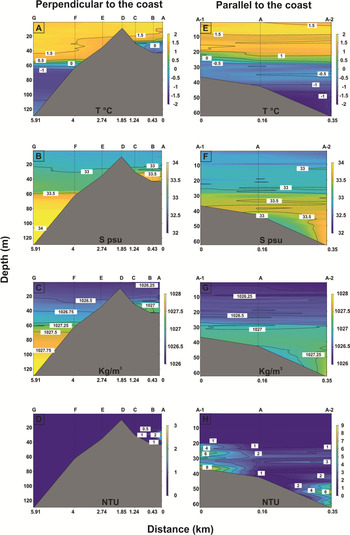
A shallow sill was observed at station D in Fig. 2a, which divided the area into an outer sector with a maximum depth of ~120 m (Fig. 2a) and an inner sector with a maximum depth of ~60 m (Fig. 2e). In the outer sector, a thermocline was observed at ~60 m depth (from ~0.5°C to -1.0°C) and for the inner sector, a thermocline was observed at ~25 m depth (from ~1.0°C to -0.5°C). The water structure close to the glacier front had strong stratification with warmer and lower salinity in the upper layer (Fig. 2b & f) and lower densities (< 1027 kg m-3) (Fig. 2c & g). Higher values of turbidity (> 1 NTU) (Fig. 2d & h) were found below the thermocline corresponding with higher salinity (> 33 PSU) and density (> 1027 kg m-3) (Fig. 2f & h). In general, turbidity did not exceed that of the inner sector, reaching a maximum distance of ~1.2 km from the glacier. In Station A-1, there were four main nuclei of turbidity (Fig. 2h), in which a maximum value was obtained close to the bottom (14.8 NTU, 59.5 mg l-1), with an average value of 2.5 NTU (12.3 mg l-1). The central Station A showed the lowest turbidity values with an average of 1.1 NTU (7.0 mg l-1) and a maximum value of 8.1 NTU (33.9 mg l-1). Finally, Station A-2 was similar to Station A-1 with several nuclei of maximum turbidity, in which, close to the bottom, a maximum of 8.3 NTU was obtained (34.7 mg l-1), with an average value of 1.9 NTU (10.0 mg l-1).
Oceanographic sections of temperature (°C), salinity (PSU), density (kg m-3) and turbidity (NTU), perpendicular (Stations A–G) and parallel (Stations A-1, A and A-2) to the coast or glacier front, at Horseshoe Island.

Discussion
The observed water structure was similar to that found by Antezana (Reference Antezana1999) in the Patagonian glacier fronts, showing strong stratification with a warmer and less saline upper layer. Colder and turbid layers below the thermocline are interpreted as sediment plumes coming from the tidewater glacier. The variable turbidity concentration in the water column close to the glacier indicates plume interstratification and different sediment sources from the glacier wall, where higher concentrations were close to the sea floor, demonstrating turbid subglacial discharges. In general, average turbidity values were higher than those found on the Danco Coast in the Antarctic Peninsula (~10 vs ~3.0 mg l-1) (Rodrigo et al. Reference Rodrigo, Giglio and Varas2016, unpublished data 2021) and higher than those of King George Island (~5.1 mg l-1) (Yoo et al. Reference Yoo, Kyung Lee, Il Yoon, Il Lee and Yoon Kang2015). However, for the stations closer to the glacier, the values were considerably higher compared to those of the Chilean Patagonian fjords, for example (maximum value < 5 NTU or 22 mg l-1) (Castilla-Hidalgo et al. Reference Castilla-Hidalgo, Landaeta, Anaya-Godinez and Bustos2018). The maximum reported data are graphed as a function of latitude (Fig. 3), showing that there is a decrease in turbidity towards higher latitudes, but in the study area, the values go against the trend. However, this trend is reversed on the Danco Coast, with lower turbidity values in the northern bays. As noted by Rodrigo et al. (Reference Rodrigo, Giglio and Varas2016, unpublished data 2021), colder Bransfield or transitional Weddell waters influence the northern Danco Coast. Further south, the influence of warmer transitional Bellingshausen waters coincides with higher turbidity values. Glaciers also tend to experience major ice loss from the Danco Coast to Marguerite Bay (Cook et al. Reference Cook, Vaughan, Luckman and Murray2014). Therefore, warmer water masses forcing the glacier retreat in the western Antarctic Peninsula (Cook et al. Reference Cook, Holland, Meredith, Murray, Luckman and Vaughan2016) produce more sediment input into the glacimarine environments. Shoesmith Glacier has also shown an ice-front retreat (Cook et al. Reference Cook, Vaughan, Luckman and Murray2014); for example, there was an ice-front retreat of ~200 m from 1999 to 2012 (Fig. 1). Its small size and open exposure to Marguerite Bay make Shoesmith Glacier more sensitive to oceanographic and atmospheric forcing, producing concentrated sediment plumes into the sea. The glacier behaviour and sediment yield changes remain poorly understood, and so further systematic measurements over time are needed in order to better understand the changes in the meltwater discharges and sediment yields of Antarctic Peninsula glaciers.
Maximum sediment concentrations reported by several studies (see main text) along latitudes. P = Chilean Patagonia, SSI = South Shetland Islands, DC = Danco Coast, HI = Horseshoe Island. A zoomed-in image of the DC sector is shown in the insert.

Acknowledgements
The authors thank the Chilean Navy for their logistic support. The authors also thank the editor and the anonymous reviewer for their constructive comments.
Author contributions
CR wrote the manuscript and designed the study, objectives and fieldwork. AV-G and AB-M processed the data and made Fig. 2. AV-G and EM-H helped with the data interpretation.
Financial support
This study was partially funded by the FONDECYT N°11121522 grant to CR and by the Chilean Antarctic Institute.
Data deposit
Data are deposited at the Chilean Antarctic Institute (www.inach.cl).