I. INTRODUCTION
During the last few years, multicomponent alloys with at least 5 major alloying elements and individual concentrations ranging between 5 and 35 at.%, generally termed as high-entropy alloys (HEAs) or compositionally complex alloys, have attracted considerable attention. Reference Yeh, Chen, Lin, Gan, Chin, Shun, Tsau and Chang1–Reference Miracle, Majumdar, Wertz and Gorsse7 The extraordinarily large number of alloys conceivable in this multicomponent space, together with promising mechanical properties (in some cases), has opened a fascinating new field in metallurgy and materials science. This novel alloying concept can benefit from new combinatorial approaches Reference Miracle, Majumdar, Wertz and Gorsse7,Reference Pradeep, Tasan, Yao, Deng, Springer and Raabe8 and high-throughput characterization techniques, especially if small sample volumes can be characterized in terms of their mechanical properties and phase stability. Reference Miracle, Majumdar, Wertz and Gorsse7,Reference Maier-Kiener, Schuh, George, Clemens and Hohenwarter9 Pioneering studies on the face-centered cubic (fcc) alloy, CrMnFeCoNi, showed that it has extraordinary mechanical properties, including high tensile strength and ductility Reference Gali and George10 and high strength and fracture toughness Reference Gludovatz, Hohenwarter, Catoor, Chang, George and Ritchie11 at temperatures down to the cryogenic range. Subsequent studies not only concentrated on other mechanical properties such as the elastic constants of CrMnFeCoNi Reference Laplanche, Gadaud, Horst, Otto, Eggeler and George12,Reference Haglund, Koehler, Catoor, George and Keppens13 but also on phase and microstructural stability. In the nanocrystalline state, Reference Schuh, Mendez-Martin, Völker, George, Clemens, Pippan and Hohenwarter14 it was demonstrated that, because of high-grain boundary density, this initially single-phase alloy starts to decompose at temperatures above 300 °C. Others Reference Otto, Dlouhý, Pradeep, Kuběnová, Raabe, Eggeler and George15,Reference Pickering, Muñoz-Moreno, Stone and Jones16 showed that phase decomposition occurs at intermediate temperatures even when the alloy had coarse grains. Nevertheless, not all fundamental, structural, and mechanical properties and their underlying mechanisms are fully understood. Attempts have been made to relate the thermally activated behavior of relatively coarse-grained CrMnFeCoNi at room and low temperatures to high lattice distortion and sluggish diffusion. Reference Komarasamy, Kumar, Mishra and Liaw17 However, studies within the last year have cast doubts on both aspects, since diffusivity appears not to be significantly reduced Reference Vaidya, Trubel, Murty, Wilde and Divinski18 and neutron scattering experiments suggest a lattice that is not significantly distorted. Reference Owen, Pickering, Playford, Stone, Tucker and Jones19 Additionally, for the CrMnFeCoNi alloy, the mean-square atomic displacement measured by synchrotron X-ray diffraction Reference Okamoto, Fujimoto, Kambara, Kawamura, Chen, Matsunoshita, Tanaka, Inui and George20 was found to be only about 23.5 pm2 (from which the average atomic displacement of the constituent elements from their ideal lattice sites can be estimated as 4.85 pm or approximately 2% of the Burgers vector) and the largest (pairwise) effective atomic size misfit between the constituent atoms was found to be only about 4% from ab initio calculations. Reference Okamoto, Fujimoto, Kambara, Kawamura, Chen, Matsunoshita, Tanaka, Inui and George20
An increasing number of studies have recently been published Reference Gali and George10,Reference Otto, Dlouhý, Somsen, Bei, Eggeler and George21–Reference Wu, Bei, Pharr and George27 on the governing deformation mechanisms at low temperatures and thermal activation during deformation, including investigations of strain rate sensitivity (SRS) and apparent activation volumes. Since available sample volumes can be limited in certain HEAs, small scale testing techniques, such as nanoindentation Reference Maier-Kiener, Schuh, George, Clemens and Hohenwarter9,Reference Lee, Choi, Seok, He, Lu, Suh, Kawasaki, Langdon and Jang28–Reference Lee, Seok, Zhao, Choi, He, Lu, Suh, Ramamurty, Kawasaki, Langdon and Jang30 and micropillar compression Reference Okamoto, Fujimoto, Kambara, Kawamura, Chen, Matsunoshita, Tanaka, Inui and George20,Reference Raghavan, Kirchlechner, Jaya, Feuerbacher and Dehm31–Reference Zou, Maiti, Steurer and Spolenak33 become valuable for mechanical characterization in general. They are also helpful in probing, at a local level, the mechanisms that govern macroscopic mechanical properties. Initial micropillar compression studies Reference Okamoto, Fujimoto, Kambara, Kawamura, Chen, Matsunoshita, Tanaka, Inui and George20,Reference Raghavan, Kirchlechner, Jaya, Feuerbacher and Dehm31 indicated a weaker size effect typically found for fcc metals and a scaling behavior closer to bcc metals, probably because of higher friction stresses in solid-solution HEAs. In addition, incipient plasticity in these alloys has also been studied. Reference Ye, Lu and Nieh34–Reference Zhu, Lu and Nieh36
This paper focuses on thermally activated deformation and related mechanisms in an equiatomic HEA, CrMnFeCoNi, in which the nanocrystalline state is compared with the coarse-grained state. The thermally activated deformation behavior is investigated by means of nanoindentation strain-rate jump tests from room temperature (RT) to 400 °C. Microstructure and testing temperatures were varied to achieve a better understanding of the relation between grain size and thermally activated processes. SRS m and apparent activation volume V* are calculated and discussed to identify the possible deformation mechanisms at different temperatures.
II. EXPERIMENTAL
A. Materials
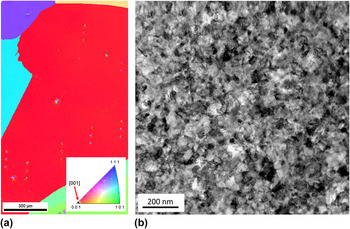
The equiatomic HEA, CrMnFeCoNi, was synthesized by arc melting and drop casting in pure Ar-atmosphere followed by homogenization at 1200 °C for 48 h, as described elsewhere. Reference Schuh, Mendez-Martin, Völker, George, Clemens, Pippan and Hohenwarter14 This material state with grain sizes in the millimeter range will be referred to as-cast and homogenized material. To investigate single-crystal deformation behavior, electron backscatter diffraction (EBSD) was carried out on a polished surface of the cast and homogenized material and a grain with 〈100〉 orientation was selected for all further nanoindentation investigations [Fig. 1(a)]. The HEA was also processed by high-pressure torsion (HPT), using disks 8 mm in diameter and 0.8 mm thick. The pressure during deformation was 7.8 GPa, the rotational speed was 0.2 rotations/minute, and 5 rotations were applied in total. The grain size after HPT was analyzed by transmission electron microscopy (TEM) and was confirmed to be nanocrystalline with a grain size of ∼50 nm [Fig. 1(b)]. Further information on the HPT deformation process and the mechanical properties of the nanocrystalline alloy can be found in an earlier publication by Schuh et al. Reference Schuh, Mendez-Martin, Völker, George, Clemens, Pippan and Hohenwarter14
Microstructural states of the investigated CrMnFeCoNi HEA. (a) Cast and homogenized state showing the selected red grain with orientation close to 〈100〉 (for color reference the reader is referred to the electronic version), and (b) TEM micrograph showing the nanocrystalline grains produced by HPT.

B. Nanoindentation testing
Nanoindentation experiments at room and elevated temperatures were performed to investigate the mechanical properties of the two microstructural conditions. The specimens were ground and polished, first mechanically with SiC papers, then mechanochemically with colloidal silica to allow microstructural analyses with scanning electron microscopy and EBSD. Nanoindentation testing was carried out using a Nanoindenter G200 (Keysight-Tec, Santa Rosa, California) equipped with a continuous stiffness measurement unit, which analyzes the contact stiffness continuously by superimposing a sinusoidal load signal (45 Hz, 2 nm oscillation amplitude) on the normal nanoindentation load. A three-sided sapphire Berkovich tip (SurfaceTec, Hückelhoven, Germany) modified for high-temperature laser applications was used. According to the literature, sapphire should minimize chemical reactions with the sample material. Reference Wheeler and Michler37 Tip shape and frame stiffness calibrations were performed at regular intervals with fused silica as reference following the Oliver & Pharr method. Reference Oliver and Pharr38 To characterize potential degradation due to blunting of the tip, tip shape calibrations were performed at RT using fused silica before and after each high-temperature indentation session and the tip showed no significant changes. For the elevated temperature experiments, a laser-heating stage (SurfaceTec, Hückelhoven, Germany) was used, with the tip and sample independently heated to adjust and stabilize the contact temperature, minimize thermal drift influences, Reference Wheeler, Armstrong, Heinz and Schwaiger39 and guarantee a well-defined homogenous temperature distribution during the entire indentation process. At elevated temperatures, the whole system was actively water cooled and kept at 18 °C, including the sample tray and a Cu-cooling shield that surrounded the heated tip to protect the indenter head from thermal influences. Additionally, an inert gas environment (forming gas—N2 containing 5% H2) was maintained with the help of two separately controlled valves that individually regulated the gas flow to the sample tray and cooling shield. This set up created an oven-like, gas flooded volume around the tested sample. The oxygen concentration of the gas near the heated tip could not be measured; however, the specimen surfaces retained their mirror-like finish after testing. Clear EBSD images could also be obtained after high-temperature testing. Together, these observations indicate that significant surface oxidation did not occur. The initial thermal drift for all testing temperatures was set to less than 0.3 nm/s before the experiments started and was determined in advance for each indentation array. Arrays with three or six indentations were made at each temperature, and test temperatures were chosen for the two microstructural conditions between RT (22 °C) and 400 °C in 50 and 100 °C steps, respectively. For each condition, all the elevated temperature measurements were performed on the same sample within the same testing batch, starting at RT and increasing thereafter as described above. At each step, after reaching the preset temperature, the setup was stabilized, the contact temperature was adjusted, and finally the nanoindentations were performed.
Depth-dependent local mechanical properties were determined in a constant strain-rate mode (0.05 s−1) to a preset indentation depth of 2500 nm and at thermal drift rates of less than 0.1 nm/s. Hardness and Young’s modulus (assuming a Poisson’s ratio for the HEA of 0.25 Reference Laplanche, Gadaud, Horst, Otto, Eggeler and George12 ) were calculated by averaging the depth-dependent results between 1100 and 1400 nm indentation depth. Local SRS data were calculated from nanoindentation strain-rate jump tests Reference Maier, Durst, Mueller, Backes, Höppel and Göken40 during which the applied strain rate was changed abruptly every 500 nm, starting at 0.05 s−1, then dropping to 0.01, followed by an increase to 0.05, then dropping to 0.005 s−1, and back to the initial strain rate of 0.05 s−1.
Thermally activated processes were quantified as described elsewhere
Reference Wei, Cheng, Ramesh and Ma41,Reference Durst and Maier42
by calculating the SRS m
 $\left( {m = \partial \ln H{\rm{/}}\partial \ln \dot \varepsilon } \right)$
and apparent activation volume V*
 $\left( {{V^ * } = {C^ * } \cdot \sqrt 3 \cdot {k_{\rm{B}}} \cdot T{\rm{/}}mH} \right)$
from the measured dependence of hardness H on strain rate
 $\dot \varepsilon$
(with C*: constraint factor of 2.8, k
B: Boltzmann constant, T: testing temperature). To investigate deformation within one grain of the coarse-grained sample, an instantaneous determination was made at the depth corresponding to each strain-rate jump, which is described in detail in Maier et al.
Reference Maier, Schunk, Göken and Durst43
III. RESULTS—MECHANICAL PROPERTIES AT ELEVATED TEMPERATURES
A. Hardness and Young’s modulus versus temperature
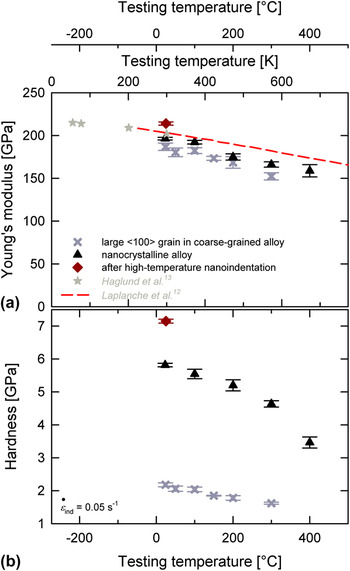
Young’s modulus and hardness of the HEA as a function of temperature are plotted in Fig. 2 for the cast, homogenized, and nanocrystalline samples. The data were obtained at an indentation strain rate of 0.05 s−1 and at indentation depths between 1100 and 1400 nm. The results of the cast and homogenized material represent the mechanical behavior of a single grain, since the size of the plastically deformed zone around a nanoindent is small compared to the large grain size of the sample. The tested grain has a 〈100〉 crystal orientation as shown in Fig. 1(a), which was recorded after all nanoindentation tests were completed, indicating lack of significant oxidation during the high-temperature exposures.
Results of constant strain-rate indentation (0.05 s−1). (a) Temperature dependence of Young’s modulus (together with literature data from Haglund et al. Reference Haglund, Koehler, Catoor, George and Keppens13 and Laplanche et al. Reference Laplanche, Gadaud, Horst, Otto, Eggeler and George12 —data are taken with permission from Elsevier) and (b) temperature dependence of hardness.

At RT, the Young’s moduli of the two specimens are slightly different with somewhat higher values for the nanocrystalline state. For the nanocrystalline material the modulus measurement included many grains with different orientations, whereas for the coarse-grained material the measurement was made in a single 〈100〉 grain. Since the 〈100〉 orientation is the elastically softest in fcc metals, it may partly explain the observed difference; however, the multiaxial loading condition during nanoindentation makes a direct comparison with the bulk single-crystal moduli difficult for anisotropic materials. Reference Vlassak and Nix44 Overall, our RT results are consistent with the literature data obtained by different macroscopic and local techniques. Reference Maier-Kiener, Schuh, George, Clemens and Hohenwarter9,Reference Laplanche, Gadaud, Horst, Otto, Eggeler and George12,Reference Haglund, Koehler, Catoor, George and Keppens13,Reference Wu, Jang and Nieh29
With increasing testing temperature, the Young’s modulus for both microstructural states decreases in an almost parallel fashion. The observed trend is very close to that reported in earlier publications by Haglund et al. Reference Haglund, Koehler, Catoor, George and Keppens13 and Laplanche et al. Reference Laplanche, Gadaud, Horst, Otto, Eggeler and George12 Haglund et al. reported low-temperature moduli of CrMnFeCoNi determined by resonant ultrasonic spectroscopy from RT down to ∼55 K, whereas Laplanche et al. examined the same composition between 200 and 1000 K with a resonant frequency technique in bending mode. In the temperature range investigated, the moduli obtained from nanoindentation are slightly lower than those from bulk techniques, but the overall nonlinear trend agrees well with the earlier works. Reference Laplanche, Gadaud, Horst, Otto, Eggeler and George12,Reference Haglund, Koehler, Catoor, George and Keppens13 To qualitatively evaluate possible decompositions of the highly deformed nanocrystalline HEA, Reference Maier-Kiener, Schuh, George, Clemens and Hohenwarter9 its Young’s modulus was determined at RT after elevated temperature indentation and the result is plotted in Fig. 2(a). The modulus value of 214 GPa is about 10% higher than that of the nanocrystalline alloy at RT before it was subjected to elevated temperature indentation, which is consistent with earlier nanoindentation results of Maier-Kiener et al. Reference Maier-Kiener, Schuh, George, Clemens and Hohenwarter9 who ascribed the modulus change to the phase decomposition reported by Schuh et al. Reference Schuh, Mendez-Martin, Völker, George, Clemens, Pippan and Hohenwarter14
As shown in Fig. 2(b), the hardness of the nanocrystalline alloy is significantly higher than that of the coarse-grained alloy, especially at RT where it is approximately three times higher. This is due to grain refinement producing pronounced Hall–Petch hardening. With increasing temperature, the hardness of both microstructures decreases. For the coarse-grained material, this decrease is rather linear, while for the nanocrystalline alloy a more pronounced loss of hardness is measured. The reason for the latter decrease is unclear since from earlier microstructure investigations it is known Reference Schuh, Mendez-Martin, Völker, George, Clemens, Pippan and Hohenwarter14 that the grain size remains fairly stable even after relatively long-term anneals at temperatures to 450 °C; therefore, the strong decrease in hardness cannot be explained by grain growth. After completion of the elevated-temperature tests, when the hardness of the nanocrystalline alloy was remeasured at RT, a significant hardness increase of about 20% was noted, to more than 7.1 GPa, which could be due to two reasons. First, the decomposition into a multiphase material might lead to a hardness increase. Second, for several nanocrystalline materials a “hardening by annealing” phenomenon has been described, Reference Huang, Hansen and Tsuji45–Reference Renk, Hohenwarter, Eder, Kormout, Cairney and Pippan47 which might occur in this HEA as well. Reference Maier-Kiener, Schuh, George, Clemens and Hohenwarter9
Overall, with increasing testing temperature, the relative reduction in modulus is less pronounced than the decrease in hardness, especially for the nanocrystalline material [Fig. 2(b)] whose modulus decreases by around 15% and hardness by more than 40% between RT and 400 °C. Comparing the change in hardness of the two microstructures between RT and 300 °C, the hardness of the coarse-grained alloy decreases by 0.56 GPa, whereas the hardness of the nanocrystalline alloy decreases by 1.18 GPa.
B. Strain-rate jump tests
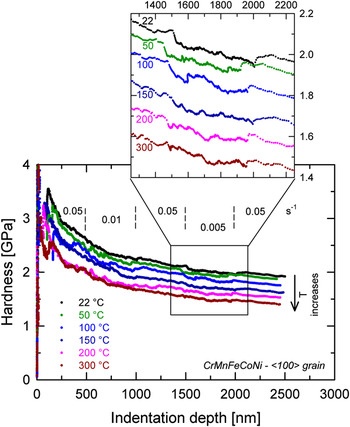
To probe thermally activated deformation behavior on a local scale, nanoindentation strain-rate jump tests are useful. In Fig. 3, the hardness is plotted versus indentation depths for several different testing temperatures from RT to 300 °C for the coarse-grained material. Independent of the testing temperature, all curves are affected by an indentation size effect (ISE), Reference Maier, Schunk, Göken and Durst43,Reference Nix and Gao48 manifested as a hardness decrease with indentation depth, which is the expected single-crystal response. Application of abrupt strain-rate changes during a single indentation test leads to corresponding changes in the load-displacement curves and thus also in the hardness. This has been seen before, mainly in single-crystal bcc metals, where the flow stress has a significant thermally activated component. Although CrMnFeCoNi has an fcc crystal structure, after each abrupt strain-rate jump, the hardness changes markedly. It goes through a transient stage at first, before settling to the steady-state stress level. Generally, this behavior is dependent on material-alloying content or/and microstructure. After several tens of nanometers, the hardness of the 〈100〉 grain saturates and continues in line with the applied strain rate. For both strain rates, the overall shapes of these curves are additionally influenced by a superimposed ISE. Reference Maier, Schunk, Göken and Durst43 To clarify the hardness changes during each strain-rate jump, magnified views of the third and fourth strain-rate jump are provided as inset in Fig. 3. At RT, a pronounced and abrupt change in hardness can be observed. With increasing temperature, however, the magnitude of the hardness change is reduced. Finally, at 200 °C and above, no significant changes are observable anymore. The low strain-rate segments have more data points per indentation depth due to the longer indentation time. These regions also exhibit a small zig-zag scatter indicative of the jerky flow that may be due to dynamic strain-aging effects or analogous dislocation interactions with obstacles. Reference Hong, Moon, Hong and Kim24 That is, dislocations may be pinned by obstacles, such as clusters or solute atoms, and when a specific local stress is reached these dislocations suddenly break free and the hardness correspondingly drops. This behavior is thermally activated, as indicated by different amounts of serrated flow within the different strain-rate regions.
Nanoindentation strain-rate jump tests on a 〈100〉 orientation grain in the coarse-grained HEA; representative hardness versus indentation depth curves for different testing temperatures, with the enlarged region showing changes to and from the lowest indentation strain rate.

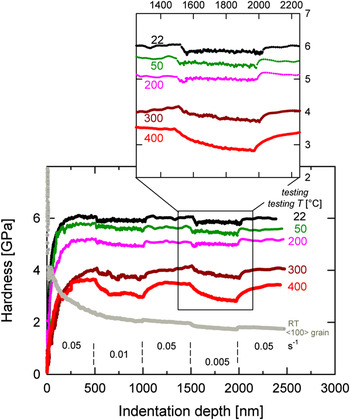
Strain-rate jump tests were also performed on the nanocrystalline alloy and the corresponding hardness curves as a function of indentation depth are shown in Fig. 4. These nanoindentation experiments were performed from RT to 400 °C. Due to the nanocrystalline microstructure, the curves are significantly different than those shown in Fig. 3 for the coarse-grained sample. For ease of comparison, results from RT indentation in the coarse-grained alloy are included in Fig. 4 (gray curve). As previously discussed (Fig. 2), the hardness of the nanocrystalline alloy is higher, overall, due to the extreme grain refinement after HPT. At all temperatures, the hardness remains constant with indentation depth (after an initial increase at small depths), indicating the absence of an ISE in this state. Each strain rate decrease leads to a significant reduction of the hardness. The shape of the transient behavior after each strain rate change differs from that in the coarse-grained sample (as shown magnified in the inset in Fig. 4). While for the large 〈100〉 grain, the transient regions were rather smooth with no pronounced sudden hardness changes, in the nanocrystalline state, the change in hardness appears suddenly within a few nanometers of depth but with little indication of yield-point phenomena. As already described by Maier-Kiener et al., Reference Maier-Kiener, Schuh, George, Clemens and Hohenwarter9 for the nanocrystalline HEA, after each strain rate change to a lower value, the hardness first decreases, immediately followed by a slight increase within the first nanometers. Such a behavior was also previously reported for nanocrystalline NiFe alloys during tensile testing. Reference Van Petegem, Zimmermann and Van Swygenhoven49 Continued indentation at the lower strain rate keeps the hardness constant as a function of the indentation depth. Upon jumping back to the initial strain rate, a slight yield point seems to appear; however, due to the paucity of data points in this segment its presence cannot be definitely concluded.
Results of nanoindentation strain-rate jump tests on the nanocrystalline HEA. Representative curves showing hardness versus indentation depth for different temperatures. The inset shows an enlarged segment of the slowest strain-rate region for all temperatures.

Increasing the temperature above 200 °C causes a further change in the transition behavior. The pronounced sudden hardness changes become smoother, as already seen for the large 〈100〉 grain. The transients are extended, thus the hardness changes require more than a few nanometers to reach a steady-state behavior again. The relative magnitudes of the hardness changes are larger as well. A serrated flow behavior indicated by a zig-zag hardness curve is observed especially at 300 °C. At the highest tested temperature (400 °C), the hardness changes are very pronounced, and for the lower strain-rate segments the hardness approaches to within about 50% of that of the large 〈100〉 grain, even though the material remains nanocrystalline. Reference Schuh, Mendez-Martin, Völker, George, Clemens, Pippan and Hohenwarter14
IV. THERMALLY ACTIVATED DEFORMATION PROCESSES—SRS AND ACTIVATION VOLUME
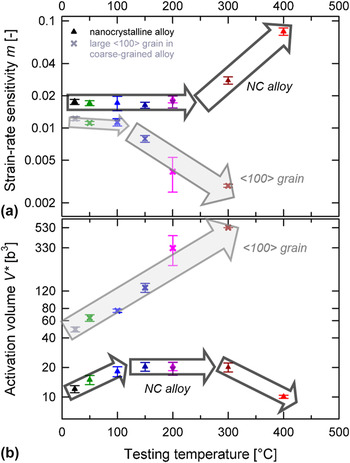
To understand the dominant rate dependent deformation processes in CrMnFeCoNi, the SRS and the apparent activation volume can be calculated Reference Maier, Durst, Mueller, Backes, Höppel and Göken40,Reference Durst and Maier42 from each transient region of the strain-rate jumps tests. The results are plotted in Fig. 5. While the SRS m is a quantity that describes the change in hardness with strain rate, the apparent activation volume V* gives an idea of the volume involved in the plastic deformation. For the simple case of dislocations overcoming obstacles, V* of x·b 3 can be rationalized as the depinning of a dislocation segment having a length of x·b and cross section of b 2. SRS values of m > 0.01 indicate a significant influence of the applied strain rate on the resultant flow stress, while m values below 0.01 indicate that thermal activation is negligible during deformation. Further, activation volumes between 100 and 1000·b 3, conventionally reported for coarse-grained fcc metals, are associated with dislocations cutting through forest dislocations. Reference Meyers, Mishra and Benson50 For coarse-grained bcc metals, V* is generally reported to be lower, with values ranging between 8 and 100·b 3, in which case the rate-dependent deformation is dominated by the thermally activated kink-pair mechanism. This is connected to the temperature-dependent component of the flow stress due to the high Peierls stress in bcc metals that is strongly affected by sample purity. Refining the microstructure, on the other hand, leads to a confinement of dislocation segments within smaller grains and consequently a global change of dislocation–dislocation and/or dislocation-grain boundary interactions, as will be further discussed within this section.
Quantification of the thermally activated deformations processes in the CrMnFeCoNi HEA: (a) Strain-rate sensitivity m and (b) corresponding activation volume V* (b ∼ 2.53 Å), determined from nanoindentation strain-rate jump tests on a nanocrystalline sample and a large 〈100〉 grain.

In this study, at RT, the values obtained for the SRS, m, are 0.018 for the nanocrystalline state and 0.012 for the large 〈100〉 grain, and the corresponding values for the apparent activation volume V* are 12·b 3 and 49·b 3, respectively. These values agree well with an earlier report on CrMnFeCoNi tested by nanoindentation. Reference Maier-Kiener, Schuh, George, Clemens and Hohenwarter9 As for the apparent activation volume, Hong et al. Reference Hong, Moon, Hong and Kim24 (who used the tensile test results of Gali and George Reference Gali and George10 ) and Wu et al. Reference Wu, Gao and Bei23 came up with a slightly larger V* for coarse-grained CrMnFeCoNi alloys. Nevertheless, all these values suggest that the classical deformation behavior of coarse-grained fcc metals with V* ∼ 1000·b 3 may not be present in this HEA. Both groups Reference Gali and George10,Reference Wu, Gao and Bei23 also studied the thermal activation at lower temperatures by low-temperature tensile testing at 77 K and found even smaller V* ∼ 7–10·b 3 and a slightly higher SRS. These first results provide some hints about the role of thermal activation in these complex HEAs. Although additional work is needed, there appears to be some resemblance to the behavior of bcc metals below their critical temperature, which according to Seeger is around 0.2·T m. Reference Seeger51 For our CrMnFeCoNi HEA, since incipient melting has been found to occur at 1280 °C, Reference Okamoto, Fujimoto, Kambara, Kawamura, Chen, Matsunoshita, Tanaka, Inui and George20 the critical temperature can be estimated as ∼40 °C. Consistent with this, Fig. 5 shows that, for the 〈100〉 grain, m remains constant and V* increases only slightly between 50 and 100 °C, suggesting that the critical temperature is around these temperatures. Based on the reasoning that the RT is below the estimated critical temperature, one would expect to see thermally activated behavior. However, it must be noted that, for a reliable and meaningful comparison between different studies and over different experimental length scales, all values for V* and m should be calculated at a constant microstructure or strain so that similar material states are evaluated.
In connection with thermal activation at higher temperatures above RT, some interesting findings are presented in Fig. 5. With increasing T to about 200 °C, the SRS m does not change for the nanocrystalline alloy and is constant at around 0.017 ± 0.001. For 300 °C and beyond, the m-value increases significantly, indicating a strong change in the underlying deformation mechanism. For the large 〈100〉 grain, the initial value of m, although slightly lower, remains almost constant around 0.011 ± 0.0009 up to 100 °C. However, at temperatures of 150 °C and higher, the values drop strongly, indicating a diminishing thermally activated contribution. This behavior was qualitatively observed in the hardness versus indentation depth curves (Fig. 3), where for 150 °C and higher there was almost no change in the hardness with strain-rate jumps.
The corresponding V* is depicted in Fig. 5(b). For the large 〈100〉 grain, the calculated values increase almost linearly with the temperature from around 40·b 3 at RT to 530·b 3 at 300 °C. While the RT value is relatively low for an fcc single crystal, it is consistently reported that for CrMnFeCoNi, Reference Maier-Kiener, Schuh, George, Clemens and Hohenwarter9,Reference Gali and George10,Reference Komarasamy, Kumar, Mishra and Liaw17,Reference Wu, Gao and Bei23,Reference Hong, Moon, Hong and Kim24 with increasing testing temperature, V* reaches values typical for conventional fcc metals. For the nanocrystalline alloy rather unexpected values are obtained. At RT, V* is relatively small, around 12·b 3, and with increasing T up to 100 °C, V* increases slightly to ∼20·b 3. With further temperature increase up to 300 °C, this value remains constant, implying that the dominating deformation mechanism remains unchanged. At 400 °C, however, V* decreases again to a value below 10·b 3. Generally, such low values indicate that diffusional processes at grain boundaries Reference Conrad52 might start to contribute to the deformation, or that the length scale controlling plasticity had changed markedly, approximately by a factor of two.
A comparison of the two data sets suggests that, at lower testing temperatures, from 22 to 100–150 °C, the dominant deformation mechanisms might be similar for the two grain sizes. The high resistance to dislocation motion may be associated with the presence of nanoscale heterogeneities. Reference Gali and George10,Reference Wu, Gao and Bei23,Reference Hong, Moon, Hong and Kim24 Both the parameters, m and V*, behave comparably in the two states, with the former remaining constant while the latter increases linearly. Above 150 °C, the large numbers of grain boundaries in the nanocrystalline alloy become more and more influential and finally start to control the deformation. The temperature-independent values of m and V* for the nanocrystalline state suggests that the dominant deformation mechanism stays the same up to 200 °C, governed by thermally activated dislocation annihilation at the high fraction of high-angle grain boundaries. Similar behavior has not only been been reported for many other fcc materials including Ni Reference Li, Mueller, Höppel, Göken and Blum53,Reference Mohanty, Wheeler, Raghavan, Wehrs, Hasegawa, Mischler, Philippe and Michler54 and Al Reference Durst and Maier42,Reference Höppel, May, Eisenlohr and Göken55 with ultrafine or nanocrystalline grains Reference Wei, Cheng, Ramesh and Ma41,Reference Meyers, Mishra and Benson50,Reference Conrad52,Reference Wei56 but also for bcc metals tested above the critical temperature T c Reference Kreuzeder, Abad, Primorac, Hosemann, Maier and Kiener57,Reference Wu, Wang and Nieh58 and nanoporous materials. Reference Kreuzeder, Abad, Primorac, Hosemann, Maier and Kiener57,Reference Leitner, Maier-Kiener, Jeong, Abad, Hosemann, Oh and Kiener59
Above 300 °C, m further increases to 0.1 for the nanocrystalline state, but V* drops suddenly to values of less than 10·b 3 at 400 °C. Two different explanations are possible for this behavior. Firstly, diffusional processes become more pronounced at homologous temperatures higher than 0.4·T m. Since a testing temperature of 400 °C is equal to 0.43·T m (T m = 1553 K Reference Okamoto, Fujimoto, Kambara, Kawamura, Chen, Matsunoshita, Tanaka, Inui and George20 ), diffusion and diffusion-controlled grain boundary sliding might be active. Secondly, from the RT nanoindentation experiments performed on the specimens subjected to elevated-temperature nanoindentation, it is evident that the Young’s modulus increases, which qualitatively indicates the start of decomposition of the original single-phase material. Reference Maier-Kiener, Schuh, George, Clemens and Hohenwarter9 The formation of precipitates Reference Schuh, Mendez-Martin, Völker, George, Clemens, Pippan and Hohenwarter14,Reference Otto, Dlouhý, Pradeep, Kuběnová, Raabe, Eggeler and George15 can change the internal length scale associated with deformation, that is, dislocations now have to interact with these newly formed intermetallic phases potentially reducing the apparent activation volume once the decomposition starts.
V. CONCLUSION
The thermally activated deformation behavior of CrMnFeCoNi was studied by nanoindentation from RT to 400 °C. Two different microstructures were investigated: a nanocrystalline state produced by HPT, and a single-crystal state produced by selecting a grain with orientation close to 〈100〉 from a cast and homogenized coarse-grained sample. Constant strain rate and strain-rate jump tests were used to determine the SRS m and apparent activation volume V* for the two microstructural states as a function of temperature. The main results can be summarized as follows:
-
(1) With increasing testing temperature, the hardness, and Young’s modulus decrease. The relative modulus decrease is smaller than the hardness change, especially for the large 〈100〉 grain. The temperature dependence of Young’s modulus agrees well with the literature data determined by macroscopic testing methods. Moreover, the modulus of the grain in the 〈100〉 orientation was lower than that of the nanocrystalline sample, which is indicative of elastic anisotropy in this HEA.
-
(2) Both microstructural states show a thermally activated component of the flow stress, as changes in the applied strain rate led to variations in hardness. With increasing temperature, these changes became more intense for the nanocrystalline alloy, but diminished for the large 〈100〉 grain at temperatures above 100–150 °C.
-
(3) To quantify the thermally activated deformation processes, SRS m and apparent activation volume V* were evaluated. From RT to 100–150 °C, the overall behavior of the two microstructural states is similar and consistent with dislocation interactions with nanoscale heterogeneities, although additional work is needed to confirm this. The indentation load-displacement curves show a serrated flow behavior consistent with repeated pinning and breakaway from obstacles.
-
(4) For the nanocrystalline state the high-temperature behavior was studied for the first time by nanoindentation. Above 100–150 °C, the SRS increases, but the activation volume remains constant, similar to what has been reported for many other fcc metals and has been associated with deformation governed by thermally activated interaction of dislocations with high angle grain boundaries. A further increase in testing temperature led to further increases in m but also a significant reduction in V*, which was explained by the onset of diffusional processes such as grain boundary sliding at T > 0.43 T m and by the decomposition of the originally single-phase material. The newly formed precipitates can act as further obstacles that change the internal length scale for the deformation.
ACKNOWLEDGMENTS
Funding by the Austrian Science Fund (FWF) in the framework of Research Project P26729-N19 is acknowledged (B.S. & A.H.). Further financial support by the Austrian Federal Government (837900) within the framework of the COMET Funding Program (MPPE, A7.19) is highly appreciated (V.M-K.). E.P.G. is sponsored by the U.S. Department of Energy, Office of Science, Basic Energy Sciences, Materials Sciences and Engineering Division.