In a rapidly changing society, romantic relationships have been evolving along different paths other than those considered to be the traditional dating-engagement-marriage sequence (Kalmijn, Reference Kalmijn2007; Manning & Smock, Reference Manning and Smock2002), and, currently, we can rather refer to different types of conjugal trajectories, with the number of unmarried cohabitations and formal unions (also known as domestic partnerships) increasing in relation to marriages (Narciso & Ribeiro, Reference Narciso and Ribeiro2009; Regan, Reference Regan2008). At the same time, in line with the increasing relationship complexity, studies have focused on how couples currently come together, stay together and function, in an effort to identify richer and broader constructs, such as commitment, attachment and forgiveness (Stanley, Reference Stanley2003). Stanley and his team of colleagues have especially focused on the study of the commitment dimension (e.g., Rhoades, Stanley, & Markman, Reference Rhoades, Stanley and Markman2012; Stanley & Markman, Reference Stanley and Markman1992; Stanley, Markman, & Whitton, Reference Stanley, Markman and Whitton2002; Stanley, Rhoades, & Whitton, Reference Stanley, Rhoades and Whitton2010), dealing with the different paths of romantic relationships and the decision making processes of couples.
Personal Commitment
Concisely, these authors define relationship commitment as “the personal desire and intent to maintain a specific relationship for the long-term” (Whitton, Rhoades, Stanley, & Markman, Reference Whitton, Rhoades, Stanley and Markman2008, p.789). Influenced by the initial work of Johnson (1978, 1982; cited in Stanley & Markman, Reference Stanley and Markman1992), Levinger (e.g., 1979) and Rusbult (e.g., 1980), they present a model that proposes two commitment components: personal dedication and structural or constraint commitment. Dedication consists of a more intrinsic type of commitment between the members of the couple, including the desire and disposition to maintain or improve the quality of the relationship for the benefit of both members, the willingness to sacrifice for the relationship and the balancing of personal matters with the relationship (Stanley & Markman, Reference Stanley and Markman1992; Stanley et al., Reference Stanley, Markman and Whitton2002). On the other hand, structural commitment consists of the constraints that arise from the evolution of a relationship (e.g., social pressure, financial situation, common responsibilities) and that, naturally, make it more difficult to end it. If, on one hand, this component can give rise to a feeling of being trapped, which is a determining factor in maintaining unsatisfactory relationships (Narciso & Ribeiro, Reference Narciso and Ribeiro2009), on the other, it mostly prevents impulsive or destabilizing behavior in times of crisis that can be overcome by the couples (Stanley et al., Reference Stanley, Markman and Whitton2002). According to Stanley and Markman (Reference Stanley and Markman1992), these two dimensions, although distinct, are related, seeing that a previous high level of dedication leads to constraints in the future, for example, marriage, children, common assets, etc. For the authors, personal dedication is thus the starting point and the determinant factor of future stability and quality of the relationship. Above all, commitment, in all its complexity, leads people to have a long-term view of their relationships. A clear and consistent commitment allows both members of the couple to feel secure and act in the relationship in a way that is only rational within the context of that safety (Stanley et al., Reference Stanley, Markman and Whitton2002; Stanley et al., Reference Stanley, Rhoades and Whitton2010).
Seeing that commitment is fundamental for security in a relationship, its role is equally relevant in the end of relationships. A recent study with divorcees (Scott, Rhoades, Stanley, Allen, & Markman, Reference Scott, Rhoades, Stanley, Allen and Markman2013) highlights the absence of commitment as the main contributing factor to the end of the relationship, as was referred by 75% of the participants and by at least one of the members in 94.4% of the couples.
Commitment and Different Relationships Statuses
Taking into consideration the increasing diversity of relationships statuses, some studies have sought to explore how they relate to different levels of commitment. Various variables may be able to explain this relationship, such as gender (Stanley, Rhoades, & Markman, Reference Stanley, Rhoades and Markman2006), religious involvement (e.g., Olson, Goddard, & Marshall, Reference Olson, Goddard and Marshall2013), the duration of the relationship (e.g., Weigel, Bennett, & Ballard–Reisch, Reference Weigel, Bennett and Ballard–Reisch2003), the quality of the relationship (e.g., Schoebi, Karney, & Bradbury, Reference Schoebi, Karney and Bradbury2012) and the relationship status itself, more specifically being married or cohabiting, has proven to be relevant. For example, Stanley et al. (Reference Stanley, Rhoades and Markman2006) refer that couples that choose to live together with no intention of getting married demonstrate greater asymmetrical levels of dedication than those that define their life project before starting a conjugal life. Poortman and Mills (Reference Poortman and Mills2012) point out that individuals that are cohabiting tend to be more cautious with regards to their investment in the relationship than those that are married, due to the inherent uncertainty of the relationship and the absence of laws to protect them from the risk of those investments. These and other authors (e.g., Seltzer, Reference Seltzer2004) point out, nonetheless, that any studies in this domain should avoid looking only for differences between marriage and cohabitation, considering the variability that exists within these groups.
Rhoades et al. (Reference Rhoades, Stanley and Markman2012) also point out the relevance of studying younger couples that are dating but not cohabiting, seeing that studies comparing this type of relationship to cohabiting relationships are few and their results ambiguous. For example, Forste and Tanfer (Reference Forste and Tanfer1996) and Rindfuss and VandenHeuvel (Reference Rindfuss and VandenHeuvel1990) verified that there was little difference in the structural characteristics of both. Kline et al. (Reference Kline, Stanley, Markman, Olmos-Gallo, St. Peters and Whitton2004), in turn, report that cohabiting couples have lower levels of dedication in comparison to those that are not living together, this study, however, focused only on couples that already had planned to get married. Rhoades et al. (Reference Rhoades, Stanley and Markman2012) state that it is expected to see an increase in constraints between dating and cohabitation, but not in dedication, as would have been thought.
Personal Commitment Scale
The work carried out by Stanley's team has been accompanied by the improvement of the instruments used to measure the specific constructs of his model, particularly that of commitment by constraints and personal dedication. A commitment inventory was initially developed (Commitment Inventory; Stanley & Markman, Reference Stanley and Markman1992) with two subscales, a Dedication Scale and a Constraint Commitment Scale. In the meantime, researchers have proceeded with their studies mainly focusing on the personal dedication scale, using the once subscale as an independent scale. This option seems to be based on the predictive strength of this first variable as an expression of the personal investment of the individual in the relationship. In the original study (Stanley & Markman, Reference Stanley and Markman1992), the Dedication Scale, sometimes also referred to as the Commitment Scale, consisted of 36 items, divided into six dimensions: Relationship agenda, Meta-commitment, Couple identity, Primacy of relationship, Satisfaction with sacrifice and Alternative monitoring.
The need for a simpler instrument, for use in either a research context or a clinical context, led the authors to create a reduced version of the Dedication Scale, consisting of only 14 items (Rhoades et al., Reference Rhoades, Stanley and Markman2006). The scale assesses a person's commitment to the relationship and is unidimensional, although it does include items from the six previously mentioned dimensions, for example, prioritizing the relationship (“My relationship with my partner is more important to me than almost anything else in my life”), couple identity (“I like to think of my partner and me more in terms of “us” and “we” than “me” and “him/her”), meta-commitment (“It makes me feel good to sacrifice for my partner”) and the desire of maintaining a long-term relationship (“I want this relationship to stay strong no matter what rough times we may encounter”). As a measure of internal consistency, Cronbach's alpha was used, with values ranging between .87 for women and .86 for men. The scores (i.e., the average of all the items) may vary between 1 and 7, with higher results indicating greater personal commitment, with no indication of a cut-off point. The average, in that study, was 6.33 (DP = .55), and was considered by the authors as an indicator of high commitment. The scale has been used in various studies, always demonstrating good levels of validity (Kline et al., Reference Kline, Stanley, Markman, Olmos-Gallo, St. Peters and Whitton2004; Rhoades et al., Reference Rhoades, Stanley and Markman2006; Reference Rhoades, Stanley and Markman2012; Whitton et al., Reference Whitton, Rhoades, Stanley and Markman2008).
In addition to its simplicity, consequence of a nevertheless solid theoretical base, and its good psychometric characteristics, the scale also benefits from having been formulated in such a way as to allow it to be used on dating, cohabiting or married individuals. These reasons allow it to be considered as an adequate choice for research in the field of romantic relationships and conjugality in general and for the assessment of therapeutic and psychoeducational interventions.
Therefore, the first goal of this study is to present the translation and validation process of the Dedication Scale to the Portuguese population, in a broad and diversified sample, exploring its psychometric characteristics and the concurrent criteria validity. To date, we have no knowledge of any published work regarding the commitment variable as conceptualized by Stanley (Reference Stanley1986) in such a broad ranging sample, or of the validation of this scale in Portuguese.
Furthermore, an attempt is made to contribute in an innovative way towards the comprehension of romantic relationships in different relational contexts, exploring the association between personal commitment and the relational statuses present in the sample (dating with no cohabitation, cohabiting couples, formal unions and marriage), thus overcoming the already mentioned dichotomy marriage-cohabitation. In these analyses, various relationship and sociodemographic variables susceptible to having an impact on commitment are controlled, more specifically: relationship quality, duration of the romantic relationship, gender and religious involvement.
Method
Participants
The sample consisted of 924 heterosexual individuals of both genders (63% female), of Portuguese nationality, with an average age of 26.67 (SD = 6.90), between the ages of 18 and 64. Each participant was involved individually in the study, making our unit of analysis the individual (not the couple). The sample included four relationship statuses: 55.7% of subjects in a dating relationship with no cohabitation for more than 6 months (n = 515), 7.5% in a dating cohabiting relationship for less than two years (n = 69), 10.8% as couples in a formal union (n = 100) and 26% were married (n = 240). In Portugal, the legal constitution of a formal union is attributed after 2 years of a shared household.
With regards to the total duration of the relationship, the average, in years, for the different statuses described was, respectively: 2.89 (SD = 2.27); 4.94 (SD = 2.97), both groups varying between six months and 11 years of relationship; 7.76 (SD = 4.01), between two and 19 years; and 10.43 (SD = 4.82), between less than a year and 31 years. Amongst the participants in a dating relationship, most were university students (77.8%) and lived with family, while those living with their partners were mainly working individuals (69.2%), of which 53% had university or post-graduate degrees. Of the formal union participants, 67% had university or post-graduate degrees, of which 89.8% were employed, 2% retired and 8.2% unemployed. The working situation for the married participants was similar: 89.5% were working, 2.9% were retired and 6.3% were unemployed, and 1.3% referred another employment condition. In this group, 62.5% of the participants had university or post-graduate degrees.
Instruments
The data presented was collected within the context of broader research projects, which contained a detailed sociodemographic and relationship evaluation, as well as other scales within the scope of romantic relationships.
Personal commitment was evaluated according to the Portuguese version (Table 1) of the reduced version of the Dedication Scale (Stanley, Reference Stanley1986), which was translated according to the following translation and retroversion procedures: after permission was given by the author, the original scale was translated by two experts in the field, both these translations were subjected to retroversion by two experts, one bilingual and another proficient in the use of the English language; finally, each version was compared to the original scale, opting for the use of the terms and items with greater proximity to it. The Portuguese version thus consisted of the 14 original items and the same answer scale and was named, after deliberation by the team, the Personal Commitment Scale ('Escala de Compromisso Pessoal' – ECP). For the final stage of the translation process, the instrument was administered to three participants with the goal of verifying the adequateness of the vocabulary and the unambiguous understanding of the items, which were discussed with the participants after application of the questionnaire. As there were no comments stating otherwise, the items remained the same.
Relationship Quality, chosen to verify criteria validity, was measured with the Relationship Rating Form - Revised (RRF-R; Davis, 1996, adapt. by Lind, Reference Lind2008). Resulting from a revision of the original Davis (1996, cited in Lind, Reference Lind2008) scale, this instrument is intended to measure relationship quality perception, with the expectation that, according to the theoretical assumptions, both scales will positively correlate. The items are presented in the form of questions that the subjects will answer according to a rating scale of 1 (not at all) to 9 (completely or extremely). The Portuguese version consists of a total of 46 items grouped in four dimensions: Passion, Confidence, Conflict and Intimacy. The RRF-R revealed psychometric properties ranging from good to excellent, obtaining an excellent internal consistency at the total scale level, with Cronbach's alpha values between .97 and .98, for women and men respectively, and .81 and .97 at subscale level, a good temporal stability (significant correlations ranging between .70 and .87; p < .01) and high concurrent validity with a marital satisfaction scale (significant global score correlations between .88 and .85, for women and men respectively; p < .01). In the current sample, the RRF-R presented for the total scale, an excellent Cronbach's alpha of .96; .94 for the Passion subscale, .93 for Confidence, .77 for Conflict and .83 for Intimacy. The internal consistency of the total scale remained excellent for the four subsamples: .95 for participants in a dating relationship, .94 for those in a dating relationship with cohabitation and .97 for participants in both formal unions and married relationships.
Within the scope of sociodemographic characterization of the participants, the level of religious belief was assessed through the question “With regards to your religious beliefs and practices, do you consider yourself to be: 1. A non-believer; 2. A non-practicing believer; 3. A practicing believer?”.
Procedures
This study is encompassed by the Doctorate projects of the first two authors, having both been approved by the Scientific Council of the Faculty of Psychology of the University of Lisbon, organ which to date, was responsible for its scientific and ethical evaluation.
Data was collected in the following two formats: (a) a paper based version administered to a convenience sample (Hill & Hill, Reference Hill and Hill2005), obtained through informal contacts, individual application and also in group, within a university context (more specifically through the Psychology, Law, Medicine and Science courses), a business context (e.g., call-centres, consulting firms) and reunions with legal guardians (schools and kindergartens); (b) online format, resorting to snowball sampling methods. The first page of the protocol of the paper version contained information regarding the nature and objectives of the study, context of the investigation, researchers, average time for completion, criteria for inclusion and space for the signature of informed consent. In the second format, to which 12% of the sample responded, participation in the study was requested by means of e-mail and social networks, and access to the page where the informed consent protocol was hosted, was provided. The protocol was set up in a commercial platform that offers complete anonymity of the participants (the IP address is not registered). The informed consent page provided the same information as was previously referred and instructions on how to abandon the completion process at any time. Upon completion, the participant was sent an e-mail with the contact information of the team conducting the investigation, thus enabling them to request the conclusions obtained by the study.
Statistical Analyses
Statistical procedures were carried out with the software Statistical Package for Social Sciences (SPSS), version 19.0 for Windows and AMOS software. Descriptive statistics such as frequencies, averages and standard deviations were used. With regards to the ECP (Personal Commitment Scale) validation scale, we first adopted a strictly confirmatory approach to test the factorial validity of the measurement model proposed by the authors. We considered that the model would be adaptable to the data if the CFI, TLI and GFI values were greater than .95 and the RMSEA values less than .60 (Hu & Bentler, Reference Hu and Bentler1999), and the χ2 / df values equal to or less than 3 (Segars & Grover, Reference Segars and Grover1993). RMSEA values between .06 and .08 are considered acceptable, between .08 and .10 are tolerable and are unacceptable if greater than .10 (Browne & Cudeck, Reference Browne and Cudeck1992).
Next, an exploratory factor analysis was carried out using the Principal Axis Factoring method with Direct Oblimin oblique rotation. The process of adaptation and the decisions for alteration of the original scale were made according to the guidelines established by Stevens (Reference Stevens2009) and Field (Reference Field2009). Thus, with regards to factor unidimensionality or multiplicity, the inclusion criteria considered were the analysis of scree-plot graphs and eigenvalues greater than 1. With regards to the adequacy of the items, the loading value of each on the factor was considered (included if greater than .162; Stevens, Reference Stevens2009), the item-total correlation (included if greater than .30; Field, Reference Field2009) and changing or maintaining Cronbach´s alpha. The theoretical adequacy of the items was also taken into account. Furthermore, Cronbach's alphas were also calculated for the scale being studied as well as for the RRF-R scale (and its subscales), used to verify criteria validity, as well as the Pearson correlation between the scores of the two instruments (Cronbach, Reference Cronbach1970; Maroco & Garcia-Marques, Reference Maroco and Garcia-Marques2006).
With regards to statistical inference, the one-way ANOVA method was used to evaluate the significance of the effect of the relationship status on the level of personal commitment of the participants (p = .05), after verification of the assumption of normality with the Kolmogorov-Smirnov test and homoscedasticity with the Levene test. The dimension of the effect was assessed by η2p and the differences between groups were assessed with two post-hoc tests for α = .05, the Gabriel procedure, appropriate for samples in which the size of the subgroups is different, and later confirmed by the Games-Howell procedure, suggested when it is not known if the variance in population is equivalent (Field, Reference Field2009). Analyses of covariance, resorting to the ANCOVA method, were also carried out to control the possible effects of sociodemographic variables (Field, Reference Field2009).
Results
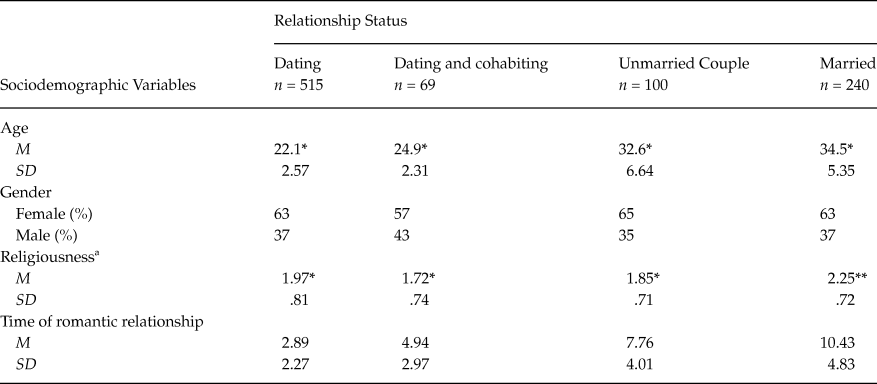
As mentioned, the sample was considered according to the four relationship statuses being studied. Resulting from the analysis of the sociodemographic data of the participants, we highlight the data shown in Table 1. Significant differences were found between some of the sociodemographic groups present in the sample with regards to age, F(3, 920) = 610.72; p < .05 and religiousness, F(3, 917) = 9.128; p < .001. Participants in a non-cohabiting dating relationship were the youngest, followed by dating relationships with cohabitation and the eldest were married participants. In terms of religiousness, participants in a dating relationship that were cohabiting presented the lowest values, followed by the participants in a formal union. Married participants showed the highest scores for this variable.
Descriptive statistics of the sociodemographic variables of the participants according to relationship status (N = 924)

ª Religiousness: 1 = Non-believer; 2 = Non-practicing believer; 3 = Practicing believer.
* Averages differ in p < .05.
** Married average differs from all other statuses in p < .001.
ECP Validation Study
Confirmatory analysis
The Confirmatory Factor Analysis of the Personal Commitment Scale (ECP) showed that the original model proposed by the authors did not have an adequate fit in the current sample (χ2 / df = 5.63, GFI = .93, CFI = .86, TLI = .84, RMSEA = .07), namely in terms of the χ2 / df, CFI e TLI values. In light of these results and considering the parameters used (Browne & Cudeck, Reference Browne and Cudeck1992; Hu & Bentler, Reference Hu and Bentler1999; Segars & Grover, Reference Segars and Grover1993) we chose to proceed with an Exploratory Factor Analysis.
Exploratory analysis
The Exploratory Factor Analysis of the Personal Commitment Scale (ECP), by means of Principal Axis Factoring, revealed the unidimensional structure of the scale, as only the option of one of the components reached the minimum Eigenvalue of 1. This was also evident during the interpretation of the scree-plot graph (Field, Reference Field2009).
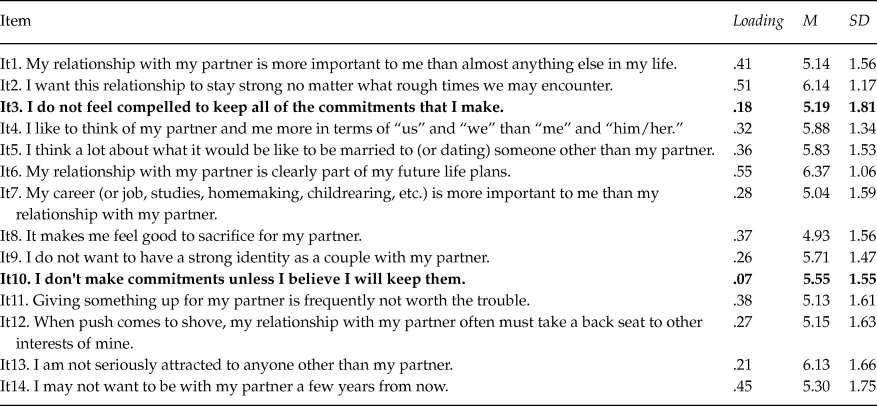
The precision of the measurement was analyzed through the internal consistency of the scale, by means of Cronbach's alpha, and the adequacy of each item was also verified (Table 1). It was verified that items 3 and 10 did not meet the minimum requirements for inclusion, with the loading for item 10 below the value considered acceptable, both had weak item-total correlations and the removal of both items increased the total value of Cronbach's alpha, with the value before removal being .80. In light of this data, the decision was made to remove these two items from the analysis (Maroco & Garcia-Marques, Reference Maroco and Garcia-Marques2006; Nunnally & Bernstein, Reference Nunnally and Bernstein1994). These items correspond exactly to the two items the authors consider as being relative to the meta-commitment dimension, thus being theoretically adequate its empirical differentiation from the remainder of the items and their exclusion from the scale. The final unidimensional structure, without the referred items, explains 28.22% of the total variance, with acceptable item-total correlations (Field, Reference Field2009) between .36 and .60 and with a total average score of 5.56 (DP = .86). The Cronbach alphas vary between .82 for the total sample, .83 and .81 respectively for the male and female sample. For the four subgroups, we obtained .82, .80, .70 and .84 respectively for participants in a dating relationship, dating with cohabitation, formal union and married couples. We can thus consider most of the internal consistency indices as good (Cronbach, Reference Cronbach1970; Maroco & Garcia-Marques, Reference Maroco and Garcia-Marques2006).
Summary of the descriptive statistics and loadings of the 14 ECP items, with the Principal Axis Factoring method, Direct Oblimin orthogonal rotation (N = 924)
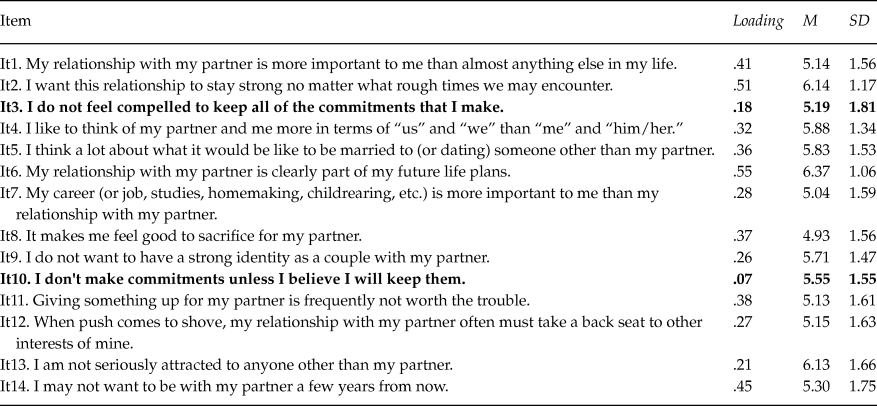
Note: Items in bold were removed after factor analysis.
Explained variance 28.22%.
Cronbach's alpha after removal of the two items = .82.
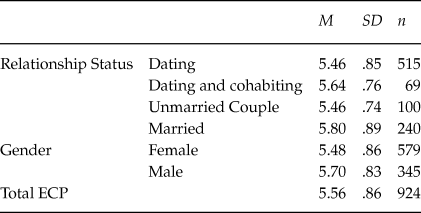
Table 3 shows the descriptive statistics of the ECP, and considers the relationship status and gender of the participants. The average ECP scores in the current sample are as follows, 5.56 (DP = .86) for the total sample, 5.48 (DP = .86) for women and 5.70 (DP = .83) for men. This difference is significant F(1, 922) = 14.578; p < .001; η2 p = .02.
Descriptive statistics of total ECP and relative to the relationship status and gender

Concurrent criteria validity
Continuing with the validation of the Personal Commitment Scale (ECP), we proceeded with the concurrent validity criteria analysis. The global values for personal commitment showed, as expected, significant positive correlations (p < .001) with the total RRF-R (.63) and with all its subscales (Passion, .64; Confidence, .51; Conflicts, .44; Intimacy, .45), which indicate that higher levels of personal commitment correlated with higher indices of relationship quality, in all its dimensions.
Personal Commitment and Relationship Status
Once the described analyses were completed, they were followed by the exploration of the various relationship statuses present in the sample of participants (Table 3) with the results obtained by these in the Portuguese version of the scale thus validated, the ECP. The significance of the effect of the relationship status on the level of personal commitment of the participants was evaluated by the ANOVA one way method, in which the normality (p < .05 for three of the four types of relationship statuses) and homoscedasticity analyses W(3, 920) = 1.06; p = .298 were sufficiently robust to proceed with the analyses. A statistically significant effect of the relationship status on the personal commitment levels of the participants F(3, 920) = 9.59; p < .001; η2 p = .03 was observed.
With the multiple comparison analysis, the statistically significant differences between the personal commitment averages of participants that were dating and those that were married (p < .001), and between those that were married and those in a domestic partnership (p = .004) became evident. As such, married participants (M = 5.79; DP = .88) reported higher levels of personal commitment than those that were dating (M = 5.45; DP = .85), and higher than those individuals in a formal union (M = 5.46; DP = .74).
Next, the various sociodemographic and relationship variables, which were referred in literature as being relevant with regards to their influence on personal commitment, were controlled through the analysis of covariance, in order to verify the permanence, or not, of the relationship status effect. It was thus verified that the effect of the relationship status variable remained significant, even when controlling for the influence of the variables gender F(3, 920) = 9.62; p < .001; η2 p = .03 religiousness, F(3, 920) = 7.92; p < .001; η2 p = .03, relationship quality, F(3, 920) = 21.30; p < .001; η2 p = .07, and total duration of the relationship, F(3, 920) = 7.09; p < .001; η2 p = .02. In order to evaluate possible interference originating from the application of the questionnaires (online vs. pencil and paper), this variable was controlled in order to assess the permanence of the relationship status effect. It was observed that the relationship status variable remained significant, F(3, 920) = 7.90; p < .001; η2 p = .03.
Discussion
The current study attempted to contribute towards the study of personal commitment, by validating the Portuguese version of the Commitment Scale, the Personal Commitment Scale (ECP - Escala de Compromisso Pessoal) on a sample of 924 participants that were involved in romantic relationships and by exploring the influence of various relationship statuses on it. Various sociodemographic and relationship variables were controlled, and the significant effect of the relationship status was systematically found.
With respect to the ECP validation study, the scale has good indices of psychometric quality, which, associated with its size, make this scale a practical and quality option for use in research work, in intervention assessment, and at a therapeutic and preventive level. Notwithstanding, the structural factor analysis that was carried out produced an interesting result, with respect to the theoretical conception of the authors of the original scale. While Stanley and Markman (Reference Stanley and Markman1992) defend a bidimensional model of commitment (personal commitment on the one hand – dimension evaluated by the ECP, and commitment by constraint, on the other), the factor analysis of the scale leads to the exclusion of two items that the authors associate with the meta-commitment construct. According to them, this construct is empirically integrated in the personal commitment variable, and as such, in their scale. However, the results presented here diverge from this integration and are more consistent with three-dimensional commitment models, which separate personal, structural and moral commitment, much like Johnson's model (Johnson, Caughlin, & Huston, Reference Johnson, Caughlin and Huston1999), which other authors have taken into consideration and replicated (e.g., Narciso & Ribeiro, Reference Narciso and Ribeiro2009; Pope & Cashwell, Reference Pope and Cashwell2013).
With regards to the exploratory study, we consider it adds value to the existing literature by alerting to the contemporary relationship variability and by exploring the effect of the four different relationship statuses on the participants, overcoming the common cohabiting-married dichotomy and including couples in a dating relationship. The results show that couples in a formal domestic relationship present lower levels of commitment than married couples, independently of the duration of the relationship, gender, religiousness and relationship quality. The results thus suggest that couples in a formal domestic relationship, although they are stable cohabitation relationships, are characterized by a less secure level of personal investment than are marriages. This data seems to corroborate the theory of Stanley et al. (e.g., 2010), when they refer to the existence of ambiguity in conjugal relationships where a formal bond of commitment has not been made, which may result in greater instability and relationship dissolution. In their model and research, the authors consider that cohabiting relationships are often marked by the absence of choice and intentionality by one or both partners, which they summarize in their explanatory relation Sliding vs. Deciding. For Brines and Joyer (Reference Brines and Joyner1999), the absence of institutional protection in cohabitation is one of the reasons for its high instability, which leads to a feeling of less security by the partners, less investment and less commitment. It is noteworthy of mention though, that contrary to the cohabitation usually referred to in articles written on the subject, couples in a formal domestic relationship in Portugal are protected by law, i.e., a couple living together for at least two years is legally considered to be in a “formal union” relationship. Nonetheless, living as an unmarried couple remains a status for which making a choice or having to undergo a social/legal procedure is not necessary. The same is not true for marriage – even if it may be possible to have a sliding component, marriage always implies making a conscious decision and publicly assuming that commitment. Thus, the public aspect and social framework of the romantic relationship, translated into the institutional convention of marriage, reveals itself in the data as an expression of a more committed relational reality.
The results relating to the first three statuses (dating with and without cohabitation and formal union couples) can also provide pertinent considerations, seeing that there are no significant differences between them, and, in global terms, the dating participants are as much or more committed than those in a domestic partnership. With regards to this, Stanley and Rhoades (Reference Stanley, Rhoades, Benson and Callan2009) reflect upon the current relationship progression, with several young people perceiving as normal transitions that were previously experienced in marriage (e.g., active sex life and cohabitation), whether or not they have marriage in their prospects for the future. From a progressive relationship development point of view, it could be theoretically assumed that the four statuses considered would reflect a continuum of commitment, corresponding to increasing levels of relationship intimacy. Such is suggested by Niehuis, Huston, and Rosenband (Reference Niehuis, Huston and Rosenband2006), who, in their romantic relationship development model proposal, suggest the progression of commitment as one of the fundamental relationship processes. However, such is not verified in our study: the participants living together do not present higher commitment values when compared with those not living together, thus evidencing that the transition to cohabitation is not necessarily and expression of greater commitment. A qualitative study carried out by Manning and Smock (Reference Manning and Smock2005) also reports that few people state having made a conscious decision to start living together. Such an event seemed to happen gradually, many times without open communication between the partners about the meaning of this transition and a clear vision of a future together. For Stanley and Rhoades (Reference Stanley, Rhoades, Benson and Callan2009), such progression in a relationship corresponds to a risk development course, as opposed to processes of greater clarity and intentionality.
It is worthy of note to mention that risk may also reside in unbalanced levels of commitment and motivations within the couple, and cohabitation may have different meanings to each of the partners (e.g., to the woman it may mean a stage prior to marriage and to the man it may mean a test stage of the relationship), a situation that may have implications regarding the dimension of power within the relationship (e.g., Rhoades et al., Reference Rhoades, Stanley and Markman2006, Reference Rhoades, Stanley and Markman2012). Notwithstanding the risks mentioned, some studies seem to indicate that cohabitation continues to be viewed as a more attractive alternative to marriage, based on fallacious assumptions (Reed, Reference Reed2006). Such conceptions can be clarified, by supporting couples in making more informed decisions regarding the development of their relationship.
The current research, despite its contribution to the domain of psychological evaluation and the comprehension of romantic relationships in different relationship statuses, has several limitations. Its results should be considered from a convenience sample point of view, not a probabilistic one, so they cannot be generalized to other populations. Naturally, this applies not only to the Portuguese population but to the understanding of the phenomenon in a European and international context. For example, the authors Liefbroer and Dourleijn (Reference Liefbroer and Dourleijn2006), in a vast European study that attempted to understand the influence of cohabitation on the stability of a relationship, highlight the fact that this effect varies strongly between countries, in which case this data should be – as in similar studies – interpreted within a macrosociological context which naturally influences all relationship processes. The adaptation of the scale to the specific population being studied (e.g., removal of two items) should be interpreted in its national context, in which case transcultural studies should be cautious with their affirmations (Maroco & Garcia-Marques, Reference Maroco and Garcia-Marques2006).
With regards to procedures, the fact that part of the data collection was carried out online may be considered to be a risk to the research seeing that it is a practice that is still “taking its first steps” and whose ethical debate is still in the early stages (cf. Madge, Reference Madge2007). Nevertheless, various studies have shown that the quality and validity of the answers do not differ from those of other methods, showing that the two formats (paper vs. online) are completely convergent with regards to the essential aspects (Birnbaum, Reference Birnbaum2004; Gosling, Vazire, Srivastava, & John, Reference Gosling, Vazire, Srivastava and John2004). It is worthy to note that all procedural requirements were complied with, such as anonymity, informed consent and respect for the autonomy of the participants (Kraut et al., Reference Kraut, Olson, Banaji, Bruckman, Cohen and Couper2004). The criticism sometimes made with regards to sample skewing of online studies, due to the fact that people using internet are different to those that do not use it with regard to various demographic and social characteristics, has a reduced bearing on the current study, seeing that it is based on a mixed collection process.
Regarding the translation and validation of the Personal Commitment Scale (ECP), it is important to study the temporal stability of the instrument in a test-retest evaluation, as well as verifying the exclusion of items in other cultures. To complete the study of this variable, it would also be interesting to adapt other instruments used by the team that created them, more specifically the scale that evaluates the constraints commitment dimension.
With regards to the exploratory study of the various relationship statuses, its transversal design must be taken into account. The fact that the current data collection took place during a specific moment in time constitutes a limitation that may be overcome in the future by longitudinal studies that allow for the understanding of causal relationships between the evaluated constructs, taking into account the development of romantic relationships.
Also considered to be of interest is the possibility of carrying out qualitative studies that allow for a deeper understanding of the relationship processes, more specifically with regards to commitment and its influence on the progression of the relationship. The relationship between commitment and ambiguity may also shed some light on the scarcely studied specific domain of decision making in young people, with respect to their motivations regarding marriage or cohabitation, as well as the current markers of these transitions. More research is necessary in the domain of alternative forms of conjugality and their implications in terms of relational outcomes, in light of the sometimes contradictory results of existing studies. Still worthy of mention, is that the development of similar studies should seek to encompass the dyad and not only the individual, as was the case here, which would add interesting contributions to the understanding of relational dynamics and, especially, of the commitment dimension and its relation to other variables that were only controlled during the current study. New studies may thus explore in-depth variables such as gender, religiousness, duration of the relationship and satisfaction and relationship quality. Finally, future studies should control the existence or non-existence of cohabitation before marriage, as well as the desire or decision to get married in the future, seeing that these are found to be relevant aspects in literature in the field, which was something that did not take place in this research (Rhoades, Stanley, & Markman, Reference Rhoades, Stanley and Markman2009).
The study of commitment and the diversity of relational statuses and experiences is a recent subject in international research, it nonetheless seeks to provide answers for the new challenges couples currently face. In fact, the construction of secure and lasting intimate relationships nowadays seems more difficult to achieve when so many changes are occurring at the level of gender roles, education, work, values and expectations in a relationship (McGoldrick & Shibusawa, Reference McGoldrick, Shibusawa and Walsh2012), at the same time that couples continue to resist facing the not very adaptive myths and expectations they have towards marriage and cohabitation (Storaasli & Markman, Reference Storaasli and Markman1990).
Commitment is thus a main issue in the progression and definition of relationships. This dimension, as well as the ambiguity that some relationship statuses seem to represent, should be included in the agendas of clinicians and intervention agents who dedicate themselves to the promotion of healthy and satisfactory romantic relationships. Reflection on these factors will allow them to support their clients in processes such as the clarification of expectations and motivations regarding the various transitions, in making conscious and informed decisions and in the exploration of the dimension of power in the relationship, and its possible asymmetries. The deepening of our comprehension of the commitment variable in distinct romantic relationships thus sheds light on new clues for the current research panorama, for clinical work and for various interventions with individuals, couples and communities.
This study was funded by two grants, SFRH/BD/6319/2009 and SFRH/BD/70789/2010, from the Portuguese Foundation for Science and Technology (Fundação para a Ciência e Tecnologia).