1. Introduction
Impunity for human rights violations committed by past authoritarian rulers has been a thorny issue for transitional countries. While some countries have prosecuted perpetrators of past abuses, many more have opted to close the books and avoid accountability through the implementation of amnesty laws. A third pathway remains to be analysed: challenges to the amnesty laws that attempt to overcome impunity.
This article takes a unique look at legal challenges to amnesty laws that have led to their removal, erosion or validation. We consider not only the actors and factors necessary for successful challenges that weaken or annul amnesty laws but also the failed challenges that reinforce those laws.
To conduct our study, we rely on our database of amnesty laws enacted in 88 countries that have undergone a transition from authoritarian rule between 1970 and 2011. We then analyse the 63 amnesties for human rights violations committed by state agents that were enacted in 34 of these transitional countries (see Appendix 1 and 2), and the 161 processes, or challenges, by which the power of the laws has been validated, curtailed or overturned.
We find that the characteristics of four actors explain the variation in the level of success in challenging amnesties across countries: (i) civil society; (ii) international governmental and non-governmental agencies; (iii) domestic executives; and (iv) judicial leaders. We further contend that time plays a conditioning role that enables the four actors to acquire the appropriate characteristics and interaction necessary for successful challenges.
The article proceeds as follows. The next section (Section 2) considers the persistence of amnesty laws, setting the stage for the efforts to challenge them. Section 3 then analyses challenges that are aimed at eroding the legal standing of amnesty laws. We then present (in Section 4) an explanatory model for a successful challenge to an amnesty and one that has failed. We illustrate these processes in Section 5 by presenting emblematic country case studies. This section makes the additional observation that the displacement or erosion of amnesty laws does not necessarily lead to justice. Even where the legal validity of the amnesty law is undermined, impunity tends to persist in some form. Thus the most significant block to successfully ending impunity is its continued domestic appeal. We conclude that the presence of actors willing to champion accountability may be less significant to ending impunity than eroding the power of the actors and factors that support it.
2. The Persistence of Amnesty
There is little doubt that amnesty laws have maintained their attraction despite the emergence of a ‘justice cascade’Footnote 1 a ‘justice revolution’,Footnote 2 and the ‘age of accountability’.Footnote 3 Scholars offer a variety of explanations for the persistent appeal of amnesties. Louise Mallinder, for example, contends that amnesty laws have increased in number, but the new amnesty laws leave more possibilities for accountability than their earlier counterparts. Drawing on her Amnesty Law Database, Mallinder offers a nuanced account of the role of amnesties in political transitions, suggesting that there has been a move away from blanket impunity in favour of conditional and individualised amnesty, and that amnesties – when used with other mechanisms – can contribute to guaranteeing the rights of victims.Footnote 4 Mallinder interprets the trend in continued amnesty enactment by states – despite international efforts to combat impunity – as constituting ‘a response to the increasing salience of human rights law’.Footnote 5 Even repressive regimes sanction amnesties in situations in which they would not have done so before.
In a more recent essay Mallinder agrees, in part, with Kathryn Sikkink's notion of the justice cascade. Both scholars contend that the increase in amnesty laws is a response to the threat of trials. In other words, as human rights trials increase, states are more likely, rather than less likely, to enact amnesty laws as protection against the destabilising processes of putting perpetrators of past atrocities on trial.Footnote 6 Before trials became a threat, amnesty laws were not necessary; impunity prevailed.
The study of amnesty laws carried out by Tricia Olsen, Leigh Payne and Andrew Reiter makes a different argument. First, they find that the adoption of amnesty laws has remained fairly steady over time. As long as the number of transitions from authoritarian rule and transitions from civil conflict persist, they argue, so too will amnesty laws. The appeal of amnesty laws is to promote politically stable and peaceful transitions. Amnesties provide effective bargaining tools to bring authoritarian or warring factions to the negotiating table and they appease potential spoilers to secure the transition. They thus play a crucial role in the early and vulnerable transition years.Footnote 7
In the process of updating the data on amnesties to the current period, and also refining that data to include only amnesties for human rights violations, we have derived different findings from the previous studies by Mallinder and Olsen and colleagues. Our divergent findings may result in part from analysis of a different set of amnesty laws. While we do not add any past amnesty laws to our analysis other than those in the existing Mallinder or Olsen and colleagues databases, we have updated the list to 2011. In addition, we have removed from our analysis the amnesty laws in both databases that do not meet our definition of amnesties for human rights violations perpetrated by the state, committed by state officers and non-state agents on behalf of state interests (for example, paramilitary forces) in countries that experienced authoritarian rule between 1970 and 2011. We exclude amnesty laws that benefit only non-state actors and those that benefit state actors for the commission of other crimes, not related to human rights.Footnote 8 Our more restrictive definition of amnesty laws passed before 2012 allows us to examine whether the pattern of adoption resembles that found by previous scholars analysing a broader set of laws in an earlier period. We also obtained information about the content and coverage of amnesty laws by creating an archive of the amnesty laws and additional sources to explore whether the scope of amnesty law coverage has changed over time.
We define amnesties as any legislative, constitutional or executive provision granting impunity for human rights violations. This includes institutional measures that prevent prosecution for such crimes and pardon those already convicted. We select this broad classification because it encompasses the multiplicity of forms that amnesties have taken in different legal environments, times and contexts, ranging from (i) self-amnesties – only when subsequent democratic governments and/or courts validate them – such as Brazil's 1979 Amnesty Law; (ii) pseudo-amnesties ‘designed to have the same effect as amnesty laws … while avoiding the damning name of amnesty’,Footnote 9 such as Argentina's Due Obedience Law 23.521; to (iii) blanket amnesties and presidential decrees.
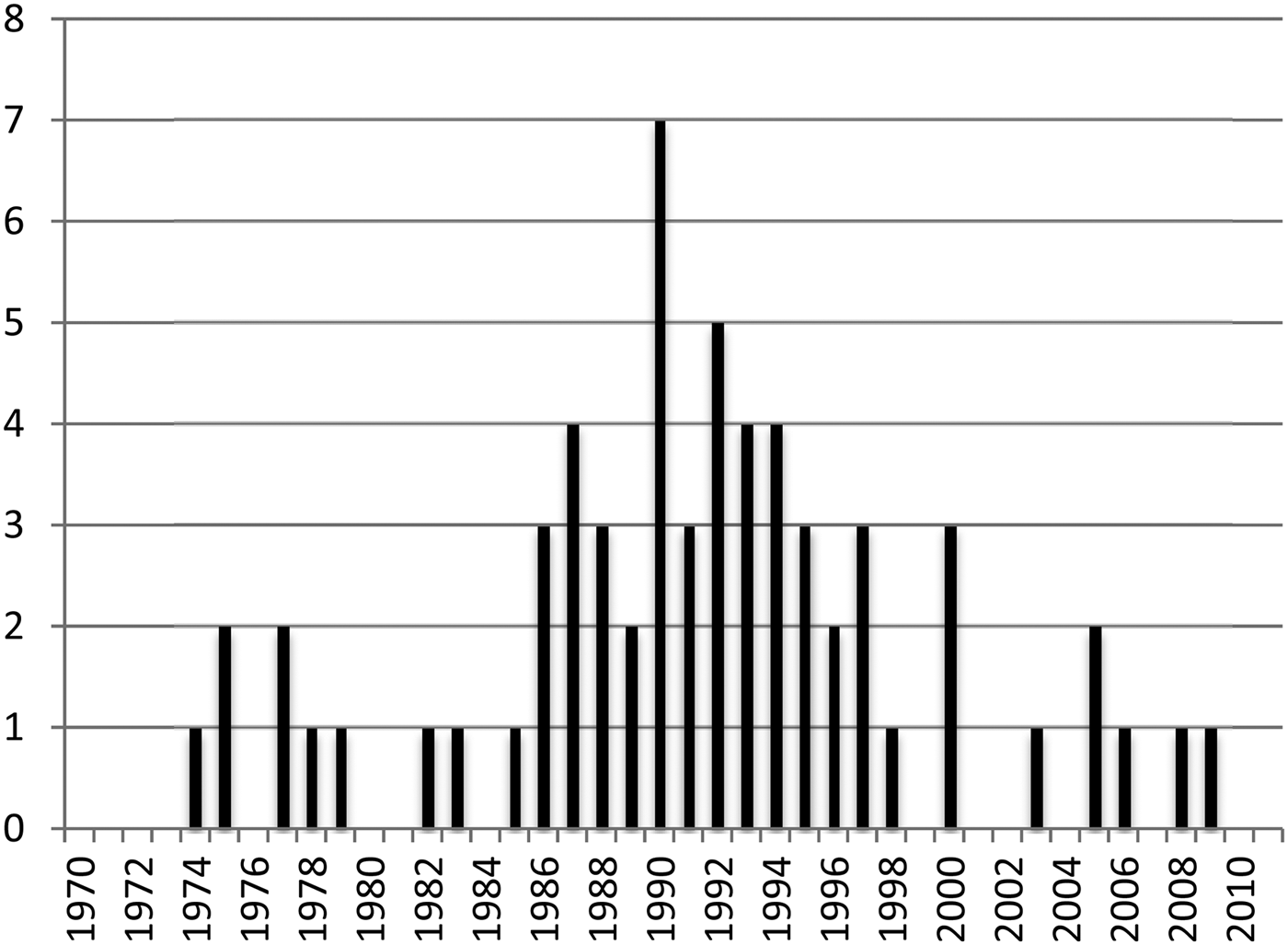
Based on our more restrictive definition of amnesties for human rights violations, we find a different pattern of adoption from that of Mallinder or Olsen and colleagues. Amnesty laws have neither steadily grown, as Mallinder claims, nor remained steady, as argued by Olsen and colleagues. Instead, Figure 1 shows that they peaked in three main periods. These periods correspond with the three main waves of transitions from authoritarian rule: the mid-1970s, with the transitions in Southern Europe (for example, Greece, Portugal and Spain), from the mid-1980s to mid-1990s, with the transitions in Latin America and Eastern Europe, and lastly, in the mid-2000s, transitions in several African countries, including Algeria, Democratic Republic of the Congo (DRC) and Liberia.
Amnesties adopted for human rights violations, 1970–2011

Although our findings seem to contradict the notion of Olsen and colleagues of the steady use of amnesties, our findings appear to be consistent with that study's assumption that amnesty laws increase with transitions. Olsen and colleagues assume that amnesties play a strategic role; transitional governments and peace negotiations tend to rely on them to end the repression and human rights violations, advance democracy and promote political stability. These strategic uses of amnesty laws have been widely acclaimed.Footnote 10 In addition, and in contrast to those who reject amnesty laws as impunity, some scholars have identified amnesties as being consistent with international treaties and international norms; they see amnesties as ‘necessary evils’.Footnote 11
Our findings appear to contradict the claim by Mallinder and Sikkink that amnesty laws are likely to increase with the perceived threat of prosecution. In the same period during which Sikkink's justice cascade study and Olsen and colleagues' justice balance analysis show that trials have increased, the adoption of new amnesty laws has not increased. In the 13 years since the adoption of the Rome Statute establishing the International Criminal Court (ICC),Footnote 12 and thus a global enforcement mechanism to adjudicate human rights abuses, only nine new amnesty laws have been passed: Algeria, Burundi, DRC (three amnesties), Liberia, Mali, and Zimbabwe (two amnesties). This is far lower than the number of amnesties adopted in the 13 years before the ICC Statute, or even than the number of amnesties passed between 1974 and 1979 in the early years of the justice cascade.
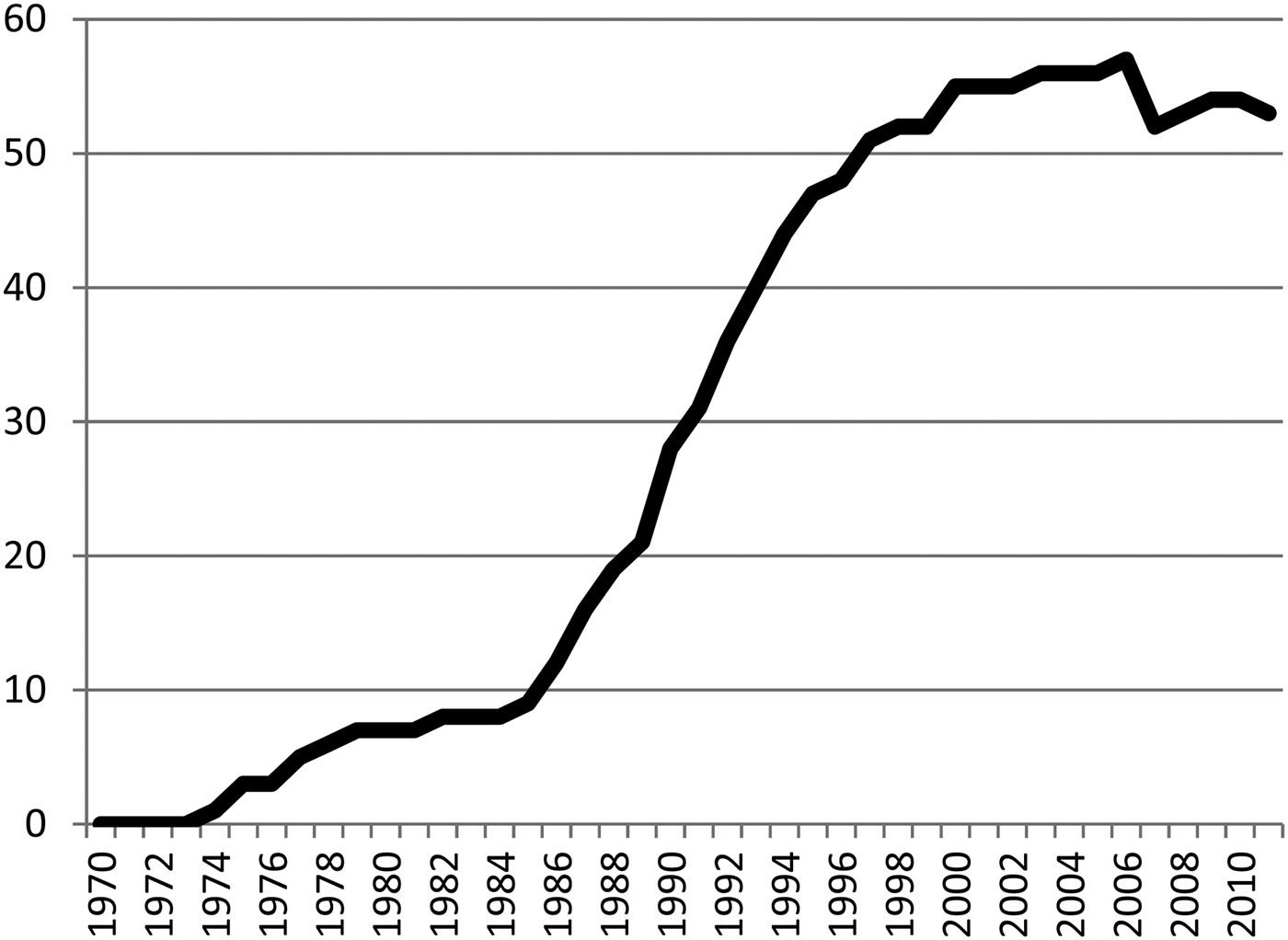
The apparent decline in the number of new amnesty laws, however, does not suggest that they no longer hold appeal for transitional countries. As Figure 2 shows, the cumulative number of amnesties with legal standing continues to grow. Only ten amnesty laws have been derogated from in the world and this process occurred long after those countries began their democratic transitions. Amnesty laws, in short, have significant staying power. They retain their legal effect long after the transitions from authoritarian rule or conflict.
Cumulative number of amnesties for human rights violations with legal standing, 1970–2011
The persistence of amnesties – in conjunction with the observations by scholars that trials have increased – suggests that amnesties fail to block trials and trials fail to overturn amnesties. Trials and amnesties coexist.
One explanation for this coexistence is Mallinder's expectation that recent amnesty laws are restricted in scope, allowing for prosecutions of some perpetrators or some crimes that would have previously enjoyed the benefits of blanket amnesty laws. Our analysis only partially supports such a claim. We do not see significant variation in the wording of amnesty laws over time. Many tend to be quite vague and general, often subject to interpretation by the courts. For example, Article 1 of the Chilean self-amnesty Decree 2191 of April 1978,Footnote 13 upheld by the democratic government, granted amnesty to
all individuals who, whether acting as authors, accomplices or accessories have committed criminal acts, while the State of Emergency was in force, from 11 September 1973 to 10 March 1978, so long as they are not currently subject to trial or already convicted.
Similarly, while laws might appear to be intended for crimes other than human rights violations, they are often written in such a way as to include such violations. Bangladesh's Ordinance No XIX of 1975 (also known as The Indemnity Ordinance 1975), for example, granted immunity from prosecution to those involved in the assassination of the first President of Bangladesh, Sheikh Mujibur Rahman, and members of his family during a military coup on 15 August 1975.Footnote 14 Because the law includes coup-related human rights violations, it thus continues to protect the perpetrators of those crimes.
This type of broad coverage prevails in the post-1998 era. For example, Algeria's Ordinance No 06-01 of 27 February 2006, Decree Implementing the Charter for Peace and National Reconciliation, granted security forces complete immunity from prosecution for human rights violations such as enforced disappearance, extrajudicial executions and torture and other forms of ill-treatment, thus disregarding international human rights law. Article 45, in fact, protects the security forces from prosecution regardless of how much evidence there is of their implication in serious human rights violations:Footnote 15
No legal proceedings may be initiated against an individual or a collective entity, belonging to any component whatsoever of the defence and security forces of the Republic, for actions conducted for the purpose of protecting persons and property, safeguarding the nation or preserving the institutions of the Democratic and Popular Republic of Algeria. The competent judicial authorities are to summarily dismiss all accusations or complaints.
Our analysis of amnesty laws further shows that very few amnesty laws comply with international human rights standards regarding non-derogable crimes: only ten of the 63 amnesties (16 per cent) comply. Of these ten laws, five were adopted before 1998 in Uganda (1987), Croatia (1992), Liberia (1993), Guatemala (1996) and Albania (1997). The remaining five were enacted after 1998: three in the DRC (2003, 2005 and 2009), one in Burundi (2000), and one in Liberia (2005). With the ten laws that comply and the ten laws that were overturned, a total of 20 laws meet international human rights standards and 43 do not. This means that 68 per cent include broad provisions that do not exclude crimes against humanity, genocide or war crimes. Our data on the scope of amnesty laws, therefore, cannot confirm Mallinder's expectation of more partial, focused and compliant amnesty laws.
Enforcement mechanisms – such as the ICC, universal jurisdiction, and some regional courts, most specifically the Inter-American Court of Human Rights (IACtHR) – have repeatedly condemned countries for amnesty laws that protect human rights violators, considering such laws to be incompatible with obligations under international human rights agreements. The attempt in 1998 to extradite former Chilean dictator, Augusto Pinochet, from the United Kingdom to stand trial in Spanish courts illustrates some of these international efforts to get around domestic amnesty laws that block prosecution for international human rights violations. From the watershed Barrios Altos sentence in 2001 to the most recent verdicts in 2011 in the Gelman case and in 2012 in the El Mozote and Neighbouring Locations case (discussed later in this article)Footnote 16 the IACtHR has consistently found countries to be in breach of their human rights obligations and amnesties to lack legal validity under the American Declaration of the Rights and Duties of ManFootnote 17 and the American Convention on Human Rights.Footnote 18 Yet many of these laws nonetheless remain on the books, as our analysis above demonstrates, and courts lack the enforcement power to remove them.
If these laws were truly and universally blanket amnesties, however, we would not see the increase in trials as indicated in Sikkink's justice cascade and Olsen and colleagues' justice balance studies. To understand how countries have circumvented amnesty provisions to allow for accountability thus requires a study not only of the laws themselves but also of the legal challenges to them that have made prosecutions possible.
3. Challenges to Amnesty Laws
Challenges to amnesty laws are an innovative contribution of our study of amnesty laws. Our definition of ‘challenges’ includes only legal challenges at the domestic and international levels. At the domestic level, we define challenges as all attempts to modify the legal scope of amnesty laws – whether these occur in the courtroom, parliament or via the ballot box. They might include efforts to interpret the law in such a way as to exclude its coverage of certain types of crime, particular types of perpetrator or the time period of the crimes. We also consider domestic challenges to be those efforts to cancel the legal effects of amnesties either retroactively, or for the future (derogation), or both (nullification). We include only criminal trials as challenges when they alter the interpretation and application of the law itself. We do not include those trials that test the strength of the amnesty in individual instances. Our definition of challenge excludes those legal strategies that are intended to achieve accountability but are not aimed at undermining the legal effect or validity of amnesties, such as Argentina's truth trials in the late 1990s and the foreign trials of Argentine perpetrators in the same era. At the international level, we code challenges to the legal standing of amnesties by inter-governmental organisations (for example, the Inter-American system or the United Nations (UN) system for the protection of human rights).Footnote 19 Coding both international and domestic challenges is fundamental to our process-mapping exercise, allowing us to track and understand all forms of legal pressure that may influence the validity and legitimacy of amnesty laws.
We include successful and unsuccessful challenges: those efforts that win or fail in overturning amnesty laws. In some cases, a challenge may be aimed at applying a partial amnesty law more effectively – in other words, to push courts to hear cases that should be prosecuted, given the limited scope of the amnesty law. For example, Guatemala's 1996 National Reconciliation Law excludes crimes of genocide, torture and forced disappearance as amnestied acts.Footnote 20 In this case, domestic challenges include legal efforts to designate particular acts as genocide or torture, rather than general political crimes that would receive amnesty. Judge Delgado's decision in the Myrna Mack murder case in 1997 represents an example.Footnote 21
Despite recognition of the validity of some amnesty laws, our systematic tracking of challenges reveals a dynamic process by which actors around the world have attempted to erode the power of amnesties and promote accountability. Overall, we find 161 domestic and international legal challenges relating to 63 amnesties. Latin America stands out as the region with the greatest concentration of these challenges: 145 challenges or 90 per cent of all challenges in the world. Our research further indicates that half of the legal challenges to amnesty laws (80 out of 161) have occurred in the 13 years since 1998 and the other half occurred in the 28 years between 1970 and 1998. Regional patterns suggest that the post-1998 era has increased the number of challenges to amnesty laws: Latin America had 73 challenges before 1998 and 72 afterwards; Europe had three out of four of its total number of challenges in the post-1998 era; the Middle East and North Africa had three of its four challenges in the post-1998 period. The regional anomalies are Africa and Asia where only one of their challenges occurred after 1998; the majority occurred before 1998: three of three in Africa and four of five in Asia.
A qualitative analysis of the outcome of these challenges reveals three distinct categories. We identify as the most successful challenges those that result in the displacement of the amnesty law, or when the amnesty law loses legal standing through official annulment or derogation. This is an extremely rare scenario. Of the 34 transitional countries with amnesties for human rights violations for state agents in our analysis, we find only three countries that have overturned their amnesty laws: Argentina, Uruguay and Bangladesh. The second outcome involves the legal circumvention of the amnesty law: where the amnesty remains valid but the court's reinterpretation of its scope and application is reduced in terms of beneficiaries, crimes or time frame. Five countries fall within this category: Chile, El Salvador, Guatemala, Honduras and Peru. Finally, the third outcome of challenges is validation: the amnesty has faced challenges but the process instead confirms the scope, application and legitimacy of the amnesty law. We find four cases in this category: Brazil, South Africa, Spain and Thailand. The remaining 22 countries of the 34 with amnesty laws (65 per cent) did not face any challenges.
In other words, while the number of challenges to amnesty laws is quite high (161), they are concentrated in a small number of countries (12), and are successful only in overturning or circumventing amnesties in an even smaller number of countries (8). Most countries with amnesty laws did not face any challenges. Our research thus shows not only that amnesties persist but also that efforts to erode them rarely occur and, when they do, only sometimes succeed. In the next section we examine the processes that contribute to this success or failure.
4. Explanatory Framework
The evidence from this study of challenges to amnesty laws reveals three types of outcome: two successful (displacement and circumvention) and one unsuccessful (validation). Based on our study of these amnesty laws, we contend that the characteristics of four actors explain that success or failure: (i) domestic civil society; (ii) international organisations; (iii) the judiciary; and (iv) the executive. We argue that no one factor is decisive; nor is their simultaneous existence sufficient to lead to a reduction in the impunity powers of amnesties. We further argue that it is not the presence or absence of these actors that explain the variation, but rather their specific characteristics. Time is a conditioning factor, enabling the four actors to acquire the appropriate characteristics and permitting the sequenced interaction among them.
The characteristics that we find conducive to successful challenges of amnesty laws include: (i) the consensus and civil society's capacity to mobilise; (ii) domestic resonance of international actors' pressure; (iii) independent and democratic leadership by the judiciary; and (iv) an engaged and motivated executive.
We find that successful challenges begin with civil society's demand for accountability. Civil society, especially human rights organisations and victims groups, have long been recognised by the transitional justice literature as playing crucial roles in pushing for accountability.Footnote 22 They raise awareness of human rights crimes at the time of their perpetration and champion the agenda of truth and justice after transition. They even carry out their own investigations into atrocities, replacing official initiatives when these were unlikely to take place or complementing official initiatives, such the Catholic Church's Recovery of Historical Memory Project in Guatemala to complement the UN-sponsored Commission for Historical Clarification.
While civil society actors champion accountability in nearly every transitional country, we find that they tend to succeed in challenging amnesty when they are united and able to mobilise against amnesty laws. Contextual factors explain the capacity to unite and mobilise. Fear is an important element: unless or until the authoritarian regime is fully discredited (the Argentine scenario), civil society actors will remain deeply divided over the past and unlikely to mobilise as a result of their expectation of repression. Discrediting the regime's practices and overcoming fear of retribution are thus two key elements in uniting and mobilising successful civil society demand for accountability. Unless the regime has collapsed, these processes take time. Negotiated transitions in which the regime is not fully discredited often engender deeply divided public perception about past human rights abuses. Such divisions mean that civil society forces in favour of accountability face obstacles from opposing and mobilised civil society forces that support amnesty.
One way around this civil society impasse is through autonomous and democratic judicial leadership. A judiciary aware of democratic principles of the right to redress and human rights norms may prove willing to challenge impunity. Over time this type of judicial leadership is likely to emerge as new generations of legal practitioners with new kinds of legal education move away from the old authoritarian order and become independent of the executive.Footnote 23 These judicial leaders are also likely to be more susceptible to the international reputational effects of condemnation of laws and practices. Independent and democratic judicial leaders will be more likely to take up the civil society demand for justice. They may also react to the failure of existing amnesty laws to comply with domestic constitutional law or to the international and regional treaties and conventions that the country has ratified. Legal professionalism, legal responsiveness and reputational effects are likely to emerge over time. We hypothesise, therefore, that where new generations of autonomous and democratic prosecutors and judges have emerged, we are more likely to see successful challenges to amnesty laws.Footnote 24
The discussion of civil society demand and judicial leadership shows that these two actors do not occur in a vacuum. International pressure may play an important role in reinforcing both. The notion of the ‘boomerang effect’ described by Margaret Keck and Kathryn SikkinkFootnote 25 highlights the impact of the capacity of international actors to amplify the demands of domestic civil society actors. Their ability to ‘name and shame’ contributes in some situations to effective responses on the part of the judiciary to domestic civil society demands.
Since the end of the Cold War, states have faced consistent pressure from regional and international human rights bodies to provide accountability for past crimes.Footnote 26 Increasingly, actions such as torture, disappearances and other violations of human rights are no longer viewed as legitimate state actions, but rather as international crimes. In particular, since the seminal Barrios Altos sentence by the IACtHR in 2001, there has been a backlash against the legitimacy and validity of domestic amnesties and statutes of limitation in cases of gross human rights violations at the level of regional human rights bodies as well as the UN.Footnote 27 Since the late 1990s, the UN has taken the position that amnesties that prevent the prosecution of individuals charged with war crimes, genocide, crimes against humanity and other gross violations of human rights are ‘inconsistent with States’ obligations under various widely ratified treaties as well as United Nations policy, and may also be inconsistent with emerging principles of customary law'.Footnote 28 Yet the impact of international actors on domestic processes depends on its resonance domestically. This resonance is connected with how domestic institutions relate to the international arena. For example, some legal systems are more open to international law, which increases the chances that local judges will adopt human rights standards set by international organisations. In this context, it is more likely that judges reduce the power of amnesties and they are regarded, in general terms, as being contrary to these standards. In the same vein, governments that are sensitive to their international reputation are more likely to overturn amnesties upon international condemnation by international human rights organisations or institutions.
International pressure is likely to work to change state's attitudes about amnesty laws where an engaged and motivated executive exists. The generational change mentioned above with regard to the judiciary does not seem to be an adequate indicator of more favourable political will on the part of the executive. Executive members' human rights background or their experience as victims of torture or political imprisonment may make them less resistant to weakening impunity, but this is hardly determinant, as superficial analysis shows.Footnote 29 We hypothesise, instead, that the political will behind eroding the amnesty law is likely to emerge under two conditions: where the executive sees a concrete political gain from weakening the amnesty provisions with no perceptible cost in doing so, or where international pressure is likely to undermine the government's reputation in key fora. In these contexts, the executive is likely to be both engaged in the matter of impunity and willing and motivated to support challenges to it. Executive engagement and motivation in altering the amnesty provisions is unlikely to emerge without consensus and mobilisation within civil society. However, civil society pressure for accountability may exist without any response from the executive.
Time is an important conditioning factor in the development of the civil society, judicial, executive and international characteristics that are conducive to challenging amnesty laws. First, through the passage of time actors have the potential to develop the characteristics necessary for successful challenges: unity, mobilisational capacity, autonomy, democratic values, resonance, engagement and motivation. Second, time allows for the interaction among these actors and their mutual reinforcement: civil society and the judiciary; civil society and international pressure; civil society and the executive; international pressure and the judiciary; international pressure and the executive.
Based on our findings, we suggest that a particular sequencing over time and through interaction is most likely to be successful. The starting point for this process is with domestic groups. Victims and their families seek retributive justice and oppose impunity. When legal professionals working with these victims and their families take up the demand, it becomes a legal challenge to the amnesty law. The failure of the domestic legal system to take up this demand may lead victims and their families, along with their legal representatives, to approach international justice mechanisms. International bodies that challenge domestic amnesty laws involve legal pressures from outside the system. At various points in the process, political leaders may begin to promote accountability, working from their own personal experience, responding to civil society demand or international pressure, and/or recognising the possibility of justice arising from shifts in the domestic courts.
Our research leads us to claim that domestic groups and judicial leaders together are the most significant actors. They could be viewed as both necessary and sufficient. Such a perspective, however, ignores the factors that might explain their ability to heighten their visibility, legitimacy and power: time and its role in reducing threats from the former regime supporters, international pressure that amplifies domestic demand and raises the stakes for failing to comply with international standards, and an executive willing to implement change.
It is not the absence, but rather the weakness, of these characteristics that explains the failure to challenge amnesty laws. Civil society may lack sufficient unity to mobilise effectively. Autonomous and democratic judicial leaders may be blocked by the pervasive legacy of authoritarianism in the judiciary or in the political arena more broadly that block judicial initiative and change. International pressure and resonance may exist without succeeding in overturning amnesty laws because of the continued domestic appeal of those laws. Even an engaged and motivated executive could be blocked by courts or legislatures unwilling to allow for change.
Thus the variation in the characteristics of these actors and their interaction does not lead to a single outcome from challenges to amnesty laws. Three different outcomes are likely. Moreover, even where amnesties are successfully challenged, characteristics of these actors may continue to block accountability.
5. Outcomes of Challenges
To illustrate the importance of this set of actors, their characteristics and their interaction over time in overturning or blocking challenges, we consider illustrations from particular countries of the three outcomes: (i) displacement; (ii) circumvention; and (iii) validation.
5.1 Displacement
Challenges that completely eliminate the impunity power of amnesties result in their displacement. These cases represent the most successful type of outcome in terms of challenge as the nullification of the amnesty opens, at least formally, the door to prosecution. This outcome is very rare; we find it in only Argentina, Uruguay and Bangladesh. In these countries, the primary explanation for the displacement of their respective amnesties is sustained and long-term civil society demand for an end to impunity, coupled with judicial leadership. In two of the cases (Argentina and Bangladesh), executive engagement and motivation also played a crucial role. Displacement would not be possible, therefore, without time for civil society mobilisation to emerge after the end of the dictatorship and for a generational shift in the judiciary that creates new independent and democratic leadership. In addition, international pressure was instrumental in legitimising the civil society demand for accountability.
Argentina provides the best illustration of these explanatory factors in overturning the blanket amnesty laws and allowing for justice. We show, however, that Argentina's success in challenging its amnesty law has not meant that the supporters of prosecutions are satisfied: institutional and ideological limitations on justice persist. Indeed, we discuss Uruguay briefly as an example of how displacement of amnesty laws does not necessarily mean that prosecutions for past human rights abuses will occur. The characteristics of the key actors may continue to promote impunity even after the derogation of the amnesty laws.
In Argentina, the persistent advocacy of human rights groups through the courts – at both the domestic and international levels – reinforced by the support of the national government, led to the legislative and judicial overturning of the amnestiesFootnote 30 almost two decades after their adoption.Footnote 31 A vibrant human rights movement deployed a wide range of legal strategies to weaken the power of the amnesties during the 1990s.Footnote 32 Some positive results at the domestic level, although partial, transformed the demand for justice into a legally supported claim. Remarkably, in 2001 a lower judge declared the two amnesty laws unconstitutional.Footnote 33 At the international level, demands by human rights groups were supported largely by international organisations such as the IACtHR and the UN Human Rights Committee.Footnote 34 As a result, the struggle against impunity became a demand reinforced by the international community.
In 2003, newly elected President Néstor Kirchner endorsed the Memory, Truth and Justice agenda advocated by human rights groups. At the accountability level, the first measure proposed by the President was the legislative nullification of the amnesty laws, which eventually occurred in August 2003. The Supreme Court of Argentina later validated this nullification and declared the amnesties unconstitutional in 2005. As Engstrom and Pereira argue,Footnote 35 Kirchner's political leadership should be understood, at least partially, in the context of the precarious political circumstances in which he came to power. With a weak political mandate entering the presidential office,Footnote 36 Kirchner moved quickly to seize the opportunity to legitimise his government through public support for accountability. As a result, the demand for justice became, finally, a salient issue in the domestic political arena and its embrace created a source of legitimacy for Kirchner's party. Since 2006, 439 individuals have been convicted for crimes against humanity and hundreds more have been charged.Footnote 37
Argentina's annulment of the amnesty laws thus shows the dynamic interplay among civil society, international pressure, judicial leadership and executive political will, together with timing and sequencing. Without the mobilisation of victims, survivors and human rights groups, it is unlikely that the judiciary or the executive would have initiated the challenges to the law. Time also contributed to the overturning of the law, since a new generation of judicial leaders emerged over time and civil society forces became more adept at making demands at the local and international levels. The Inter-American system further played a key role in legitimising civil society demand for justice and encouraging judicial leadership in initiating that change. But it is important to note that old regime supporters lacked the power to resist these changes. Unlike other democratic transitions that we observe in Latin America and elsewhere, the Argentine dictatorship lacked any significant support as a result of its mishandling of the economy, its military debacle in the Falklands/Malvinas War, and global attention to its human rights atrocities. The amnesty laws thus had few defenders.
While Argentina is emblematic of the capacity of challenges to displace amnesty laws, significant legal and political hurdles to accountability persist. An insufficient state infrastructure struggles to cope with the scale and scope of the trials.Footnote 38 Some sectors of the judiciary have expressed resistance to the trials, not only on practical grounds but also for ideological reasons.Footnote 39 Some efforts have been made to resolve these problems with the creation of a committee in 2008 made up of representatives from the three branches of government as well as specialised agencies created by the Supreme Court and the General Prosecutor's Office. The experience in Argentina, however, indicates that amnesty laws are not the only obstacle to accountability.
Uruguay has faced even more significant hurdles in implementing justice after the displacement of its amnesty laws in 2011.Footnote 40 Cases progress extremely slowly; judges and prosecutors often lack adequate training in dealing with complex human rights trials; and lawyers for the defendants have interposed unconstitutionality challenges regarding the derogation of the amnesty, effectively putting on hold many judicial proceedings.Footnote 41 Furthermore, in February 2013 the Supreme Court of Uruguay, invoking the principle of non-retroactivity of criminal law (ex post facto), declared that the crimes of the dictatorship constituted common crimes, and not crimes against humanity, and were therefore subject to statutes of limitation as in domestic criminal law.Footnote 42 In the aftermath of the amnesty's derogation, the Supreme Court raised a further hurdle on the path to justice. In fact, this jurisprudence had already resulted in the closure of two criminal investigations, although some judges have refused to follow the Supreme Court's stance. While the actors behind Uruguay's challenges to the amnesty law proved to be sufficient in displacing that law, certain obstacles to accountability persist in the form of some judicial leaders who favour amnesty and an executive that has remained unengaged and unmotivated to take on the challenges to the amnesty law.
Displacement of amnesty laws may be explained by the interplay between agency factors and timing. In the cases discussed, pressures from civil society, the judiciary, the executive and international forces led to the overturning of the amnesty laws. While this process has formally opened up the pathway to justice, we have shown that displacement does not always lead to the prosecution of human rights cases. Severe institutional and ideological limitations on accountability remain even when they are not sufficient to block the overturning of the amnesty law.
5.2 Circumvention
Challenges resulting in the circumvention of amnesties lead to a reduction in the power of amnesties to prevent accountability for past crimes. This means that criminal prosecutions may occur even though the amnesty remains legally valid. We place five countries in this category: Chile, El Salvador, Guatemala, Honduras and Peru. We focus here on the case of Chile to demonstrate that circumventing amnesties involves the presence of the same set of factors of civil society mobilisation and judicial leadership as with displacement. Those two factors depend in large part on time for the creation of mobilisation and generational shifts in the judiciary. They also depend on pressure from international actors. But, as we will see in the analysis, the strength of support for the old authoritarian regime has successfully blocked the annulment of the amnesty laws, even if it has failed to block trials that get around that amnesty law. We further show, with a discussion of both Chile and Peru, that support for, and the practice of, impunity may persist even when civil society and the courts have found ways to circumvent the laws.
The case of Chile illustrates how the interplay of causal factors differs from the dynamics observed in the displacement of amnesties and, as a result, generates a different outcome. Although judicial and legislative attempts to undermine the validity of the amnesty have been unsuccessful, since 1998 judicial challenges circumventing the scope of the self-amnesty have proved to be effective in producing a substantial decrease in the impunity offered by the law. This occurred through a jurisprudence that restricts, although not completely, the application of the democratically upheld self-amnesty law. Specifically, the crime of enforced disappearance was reinterpreted by the courts as a ‘permanent crime’, thus falling outside the time frame shielded by the amnesty. As a result, a wave of prosecutions began in the early 2000s; by February 2012, 1,342 human rights cases had been opened in the country and perpetrators found guilty of those violations are now in prison.Footnote 43
The increasing levels of accountability can be explained by the effort of active civil society groups, whose demands were backed by a moderate judicial leadership and international bodies. By the end of the Pinochet regime, a vocal and well-organised human rights community was present in Chile but positive outcomes in the accountability arena were scarce during most of the 1990s.Footnote 44 This negative scenario started to be reversed by more effective domestic and international legal strategies brought by human rights groups since 1998 – the year in which Pinochet was arrested in London on charges of torture. In the domestic realm, the main strategies were aimed at circumventing the effects of the amnesty rather than attacking its validity. In 1998, the Supreme Court of Chile made two relevant contributions to this development. First, it reinterpreted the amnesty and established that disappearance constituted an ongoing crime, which could not be subject to a time-limited amnesty.Footnote 45 Second, the Supreme Court established the applicability of the Geneva Conventions to political prisoners, which has resulted in the non-application of the amnesty for cases involving political prisoners.Footnote 46 In the international arena, local organisations were successful in obtaining the support of intergovernmental organisations. The Inter-American Commission of Human Rights (IACHR), in particular, has declared the amnesty to be contrary to international human rights standards on several occasions during the 1990s,Footnote 47 and the IACtHR in the Almonacid Arellano case decided in the same direction.Footnote 48 Consequently, the persistent claim for justice of human rights groups eventually prompted a response at the domestic judicial level and in the regional court.
While the benefits of the amnesty law have been successfully curtailed, it retains legal validity. This is no doubt as a result of the support that the prior Pinochet dictatorship continues to enjoy long after the end of that regime. Unlike the position in Argentina discussed above, the military regime is perceived positively by a significant element of the population owing to perceptions of successful economic policies and political legitimacy.Footnote 49 These political views are represented by several right-wing parties and forces that opposed the annulment of the amnesty. They have balanced out those parties and leaders of the centre-left coalition who have ruled the country since the beginning of the transition in 1990 until 2010 and advocated accountability. The amnesty law has been maintained but the courts have found ways around it.Footnote 50 The election of President Sebastian Piñera in 2010 reinforced the sectors of society who favoured impunity and the President has shown no intention of changing the law. As a consequence, as Collins remarked before Piñera's election, the steady progress in human rights accountability has been possible as a result of the constant activism of private human rights lawyers, rather than political will.Footnote 51
The circumvention outcome has led scholars and practitioners to debate whether the amnesty law has only symbolic power in protecting perpetrators from prosecution or whether the amnesty law continues to have the political power to delay progress towards justice and render just sentences. Civil society groups have complained about excessively lenient sentences for perpetrators of mass human rights violations in Chile. For humanitarian reasons, some older perpetrators may never set foot in jail, despite sentences having been imposed, and will serve their time instead under house arrest. Others are in luxury prisons.Footnote 52 There is no doubt, however, that the creative uses of legal loopholes by judicial leaders, at least regarding the disappeared, has allowed domestic courts to respond effectively to the demand from domestic human rights and victims/survivors groups and international courts to circumvent a seemingly blanket amnesty law to allow for some justice. But it is also clear that the military regime's sustained support has somewhat blocked the process of justice.
In Peru, we found similar dynamics at play since civil society and judicial leaders were able to limit the application of the amnesty laws enacted under President Alberto Fujimori in 1995 to provide immunity for all military, police and civilian officers involved in the fight against terrorism unleashed by the government against the Shining Path (Sendero Luminoso) and the Túpac Amaru Revolutionary Movement. Resorting to the Inter-American system and the seminal Barrios Altos verdict, civil society successfully employed international pressure and took advantage of a more favourable political context in the aftermath of the collapse of the Fujimori regime in 2000 to restrict the application of the amnesties. In fact, both the President of the Supreme Court of Peru in 2001 and the Attorney General's Office in 2005 ordered that they should no longer be applied by courts.Footnote 53 Important trials have thus occurred, most significantly that of former President Fujimori, who is in prison today serving a 25-year sentence after his 2009 trial for human rights violations, including the Barrios Altos and La Cantuta massacres. Yet prosecutions remain slow, often not moving beyond the preliminary investigation stage, and several hundred proceedings have been archived as a result of lack of information.Footnote 54 Between 2005 and 2012, only 46 sentences were delivered in human rights trials, of which nine were guilty verdicts, 26 not guilty verdicts, and 11 ‘mixed’ sentences (indicating that at least one defendant was absolved and another condemned); 113 defendants were acquitted, while 66 were condemned and 12 were absent.Footnote 55 The weakening of the amnesty law has not resulted in justice in all cases, and the removal of the amnesty obstacle did not result in a cascade of prosecutions. Many delays and obstacles, resulting from judicial and executive support for the old amnesty laws, mire Peru's pathway to accountability.
Circumvention provides an effective way around amnesty laws that promotes accountability. In some cases circumvention may even allow for more accountability than displacement, as is shown by the trials in Chile and Peru, compared with those in Uruguay. Nonetheless, certain aspects of the laws in Chile and Peru – even those that fail to respect international human rights standards – remain legally valid and block some court cases. In addition, the failure to displace the law means that it still retains certain symbolic validity. On one hand, this may appease those who continue to support amnesty and oppose trials. On the other, it illustrates a significant impediment in the form of a divided civil society to overcoming amnesty laws. Despite the forceful efforts by a mobilised local human rights community, a responsive judiciary and strong international pressure, these laws remain valid. In these cases, some, albeit arguably mild, executive and legislative support for accountability also exists. In other words, circumvention hinges largely on overcoming opposition to accountability in civil society. Given that (mildly) supportive executives and legislatures, judicial leadership and international pressure already exist, it is impossible to imagine that unity within civil society behind displacing the amnesty law would fail.
5.3 Validation
The third possible outcome of challenges to amnesties is validation, a situation in which attempts to challenge amnesties are unsuccessful and the power of the amnesty law to guarantee impunity for human rights crimes remains intact. In this case of obstinate amnesties, we found several endeavours by civil society, judiciaries and international actors to question and reduce the legitimacy and validity of amnesties. These efforts failed and the constitutionality and legality of the amnesties were reinforced by legal decisions on the challenges. We attribute the longevity of amnesty laws in this category in part to the weakness of civil society demand and judicial leadership. But that weakness is also relative to the institutional or social power of those actors who continue to support amnesty laws. We focus here on the case studies of Brazil and Spain. Together with Thailand and South Africa, they represent the four countries in the validation outcome category.
The 1979 Amnesty Law (Law No 6683)Footnote 56 was passed in the midst of Brazil's military regime (1964–85), granting amnesty to individuals who had committed political offences or electoral crimes between 1961 and 1979. Though hailed as a bilateral or reciprocal amnesty for the benefit of torturers and tortured alike, the law was inevitably warped to suit the military regime's own preferences.Footnote 57
All internal challenges to the amnesty have been vigorously rejected by Brazil's highest court: as a result, the amnesty has not been weakened and criminal prosecutions have yet to take place.Footnote 58 The frequency of criminal cases that have challenged the amnesty directly is also notoriously low. Unlike Argentina, Chile, Uruguay, or even Guatemala, domestic challenges to the amnesty law have not originated from victims, relatives or human rights organisations. Rather, the Brazilian Lawyers Association initiated the most high-profile domestic challenge to date in an appeal to the Brazilian Supreme Court in 2008 to exempt torture from the amnesty. In April 2010, the Brazilian Supreme Court rejected the appeal, citing the historical context of a bilateral, mutually beneficial amnesty which had served as a catalyst for democratisation.Footnote 59 Even the subsequent historic ruling by the IACtHR in November 2010 in Gomes Lund et al v Brazil Footnote 60 – which declared that the 1979 amnesty, by preventing the investigation and punishment of human rights violations, was unequivocally incompatible with the American ConventionFootnote 61 – failed to initiate further challenges inside Brazil.
The dearth of challenges within the domestic court system seems to indicate a general disinterest at the civil society, judicial and executive levels in revoking or even circumventing the amnesty.Footnote 62 While civil society successfully mobilised in the 1970s to demand a general, unrestricted amnesty, it did not push for accountability. That moment would also mark the last instance of relatively unified, widespread popular mobilisation for a cause related to past human rights violations. Since then, Brazilian civil society has become increasingly fragmented; there was little public protest in response to the 2010 Supreme Court verdict despite widespread criticism by victims' families and the international community. Apart from public disinterest and weak civil society mobilisation on the issue, there has also been a significant lack of institutional reform within the judiciary. During the dictatorship, the judiciary was filled with loyal legal practitioners and after 1985 there was a complete absence of lustration or turnover processes: the last judge appointed during the dictatorship did not leave office until 2003, 18 years after the end of military rule.Footnote 63 The 2010 Supreme Court decision to uphold the amnesty as a legitimate instrument of reconciliation underlines a lack of judicial reform.
There are some indications of growing pressure for change. The Inter-American Court's decision on the amnesty law (international pressure) seems to have had some effect on the views of Brazilian prosecutors of their country's reputation in terms of rule of law. At least some judicial leadership has emerged, with prosecutors searching for creative ways to circumvent the amnesty law in lower courts and respond to a fairly weak demand from victims and their families for justice. It may also be that the decision by President Dilma Rousseff to appoint a national truth commission demonstrates a shift in executive engagement and motivation towards some sort of accountability. The proliferation of subnational truth commissions in individual states and universities also reflects growing civil society demand for accountability, which could become even stronger when the findings of these commissions are revealed. Whether they will prove sufficiently strong and consensual to mobilise to displace or circumvent the amnesty law remains to be seen.
In Spain, similarly, very few challenges have been made and there is little sign of change. Spanish Judge Baltasar Garzón – well known for his role in promoting justice in Latin America by attempting to extradite Chilean dictator, General Pinochet, to stand trial in Spain, among other efforts – ended up hurting his own professional career when he attempted to bring justice for past violence in his own country and failed to weaken the 1977 Amnesty Law. Support for the amnesty law is deeply and institutionally embedded in Spain. While there seems to be growing attention to the problem of impunity with efforts by family members to recover the victims of Franco-era mass graves, strong opinion supports a ‘pact of silence’ over the past that paved Spain's democratic pathway.Footnote 64 Relatively weak international pressure, divided popular opinion, lack of training for judges and judicial reform leaders, and strong support for the amnesty law explain the obstinate amnesty in Spain.Footnote 65
These two country case studies illustrate that obstinate amnesties are not the result of the failure to challenge the amnesty laws, but of failed efforts to succeed. We have selected Brazil and Spain because they show that even the passage of a long period of time following the end of the dictatorship may not be favourable for successful challenges. All of the other cases we have examined, with the exception of Argentina, passed through a period during which challenges were either not made or proved to be ineffective. Over time, these challenges eventually proved to be at least partially successful. The length of time, however, may be less relevant than what happened during that time. The characteristics of actors and their interaction that made for successful displacement and circumvention have not emerged in the validation cases.
While civil society demand is not absent in these cases of violation, they have tended to be relatively muted until very recently. Whether the new voices demanding accountability will prove to be capable of overcoming strong civil society support for the amnesty may depend on additional factors. In particular, judicial leadership has not emerged to champion accountability in these two cases. When it has (as in Spain) it has backfired, harming the leader and failing to advance the accountability cause. Political will in the executive and legislative branches of government has also failed to materialise even when the President (in Brazil) faced political persecution during the dictatorship. Spain and Brazil experienced little international pressure to challenge their amnesty laws, thus failing to bolster weak domestic leadership at the civil society, judicial and executive/legislative levels.
6. Conclusions and Future Research
Overcoming impunity is viewed in the existing theoretical and empirical literature as a key step towards strengthening democracy and improving human rights. The proliferation of trials around the world has encouraged scholars and practitioners alike to assume that progress towards accountability is inevitable. Our project questions that linear process by examining not only where amnesty laws have been successfully challenged but also where these challenges continue to face constraints and impunity prevails.
We have identified a set of actors with specific characteristics conducive to successful challenges to amnesties: civil society unity and mobilisational capacity, independent and democratic judicial leadership, executive engagement and motivation, and international resonance and pressure.
Time itself appears to be less important than what it permits. Time is not a causal factor; it is a conditioning factor. It permits actors to acquire the characteristics and motivations necessary to challenge amnesties and it facilitates the convergence and, sometimes, coordination among the four actors. In this sense, time increases the likelihood that the agents of change will succeed in their endeavours to challenge amnesties and promote accountability. However, we recognise that time alone is not a sufficient or a necessary factor. After all, two of the cases of obstinate amnesty (Spain and Brazil) where challenges have so far failed to promote accountability are two of the oldest transitions. Furthermore, in Argentina the amnesty law was successfully circumvented in the early years of the transition and eventually displaced. Time is neither necessary nor sufficient for successful or unsuccessful challenges to amnesty laws.
We have found that without civil society demand, the other factors will not typically emerge to challenge amnesty laws. Furthermore, civil society demand and judicial leadership together are necessary factors for successful challenges, and they are close to being sufficient. They may need international pressure and executive engagement to reinforce their efforts, particularly when strong countervailing forces in civil society, the judiciary and the executive support impunity. International pressure and political will cannot, on their own, promote justice. Instead, they, like time, provide a favourable environment in which civil society and judicial leaders can advance justice claims and erode the power of amnesties.
If the initial demand from civil society and support from judicial leaders are key to the process of successfully challenging amnesties, what explains the emergence of these two factors? Our knowledge of the case studies allows us to pose some possible explanatory factors.
In terms of civil society demand, we suggest that a history of human rights activism may be the most important dimension. This relates to Charles Tilly's notion of collective action repertoires. Civil society mobilisation behind rights may be halted or muted during the authoritarian period or during civil conflict, but resurrected or restored post-transition to successfully challenge amnesty laws and promote accountability.Footnote 66 We see in the cases of displacement and circumvention a much more powerful history of rights-based mobilisation than we do in the cases of validation. For instance, Peru's strong network of human rights mobilisation played a fundamental role in challenging the country's amnesties. Established in 1985, the Coordinadora Nacional de Derechos Humanos, which groups over 60 human rights organisations throughout Peru, has been documenting abuses over time and, in particular, has presented emblematic cases of human rights violations, such as Barrios Altos Footnote 67 and La Cantuta,Footnote 68 to the Inter-American system to complement the domestic demands for justice with international pressures.Footnote 69 Similarly, the strength of the human rights movement and associations of victims' relatives in Argentina, Chile and Guatemala is recognised, with organisations such as the Mothers and Grandmothers of the Plaza de Mayo, Mutual Support Group and the Vicariate of Solidarity having led the struggles for truth and justice for decades.Footnote 70
Judicial leadership may emerge from different background factors. Legal cultures or the establishment of functional rule of law systems, even if they are suppressed during states of emergency, will be more easily re-established after the end of these exceptional moments than building such systems wholesale. Judges, prosecutors and attorney generals have been willing in some of these cases to use innovative legal strategies to bypass amnesty laws or to strike them down. The role of legal cultures is important in this regard.Footnote 71 In fact, following the 1994 constitutional reform in Argentina, domestic judges increasingly applied relevant international human rights law provisions first to challenge the amnesties and later to prosecute human rights abuses such as crimes against humanity, genocide and torture. Argentine judges were far more progressive and innovative when it came to taking international law into consideration compared with their counterparts in places like Brazil and Uruguay. In Uruguay, a conservative judiciary has been reluctant to apply international law treaties and the vast majority of prosecutions – 23 cases out of 24 – have indicted defendants for common crimes such as murder, even in cases of forced disappearances.Footnote 72 Even the Inter-American Court ordered Uruguay in its 2011 Gelman verdict,Footnote 73 to
implement, at the Center for Judicial Studies of Uruguay, in a reasonable period and with the corresponding budgetary means, permanent human rights programs, offered to district attorneys and judges of the Judicial Branch of Uruguay, that entail courses or training programs on the diligent investigation and judgment of acts which constitute enforced disappearance of persons and abductions of minors.
Similarly in Brazil, we found a reluctance to apply and comply with international law. In spite of a condemnatory sentence in the Gomes Lund case,Footnote 74 Brazil has so far failed to carry out any meaningful action as instructed by the Inter-American Court in terms of ensuring ‘to effectively conduct, within the ordinary jurisdiction, the criminal investigation of the facts of the present case in order to ascertain them, determine those criminally responsible, and effectively apply the punishment and consequences which the law dictates’.Footnote 75 In fact, attempts to prosecute those responsible have stalled; in December 2012, a judge from Brasilia's Regional Federal Tribunal decided to suspend the ongoing criminal action against Colonel Sebastião Rodrigues Curió, who was involved in the kidnapping and imprisonment of members of the Guerrilha do Araguia movement.Footnote 76
Both civil society and judicial agents of change are likely to face domestic obstacles in promoting justice after atrocities. Their success in doing so will depend not only on their own capacity but the degree to which their actions resonate within and outside the country. This is where international pressure can play an important role. While international pressure is unlikely to promote justice efforts on its own, it can legitimate domestic demand and legal strategies. It can thus reinforce those local challenges to impunity, thereby applying more pressure for change. One of the main differences between the success in overcoming impunity in Latin America stems from the very active role the Inter-American Commission and Court of Human Rights have played in weakening the legitimacy of amnesty laws. Civil society groups and their legal representatives have taken many of these cases to the regional court. They have also taken these cases to foreign courts and worked with the domestic legal communities to find ways around blanket amnesty laws. Their success can be attributed not only to their high level of organisation but also on resonance at the international level, and within the executive, legislative and judicial branches of local government.
Political will may be less predictable and more opportunistic. At times, overcoming impunity has depended on electoral shifts that have brought in presidents who are more favourable to accountability for past human rights activities. As we have seen with the case studies presented here, there are only rare instances in which executives might use human rights trials to promote their electoral support and legitimacy against their competitors (for example, Kirchner in Argentina). We might expect executives to be protagonists of change where they were themselves former victims of torture or detention during the dictatorship, but this has not turned out to be the case (for example, Michelle Bachelet in Chile, Dilma Rousseff in Brazil, or José Mujica in Uruguay). The importance of political will tends to depend on failing to pose an obstacle rather than promoting change, except in a few instances.
Where strong support for amnesty prevails is also less predictable than is anticipated in the literature. So few cases exist of regime collapse that most of the cases we have to consider involve negotiating amnesties with exiting authoritarians. These situations tend to leave in place an authoritarian legacy that supports impunity over accountability. Yet even in these cases we have seen some evidence of change. Pressure to hold perpetrators accountable domestically and internationally have meant that even in the most unlikely negotiated transitions – Guatemala and El Salvador – the beginning of accountability is evident. Such pressure in Brazil in recent years may finally begin to give way to some form of accountability with the national and local truth commissions.
The holding of trials, we have argued, is not enough to promote justice. In many cases, these trials involve very lenient sentences, country-club style prisons, or the sentences are stalled, shelved or reversed on appeal (as in Chile, Uruguay and Peru). Indeed, it is entirely possible that countries begin to realise that they can avoid international pressure by holding strategic trials and offset the greater demand for justice in international, regional or foreign courts. This might be termed the ‘South African pathway’.
In a paradoxical shift, therefore, the demand for accountability internationally has started to remove the legal barriers to justice, but has not yet succeeded in overcoming impunity. New strategies may have to be developed that go beyond weakening amnesty laws and look instead to strengthening judicial leadership, civil society demand and international pressure for change. In sum, the path to justice is littered with obstacles. There is no inevitability about the removal of obstacles in the form of amnesties. While time increases the opportunity that certain agents of change will promote that change, time alone is not enough. Neither is civil society enough. While civil society is critical for the starting point, the desired end point of access to justice relies fundamentally on judicial leadership. That leadership, without a generational shift, democratic orientation or independence, can reinforce rather than undermine the validity of amnesty laws. The best guarantee of accountability depends on continued pressure from a united civil society, democratic judicial leadership, international pressure, and an engaged and motivated executive to overcome the persistent appeal of amnesties and the resistance to prosecution.
Appendix 1
Transitional Countries (88) and Countries with Amnesties (34)
Note: Country names in bold indicate the 34 countries with amnesty laws for human rights violations by state agents
Albania
Algeria
Argentina
Armenia
Azerbaijan
Bangladesh
Belarus
Benin
Bolivia
Bosnia and Herzegovina
Brazil
Bulgaria
Burkina Faso
Burundi
Cambodia
Central African Republic
Chile
Congo, Republic of
Cote d'Ivoire
Croatia
Czechoslovakia
Czech Republic
Dominican Republic
DRC
East Germany
Ecuador
El Salvador
Estonia
Ethiopia
Gabon
Georgia
Ghana
Greece
Guatemala
Guinea Bissau
Haiti
Honduras
Hungary
Indonesia
Iran
Kenya
Kosovo
Kyrgyzstan
Latvia
Lebanon
Lesotho
Liberia
Lithuania
Macedonia
Madagascar
Malawi
Mali
Mauritania
Mexico
Moldova
Mongolia
Mozambique
Nepal
Nicaragua
Niger
Nigeria
Pakistan
Panama
Paraguay
Peru
Philippines
Poland
Portugal
Romania
Russia
Senegal
Serbia/Montenegro
Sierra Leone
Slovakia
Slovenia
South Africa
South Korea
Spain
Sudan
Taiwan
Thailand
Timor Leste
Turkey
Uganda
Ukraine
Uruguay
Zambia
Zimbabwe
Appendix 2
List of 63 Amnesties for Human Rights Violations by State Agents by Region